Capitol Journal
January 9, 2026
Season 21 Episode 1 | 56m 40sVideo has Closed Captions
Doug Jones; Rep. Anthony Daniels; Michael Lowry
Joining us in studio this week: former U.S. Senator and now Democratic candidate for governor Doug Jones talks about his campaign. House Minority Leader Anthony Daniels tells us what we can expect from the upcoming session. And Michael Lowry of the Alabama Poll shares some his latest data on voter opinions leading into 2026.
Problems playing video? | Closed Captioning Feedback
Problems playing video? | Closed Captioning Feedback
Capitol Journal is a local public television program presented by APT
Capitol Journal
January 9, 2026
Season 21 Episode 1 | 56m 40sVideo has Closed Captions
Joining us in studio this week: former U.S. Senator and now Democratic candidate for governor Doug Jones talks about his campaign. House Minority Leader Anthony Daniels tells us what we can expect from the upcoming session. And Michael Lowry of the Alabama Poll shares some his latest data on voter opinions leading into 2026.
Problems playing video? | Closed Captioning Feedback
How to Watch Capitol Journal
Capitol Journal is available to stream on pbs.org and the free PBS App, available on iPhone, Apple TV, Android TV, Android smartphones, Amazon Fire TV, Amazon Fire Tablet, Roku, Samsung Smart TV, and Vizio.
Providing Support for PBS.org
Learn Moreabout PBS online sponsorshipThis week on Capitol, just the legislative session is just days away.
We'll get you caught up on what to know ahead of Tuesday with all the construction going on near the statehouse.
Randy Scot reports on the parking situation for those visiting the legislative.
Jeff Sanders reports on more talk over the state's online sales tax, and the lawsui threatens that revenue stream.
And Alex Angle has the lates from Washington, where Alabama's delegation remains engaged in the health care debate.
Joining us in studio this week, former U.S.
senator and now Democratic candidate for governor, Dou Jones, talks about his campaign.
House Minority Leader Anthony Daniels tells us what we can expect from the upcoming session.
And Michae Lowry of the Alabama Poll shares some of his latest data on voter opinions leading into 2026.
That's all next on Capitol Journal.
From our statehouse studio in Montgomery, I'm Todd Stacy.
Welcome to Capitol Journal.
The Alabama legislature 202 regular session is now upon us.
The House and Senate will gavel in on Tuesday, January 13th at 12:00 noon per the state constitution.
As a reminder, the session can las a total of 30 legislative days.
That means days when they meet in the chamber to pass bills.
And that can happen ove the course of 105 calendar days.
Lawmakers tend to move fast in election years, so they may not take up the entire duration.
And that also means Capitol Journal will go to nightl programing beginning on Monday.
We'll broadcast Monday through Thursday each week from here at the statehouse at 10:30 p.m.
or after your local news with all you need to kno from the legislature that day.
You can also follow along via our podcast and YouTube page.
If staying up late isn't your thing, and we hope you'll join us for the state of the State Address on Tuesday night to kick off the session.
This will be Governor Kay Ivey's last state of the state address during her time in office.
Our live broadcast will begin at 530 with some pre-game commentary.
The speech itself live at 6:00 and then we'll stay on the air live until 730 with some postgame reaction, including the official Democratic response.
Again, that's the state of the state address live starting at 530 Tuesday night here on APD.
Well, if you've been anywher near the state capitol complex lately, you've seen the bevy of construction projects going o related to the new statehouse.
That has many wondering what the parking situation will be like just days before the session starts.
Capital journal's Randy Scott has that story.
You're looking at some expensive real estate in the capital city parking spaces, with the 2026 regular session days away and sections around the state capitol altered due to construction.
You can believe this is going to be a challenge for some people.
Parking downtown is kind of disaster in the Capitol complex.
Take, for instance, Emma Butler and Anna Dickson Beck.
Both ladies work together downtown and know how the changing landscape affects people who work her and those who come for a visit.
We are really lucky because we get to park in a parking deck, but I know that there are some state agencies that are driving like they're walking lik from the Cramton Bowl to their, offices.
Parking is very hard.
I mean, if you go further downtown, it may be easier.
A big part of the political process is being able to watch lawmakers hard at work with the people's business.
But as you can see, with construction going on around the state House, with a new garage and a new state house, parking in this area is at a premium, which makes it difficult for citizens to get here.
To see them in action.
But there are those who think this will soon be fixed.
One such perso is Representative Chris Pringle.
Speaker pro tem of the Alabama House, who says lawmakers have closed parking and soon citizens will too.
For the public, yes, it's been a problem.
It's been a problem for years.
And hopefully with the new parking deck, which will be ope next week, doesn't look like it will be open.
I don't think we're going to be open for public parking there, but all of the employees that we have that are taking up the other parking spaces are going to mov to the new parking deck, which will free up some other spaces around the Capitol complex.
Representativ Pringle says this construction may be a headache now, but it will provide people with a better view of the government working once it's done.
The whole purpose of thi new building, this transparency, I mean, every committee room will be, it's not broadcast on the internet.
You can stay at home and watch us and every committee meeting cast every vote.
You can watch u on the floor, cast every vote.
People hope the work wraps up soon to ease some stress.
Like I've heard people say that they've walked in the pouring rain.
Have their shoes soaking wet.
Yeah, you're like, that's not fine.
And you don't want to wait 30 45 minutes just to go to your car.
They are making strides, but maybe we'll get there one day.
In Montgomery, Randy Scott, Capitol Journal.
Thank you.
Randy.
One issue that could crop up i this session is the simplified seller's use tax, better known as the online sales tax.
A number of cities have sued the state, arguing they are being shortchanged by that tax.
While many other city and county governments warned that a ruling suspending that tax would disrupt a critical revenue stream.
You know, the state of Alabama is very diverse.
There's areas that are very rural.
There's areas that are very large and metropolitan.
And this issue of money is very important.
All across the state of Alabama, just this past year, we have had several municipalities that have relied on sheriff's offices to take over law enforcement services in their cities.
And there's a reason for that.
The sheriff isn't the supreme law enforcement officer of every county.
The buck stops there when it comes to things that need to happen and resources that need to be filled.
And if there was any of this money that were to be taken away, it would compromise public safety.
We're about to begin a legislative session where there will be dozens of new crime bills introduced and considered by the Alabam legislature, and then those laws will be enforce by the 67 sheriffs in the state.
Those persons who are arrested will go inside the jails that the 67 sheriffs operate.
And it's the county commission's responsibility to fund those activities in the current budget year.
County government will spend almost $1 billion in providin funding to protect the citizens through the provision of law enforcement services in our stat during this current budget year.
Counties will receive about 200 million from such that money is essential in our ability to continue to provide the revenue that's necessary to protect our citizens.
Meanwhile, that dispute over Alabama's online sales tax bubbled up in the statehouse this week for the second time, state Senator Greg Albritton delayed approval of more than $1 million in state agency legal contracts, tyin the move to the ongoing lawsuit.
Capital Journal's Jeff Sanders reports A lawsuit over Alabama's internet sales tax is once again affecting business inside the state House.
At Thursday's contract revie committee meeting, Republicans Senator Greg Albritton of Atmore again blocked six state agency legal contract totaling more than $1 million.
Albritton sai the delay is tied to a lawsuit filed by several cities ove the simplified seller's use tax, known as s UT.
The lawsuit argues some retailers with a physical presence in Alabama should not be allowed to use the suit progra and collect a lower online tax instead of the standard local sales tax that the lawyers have their jobs to do and the legislature has their job to do, let us do our job.
But the move by All Britain drew criticism from Democratic Representative Chris Englund of Tuscaloosa, one of the cities suing over the tax, the distribution of funds from the city creates a unique issu for municipalities and counties across the state because as more people buy things online, it reduces the amount of mone that you take in through brick and mortar sales, through sales taxes, which, by the way, the more that grows, the less money they get from brick and mortar sales, which, by the way, they get more from brick and mortar sales than they do from is from online sales.
This is the second time all Britain has delayed the same contracts after taking similar actio at an earlier committee meeting.
Britain said the lawsuit challenges the legislature's constitutional authority over tax policy and public funds.
Let's get it back here where we need to fix it.
Let's fix it.
I welcome the opportunity.
But until then, we need to get it out of the judiciary so that we can handle it.
Lawmakers on the contract review committee can delay contracts for only 45 days.
The tactic is commonly used by legislators to draw attention to issues they oppose, even when the contracts themselves are unrelated.
Reporting from the Statehouse in Montgomery.
I'm Jeff Sanders for Capitol Journal.
Thank you Jeff.
Another issue likely to crop up during the session is frustration over how a major highway project in West Alabama is being paid for.
The state recently bonded out $730 million to finish the West Alabama corridor.
Some lawmakers have raised concerns because the project is being funded entirely with state dollars, rather than the typical 8020 federal and state split.
That frustration service surfaced during this week's Contract Review Committee, when State Representative Chris Pringle delayed approval of a series of unrelated Department of Transportation contracts in protest.
I'm for the project.
I'm just not for the way it's being built.
I think they're going to run out of money before they run out of construction.
What do you do from here?
I don't know.
I'm at the very best tha four lane is going to come from.
Mobile is going to go straight to Tuscaloosa.
It is going to stop at a red light in Tuscaloosa.
We need a transportation corridor that goes through.
It needs.
Those trucks need to be able to come out of the port, run up the highway and go to at least to morning and not just be dumped in a, i a at a red light in Tuscaloosa.
Or they have to find a way to get back on another interstate, which is going to take them to Birmingham, and then they have to get back on I-65.
The start of the new year brought the qualification period for political candidates in the state.
US Senator Tommy Tuberville now officially qualified to run for governor this week.
We caught up with him on the coast where he was speaking to the Alabama Forestry Association.
Tuberville said he wants to build upon the state's progress in recent years improving education.
He specifically mentione gains made in reading and math, and said he wants similar gains in the career and technical education area.
I want to look at all levels of education.
We're going to start with K through 12.
We're going to evaluate that, how we're doing it, the curriculum that we'r teaching while we're doing it, I think and I want to start workforce development a lot earlier.
It doesn't need to start when you're in a one year or two year university.
It needs to start in high school.
Back when we were in school, we a lot of us had shot, we took, we took things wher we could learn to use our hands.
But if it starts there, young people might enjoy what you're doing.
They say, you know, I'm not.
I'm not going to spend four years of my life and spending a lot of money, get an education.
And that might not help me.
So we're going to evaluate K through 12, then evaluate our workforce development center or Stem programs.
We're going to evaluate our two year universities.
And again I've met with all the presidents.
We've got a lot of good ones in this state.
We're going to get all of them together between now and next year at this time, and make a plan for everybody to make sure that we can help all the young people go the right direction.
And then I meet regularly, whether four year schools and, you know, we're too expensive.
We charge way too much.
We've got way too much.
Wokeism, as we call it in some of our universities that need to be out.
It didn't.
We don't need indoctrination centers.
We need education institutions.
And, that's will not be overlooked by me because I've dealt with it now for many, many years, and I've seen it and I've seen what's happened and how it's happening.
And, we need to spend the taxpayers money the right way and educate people.
And as you said, the Mississippi miracle has been great but we can have our own miracle.
And they have made a lot of progress, bu we can make a lot more progress.
And I'll be sitting down with Democratic candidate for governor, Doug Jones, later in the show.
Turning now to Washington, where fallout from the U.S.
operation in Venezuela hung over much of Congress' first week back in the new year.
Trump administratio officials visited Capitol Hill for classified briefing with lawmakers about the capture of Venezuelan President Nicolas Maduro.
Our own Alex Engle has the latest from Washington.
Capitol Hill was a flurry of activity this week as lawmakers returned to Washington for the start of 2026.
Congress has a big to do lis in this midterm election year.
But much of that work was quickly overshadowed by the aftermath of the Venezuelan raid following the U.S.
military operation in Venezuela.
Alabama's federal delegation, like much of Congress, was split on party line on how they viewed the attack.
Emerging from classified briefings Wednesday.
Republicans, including Congressman Barry More praised the military's precision in seizing Venezuelan President Nicolas Maduro.
President Trump, and certainly the secretary of war and the Joint Chiefs, they did an excellent job coordinate with the CIA to make sure that that we apprehended an individual that was wanted for justice in New York.
Senator Tommy Tuberville a member of the Armed Services Committee, says he doesn't foresee the United States putting troops on the ground in the South American country.
I'm not for putting people on the ground.
Nobody is.
I don't think that will happen.
I think the Venezuelan people are going to take over their country and and get back to democracy.
But we need to help them.
But President Donald Trump over the weekend failed to rule out that possibility.
We're not afraid of boots on the ground.
While Democrats acknowledg that Maduro is a corrupt leader, the lawmakers were angry that the Trump administration did not alert Congress before the attack.
Congresswoman Terri Sewell called the administration's failur to seek congressional approval, quote, extremely alarming.
After the briefings, Senate and House Democrats called for more transparency into the rationale behind the attack and what comes next.
They think they can do step one take out Maduro, and they have no idea what steps two through ten are going to be, which gives all of us a great deal of worry.
On Thursday, five Senate Republicans joined Democrats to advance a war powers resolution to rein in Trump's action in Venezuela.
It'll wait.
The final vote in the Senate and would also need approval in the House.
Also this month, Congress is running up against another government funding deadline coming on January 30th.
And lawmakers are scrambling to reach a bipartisan deal on health care.
Reporting on Capitol Hill Alex Engle, Capitol Journal.
Thank you Alex.
And we'll be right back with th interview portion of the show.
Stay with us.
You can watch past episodes of Capital Journal online any time at Alabama Public Television's website.
aptv.. org.
Click on the online video tab on the main page.
You can also connect with Capital Journal and link to past episodes o Capital Journal's Facebook page.
Welcome back to Capital Journal.
Do you want to be.
Next is Doug Jones, former United States Senator and current candidate for governor of Alabama.
Senator thanks for coming on the show.
It's great to be with you.
Thanks for having me.
I've been looking forward to this conversation.
We're here in the political season.
It's 2026.
So let me begin by asking you the question I ask every candidat that signs up to run for office.
Why are you running for governor?
And maybe more specifically why do you want to be governor?
You know, look, I've always felt like that the governor's office and the state government i where the rubber meets the road.
That's where you can do the most good for the most people.
I think in a stat when you've got a constituency.
And right now I think people are hurting out there.
I think people are seeing their prices rising, their their wages a little bit stagnant.
They've risen some, they're concerned about their health care.
They're concerned about the cost of their health care and whether they're going to keep it.
The concern about their power rates, they're concerned about their grocery bills.
And I think they want a champion.
And that's wh I think I can be that champion.
And to try to make sure people's lives, or better and to give people a choice.
Todd, I think at this time this is a historic opportunity, I think, in Alabam for folks to have a real choice, which, to some extent, one could argue that those choices haven't always been there, as much up and down the ticket.
So we're going to do that and we're going to build a ticket that I thin is going to give people choices in every, every race, not just the governor's race.
Well, you're right about that, that the Democrats this year seem a lot more organized in terms of filling out the ballot, finding candidates of the Philippines to hear the legislatures sign up to run for lieutenant governor.
That's different than the last few cycles, where it was pretty bleak in terms of, you know, kind of bare.
So it's a definitely a difference.
Interesting.
You brought up the economic issues because we're going to go ove some polling later in the show showing that voters really d care about those kind of things.
Let me ask you, though, you've been, since you announced very critical of Tommy Tuberville, the leading candidate for on the Republican side.
He's kind of running as if he's already, you know kind of a shoo in for governor.
So you've spent a lot of time kind of talking about your criticism of him.
Do you think he would have gotten in the race if it wasn't for a Tommy Tuberville type candidate that that you have specific disagreements with?
It's hard to say.
You know, look, we've been looking at this.
I've been having people encouraged me to do this for the last 2 or 3 years.
Whether it was the run for the Senate again.
But mostly it was interesting.
Most people focused even before he announced he was running, wanted me to try to run for governor to help do that, rebuild the party, to recruit those candidates that you're talking about.
Just a few minutes ago, to try to be on the ticket that is running under the Democratic banner.
And so I don't know the answer to that.
I know this, I'll say it made it a heck of a lot easier, because I think he is certainly a very flawed candidate in many, many way that he cannot hide this year.
He cannot hide like he did in 2020.
He's got a record or as I would say, a lack of a record.
And many of the issues that are people are facing now with their affordability and their health care.
They go straight back to some of the votes that he has taken.
So, it certainly made it easier.
We'll certainly get into that as the campaign goes along.
You talked about health care.
You talked about economics.
What other issues do you want to focus on?
As you run for governor, why don't we see come up whether it's in events, press conferences, television ads, things like that.
What issues do you want to focus on as a candidate?
You know, there's there's a number of things that I think that are important for people this year.
And, and one of them and some of these are very broad based, policy issues.
Others are going to be somewhat specific in a broad sense.
I want to give some power back to people.
I'm here in Montgomery today, and, you know, the legislature is going to start.
And all of the power right here it is with lobbyist.
It is with power brokers.
You know, it's crazy to me that so many of the interest groups that you see roamin the halls of the state Capitol have already endorsed candidates, but yet we don't even know who's running.
The whole group that may be running the ballots changed it a little bit.
And.
And why is that?
And it's becaus they want to intimidate people.
They want to rig the system to try to keep candidates out and to make sure folks kno that they may not have a shot.
And I just don't think that's that's Alabama.
I don't think that's democracy.
So we're going to be talking about ballot initiatives.
We're going to be talking about ways to get, power back into the hands of the people of the state of Alabama.
We're going to be talking about a couple very specific a ballot initiative initiatives.
One, we're going to be talking about a lottery.
If we'd have had a ballot initiative, we'd already had a state lottery, because people in this state want a lottery.
And where that money will go.
I think that is going to be a significant issue because we are going to be losing money, in state government over the next several years.
Everybody knows that whether it's education, health care, you name it teachers are going to need this.
Law enforcement is going to need it.
So that's an issue.
But we're going to campaign on a lottery.
We're going to campaign on some like online sports betting.
We're going to campaign on things that can help bring some money in and not have it go to Florida and Tennessee and Mississippi and Georgia.
On a broader perspective, if I want to, I think health care, again, just like it was in my race in 2017, health care and the ACA subsidies and Medicaid expansion, is a big deal right now.
As we sit here today, there are so many people whose insurance rates are skyrocketing.
They are going sky high.
They're going to lose ACA subsidies because people in Congress will refuse to help people ou to benefit from those subsidies.
And in Alabama, we've got so many people that are going to get hurt.
We've got so many hospitals that are closing in the rural areas.
We're going to us those specifically to talk about education is always a big thing.
It's a number one issue, I think, on a lot of people's mind.
And we want to give we want to give some peopl the opportunity to have a say.
Here's where I have some real disagreements, wit what's going on in Montgomery.
We've done some pretty good job in early years.
We did, for instance, I just saw something about the reading on third grade levels and how that's improved.
But it's improved because there was mone going into those school systems and it was federal dollars going in, and it was Covid money going in.
We don't have that anymore.
How are we going to sustain that literacy going forward when the budget is not there?
We got to work on that.
I am very concerned about the news Act.
I understand people need or would like to have choices to get to better schools, but I got a real problem with paying taxpayer money going to private schools that have no accountability.
The state government.
I don't think tha that is a proper way to do so.
We're going to be looking at those issues.
That's just a few.
I could I could go on and on about the things that we're going to be looking at.
Well, that we love to talk about issues.
And that's why I asked you we want this to be a substantive campaign, as is possible, because we don't know what happens on the televisio ads and all that kind of stuff.
That's what this space is for.
But I'm curious about that because you were a United States senator for three years.
Much different than being governor.
So I'm curious how that kind of process.
I mean, you had kind of studied remind yourself, reacquaint yourself with the interactions of state government versus federal policy.
Yeah.
Yeah.
Of course.
I mean, the good thing for m is that I've lived in this state all my life.
I've grown up here.
I was working with folks.
I interned, when Bill Baxley in the attorney general's office when I was in college, and the Ethics Commission when I was in college.
I've grown up with state government and worked with state government for years before I worked as a staffer for Senator Howell Heflin from Alabama.
So, yeah, it's, you know, things change.
But by and large I think I've got a pretty good handle and familiar familiarity with state government.
Unlike others who hadn't even lived in Alabama.
Probably still don't.
But the fact is, it's real easy to pick that back up and become focused.
The biggest problem right now is getting around Montgomery.
That's what's changed so much.
All the construction and the buildings going up, with the RSA and other things.
And it's a it's a different world than it was back when I was in school.
Oh, tell me about it.
We're just we're basically in a construction zone.
It will be, for a while.
Of course.
You get ag up on the hill.
Absolutely.
It's it's fascinating.
You mentioned 2017 strikes me.
And just to remind folks, that's when you won that special election.
It was in December, December 2017.
Concessions was appointed AG right.
Open Senate seat.
Those used to not come around very often.
Now they're coming around quite a bit.
But you were successful, and it's my recollection that you were able to build this coalition.
It didn't hurt that you had Roy Moore to run against.
But there was this coalition of, obviously Democrats who were excited, who had it reinvigorated.
You had Republicans either not vote or vote for you.
And I think you got a lot of the share of independents, again, propelled you to victory in 2017.
Fast forward to 2020.
You were defeated by the very person you're likely to run against.
And Tommy Tuberville.
So here we are in 2026.
How do you rebuild that coalition knowing that the the state has really only gotten more Republican since then?
How do you recreate that successful coalition that propelled you to victory?
The background?
We didn't build that coalition.
The coalition was built for us with the circumstances, and that's where we are today.
That coalition is still ther because there are so many people dissatisfied with their state government.
If you look at wha Park has done and some others, every year for 20 years, mor than a majority of the people in Alabama said that Montgomery does not answer to them.
They don't listen to them.
They don't care about their needs.
They do other they come down here and do other things.
So I think that coalition is just there, and you've just got to remind people of what's important to them and get them to vote that way and look at issues.
That's what we're going to be doing.
It's not a question.
When you build a coalition, you're automatically trying to exclude somebody.
We're not doing that.
We are going to be going into every county across this state talking to people.
And more importantly, Todd, we're going to be listening to people.
We want to know what their concerns are.
I really believe, unlike tip O'Neill, who used to say all politics is local, I don't disagree with that.
But I also think in today's world, when people are concerned about their families and how they're going to put food on the table, how are they goin to get clothes for their kids?
How are they going to get their kids education?
All politics is personal and that's not from a a selfish standpoint.
But they have got to survive.
They've got to live, and they want to live and grow in the state of Alabama and thrive in the state.
So we've got to build an economy around that.
We've got to get them working.
We've got to build up that workforce that we've got such a low participation rate in.
And when you do that, I think it lifts all boats and the economy grows in these areas.
Get those hospitals open back up as well.
Big issue there.
You mentioned tip O'Neill on.
Yeah.
That's been the old adage all politics is local.
You know, there are some that have argued here recently, to my chagrin.
I don't wish it was like this.
But a lot of politics just become national.
People are glued to cable television.
They silo themselves off to you can get whatever you want if you're, you know, conservative.
You can watch Fox News.
If you're local, you can watch whatever.
So a lot of politics has become national.
Knowing that that's the case, how do you remove how do you get folks to focus on Alabama versus maybe some of the focu of the national Democratic Party that may be unpopular here?
We ignore the national news.
We know.
I mean, we go to people and talk about what they want to talk about.
When you were it was interesting as you were describing politics, get national.
You talked about the media more than you talked about people.
It's the media that has bee driving the national politics.
When I grew up, it was all local because we didn't have 24 hour news.
We didn't have people on their cell phones all the time getting alerts and that sort of thing.
We're going to be going in and talking to people.
We're going to be listening to people, and we will help drive local news coverage.
And I say news information.
That's what we're going to be doing.
And yes, people need to understand Alabama is a state with that is unique.
It is unique in the South, much less the United States.
So not every this is not cookie cutter politics for Republicans or Democrats, because let me tell you, I know there's a lot of people in Alabama that criticize, Democrats on a national level, and they should have done that as well.
But there's a lot wrong with the Republican Party these days, too, especially with the lack of respect for the rule of law and institutions of government.
And I think people are also seeing that, and they're becoming very concerned abou the state of American democracy.
Well, look, I hope we're going to be able to have you back.
We'll journal as the election goes forward, maybe even a debate.
Would you be open to debate later in th when we get past the primaries?
Things like that?
Todd I am always open in the debate.
If you can.
First of all, let me say I am not taking a primary for granted.
I've got a primary.
I fully expect to win that primary.
But come the general election, if you can get the Republican nominee into debate somewhere, I will buy you dinner, because it is not going to happen.
But we would like we'd like a debate all around the state, not just here in the in your studio.
Yeah, well, we'll we wil certainly be pushing for that.
Before I let you go, we we ask all candidates, do you have a website where folks can learn more about your campaign?
Thank you very much.
And go to Doug jones.com.
You can sign up to volunteer.
You can sign up to get money.
We always going to need that.
So yeah but thanks for asking.
But Doug jones.com.
The response has been extraordinary Todd we've had 7000 contributions in 30 days.
Fourth over 4000 of those have come from people in Alabama, which I will if you want to look it up.
It's a record number of individual contributions from people of the state of Alabama.
There's a lot going on out there that we're very proud of and we're going to catch that.
We're going to catch the tail win.
Okay.
Well, look, thanks again for coming on the show and good luck on the campaign trail.
Thanks to we'll be right back.
You're watching Alabama Public Television celebrating 70 years of service to Alabama.
Welcome back to Capitol Journal.
Joining me next is Stat Representative Anthony Daniels, minority leader for the Alabama House of representative.
Mr.
leader thanks for coming on the show.
Thank you for having me.
Always good to see you, bro.
Here we are.
Sessions here a couple days away.
You ready?
I am, I am looking forward to getting back in the swing of things.
How are you feeling?
You know, I feel pretty good.
You know this.
Of course I've faced some challenges, but I tell you, God is good.
Yeah, and so are the prayers of man prayers and support from members on both sides of the aisle, people all throughout the state and throughout the country.
And so it's been very, very encouraging to me.
And it really, got m coming back stronger than ever.
There you go.
I'm gonna be watching you at the breakfast, making sure you don't get tired.
Well, look, I wan to have you on to get a preview of what we might see from the Democrats, this session.
In terms of an agenda, it's interesting, because it's the last session of a term.
Some people call it the quadrennial dream.
It's also an election year.
So you know that there's talk about a condensed calendar, maybe no big, huge issues.
But from your perspective, what might we see Democrats propose?
Well, you know, for me, Democrats in our caucus, they're meeting as we speak.
But I think that, some o the things that we're looking at is affordability issues.
We found that looking at a poll, that was published by, the, daily.
Daily reporter.
And, and showing some of the things that we've already, we've been talking about for years, grocery, the cost of groceries, looking at health care costs and other things that impact their day to day lives.
And so, our theme and our focus is going to be around affordability and looking at a lot of the things, the dynamics of the federal level.
Hopefully I saw that the House of Representatives did vote, on, the subsidies.
I think it was today.
They voted on, the subsidie might be a couple votes coming, maybe a couple votes on that, but, voting on the subsidies and we were hopeful that, the the it will pass.
If not, we got to brace ourselves for figure out ways to, to be helpful, maybe putting more money into public health and other area to to really subsidize and help, those individuals that were insured and figure out a model there.
The of course, health care is going to be one of the priorities for us.
Affordability, is you know, the cost of groceries, and looking at taxes, personal property taxes is something that we're very interested in.
And giving small businesses some relief.
We feel that is very unfortunate that a small business owne has to pay taxes on something.
They pay taxes, pay taxes all when they do it in their purchase.
And they're continue to pay taxes on it every year.
That's unfortunate.
That's a double taxation, for a person that's trying to survive and create jobs, in order to impact our economy in a positive way.
We're going to be looking at, higher education.
We know that with the jobs and the things that we've been attracting or whether there's the Eli Lilly, the defense industry, aerospace, and other technical areas, in other, area that are the jobs of the future.
But they're here today.
We want to make certain that the investments that we're making, in higher education institutions, are around providing a pipeline for the workforce for the workforce that we have in the workforce that we want to attract long term, that want to reside within the state of Alabama and continue our innovation investments in innovation.
You know, Innovate Alabama has been on the front lines of innovation, have given opportunities for Alabama to finally get, some startups that that's headquartered in Alabama or attract other companies to move their headquarters to the state of Alabama, small businesses to the state of Alabama, and just really, create that, that, that technical economy, that, that gig economy, that we, you know, we've been talking about for years, but being able to see it demonstrated and seeing the fruits of our labor is extremely important.
And so in education is one of the priorities too, is you brought up Innovate Alabama.
I was up there for that, latest meeting, I guess it was in December when Secretary Rice was here again.
So coo that she's invested so much time and effort into Innovate Alabama.
I'm going to be really curious how that goes.
You know, as after this election, as everything changes in state government will those investments keep up?
Because, again, I think that's billed as more of a of a long term thing.
And you mentioned affordability that's become kind of the watchword here recently, in recent recent years.
And you mentioned the polling.
We're actually going to have Michael Lowry on later in the show to talk about some of those results.
Because you're right.
Economy, economic issues, affordability.
Those were, according to polling, what voters are looking for.
In terms of even in state elections, this time around.
Let me, let me press you on tha health care thing specifically because, yeah, you're right.
A lot of this resides in Congress.
And whatever they're going to do with some of these subsidies, kind of a longer term thing we'll we'll figure all that out.
But you've got this rural health care fund, Alabama, that for the first year is going to get about, what, $203 million, a big, big sum specifically for rural hospitals, rural clinics, things like that.
You're on the Rural Health Care Transformation Commission, appointe by the governor and everything.
What did you have conversations been like?
Because how are we going to leverage this $203 million to actually get results, maybe more long term?
Well, we're working with the providers.
I think that, you know, adding the talent that the governor' appointed to this, commission, you know, Representative Kevin Warren and making sure county, tremendous asset, actually, sits on the health care committee but has a long histor and knowledge about health care.
And she's certainly an advocate for Macon and Lee counties in rural communitie throughout the state of Alabama.
And so we're very fortunate to have individuals like her, and others, throughout the state.
That's on this commission.
The other piece to it will be to talking to the providers.
There are no one that, individuals that understand rural communities and those that reside there, from the hospital, CEOs, to the local providers, to the leaders that are in there, as well as county commissioners.
We'v heard from county commissioners that county commissioners are keeping hospitals afloat.
And so hopefully with the, you know, $203 million, there's a really not a whole lot of money when you're talking about Alabama all over ho Alabama is such a rural state.
And so, but I think more importantly, when we look at what Congress is working with, hopefully, the the wage index will become a reality.
Right now I know that is about 30 miles.
But if we go, they move it up to 50 miles.
I think that'll give our hospitals that are on the border of other state that have better reimbursement, as well as in proximity to hospitals that are larger, that have been able to negotiate at a higher rate because of how massive they are, in order to increase those reimbursements.
And so I think that it could be a win win situation.
And so I certainly hope that Congress will consider, moving in that direction here in the coming months.
Yeah, that's a big one.
And I want to we want to go deeper on this.
Alex Angle is the one that really broke this story about the wage index.
And, an and for the federal government, it could be a game changer.
Now it's it's a it's kind of a long shot, but we'll be reporting more on that, going forward.
Because you're right.
That would when you see those numbers that California gets, you know, 1.23, per dollar, we get on the $0.64 a dollar.
That doesn't seem fair.
And so I'm, I'm, reall interested to see how that goes.
I have to ask you about one of your biggest issues from this current term.
And that was the overtime tax cut hugely popular, but it was temporary because there was a sunset in there.
And because of some of the revenue concerns, the legislature allowed it to expire.
But now you've got the overtime tax cut included at the federal level.
And the big beautiful bill right, that the president had.
Does that put pressure on Republicans, yo Republican colleagues, to maybe, I don' know, have some conversations?
Do you see that bill coming back up this session?
I do see the bill coming back up this session.
I think that for me, I'm realistic, looking at, a lot of the cuts that have happened at the federal level, making certain that we were able to ensure that services to people from a health care standpoint and affordability standpoint, and we'll look at a lot of area dealing with our, our farmers, making certain that we're able to drive down costs, because we can cut continue to cut taxes on groceries.
But if we're not necessarily controlling calls, every tax cut and then an increase happened after that, then what do you say?
But what have you saved?
Citizens.
And so it is more about how do we how do we figure out a way to, to, to reduce costs, improve quality improve quality, reduce costs, but also look at, way to put more money in the pockets of hardworking individuals and Alabamians especially.
And so I think that, we're certainly looking at, bringing the, eliminatin the income tax on overtime back.
We want to have some reall rich debate on the on the issue.
And for me, we gotta look a and one of my colleagues earlier in an a panel earlier in the week, Senator Elliott talked about, you know, let's look at what it actually has done for the economy.
Let's look at the return on investment.
Because when you look at it is not necessarily money that's taken from the Education Trust Fund budget is is revenue.
That probably would have would have gone there.
But it was capture ahead and going in back in the pockets of Alabama is right.
But it also created tax.
Opportunity for more tax revenue for, for for the state of Alabama sales tax, the individual income tax receipts increase, the corporate tax receipts increase.
Because if I'm a company and I have 20 contracts where I'm sure I'm, I'm sending ou chicken to 20 different vendors.
Well, if my employees are able to work extra, I may have enough room to add another two vendors.
Well, what does that do fo the state of Alabama's economy?
Well it increased my profit margins, which increases my corporate tax receipts.
That goes to the budgets that that are that we say are impacted by this.
And so I think that when you look at dynamic scoring, the impact of it, you will se that is a net game and actually gain it actually bring you bac more than it's actually taken.
Well, we'll look forward to that debate.
Because you're right.
I think there are many nuances.
It may maybe it may look different at the end of the day than it did at the beginning.
What your original bill did.
That's interesting.
We'll talk about, you know, there's obviously a Republican supermajority, in both the House and the Senate.
And yet.
So your caucus and the Senate caucus has to work with that, right?
You can't change the math.
So how do y'all g about strategically finding ways to work with Republicans to get those wins on certain issues that are important?
Well we certainly expect this session to be, going by fairly quickly.
Not necessarily.
The days will still be captured, but we see we'll likely see more days on the calendar to, to actually for actual session days.
And so that was certainly, create a limit what you can get through the process.
And so what we want to do is be able to prioritize certain pieces of legislation.
As you saw, I run an op ed early in the week, about, a piece of legislation that myself and one of my Republican colleagues are going to bring forward, in the House of Representatives, dealing with, individuals that are donating that are organ donors and into preventing, insurance companies, from dropping them from their coverage life insurance company, insurance companies, from dropping them from their coverage so that we're able to encourage more individuals to to, be organ donors, and then state employees that are organ donors will get an opportunity to have that time off to recover.
And will will make certain that they're paid during that particular time.
And we're gonna offer a tax incentives to, private, the private sector to be able to allow their employees to do the same.
Interesting.
Well, yeah it's always interesting to see, how the Republicans and Democrats work together down here as opposed to Congress, because it's a lot different environment, a lot different dynamic here.
As you see you know, whenever you turn on the cable news and everything well, look, we're out of time.
I'll see you back soon.
I will be her back in a couple of days, but, we're looking forward to session and hope you'll, come back on Capitol Journal very soon.
Man.
Always enjoy being with you, man.
All right.
Appreciate it.
Thank you.
We'll be right back.
You can watch past episodes of Capital Journal online any time at Alabama Public Television's website.
Appy tv.org.
Click on the online video tab on the main page.
You can also connect with Capital Journal and link to past episodes o Capital Journal's Facebook page.
Welcome back to Capital Journal.
With the calendar turning to 2026.
It's a big election year here in the state of Alabama, and fortunatel we have some new polling numbers looking forward to the primary elections here in Alabama.
Joining me next to talk about that is Michael Lowery, founder of the Alabama Poll.
Michael, thanks for coming back on Capital Journal.
Well, Todd, you know, I always love coming on your show.
So thank you for having me.
Good to have you in studio this time as opposed to zoom.
So and we were sharing some of this information, this poll that you put out, here recently.
But before we get started, kind of describe the poll because we're looking at jus the Republican primary voters.
There's a reason it's just the Republican primary voters are not als Democrats.
Right.
At this point.
What we're looking at are the competitive races.
And unfortunately, on the Democratic side, well we've got a number of candidates that have already qualified, for governor, for example, we know that Doug Jones is going to win that race.
So there's really not a lot of, call at this point to to be looking at the, the Democratic primaries.
But the Republican primaries are all wide open, very competitive, except at the top.
Right.
Good time.
We don't got no reason to pull that really either.
Right.
Okay.
Well we get to the races in a minute, but I was really interested in, you know, you polled what issues are important to voters?
Look, that's important information for whether you're running for governor, whether you running for lieutenant governor or state legislature up and down the ballot.
And what struck me was it was the economic issues that voters really said, that's what they're paying attention to.
Talk about these numbers.
Yeah.
I mean, a good 30 years ago, what was it?
James Carvill said, it's the economy, stupid.
And, it's as true today as it was back then.
I mean, when we asked voters, what are the two biggest issues that you're concerned about in Alabama?
It was 80% of an economic, front.
So that dealt with, we had it was, inflation, cost of living was 28%.
Insurance costs were 12%, economy and jobs 11%, utility costs 10%.
Government spending and taxes came in at ten and nine.
And when we talk about these costs, when we talk about health care, when we talk about insurance, we're talking about the kitchen table economic issues.
So it's going to be how do we pay for Suzy or Johnny joined in our auto insurance policy when they turned 16, you know, how are we going to pay for Suzy or Johnny's broken arm?
You know, the cost that are associated with that.
We're past the point where it's about keep your doctor.
Those kind of arguments, but it's about how do I pay for my prescription drugs?
How do I pay for the things that I need to pay for?
Sure.
And groceries.
Right.
The rising cost me.
I saw inflation in there.
Inflation has cooled a little bit, but those prices are still up.
And so when all those costs are around families tend to get squeezed.
Yeah.
And so I really think it's interesting that these economic issues are at the top of the mind for, for these primary voters.
Yeah.
And I think that the groceries are a great example because when you listen to the economists, they talk about that the economy's improving.
We're seeing strengthening.
But really what what that is okay.
Let's call that the reality.
You know, let's not argue abou the numbers and I know we can.
But let's just set that asid and say that that's what's real.
The perception among voters is that we're struggling and perception is always going to beat, the reality when it comes to elections.
And if you're a candidate running in, a primary that's going to be decided in May 2026, you had better be talking about what the perception of voters is.
Yeah, interesting.
And you brought this up earlie in our event earlier today was, you know, the the legislature did cut that grocery tax.
So I would imagine we're going to see a lot of lawmakers running, running on that issue say, hey, we cut your groceries.
Well, and they go, yeah, and they really should because the other corollary to this is when we look at right track, wrong track, we asked people, you know, in Alabama, do you think things are on the right track or the wrong track?
It's overwhelmingly that people think we're on the right track in the state.
It's 64% say yes, we're on the right track.
Only 24% say wrong track now and then.
When you dig into those issues or those numbers a little bit further, you get into, you know, thos utility costs, everything else.
People are still really confident state of Alabama.
So what it says to me is we're not happy wit what's coming out of Washington at this point, but our state is doing well.
So if you're an incumbent running in Alabama, you have built in advantage in your race.
Yeah.
That's, I know a lot of lawmakers who that music to their ears, but there's a lot of interesting primaries going on around the state.
Okay, let's get into some of these races.
I think, the most interestin right now, the most maybe mature numbers we're looking at, is in the Senate race.
Yeah.
So the US Senate, Tommy Tuberville obviously is vacating that seat to run for governor.
So it's a wide open primary on the Republican side.
You've got Steve Marshall leading.
But still not to that 50% that you would need to avoid a runoff.
Right.
And you've got five people in that race.
When I ran a race back in 2008 for Congress in the second Congressional District, at the time, we had a six way primary, and we came out ahead and first out of the initial, ballots.
But we were only at 38%.
Now, I think Steve has a pathway to get to 50% in the May election, and certainly that' what he's going to strive for, because if he can win the election, then that's not going to be any additional money that he has to spend to convince voters for what, you know, we would perceive at that point as being his race to to lose.
But he's at, he's a very popular figure in the state, still unknown to a certain extent, but his approval disapproval numbers are 45, 12.
Typically, what we're looking for in that is about a 3 to 1 ratio.
So, you know, if you were t look at that, it'd be he's he's sitting at about, roughly just under, 4 to 1.
You know, if I did quick math, I'd say he's probably about 3.8 to 1, which is a strong place to start.
Barry Moore right now is in second place at about 12% of the vote.
If we them head to head, Steve is sitting at 30%.
Barry's at 12%, Jared Hudson's at 8%.
So from Barry back, we have a statistical tie.
And what I mean by that is it's within that margin of error.
So Steve is the front runner at this point.
Right.
And looking at those numbers from Barry more as compared to Jared Hudson, Jare Hudson is the former Navy Seal.
Never been a candidate before.
So just for him putting his name on the ballot, no advertising any of that.
That's actually not, you know, kind of impressive to be at least that 8%.
Very more 12%.
Again, the race is very early, but he's been in politics for a while.
He seems like he's got a long way to go to catch up with Steve Marshall.
Well, and he does because it's hard to get name recognition coming out of a congressional district.
Even a congressman that's been there for quite a while.
I would never be shocked to see that their approval numbers are around 36%, because truth is, people don't really know who thei elected officials are anymore.
You know, that's one of the changes that we've seen in the electorate.
But Jared I think is in a good position, depending on how he runs a campaign, which is i always going to be a question.
But Alabama has a traditio where we get two front runners and then a third candidate runs right through the middle while those two guys are attacking each other.
I think we've seen that before.
In Alabama, we have.
I'm thinking of Bentley, James and Byrne back in back in the day.
And we certainly, you know like our guy that can stay out of the fray.
Yeah it's someone's attack it.
Yeah yeah.
S Jared has a pathway to do this.
Now going back to Barry Moore.
The problem that Barry really has with it is being a congressman from a limited district.
Okay.
Representing the Wiregrass until very recently part of Montgomery.
And now more recently over into the mobile area within his own congressional district.
He's suffering a little bit on his approval, disapproval numbers.
Just to put that into perspective, in Birmingham, he' a 14 five approve, disapprove, which you would is fairly what you would expect.
Dothan.
He's a 6128.
So he's got higher approval numbers there.
But he's also got higher disapproval numbers.
And then when you get over t mobile, he's basically a 1 to 1.
When I talk about my ratio, he's at a 26 to 2023.
And that's a problem because we always talk about when you run a campaign, you want to make sure that you hold your base.
And if you're a congressman, your base has to start wit your own congressional district.
So for Barry, he's got to overcome the the, you know, disapproval numbers and strength.
His approval numbers in his own congressional district.
We're almost out of time.
But I wanted to hit on the race for attorney general real quick.
We have all these candidates on.
We're looking forward to having all of them on.
This is a race where nobody's really pulled ahead because it's, you know, very low, you know, in terms of ho they even know these candidates, a little bit of a lead for Jay Mitchell, the former, Supreme Court justice.
But Katherine Robertson, who works for Steve Marshall, has gained a little bit in that race.
Yeah.
And what we've seen there is it's a 12, ten, seven with, Pamela Casey at the 7%.
So those guys are all within, you know, one bunch, which I would call it basically a statistical tie.
I think you were the one that mentioned it to me earlier that the the case for Jay Mitchell.
Now he's run statewide.
That's right.
But again, you don't necessarily know who your elected officials are.
And the fact that he was on Supreme Court that one's wide open a lesser known.
Yeah.
When when undecided is winning in the 70s you know that that race is wider.
But I'll say this to to finish the thought here, Katherine Robertson from my last poll in August, I've actually seen her numbers improve.
And part of that, I think, is she, has been advertising up in the Huntsville area, to my understanding.
So I think that once you start putting money into a race, you're going to see your numbers improve.
Absolutely.
We're going to see those campaign ads start in real, earnest here, very soon.
Michael, we're out of time.
Thank you for sharing these poll numbers.
People can get it at Alabama Apple.com.
Again, thanks for coming on Capital Journal.
Thanks, Todd I'll come any time you call me.
We'll be right back.
Since 1997, Alabama Public Television has provided programs, services, and resources to childcare professionals, teachers and parents.
Visit AP tv.org/education to learn more.
That's our show for this week.
Thanks for watching.
I hope you'll join us for our live coverage of the state of the State address on Tuesday night, beginning at 530.
We'll have special guest with commentary befor and after the speech right here on Alabama Public Televisio from our capital Journal team.
I'm Todd Stacey.
We'll see you next time.
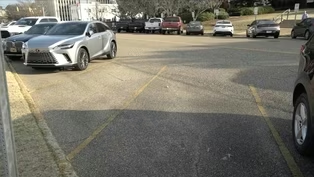
Parking issues in Montgomery for whose having to do business downtown
Clip: S21 Ep1 | 3m 1s | TBD (3m 1s)
Providing Support for PBS.org
Learn Moreabout PBS online sponsorship
- News and Public Affairs

Top journalists deliver compelling original analysis of the hour's headlines.

- News and Public Affairs

FRONTLINE is investigative journalism that questions, explains and changes our world.












Support for PBS provided by:
Capitol Journal is a local public television program presented by APT