Vermont This Week
January 9, 2026
1/9/2026 | 26m 46sVideo has Closed Captions
Legislature back in session | Governor Scott’s State of the State
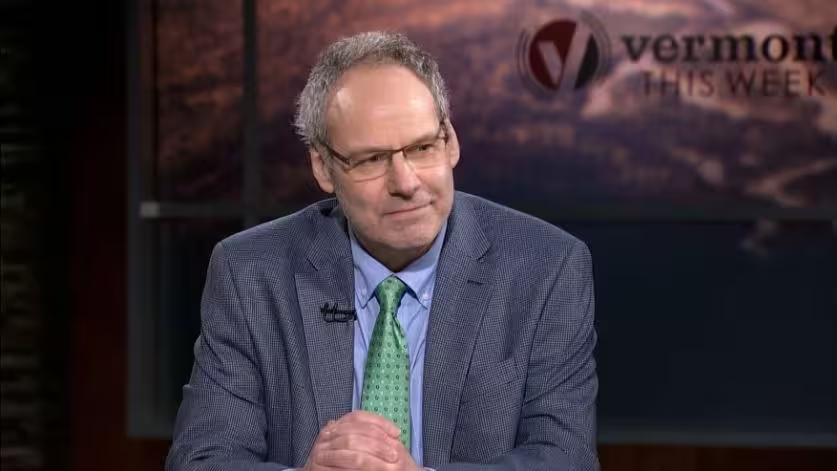
Legislature back in session | Governor Scott’s State of the State | Reactions from around the statehouse | Panel: Mitch Wertlieb - Moderator; Shaun Robinson - VTDigger; Alison Novak - Seven Days; Kevin McCallum - Seven Days.
Problems playing video? | Closed Captioning Feedback
Problems playing video? | Closed Captioning Feedback
Vermont This Week is a local public television program presented by Vermont Public
Sponsored in part by Lintilhac Foundation and Milne Travel.
Support provided by:


Vermont This Week
January 9, 2026
1/9/2026 | 26m 46sVideo has Closed Captions
Legislature back in session | Governor Scott’s State of the State | Reactions from around the statehouse | Panel: Mitch Wertlieb - Moderator; Shaun Robinson - VTDigger; Alison Novak - Seven Days; Kevin McCallum - Seven Days.
Problems playing video? | Closed Captioning Feedback
How to Watch Vermont This Week
Vermont This Week is available to stream on pbs.org and the free PBS App, available on iPhone, Apple TV, Android TV, Android smartphones, Amazon Fire TV, Amazon Fire Tablet, Roku, Samsung Smart TV, and Vizio.
Support the crew
Help Mitch keep the conversations going as a member of Vermont Public. Join us today and support independent journalism.Providing Support for PBS.org
Learn Moreabout PBS online sponsorshipGovernor Phil Scott issued an ultimatum on education reform following through.
It's about keeping our word to students, teachers and taxpayers who all deserve better.
So I want to be clear I will not sign a budget or an education bill or tax bill that deviates from act 73 or fails to fix what's broken.
Plus, ethics complaints against two state senators with ties to private schools are dismissed, and legislators float a bill to lower prescription drug prices through a bulk purchasing program.
All that more ahead on Vermont This Week.
From the Vermont Public Studio in Winooski.
This is Vermont This Week, made possible in part by the Lintilhac Foundation and Milne Travel.
Here's moderator Mitch Wertlieb.
Good evening everyone.
I'm Mitch Wertlieb.
It is Friday, January 9th.
Happy New Year to everyone on our panel.
Today we have with us Kevin McCallum from Seven Days.
Also from Seven Days, Alison Novak and Shaun Robinson with VTDigger.
Thank you all so much for being here.
And of course, our main topic of discussion we're going to start out with is the legislature reconvening in Montpelier.
They're all back now dealing with a lot of tough issues.
Shaun Robinson, you were at the statehouse, for the reconvening.
Everyone getting back.
We had some legislators on our show, previewing what was coming up, and all of them seemed to say that, yeah, they have a lot to deal with, but they're excited to get back.
They want to be together talking about all these things.
What was your sense of what the tenor was like in that room, and were they legislators actually excited to be back in Montpelier?
I think so.
I mean, it's always fun the first week of the session, right?
Everyone's got their new outfits.
It feels like the first week of school.
And everyone comes in with their, you know, brighter eyes, big ideas, new bills they want to introduce.
But as I'm sure we're going to talk about a lot in the next, you know, the rest of the show, obviously you couldn't have a conversation for more than a few minutes without the words redistricting or consolidation, you know, coming up.
Right.
So education is the big topic.
And the legislators talked about that here a couple weeks ago.
Yeah.
It is such a big deal.
And you know, so the governor then gave his state of the state address, after this.
And Kevin McCollum, you know, this reminded me of how laser focused he was on one topic here of what former Governor Peter Suleman once did with the state of the state address, where he devoted the entire speech to the opioid addiction problem in Vermont.
The the speech the governor Scott gave was pretty much all about education reform and act 73.
Why was he so laser focused?
That's right.
Yeah.
No.
Normally this is a chance for the governor to lay out a broad agenda for all the things he would like to accomplish in the upcoming session and, you know, urging lawmakers to focus on several key areas.
And he dispensed with that completely this time around.
He said, look, we made significant positive progress on reforming the education system of the state of Vermont last year with the passage of act 73, and it is absolutely critical that we follow through on that.
This session, we promised Vermonters that we would do it.
Now we need to follow through.
And then what he how he followed that up with was, a long, and very strong, series of supports for lawmakers for having done what they did last year.
He praised them up and down, which is unusual.
Right?
Normally he can be pretty critical of the legislature in what he views as some of their inaction on key issues.
He spent a great deal of time praising lawmakers for their courage that they shown last year to pass act 73.
He talked about their resolve in the face of critical, you know, criticism of that bill, and he and he praised them and he thanked them essentially for for setting the stage, for starting the process of building a better future for Vermont's kids and for its economy.
And so, he he did that in a very strong and lengthy way.
And then he did it again with teachers to talk, in great detail about how great teachers are, how important they are to, to this system and, and to try to undermine, I think, the idea that that somehow, you know, teachers are going to lose their jobs or the consolidation is going to hurt teachers.
So he spent a great deal of time on those two fronts in an effort to ensure that those lawmakers who've just gotten back together know what their marching orders are.
But was all of that Alison Novak set up for what he said and what we teased there at the top where he said, look, I am not going to sign the budget bill, some $9 billion worth unless something gets done with redistricting mapping here.
Yeah.
So I think that was an ultimatum.
And some might say a threat.
I found it really interesting the way the governor really changed his strategy in terms of the way he's talked about act 73 last year, it felt like it was all about cost savings, lowering property taxes.
And in his speech this week, it really felt like it was about making the education system better for all students, for making for improving the equity, among school districts.
And so I was really struck by that, like very it felt like a very deliberate change in strategy.
In terms of the way he's talking about act 73, but that ultimatum saying, look, unless we get some new maps drawn here, consolidating school districts, which is going to mean some school closures, he said he's not going to know.
He's not going to let the budget go through.
What was the reaction, from from lawmakers after he said that?
Was that any surprise there in the room?
Well, I mean, I think that, you know, it was a pretty strong, strongly worded ultimatum.
And I think now it's in the legislature's core, right, to see what they're going to do.
Are they going to be able to draw maps immediately or do they need more information?
There was a redistricting task force that met during the off session that had four months and about eight meetings to try to draw maps.
They did not draw maps, which the governor said is a failure.
And he also, in his speech called it kind of a political strategy not to draw maps, which I think upset the members of that redistricting task force, given that they do say they worked really hard, they collected a lot of data.
And so I think it remains to be seen, like how the legislature is going to, heed the governor's words, whether they're going to jump right into making maps or they're going to take their time.
And again, the redistricting task force came back and said, you know what?
We're not going to suggest mandatory school consolidation right now for various reasons, and we can get into some of that.
I want to hear a little bit more of what the governor said here in setting all this up.
In talking about, again, what Kevin was saying with praising some lawmakers, but also saying, we've got work to get done.
Here's what the governor had to say.
I know the pressure you're under with calls to delay, to water things down or stop this transition altogether, but we've been down that road before, and every time we bend to the vocal minority, these problems get worse.
We didn't pass act 73 because it was easy.
We did it because solving this problem matters, and what you do next matters even more.
Okay, the follow through he's talking about there is really interesting.
Shaun Robinson, what did the governor what stood out to me in that clip, especially when he talked about we can't be listening to the vocal minority here.
He didn't name any names.
They're nothing specific.
We have a general sense of who he's talking about.
The folks that are maybe against this redistricting plan.
Yeah, I, you know, I might throw it to Kevin Allison on this one.
Honestly, just to talk about a little more.
Yeah, yeah.
I mean, I know I can think of one right out of the gate.
And that was just yesterday.
The Progressive Party of the state of Vermont called for a repeal of act 73.
So it's very clear that there are organizations.
And Alison is as well tuned in with some of the organizations that pushed back on Act 73 last year.
They are back and they are advocating against act 73.
For sure.
And so the vocal minority, but it's an open question of whether there really is a vocal minority.
I mean, because there was, a significant amount of testimony during the redistricting effort last fall, I think that indicated there was I don't know how you would put it, Alison, but broad opposition to what the governor had planned.
So his characterization of it as bowing to a vocal minority is, is an interesting one I'd be interested in.
Yeah, I, I question whether minority is the right word.
Right.
So we heard from many in the educational establishment.
So not just the Progressive Party, but we heard from school board superintendents, people who didn't, you know, often usually speak out, saying that we don't think this massive consolidation is going to be good for kids.
And we also don't see the proof that it's going to save money.
Right.
And so I don't know that it's a minority.
Everyone I've talked to who actually works in education and in the field is skeptical of consolidation.
I haven't heard one person who works in schools say, I think it's a really good idea to do this massive consolidation.
But if the Baps don't get done, if the governor is serious about his threat, then there's no money to actually fund everything else that needs to be funded here.
What are some of the, of the challenges, I guess, with drawing up these new maps?
Again?
If the redistricting task force couldn't do it, why do we believe that it's going to happen otherwise?
Well, I think in a way, drawing maps is easy, right?
You could just draw lines.
You can just, like, carve up the state however way you want.
But it's the implementation of consolidation that's actually really difficult.
So there's a lot of factors that come into consolidation.
So you're going to have to level up teacher salaries for example.
So if you bring together teachers from several different districts you're not going to lower teacher salaries, right.
You're going to raise them.
And that comes with a cost.
So I think some people are feeling like, well, there's going to be a cost there.
So how is that actually going to save money.
So these hidden costs that come with consolidation I think is one thing.
And I think this is what the district task force saw when they started really jumping into it, because they did draw maps, actually, they just didn't approve any maps.
So they did kind of test out a number of different maps, including maps arranged around CTE centers, county maps, and what I think they found is there was just so many unanswered questions when they started drawing those maps that they didn't, in good conscience, feel like they could recommend any to the legislature.
So again, the map drawing is not the hardest part.
It's actually figuring out all the little details after those districts are those new districts are made about how to actually like implement the law.
I think that's that's really interesting.
I didn't realize that it was.
So, you know, the maps there, suggestions there that could happen.
But the actual implementation of it, you get into some some difficulty in which schools are going to close and, you know, talking about teacher leveling up those teacher salaries.
Right.
You can do that.
But the school school consolidation happens, schools closed, teachers are actually going to be losing some jobs, I imagine, or administrators.
Right.
I imagine teachers would lose jobs, but I don't know that it would be a mass layoff of teachers.
Right.
So and administrators guess there would be some administrators that would lose their jobs.
There might be one superintendent for a larger number of students.
But you also do still need administrative staff to do certain things within these bigger districts.
So it's not like you're going to just have one administrator for a massive district.
You're going to still have other administrators, in that district.
So and then there's also transportation costs, right?
So there's all these kind of hidden costs in consolidation.
And I think, I think many feel that there's just not any evidence or proof right now that the consolidation, that the governor is calling for is going to save money and improve educational opportunity for kids.
Do we have any sense of a time frame on about all of this?
I mean, the governor is talking about ultimatums and not passing the budget.
But what are we looking at here for time?
Is the clock ticking?
Well, yeah.
He said that he wanted the lawmakers to make this their top priority and to jump right into this.
And, that's exactly what they did yesterday.
They had a joint hearing of the education committees of the House and the Senate, and they heard from, some of the members of the task force to outline the work that they did last fall, and they've committed to jumping right into answering some of these key questions.
And, so I think I think they're paying close attention to what the governor is asking.
And while they do have a lot of other things they'd like to accomplish this session, they are taking his, his urging very seriously, and they're taking his veto threat really seriously.
Right?
I mean, because, remember, he if he doesn't pass a budget, right, we get to June.
And, if he vetoes a budget, they can't go home.
They can't leave.
I mean, he he really does have them in a position where he can force them to move forward on next 73, in some fashion.
So that's going to be fascinating.
Yeah.
No, I think that's totally right.
And I mean, right, the governor, he has the political power to come out and make a threat like this because so many of the folks who voted for these Democratic lawmakers also voted for him.
And I voted for him many times when he's run for governor.
Right.
So I think that's worth remembering.
And I guess on election two, right.
This is an election year.
Yeah.
Remembering that context to write that, you know, whatever decisions lawmakers, legislators are making the next few months, they're going to have to go if they are running for reelection.
Right.
And of course, all the all but many will go back to their towns and like, face these really hard questions, possibly about their votes from folks who they want them vote from.
Yeah.
And the governor knows at this point, too.
He's very well aware of that.
That supermajority no longer exists where he knows that vetoes can be overridden.
I mean, the majority right now for the Senate, for the Democrats is fairly slim, right?
Yeah.
That's right.
And I think I remember I mean, you might have been there we were talking to maybe the pro tem and sort of there were folks suggesting, you know, well, you know, are you guys really just been following the governor's lead on this the whole time?
Right.
I think the legislature would really like to, to frame the size, you know.
No, like we have the majorities in the House and the Senate.
Right.
And, you know, we're we're leading this and our branch of government.
But I think it's pretty indisputable, right, that, you know, the governor's been the one pushing this the hardest.
And, you know, I think we, heard some critique from legislative leaders after the, the state of the state address saying, you know, we'd like to see the governor hit the stump, hit the road and make the pitch for these proposals himself right out on the ground.
And, you know, I'd be curious to hear the governor's response to that next time we talked to him.
But, you know, they were pretty clear and said, you know, we don't want to be the only ones making this pitch, right.
We need you out there the way that you were making the pitch for, you know, electing a lot more Republicans in 2024.
I want to follow up on that thought, Shaun, because that's really interesting to me, because Senator Filbert, Ruth and I and you, you noted this, in your coverage.
He's floating this idea right about having a sort of a spending cap for, for two years and education costs.
You know, he feels like that will save some money.
But to Shaun's point, I think what Phil was also saying was, you know, it's time for the governor now to take the lead on this.
It is time for the governor to get out on the road, make this pitch to Vermonters and say, this is what's going to help solve this problem.
What is a tell us a little bit more about Phil Brus idea here, and, how that was, received as it was floated.
So this was a bill that was actually introduced yesterday.
And so it's a bill that would put spending caps on how much school districts could spend.
Now, it wouldn't apply to this year, the budgets that people will be voting on in March on town Meeting Day this year, it would apply to budgets in the two subsequent years.
So essentially it's saying that there's actually a variation.
So for lower spending districts, they'd be able to spend I think it's up to 9%, above the previous year.
Where is the higher spending districts could spend no more than 3%.
So it's kind of this cap.
And it is dependent on how, if you're a high spender, spender already.
Yeah.
Yeah.
And so I think one of the criticisms already of this plan is the idea that, like just putting these spending caps and not like taking into account like the health health insurance costs that are going up and inflation could really mean like severe cuts for school districts who are, who are having to stay within certain parameters.
And so, you know, this was a bill I think it was introduced in Senate Finance, yesterday.
And they were talking about it and, I think I Chair and Cummings seemed kind of amenable to it.
Others were questioning it.
So I think it still remains to be seen whether it's going to get traction.
Yeah.
Kevin McCallum, I have to ask you about the political aspect of all this.
Is Phil Booth playing a kind of long game here?
I mean, look, Governor Phil Scott is still perhaps the most popular governor in the country.
Based on polling, he knows he has tremendous support from Democrats in the state of Vermont.
However, it's also true that under his leadership, we have seen health care costs go up.
School costs have gone up.
Everything is just has gone up.
Is Phil Brewer thinking now in making his proposal and then saying, yes, the governor's got to get out and talk to Vermonters about this.
This is kind of saying like, it's time to stop blaming the Democrats on this.
Now, the governor at some point is going to take some responsibility for his vision of all this.
I think the spending cap proposal that the pro tem made was more a reflection of the fact that the number, that is now exists for how to buy down the property tax rate.
Again, this year has ballooned to such a massive number, $200 million over the last two years.
Right?
Right.
No.
So if we want to get the 12% property tax increases that we're facing next year down to zero, we would have to come up with 200 million to keep it at zero.
And so everyone sort of acknowledges that we need to spend.
I think the governor has admitted or agreed that we've got to probably spend at least $75 million again to keep it, to get the 12% property tax increase down to about six, but or seven or somewhere in there.
But like to do the whole thing would be $200 million.
And so I think feels Phil Berreth realizes that he can't, he can't that can't fly and that the governor does make significant, important points about what that would do to the general fund, what that would do to roads, what that would do to childcare, what that would do to housing, what so so that we don't have that kind of money to spend.
And so we may be able to come up with 60, 70, $80 million to soften the blow on the tax, property tax increase front.
But we don't have 200 million to do that.
And so we've got to come up with a cost saving some other way.
And so his idea is in the interim, until this consolidation effort actually takes place two, three years from now.
Really.
Right.
And the cost savings from that can start to be noticed.
And the benefits of that cost savings can be incorporated into the budget.
We got to do something in between.
We got to get from here to there.
This is his interim way of getting from here to there, I think.
Very, very interesting.
Yeah.
Shaun Robinson, there was also, the governor did go out of his way to, to praise teachers here in the job that that they have been doing right.
Yeah.
That's right.
I think he actually named a number of teachers by name.
You know, instead, I think he said there was a, a teacher watching, doing a watch party, and the whole chamber stood up and applauded for the teachers.
So there was yeah, there was a very direct appeal.
I think he even might have said, you know, I'm directly appealing to you watching, one thing on Kevin, Kevin's point, you just know you mentioned the $75 million that the governor's administration just talked about for buying down some of this property tax, rate that money.
And correct me if I'm wrong here, everyone, but is would come from a pot that was set aside last year to respond to possible cuts from the federal government.
Right.
So it's like you talk about what do we have money for, right?
Like all these fires that we're seeing, right?
It's like, that's $75 million that, you know, we could have on hand in case we see drastic human services cuts that we aren't immediately anticipating over the next fiscal year.
Right.
So it's all connected.
Right.
And that's part of what we're challenging.
Yeah.
Yeah.
And it's such an important point too, because we know that what happens at the federal level is going to start affecting Vermont when it comes to Medicaid and so many other issues.
And in fact, in trying to deal with some of these health care costs things.
Kevin McCallum, I know that Mike paycheck, the state treasurer, floated this idea about keeping, prescription drug costs down.
What was his idea of that?
Right, right.
So what we've got is a governor trying to keep everybody focused on a single issue, but we've got Democrats saying, no, we've got a lot of things we need to address.
And Mike Peacock and Democratic leaders, just, just yesterday came out and said, look, prescription drug prices, what hurts people more in their paycheck, in their, in their, in their, in their household expenses, then when pharmaceutical costs go up, they've got to take they need they need the drugs and the, the insurance costs.
Their health insurance is not covering them as much.
There's people losing health insurance at the federal level.
So we've got to do something significant and immediately about containing the increases in drug prices.
And so there's, a couple states in the country, several states in the country that have bound together and have created a program that allows them to buy drugs in bulk and negotiate the prices of those.
And Mike Pejic and others think it's a fabulous idea to just join up with Washington, Oregon and some other states and then, you know, start a program that gives Vermonters, essentially a card that allows them to buy, buy their pharmaceuticals, their drugs directly, through in a low cost program.
And, and they're just expecting that there's going to be more people without health insurance of any kind in the coming months.
And so they just think this is a, a perfect way to not solve all the health care problems in the state.
But, at a minimum, try to tackle the rising costs.
And this would probably this would be the greatest savings here would be for generic drugs, right?
Yeah.
Right.
I don't really understand why that is, but apparently they can really get the cost down for generic drugs by like 80%, whereas name brand drugs, I think they can still save significantly like 20%.
But yeah, there's great optimism.
And I even asked, you know, some of the Republicans at their press conference today, they're react to some of the things that the governor said and what some Democrats have been saying.
And and they were like, yeah, that sounds like a great idea.
So I think that one's going to get some traction and probably move very quickly.
Everything, wasn't just about education reform.
There were some other business that was done.
Alison, Novak, Senate ethics panel, basically dismissed complaints that were made against two state senators, Beck and Vonnegut's.
What was that all about?
So that actually did relate to act 73.
So act 73.
Yeah.
Yeah.
But when they were both, Senator Beck and Senator Bond guards were on the conference committee that was negotiating the final details of act 73.
And anyone in the room watching that conference committee, would have seen that a lot of discussion was on independent schools, on private schools, how they were going to fare under act 73.
And, Senator, back is a long time teacher at Saint Johnsbury Academy.
Senator Bond guards, was the, trustee head of the trustees of Burr and Burton for many years.
And so these complaints, one was against both senators.
One was just against Senator Bach.
But essentially, we're saying that they had a conflict of interest in kind of negotiating the details of act 73 to favor or to benefit independent schools.
The these are normally confidential procedures, proceedings.
But, in this case, both complainants shared their complaints and the letters that they received in December from the Senate ethics panel, which is made up of five, senators basically saying they did found that they did not have a conflict of interest.
And I think it just important to say that Vermont has a pretty narrow definition of conflict of interest as well.
And both senators said, you know, they didn't really lose any sleep over the, allegations that they are they always knew that they would be vindicated.
Okay.
Well, one, complaint dismissed, but another is filed.
Shaun Robinson, this dealing with, something that happened, I guess, over the summer where five House lawmakers took a trip to Israel.
It was largely derided by many people as a kind of a junket.
Tell us about the complaint that's been filed in that case.
Yeah, I think we can say this is one thing that does not have to do with acts 73.
Maybe someone watching will find a connection.
I don't know, but yeah, this was in September.
I think this was five members of the house.
Byron Austin, Greer, Gregoire and, Gal Fetty.
And they, were part of this nationwide trip of legislators from all 50 states.
And it was to Israel is a handful of days in Israel.
And, you know, the kind of main thing that's got folks really concerned about this is that it was completely funded by the Israeli government.
It was about $6,500 per person.
Was the value of the trip, and the ethics complaint, filed right at the end of last year before New Year's.
Basically says, you know, in the opinion of this group that filed it, the group is called Jewish Voice for peace of the Jewish group that opposes Israel and Israeli policies.
They said, you know, this trip does not fall under kind of what is a permissible ethical trip, as is laid out in Vermont's, state ethics rules.
They also, as you alluded to, you know, they think that because during this trip, these lawmakers from all over the US heard from top Israeli officials, and actually got, you know, a pitch on the trip, among other things, to, kind of stand against legislation that might be harmful to Israel's interest in their respective states back in the US, that it was a lobbying trip, a lobbying junket, like you said, and saying that that at the very least creates the impression of an ethical conflict and we don't know where it's going to go from there.
But there could be some changes, perhaps to, certain disclosure rules coming from this.
Yeah.
Two of the lawmakers who, went on that trip, Greer and Gal Ferry, have, they're working on a bill that would require some additional disclosure.
When lawmakers take gifted trips.
Right now, there's no requirement that, that those trips are disclosed and no one disclosed this trip.
But, you know, at the state level in Vermont when it happened last year and we only found out because photos were posted online, and then it kind of went into the press from there and went from there, so much that we could talk about it.
We will in the coming weeks, of course, about what's going to come out, as the legislature reconvenes.
I want to thank you all so much, though, for letting us know about what did happen on this first big day back.
I also want to say congratulations to Thetford Academy students for a sixth year in a row, are going to be heading to the Vex Robotics World Championships in Dallas, Texas, so we hope that they will be competing in their Guinness Book of World Records.
Says this is the largest robotics championship in the world, so Thetford Academy students will be competing there.
Thanks so much to our panel today.
Kevin McCallum from Seven Days, also Alison Novak from Seven Days and Shaun Robinson from VTDigger.
Really appreciate your time so much.
I'm Mitch Worley, thank you so much for watching and join us again next Friday for Vermont This Week.

- News and Public Affairs

Top journalists deliver compelling original analysis of the hour's headlines.

- News and Public Affairs

FRONTLINE is investigative journalism that questions, explains and changes our world.












Support for PBS provided by:
Vermont This Week is a local public television program presented by Vermont Public
Sponsored in part by Lintilhac Foundation and Milne Travel.