
Your Vote Your Voice
Jasmin III vs Poulson Debate | WA STATE REP District 3 | KSPS PBS
10/15/2026 | 29m 21sVideo has Closed Captions
Spokane voters in District 3 will choose someone new to fill Timm Ormsby's seat.
Spokane voters in District 3 will choose someone new to fill Timm Ormsby's seat. Luc Jasmin III (D) and Natalie Poulson (R) debate at KSPS PBS October 13. At Issue host Dana Haynes moderates.
Problems playing video? | Closed Captioning Feedback
Problems playing video? | Closed Captioning Feedback
Your Vote Your Voice is a local public television program presented by KSPS PBS
Your Vote Your Voice
Jasmin III vs Poulson Debate | WA STATE REP District 3 | KSPS PBS
10/15/2026 | 29m 21sVideo has Closed Captions
Spokane voters in District 3 will choose someone new to fill Timm Ormsby's seat. Luc Jasmin III (D) and Natalie Poulson (R) debate at KSPS PBS October 13. At Issue host Dana Haynes moderates.
Problems playing video? | Closed Captioning Feedback
Where to Watch Your Vote Your Voice
Your Vote Your Voice is available to stream on pbs.org and the PBS app.
Providing Support for PBS.org
Learn Moreabout PBS online sponsorshipThis is a KSPS PBS Vote 2026 Special featuring candidates running for election to the Washington state legislature from District 3.
Hello and thank you for joining us.
Im Dana Haynes - We are pleased to bring you this debate featuring the candidates running for state representative in Washington's third legislative district.
The district represents most of the city of Spokane.
And following the retirement of longtime Democrat, Timm Ormsby, position two will be filled by someone new for the first time in more than 20 years.
Let's go ahead and meet the candidates.
Luc Jasmin III, we'll give you 30 seconds now to introduce yourself.
- Yeah, good evening everyone.
My name is Luc Jasmin III,.
I'm a father of two teenage daughters.
I'm a small business owner.
I own a childcare and a bookkeeping and accounting firm.
And for the past 13 years, I've been working with community members and leaders in this district to bring about policy and funding for our region.
I look for your support to expand on that as your state representative.
- All right, thanks, Luc.
- And Natalie Poulson is the other candidate.
You too have 30 seconds.
- Thank you.
Yes, Natalie Poulson, a lifelong Spokanite, been here my whole life.
I have three beautiful children and I've also been a teacher for over 20 years, most of those years in special education.
And I just, I, again, lived here my whole life, so I get it.
I've watched our city and our state, unfortunately, become very unaffordable and unsafe.
So I'm here to represent the people and just know that every problem that Washington has should not be a new tax onto the people.
So I'm here to hear the voice of the people.
- All right.
Welcome to you both, thank you.
The candidates will answer questions from two Spokane journalists tonight, Amanda Sullender from the Spokesman Review, and we have Daniel Walters from Range Media.
We want to thank you both for joining us as well.
Before we begin, here's a quick look at the debate rules tonight.
The panel can ask the same question to both candidates or can direct the question to just one.
The panelists may request a follow-up to an answer.
Candidates will have one minute for answers and are allowed just two rebuttals for the entire debate.
Rebuttal length is limited to 30 seconds.
A coin flip determined that Natalie will take the first question and that will come from Amanda.
- Both candidates have a background in education.
Washington State's constitution says that fully funding K-12 education is the paramount duty of the state.
Are we fully funding education right now and should we spend the money differently?
- Well, no, I've lived that.
No, education has not been fully funded, especially not special ed.
And I do feel that we need to definitely have targeted dollars and be a lot more efficient with those dollars.
And I think a lot of it comes down to we need to stop adding mandates to the classroom and to teachers.
We have amazing teachers and we need to let them teach.
They know what they're doing and we need to trust that they will do that.
And every mandate that we add, it just adds more cost, which then our students don't get what they need.
So it's really tough, and it's tough to really make sure that our most vulnerable population gets what they need when we're adding mandates and we're not thinking about the outcome of it and making sure that everything that we ask a school or a teacher to do is actually producing an outcome that is positive.
We need to be worried about reading skills, and writing, and science.
So I'm a huge proponent of the basics and making sure we have that and then obviously looking at technology.
- [Amanda] Luke, same question.
How should we fund education in Washington and are we doing enough?
- Well, we should fully fund K-12 education along with early learning and higher ed and we are definitely not meeting that call.
And one of the big ways that we can do it is saying no to initiative 645 that's on the ballot right now that would blow a huge deficit that we would have to figure out as lawmakers to fill.
And a lot of that is funds for special education, it's for childcare, and we absolutely need to fund education, not only K-12, but starting with the earliest learners.
- Daniel.
- Speaking of education, what role should private K-12 education play in Washington State?
What, if anything, should the state do to support private, or religious, or charter schools?
We'll start with you, Natalie.
- Thank you.
I think that we absolutely should have school choice.
I believe very much in public education and why it was created, and I don't think we should lose making sure all children are educated, but I do think we also need to look at choice and make sure kids are getting educated where they can best be educated.
And I'm all for early intervention, but I want to be careful that every time, again, we add something onto that, that we're careful not to add cost to our taxpayers.
So school choice I think would be a great option.
- [Daniel] Luc?
- Yeah, so let's start with the basics, right?
We need to start with actually funding general ed, and we're not doing that.
So we absolutely need to do that.
Now, the question is, how do I feel about private schools?
Well, in charter schools, I was actually part of the group that helped open Lumen High School with the Connecting GLOW children.
So there's been actual work that I've done in the space of actually creating more opportunities for our students.
And I'm fully open to working on how we can support non-traditional ways for students to learn, but we have to start with actually funding our basic ed right now and our public schools, which we are not doing.
- Amanda.
- Natalie, speaking of your background in education, you resigned from Finch Elementary for refusing to wear a mask during the COVID pandemic.
Why did your objections to masking overtake the students there and why did you take that step at that point in time?
- Well, I had worn a mask for two school years and I was watching kids deteriorate.
And so I watched kids in special education lose language skills.
Actually, really all of our primary grades were losing quite a bit.
Our older kids, which I was doing social emotional learning at the time, were withdrawing.
They weren't even making eye contact.
A lot of them were not engaging with even their peers.
So as I saw that happening, I stood for the kids.
I had exhausted efforts with the school board and going to administration and trying to talk to them, presented them with 47 mask studies of ineffectiveness in children and just tried to talk to them about let's look at what's best.
And there were some special education rooms that we should have definitely maintained a level of mask wearing, but a good majority of the general population were losing more than they were gaining from that mandate.
And so I stood with the kids on a one day mask protest to try to bring awareness.
- Daniel?
- This is for Luc Jasmin II.
Earlier this year, your father, Luc Jasmine, sorry, Luke Jasmine III.
Earlier this year, your father Luc Jasmin II resigned from the State Human Right Commission following comments that Jewish people are "Always crying with the antisemitism."
What have you said to your father about these statements and is Washington State doing enough to combat antisemitism?
- So I have had many conversations with my dad and one of the things that I will applaud him for doing is apologizing for his comments and then also re-engaging with our local members of Jewish community here.
And that's what I look for.
I think, in general, we're gonna to have folks that mess up, that say things out of either ignorance or just not having the full facts.
And I think we as Washingtonians need to make sure that we have adequate education for folks, not only for antisemitism, but all the violations and rights that we're seeing being attacked.
So our LGBTQA+ community, our Black and brown community, our immigrant and refugee community.
So to answer your question, there's a lot more that we could do to combat hate in Washington State.
And to me, that comes through education and pulling people in.
- Natalie, you want to cut taxes in the state.
Where can the state cut spending and will those cuts not leave vulnerable people in the lurch?
- Well, I definitely think we need to look at not adding new taxes and then looking at the efficiency of those that we have in place.
So we definitely have a spending problem right now and we do need to look at priorities.
So I think we need to look into what our current budget is, really see if there's anything that is wasteful.
So do a really good audit of the systems and then look at some of the programs.
Are they producing an outcome that is beneficial?
So for example, even the recovery, I know we put it into homelessness, but really making sure we separate that and help our addiction crisis and our mental health crisis, so that we're really focused on producing outcomes that get people to live their best lives.
So I don't know that I would say cut.
I think there might be some hard decisions to make and I do know that I'm ready for that and really making sure that I bring the right people to the table, have really in-depth conversations, because our state's in trouble.
So we have to start really looking and making hard decisions, but we can't keep adding that to our taxpayers.
- I have a rebuttal.
- Luke your first rebuttal.
- Look, let's just be honest.
We know that Washington State has the most upside down tax code in all of United States.
And right now, for us as middle income and lower income families and residents, we're paying 14 and in some cases 18% of our earned income to taxes.
And our wealthiest 1%, they're only paying 4%.
So this is about tax fairness because I'm not going to push for cutting schools.
I'm not going to push for cutting services like healthcare that we definitely need in our state.
- Thank you, time's up.
All right, Daniel, I believe you have the next question.
- Yeah, Luc, your proposed education spending increase and other proposals would increase state spending, yet we're in a really intense budget crunch right now.
How can you pay for your policies?
- Yeah, so there's several ways that we can pay for the policies.
Number one is we have to admit that not everybody is paying their fair share.
They're not.
And so we absolutely need to vote no to 645 so that we can get more funds for special education, education, healthcare.
And we have to also acknowledge that we have massive cuts that are happening on the federal scale that are putting even more pressures on us in our state.
So how do we pay for it?
Number one, we need to make sure that we actually have everyone paying their fair share.
And through that, we can put funds towards, like I said, education, especially special education, childcare and healthcare, which we really need to figure out what we're going to do there as many people are in jeopardy of losing care.
- All right.
Natalie, go ahead with your rebuttal.
- So speaking of fairness, I think we need to be careful when we talk about fairness.
When we are looking, yes, we have a regressive tax structure and I do think that needs to be addressed, but adding it to one group of people is not necessarily going to fix the problem.
If we push out small businesses with the 645, which I'm a yes to 645 to repeal it, we could drive out businesses that employ people and then we're raising costs to those families, those working families who are already paying a lot at the pump and the grocery store.
- All right, thank you.
Time's up.
Amanda.
- Just to clarify, we're speaking about the state's billionaire tax, which taxes-- - There's an M, it's a millionaire tax.
- Millionaire.
Millionaire tax, which taxes household incomes over a million dollars at a rate of 9.9%.
Natalie, you mentioned that you want to get rid of the millionaire's tax, but you also said that you think that our tax system is too regressive.
What exactly would be the solution here that you would push for?
- I want to push for really looking at revenue streams and really sitting down and looking at our tax structure.
And I do think it should be fair.
I want to be careful taxing one group just to try to solve another problem, because again, we're looking at taxing what we're calling the millionaires.
A lot of those are small businesses.
A lot of those are generational farmers.
And we have to be really careful that we don't drive business out, lose revenue, and then turn around and possibly lose jobs.
So working families continue to pay more at simple things like the gas and groceries.
Even the climate commitment, 86% of what it was intended to do has been shown ineffective.
So that cost right there is on our working families.
Let's start talking about things like that.
- [Amanda] And when you say fair, does that mean flat or can there a progressive tax be fair?
- I think the best approach is to sit down with economists.
I'll be honest, I'm not an economist, so I think it would be great to get the right people to the table and have serious conversations with budget in hand and make some decisions to get our--- Washington used to have a surplus.
We used to be thriving.
Let's get back to that.
- [Dana] Okay, thank you, Natalie.
- This is for Luc.
Some Democrats have said they would like to expand the millionaire's tax to include incomes for a lower threshold.
Governor Ferguson, however, said that he would veto any expansion of that tax.
Will you promise right here and now before KSPS, not to expand the millionaire's tax?
And if not, what's the lowest threshold you would accept?
- Yeah, so right now, I think we are feeling, especially middle income and lower income folks are feeling tax burden with, again, regressive tax system where we're paying the highest rates in sales tax and we're paying a gas tax.
And so, what I'm hearing from folks at the door is they do support a millionaire's tax to, again, make it fair so that everyone is paying their fair share.
But as far as adding additional taxes on top of that, I think we need to figure out how to reduce taxes, especially you look at our seniors who are aging in place.
I support lowering taxes for them as far as their property tax.
So I'm supportive of reducing taxes on middle income and lower income folks and not adding more.
- Just to clarify, is that a promise not to expand the millionaire's tax?
- I think I can make that promise, yeah.
- [Dana] All right.
- [Daniel] It's on the record.
- Yeah, yeah.
I think I can make that promise.
- A data center has been proposed in Spokane's backyard.
Approval of the project has been paused amid community pushback.
What regulations on data centers should the state adopt and should a moratorium on data center development be put in place while those regulations are debated?
Let's start with Natalie.
- Well, thank goodness there is at least a pause, so that we can get to some of those decisions.
And yes, I think number one, we need to have some systems in place that we are being very conscientious of our environment.
We live in a beautiful place and we need to be very careful with our water, our aquifer, our rivers.
I've heard a lot about sound pollution and that's a big deal.
And so I just want to make sure that we're being, again, always putting the people first.
So if it's going to affect the people, then we need to really make sure that that's not happening.
In addition, if we move forward with some sort of data center, it cannot go onto the rate payer, right?
That cost has to be figured out before it even is a discussion.
So making sure environment is safe, making sure it doesn't go onto the rate payer.
So yes, I'm all for putting in some pretty serious boundaries to even have the discussion and making sure we don't forget that innovation's always good as long as there's a good positive outcome.
- Luke, same question to you.
Data centers, what should the state do about them and should a moratorium be put in place?
- Yeah, so one of the things that I've been able to work on is building relationships with legislators across Washington State.
And there are a few legislators, especially Representative Hill, who are working on legislation that would put a moratorium on large scale data centers.
And I do support that.
We need more information.
Community's been asking for more information.
And then also we need to put some provisions on water use.
We need to put provisions on energy as far as the creation of energy and who's paying for it.
So there's a lot of questions that are out there.
So I will look to support a full moratorium on large scale data centers if elected.
- [Dana] Daniel.
- Yeah.
I ran your questionnaire answers that you sent into Range and your campaign websites through state-of-the-art AI detector software.
We found significant amounts of AI writing on both your websites and some of your questionnaire answers.
How can voters trust they're getting the authentic you and not Robo Jasmin or Mecha Natalie?
I'll start with human Natalie.
- Thank you.
Well, my videos are all human Natalie.
I try to make sure every video and every photo is authentic, so that you're able to know who I am.
Full transparency, which we talked about, I absolutely use it as an editor.
I think it's a great tool, but as a teacher, you've gotta make sure that you use tools effectively and not use them as replacing the human.
I am never for that.
So I think it's really important that we're cautious and we're really careful.
The other thing I never thought about before our discussion was when you hire somebody.
So I hired somebody to do my website and I didn't even think to have that discussion about what they would use to create that.
So definitely learned a few things and then moving forward, just trying to make sure that things are more authentic.
- [Daniel] Human Luc?
- Yeah.
You know, it is a tool.
I believe it is a tool.
And like any other innovation or technology, we need to put strong parameters around it.
I mean, we've done it with every other technology that we've had.
So, you know, I do, after our conversation, actually, I've been looking at just what my use is.
Like Natalie, I use it for editing, but I think what you brought up was just that community conversation.
How much are we talking about it?
The other piece too is I don't want us to lose sight that I'm assuming the reason why you did your story is because there are concerns about AI replacing jobs.
I'm hearing it from our labor unions and their fear of potentially losing jobs.
I'm hearing it from journalists as well.
So I want to work with community to make sure that we're putting provisions in place to also protect jobs.
- [Dana] Amanda.
- Natalie, as I'm sure you're aware, the third district is composed of a lot of Democrats.
To win, you'll have to convince a lot of those Democrats to vote for a Republican.
Where would you say that you disagree with the Republican Party and how can you convince them?
- Well, one of the things I like to say is I'm a mom on a mission, not a politician.
I don't believe in party politics.
Most of the platform, some of the major things I do agree with.
Where we disagree, we just did a few different things.
Wow, I don't have anything right off the top of my head.
I know there are definitely things that I have disagreed.
I pushed back pretty severely in our last convention and did not vote for some of the new things that were put into place.
Why they're not coming to my brain at the moment, I'm not sure, but definitely won't be that party, play that party line as far as I'm going to always put the people first.
The people are what matter.
- What about just, you know, Republican or conservative policies in general, not necessarily something on the party's plank?
- I believe in limited government.
So again, I'm going to always push for whatever comes before me.
I'm going to see what's best for the people and not worry about the politics part of it.
I live here.
I've been here my whole life, so I'm living it with the people and I'm gonna make sure that whatever legislation comes at me, I have that lens to move forward.
- [Amanda] Okay, thank you.
- Luc, you're the Eastern Washington liaison for Governor Bob Ferguson.
What's one thing you disagree with Governor Bob Ferguson about?
- Oh, so you're trying to get me in trouble.
(everyone laughs) You know, one thing is us as Democrats, we're not a monolith, so we have different opinions and thoughts.
One area right now that I'm a little concerned about is we gave a lot of money to law enforcement in Governor Ferguson's first year as governor.
And, you know, I'm not saying I don't support law enforcement, but when you look at our district and the history of our district and use of force issues that we've had, I would have liked to see money more targeted towards training, proper training, so that everybody could feel safe in our community.
So that's one area where I've disagreed.
And, you know, there's been other components that I've disagreed with as well as far as saving rate payers for the waste to energy facility.
Where Gov started was where it ended.
And I think with community, we were able to change that.
- All right.
We have time for one more question for each of the candidates.
- [Daniel] Perfect.
- Natalie, I believe you have called for state sales tax relief for fire victims, of course, with the recent Spokane complex fires.
Are there any other measures that the state should take to help those affected with the fires?
- Yeah, I've actually had conversation with quite a few people that are trying to rebuild and they're coming up against a lot of red tape.
There's been a lot of things said even by my opponent that they're streamlining permits.
And at least from people I've talked to, they're actually going through it, that is not happening.
And so I really want to see that we push for streamlining things so that they can start to rebuild and making sure that we are not changing it from when they originally had their home.
Meaning if they had natural gas, they shouldn't be prevented from having natural gas in the home that they're rebuilding.
And then yes, push for the tax.
It's going to take legislation to make sure that tax exempt actually goes through.
And so that's what I will make sure happens if elected.
- Luc, as Governor Bob Ferguson's liaison, you were by his side as he surveyed damage from the Spokane complex fires.
What can you do with your influence to ensure the state makes whole the victims of the fires?
- Yeah, there's several things that we could do.
Number one, I do agree with sales tax relief for folks that are looking to rebuild just because, one, our state wasn't counting on that money already.
And then two, because we need folks, to make folks whole.
So that's one area that I look to support.
The other thing that this brought up was, luckily nobody lost their life due to specifically to the fires.
But I think about different neighborhoods in our district that fear what would happen if they have a fire.
So places like Latah, Hangman or Eagle Ridge.
And I want to work on making sure that, yes, we are relieving the permits, but we're making sure that the building is happening with people's safety in mind and that we're getting facilities like a fire station in places so that they can deal with the fires right away.
- All right, you're using your last rebuttal.
- Yes.
- Go ahead.
- Just wanted to add one of the most important things that I did not add about that was that we really need to look at forestry and make sure that we're paying attention to the tree, the health of our forests around our neighborhoods, making sure that we're paying attention to the water use and making sure that during the season that we do have enough water to make sure that we don't have these extreme fires.
We had a great response by our fire department, but sometimes you can't prevent everything, but I do think there's things that we could have done, at least through forestry.
- All right, time now for closing statements.
And Natalie, you will go first.
- Thank you.
Again, I really want your vote and I want it because we have had the status quo for a really long time and I think it's time for change.
Washington has not become more affordable in the last 30 some years.
And as much as I respect my opponent, he's just kind of the status quo.
So I think it's time that we stop voting for our own struggle and we vote for change.
We vote for somebody that is going to always represent the people and put them first in every decision, because every problem should not be a new tax onto the people.
And it's a representative.
I'm supposed to go to Olympia and represent the voice of the people.
I'm not there to lead anybody.
I am there to represent what my people need, and that is what I believe in.
Being here my entire life, I am Spokane.
I have been the teacher.
Before this, I was just boots on the ground.
I was always doing the work in the neighborhoods.
So vote Natalie.
- All right, Luc.
- I would say go with who's doing the work.
I've been here doing the work in our community for over 13 years, making actual things happen around housing, around healthcare access, around early learning.
And I really look for your vote to be able to continue and expand on that.
We just lost a legislator that was in state legislature chair of our appropriations, chair for 12 years and in state legislature for over 20 years.
So this race is very important and we need to send a strong statement that here in Eastern Washington, we deserve to have policy and funding that represent us and that really help our lives.
And I'm the person to do that.
I just need you to vote for me in large numbers come November 3rd.
Thank you.
- All right, well, that will do it for this debate for Washington State's third legislative district.
Our thanks to the candidates, Luc Jasmin III and Natalie Poulson, as well as our journalists, Amanda Sullender and Daniel Walters.
Stay tuned for another legislative debate coming up next.
Or this and other KSPS debates are always available for viewing on ksps.org, on the PBS app, and on KSPS PBS YouTube channel.
Thanks for watching.
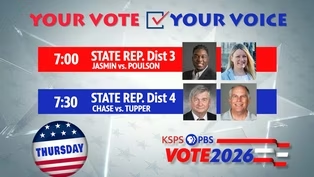
STATE REP District 3 and 4 DEBATES
Video has Closed Captions
Candidates for 2 seats to represent the Spokane area in Olympia debate at KSPS PBS. (30s)
Providing Support for PBS.org
Learn Moreabout PBS online sponsorship New Episode
- News and Public Affairs

Top journalists deliver compelling original analysis of the hour's headlines.

- News and Public Affairs

FRONTLINE is investigative journalism that questions, explains and changes our world.
 New Episode
 New Episode
 New Episode
 New Episode
 New Episode

 New Episode
 New Episode

 New Episode


Support for PBS provided by:
Your Vote Your Voice is a local public television program presented by KSPS PBS