
Here and Now
Jason Stein on School Choice Voucher Enrollment and Funding
Clip: Season 2500 Episode 2514 | 5m 27sVideo has Closed Captions
Jason Stein on enrollment caps being lifted for Wisconsin's school choice program.
Wisconsin Policy Forum President Jason Stein discusses impacts of enrollment caps being lifted for the state's school choice program and changing funding levels for vouchers covering private schools.
Problems playing video? | Closed Captioning Feedback
Problems playing video? | Closed Captioning Feedback
Here and Now is a local public television program presented by PBS Wisconsin
Here and Now
Jason Stein on School Choice Voucher Enrollment and Funding
Clip: Season 2500 Episode 2514 | 5m 27sVideo has Closed Captions
Wisconsin Policy Forum President Jason Stein discusses impacts of enrollment caps being lifted for the state's school choice program and changing funding levels for vouchers covering private schools.
Problems playing video? | Closed Captioning Feedback
Where to Watch Here and Now
Here and Now is available to stream on pbs.org and the PBS app.
Providing Support for PBS.org
Learn Moreabout PBS online sponsorshipvote.
But first the caps are off.
That is enrollment caps for Wisconsin school choice programs.
They were lifted this school year for the state funded voucher programs, allowing children to attend private schools across the state.
Last year, Wisconsin spent more than $700 million funding school choice with about 60,000 students participating.
School districts are allowed to levy additional property taxes to offset the private school payments.
Earlier this year, Governor Tony Evers vetoed a bill that would have opted Wisconsin in to a new federal school voucher program.
But what are the implications for the growth of school choice in Wisconsin?
With no enrollment caps?
We turn to Jason Stein at the Wisconsin Policy Forum.
And Jason, nice to see you.
>> My pleasure.
Thanks for having me.
>> So as we just said, Wisconsin won't be taking part in that federal voucher program.
But as you know, Wisconsin was an early adopter into school choice in the 1990s with expansion statewide more recently.
But what are the implications of having no caps?
Should we expect school choice programs to kind of explode?
>> I think what you can think about is the short term implications are modest, but the long term implications could be very big.
So in 2015, we sort of switched the cap for the statewide program in our in the budget that year.
And we added 1% of students a year.
And so last year it was at 10% was the cap.
This year that comes off.
Now, of the 421 districts statewide, only three districts Manitowoc, Watertown and West Allis, West Milwaukee are were at that 10% cap in the most recent data.
Of those, maybe West Allis, West Milwaukee, because it's close to Milwaukee and all those choice schools in Milwaukee could probably have the most impact.
But long term, it could affect many other districts that aren't yet at the cap.
>> So there is one private choice school in Milwaukee that took in $50 million last year in voucher payments, having expanded to online learning.
Is that a way to kind of expand capacity for schools that might want to take part, but just don't have the seats?
>> It's certainly the virtual schooling is a wild card because that really obviously doesn't answer to geography.
Now, you know, most choice schools, just like most public schools, are going to have to draw from a fairly limited geographic area around them, right?
It may also be the case that for most schools, virtual learning may also be somewhat capped in the sense that it didn't perhaps gain the best reputation during the pandemic.
But at the same time, there's certainly going to be schools that are going to grow and grow significantly in the next few years because of this change.
You know, in many other districts, rural districts, other places, the schooling may not look that much different.
So it's really going to be a case by case and community by community, I think.
>> Now we know that districts can offset the loss of funds by raising property taxes.
But what is the breaking point there?
>> Well, it's one more factor that adds into recent school property tax increases, which have been pretty large.
Back in December, they were the most since the school levy increase for all public schools was the most.
Since the early 1990s.
And I think that got some people's attention when they opened their property tax bills last December.
They're probably going to be pretty big increase, not just because of vouchers, but because of other factors as well.
Come this December.
So we'll see.
I mean, the next legislature could look different from this one.
And they might look at a host of these ideas and issues differently.
You know, that will be a big determinant too, I think.
>> So there are income limits to take part in the school choice program, a family income of, I think $71,000.
But some critics of the program say many of these students were already attending, say, parochial schools, and now they just get those kind of voucher funds.
Does that matter at all?
>> Well, that's another factor to think about when we think about the cap coming off for the statewide school Choice program.
It is a 220% of the federal poverty level for a family, which, you know, if it's a family of 4 or 5, can be, you know, what we might think of as a middle class income or low middle class income, so that is another factor that would limit the the media impact, as you say.
We don't have great data on this, but I think many of the people who took initially advantage of the school choice program were families that already had their kids in a private school, and that that school joined the school choice program because not all private schools do.
And then they qualified on income.
So there's those other factors that you have to think about as well.
>> So how could the Wisconsin school choice program change or even expand depending on the results of the November elections?
>> Well, you know, right now we've had a Republican legislature since January 2011.
That's could change.
I mean, we'll see, right?
Or at least in one house or two houses, that would really change how lawmakers and the body as a whole looked at school choice.
But, you know, that's really why elections matter.
And we have to watch these things.
>> All right.
Jason Stein, thanks very much.
>> Thank you.
>> In younger voters born between 1997 and 2012, the between 1997 and 2012, the
 New
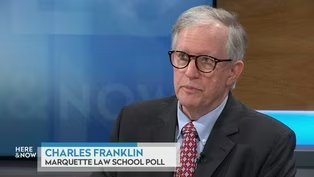
NewCharles Franklin on a Tight Race Between Crowley and Tiffany
Video has Closed Captions
Clip: S2500 Ep2514 | 6m 28s | Charles Franklin on polling voters about enthusiasm for David Crowley and Tom Tiffany. (6m 28s)
 New
NewHere & Now opening for October 2, 2026
Video has Closed Captions
Clip: S2500 Ep2514 | 56s | The introduction to the October 2, 2026 episode of Here & Now. (56s)
 New
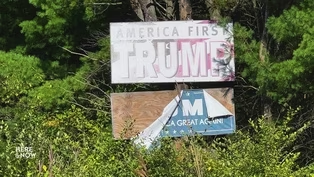
NewWhat's the Trump Factor for Rural Wisconsin Voters in 2026?
Video has Closed Captions
Clip: S2500 Ep2514 | 7m 25s | President Donald Trump's influence among rural voters remains key in the 2026 vote. (7m 25s)
 New
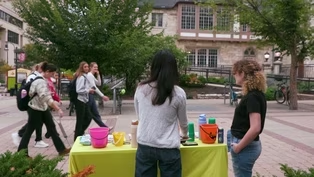
NewThe 2026 Youth Vote and Where Gen Z Wisconsinites Stand
Video has Closed Captions
Clip: S2500 Ep2514 | 5m 48s | Democrats and Republicans are in a fierce competition to earn the support of young voters. (5m 48s)
Providing Support for PBS.org
Learn Moreabout PBS online sponsorship New Episode
- News and Public Affairs

Top journalists deliver compelling original analysis of the hour's headlines.
 New Episode
- News and Public Affairs

Today's top journalists discuss Washington's current political events and public affairs.
 New Season
 New Episode
 New Episode
 New Episode
 New Episode
 New Episode
 New Episode

 New Episode
 New Episode
Support for PBS provided by:
Here and Now is a local public television program presented by PBS Wisconsin