
Jazz Festival & Tacos Aarón
Season 15 Episode 3 | 24m 47sVideo has Closed Captions
In this episode, we get swept up in the soulful sounds of the San Diego/Tijuana Jazz Festival.
In this episode, we get swept up in the soulful sounds of the San Diego/Tijuana Jazz Festival. This cultural celebration brings together top musicians from both sides of the border. We dive into the history, energy, and artistry behind the music—then follow our appetites to “Tacos Aarón,” a local favorite serving some of Tijuana’s “tacos varios.”
Problems playing video? | Closed Captioning Feedback
Problems playing video? | Closed Captioning Feedback
Crossing South is a local public television program presented by KPBS
Jazz Festival & Tacos Aarón
Season 15 Episode 3 | 24m 47sVideo has Closed Captions
In this episode, we get swept up in the soulful sounds of the San Diego/Tijuana Jazz Festival. This cultural celebration brings together top musicians from both sides of the border. We dive into the history, energy, and artistry behind the music—then follow our appetites to “Tacos Aarón,” a local favorite serving some of Tijuana’s “tacos varios.”
Problems playing video? | Closed Captioning Feedback
Where to Watch Crossing South
Crossing South is available to stream on pbs.org and the PBS app.
Providing Support for PBS.org
Learn Moreabout PBS online sponsorshipJorge Meraz: Hey, folks, on this episode of "Crossing South," music takes over Tijuana at the San Diego-Tijuana International Jazz Festival, where legendary musicians and serious rhythm turn the border into one big stage.
Then we bite into real Mexican home-cooked tacos from a local food truck, and it's all coming to you now!
♪♪♪ ♪♪♪ Jorge: Downtown Tijuana is becoming the hip place to be, experiencing a cultural gentrification which is benign and that is replacing what used to be the predominant industry that saturated this strip for years, namely just souvenirs and trinkets.
[men playing instruments and singing] Jorge: So even though Revolution has been revamped in many ways, a lot of new coffee shops and restaurants, you still have the classic, you know, trinkets and souvenir shops that have been here for so many years.
Of course, before, there used to be so much more than this, so we only need a few, don't need that many.
Well, today, we are meeting the organizers of a unique event that is being held here.
Jorge: Daniel, nice to meet you, my friend.
Daniel Atkinson: Great to have you here.
Jorge: Daniel Atkinson, right?
Daniel: Yes, that's right.
Jorge: What's your story?
Well, what's--why are you organizing jazz events in TJ?
Who do you think you are, huh?
Daniel: Yeah, that takes a lot of guts, doesn't it?
I've been doing jazz production in San Diego for the last 36 years.
Jorge: Oh, really?
Daniel: And right when I started in 1989, it was almost the last time there was a jazz festival in San Diego of international quality.
Jorge: No, there hasn't been one in-- Daniel: Not in 40 years, and I've been thinking about it, thinking about it.
Finally, I got to the moment in life when I thought, "Well, if you're going to do it, you better do it now."
Jorge: Yeah.
Daniel: And, of course, I had the advantage of knowing Julian Placencia, my partner here in Tijuana, who makes all of this possible.
Jorge: He manages Caesar's Restaurant, right?
Daniel: Yes, that's right.
The thing that's unique about San Diego is Tijuana, you know?
Jorge: Land of the freer, home of the braver.
Daniel: Well, yeah, you could say that, but-- Jorge: Less regulations, maybe.
Less red tape.
Daniel: That is also true.
Well, different red tape.
But the thing is, we're sitting here right on this international border.
Like, no other pair of major cities anywhere that I'm aware of, and we have this incredible opportunity to experience one another's cultures to find places where we are connected to create new connections, and I don't know what could be more exciting than that.
Jorge: And you're bringing artists from all over, right?
Daniel: That's right, yeah.
We have a whole group from New York City, someone from Cuba, artists from the Bay Area, from Los Angeles, and, of course, artists from here and from San Diego.
We have five bands here today.
We're going to start with the Binational Youth Ensemble, eight students from Ensenada in San Diego.
So after the students, we have an amazing band from right here in Tijuana.
They have a wonderful name in English.
The band name is The Less Likely.
They have this incredible fusion of jazz, hip hop, jazz and rock, incredible vocals.
It's just an extremely special band, so.
Next we have an amazing young singer named Lucia, who is originally from Veracruz in Mexico, won the world's most important jazz vocal prize, and is someone who was raised in a son jarocho family, so she sings standards and son jarocho and boleros and you name it.
Jorge: Wow.
Daniel: Then we have Irving Flores, great pianist from San Diego, originally also from Veracruz, who's bringing his sextet with an Afro-Cuban drum legend, Horacio "El Negro" Hernandez.
And then, finally, the two-band combination of Arturo O'Farrill and The Afro Latin Ensemble from New York City and the Fandango Fronterizo Colectivo from right here in Tijuana.
And that is a blowout, blow-your-mind, never-seen-this-anywhere-before kind of experience.
Jorge: Ivan, I understand that for today's concert, you are bringing a--literally a Binational Youth Ensemble.
Can you tell me, you know, what that group's made of?
Ivan Trujillo: We are happy for this collaboration because this was an idea for Dan Atkinson.
All the festivals are about artists playing music, but this festival is about education.
Jorge: Oh, really?
In what way?
Ivan: We have students from Ensenada.
We practice jazz improvisation.
And Gilbert Castellanos, a huge trumpet player from San Diego, has his own conservatory.
So we have this band to--with a few students from Ensenada and a few students from San Diego, and they practice right before the concert, and they do the concert.
Jorge: Are they jamming?
Have they found the synergy?
Ivan: Yeah, yeah.
Jorge: I hear that your young lions, you know, are gonna be playing here today.
Gilbert Castellanos: Yeah, so I have a nonprofit jazz conservatory in San Diego, where we have about 200 kids in the program now, and this is just a small sample of our students that have traveled on this side of the border to participate in this amazing festival.
So I have four of my students performing this-- Jorge: In that ensemble with Ensenada kids, right?
Gilbert: Yeah, so it's a mix of the two groups, so Binational Youth Ensemble.
So four and four.
We didn't have a lot of time to rehearse, you know, obviously because we're on two sides of the border, so we had our first rehearsal Thursday when they performed for the first time.
Jorge: How'd they feel?
Gilbert: They felt--they sound great.
They--I mean, they sound like a band, like they have been working together-- Jorge: You think the Jatos are out?
Do you think it's gonna be here, like-- Gilbert: Oh, yeah, yeah, yeah, yeah.
I mean, these kids are ready to go on tour and hit the road and make records.
They're that good.
Jorge: Now, one thing that surprised me is that the local population has a proclivity for jazz.
I didn't even know that.
Did you know--obviously you knew that already.
Daniel: Well, I knew it already, but not from so far back.
I mean, I've been working in jazz in San Diego for 36 years.
I kind of discovered the Tijuana jazz scene about ten years ago.
So shame on me, but I love my people here.
They're so warm, they're so creative, and so willing to try to make things happen.
It's just a total pleasure and a blast for me.
Jorge: Irving, my friend, important jazz musician.
You've come a long way, and now you're here in Baja.
Irving Flores: Thank you so much.
Jorge: Gonna please the local audience with your music?
Irving: It's so pleasant surprise to find you guys, and we are very excited for tonight to have an amazing concert with an amazing lineup from Cuba, Horacio "El Negro" Hernández.
We brought Horacio that is included in the--in my album "Armando Mi Conga."
So we are--we're having a serious release concert tonight.
Jorge: People are excited.
Irving: They're very excited, and-- Jorge: You recorded "Armando Mi Conga" in New York, right?
Irving: In New York in 2024, and we released it in 2025.
Jorge: But this is the first time it's playing in-- Irving: Yeah, in Tijuana, it's the first time.
Jorge: You've come a long way from Veracruz to the States, and how did you go from that to playing like Afro-Cuban jazz?
Irving: I born in the southeast of Mexico.
And I received all the influence from Cuba.
Jorge: Right--oh, that's right.
Veracruz, right?
Is that where you were born, Veracruz?
Irving: In the gulf-- Jorge: So that's the coast.
You were off of Cuba.
Irving: Yeah, in the Gulf of Mexico, right there is Veracruz, and it's facing to Cuba.
Jorge: So that's the influence, that's right.
I didn't realize, oh.
Irving: And a funny thing, my grandma, she put the vinyls, and I was a kid, and she showed me to learn, and that music emerged.
Jorge: You've liked it since you were a child.
That's why it was natural for you.
Irving: And then I grew up in the northeast of Mexico, and then I moved to the conservatory in Mexico City.
Jorge: Right, right, and then you're in San Diego, based out of there.
Irving: Yeah, since 22 years ago.
In 2023, my wife, my beautiful wife, Amanda Flores, she took me to celebrate a Thanksgiving in Puerto Vallarta, and then she said to me, "Irving, tell me what you really want to make successful through your composition."
And I said, "Recording an album."
Write it down, boom.
"Who's the people you want?"
"Giovanni Hidalgo, Horacio 'El Negro.'"
Jorge: Visualize it.
Irving: That was in November 2023.
In March 11, she made everything possible.
Jorge: Your wife made it happen, fantastic.
Irving: Hey, she's here.
Come on, come on.
Jorge: Get in there, girl.
Jorge: You guys are a power couple for sure.
Irving: Oh, thank you.
Jorge: Thank you for being a wife that helps her husband manifest his dreams.
You're a fortunate man, my friend.
Irving: Thank you, thank you.
Jorge: Nice to meet you both.
We look forward to seeing you today.
Irving: Thank you.
Jorge: On stage, Irving, okay?
Irving: Thank you, buddy.
Jorge: Yeah, this place was jamming for hours with world-class musicians.
I mean, look at it.
Jorge: Arturo, so happy to have you here.
Arturo O'Farrill: What a thrill, what a thrill!
Jorge: Are you excited, then, to be here?
Arturo: I'm so thrilled.
You have no clue.
I am in Mexico, where I was born, where my people are, and it's a beautiful vibe.
Jorge: Fantastic.
Are you Irish, or why it was O'Farrill, you know?
It's like where's that last name from?
Arturo: All right, okay, I'm Mexican too.
I'm Mexican, Cuban, German, Irish.
My wife is African American, Jewish.
My kids don't know who to hate.
They don't know who to hate.
We are hyphenated Americans in the best sense of the word.
Jorge: Hey, you get the best from every culture, right?
Arturo: I'm grateful.
I'm grateful to be a mutt.
I'm grateful to represent people of Mexico, people of Cuba, people from all over the world.
[jazz music playing] Jorge: How do you feel carrying on your dad Chico's legacy, you know, in music?
Do you feel--is there a balance between doing your own thing and honoring your dad?
You know, how-- Arturo: I feel really privileged to carry my father's progressive visioning.
I don't exactly do what he does at all, but I feel like he stood in the same place that I do, where there's a lot of worlds that are being connected musically by him, and now I see those worlds and different ones beyond that.
So, in a way, the great work of every progressive visionary is to make the connections in their contemporary time.
Jorge: For your--what's contemporary to you?
Arturo: In my father's period, Afro-Cuban was the height of progressiveness.
For me, that's no longer the case.
We got Peru, we got Bolivia, we got Baja California, we got Mexico, we got Haiti.
We got it all, and we're connecting all those things.
Jorge: Have you ever played in Baja before?
Arturo: I did Ensenada.
There was a vineyard owner who had this fabulous spread, and he hosted a festival, yearly festival, and so we got to play in his vineyard.
But the other thing that I did was play at the border of San Isidro in Tijuana in that famous incredible artivistic festival called Fandango Fronterizo, and where we played, we had musicians on the American side and on the Mexican side playing across the mesh using killer dogs, automatic weaponry, border guards, chicken wire, and fencing to declare community love, pueblo, and unity.
It was the most amazing thing I've ever seen in my life.
♪♪♪ Jorge: What can you say about-- now that you're aware of the jazz scene in Baja and in Tijuana, is there anything you can say about it?
Like, what state is it in?
Daniel: Well, there's some amazing musicians here, and they're people who are dedicated and committed.
Someone like Ivan Trujillo, he isn't just a trumpet player, he has a school, he has a festival.
He has, I think, four or five bands.
Jorge: Oh, my goodness.
Daniel: And this is a busy guy.
But I think one thing that I tell jazz people from--in the US is the music here isn't what you might expect it to be, so they're thinking, "Oh, well, maybe it's kind of related to mariachi or maybe it's just standards being played by people who play standards."
And there are people here who play very avant-garde music, like music that is not easy for a lot of people to understand or listen to.
There are people here who play-- like my partner Julian plays jazz-rock fusion, which is maybe not as strong in the US right now, but it's retained its kind of-- Jorge: But that's the progressive, you know, movement here, where because they're not constrained by rules, they're kind of experimenting.
Daniel: They can do anything, yeah, yeah.
So I think it's an extremely rich scene that is really its own thing.
It's like it's this region that is doing this in this way.
[woman singing] Jorge: What's your aspiration for the festival?
Where do you see it--you know, you may be handing off one day to someone.
Where would you like it to go?
Daniel: Well, you know, I'm hoping I can hang in there for a few years.
You know, this is only year two.
It's a huge job.
I've got to say it is a year-round job, and-- Jorge: Organizing an event always is.
Daniel: Because we want it to be free to the public, raising funds is a huge job.
Jorge: For sure.
Daniel: But it's of the essence to our mission.
We want it to be free and available to everyone.
We like to say jazz knows no borders.
Jazz welcomes everyone.
Jorge: It sure does.
I mean, look at that.
The superlative exchange of culture and good vibes is something that is clearly evident in this event, and Tijuana is better for it.
So we moved to another part of Tijuana, another part of the city, to the Soler neighborhood, because we went to visit a very particular taco truck.
Jorge: Okay, I find myself in a colonia, a neighborhood, in TJ that is near the border.
Like you could literally see the wall from this colonia.
It's called El Soler, and I'm here because there's a food truck that apparently has been here for a while, and they have a type of tacos that is common in some parts of Mexico.
Certainly it's common here.
It's called tacos varios.
It's a type of taco that's been here for a while.
Instead of like your asada, your adobada tacos, there's tacos with different dishes.
They're called guisados.
Like imagine you have your Mexican dish, your mole, or your chiles rellenos, right?
They'll put those in a taco, and we're gonna try them right now.
Don't go anywhere, folks.
"Crossing South."
Jorge: Okay, I'm gonna try the first one.
This one is the pollo adobado, and I was telling him that "Hey, do you put this sauce on all of them?
'Cause it kind of covers what's inside, and now you can't see it."
Think of the adobada tacos, all the seasoning that it has inside, the adobado, all the peppers that it has that they make that giant, you know, spindle with.
I've not had many chicken tacos in my life, I'll be honest, so this will be interesting.
Adobado, but instead of pork, it's chicken, and they put the sauce.
So this sauce is a chicharrón sauce they put on all their tacos.
So it hides what's inside, but we'll see, okay?
This is crusty as it gets, right?
Cars driving right up to your seat here, one distracted driver away from your friendly neighborhood travel show host being eliminated from this table, but it's part of the experience, right?
This is a really good taco.
Not like knock-your-socks-off for me, my personal taste.
And I think one of the reasons: I think this chicharrón sauce is very overwhelming.
So I was asking him why I'm not seeing the chicharrón.
Chicharrón is like the pork skin, and he's saying that most people, when they sell chicharrón, they just sell the cueritos, like the skin.
Their version of chicharrón is the actual pork rind and also carnitas.
So these pieces of pork, these chunks of pork, is basically carnitas.
That's pretty good carnitas.
Let me try it with the sauce.
Let's see what it does to it.
It works.
You know how in the states you get your pizza day at school cafeteria and kids are excited for pizza day?
In school growing up, milanesa day was like something that got you excited.
They put avocado and sour cream.
The frijoles are attached to it, so you can't see, but it's like a breaded steak.
Their chicharrón sauce, that's the chicharrón right here, they put it to everything.
I just--I personally think that's a mistake because even though it's so far, so good-- it's tasted really good--it can kind of homogenize the taste, where everything tastes like chicharrón.
But so far, it's been good, so it's not a--it's just a moral objection rather than a taste one.
Let's add the chipotle sauce to this one.
Again, a good taco.
Right now, I think it's probably the one with the most subdued flavor, but so far, so good, man.
They're tasty.
Like if I was a patron, I would not be complaining.
When you go to a Mexican home and you get invited in for a Mexican traditional meal, you're always gonna get a batch of tortillas.
So as you're eating the dish, you're breaking off tortillas, and you're eating the food with your fork, with your tortilla, and you're getting bite-sizes of it.
They're doing the same concept here, they're just saving you the trouble.
They're putting it all in a taco.
So this is--this tastes very much like a home-cooked meal, like a traditional home-cooked meal.
So this one's the--is the empechemado, if I remember correctly, and it's got the corn tortillas.
So we're not gonna detach it because this is part of the arrangement of a fried tortilla inside and a soft tortilla on the outside.
This is probably better than your Taco Bell chalupa.
You've got your birria.
You've got your chicharrón.
For sure it tastes like a home-cooked meal.
This takes me back.
This region would not be what it is without these precursors.
I'm telling you, innovation would have been stagnant.
These are the foundations of everything that's going on in Baja today.
When you have a base food that is so delicious and so good and then you can build off of that, you're already starting with the winning equation.
What a great thing.
Okay, there's some marlin.
There are marlin taco shops and taco carts and taco stands.
The marlin taco is a staple of the region.
They're normally in gobernador tacos.
If you ever ask for a gobernador taco, it'll probably have shrimp, melted cheese, and seasoned marlin.
That is really good.
Okay, so the last one I'm gonna try, they call it a vampira with birria and chicharrón.
So it's like a lightly fried flour tortilla.
Thing about birria is that it's very juicy, and it tends to moisten the flour tortilla, and maybe that's why they fry it, so they don't--it won't get soggy.
So you have your chicharrón here.
You have your birria in there.
You have your melted cheese and your cilantro, your onions, which is your classic Mexican taco condiment.
They probably want me to eat it like that, but to have more coverage and efficiency and it won't fall apart, whenever they give me something like that, I tend to just condense it into like a burrito, you know, shape.
I'm not the biggest chicharrón guy, and this has been really good.
You know, for someone who doesn't like chicharrón, someone who never orders chicharrón, this has been pretty good.
Let's see what this--this looks great, but let's see how it is.
That is extremely good.
Oh, man.
Another thing is the tacos varios, but if you come, I would recommend make sure you save some space or get the vampira with chicharrón and birria.
It's really good.
What a pleasant experience to, you know, go to TJ's past and see someone that has survived the test of time, innovated just enough to provide something new.
The tacos varios have been here for a while, but some of the ones that he gave me, like that vampiro one, that was something special.
So a very nice place to know if you want to be immersed in Tijuana's crustiness, in Tijuana's popular colonias, this is what you want, away from the touristy stuff where the locals eat.
That's this one, Tacos Aaron.
It's been here for a while, and we're happy we came to it.
Jorge: So after feeling the rhythm of world-class jazz take over the streets of Tijuana and tasting the simple, honest flavors of homestyle tacos, we leave reminded that this city lives through its culture in every note, every bite, and every corner you explore.
And for us, just another unforgettable journey until the next time we get to cross south.
♪♪♪ ♪♪♪ male announcer: Like to know more about the places you've just seen?
Maps, videos, podcasts, and more at crossingsouth.com.
We also do Facebook, Instagram, and YouTube.
♪♪♪
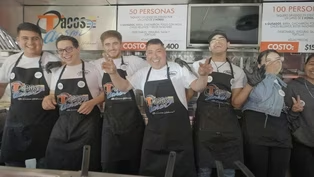
Jazz Festival & Tacos Aarón Preview
Video has Closed Captions
Preview: S15 Ep3 | 30s | In this episode, we get swept up in the soulful sounds of the San Diego/Tijuana Jazz Festival. (30s)
Providing Support for PBS.org
Learn Moreabout PBS online sponsorship













Support for PBS provided by:
Crossing South is a local public television program presented by KPBS