State of Affairs with Steve Adubato
Jeanette Hoffman; Adele LaTourette; Sgt. Terrell Washington
Season 9 Episode 24 | 27m 15sVideo has Closed Captions
Jeanette Hoffman; Adele LaTourette; Sgt. Terrell Washington
Jeanette Hoffman, Republican Strategist and Host of "Energy Matters," examines the importance of meaningful dialogue around energy policy. Adele LaTourette, Assistant VP of Policy & Advocacy at the Community FoodBank of NJ, talks about rising food insecurity. Sgt. Terrell Washington, Former U.S Army Soldier & Board Member at Backpacks for Life, discusses the struggles veterans face post-service.
Problems playing video? | Closed Captioning Feedback
Problems playing video? | Closed Captioning Feedback
State of Affairs with Steve Adubato is a local public television program presented by NJ PBS
State of Affairs with Steve Adubato
Jeanette Hoffman; Adele LaTourette; Sgt. Terrell Washington
Season 9 Episode 24 | 27m 15sVideo has Closed Captions
Jeanette Hoffman, Republican Strategist and Host of "Energy Matters," examines the importance of meaningful dialogue around energy policy. Adele LaTourette, Assistant VP of Policy & Advocacy at the Community FoodBank of NJ, talks about rising food insecurity. Sgt. Terrell Washington, Former U.S Army Soldier & Board Member at Backpacks for Life, discusses the struggles veterans face post-service.
Problems playing video? | Closed Captioning Feedback
How to Watch State of Affairs with Steve Adubato
State of Affairs with Steve Adubato is available to stream on pbs.org and the free PBS App, available on iPhone, Apple TV, Android TV, Android smartphones, Amazon Fire TV, Amazon Fire Tablet, Roku, Samsung Smart TV, and Vizio.
Providing Support for PBS.org
Learn Moreabout PBS online sponsorship- [Narrator] Funding for this edition of State of Affairs with Steve Adubato has been provided by Valley Bank.
NJM Insurance Group.
Serving New Jersey’s drivers, homeowners and business owners for more than 100 years.
New Jersey Sharing Network.
IBEW Local 102.
Celebrating it’s 125th Anniversary.
RWJBarnabas Health.
Let’s be healthy together.
The Port Authority of New York and New Jersey.
Moving the region through air, land, rail, and sea.
Horizon Blue Cross Blue Shield of New Jersey.
The New Jersey Economic Development Authority.
And by Robert Wood Johnson Foundation.
Working to create a future where health is no longer a privilege, but a right.
Promotional support provided by NJBIA.
We put business at the center.
And by Insider NJ.
[INSPRATIONAL MUSIC] - Hi everyone, Steve Adubato.
We kick off the program with our longtime friend, Jeanette Hoffman, Republican strategist, who is also the host of a new series called "Energy Matters" with Jeanette Hoffman.
Good to see you, Jeanette.
- Hey Steve, thanks so much for having me.
- Are you saying we have an issue with energy in New Jersey?
I hadn't noticed.
- It's crazy, right?
I mean, listen, it is the biggest issue in this year's gubernatorial campaign and legislative races, and if you told me that four years ago, I wouldn't have believed you.
But if you look at both candidates for governor, Mikie Sherrill on the Democratic side, and Jack Ciattarelli on the Republican side, they're both talking about ways to reduce your electric rates, which have increased by 20% for most New Jersey homeowners.
- Okay, this program, this segment may be seen before, as well as after, but as we speak mid-September, we actually just did an interview with Jack Ciattarelli, later today, we'll be talking to Congresswoman Sherrill as well.
Energy is a huge issue, but let's do this, what is the series?
And we'll let everyone know is that, this streams with our colleagues and the folks over at on ONNJ, we'll put up the website, describe the format of the series, 'cause anything we can do with our media partners to promote what they're doing is important, go ahead, Jeanette.
- Sure, the show is called "Energy Matters," It's sponsored by New Jersey Policy Institute, and it's hosted on a streaming platform forum called ONNJ, ONNJ.com, and it's an interview series, and we look to talk to everybody on both sides of the aisle, Republicans, Democrats, people involved in policy, people involved in the energy world, to help break down this really complicated issue, Steve, it's not simple, it's all about supply, our energy supply, and demand.
The problem is, we have a huge demand for energy right now, especially electricity when we're talking about artificial intelligence and data hubs in New Jersey, and we don't have that much of a supply.
So, you know, what happens then?
Well, we see our energy rates are going up.
So in this interview series, we look to talk to people who are making decisions about these issues, now and into the future, about how it will impact New Jersey consumers, and what the best way is to go about lowering their costs.
- Jeanette, you understand politics, you understand polling better than most, to what degree do you really believe that the average New Jersey citizen, 9.5 million New Jerseyans, to what degree do you believe the average citizen is, other than the utility bills, which, yes, that'll get your attention, - Yeah.
- What do you believe the, quote, "Appetite is for a meaningful discussion about energy?"
- Oh, I think people wanna hear it because until it impacts you, you don't really understand it or you don't really wanna talk about it, but when you open that bill, from either, you know, PSE&G or FirstEnergy, and you see, "Whoa, wait a second, why did my electricity bill go from $200 to $500 overnight?"
You wanna know, I think people really wanna know, and they wanna talk about it.
And, of course, we talk about clean energy too, because that's important, having a cleaner environment, everybody wants that, but the problem is, we are not quite there yet with our energy supply, and we need other things too, to keep us, you know, affordable and dependable in energy.
- Again, you've known us long enough to know we don't have a quote-unquote "Point of view," we don't have a dog in the fight, a horse in the race, whatever prescription you wanna use, the series that you do, "Energy Matters", Does it have a point of view?
- Well, I think everybody is looking for pragmatic solutions to lower energy bills, right?
- Right.
- And I think that's the basic issue.
- That's a point of view.
- Yeah, I mean, how can we help New Jerseyans get their costs down and make sure that we have a stable, affordable energy grid, that, you know, helps New Jerseyans - What do you mean a grid?
- keep the lights on, right?
- Go back, go back, Jeanette, just using the term grid, you know, I'm obsessed by communication and the way we use language, people go, "Grid, what grid, what grid?"
- Yeah, well, the energy grid is where we pull our electricity from, right?
And that's what powers everything in New Jersey, that's what keeps our lights on, and allows us to run our homes and our businesses, so our energy grid, the problem is, we don't have enough supply going to our energy grid, so we're buying electricity from different states, right?
So, in fact, you hear different legislators saying, "You know, we want clean energy, but right now, we don't have enough energy, so we're buying coal from West Virginia," which people would say, "That's not the cleanest supply of energy," but New Jersey isn't producing enough energy, so we have to rely on other supplies right now.
But having an energy grid that's dependable and reliable is really important, Steve, because in other states, you've seen brownouts and blackouts, we don't want that for New Jersey, we wanna make sure that our grid is reliable and dependable, as well as affordable.
- Okay, so how the heck, as someone, my colleague Mary Gamba, who you know well, is always like, "Steve, you keep mentioning IA, but ..." IA, AI, she goes, "But you don't understand it."
And I go, "You think I'm alone?
I'm trying to understand it.
I'm trying to understand how it connects to what all of us are doing, in one way or another."
But then I'm going, "Wait a minute, AI, AI data centers, energy costs."
I'm thinking, "What, what does AI have to do with energy costs?"
Jeanette.
- Well, AI data centers use a ton of electricity to run - What's a data center?
- artificial intelligence.
- It's, a data center, you know, it's a business, Steve, it's a technology business, and a lot of them are coming to New Jersey or they're going to other states that have more affordable energy or lower taxes.
We wanna recruit the best businesses to come here to New Jersey, such as data centers.
I can say data center, I don't have to say AI, if that confuses you.
- Jeanette, I know what it is, I'm just saying, but these data centers are critical to the "infrastructure" to allow IA to function, AI, AI, - Yeah.
- artificial intelligence to function, but we don't have them?
- We have some of them, but we wanna recruit more of them here.
The ones that we do, we have, they're pulling a lot of electricity, and as I said, that is increasing the demand for energy in New Jersey.
Other states are recruiting AI data centers to come to their states as well.
We are not as attractive because our energy rates are very high, our business taxes are very high, so we're losing out on that competition to other states.
So again, we have to think about affordability and reliability when it comes to energy.
- So, with AI, artificial intelligence, there's competition among states, between states, as to who gets this cash cow connected to AI?
- Sure, Steve, it's like any other business, right?
States wanna recruit employers to come to their communities, to, you know, increase their tax base, to increase employment in their communities, but businesses look at New Jersey, like they look at other states, and they look for competitiveness, and if we're not cost-effective for them to do business here, they'll go to Pennsylvaniaú or they'll go to New York.
Another employer, manufacturing, that is a big sector, New Jersey is really trying to recruit, but do you know that manufacturing uses a ton of energy?
So, when we look at manufacturing, we also have to look about lowering their energy costs if we wanna recruit them and have them stay here in New Jersey, - Jeanette Hoffman is not just a Republican strategist, the name of your firm, by the way, let everyone know?
- Marathon Public Affairs.
- Also, the host of "Energy Matters" with Jeanette Hoffman, it is on ONNJ, our streaming colleagues.
And listen, even though we're in public media and we distribute our content everywhere, we wanna do everything we can to promote the distribution of important, relevant public policy-centric information on other platforms, that includes ONNJ.
Jeanette, thank you my friend, all the best.
- Thanks, Steve, appreciate it.
- You got it, stay with us, we'll be right back.
(grand music) - [Announcer] To see more State of Affairs with Steve Adubato programs, find us online and follow us on social media.
- We're now joined by Adele LaTourette, who is Assistant Vice President of Policy and Advocacy at the Community FoodBank of New Jersey, one of our longtime partners, promoting greater public awareness around food insecurity issues.
Adele, good to see you.
- Good to see you, Steve.
- You got it.
Hey, we'll get right to this, 50 years Community Foodbank celebrating, talk about that.
- That's exactly right.
Kathleen started the FoodBank in 1975.
- Kathleen DiChiara.
- [Adele] Kathleen DiChiara, yes.
- [Steve] Out of a station wagon, right?
- Out of a station wagon, yep.
In the back of her station wagon in Newark.
- And right now, the Community FoodBank is the largest organization dealing with food insecurity issues in the state, correct?
- That's right.
We now serve 90 million meals annually.
So yeah, it's a new world.
- Talk about advocacy and public policy.
What would you say is the greatest impact of federal funding cuts?
We've had people on who debate this and say, "Steve, the cuts in SNAP, which stands for Supplemental Nutrition Assistance Program, SNAP, S-N-A-P, otherwise known as Food Stamps before that, that the cuts do not negatively impact people who are currently on SNAP.
You say.
- I disagree.
- Talk about it.
- I think what we really have to focus on is, so, SNAP brought in 1.9 billion into the state last year.
What H.R.1 did, the Big Bill, is, it's hard to call it cuts in certain instances.
And please tell me if I get too wonky because I kind of have a wonk reputation around here.
- You're talking about the federal legislation, the so called.
- Federal legislation.
- The Big Beautiful Bill that Congress passed by a narrow margin.
Go ahead.
- So, what it did was, it really erected more barriers.
It really made it more challenging to participate in the bill.
But I think also part of what happened, we have people going to food pantries that were saying, "SNAP doesn't exist anymore."
So much of it is kind of public perception, messaging around the program.
But again, yes, that bill, I think to me the biggest change is so much of the financial aspect of SNAP, formerly known as Food Stamps, is going to now come down to the state.
So at the state level, we'll be looking at increased cost of 100 to 300 million to operate the program.
And at the county level, we'll be looking at 78 million between the counties to run the program.
So, that's going to be a huge lift in terms of what the state can do and what the counties can do.
- So the new governor, who will take office in January 2026, this issue will be front and center.
- Absolutely, and not just SNAP.
We also have the Medicaid issue.
I think, in fact, I know what we need to do in New Jersey, and I'm just going to talk New Jersey because that's the state that I know.
We need to focus on making sure that we inform people about the changes, educate them about how they can comply.
We need a broader partnership.
We need a bipartisan partnership.
I optimistically really believe that New Jersey can lead the way in showing what we can do in a bipartisan way.
We are going to have to come at this regardless of who wins the governorship.
This is going to have a huge impact on the state and the people in the state who are hungry and food-insecure.
And I believe that no politician in New Jersey thinks that we should have hungry and food-insecure people living in our state.
So I think we have to work together, build bridges to one another, and make sure we focus on how we can help people comply, how we can build avenues of compliance, and how we can really make sure that people have access to the benefits they so desperately need.
- And as we talk about this, team put up the website for the Community FoodBank for people to find out how they can help.
By the way, people can help, right, Adele?
- They can help.
They absolutely can help.
- How?
- They can donate to the FoodBank.
They could donate to their local food pantry.
The food banks together as a group, last year served 1 million people per month.
Food banks cannot absolutely not fill in the gap that the loss of SNAP or the challenges to SNAP will produce.
We can't do it.
It's not possible.
Emergency food was never meant to do that.
Kathleen started the FoodBank in '75.
I came into this work in '79.
And back then, hunger looked very different.
It literally was, emergency food was emergent.
It was if people lost their power and the, you know, the groceries in the refrigerator.
It's changed now.
It's working families that come to our food pantries.
- I ask this of every one of your colleagues when we talk about food insecurity, and I'm going to try it with you as well.
So someone says, "My family is good.
We're okay.
It's tight, affordability in New Jersey is not easy, but we have food on the table.
Why is someone else's, another family's challenge around access to healthy food, food insecurity, why is that my problem?
Why should I be concerned?"
Tell folks.
- I think it's about living in community, living in your own community.
I mean, people who are in need of food, they're your neighbors.
It's not an us and them, it's just not.
It's people who are your neighbors, people who are your friends, people who are alongside you at the grocery store.
To me, that's basic definition of community.
- Do we not even, Adele, sorry for interrupting.
Do we not even know who's struggling?
- No, absolutely not.
You cannot look at a person and say that person is not struggling.
We have hunger, food insecurity in every single county in this state, which is another thing that's changed.
It really is your neighbor.
It really is someone who's potentially in your family.
It's everyone.
There is no particular demographic.
It's universal.
- What is this Map the Meal Gap study?
- So basically, Feeding America really takes a look at what they are- - Feeding America is a national organization.
- Feeding America, yes, sorry.
A national organization of food banks, of which we are a member.
And basically, it measures what the meal gap is in terms of food insecurity.
So, the most recent study had about one in nine people in New Jersey who are food-insecure.
I tend to think that number is higher.
I think reporting hunger and food insecurity is challenging because I think a lot of people will not talk about what it is they need, and I think going by how much people earn is deceiving.
Again, cost of living in New Jersey is very high.
I think more people are struggling than ever.
So I'm not a huge believer in statistics.
I think everything statistically should be taken with a grain of salt.
I think the numbers are bigger, basically.
- Adele LaTourette is the Assistant Vice President of Policy and Advocacy for a terrific organization.
They've been doing it for 50 years.
Our late friend, Kathleen DiChiara, who started this organization in 1975.
Actually, check out the piece that we did on our sister series, Remember Them, with my colleague Jacqui Tricarico.
The website for Remember Them will come up.
We did a piece on Kathleen and why, even though she's no longer here with us in person, she's here with us in spirit.
- Totally.
- And her legacy lives on.
- Absolutely.
- Adele, thank you so much.
- Thank you so much, Steve.
- You got it.
Stay with us, we'll be right back.
(grand music) - [Announcer] To see more State of Affairs with Steve Adubato programs, find us online and follow us on social media.
- We're now joined by Terrell Washington, United States Army Veteran and a board member at an organization called Backpacks for Life.
We'll put up the website.
Sergeant, good to have you with us.
- Good to see you too, Steve.
- Before we talk about Backpacks for Life, tell us the moment you decided to join, sign up to serve in the United States Army, please.
- I was a sophomore in high school.
Henry Snyder High School here in Jersey City, New Jersey.
I actually, we were inside the classroom on the third floor watching on TV one of the towers burn and then the second tower got hit while we watched live from our classroom.
Right there I knew that I was gonna join the military.
- So on 9/11 - Yes.
- You're there, you see this happening and you decided you're gonna join the military because?
- Because I seen it and it did something.
Me seeing the towers be attacked, it did something to me.
I see how everybody was in disarray and while everybody wanted to go to college and other people didn't have plans, right there as being a sophomore in high school, I wanted to do something for my country.
I wanted to defend and honor my country.
So that's when I decided to go.
- You served in Iraq?
- Yes.
- Thank you for your service.
Thank you for, and again, we're doing a series that it's simply called "Honoring our Veterans."
Put up the website team, "Honoring our Veterans."
It is not a one-off program.
It is an ongoing initiative that honors our veterans and the work they're doing.
Like Sergeant Washington.
Tell us about Backpacks for Life.
- Backpacks for Life is a nonprofit organization ran by Brett and Alexa D'Alessandro.
I bumped into them during a military event and they actually, I started working with them and then a year later they had a meeting to bring me on as a board member, board of directors for the organization.
We help veterans that are homeless, at risk of being homeless that deal with substance abuse problems.
Basically, if you're a veteran, you are not forgotten by our standards.
We know that there's a lot of red tape from state and city like City Hall and things of that nature.
We don't care if it's two in the morning or two in the afternoon.
We are coming to you, we're gonna help you get services.
We're gonna put you up in a hotel, get you food.
Basically we take you from feeling like you don't wanna be here to, you should be here.
You need to be here.
'cause a lot of our veterans are forgotten about.
- Sergeant, let me ask you this.
The transition from military life to civilian life is challenging, I'm sure on so many levels.
Just share with us a little bit about why it's so challenging and what's so challenging.
- While while you're in the military, they teach you how to be a soldier, but when you get out, they don't teach you how to reintegrate yourself back into society.
It's like they just give you your papers, they kick you out and then you have to find your way.
That's how a lot of veterans, they succumb to the bottle or substance abuse or worst case scenario, self transitioning.
And when you get out there, there's really no guide on telling you, Hey, this is your next step.
This is what you do.
It's like we serve the people and then when we get out, the people don't serve us.
And there's a disconnect between the military and civilian life and that's what needs to be fixed.
- You also work in the municipal government in Jersey City and Veteran Affairs?
- Yes sir.
- Talk about that.
- So there we identify the veterans in Hudson County, Jersey City, New Jersey.
We find out what they need.
We have on the website, we have a form that they fill out whether they need food, clothing, educational benefits, if they need a job, things of that nature.
So what we'll do is we'll screen them and then we'll help them out from there.
And we try to give them the best help possible that they can get.
But we make it personal.
We actually have them come into the office, we meet with them, we talk with them, we sit and we talk to them person to person and not just over the phone or through a laptop.
- Sergeant, for you, when you are helping a fellow veteran deal with the many challenges they're facing as they leave the military, how much of that is in fact personal for you?
- It's very personal.
While serving in Kuwait and Baghdad, Iraq, I lost people that were close to me, family that while I was abroad, they were home, I lost.
And also soldiers, veterans, DOD, everyone.
So we're trying to abstain from losing anyone else.
So when I see a veteran male, veteran female, veteran older, younger, when I see that they're in need, I drop everything because that's my mission and that's how I get my blessings.
I don't need to be compensated for it.
It's because I actually went through personal demons of my own.
So for me to come out of it, it's like, how dare me not help a fellow veteran get through theirs as well.
- It wasn't easy for you?
- Negative.
- What'd you face?
- I faced at times not being able to talk to anyone because my family and my friends couldn't relate.
And I was lucky enough not to get into substance abuse, but I did have thoughts of depression and suicide, which I never took action for it.
But every veteran isn't lucky enough not to take action about it as in hurting themself by actually being successful with doing that.
- Wow.
What is a VetWorking?
VetWorking is an an LLC that I came up with at 2024 to help veterans, play on networking, obviously, to help veterans organize networking events, helping from veterans with businesses, opportunities and their benefits.
So I identify veterans through city hall and through the ones that I run into 'cause usually I have some type of military insignia on me whether my dog tag, military hat, a placard on my car.
So when I talk to these veterans, there's a big disconnect between older veterans and the younger veterans.
So what I like to do is get all the veterans inside of an area and then I have people from everywhere from Home Depot to places where they can work to a VSO, a veteran service officer from City Hall.
And I get all of these people in one room and they all give their stick.
They all tell what they do.
And when the veteran matches up with that, once we break, kind of like a football huddle, we all have our name tags on and you go to the appropriate area that you need help in because a lot of the younger veterans don't like dealing with the older, and a lot of older don't like dealing with the younger, but when we get 'em all in a room, we are all veterans.
So it doesn't matter where you serve and what you do.
So I serve people, but I serve veterans more so because I am one.
And that's my mission.
VetWorking, networking with veterans to get them to their next level so they're not forgotten.
- Thank you, Sergeant Washington.
- Thank you, Steve - Keep doing what you're doing.
We'll have you back.
All the best.
- Thank you, all the best of you as well.
- That's a terrific American, a veteran making a difference in the lives of so many of his colleagues, men and women who served our country part of our series "Honoring our Veterans", not just the rhetoric, but the reality of what our veterans are facing.
We honor them every day.
I'm Steve Adubato.
We'll see you next time.
- [Narrator] State of Affairs with Steve Adubato is a production of the Caucus Educational Corporation.
Funding has been provided by Valley Bank.
NJM Insurance Group.
New Jersey Sharing Network.
IBEW Local 102.
RWJBarnabas Health.
Let’s be healthy together.
The Port Authority of New York and New Jersey.
Horizon Blue Cross Blue Shield of New Jersey.
The New Jersey Economic Development Authority.
And by Robert Wood Johnson Foundation.
Promotional support provided by NJBIA.
And by Insider NJ.
- (Narrator) For the last 125 years, the International Brotherhood of Electrical Workers Local 102 has powered progress and built a brighter future.
As we celebrate this incredible milestone, we honor the dedication of our past, the strength of our present, and the promise of our future.
Together, we're stronger.
Together, we're Local 102.
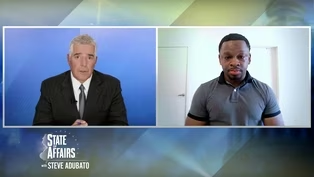
Empowering veterans through advocacy, support, and resources
Video has Closed Captions
Clip: S9 Ep24 | 9m 23s | Empowering veterans through advocacy, support, and resources (9m 23s)
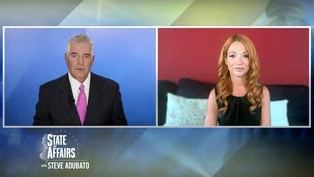
Finding meaningful solutions to New Jersey's energy crisis
Video has Closed Captions
Clip: S9 Ep24 | 9m 19s | Finding meaningful solutions to New Jersey's energy crisis (9m 19s)
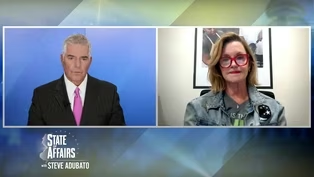
The impact of SNAP & Medicaid cuts to vulnerable populations
Video has Closed Captions
Clip: S9 Ep24 | 9m 11s | The impact of SNAP & Medicaid cuts to vulnerable populations (9m 11s)
Providing Support for PBS.org
Learn Moreabout PBS online sponsorship
- News and Public Affairs

Top journalists deliver compelling original analysis of the hour's headlines.

- News and Public Affairs

FRONTLINE is investigative journalism that questions, explains and changes our world.












Support for PBS provided by:
State of Affairs with Steve Adubato is a local public television program presented by NJ PBS