Bower School of Music & the Arts
Jeanie Darnell, soprano/Michael Baron, piano Nisita Concert
10/13/2021 | 1h 24m 5sVideo has Closed Captions
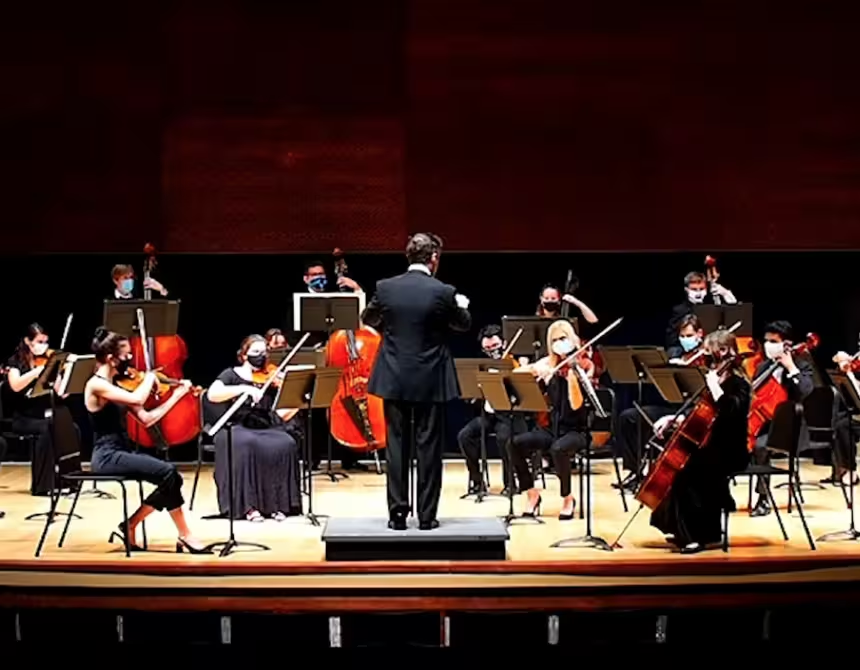
Soprano Jeanie Darnell and pianist Michael Baron perform art songs and opera arias.
Soprano Jeanie Darnell and pianist Michael Baron, founding faculty members of the Bower School of Music, have performed recital programs collaboratively throughout the United States, South America, and Europe for fifteen years. A special feature to the program will be a comparison between the original Chopin mazurkas for solo piano and the Pauline Viardot arrangements for voice and piano.
Problems playing video? | Closed Captioning Feedback
Problems playing video? | Closed Captioning Feedback
Bower School of Music & the Arts is a local public television program presented by WGCU-PBS
Bower School of Music & the Arts
Jeanie Darnell, soprano/Michael Baron, piano Nisita Concert
10/13/2021 | 1h 24m 5sVideo has Closed Captions
Soprano Jeanie Darnell and pianist Michael Baron, founding faculty members of the Bower School of Music, have performed recital programs collaboratively throughout the United States, South America, and Europe for fifteen years. A special feature to the program will be a comparison between the original Chopin mazurkas for solo piano and the Pauline Viardot arrangements for voice and piano.
Problems playing video? | Closed Captioning Feedback
How to Watch Bower School of Music & the Arts
Bower School of Music & the Arts is available to stream on pbs.org and the free PBS App, available on iPhone, Apple TV, Android TV, Android smartphones, Amazon Fire TV, Amazon Fire Tablet, Roku, Samsung Smart TV, and Vizio.
Bower School of Music & the Arts
All videos in the Bower School of Music & the Arts seriesProviding Support for PBS.org
Learn Moreabout PBS online sponsorshipWelcome to the Bower School of Music and the Arts.
I am Jeannie Darnell.
This is Michael Barron.
We are faculty here and we've been here for 15 years.
This is our anniversary.
As I look out into the audience today, I am so thrilled that our community is back at our concerts again.
So thank you for coming today.
Robert Schumann was both a composer and a music critic, and he's often remembered for his beautiful piano works as well as for his masterful art songs.
He began his music career as a pianist, but he developed a debilitating hand condition, he turned his attention to composing, and to writing about music.
He fell in love with the world renowned pianist, Claire Weick for whom he dedicated many of his songs.
Claire's mother was an opera singer and she liked songs, so Robert first wrote songs for her.
The piano accompaniments of his songs play an important role with the voice in expressing the words: they have melodic material equal to that of the voice part, and he often incorporated preludes, interludes and postludes to his songs.
He also carefully organized key relationships in his song cycles, and frequently linked them with motives.
Robert was the son of a book seller, publisher and a novelist, so he was an avid reader his entire life, He intuitively knew how to connect with poetry in a musical setting.
In the year of 1840, he married Claire Weick, he composed a hundred and thirty eight songs, which included his masterpieces, the Dichterliebe cycle, both Liederkreis opuses, and the Frauenliebe und Leben.
Many of his songs, cycles and collections are devoted to one poet, such as the poetry of the Frauenliebe und Leben written by Adalbert von Chamisso.
The Frauenliebe und Leben was intended as a wedding gift for Clara.
The text narrates, in a woman's words, the progressive stages of her relationship with her husband, From their first meeting until his death.
Each song marks a significant event in this woman's life.
Schumann's musical interpretation of the poetry creates a beautiful romantic story about a woman who finds comfort and happiness who finds comfort and happiness through her husband and childre Il est doux, il est bon Salome is the secret daughter of queen Hérodias in Massenets opera Hérodias.
And In Act 1, Solomon has just returned to the palace of King Herod, where she is a favored dancer of the court.
As she enters she sees the mystic Chaldean Phanuel who is an adviser.
who saw her where she shouldnt been - in Jerusalem at a near political riot.
Salome tells him that she has fallen in love with the prophet John the Baptist.
And she explains how she was looking for her mother.
And that she had an emptiness all of her life because she had because she had never met her mother And that when she was looking she heard John the Baptist.
And that his words comforted her and filled that emptiness that she had.
And that she followed him to Jerusalem.
She fell in love with him.
And that she.
Cannot wait to be with him again.
Good afternoon.
I'd like to say a few words about the next group of pieces.
The reason that Dr. Drewtel programmed these pieces is because this year is the two hundredth anniversary of the birth probing their Adobe, and we wanted to honor her in this concert.
Let me speak for a moment first about Chopin, but he needs almost no introduction whatsoever.
Chopin since he was alive to this day, his music has been beloved by audiences and pianists all over the world.
And I say pianists because it is very unusual for a composer to write only in one medium.
Everything Chopin composed was for a piano in one way or the other.
The vast, vast majority of his works for solo piano.
But then some pieces for solo piano and orchestra.
And then there's a small amount of chamber music and songs, but even those have piano.
So he was an absolute piano composer.
There are no symphonies.
There are no string quartets.
And that's fine.
No problem.
We have to remember Chopin that he was born and raised and educated in Poland.
He left Poland at the age of twenty for Paris.
And for the rest of his short life, he lived in France.
But he always remained, very patriotic to Poland and the Polish people.
I mentioned this because the pieces that were performing today are mazurkas.
It's one of the two Danz forms that are used that come from Polish folk dancers, Polish folk songs.
These would be Polynesia's.
But the mazurkas many, many people consider Chopin's mazurkas to be the absolute heart of his compositions.
These are many masterpieces here, not long pieces.
There are two to four minutes mostly.
But he wrote 57 of them.
And he composed these throughout his life the first one he composed when he was 15 years old.
And the last one was the last year of his life.
So we have a very nice chronology of his development as a composer if we just look at the surface themselves.
From the student mazurka when he was 15 years old, all the way to the end.
However, most people consider his maturity key.
He reached at the age of 19, so it didn't take too long, but it did and he did continue to develop more and more.
And he's credited, rightfully so, for transforming piano technique.
He opened new vistas, new sounds, new possibilities for the piano.
Now, getting back to those mazurkas, they are Polish folk dancers, and I believe that it's difficult for those of us who are not from Poland or some of the Eastern European countries to feel these rhythms.
Very well, if you're from Poland, they're part of your culture.
Part of what you grew up with is that it's easy as as a waltz here.
The mazurkas are all in triple meter, just like a waltz But like a waltz has its main beat, strong beat, almost always on the first beat with the mazurkas, the beat is all mixed up.
Sometimes it's on the third beat.
Sometimes it's on the second beat.
Sometimes it's on the first beat.
And sometimes those beats are elongated.
So I think it's very important for those of us who are interpreting these pieces to listen a great deal to the great pianists of the past or the present who have done so well with these mazurkas.
And they tend to be Polish pianists.
The ones who are particularly come to mind for most pianists are Ignost Friedman and Arthur Rubinstein.
They were both great pianists in the past, and they were both born in Poland.
And I think it's also very important to watch the dances on a video, if you can't see them in person, because it's just very different and it takes a little time to absorb that.
I think it's the same for another great Eastern European composer, Bartok, where the rhythms are so different than what we're used to, but that they come out of Hungary and Romania as these folk dances.
With Chopin he uses three dances.
The Mazor name Mazurka comes from the KUia VEAC and the Berberich.
And different mazurkas use different ones of these dances, and some of them combine them.
The first one we're doing, these mazurka in this minor actually combines all three of those.
Now this brings us to Pollinger.
Well, Chopin is a household name in the classical music world.
Pauline Verdel maybe is not at the moment, but she certainly was in her time in the 19th century.
She was one of the most famous singers in the world, absolute superstar of a singer.
And she had quite a pedigree, her father, Manuel Garcia, came from Spain.
And he moved the family to France, actually, before Pauline was born.
But Manuel Garcia was a legendary singer and he was a legendary teacher to be taught the next couple of generations of opera superstars.
Pauline also had a much older sister who unfortunately died in her early 30's from a horse and carriage accident.
But she was the reigning superstar, the soprano of her time.
And then the mantle fell to Pauline, who apparently was just such an extraordinary person, who is brilliant in so many fields.
She actually was a brilliant pianist.
And List of all people encouraged her to become a concert pianist.
And she had informal lessons with both List and Chopin on the piano.
Can't get a better pedigree than that.
But she followed in the family tradition at 18, and she made her debut.
And it was it was like a rocket ship going up from there She was so famous.
She had an extraordinary agile voice, capable of tremendous amounts of trills and leaps and chromatic runs, which you will hear from Dr. Darnell.
We hope!!
So she was also very.
Very cosmopolitan, you spoke many, many languages fluently as you traveled around the world, She became an important teacher herself later in life.
But she was in the center of the arts universe in a way.
She was close friends with List and Chopin.
And Clara Schumann, Vagner and Brahms and Saycon Roshini composed operas for her and she was just in the middle of everything and also literary people.
She was quite, quite an extraordinary person.
But this brings us back to show and her closest musical partner.
In a way, in part because the right word, but one was Chopin, she spent a great deal of time with him.
And as I said, had lessons with and loved his music, and it was a mutually beneficial arrangement and that Chopin was always in the back where he was, always wanted his piano music to imitate the human voice, especially the bill counter.
He loved Baldini.
So this this partnership of Chopin and Viridian was very, very productive and very wanted to take some of Chopin's mazurkas.
And she did.
She took one to the circus.
She hired a French librettist and had him write French words to 12 of of the mazurkas, and she started to perform with them.
So she arranged these mazurkas for piano and voice.
We don't have any historical evidence of what Chopin thought of these.
However, we do have evidence that he did or accompany her once couple of these mazurka So to me, that says that he he was fine with that.
So what we're going to do right now is I'm going to play just four of these, and like I said, they're short pieces.
Four of the mazurkas I'm going to play first the original one, these great, wonderful masterpieces.
And then Dr. Darnell will sing the very Gerardo.
Manipulation.
Thank you.
Really?
The opera La Forza del destino often that we see, very often they offer companies here in the stages It tells a tragic story of two lovers, Leonora and Alvaro Leonora is the daughter of a nobleman from Seville, and her beloved Dona model is a Peruvian of Indian heritage and her father, the marquee does not approve of their union.
The lovers attempt to elope, and on the eve of their planned departure, the marquee stops them and he accuses them of shameful conduct.
Alvaro, in an attempt to defend Leonora assumes all of the blame And he offers his chest to the nobleman's sword.
But when he drops his pistol to the floor, it fires and it shoots the marquee who curses Leonora as he dies and the mortified lovers separate and they run away.
Leonora's brother, Don Carlo, has vowed to avenge her father, her father's death by killing both his sister and her lover, Alvaro.
Leonora flees to a monastery in the nearby mountains, and she confesses everything to the priest there, and she's allowed her wish to live the rest of her life as a hermit in the caves nearby to the monastery.
And the priest there pledged to protect her and tell her that bring her food and make sure she is protected from her brother.
Now, plenty reporting comes from a four scene two and Leonora is in her cave and she emerges.
Outside her cave to pray.
And she's still tormented by memories of Alvaro and her father's death, and she still loves Alvaro and she longs for him.
But suddenly she hears a terrifying clash of sorts and she doesn't understand how her location has been discovered.
But then she remembers her father's curse.















Support for PBS provided by:
Bower School of Music & the Arts is a local public television program presented by WGCU-PBS