
Jeanne Sperber
Season 15 Episode 4 | 28m 15sVideo has Closed Captions
Expressions welcomes flutist Jeanne Sperber for a special performance
Flutist Jeanne Sperber is featured on this episode of Expressions. Jeanne has been playing since she was 14 years old and has performed all over the world. Inspired by the protests for social justice in the wake of the George Floyd tragedy, Jeanne has put together a setlist written completely by composers of color. William Grant Still and Valerie Coleman are featured. Adara Alston hosts.
Problems playing video? | Closed Captioning Feedback
Problems playing video? | Closed Captioning Feedback
Expressions is a local public television program presented by WSKG
Jeanne Sperber
Season 15 Episode 4 | 28m 15sVideo has Closed Captions
Flutist Jeanne Sperber is featured on this episode of Expressions. Jeanne has been playing since she was 14 years old and has performed all over the world. Inspired by the protests for social justice in the wake of the George Floyd tragedy, Jeanne has put together a setlist written completely by composers of color. William Grant Still and Valerie Coleman are featured. Adara Alston hosts.
Problems playing video? | Closed Captioning Feedback
How to Watch Expressions
Expressions is available to stream on pbs.org and the free PBS App, available on iPhone, Apple TV, Android TV, Android smartphones, Amazon Fire TV, Amazon Fire Tablet, Roku, Samsung Smart TV, and Vizio.
Providing Support for PBS.org
Learn Moreabout PBS online sponsorship(light exciting music) (bright flute music) - [Announcer] Performing this week on Expressions, flutist Jeanne Sperber.
(bright flute music) Plus a poetry reading from writer Sharon Ball.
- I note the obvious differences in the human family.
Some of us are serious and some thrive on comedy.
- [Announcer] Next on Expressions.
Expressions is made possible by the support of viewers like you.
Thank you.
(audience applauding) - Hello and welcome to Expressions.
I'm Adara Alston.
We have a special performance tonight featuring flutist Jeanne Sperber.
She has been playing the flute since a fortuitous trip to the dentist office made her give up the clarinet at the age of 14.
Since that time, she has graduated from the Manhattan School of Music and has performed all over the world.
Jeanne also attended the Royal Northern College of Music in Manchester, England, and is currently teaching the flute at Binghamton University.
For her performance tonight, Jeanne was inspired by the demonstrations against racial injustice that took place following the death of George Floyd in 2020.
And she has compiled a set of compositions written entirely by composers of color.
To start, here is a piece from William Grant Still.
He was the first African American to have a complete score performed by an orchestra with his 1930 piece Symphony No.
1 "Afro-American."
Here is Jeanne Sperber accompanied by pianist Pej Reitz performing William Grant Stills, "Mother and Child."
(soft tender music) (soft tender music continues) (bright music) - I was 14 years old when I started playing the flute.
I played flute through high school and then when it was time for college I was going to be a math major.
But of course, I brought my flute and got very involved in the music department.
And at the end of that year I decided that I needed to take some time and consider going into music for real.
So I went home and I joined an actual folk rock band and I gigged around, did some studio recording, and kept myself quite busy while I got myself ready to go to a music conservatory.
And it took me a few years and I got into Manhattan School of Music, and I loved it.
I remember saying to myself that I was happy for the first time in my life, that I fit in and that this was where I belonged.
It was wonderful working with Pej because we have such a great history together.
We've put together quite a few programs and we know what each other wants to do in a particular musical moment.
So she knows how I'm gonna react to a certain cadence.
And I know how she's going to react.
This preparation cycle was very different from any other because it happened during the pandemic.
And so we could not practice in person together.
We would at, at that point, there was no playing flute near anyone.
(light music) Basically we learned the pieces on our own.
And then as things got started to get a little bit better we were both vaccinated, we went to the Phelps Museum and practiced.
We were at least 15 feet apart.
So we had very little rehearsal and it was very limited and very restricted.
- Composer Adolphus Hailstork was born in Rochester and has written many pieces throughout his career that have documented important moments in African American history.
From Paul Robson, to Martin Luther King, to George Floyd, Hailstork uses music to educate, inspire, and also entertain.
The piece Jeanne is playing for this program, "The Pied Piper of Harlem" was written to celebrate children he observed at a church service in Virginia.
(soft flute music) (bright flute music) Flutist and composer Valerie Coleman is one of the biggest names in classical music today.
She was named Performance Today's Classical Women of the Year in 2020.
And the piece Jeanne is playing tonight was inspired by the Maya Angelou poem, "Human Family."
(soft music) (moves into uptempo music) (moves into soft music) (moves into lighthearted music) (moves into uptempo music) We wanna thank Jeanne Sperber for an inspiring performance.
Please visit wskg.org/expressions for performances not seen tonight.
To end the program, we have brought in Sharon Ball to recite Maya Angelou's poem, "Human Family."
Thanks for watching Expressions, I'm Adara Alston.
Goodnight.
- I note the obvious differences in the human family.
Some of us are serious and some thrive on comedy.
Some declare their lives are lived as true profundity, and others claim they really live the real reality.
The variety of our skin tones can confuse, bemuse, delight, brown and pink and beige and purple, tan and blue and white.
I've sailed upon the seven seas and stopped in every land.
I've seen the wonders of the world.
Not yet one common man.
I know 10,000 women called Jane and Mary Jane, but I've not seen any two who really were the same.
Mirror twins are different, although their features jive, and lovers think quite different thoughts while lying side by side.
We love and lose in China.
We weep on England's moors, and laugh and moan in Guinea, and thrive on Spanish shores.
We seek success in Finland, are born and die in Maine.
In minor ways we differ, in major we're the same.
I note the obvious differences between each sort and type, but we are more alike, my friends, than we are unalike.
We are more alike, my friends, than we are unalike.
We are more alike, my friends, than we are unalike.
(bright flute music)
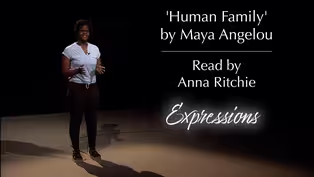
Clip: S15 Ep4 | 2m 14s | Anna Ritchie reads the Maya Angelou poem 'Human Family' (2m 14s)
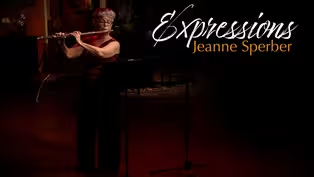
Expressions: Jeanne Sperber Preview
Preview: S15 Ep4 | 30s | Preview of Jeanne Sperber's Expressions Episode (30s)
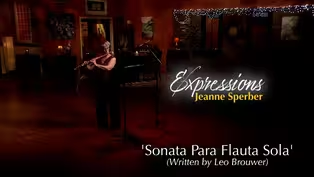
Jeanne Sperber | Sonata Para Flauta Sola
Clip: S15 Ep4 | 7m 27s | Jeanne Sperber performs Leo Brouwer's 'Sonata Para Flauta Sola' (7m 27s)
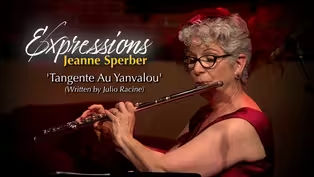
Jeanne Sperber | Tangente Au Yanvalou
Clip: S15 Ep4 | 5m 44s | Jeanne Sperber performs Julio Racine's 'Tangente Au Yanvalou' (5m 44s)
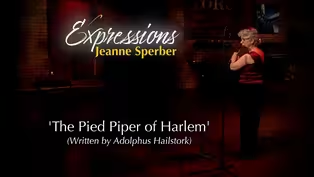
Jeanne Sperber | The Pied Piper of Harlem
Clip: S15 Ep4 | 5m 36s | Jeanne Sperber performs The Pied Piper of Harlem (5m 36s)
Providing Support for PBS.org
Learn Moreabout PBS online sponsorship

- Arts and Music
The Best of the Joy of Painting with Bob Ross
A pop icon, Bob Ross offers soothing words of wisdom as he paints captivating landscapes.













Support for PBS provided by:
Expressions is a local public television program presented by WSKG