State of Affairs with Steve Adubato
Jeff Jarvis; Phil Alagia & Mike DuHaime; Trish O’Keefe
Season 5 Episode 11 | 27m 19sVideo has Closed Captions
Jeff Jarvis; Phil Alagia & Mike DuHaime; Trish O’Keefe
Jeff Jarvis talks about the role of the media in politics and social movements during the pandemic and the next generation of the internet; Phil Alagia and Mike DuHaime discuss President Biden’s leadership during the COVID vaccine rollout and Gov. Murphy’s leadership during the crisis; Trish O’Keefe shares the impact of COVID on nursing and the importance of being educated on the COVID vaccine.
Problems playing video? | Closed Captioning Feedback
Problems playing video? | Closed Captioning Feedback
State of Affairs with Steve Adubato is a local public television program presented by NJ PBS
State of Affairs with Steve Adubato
Jeff Jarvis; Phil Alagia & Mike DuHaime; Trish O’Keefe
Season 5 Episode 11 | 27m 19sVideo has Closed Captions
Jeff Jarvis talks about the role of the media in politics and social movements during the pandemic and the next generation of the internet; Phil Alagia and Mike DuHaime discuss President Biden’s leadership during the COVID vaccine rollout and Gov. Murphy’s leadership during the crisis; Trish O’Keefe shares the impact of COVID on nursing and the importance of being educated on the COVID vaccine.
Problems playing video? | Closed Captioning Feedback
How to Watch State of Affairs with Steve Adubato
State of Affairs with Steve Adubato is available to stream on pbs.org and the free PBS App, available on iPhone, Apple TV, Android TV, Android smartphones, Amazon Fire TV, Amazon Fire Tablet, Roku, Samsung Smart TV, and Vizio.
Providing Support for PBS.org
Learn Moreabout PBS online sponsorship- [Narrator] Funding for this edition of State of Affairs with Steve Adubato has been provided by TD Bank.
Johnson & Johnson.
Summit Health a provider of primary, specialty, and urgent care.
NJM Insurance Group.
Serving New Jersey'’s drivers, homeowners and business owners for more than 100 years.
New Jersey Sharing Network.
Horizon Blue Cross Blue Shield of New Jersey.
Here when you need us most, now and always.
The New Jersey Education Association.
United Airlines.
And by Operating Engineers, local 825.
Promotional support provided by The New Jersey Business & Industry Association.
And by New Jersey Monthly, the magazine of the Garden State.
Available at newsstands.
[INSPRATIONAL MUSIC] - Hi, I'm Steve Adubato.
And I don't wanna waste any time because we've been wanting this gentlemen on with us for a long time.
And we have him.
He is Jeff Jarvis journalist, author, professor at the Newmark Graduate School of Journalism at CUNY City University of New York.
Also has a media blog BuzzMachine.com and the author of this book.
I love this book.
He's got many books, but this one Public Parts, How Sharing in the Digital Age Improves the Way We Live and Work.
Hey, what year was this published Jeff?
- Oh, it's been a while.
Probably about six years.
- Okay, so here's the setup question.
Six years after the digital age, does it improve in your view the way we live and work together particularly a year plus into this pandemic?
- Yes, I think it does.
That's a minority opinion.
I know 'cause these days only dystopia and moral panic tend to sell about the internet.
But I think very importantly, Steve, to look at the last year, not in the last four years of Trump the internet had the opportunity to answer him.
Yes, he used it for his ill, but we got to use it as well.
But far more important than that I think with the movements of Me Too and Black Lives Matter.
Mass media, the media that I've worked in my whole career run by people who look like me and you all white men.
I'm older than you.
Did not give proper representation to all kinds of communities.
And social media did.
The hashtag is a platform.
Black Lives Matter.
I hope leads finally to a racial reformation in America and that's made possible because the internet gave people a way to speak that media didn't.
And these days we hear media trying to dismiss the internet and everyone on it.
And I think that would be a dire mistake.
- Follow up on this on the media.
Friend of mine the other day said, "You guys on PBS.
You lean to the left, right?"
I said, I'm sorry what?
"Well, whose side are you on?
Are you with Biden?
Are you you're against Trump?"
I said, no, no.
We actually try to talk about what's going on and make sense of things.
No, no, seriously who's side are you on?
Here's the question?
Have we gotten to the point where the vast majority of Americans simply consume Jeff Jarvis what they want to consumer need to consume in their minds via the media that simply reinforces what they think they already believe verses we don't have a horse in this race.
We just want to talk about what's going on and try to make sense of it.
Or am I being too idealistic, Jeff?
- That belief in echo chambers and filter bubbles I think was the common belief around the net.
But this last year I read a book by an Australian researcher named Axel Bruns.
The book's title is the question, Are Filter Bubbles Real?
And his answer is no.
He pulled together tons of research out there that says that people don't just make, befriend the people who agree with them, they don't just listen to one side.
They are aware of other sides.
Do we have a problem in internet discourse?
Yes, we do, but I think that's early days, Steve.
I think that in a sense I'm working on the book about the end of the Gutenberg age and what I've learned I think is the early days of media were conversational.
And somewhere along the line with mass media we lost that ability.
We are a society relearning how to hold a conversation with ourselves.
- Hmm, so may I ask you.
Trust, distrust of quote mainstream media, President Trump, Enemy of the People Jim Acosta's book of the same title, fake news, all of that.
What impact do you believe Jeff has it had on people's ability to trust us?
- I think it's a malign influence but there's more than just that.
Trust in American journalism started falling in the 70s.
I've never fully understood why it could be because papers became monopolies in a lot of towns by then.
It could be because the news destroyed Richard Nixon.
I don't know why it is, but it started falling then.
And there's other factors today.
I think that there are malign actors within the media.
People say often, "Well, I don't like the media", but they do like one outlet or another.
They like you, Steve Adubato and they trust what you have to say, but they the same breath could say they dislike the media.
I dislike what Fox News has done to American democracy.
I dislike what Rupert Murdoch has done to it.
That's my view of the media.
And actually I think that in all honesty the majority of media do have a liberal worldview.
And in fact, what that results in is, Gallup had a survey about two years ago that said that the single most trusted outlet news was Fox News.
That's because there's one of them and then all the rest of liberal media.
So I actually believe we need more conservative media to compete with Fox to change the balance of the ecosystem.
- But Jeff, respectfully, because I have so much respect for you.
People say that as a cliche, but in your case, it's true but don't we need more and I'm not going to turn this into a commercial for public broadcasting.
You say, we need more conservative media.
There's America One News, whatever the heck it's called there's Newsmax, don't we need more public broadcasting or broadcasting that does not have an agenda that does not have a horse in the race that does not have a point of view but it's breaking things down and having other voices heard.
Isn't that what we need more of?
- I think media with a public agenda.
Yes, that's true.
But I also think that one thing we've lost in media is a certain transparency, is a certain honesty, right?
The New York times is basically liberal in its viewpoint.
The fact that it wouldn't say that means that a lot of people would not trust it.
If I can't trust you to say that then what else can I trust you with?
So I think that transparency is the new objectivity as a friend of mine once said and that we've got to be honest about our own worldviews our own perspectives and our own lived experience.
And then we have to value other lived experiences.
There's an author named Louis Raven Wallace who wrote a book as a transgender journalist who was fired from NPR because he wouldn't hold up to NPRs standards of objectivity, Wesley Lowery former Washington post journalist wrote a great op-ed in the New York times, a few months ago, who said that objectivity is fundamentally a racist construct.
Because again, it's people who look like us who get to decide what is objective and what is biased.
So I think we've got to value other people's lived experiences and perspectives more and recognize that we all come to the news with different perspectives.
Then we can try to find where we have common ground.
I re-read recently Steve, Hannah Arendt's Origins of Totalitarianism.
And there was one particular piece in there that really instructed me where she said that people under a totalitarianism give up their everyday concerns for abstract notions.
That's what I think we see happening in politics today.
I don't believe that the second amendment and guns and abortion or cancel culture is the most important thing in people's lives.
I think the most important people, things in people's lives is the same for you and me.
It's about our family and their welfare.
And if we can have media talk about those real concerns and people's lives, then I think we can start to see change.
But political coverage is too often an agenda set around abstract notions.
- Before I let you go.
Are you optimistic or hopeful about the quote next generation of media in our country?
- Very, I teach at the City University of New York at the Craig Newmark Graduate School of Journalism to get that plug in.
I created a new degree in social journalism there with my colleague, Carrie Brown.
These are journalists who, when they come in we tell them, all right, learn what we teach you.
And then question everything we teach you.
And they do that.
Oh, they do that.
And they come up with really creative new ways to imagine serving the public through journalism.
They are the ones who make me very optimistic.
- Jeff Jarvis, when you're optimistic, it gives reason for the rest of us to be optimistic as well.
Jeff Jarvis journalist, author, professor at Newmark Graduate School of Journalism at City University of New York, Jeff, all the best.
Thank you so much for being a role model for all of us who try to do the best we can in media.
Thanks, Jeff.
- Thank you for the conversation.
- You got it, I'm Steve Adubato we'll be right back.
(grand music) - [Announcer] To watch more State of Affairs with Steve Adubato, find us online and follow us on social media.
- Folks, they say you can't bring Democrats and Republicans together and have civil discourse.
Well, we're gonna disprove that right now.
Joined by Phil Alagia who's a Democratic Strategist.
Yes, he admits it.
And also, he's the Chief of Staff in Essex County to the Essex County Executive.
Checkout our interview with Joe DiVincenzo, the Essex County Executive And Mike DuHaime our longtime friend and Republican Strategist and Partner at Mercury.
Good to see you, gentlemen.
- Good to see you Steve.
- Good to see you guys.
- A civil and spirited discourse.
Phil, let's start with this.
How would you rate President Biden's rollout of the vaccine to date, at the end of March?
This will be seen later, how's it going?
- I think it's going great.
I mean, he's hit his goals.
We're well over a million vaccines a day.
Everyone's telling me, every week we're getting more and more vaccines produced.
More and more Americans are getting vaccinated.
We're well on our way to herd immunity at over 70%.
He got in just in time to fix the mess that was there behind him.
- And by the way, let me just say that I was in fact vaccinated with Moderna vaccine first and second, along with my mom, in Essex County.
And you could see that interview with Joe D and we talked about the importance of having an organized roll out.
Let me ask you, Mike.
How much do you think President Biden has changed the course of not just the approach of the country or the attitudes of the country about COVID but also on the vaccine acceptance end?
- Well, I think he's certainly helped in terms of the leadership he's provided and the encouragement he gives.
But I think President Trump and I've been one who's unafraid to speak the truth, when I disagreed with President Trump, which has been often, but I think it actually clouds, all the chaos that he has caused around himself and certainly everything around the Capitol Riot and then so much other stuff has actually clouded what probably was his greatest accomplishment which was Operation Warp Speed.
To make sure that the the pharmaceutical companies had the backstop that they needed to throw everything into R & D and actually bring a vaccine out in what is an incredible speed.
I mean it's a medical marvel that the vaccines have come out so fast and they're being produced and distributed.
And they're great New Jersey companies like J & J and Merck who are a big part of this.
But you know, when President Trump was saying that we were going to have a vaccine by December most people didn't believe him because it was hard to believe a lot of the stuff he said it actually was one of his great accomplishments.
And I don't know if people will reflect on him differently in history because of it.
But I think the Biden Administration is doing a good job taking it from there but they wouldn't be able to do anything if the vaccines hadn't been produced.
And quite frankly President Trump deserves some credit for that.
- But Phil, I want to follow up on that recent poll.
I think the Pew Poll showed that over 50% of Republican men say, "No, not taking it.
"I don't care."
And I don't care what anyone says.
That's a problem.
Phil, what needs to be done to communicate to those, not just in the Republican Party, but in the African-American community as well who are resistant to the vaccine.
Based on the science, because it's not political.
It's not based on who you voted for in 2020 it's based on the science.
Phil, go ahead.
- First of all, I agree with Mike.
It's an amazing, I thought about this the other day.
It's an amazing accomplishment that we now have three vaccines that are almost 95 to 100 percent effective in preventing death.
And we got it so quick.
And the Trump administration in the last six months should be commended for it.
But I do think the problem Mike and Steve is that this whole vaccine, the whole COVID issue became political, right?
Mask wearing, if you were Republican, you didn't wear a mask or you shouldn't wear a mask.
If you're a Democrat, you know, Trump almost made it seem weak, that if you wore a mask, you were weak.
And I think that all that rhetoric has caused this vaccine.
People who feel "I'm a Trump loyalist" or "I'm a Trumper".
I should not get the vaccine because I need to stand up tall.
We need to remind - But Trump got the vaccine, Phil.
- Yeah, absolutely.
We need to stand tall.
We need Trump and we need all Republicans.
We need the governors in Republican counties.
We need former presidents, everyone.
We need, in the African-American community.
It's one thing to hear it from an elected official or a politician to say, "Go out and get vaccinated."
But they need to hear from their pastors, their community leaders, the people that they work with.
I think everyone needs to move forward.
It's a personal choice and people should make that choice not based on fear or worry.
Some people may choose not to take it but it certainly shouldn't be a political decision.
Not whether or not you take the vaccine.
- Mike, your word to your friends in the Republican Party about the vaccine, because herd immunity does not happen without all of us being a part of this.
But again, I respect people's right to make a decision but what is it based on is another question.
Go ahead, Mike.
- Yeah, I would say go get it.
I'm going to get vaccinated as soon as I can.
And then I encourage everyone else to do so.
And I'm encouraging, you know, family and friends to do it as soon as they possibly can.
I think it's the right thing to do.
President George W. Bush has come out with President Obama to say, get vaccinated.
Governor Christie obviously has talked about his battle with COVID hopefully as an encouragement to try to encourage people to get vaccinated.
So I'm a hundred percent for it.
Obviously, if there are reasons not to get vaccinated, that should be made in consultation with your doctor based on any medical issues that you may have, not based on what you heard from President Trump.
I agree with Phil about mask wearing.
Not only was it from a healthcare point of view, silly.
It was politically stupid to make a mask wearing some sort of political litmus test, - It's not.
- because I think it hurt him politically because ultimately it hurt the country from a healthcare point of view.
And that ultimately was used against the president when he ran.
- Mike let's bring it closer to home.
Phil, I want you in on this as well.
Your assessment, Mike DuHaime of Governor, by the way, check out Mike.
He joined us on our sister program "Lessons in Leadership" for a conversation about crisis communication leadership.
Mike assess Governor Murphy's leadership in the last year plus on COVID.
- I think right now- - What has he done well.
What hasn't he done well?
- I think for the most part, I think he's he's done well in terms of making difficult decisions and explaining them and having access to the public.
I think a couple of things.
His re-election in my opinion, will rise and fall based on his COVID response.
People, like the three of us, we pay attention to every little thing that goes on in Trenton.
Most people are not.
This is the one thing that people are judging him on.
So I think right now, in the spring, people are grading him very well.
His numbers are good.
For the most part, people think positively.
But they're gonna be voting in the fall.
And I think the ultimate decision will be made where there are frustrations or whether or not kids are back in school.
We have school districts that have been out now for a year and I think that's unacceptable to many parents.
And I think they expect even though the decisions are made locally, because there's a big population density difference between Cumberland County and Hudson County.
But I think they want the Governor to use the bully pulpit to get more kids back in school.
And certainly Jack Ciattarelli is gonna talk about nursing homes as well.
And certainly, obviously the death rate was very high unfortunately in New Jersey when this first came out and that was a part of it.
So I think for the most part, the Governor is seen as having done well, but in the fall, the unemployment rate and whether or not kids are back at school are gonna be the two determining factors.
- By the way Mike DuHaime mentions Jack Ciattarelli, the likely Republican candidate for the governorship, we will have him on as well.
Phil Governor Murphy done well, where?
Where fallen short on COVID?
- When you look at the where we are in the country with vaccines, the percent of our population getting vaccinated.
We are in the top part of the country.
We are in that dark green area.
If you look at the maps, which means right now, when I last checked, we're at 27% of our population is vaccinated, which is the top 10% in the country.
We're doing much better than New York and Pennsylvania and Delaware our bordering States.
So that's something that I think the governor is gonna really take credit for, as he should.
For getting the vaccines and working with all the localities to get it out and distributed.
And I know in Essex County, we want even more vaccines because we want to vaccinate our public.
So I think you're absolutely right now, Mike.
Right now he's an overwhelming favorite to win re-election, not only for his COVID response, but for the great job he's done in the last four years, we're coming, we are a Democratic, we are a blue state.
He is an incumbent and he's done actually a very good job with our COVID response.
From a food distribution, to finances, to right now the vaccine rollout.
I do think you need a significant reason to not re-elect an incumbent.
And there's nothing that I could see that would prevent him from getting re-elected in November.
- Mike, gimme 10 seconds or less on Governor Murphy and small business in the State with COVID.
- I think there's a lot of frustration right now.
And as I said, the unemployment rate is still high.
The last time a Democrat didn't get elected which I was involved in, the unemployment rate was very high.
Ultimately that's what most of the people.
So, if small businesses don't come back I do think it could be a problem for the governor.
- Phil, you get the last word - Listen, I'm on the NJEDA under Governor Murphy's leadership, we've implemented a lot of new programs.
I think the whole country is having issues because of COVID, but New Jersey's leading the way under his leadership.
And once we get COVID under control, small businesses and the business community and unemployment will be taken care of.
- By the way Phil makes mention of the New Jersey Economic Development Authority, check out our interview with Tim Sullivan recently on this.
Phil, Mike, thanks so much for joining us.
I'm Steve Adubato, stay with us.
We'll be right back.
(grand music) - [Announcer] To watch more State of Affairs with Steve Adubato, find us online and follow us on social media.
- We're pleased to be joined by Trish O'Keefe, who is President of Morristown Medical Center and Vice-President and Chief Nursing Executive at Atlantic Health System.
Good to see you, Trish.
- Good to see you, Steve.
- I wanna make it clear, you have, in fact, a very deep nursing background and history.
Talk about that.
- Sure, I came to Morristown Medical Center as a graduate nurse out of Wilkes, advanced my career going back to Seton Hall for my Nursing Administration, and then followed suit at Seton Hall for my Ph.D.
So, very proud of my nursing background.
- Let me ask you, and by the way, Atlantic Health is one of the healthcare organizations that are supportive of what we do as underwriters in the area of public health issues.
Trish, let me ask you, as a nurse who's seen it from every perspective, I'm curious about this, what impact do you believe COVID has had where 12, 13, 14 months, this is to be seen after that, into this pandemic, what impact has this had on nursing, nurses and nursing?
- Yeah, a great deal of impact on nursing, it truly has shown the resilience of our profession, focusing on the patient, the family, it was always a can-do attitude from every nurse.
Our seasoned nurses, our young nurses, they just came out of school, and it was always, we will do that job, we will care for that patient.
It was always such a positive response, so again, very proud of the profession and how they responded to this pandemic.
- Are you confident that there will more people, qualified top-level caring people going into the profession of nursing or fewer?
- I think more.
I think how we have seen the evolution from a healthcare perspective, they want to give back to their community, and by giving back is working in a healthcare profession, whether they're nurses, allied health, going back to be physician as well, too.
So, we've seen a real outpouring of how can I go back to school, how can I help our healthcare in general, so yes, I think a positive note.
- When it comes to, and we're doing a lot of programming around vaccine awareness, distribution, rollout, etc., I don't know what the exact number are, but I know that between 90 and 95% of physicians have taken the vaccine or are willing to take the vaccine.
Is the number lower than that for nurses?
- The number's evolving right now.
We have seen safer in Atlantic Health's perspective.
We are in the mid-60s and higher, we are continuing to educate our young staff in regards to the benefit of the vaccine.
As you know, we have a vulnerable population as well, and a child-rearing population as well, too, that are asking a lot of questions of OB and GYN - - Good questions, legitimate questions.
I'm sorry for interrupting, Trish.
These are important questions.
- Sure, sure, very important questions.
So, you know, it has been our focus since the beginning of the vaccinations evolving to educate all of our population of the benefits.
We know vaccines save lives, we know that.
So, how do we educate people in understanding how it may impact them positively and really educating them on the benefits of the vaccine and what their concerns are.
You know, we do have very vulnerable populations out there in our communities, so we are reaching out to educate.
- You know, by the way, if people wanna find out what's going on every day in New Jersey in terms of the vaccine distribution and where we are and where we're not, check out NJ Spotlight News and also, on the New York side, well, both shows are in the region, tri-state region is Metro Focus.
But I wanna follow up on something.
When it comes to public health, you've been involved in public health for a long time, what do you believe, Trish, the long-term impact and the implications will be for public health based on what we've experienced with COVID to date.
How will it change?
- You know, I think people will be advancing the benefits of public health from an education, early detection, early treatment, prevention.
We've been, as a society, focused on acute care, but we need to be focusing on the prevention and early detection efforts, getting to your primary care as quickly as you possibly can, the routine checkups that are needed.
So, I'm pleased to see an advancement in many of those areas, as well as the technology.
You know, we've seen such advancement, eVisits, you know, telehealth, has expanded a great deal during this pandemic and very positively.
So, we're reaching people we never reached before.
- Trish, do you believe, you mentioned, you actually jumped ahead of where I wanna go, which is really good.
Do you believe that telehealth will expand over time, and if so, where does it, quote, work and is effective, and where should people see their physician or their healthcare professional directly and personally, face-to-face?
- Yeah, no, definitely.
Clearly from the primary care standpoint, telehealth has worked a great deal, and even looking at different technology, from tracking patients' blood pressures, tracking weight, compliance efforts and telehealth's base has been very positive.
But if things start evolving or more acutely ill, it is good to have that face-to-face in that meeting, whether it's in the physician office in the emergency department if more acutely ill to see that physician and that team.
- Before I let you go, more and more nursing professionals becoming leaders, CEOs, presidents of hospitals, correct?
- Yes.
- And it's good that trends gonna continue, isn't it?
- Yes, it is, yes it is, Steve, and glad to - - And it's a good thing.
- And that's a great thing, and that's a great thing.
Yeah, that's a great thing.
- Yeah, Trish O'Keefe has a Ph.D. in the exact field.
Trish, it is what?
- It's in Nursing Research, Nursing Administration.
- Also an RN President of Morristown Medical Center and Vice-President of Nurse, and Chief Nurse Executive, I'll get that right, at Atlantic Health.
I wanna thank you so much for joining us.
Trish, all the best.
- Thank you, Steve, very much.
- And, by the way, thank you for what you and your colleagues in the healthcare world are doing every day on the front lines.
I'm Steve Adubato, that is Trish O'Keefe.
Thanks for joining us, we'll see you next time.
- [Narrator] State of Affairs with Steve Adubato Is a production of the Caucus Educational Corporation.
Funding has been provided by TD Bank.
Johnson & Johnson.
Summit Health NJM Insurance Group.
New Jersey Sharing Network.
Horizon Blue Cross Blue Shield of New Jersey.
The New Jersey Education Association.
United Airlines.
And by Operating Engineers, local 825.
Promotional support provided by The New Jersey Business & Industry Association.
And by New Jersey Monthly.
(gentle upbeat music) - [Miles] I'm Miles and this is what I work for, to be my best for them and for me, in body and in mind.
I need a health insurer that helps me get the care I need for both, that has mental health professionals that I can talk to when I need to.
Because when I feel strong and secure, so do they.
This is my life.
And this is how Horizon Blue Cross Blue Shield of New Jersey works for me.
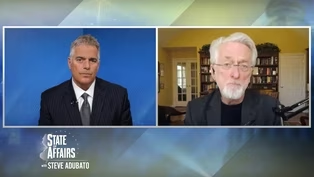
Media's Role in Politics & Social Movements During COVID-19
Video has Closed Captions
Clip: S5 Ep11 | 9m 20s | Media's Role in Politics & Social Movements During COVID-19 (9m 20s)
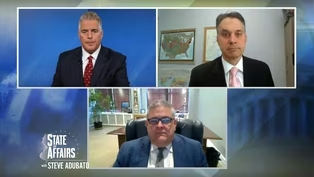
The Need to Separate the COVID Vaccine from Politics
Video has Closed Captions
Clip: S5 Ep11 | 10m 46s | The Need to Separate the COVID Vaccine from Politics (10m 46s)
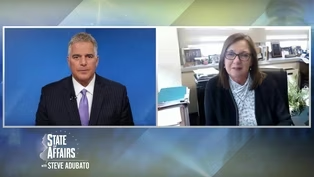
The Ongoing Impact of COVID-19 on Nursing
Video has Closed Captions
Clip: S5 Ep11 | 8m 3s | The Ongoing Impact of COVID-19 on Nursing (8m 3s)
Providing Support for PBS.org
Learn Moreabout PBS online sponsorship
- News and Public Affairs

Top journalists deliver compelling original analysis of the hour's headlines.

- News and Public Affairs

FRONTLINE is investigative journalism that questions, explains and changes our world.












Support for PBS provided by:
State of Affairs with Steve Adubato is a local public television program presented by NJ PBS