
Jeffrey Goldberg
Season 13 Episode 16 | 26m 46sVideo has Closed Captions
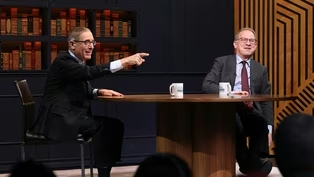
Jeffrey Goldberg, editor in chief of The Atlantic, discusses their reporting on US politics.
Jeffrey Goldberg, editor in chief of The Atlantic and moderator of "Washington Week With The Atlantic" on PBS discusses the publication's reporting on US politics.
Problems playing video? | Closed Captioning Feedback
Problems playing video? | Closed Captioning Feedback
Overheard with Evan Smith is a local public television program presented by Austin PBS
Support for Overheard with Evan Smith is provided by: HillCo Partners, Claire & Carl Stuart, Christine & Philip Dial, Eller Group, Diane Land & Steve Adler, and Karey & Chris...
Jeffrey Goldberg
Season 13 Episode 16 | 26m 46sVideo has Closed Captions
Jeffrey Goldberg, editor in chief of The Atlantic and moderator of "Washington Week With The Atlantic" on PBS discusses the publication's reporting on US politics.
Problems playing video? | Closed Captioning Feedback
Where to Watch Overheard with Evan Smith
Overheard with Evan Smith is available to stream on pbs.org and the PBS app.
Buy Now
Providing Support for PBS.org
Learn Moreabout PBS online sponsorship- [Narrator] Funding for "Overheard with Evan Smith" comes from HillCo Partners, a Texas government affairs consultancy.
Claire and Carl Stuart.
Christine and Philip Dial.
Eller Group, specializing in crisis management, litigation, and public affairs communication, ellergroup.com.
Diane Land and Steve Adler.
And Karey and Chris Oddo.
- I'm Evan Smith.
He's the Editor in Chief of "The Atlantic" and the host of "Washington Week with The Atlantic" on PBS.
He's Jeffrey Goldberg, this is "Overheard".
(audience clap and cheer) The platform and a voice is a powerful thing.
You really turned the conversation around about what leadership should be about.
Are we blowing this?
Are we doing the thing we shouldn't be doing by giving into the attention junkie?
As an industry, we have an obligation to hold ourselves to the same standards that we hold everybody else.
This is "Overheard".
(audience clap) Jeffrey Goldberg, welcome.
- Thank you.
- Good to have you here, Jeff, boss, my boss out in the world.
- You know, we're just colleagues.
- Yeah, you're my boss.
- We're all just- - And- - We're all just friends here.
- And because you're my boss, I don't know if the first question should be, why are you so awesome or why am I so awesome, actually.
- Right.
- Right?
- If you want, we could just do your performance review right now.
- Right here.
(Jeff and audience laugh) Oh, oh, nervous.
- Yeah.
- I think I'll shift the conversation- - Yeah.
- Away from us.
- We get all your subordinates in- - Right.
- And they could talk honestly about you.
It'd be really exciting for everybody here.
- So why is "The Atlantic" so awesome?
That's actually the question I want to ask you.
I mean, seriously, this is at a time when the magazine business, the magazine business is in trouble, the media business is in trouble.
No one's making money, no one's hiring, no one's having an impact.
All the indicators for this magazine that we both work at is heading in the opposite direction, why?
- I don't know.
I mean, I tend to not like the media business frame because, you know, you have car companies that are doing well and car companies that are doing badly.
- Right.
- You know, if Toyota is doing badly, you don't say that... You don't assume that everything else is doing badly.
We have different companies, we do different things.
- Yep.
- In very different ways, and it's sort of hard to lump them all together.
I think there's a lot of companies, a lot of publications and operations that are doing fairly well.
There are a lot that are in trouble and they get a lot of attention.
- Right.
- For their trouble.
They all suffer from the same thing, if you ask me, which I guess you are.
- I'm asking you.
- I guess you are.
- What is the thing?
- Well, after a break, we'll come back and I'll give you the answer.
No, no, no, no.
- I love a cliffhanger.
- You know, someone said, someone smart, it might have been you, I don't think it was in this case.
- Yeah.
- But someone smart said that the difficult thing for journalism operations is not to stay in business.
The difficult thing for journalism operations is to stay in journalism.
Meaning you gotta adhere to... You gotta follow a North Star.
- Yep.
- You've gotta remember that you're not a business, you're a mission.
You gotta remember that you're not the boss or the owner, that you're the steward.
You've gotta remember that quality is everything that people will only pay or donate or whatever model you have if they feel like they're getting a high quality product.
- Right.
- Right?
And so those rules are simple, they're just hard to do, and I think those people who follow those rules do well.
I think there's a large number of people in America who still want literate news and analysis- - Yeah.
- And nonfiction writing.
And consumers are smart, they don't go to restaurants that serve bad food, and they don't read publications that aren't trying hard.
- Right.
- You know?
It's not that hard to figure out.
- So to that point about readers, let me just do a couple of data points on this, because the magnitude of this to me is quite remarkable even as I say it.
"The Atlantic" now is almost 1.5 million subscribers.
300,000- - At 1.49999.
- Almost, almost.
- It's seriously annoying.
- Very close.
- Yeah.
If like eight of you would just subscribe.
- Come on.
Exactly.
(audience laugh) We'll put up a QR code, right, exactly.
- I just... - Yeah.
- I'll buy them.
Just give me your address.
- Yeah, yeah.
- I can't stand it.
- What's interesting to me, and not surprising if you know the sequence of this is that more than 300,000 new subscribers in just the last year.
Thank you, Pete Hegseth, thank you, Mike Waltz.
- Yeah.
- Thank you, Houthi PC Small Group.
I mean, the SignalGate reporting was a big driver of subscriptions in the last year.
- Well, you know, I met with Donald Trump after that whole business.
- Yeah.
- And he said in various different ways, of course, this conversation and other conversations actually.
You know, he said, talks in the third person.
He said, "Donald Trump's pretty good for 'The Atlantic'."
And I said, "Not gonna argue, Donald Trump is pretty good for the-" - Right, in all ways.
- He also said that "The Atlantic" would be a hot magazine if it were nicer to Donald Trump.
And I said, "We are a hot magazine."
And he said, "You'd be hotter."
I said, "I can't argue with that."
Like, I don't, you know?
- He's so obsessed with hotness.
- Well, no, no, but he's obsessed with his metrics.
It's really fascinating.
- Yeah.
- It's all how much impact does he have on the growth or shrinkage of something?
- Right.
- Right?
And it's all about his role.
- Ratings.
- He's a ratings guy.
I mean, he just care... I mean, this is the most interesting thing.
In one of our... In this big conversation we had in the Oval Office, I mentioned the fact that he had just intervened in the Canadian election on behalf of the conservative who then sunk in the polls.
And he was like, "That's amazing, right?
All I did was say something and the guy becomes unpopular.
That was amazing."
And I was like, "You don't consider that good," right?
- He's bragging about it.
- He says, "What an impact."
I mean, it didn't matter, it was really- - Negative impact is still impact.
- It was really interesting, he just had to prove- - Right.
- His existence in a kind of way.
He was more... The fact that "The Atlantic" got a lot of subscribers out of SignalGate, which was an embarrassing moment for his administration, didn't matter that it was embarrassing, it just was interesting to him and competitive.
- He liked it.
- Yeah.
- Amazing.
- He's the only one in the White House who liked it.
- So nearly 1.5 billion subscribers.
Second thing is that in the last year, you have added 50 journalists to the newsroom.
- Probably more, but yeah.
- Right?
You added a third more journalists than you had previously at a time when everybody else's publication or most people's publications are actually flat or shrinking.
And then the third thing is, this magazine is profitable, revenue is up year over year, again, not alone in the business, but this is rare.
I mean, to me- - It's pretty rare.
- These are pretty good indicators of something that's working.
(hand knocks) Right, knock on wood.
You as the editor in chief, surely have a philosophy of this magazine's success or what it is that you're trying to accomplish, that you're working toward as a goal.
What is that?
- Do you mean on a business level or like a- - From a journal- - Spiritual level?
- Well, more of a spiritual level, because journalistically you think about what you're doing in terms of the things you want to accomplish.
- Yeah.
- So what is it?
- Well, I mean, it starts on... I mean, it grows from the idea that I want to be... I wanna run the greatest collection of nonfiction writers in the English language.
I want to be that talent magnet.
Talent is everything.
- Yeah.
- And if you treat the talent well, the talent will treat you well, and people come for the talent.
This is our hedge against AI for one thing, you know?
- Right.
- You know, intelligent people don't want... They're like, "Oh, I can't wait to read what Claude has to say.
And I'll never read what OpenAI has to say about that."
- Right.
- They want writers they know.
And they want writers who are proven over time to be interesting, beautiful writers, smart, analytically acute, you know?
- Right.
- So the first thing is the talent, and being a talent hub is exciting because I get to be around interesting people like you all day long, as opposed to other people I don't want to be around all day long.
Like on a mission level, I mean, there's many ways to slice this.
I don't wanna like be verbose here, but I would say on a mission level, given what's going on in the last three years, technologically.
- Yeah.
- I've said to our staff, I said, "'The Atlantic' is a magazine by humans, about humans, made by humans, for humans," right?
And that's gonna be our differentiator.
That's the only thing I want to be anyway.
- Yeah.
- It doesn't mean you don't use available technologies to enhance the work you do and to make it move through the world at a quicker pace.
But I want to be a human magazine.
We're founded by among others, Ralph Waldo Emerson, and Melville, and Longfellow, and Harriet Beecher Stowe.
I don't know what Ralph Waldo Emerson would say about AI.
I have a feeling he wouldn't be that excited.
- Psyched about it, right.
- About the negatives.
- Yeah.
- Right?
And so I want to adhere to the spirit of the founders.
I have a very strong belief that a publication, a journalism operation, or really any business for that matter, if you stray too far from your DNA, you'll die, because you're supposed to be a thing.
This is what happened to a lot of magazines.
- Yep.
- It's like, because they ran outta money or decided they were running outta money or wouldn't invest, they try to cheap gimmickry and you stray from what your purpose was, your founding purpose was.
If you do that, you're gonna... It doesn't mean you grow, you don't grow and change, but you gotta be honest.
We don't live in a very honest age, but you have to try to be honest to the principles that have carried it through the generations - Well, consumers of your product, they know it.
They see it when you change like that.
- We can't fool them.
- We can't fool them.
- We can't put lousy journalism- - Yeah.
- In front of them - Because they'll know it.
- And 'cause then, you know, to borrow a more marketing kind of expression, you deplete the brand.
And it's- - Right.
- As important, as great as it is to have hits.
- Yeah.
- You could do more damage over time by just depleting the brand by doing things that people think are false and cheap.
- Good, well, that's good.
- And that's why- - I mean, that's good to hear you say it, I agree with it.
- Well.
- I wish everybody believed it.
- But everybody thinks that you can cut your way to success in our business, and... - You can't.
- No.
- So let me move from "The Atlantic" to "Washington Week", because, of course, here we are on PBS.
You have been editor in chief of "The Atlantic" since 2016, you've hosted "Washington Week" since 2023.
So we're now a couple years into this.
- [Jeff] Yeah.
- Why is this a good thing for the show?
Why is this a good thing for "The Atlantic" to have this association?
- Well, I don't know if this is a good thing for the show.
- Well?
(all laugh) We'll be the judge of that.
- I'm figuring out how to be on TV.
You're good at being on TV.
I mean, I've spent a lot of time on TV.
- Yeah.
- It's not like I hadn't been moderating anything, which is a completely different thing.
I was a panelist, regular panelist, on "Face the Nation" and "Meet the Press" for many years.
But, you know, at first, I was trying to sound like a TV guy.
- Yeah.
- And I can't 'cause I like... My mind goes, I don't know.
It goes all different directions.
- Everybody is Ron Burgundy when they try to do that, yeah.
- Yeah, and it's like, I mean, I felt like I was like a couple of, you know, minutes away from doing, "Next, sports, traffic and weather on the 8s," you know?
And I have that voice and I was like, "Well, who is that?"
And like I umm a lot, and I'm like, "Oh, wait, I had a thought."
And then as I got into it, I was like, "You know what, I just gotta be me."
(Jeff laughs) - [Evan] Yeah.
- I mean, 'cause I can't be someone else, and so like... But then what I realized was, and this is the value of the show right now, I think, and, you know, you're a notable exception to this.
But "Meet the Press", "Face the Nation", all these things that I used to do, they have lost confidence in themselves and in their audience.
And by that I mean that they no longer will have a 15-minute, 20-minute uninterrupted conversation with a bunch of smart journalists who are observing Washington- - Yeah.
- And the world.
It's a lot of buzzers, and beeps, and breaks, and cuts, and they're so worried about people's attention span that they're actually lowering attention spans, you know, by inadvertently.
- Right.
- I believe that there's a sizable audience in America for people who can sit through a 25-minute conversation.
The other thing that I'm not fond of in those shows these days is that they mix journalists with political consultants and ex-politicians, ex- and future politicians, which are especially dangerous.
- Yep.
- Because everything that they're saying, they're not refracting it through the question of, "Is this true?"
They're refracting it through the question of, "Does this make me politically viable next year if I say this?"
And so I don't want to be on a panel- - Right.
- With politicians and political consultants.
I just wanna be on a panel with journal... I'm not saying journalists are perfect.
- Right, but- - Far from it.
But I just think- - Yeah.
- You could, again, like the goal... I say this very, you know, with understanding my own imperfections, journalism's imperfections, everybody's imperfections.
The goal is to try to be honest in the way you deal with the world.
- Yeah.
- You know, and so the "Washington Week", the value added of that is like, I got four people who are covering the White House all week.
Come on, sit around a table.
- Yeah.
- We're not gonna interrupt them.
I mean, I'm gonna interrupt them because I can't help myself.
But we're not gonna like... We don't have commercial breaks 'cause it's PBS.
We're just gonna talk.
- Right.
- In whole paragraphs for a little while and maybe somebody in the audience will go, "Oh, I didn't think of that until I heard that show."
And then when I hear somebody say, "Oh, that was interesting.
I didn't realize before I heard Ashley Parker, or Steve Hayes, or Tom Nichols, or whoever say this thing.
I didn't realize that."
- That's achieving the goal.
- Our goal, your goal here.
- Yeah.
- Our goal on the show, our goal in the magazine, the goal of any quality journalism operation these days should be to put as much truth into the universe as possible.
- Yeah.
- Because there's so many forces now trying to put falsehood and misinformation into the world.
- Yeah.
- We're not winning that, but what we can do is we can actually try harder to push it into the world.
- Yeah, and that gets to actually the moment we're in.
The reason that "The Atlantic" and "Washington Week" for similar reasons are so important right now, is because what a moment we're in.
If things were boring, if things didn't need as much rebuttal, explanation context, they would still be important, but they're especially important now.
Can you believe this moment?
I mean, we've seen everything.
We're both old, right?
We've seen it all.
- I don't know what he's talking about.
- Come on, you were... (Evan and audience laugh) You look good though, but- - Thank you very much.
By the way, by the way, did you notice how excellent and smooth his transition was from one subject?
See, that's what I have to learn like, you know?
All I do on TV is go, "Wait, I had another question."
- Yeah, hang around the hoop a little more, I'll teach you my tricks.
- No, no, no, no, no.
It was a very smooth transition.
- So what about the moment we're in?
What do you think about this moment here and the state of the world, not just the state of the country?
- James Madison.
- [Evan] Yeah.
- Who's your guest next week, I think.
- Yeah.
(audience laugh) - James Madison.
- Yeah.
- Did not believe that America would survive the democratic experiment, would survive the rise of the daily newspaper because the introduction of new information every single day was too much for the American mind, for the human mind to absorb, analyze, cool down from, you know?
Like the constant, the constant communication was going to kill democracy.
It didn't kill democracy, but we're now 20 years into this vast unregulated experiment in cognitive overload, right?
And we're in this experiment where the filters are not around what is true, but what is popular, right?
In ordinary times, if we weren't in the social media/AI era, I would say that the tide comes in, the tide goes out, the tide comes back in again.
You have good presidents, bad presidents.
- Right.
- Mediocre presidents.
- Cycles of history.
- Everything cycles.
- Right.
- Right?
And so, like you say, okay, you had Obama and then Trump, and then Biden, and then Trump, and the next guy or a woman, doesn't seem likely these days, but, you know, woman or whoever it's gonna be, and you're like, "Okay, so things go up and things go down."
- Right.
- Things will go up.
I just don't know what's gonna happen next because of this experiment that we're doing.
And I think that we really need to, especially in this 250th year, we need to study why the founders were so skeptical of human nature, appropriately, in my mind, skeptical about the human ability to make cool, rational fact-based decisions in a collaborative way to keep a large, complicated country moving in the right direction.
We're not going in the right direction on any number of fronts related to that.
So everything that you're seeing- - Yeah.
- Is downstream.
Donald Trump would not be president if we hadn't spent 20 years experimenting with "reality TV" and social media.
- Yeah.
- It doesn't happen.
This idea that presidents should be exciting, that it should be a show- - And it should be about ratings.
- And it should be about ratings.
These are relatively new concept, and they're turbocharged now, and I- - Right.
- I don't know if our brains can- - Yeah.
- Can do this.
- I mean, obviously most obvious thing in the world, in fact, is the consequences of "The Apprentice" succeeding or failing are very different than the consequences of America succeeding or failing.
- Well, you remember famously, Barack Obama in 2011 at the White House Correspondents' dinner mocked Trump on that front, and then Trump decided he was gonna run and the rest is history.
- And the rest is history.
- So let's just- - Right.
- "Apprentice" is wildly entertaining, keep going.
You know, make, you know, make the show.
- Do that show.
- But you can't approach- - Don't do this show.
- You can't approach- - Right.
- War in the Middle East- - Yeah.
- With the same values that you approach "The Apprentice."
- When you travel around the country, certainly when I travel around the country, and you talk to people about the state of our democracy.
- Yeah.
- It's kinda like pat, pat, pat, aren't you adorable, you know?
I don't know that people in the middle of the country hear the conversation about the state of our democracy, guardrails, norms, institutions.
- We talk about things that normal people don't talk about.
- Normal people don't talk about that.
But is there an important conversation about how everything is so abnormal relative to what we were expecting, what we were used to, and the challenge of getting back to something like the undismantling of government is gonna be hard and take a long time whenever we're through this current period.
- I sometimes have a hard time getting my mind around how abnormal this is.
Some things are too big.
- Yeah.
- To understand.
You know, the cliche is, you know, at the beginning of an alien invasion movie, right?
You look like... Imagine that actually happened, you would be in a cognitive paralysis, like an under... A paralysis of understanding.
- Right.
- 'Cause the thing that's happening is too big to be believed.
I can't believe the things that happen today.
- On a daily basis.
- On a... Sometimes an hourly- - Multiple times a day, yeah.
- Sometimes on an hourly basis.
- Right.
- It did not... I have a lot of friends and acquaintances in Washington who spent, of both parties, - Yeah.
- Who spent their careers building and maintaining the systems that prevent corruption, that promote transparency and government decision-making and budgeting.
That hold people accountable for their actions.
And they're watching the dismantling of that being done so easily, in part because this administration does so much so quickly on it, it overwhelms the- - Right.
- The systems, and in part because one of the branches of government has ceased to function the part that's supposed to... - Be a check.
- Provide oversight.
- Be a check on all of these stuff.
- Of the executive.
Maybe that's gonna change, but none of those people, I mean, they actually become depressed over it.
- Yeah.
- Like, you know?
Imagine you worked for 30 years to make sure... Doing something unsexy, like making sure that bids on big government contracts were organized not according to who's your friend or how much you pay off someone, but based on that's a product that we should buy based on the merits.
And then the whole system gets thrown overboard like that and you feel like you're living in a banana republic.
- How can it be?
- How can it be?
- Right.
- How can people say the things that they say?
- Right.
But isn't it the part... I mean, it's not just that it's happening, but it's happening out in the open.
There's a- - That's the genius of it.
- There's a brazenness to it that is breathtaking.
- The genius of this is- - Right?
- The genius of this is if this were a different period, this would be a president saying, "You know, tomorrow I'm gonna break into the Democratic National Headquarters and I'm gonna break into Daniel Ellsberg psychiatrist's office and steal his medical records."
- Right.
- "Oh, you can't do that?
Oh, watch me."
- Watch me.
- And then people go like, "Oh, yeah, he just did it."
- Yeah.
- Yeah.
I mean, that's the genius... Look, okay, so this is going all the way back a distant 10 years ago.
- Yeah.
- But this is the moment for me that the moment when I stopped understanding politics or when at least I understood that new systems of technology and communication have changed the way we interact with each other.
It was the John McCain moment in 2015 when Donald Trump, a candidate for Republican nomination, insults John McCain's war record and says about POWs, "I like people who weren't captured."
I'm watching that as a patriotic American and I'm like, "Well, that's it for him."
- Right, that's the end of his campaign.
- I never could never imagine- - Right.
- That any politician would survive 24 hours into a race after having said that.
- Right.
- Not only did he survive, but he thrived.
And so I ceased to understand what was going on.
And I cannot tell you, in all honesty, that I've regained- - Yeah.
- My understanding.
I could describe- - Right.
- What I see, but I don't understand-- I don't understand the enthusiastic, almost lip smacking embrace of indecency.
You know what I mean?
It's like you spend your life teaching your children or modeling for your children.
"We don't talk that way."
Or, "You're gonna invite that kid to your birthday party even..." You know?
- Yeah.
- You're gonna do... We spend a lot of time trying to impart good values.
And then... By the way, this does infect the Democrats too.
I mean, you know, it's this dangerous cycle where they're gonna... You know, it's the old, well, if they're gonna go low, we'll go high and then people say, "Well, going high isn't working."
- Right, now, we have to go lower.
- But I just don't understand, and I'm not saying like I'm all that, I'm not.
I mean, believe me, I'm not, and I have resentments, and angers, and pettiness, and all the things that one... All the qualities or lack of qualities that human beings have, but I don't understand the rush to indecency, the joy, the joy that people feel- - Yep.
- In being sadistic and indecent toward not just fellow humans, but fellow Americans.
Because that's the most- - Yep.
- The most remarkable aspect of this presidency.
I say that advisedly because then you'll remind me of something more remarkable.
- Or something will happen in five minutes, right?
- Yeah, the most remarkable thing to me is that every president of, I shouldn't say both parties, but every party going back, you know?
- Yeah.
- There was always at least hypocritical lip service to the idea that when inauguration comes, when the president takes the oath of office, he's the president for all Americans, right?
Is that honored- - Right.
- As well as it should be?
Probably not, but there's always this idea that I'm your... I don't care if you voted for me, I'm now your president.
I'm gonna work on your behalf as an American.
And now, we have this enthusiastic embrace of the opposite notion, which is like, you didn't vote for me.
- Yeah.
- Screw you.
And so we've got a lot of things to restore.
And I don't know, again, going back to this technology problem, I don't know if in the maelstrom- - Yep.
- Of disinformation and meanness.
- Yeah.
- And sadism, I don't know how you restore it.
- I am afraid that we are out of time, because I would love to talk about this for six more hours.
- Did I talk too more?
Did I talk too much?
- You did not talk too much.
- Yeah.
- You'll come back, we'll do it again.
- Great.
- Okay, Jeffrey Goldberg, give him a big hand.
(audience clap and cheer) Thank you very much.
I loved it.
Visit our website at austinpbs.org/overheard to find invitations to interviews, Q&As with our audience and guests, and an archive of past episodes.
- It's kind of hard to kill a 250-year-old wildly successful experiment.
Like we have resilience, I mean, and, you know, the other point is it's like, people always ask me like, "Don't you get tired 10 years of whatever?"
And I was like, "No, like you have something to fight for, it's exciting."
- [Narrator] Funding for "Overheard with Evan Smith" comes from HillCo Partners, a Texas government affairs consultancy.
Claire and Carl Stuart.
Christine and Philip Dial.
Eller Group, specializing in crisis management, litigation, and public affairs communication, ellergroup.com.
Diane Land and Steve Adler.
And Karey and Chris Oddo.
(instrument playing)
Video has Closed Captions
Clip: S13 Ep16 | 15m 54s | Jeffrey Goldberg, editor in chief of The Atlantic, discusses their reporting on US politics. (15m 54s)
Providing Support for PBS.org
Learn Moreabout PBS online sponsorship New Episode
- News and Public Affairs

Top journalists deliver compelling original analysis of the hour's headlines.
 New Episode
- News and Public Affairs

FRONTLINE is investigative journalism that questions, explains and changes our world.

 New Episode
 New Episode
 New Episode
 New Episode
 New Episode
 New Episode


 New Episode
Support for PBS provided by:
Overheard with Evan Smith is a local public television program presented by Austin PBS
Support for Overheard with Evan Smith is provided by: HillCo Partners, Claire & Carl Stuart, Christine & Philip Dial, Eller Group, Diane Land & Steve Adler, and Karey & Chris...