
Jessica Care Moore
Clip: Season 11 Episode 8 | 7m 52sVideo has Closed Captions
Jessica Care Moore | Episode 1108/Segment 1
Jessica Care Moore "Obsidian Stone" Episode 1108/Segment 1
Problems playing video? | Closed Captioning Feedback
Problems playing video? | Closed Captioning Feedback
Detroit Performs is a local public television program presented by Detroit PBS
Jessica Care Moore
Clip: Season 11 Episode 8 | 7m 52sVideo has Closed Captions
Jessica Care Moore "Obsidian Stone" Episode 1108/Segment 1
Problems playing video? | Closed Captioning Feedback
Where to Watch Detroit Performs
Detroit Performs is available to stream on pbs.org and the PBS app.
Providing Support for PBS.org
Learn Moreabout PBS online sponsorship(air whooshing) - Black art is born out of struggle and a deep revolutionary love, is a balance of bullet holes and sunlight, is the fight to free Angela and Assata, black art is hand grenades and home girls personified, is anti-lynching movements, is a three quarter round an up close look inside culture, inside the hearts of a people, is unapologetic.
We are a coming together of movements and shared pains and black magic black theater never disconnected from the murdering of black bodies, the trials, the prisons, the voices, the freedoms.
Black theater is the fight for Paul Robeson's passport, the struggle against McCarthyism, the 50s busboy cots, MLK and Rosa Parks marches on Washington, the lives, the rallies, the fierceness of Malcolm's delivery, the Jackie Robinson story on Broadway, the audacity of Lena Horne, the undaunted Harry Belafonte, the swagger of Sidney Portier.
Black art and Cicely Tyson's refusal to take the role and destroying every line she decided to speak.
We storytellers, griots, we molded from obsidian stone, black and precious and honest.
We are the continuum, torch lighters full of promise, rooted in love and absolute proof that beautiful black life exists from the 40s, American Negro Theater and Negro playwrights company to the 1960's revolutionary voices who decided to abolish racial stereotypes and reach for our culture full of natural comedic pauses, a new Afro futuristic mythology that included black and beautiful in the same space from the baritone of Paul Robeson-Harlem Renaissance voice to Langston Hughes, National Broadway Nod in 1935, the training ground for black stories, necessity of black spaces coming to life through the Federal Theater Project.
We are the deep, rich color and visionary pin of Lorraine Hansberry's masterpiece a raisin in the sun.
World shapers in the form of actors, writers, dancers, composers, playwrights, poets, those of us who say we are artists, but understand, we must also represent the posts of the frontline and never bury our faces of our community in our hands or inside our scripts.
We exist in the shadows of sheer eloquence and legend and grace are the wondrous works of art.
We know as Ozzie Davis and Ruby Dee, Amiri Baraka's, the Dutchman, the corners, black artists turned in the stages.
The public we reclaimed as our own private audiences, that smokey bar, we transformed into stage into Zakys colored girls, challenging a world to hear our complicated, feminine voices of survival, the blending of poetry and dance to create currier poem.
Black art makes space for black girls to reimagine the twisted American lie of beauty.
Black art allows black boys to be human, allows black boys to become men, Black art is not for sale.
Black Theater is our safe space, is our kitchen table.
Our Sunday morning, is Ron Milner's checkmates and August Wilson's piano lessons and the fences we built and crossed over and wrote songs too and pulled apart.
Detroit is the historical heartbeat of Black Theater.
The city that gave birth to Lloyd Richards, Ron Milner, and the woman in yellow, Aku Kadogo.
In 1962 an empty tavern on East Adams Street became concept East, walls were painted, seats were installed and magic was born.
A 65-seat theater house dedicated to black community.
A team that included drama associates, founder, David Rambo, Belden Raspberry, a playwright, Dr.
Charles H. Wright.
Self-empowered and motivated, the power of collective artists carving the way for Black Theater on the east side to become celebrated national treasure.
Black art creates stages where there are no stages, turns invisible people into champions, 50 years of contribution launched in the basement of St.
Augustine's Church on the lower east side of Manhattan in 1970, Detroit Pioneer, Woody King Jr.
found a new federal theater home to Baraka's, the "Most Dangerous Man in America", Ed Bullins, The Taking of Miss Janie, a stage that saw the early careers of Chadwick, Debbie Allen, Morgan Freeman, Felicia Rashad, Denzel Washington, Latanya and Samuel L. Jackson.
A space that explored the work of Detroit-raised playwrights, Pearl Clique, Tarika Turk, Karamu Kush and more, black art is resistance writing, black art is resistance writing.
Black art makes love to language, black art is a tool for social change, black art is necessary, is the deep breath.
The recovery of sound, the emancipation of fear.
Black art is obsidian rock, volcanic with sharp edges, a flow of lava full of cool and rapidly growing stories.
Obsidian Theater is the tool that shapes the future, manufacturers the next generation of genius.
A smooth, deep, black, unbreakable glass, a bomb drop, a monologue, a translucent black rock, a perfect Ruby D. Stutter, the birthplace of soul, the unfiltered black imagination lives here.
(air whooshing) - So we're back with John Sloan, III (chuckles).
I mean, what can you say?
- I've been counting myself lucky to be a friend of Jessica's for years now.
And every single time I see her on stage or read one of her pieces, I'm always in awe of that work.
That was a piece that I asked her to create specifically for this festival.
I think is everybody just was able to see her piece in its breadth about the way it spoke to the black experience, about the way spoke to black art, and then just about the power of her delivery and the way that she's able to put everything together.
There are very few performers that have the ability to do that.
- [Satori] She's Brilliant.
- [John] She is.
- Is there anything else you wanna say about it?
- Well, I think the great thing about that is Jessica is an artist that we are... The type of artist we are trying to cultivate, right?
And so when we talk about the growth of emerging artists within obsidian, it's so they can get that opportunity so they can present their work, so that they can grow, so they can have touch points with somebody like Jessica Care Moore, so they can grow their career in that way.
And I think that's the type of artists that we know Detroit can produce and that we no Detroit can attract.
- In the future of Obsidian Theater Festival, are you going to have like education, development?
- I'm glad you asked that.
Last year, even in our first year, leading up to the festival itself, we did five weeks of educational content.
The goal is to be able to take somebody who might be walking into seventh, eighth grade, who looks at their parents and says, "I want to be in theater."
And their parents go, "Oh my God, "how do you make money doing that?
"I don't know what that is."
And show them a career path.
This is exactly how you make money doing this.
This is how you grow your career.
This is how you can foster that inside of yourself.
So what was a five-week program last year is turning into an eight-week program this year, again on the front of the festival, partnering with schools in Detroit, in Birmingham, across the country, in Atlanta, in DC, to try to make sure that everybody has access to those opportunities.
- So John, what is the message behind Jessica's poem?
- I think Jessica would actually be the best person to answer that question (chuckles).
What I will say though is, when we started talking about what this piece was, we started talking about speaking to black art and black theater, the strength, the resilience, and the history of that.
And so that's why you hear her talking about the history and the trajectory of black art and black theater and about the elders in our community that have created that work.
About how a lot of that work started right here in Detroit and grew across the country.
And is still imbued in the way that we as artists communicate, speak and produce.
- Thank you very much.
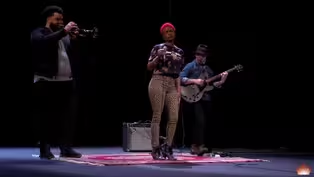
Lulu Fall, Kris Johnson, and Sasha Kasperko
Video has Closed Captions
Clip: S11 Ep8 | 6m 8s | Lulu Fall, Kris Johnson, Sasha Kasperko | Episode 1108/Segment 2 (6m 8s)
Video has Closed Captions
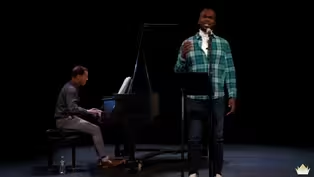
Clip: S11 Ep8 | 6m 26s | Mike Sandusky & Brian Buckner | Episode 1108/Segment 3 (6m 26s)
Providing Support for PBS.org
Learn Moreabout PBS online sponsorship New Episode
- Arts and Music

Innovative musicians from every genre perform live in the longest-running music series.
 New Episode
 New Episode



 New Episode
 New Episode
 New Episode

Support for PBS provided by:
Detroit Performs is a local public television program presented by Detroit PBS