One-on-One
Jim Kirkos; Tara Dowdell; Dr. Richard Besser
Season 2022 Episode 2503 | 27m 17sVideo has Closed Captions
Jim Kirkos; Tara Dowdell; Dr. Richard Besser
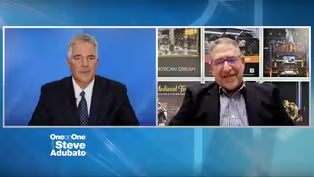
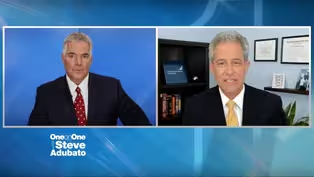
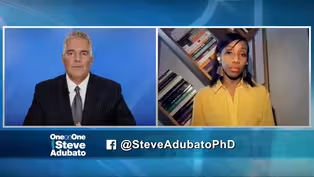
Jim Kirkos, President & CEO, Meadowlands Regional Chamber, discusses the idea of a convention center in the Meadowlands area; Tara Dowdell, TDG Speakers & Tara Dowdell Group, talks about Biden’s leadership and the impact of the pandemic on voting rights; Richard Besser, MD, President & CEO, Robert Wood Johnson Foundation, talks about the impact of the pandemic on minority communities.
Problems playing video? | Closed Captioning Feedback
Problems playing video? | Closed Captioning Feedback
One-on-One is a local public television program presented by NJ PBS
One-on-One
Jim Kirkos; Tara Dowdell; Dr. Richard Besser
Season 2022 Episode 2503 | 27m 17sVideo has Closed Captions
Jim Kirkos, President & CEO, Meadowlands Regional Chamber, discusses the idea of a convention center in the Meadowlands area; Tara Dowdell, TDG Speakers & Tara Dowdell Group, talks about Biden’s leadership and the impact of the pandemic on voting rights; Richard Besser, MD, President & CEO, Robert Wood Johnson Foundation, talks about the impact of the pandemic on minority communities.
Problems playing video? | Closed Captioning Feedback
How to Watch One-on-One
One-on-One is available to stream on pbs.org and the free PBS App, available on iPhone, Apple TV, Android TV, Android smartphones, Amazon Fire TV, Amazon Fire Tablet, Roku, Samsung Smart TV, and Vizio.
Providing Support for PBS.org
Learn Moreabout PBS online sponsorship- [Narrator] Funding for this edition of One-On-One with Steve Adubato has been provided by The New Jersey Economic Development Authority.
Holy Name.
This place is different.
NJM Insurance Group.
Serving New Jersey'’s drivers, homeowners and business owners for more than 100 years.
Horizon Blue Cross Blue Shield of New Jersey.
Here when you need us most, now and always.
The New Jersey Education Association.
PNC, Grow Up Great.
Georgian Court University.
MD Advantage Insurance Company.
And by New Jersey Sharing Network.
Promotional support provided by NJ.Com, keeping communities informed and connected.
And by ROI-NJ, informing and connecting businesses in New Jersey.
- This is One-On-One.
- I'm an equal American just like you are.
- The way we change presidents in this country is by voting.
- I'’m hopeful that this is the beginning to accountability.
- Life without dance is boring.
- I don't care how good you are or how good you think you are, there is always something to learn.
- I did do the finale, and guess where my trailer was?
A block away from my apartment, it couldn'’t have been better!
- People call me 'cause they feel nobody's paying attention.
-_ It'’s not all about memorizing and getting information, it'’s what you do with that information.
- (slowly) Start talking right now.
- That's a good question, high five.
(upbeat music) - Hey everyone.
I'm Steve Adubato.
We kick off the show.
Look, he's got all kinds of promotion behind him.
He's Jim Kirkos, who is the President and CEO of Meadowlands Chamber.
Hold on Jim, before we get into this, first, let me say you're a trustee of the Caucus Educational Corporation.
What's all the promotional stuff going on behind you?
- Well, I am coming to you live from our visitor center here at what I call the MCHQ in Lyndhurst.
And in our visitors center we're promoting all the destination, assets, and attractions to the region.
That's what we do.
- Well, let me ask you this.
For years, we talked about American Dream.
We actually taped a whole a half-hour special for American Dream connected to the New Jersey Sharing Network.
They had the Transplant Games there which was awesome.
I and I know you're very involved with the Sharing Network as well.
But here's the thing, I'm sitting there going, Kirkos is now talking about a convention center?
We're gonna show some aerial shots, but seriously Jim?
- Yeah, seriously.
- A convention center?
Explain that market, which I don't get.
- Okay, so when you think about the Meadowlands sports and entertainment complex and the assets that are already there, right?
Think about the millions and now billions of dollars that have been invested in a brand new stadium, and a brand new racetrack and American Dream.
And so when you think about the marketplace in the future and how we can leverage the sports complex to be what it was 30 years ago when they first built the track, the arena and the original giant stadium, we have an opportunity here to add an element of a destination asset like a convention center that's multi-use.
Now, the real key here is the multi-use, multipurpose, youth and amateur sports, events, conventions, meetings, conferences, all of those types of things to come to the sports complex, fill our hotel rooms in the entire North Jersey region and then support the assets that have already been invested in, in the stadium and the track and now American Dream - You're bullish on this, Jim.
- Oh, I'm very bullish on it.
And I think what we'll talk about a little bit today hopefully is the, some of the results of the phase one market analysis.
You know, we've conducted a study by a national reputable firm about whether this is like, don't take it from me.
Let's hear the-- - What did they say?
Tell us what they said.
- Yeah, in short, the experts said every box that needed to be checked relative to the marketability and the success of a facility like this has been checked.
That's what they came back with.
Now, we're about to do a phase two study that shows all the economics, what's the economic impact, What's the cost to build it.
You know, how do we get there?
What are the-- - But does it look at traffic and environmental issues too, Jim?
- It's not gonna go as deep into traffic and environmental, but listen, the facility's already built, right?
There's an arena on that site where we're proposing a convention center to be.
And the arena is this much economic impact.
And a convention center, its impact is a mile high.
And so why would we not wanna leverage everything we can for the North Jersey region, especially coming out of the pandemic where hospitality and local businesses have suffered the most.
Why wouldn't we wanna think about how to leverage that going forward for the next 15 or 20 years.
- So let's talk about it, Jim, we're going into the spring.
I'm getting ahead of myself, we're getting close to the spring 2022, 2 years plus into the pandemic.
How badly have most of the businesses at the chamber suffered and specifically how?
- You know what Steve, there is a real dichotomy because there's certain industry sectors of the chamber whose members didn't feel much negative impact at all, construction, certain elements of commercial real estate and so forth.
What was hurt was predominantly hospitality, you know, that hotel sector, restaurants, dining, attractions, all the kinds of places that have been shuttered main street businesses.
You know, those are the businesses that have been hurt the most.
And so a project like this really provides some long-term relief, not only as in terms of recovery but another source of energy and business potential to all these types of businesses in the future.
- You know, Jim obviously we have a big audience in New York, our partners at WNET, WNET Group.
P.S., watch MetroFocus every night.
WNET and public television stations, NJ PBS as well as NJ Spotlight News.
I will not plug any more than that, but the reason I bring up New York, Jim is you got the Javits Center over on the west side you got a bunch of activity going on there.
New York, New Jersey, this battle going on forever.
You really believe we are gonna compete effectively against what's going on in Manhattan?
- So let me explain to you what the study showed, right?
And this, again, this is not me.
This is not Jim Kirkos the champion of the region talking.
This is the private entity that's meant to do this in the study.
The market analysis showed that the New York metropolitan area including the Jacob Javits Center and its renovation that it recently went through adding a significant amount of space is still short.
Is still short by almost a million square feet of exhibition space as compared to the top 15 other markets around the country.
- What does that mean?
- That means if we built, so even if we built a 400 or a 500,000 square foot facility in our marketplace, the New York metropolitan region is still short exhibition space.
So that means we're not really gonna compete with Javits.
A 500,000 square foot facility and the one that we propose is 460.
It doesn't compete with Jacob Javits Center.
It's a certain element that shows that they are gonna come to us and are not gonna go there.
We compliment the Jacob Javit Center.
We compliment New York, but more importantly, I, and listen my job is not to worry about New York.
My job is to worry about New Jersey the Northern New Jersey, the greater Meadowlands area.
This is a tremendous boom.
- I hear, before I let you go, American Dream there's still news reports that talk about the fact that it's gonna struggle.
It's challenging, the economics are challenging.
What's your sense of where it is and where it's gonna be in the next couple of years?
- Here's the gauge and the barometer that I use.
There's no doubt that they've been harmed irreparably by the pandemic, right?
Their ability to make the bond payments.
They, you know, all the news recently of them making a bond payment and tapping all of their reserves.
But here's where I remain optimistic, every time I go into the place it's packed.
I see people in every element of the entire space, people are shopping, they got bags with them.
They're not just walking around, they're having fun.
They're enjoying, they're in the water park.
They're in the sea life aquarium.
They're on the ice skating rink.
They're using the facility.
Their ability to attract people is strong.
And that's why I remain optimistic.
- Jim Kirkos has called himself the champion of the Meadowlands region.
And no one is gonna debate that.
Even, you got WrestleMania, I'll leave that alone.
Hey, Jim, thank you, my friend, again, a trustee at the Caucus Educational Corporation.
And it's always good to talk to you, Jim, all the best.
- Thanks for having me, see you soon.
- Stay with us, we'll be right back.
- [Narrator] To watch more One on One with Steve Adubato find us online and follow us on Social media.
- We are pleased to once again have our good friend, Tara Dowdell who's the founder and president of TDG speakers and the Tara Dowdell group, and then she's also a Democratic consultant.
Good to see you, my friend.
- Thank you, thank you for having me.
- So let's talk about this.
2022, a huge year for a lot of reasons, because, lay it out politically.
What's at stake?
- Well, it's a big year.
I mean, President Biden's agenda is already struggling a bit, particularly his agenda around Build Back Better, that specific marquee piece of legislation that he's been trying to get passed.
So this is a big year because he's all already facing some stumbling blocks around his agenda, and so then if he were to have to contend with a Republican Congress, a Republican House, a Republican Senate, it would clearly make things even worse given the fact that they are lockstep, en masse blocking almost everything he does, with some exceptions like Liz Cheney and Congressman Adam Kinzinger.
Those two representatives have been more amenable to working with him, but by and large, the Republicans under Mitch McConnell said yet again, we're not going to do anything, anything that involves collaboration.
- So let's try this.
You understand the Democratic party better than most.
You're a Democratic consultant, you've been involved in a lot of campaigns, but I'm curious about this.
The Democrats are divided in a lot of ways.
We just actually had an interview with the former Senate President, Steve Sweeney and he talked about the so-called AOC wing of the party, very liberal, progressive wing of the party, and the more moderate wing of the party.
Incredibly divided on issues.
Fair to say?
- So I've always felt that- - Forget about the Republicans for a second.
- Right.
- Just forget about the Republicans.
Just the Democrats, divided.
- So I don't think that Democrats are as divided as other people think they are.
And so with all respect to Senator Sweeney, because around the big ticket items, there's a lot of agreement.
And so I just, I don't identify with that as much.
And I think that the messaging needs to be more coordinated, for sure.
I think there's an issue there, there's a disconnect there.
But I think that at the end of the day, a lot of the issues that all of the Democrats support have massive public support.
And so, especially when you look at them individually, and we saw this exact same dynamic when Obama was president.
The exact same dynamic played out where the policies were popular, but there was a disconnect in the public perception around when it was a large scale piece of legislation.
- But Tara, hold on, let me push back on this.
President Obama, as a student of leadership on my end, when I studied Obama, President Obama, one of the things he had was the ability to connect with people on a human, personal level.
An extraordinary public communicator.
Is it not fair to say that President Biden is struggling mightily to connect with people and communicate a clear coherent message, and frankly, some would argue, communicate with a sense of confidence when he is out there?
Or is that just what those who don't like him are saying?
- No, there's literally no better communicator within the Democratic party than President Obama.
I would still say he's probably, well, actually there's one better.
- [Both] Michelle Obama.
(both laugh) - Michelle Obama, yeah, exactly.
We're on the same page.
So Michelle Obama is the single best communicator in the Democratic Party, and number two is probably President Barack Obama, but Biden's approval ratings are only four points lower than where President Obama's approval ratings were at this exact same time.
And I think people are underestimating this pandemic.
I think they're underestimating the mass trauma that many people will realize they had after we get through this.
I think the country is divided.
A lot of people know we want out of this pandemic.
If you ask 30 different people, you get 30 different answers as to what we should be doing.
And I think that a big part of what is putting an albatross around the neck of the Democratic Party is this pandemic.
I have friends that, I don't have children myself, but the frustration from parents, and it swings in both directions, and it really honestly, I know Democratic parents that skew very differently.
It doesn't matter whether they're the far left, you know, moderate, none of that matters.
The parents I know, I know parents who are both, and this is anecdotal, obviously, right?
But I know parents who are more progressive who want their kids back in school, and I know parents who are more moderate, who don't want their kids back in school.
And so I don't envy anybody governing at this time but I do think that a lot of things have been sort of projected onto the Democratic Party, and a lot of it is grounded in this pandemic and the trauma that people face, and the disruption that they continue to face in their lives.
- Tara, put in perspective, again the graphic 'Democracy at a Crossroads' will come up because this is a huge issue as it relates to our democracy.
Voting rights.
As we speak at the end of January, this will be seen a little bit after, it looks like it's not happening as many would want it to happen.
I can't even imagine what the late great Congressman John Lewis would be thinking right now, Dr. King would be thinking right now.
Say it doesn't happen.
Say these changes are taking place in a variety of states across the nation, which is gonna make it harder, as many say, for many people, disproportionately black and brown to vote.
It's not my job to editorialize, it's your job to help us understand why voting rights matter so much, A and B, if it does not take place, what does that mean for our democracy?
- So this is what I think is the biggest threat to our democracy, and I would also add, we need publicly financed elections, but that's for another conversation for another time.
But I would say that this is, in fact, the biggest threat.
The entire point of an electoral process, one person, one vote, the entire point of that is to give the people the right to hire and fire those people that represent them.
To give the people a voice in their democracy.
Once you start to impinge upon that, by definition you are harming democracy.
This is what separates us from other countries.
This is what separates us from countries that we've offered condemnations towards, countries that we have in fact, gone to war with, countries that we have imposed sanctions upon.
This is the defining factor.
If everyone does not have equal access to the ballot box, then we cannot call ourselves a democracy.
And once we move down that very slippery slope which we are well on our way down, then things will, I think, deteriorate on a number of levels, because it's the cornerstone of everything that comprises this nation's foundations.
- Tara, I got 30 seconds left.
I say Trump 2024.
You say?
- I say Ron DeSantis is probably gonna have something to say about it.
(laughs) - Okay, but say, just say.
I'm not saying that, what I am saying is, if that were to happen again.
If he were to run again and potentially win again, what do you believe that would mean for this nation, particularly for people of color?
- Well, I think he is going to run again.
Unless something changes, I think he's definitely going to run again.
I think that it will be horrible.
Trump wanted to do a Blacks versus Whites episode of 'The Apprentice', I mean, season of 'The Apprentice'.
That was something he wanted to do.
He has been dividing people by race forever.
This is not new.
Central Park Five, and he will continue to do it because it benefits him.
We saw it on- - Donald Trump took out ads saying about the Central Park Five, later they were exonerated - Exonerated.
- based on DNA evidence, but at the time he said, 'Guilty, do what has to be done with those teenagers.'
Go ahead, I'm sorry.
- He said it after they were exonerated, after they were exonerated by DNA evidence.
He is yet to acknowledge that.
He is someone who is an opportunist and whatever he can do to leverage himself, he will do.
And for him, race, he tapped into what he saw in the Republican Party.
He saw that race was a central focus in the Republican Party and he sought to exploit it, because that's what he does.
He taps into things that already exist and leverages them to his benefit.
- Hey Tara, thank you, and we look forward to continuing our discussion with you throughout the remainder of 2022 and listening to your perspective.
All the best to you and your family.
Thanks, Tara.
- Thank you.
- You got it.
We'll be right back.
- [Narrator] To watch more One on One with Steve Adubato find us online and follow us on Social media.
- We're now honored to be joined once again by Dr. Richard Besser, President and CEO of the Robert Wood Johnson Foundation.
Dr. Besser is also the former acting head of the CDC.
Good to see you doctor.
- Good to be here Steve.
Thanks for having me on.
- You got it.
Hey, listen, we're taping in February 7th of February being seen later.
You've never tried to predict the future because you're a very smart man.
Question, If I were to ask you where you think we're going with this two years in plus, when it's seen where do you think?
- You know it's, you're right.
I try to avoid predicting what happens here, but I do think we're entering a new phase of this.
And the reason for that is that because of how contagious the Omicron variant was and the way it's spread across the country, I think that most people in our country will have some level of protection around what comes next.
And I think there will be things that come next.
But my hope is that with each return of the COVID virus with each subsequent wave, the impact will be less and we're gonna need to disrupt our lives less.
And we'll see less in the way of hospitalizations and death.
You know, that's my hope that this is the way into COVID becoming something we live with rather than something we protect ourselves so dramatically against.
But that's one of several possible scenarios.
I think it's most likely.
- Absolutely and one of the things Dr. Besser and one of the areas we focused on in our coverage and by the way, the Robert Wood Johnson Foundation is in fact a supporter of what we do in terms of our public health and educational programming.
I wanna be clear on something, one of the areas we focused on heavily is racial equity, social justice.
There's a Rutgers Equity Alliance for community health that you and the foundation very much involved in one of our trustees, Michellene Davis, very involved in as well.
What is that?
And what does it have to do with racial and social justice as it relates to this pandemic?
- Yeah.
When you look at the impact of this pandemic on our nation, you know there's not a single community that hasn't been been hit by this and hit hard.
It's hard to find anyone that you know who hasn't lost somebody, a friend or relative but when you look at the impact of this pandemic by community, when you look by race, by ethnicity, by income, you see differences.
And in particular, in the first year and a half of this pandemic, black communities, Latino communities rural communities, lower income communities were hit far harder than other communities.
There's recent data looking at the overall impact on longevity in America.
And it dropped life expectancy for the average American by 1.6 years.
But if you break that down by race Black and Latino Americans lost three years of life, twice that of White Americans.
So everyone's been hit hard, but clearly there are disparities in terms of who's been hit the hardest.
The project that you lifted up at Rutgers is something that we're very proud about.
And what it is, is it's a desire to work with communities to address the problems that people and communities see.
And so it's bringing the expertise, the intellect the research skills of our state university to our communities and saying, what is it that's challenging you most?
Let's work together to solve that.
Rather than coming in from above and saying, we know best.
Saying no, you know what the solutions are, let's help achieve those.
- Dr. Besser, Let me ask you this.
You're the former head of the CDC and I'm a student of communication, a student of trying to communicate clear, effective, credible information.
How difficult is it for Dr. Walensky, Who is the head of the CDC as we speak?
It's not really about her.
It's about that position.
How difficult is it to communicate accurate, credible information with such a moving, complex, unpredictable, dare I say target?
- Yeah.
I think Steve in the best of circumstances it's incredibly hard.
When you come into a position like that and the nation is already polarized.
You come into a position like that and there's already massive distrust of public health at the federal, state and local levels where public health many times has been lifted up as the enemy.
And you're trying to then engender trust.
I don't know how you do that and are successful.
It's just a monumental task.
What I've seen with Dr. Walensky that I really, really appreciate is that she explains why she's making the decisions that she is.
Why the CDC is making the recommendations it is and that's hard.
That's hard to understand because it- - And it changes.
- Exactly.
- I'm sorry go ahead.
Go ahead, I'm sorry.
But it does change if people say, wait a minute if you want me to do what, follow to CDC, follow the science.
And then two weeks later, a month later it changes how am I supposed to follow it?
You say, - Yeah, the science has changed.
We've learned something.
So, you know, that's one of the hardest things when you're faced with a new public health threat, is that the science is constantly changing.
You're learning more, you know, right now our governor is saying that in a month school mask mandates can come off.
Well, you know, it's really important that that's framed in terms of, because of what's going on right now, because the numbers are going down.
And if we see that change, we may need to come back to you and say, here they are, again.
Whenever we're removing a public health measure, we have to frame it in the context of we're doing it because of this, and if that changes we're gonna come back and give you the best protection.
And that may be that we put these right back in place.
You wanna set the stage for that because we've seen time and time again, during this pandemic the things that have been lifted have had to be reimposed.
People get really, really, they get annoyed they get angry and they lose trust.
- And so we're taping on the 7th of February, say this is seen in April, May.
We don't know what it's gonna be, but as of now and I'm gonna ask you this real quick before we have to go.
Dr. Besser, the polarization, you described the vehement opposition to government mandates about vaccines masks, et cetera.
Do you believe that those who have gotten the vaccine as we speak today will be those who get the vaccine and this is pretty much it?
That those who are resisting, they've resisted.
- Yes and no.
So I think that's true for the hardcore people who have said absolutely not.
But right now, what we're seeing in America is a much lower uptake in terms of boosters than in other nations.
And I think there's a big group.
There's something like 45% of people over 65 have not yet had a booster shot.
We know that that helps reduce the risk of hospitalization and death.
And I think there's room there, if we do more outreach, more outreach to the elderly to get that number much higher, because that's a group that has already accepted vaccines, that really should be getting these boosters to further give themselves further protection.
- That is Dr. Richard Besser.
He's the President of the Robert Wood Johnson Foundation and the former acting director of the Centers for Disease Control, the CDC.
Dr. Besser as always.
Thank you very much.
We learn every time you're with us.
We appreciate it.
- Thanks for having me on it's a real pleasure.
- You got it.
I'm Steve Abubato.
That is Dr. Besser.
We'll see you next time.
- [Narrator] One-On-One with Steve Adubato has been a production of the Caucus Educational Corporation.
Funding has been provided by The New Jersey Economic Development Authority.
Holy Name.
NJM Insurance Group.
Horizon Blue Cross Blue Shield of New Jersey.
The New Jersey Education Association.
PNC, Grow Up Great.
Georgian Court University.
MD Advantage Insurance Company.
And by New Jersey Sharing Network.
Promotional support provided by NJ.Com, And by ROI-NJ.
- Data shows that many patients have avoided seeking critical health care in the wake of COVID-19 for fear of contracting the virus.
Delaying medical care can have serious consequences, so you should never second guess or ignore your symptoms.
At Holy Name Medical Center we have measures in place to prevent infectious disease from spreading, we're clean, we're open and we're safe for all your health care needs.
COVID's Impact on the Meadowlands Regional Chamber
Video has Closed Captions
Clip: S2022 Ep2503 | 8m 23s | COVID's Impact on the Meadowlands Regional Chamber (8m 23s)
The Impact of the Pandemic on Minority Communities
Video has Closed Captions
Clip: S2022 Ep2503 | 9m 6s | The Impact of the Pandemic on Minority Communities (9m 6s)
The Impact of the Pandemic on Voting Rights
Video has Closed Captions
Clip: S2022 Ep2503 | 10m 14s | The Impact of the Pandemic on Voting Rights (10m 14s)
Providing Support for PBS.org
Learn Moreabout PBS online sponsorship
- News and Public Affairs

Top journalists deliver compelling original analysis of the hour's headlines.

- News and Public Affairs

FRONTLINE is investigative journalism that questions, explains and changes our world.












Support for PBS provided by:
One-on-One is a local public television program presented by NJ PBS