
Jocelyn Benson/Down to the Wire
Season 3 Episode 30 | 26m 46sVideo has Closed Captions
Jocelyn Benson/Down to the Wire | Episode 330
Christy talks with Michigan Secretary of State Jocelyn Benson about the integrity of the election, last minute voting. One Detroit contributors, Stephen Henderson and Nolan Finley, talk about last minute Republican and Democratic campaigning in Michigan. Michigan pollster Bernie Porn pulls back the curtain on polling. Episode 330
Problems playing video? | Closed Captioning Feedback
Problems playing video? | Closed Captioning Feedback
One Detroit is a local public television program presented by Detroit PBS
Jocelyn Benson/Down to the Wire
Season 3 Episode 30 | 26m 46sVideo has Closed Captions
Christy talks with Michigan Secretary of State Jocelyn Benson about the integrity of the election, last minute voting. One Detroit contributors, Stephen Henderson and Nolan Finley, talk about last minute Republican and Democratic campaigning in Michigan. Michigan pollster Bernie Porn pulls back the curtain on polling. Episode 330
Problems playing video? | Closed Captioning Feedback
Where to Watch One Detroit
One Detroit is available to stream on pbs.org and the PBS app.
Providing Support for PBS.org
Learn Moreabout PBS online sponsorship- Coming up on One Detroit, we are less than a week away from election day.
Secretary of State Jocelyn Benson talks integrity of elections, when we'll see results and defending her ban on Open Carry at the polls that was just blocked.
Plus Nolan Finley and Stephen Henderson on the key Michigan races and what to watch November 3rd.
Then the old popular vote versus electoral college debate could start again.
And do you trust the polls you see?
The insight behind the numbers with Epic MRA pollster, Bernie Porn.
It is all right now, on One Detroit - [Announcer] From Delta Faucets to Behr Paint, Masco corporation is proud to deliver products that enhance the way consumers all over the world experience and enjoy their living spaces.
Masco serving Michigan Communities since 1929.
- [Announcer] Support for this program provided by the Cynthia and Edsel Ford Fund for journalism at Detroit Public TV.
The Kresge Foundation.
Community Foundation for Southeast Michigan.
- [Announcer] The DTE Foundation is a proud sponsor of Detroit Public TV, among the state's largest foundations, committed to Michigan focused giving.
We support organizations that are doing exceptional work in our state.
Visit DTEFoundation.com to learn more - [Announcer] Business Leaders for Michigan dedicated to making Michigan a top 10 state for jobs, personal income and a healthy economy.
Nissan Foundation.
Ally and Viewers Like You.
(upbeat music) - Hey, One Detroit.
I'm Christy McDonald.
Welcome to the show.
We are less than a week away from the election.
COVID cases are on the rise here in Michigan, there is record absentee voting turnout in the state.
The political ads are crowding every commercial break and it all culminates next Tuesday.
We've got you covered heading into election day.
Coming up, Secretary of State Jocelyn Benson on the integrity of the election.
Last minute voting logistics and defending her ban on Open Carry at the polls.
Plus Nolan Finley and Stephen Henderson on the biggest races in Michigan and what to watch for on Tuesday night.
Then popular vote versus electoral college.
Is it time for a change in the system?
And rating the polls, what's behind the numbers and how accurate are they?
Pollster Bernie Porn from Epic MRA brings us up to speed.
It is all ahead on the show.
And we're starting up with my conversation with Michigan Secretary of State, Jocelyn Benson.
She has been working for months with clerks across the state to get ready for the election.
Just this week, her ban on Open Carry at the polls was blocked by a judge.
It's being appealed by the Attorney General and while that is playing out, she is adamant that the polls will be safe and clerks will be ready.
- We're seeing record numbers of people voting and the urgency to ensure everyone who has not yet voted and 2 million citizens already have but of those who haven't, making sure they know what they need to know.
To get their ballots, return their ballots, if they choose to vote in person on election day what to expect then.
- What are some of the conversations that you're having with other Secretaries of State around the country just in terms of the importance of making sure that everything is right this election cycle, especially because of a lot of the feelings that are out there.
A lot of the misinformation that is out there about the integrity of the election.
- Yeah, that's exactly right.
I mean, a lot of our conversations are about specifically that.
We're doing so much work both behind the scenes and I have done with our local clerks for months and we're ready to go.
And so really the conversations are how do we make sure voters have faith in their process?
How do we fight back against any misperceptions that threatened the integrity of the process?
How do we prepare for candidates saying things that maybe aren't true about the process?
And so it's really a bi-partisan collaborative effort among us all Secretaries of State, because so many of us are dealing with the same misinformation, challenges and perceptions and all the rest.
- So before we talk about safety of voting and also really the timeliness of the results, I wanna talk about the absentee and the number of absentee voters that we've seen here in Michigan.
And if people still this week before the election, what are you seeing and what should people still do if they have their ballot?
- Well, if you have your ballot, you can return it in person at your local clerk's office or to your local drop box prior to 8:00p.m on election day and it will count.
You can also track it to ensure it's been received at michigan.gov/vote and also get a location of your local clerk and local drop boxes at that same website.
If you don't have a ballot, you can still vote early.
You just have to go to your clerk's office really at this point to get that ballot to apply to have it and then you could fill it out and return it right then and there.
- Explain the process of when the clerks get to start to open, prepare those absentee ballots and start to count them.
- Well 7:00a.m on election day, there will be groups of election workers all across the state and every community coming together.
There'll be sequestered until the polls close at 8:00p.m, tabulating ballots throughout the day and ultimately getting ready for us to report our results as soon as soon as possible.
So they've already been trained, they're ready to go.
We've got double and sometimes some places triple the number of machines to tabulate ballots than we had even back in August.
So we've really built an infrastructure that's ready for these millions of absentee ballots to be processed and tabulated as efficiently as possible.
- You did recently ban open carry in polling places and there is now a lawsuit challenging that, that I think that we'll be seeing playing out this week.
Explain to voters what the legal precedent was for you to come out and ban open carry.
- Well, I'm the Chief Election Officer for the state of Michigan and in that regard my authority is well-grounded in Michigan law to supervise our elections, to protect particularly the sanctity of the polling place.
We train poll workers, we set other expectations and regulations and guidelines.
It's also not okay to take photos of other voters for example, at the polls.
So that guidance, those directives that we issue to clerks are designed to ensure the law is followed.
And in this case, the law is a ban on voter intimidation.
We will not stand or tolerate any voter intimidation, threats or harassment on election day.
And we need to define for our clerks for our local election workers exactly what that means in our view, in my view and in the view of the Attorney General and the Michigan state police, the brandishing of firearms in a polling place would amount to that type of threat or intimidation.
- And after you came out with this ban though, we started to hear from law enforcements, some local law enforcements saying, "well we're not gonna be enforcing this ban."
And that given, gives concern among voters and the people who are working at the polling places.
And I wanna read you a quote from the Lapeer County Sheriff Scott McKenna, who came up this weekend and said, "You just created a problem, "all you did was throw gasoline on a fire "and create a storm that didn't need to exist, "saying that this ban just adds confusion."
What's your response to that?
- It's actually exactly the opposite.
The guidance actually provides clarity to clerks about what to do.
You call those who take an oath to protect you and voters and let them know this intimidation is happening at the polls.
And I'm proud that the Michigan State Police as well as the majority of local law enforcement all across the state recognizes that and that this is a furtherance of their duty to protect people.
Now, unfortunately we're in a moment, particularly this close to a nationwide election where things become politicized.
But we're also in a moment where there are threats and violence and hateful rhetoric increasing in our state as we've seen in recent weeks.
So, we've got to take all that into account and recognize that my job is just to protect the vote, protect our voters, protect the sanctity of those polling places on election day, which is what this guidance is furthering.
- Talk about the timeliness of results.
When can we expect to see results in Michigan?
- We will start to see soon after the polls close, some results being announced but of course the full tabulation of every ballot is gonna take some time.
And so from the moment the polls close until we have that full and official tabulation, which may take a few days because we'll have millions of ballots to go through and tabulate securely, we're going to do our best, I'm gonna do my best to tell the public exactly where we are in the process so that we both ensure accuracy and transparency but we also want to avoid a scenario where in any race you see this back and forth of who's won, who hasn't and that really creates a sense of uncertainty or confusion among... And really lack of faith in the results themselves.
- Well, it is no secret, our One Detroit contributors Nolan Finley, the editorial page editor of the Detroit News and Stephen Henderson, host of American Black Journal are on the opposite sides of the political spectrum but their analysis of all things politics has taken us through years of elections in Michigan and now another presidential race.
They met up to talk about the biggest races in Michigan and what we should watch for on Tuesday.
- What has your attention as we get closer?
- Well Steve, it seems like this campaign in Michigan at least, is playing out in two different universes.
The candidates are still swarming the state.
They are campaigning here as if it were a dead heat but if you look at our polls we had a Detroit News WDRB poll out, Thursday or Wednesday rather that showed a 7.7% lead for Biden here.
That has been consistent now for the last several polls despite all this campaign, despite all this spending it is not moved.
It's still ranges between 7% and 9% in Biden's fair favor and yet these candidates are all over Michigan.
- You know, even the internal polls in both campaigns show that the president has been flat for for a while and Biden continues to kind of inch up.
- Trump put 2 million in this week, in a new ad buy, a hundred grand in a new radio buy.
They're still grabbing whatever they can.
- I think they're trying to stop the bleeding in states where they think that if you get beat too badly, it has an effect down ticket and they're trying to hold on to the hope that they could get John James elected to the Senate seat that Gary Peter sits in.
If they can't do that I think, you know, it complicates their strategy for keeping a majority in the Senate because they've got problems elsewhere.
I think that explains some of what we're seeing.
If you're Trump, you gotta win one of the three states you picked off last time in addition to keeping everything else you had.
So why not Michigan?
- I wrote today that either the Trump campaign believes they've got another Hail Mary in them here.
While Democrats put their resources into mail-in balloting and early voting, Republicans have gone heavy on this get out to vote campaign and they feel like they've got a good effort going and that they could surprise again on Tuesday.
- You and I don't agree on a lot of things right now about where the country is or where we're headed.
I'm worried about Tuesday and Wednesday and into December.
The damage that has been done to our ability to govern together if Democrats win the presidency and the Senate, there's gonna be a real instinct to take revenge on the Republican party for what it's done, not just over the last four years but over the last 20 years but that doesn't necessarily get us to a better place in terms of being able to govern the country.
And I think the worry is that we're in this seesaw political moment where you know, somebody got all the marbles and they gonna do what they want to do and then the other side gets all the marbles and does what they wanna do.
- The Republicans are looking at what Democrats did to Donald Trump in terms of not working with him for one minute during these four years and they're gonna say... They're gonna dig in and do the same thing.
Now, if Democrats could get control of the Senate which-- - It won't matter.
- A very good chance they can do what they want but just as they did in 2008.
But taking that approach where we've got this big agenda for reshaping America and we're gonna push it through because we have the Senate and the White House and the House, they can do that but that doesn't serve the purpose that united this country.
And Joe Biden's been out there saying I'm gonna be the President for both Republicans and Democrats all of America.
But if you get in office and you just gonna swap one ideologically driven agenda for another, it is not gonna serve the purpose of uniting us.
There's going to be backlash, bitterness, pushback.
- I care less about unity than I do about governability.
We shouldn't be distant on some of these issues.
There are fundamental issues that we just disagree about and there are fundamental issues that need addressing in this country that I don't think anyone should back down about.
But we do also need to be able to govern the country that we have big problems that affect us all that we need, you know, common solutions to that are not just gonna get undone the next time the other party gets control.
And I think this is headed towards something worse at this point than something better.
- I would agree but if we don't start governing from the middle and if we don't start electing politicians who commit to governing for the middle, we are not going to come together as a country.
- Well I mean, Joe Biden is a great example of that though.
I mean, you saw the primary, this was the centrist candidate among the Democrats that is center left politics.
What he's espousing it shouldn't be as much of a threat to Republicans as it is.
- Nothing about what Joe Biden is standing on right now is center left.
I mean, he has embraced the far left democratic wishlist, pulling back, tax and regulatory reforms, this whole-- - Asking people to pay taxes is radical?
- Assault on fossil fuels.
Well, and you look at that centrix.
I would look at that as far left and I think-- - That's part of the problem, right?
- We've got to come someplace in the middle but we are out of time, Steve.
- Yeah, we are and we're almost out of time in terms of the election too, five more days.
I can't wait till it's over.
- We'll be back next week.
Hopefully we'll know by next Thursday, who won this thing.
- Nolan and Steven will be back next week and the three of us we'll analyze the aftermath.
Well, it seems every presidential election the question of the electoral college versus the popular vote comes up.
Earlier this year we took a look at one organization looking to change how we choose the president.
One Detroit Senior Producer, Bill Kubota has the story.
- [Hillary] Thank you so much.
- [Bill] It's heard so often, Hillary Clinton got 3 million more votes than Donald Trump.
She should be president.
Ah but for the Electoral College.
- The Electoral College sucks and should be abolished.
- Donald J Trump received 16 electoral votes from the state of Michigan.
- [Bill] Here's Michigan's Electoral College in Lansing, 2016.
These collegians represent all 4.8 million voters in this state half who didn't vote for Trump.
Let's turn on the way back machine to see President Benjamin Harrison win the Electoral College but not the popular vote in 1888.
112 years later.
- I George Walker Bush do solemnly swear.
- [Bill] The year 2000 another candidate loses the popular vote and still takes office.
A fluke it can't happen again, right?
- I've just received a call from Secretary Clinton.
(crowd applauding) - [Bill] Someone to get rid of the Electoral College and go to a straight popular vote.
But the electoral college is etched in the constitution.
Hold on, there's another way, one that keeps the Electoral College but ensures the candidate with the most popular votes really wins.
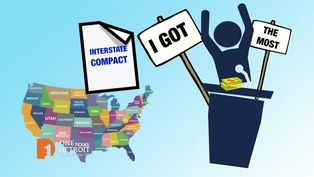
Something called the National Popular Vote Interstate Compact.
The idea is to preserve the Electoral College.
That is to retain the state's rights to do elections their own way, like going with the national popular vote.
- And my initial reaction was it sounds like a communist plot to make Al Gore President.
I said, what a stupid idea?
Why would we ever wanna do that?
- [Bill] Saul Anuzis has been a prominent Michigan Republican for years.
Now he's working for the National Popular Vote.
- You know, I've actually read the book that was about 900 pages long and said, this is a brilliant idea.
- [Bill] 2008, Obama V McCain.
Both candidates campaigned in Michigan, spent money here.
We were a battleground state until a poll came up putting McCain 12 points back.
- So the McCain campaign and the national party determined we can't win in Michigan and so they pulled out all their resources, pulled out all the people, pulled out all the money and shipped it all to Ohio and Florida.
And I sat there and said, what a crazy system we have where Michigan is relevant one day and not relevant the other.
- [Bill] Anuzis says at least 40 States aren't relevant during presidential campaigns.
It's predetermined.
States like California and New York go Democratic.
States like Idaho and Oklahoma, Republican.
Their electoral votes don't change.
- And that means there's only 10 potential battleground States.
And as the race develops, it usually goes down to anywhere from three to six battleground states.
So we end up spending 95% of all the resources.
95% of all the presidential visits are spent in those three to six battleground states.
So it perverts public policy and it perverts politics.
- [Bill] States join the compact agreeing to hand over their electoral votes to the candidate that wins the national popular vote.
Whoever that might be.
- What the national popular vote does is equalize the system because every vote and every state now becomes politically relevant every time and one voter here is the same as one or anywhere else.
- [Bill] 15 States in the district of Columbia have signed on.
Here at past the Michigan house a few years ago but went no further.
So far most of the states joining the compact lean Democratic as do compact supporters.
- Because you and Elizabeth Warren and Pete Buttigieg and George Soros kids are all on the same side.
So why did a good Republican from Michigan decide to throw in with all those characters?
- [Bill] Anuzis, he's been taking some hits because of who he's been working with.
- Just because there's a bunch of liberals backing it, you think it's a bad idea?
- So you actually think people are gonna campaign in any more states because of your plan?
I don't think anyone's understanding your distinction.
- Well-- - The Electoral College will be meaningless under yours and it will not-- - [Anuzis] That is not true.
- [Bill] For the compact to work, it needs more States to sign on, a total of 270 electoral votes, the number needed to win the electoral college.
The compact has 196 electoral votes so far.
- We've got problems, folks.
- [Bill] Some poll watchers say recent history could repeat itself yet again with Trump losing the popular vote by even more while winning the electoral college.
But if the compact were in place Anuzis says, his man Trump would still win.
Trump would just go more places and get more voters.
Voters that haven't turned out because they've been in states where the electoral college has always gone to the Democrats.
- The forgotten men and women of our country will be forgotten no longer.
- [Bill] The national popular vote seems unlikely this election cycle but Anuzis keeps looking ahead.
- More realistically, I think by 2024, we will be running the presidential campaign under the national popular vote.
- We recently checked in with Saul Anuzis who said the commission didn't gain a lot of steam but just wait to see what happens after November 3rd.
All right, so you're phone might be ringing a lot these next few days as pollsters get their last round of data.
One Detroit Associate Producer Will Glover talk with longtime Michigan pollster, Bernie Porn, President of Epic MRA for what he's seeing this election.
- What is polling in its most basic form?
- Well, there are all different kinds of a polling.
You have online polling, automated polling where robocalls are made and then people will press their phone button to respond to the polls.
And then you have live interviewer polling, which is most of what we do.
And to make sure that we get an adequate representation of younger voters.
We have continued to increase the percentage of a cell phone only contacts that we make in our polls.
- What are some of the more general ways polls are used and how might people encounter them in their everyday lives when there isn't an election cycle?
- Most of our polls are done through school districts, community colleges and transit authorities and quite often it will be to test potential ballot proposals or to just do satisfaction surveys to find out, for example, for the Transit Authority, why do people ride the bus?
And with pandemic COVID-19, have they been less likely to ride the bus because of the fear of catching COVID-19?
And if it is resolved, will they were more likely to go back and ride the bus because a lot of people are no longer riding the bus because of fear.
And you have a high percentage of people in Michigan who are extremely fearful of catching COVID-19.
And when we ask about mask wearing you have a very high percentage of African-Americans, the Detroiters who say they wear their mask.
And interestingly, when we asked that question you have almost a hundred percent of Democrats saying they wear a mask but 12% of independent voters say that they sometimes don't wear a mask but you have 28% of Republicans and Trump voters saying they don't wear a mask including 32% of male voters, Trump supporters who do not wear a mask.
So if he would simply wear a mask and encourage his supporters to wear a mask that would resolve an awful lot of the problems, at least in Michigan.
- What have been the most interesting findings that you've seen in some of the recent polling that you've done?
- Interestingly to give you an idea of how the presidential election might turn out, of those who were undecided in the presidential election, 76% supported national mask policy.
So while President Trump is talking about, well, there's two sides of the mask issue.
Well, I'm not among those folks who are undecided in Michigan.
The other thing that I found was extremely interesting and somewhat disappointing is when I saw tremendous support after the Floyd death for Black Lives Matter.
And I mean, nationally all showed as much as 70% support of Black Lives Matter.
When the message came out in support of defunding the police, there was a lot of confusion about that and that has had I think a significant impact on the perception of Black Lives Matter because it's viewed as supporting defunding the police.
And 57% of Michigan voters do not support or oppose defunding the police and that's even when we tell them that it would not eliminate police it would just reprioritize some of the spending so that healthcare and psychologists are provided to deal with those people who need specific kinds of assistance.
And you look at that and you have 48% supportive of Black Lives Matters now.
And 45% oppose, overwhelming opposition among Republicans and significant opposition by more than the state wide numbers among independent voters and overwhelming support among Democrats.
However, if you phrase the need for police reform and the need for reform of education and how systemic racism affects African-Americans in a variety of different avenues, when you deal with that way, 75% of Michigan voters think systemic racism is a problem.
So if you describe it in that way and talk about... As part of it, we need to address those times when police go over the line and make sure that we address that as well as all of the other issues that are involved in systemic racism in our country and in our state.
And when you do that and I would note that recently Joe Biden has been talking about addressing systemic racism and he's now been referring as much to Black Lives Matter.
And that is unfortunate but that is a result of the the messaging about defunding the police.
- For all things election 2020, just head to OneDetroitpbs.org, follow us on social media and make sure you check in with the PBS News Hour on election night then meet us back here next Thursday for analysis of the results and so much more.
Hang in there Michigan, only a few more days.
I'm Christy McDonald.
We'll see you next time on One Detroit.
You can find more at onedetroitpbs.org or subscribe to our social media channels and sign up for our One Detroit Newsletter.
- [Announcer] From Delta Faucets to Behr Paint, Masco Corporation is proud to deliver products that enhance the way consumers all over the world experience and enjoy their living spaces.
Masco, serving Michigan Communities since 1929.
- [Announcer] Support for this program provided by the Cynthia and Edsel Ford Fund for Journalism at Detroit Public TV.
The Kresge Foundation.
Community Foundation for Southeast Michigan.
- [Announcer] The DTE Foundation is a proud sponsor of Detroit Public TV, among the state's largest foundations committed to Michigan focused giving.
We support organizations that are doing exceptional work in our state.
Visit DTEFoundation.com to learn more.
- [Announcer] Business Leaders for Michigan dedicated to making Michigan a top 10 state for jobs, personal income and a healthy economy Nissan Foundation.
Ally.
And Viewers Like You.
Campaigning Gets Down to the Wire
Video has Closed Captions
Clip: S3 Ep30 | 5m 45s | Stephen & Nolan on last ditch MI campaigning & possible aftermath after the dust settles. (5m 45s)
The Electoral College and the National Popular Vote
Video has Closed Captions
Clip: S3 Ep30 | 4m 47s | One Detroit's Bill Kubota reports on the National Popular Vote Interstate Compact. (4m 47s)
Video has Closed Captions
Clip: S3 Ep30 | 5m 49s | SOS Jocelyn Benson talks open carry, the integrity of the election, and voting logistics. (5m 49s)
Video has Closed Captions
Clip: S3 Ep30 | 5m 12s | Epic MRA President Bernie Porn gives insight into polling and the information it collects (5m 12s)
Providing Support for PBS.org
Learn Moreabout PBS online sponsorship New Episode
- News and Public Affairs

Top journalists deliver compelling original analysis of the hour's headlines.
 New Episode
- News and Public Affairs

FRONTLINE is investigative journalism that questions, explains and changes our world.




 New Episode

 New Episode



Support for PBS provided by:
One Detroit is a local public television program presented by Detroit PBS