
U.S. Army, Greenway Plan, Ozzie Rivera, Making Black America
Season 7 Episode 7 | 26m 46sVideo has Closed Captions
Army recruitment, Joe Louis Greenway, Ozzie Rivera, Making Black America and Alison Lewis.
U.S. Army Chief of Staff Gen. James McConville talks about the Army’s soldier shortage and possible solutions. The City of Detroit has announced a two-year planning study seeking residents’ feedback on the Joe Louis Greenway project. A conversation with “Making Black America” producer and director Stacey Holman. Plus, Ozzie Rivera reflects on a lifelong passion for Puerto Rican music and culture.
Problems playing video? | Closed Captioning Feedback
Problems playing video? | Closed Captioning Feedback
One Detroit is a local public television program presented by Detroit PBS
U.S. Army, Greenway Plan, Ozzie Rivera, Making Black America
Season 7 Episode 7 | 26m 46sVideo has Closed Captions
U.S. Army Chief of Staff Gen. James McConville talks about the Army’s soldier shortage and possible solutions. The City of Detroit has announced a two-year planning study seeking residents’ feedback on the Joe Louis Greenway project. A conversation with “Making Black America” producer and director Stacey Holman. Plus, Ozzie Rivera reflects on a lifelong passion for Puerto Rican music and culture.
Problems playing video? | Closed Captioning Feedback
How to Watch One Detroit
One Detroit is available to stream on pbs.org and the free PBS App, available on iPhone, Apple TV, Android TV, Android smartphones, Amazon Fire TV, Amazon Fire Tablet, Roku, Samsung Smart TV, and Vizio.
Providing Support for PBS.org
Learn Moreabout PBS online sponsorship- [Announcer] Just ahead on "One Detroit," the US Army's chief of staff visits Michigan to talk about stepped-up efforts to recruit new soldiers.
Also coming up, the city of Detroit asks residents what they want from the new Joe Louis Greenway.
Plus, the producer of the new PBS documentary "Making Black America" talks with American Black Journal's Stephen Henderson.
Also ahead, in honor of Hispanic Heritage Month, we'll introduce you to a musician who's keeping traditional culture alive in southwest Detroit.
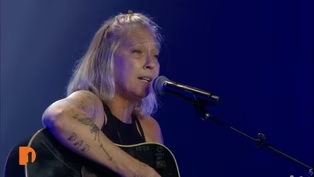
And a musical performance by Detroiter Alison Lewis.
It's all coming up next on "One Detroit."
- [Narrator 1] From Delta faucets to Bear paint, Masco Corporation is proud to deliver products that enhance the way consumers all over the world experience and enjoy their living spaces.
Masco, serving Michigan communities since 1929.
Support for this program is provided by: the Cynthia & Edsel Ford Fund for journalism at Detroit Public TV.
The Kresge Foundation.
- [Narrator 2] The DTE Foundation is a proud sponsor of Detroit Public TV.
Among the state's largest foundations committed to Michigan-focused giving, we support organizations that are doing exceptional work in our state.
Visit DTEFoundation.com to learn more.
- [Narrator 1] Nissan Foundation, and viewers like you.
(upbeat music) - [Announcer] Just ahead on this week's "One Detroit," the city of Detroit wants residents to weigh in on the impact of the proposed Joe Louis Greenway.
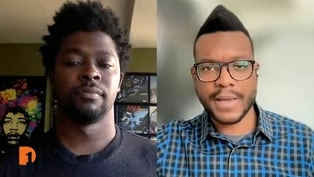
Bridge Detroit reporter Bryce Huffman talks with me about the city's next steps for the $200 million project which aims to make biking and walking the city safe and accessible.
Also coming up, the new PBS documentary series "Making Black America: Through the Grapevine" examines the resilience and joy of African-Americans, even in the face of racism.
American Black Journal's Stephen Henderson talks with the series producer.
Plus, popular Southwest Detroit musician Ozzie Rivera recalls growing up in a community filled with Hispanic culture, and how he brings the same traditions to his music.
And Detroit singer-songwriter Alison Lewis performs the title song from her album, Our Lady of the Highway.
But first up, the nation's labor shortage has impacted the military.
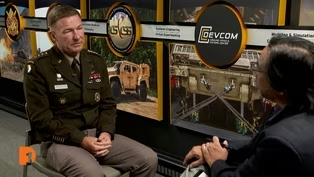
The chief of staff of the US Army is sounding the alarm on the recruitment challenges faced by the military.
General James McConville says there's a shrinking pool of young men and women eligible to serve, and it has been difficult attracting new soldiers.
The general sat down with metro Detroit civic leaders to talk solutions.
One Detroit's Bill Kubota was there.
(upbeat music) - Hey, thanks, first of all, for what you're doing in the military.
- [Announcer] The chief of staff of the US Army, General James McConville, paid a visit to Michigan for a frank conversation with business and education leaders about the challenges of military recruiting.
The meeting at the TACOM facility in Warren addressed the issues of childhood obesity and a decline in educational achievement, which has led to a soldier shortage.
General McConville says the Army has a 90-day program in place aimed at getting possible recruits where they need to be physically and academically.
- What we're looking to do is to inspire young men and women to serve that can meet the standards of the United States Army.
We want to invest in American youth, and what we've done is we've actually stood up a future soldier preparatory course to help young men and women who want to serve that are having problems meeting the academic and the physical requirements.
We're not gonna lower standards.
What we're gonna do is help them meet our standards.
What we want to do is to give those who have not had a chance participate in athletics, maybe because of Covid or some other reason, but the the ability to get physically fit, and also those who are having challenges passing the academic requirements the chance to do that.
And that's what this 90-day program is all about.
We think, we've got experience, that with the right diet, the right exercise, we can get young men and women into the appropriate shape if they have the desire to serve.
We have an academic test that recruits are required to take, and it used to be, two-thirds passed.
Now, only one-third pass.
And then on the body weight side, or the physical fitness side, we're just seeing a lot less young men and women.
And we don't know if that's 'cause of Covid the last two years, maybe sports programs, you know, virtual education.
There's a lot of reasons why it could be.
But what we do know is, we want to give these young men and women that want to serve an opportunity to serve, and they have to meet the standards.
- What about Covid?
What has that done in terms of recruitment?
- Well, it's made it much more difficult for our recruiters because they're not in the high schools, and what we see is exposure to the military is extremely important if we want young men and women to come in.
And so what we see right now is 83% of the young men and women that come into the Army are military family members.
So some would say it's a military family business.
We want it to be an American family business.
- [Announcer] For the civic leaders meeting with General McConville, his remarks opened their eyes as to how the nation's labor shortage has impacted the military.
It also provided insight as to how the Army is hoping to attract more young people.
- Whenever I have an opportunity to talk to a young person that's thinking about the military, I do, I let them know, you know, it changed my life.
The best decision I ever made.
I work for a nonprofit organization, InForum, and our focus is women and accelerating women in their careers, but we do have a program for female veterans called Next for Vets.
And so I facilitate that program and offer coaching to female veterans as they're... Just, how do they utilize the skills they gained in the military in the private sector.
- I think one of the things that came out today is that there needs to be more awareness of the military and the benefits and resources that the military have to assist people who decide to take that path, and really what's beyond that.
If they want to be a doctor or an engineer, really exploring those opportunities and better communicating to the parents and to the prospect students as well.
- What we know we want in the military when it comes to attributes, we want young men and women that are resilient, because they're gonna face adversity and we want them to be able to overcome that.
We want young men and women that are physically and mentally fit because again, they're gonna be challenged in the military.
We want young men and women that have character and if they have had challenges, we have to take a hard look at, you know, what type of soldier they're gonna be, 'cause the American people have got to trust us.
You know, we're the people with the guns.
And so you want to make sure that you can trust the United States Army.
And quite frankly, I believe you can.
And I believe that we have the world's greatest soldiers.
- [Announcer] The city of Detroit is reaching out to residents for input on the construction of the new Joe Louis Greenway.
The 27-and-a-half mile biking and walking trail will connect several neighborhoods to the Detroit Riverfront.
I sat down with Bridge Detroit reporter Bryce Huffman to get more details on the city's next steps and feedback on the impact of the Greenway.
(upbeat music) - We're gonna talk about the Joe Louis Greenway.
So it is a bike path, walking path that's being developed to connect some of the other communities around and in the city of Detroit.
Just give us an update as to what the Joe Louis Greenway is, who it's for, when it's happening.
- The Joe Louis Greenway is a 27-and-a-half mile biking and walking trail that will connect communities as far as Detroit's riverfront southeast in the city to Hamtramck, Highland Park, and even Dearborn.
So it's basically a loop that goes around and allowing people to bike and walk through different parts of the metro area.
It's really all about getting more green space in the city, more places for people to travel by bike without necessarily having to worry about car traffic, and just places for people to walk and ways to connect different city neighborhoods.
- And where are we at as far as the actual build out of the Greenway, and also, where is it it being built out from?
I know there's some sort of connection to things like the Dequindre Cut.
- Yeah, so, good questions.
One of the plans is to extend the Dequindre Cut from where it currently ends at Mac and taking it to East Grand Boulevard across from I-94.
And that's really a way to connect it to Hamtramck.
Right now, currently, they've already begun construction in southwest Detroit over kind of in the Gordie Howe Bridge area that they are constructing.
So that's where construction has begun so far.
- I think that really touches on the city's goal of, you know, becoming a city of the future, creating the places and spaces where people actually wanna spend their time, and making it all very easy to navigate.
So with that said, you mentioned that it's going to connect Detroit to Hamtramck.
What else will the Greenway be connecting the city to?
How far out, and how interconnected, I guess, are we gonna be?
- Yeah, so along with Hamtramck, there will also be connections to and through Highland Park, and then when you get in the west side of the city, it'll connect to Dearborn.
So different communities.
It's not gonna connect, you know, all the way out to some of the further metro Detroit suburbs, but the ones that kind of border inside the city and next to the city are gonna be the ones that the Greenway is impacting.
And actually, they just launched a neighborhood planning study all around making sure that the areas in the Greenway that are gonna be impacted, the neighborhoods that will be impacted by construction and the final product kind of get a say in what's gonna happen and kind of understand what changes might be coming to their neighborhood, what opportunities might be coming to their neighborhood, and things to just be looking out for for the next few years.
- Because you're mentioning the neighborhoods, one of the interesting things that I saw was something about a signage program.
Tell us a little bit about that.
- Yes, so I was at a meeting a couple weeks ago and they talked about this neighborhood signage program, which is all about making sure that cyclists and walkers know where they're at and kind of know a little bit of the history and culture of the neighborhoods they're in.
So the first neighborhood that they're starting this in is the Midwest neighborhood, which is in the city's district 6 on the west side, and it'll be between, I wanna say, Warren and Joy Road are where the signs are gonna be posted up.
So the idea is basically if you're biking through a neighborhood, you can look at the sign and kind of get a sense of the neighborhood you're in and kind of understand that history.
So one of the big concerns a lot of people in Detroit have had in general is that their neighborhoods, that history, that culture, is kind of being erased, or being displaced.
So this signage program is really about honoring those people and the people that made the neighborhoods what they are today.
- Because we're talking about the people, and that's really who this is all for, what has been the response of Detroiters hearing about this project going on?
Are people on board?
I know usually there's a little bit of pushback or concern about whether or not the residents' voices are going to be heard, whether their ideas are gonna be included, whether their needs are gonna be met.
Have you seen any friction, I guess, in this process?
- Yeah, so it's really interesting.
A lot of the times when I cover things where residents are allowed to give feedback, you hear a lot of pushback against design ideas or you hear a lot of concerns about maybe a design idea or plan.
So far there's really been two things of note.
First is that there is a lot of residents, particularly in the McDougall-Hunt, Poletown East-ish area of the city that when I asked them about the Dequindre Cut extension plan, they had never heard of it.
They say no one from the city had talked to them about it.
But very interestingly, when I actually talked about what the plan is and why they wanna do it, just about everyone was on board.
Like, very overwhelmingly supportive of the idea, very overwhelmingly in favor of the Greenway in general, the expansion of the Dequindre Cut, likes the idea of going into these neighborhoods and making sure people know where they are and what that neighborhood is all about.
- [Announcer] A new PBS documentary by Professor Henry Louis Gates, Jr. explores the social networks and organizations created by and for African-Americans as a means of empowerment in the face of racism.
The four-part series is titled "Making Black America: Through the Grapevine."
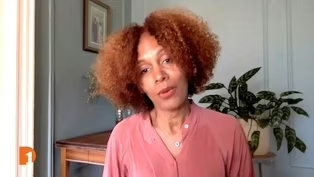
American Black Journal's Stephen Henderson spoke with the series producer and director Stacy Holman.
(upbeat music) - It's great to have you here to talk about this latest work.
Tell us about Making Black America.
- Well, this is obviously the brainchild of Professor Henry Louis Gates, who I'll defer to, probably, throughout the actual interview.
And he is really interested, this is coming off the heels of The Black Church, and he's really interested in social networks, organizations, particularly secret societies.
And he starts with the Prince Hall Masons.
And this is looking at the spaces, the places, the people, the organizations, that African-Americans, or Black people, you know, people will get that when they see the series, that we created for us, by us, behind the veil, outside of the white gaze, where we could just let down our hair, we could just take off that mask, we could just be.
- So it strikes me that a lot of the institutions that we're talking about here, they were not Black by intention, but by exclusion, right?
We were left out of lots of things for a lot of time and had to create our own spaces.
But in modern America, I think they are Black by intention.
We preserve these spaces, we celebrate them, and we build them up because they have value and importance far beyond the exclusion that forced us to create them in the first place.
And sometimes that's hard for people who aren't part of our community to understand, but I think for all of us, it's crystal clear, right?
We need these spaces.
- Yeah, we do.
I mean, it's, you know... We need that time to kind of step aside.
And I think when you talk about networks of today, and spaces, and even creative outlets, you know, look at hip hop.
I mean, that was created by us.
Also too, you look at Black Lives Matter.
That was built by a group of women, founded by a group of women, out of a need.
And then even going back during the Depression, you know, rat parties, this economic, informal economy that Black people created because in some instances it wasn't actually open to us, but in the cases of hair products, we needed to have, you know, Black women need their hair done.
So, you know, that was built out of a need.
- Yeah, yeah.
- We will ever need our hair done.
So, yeah.
So I think it was really... (laughs) So it's really just finding that, creating those spaces and those places that are meeting the need of that particular community.
- Yeah, yeah.
- That's not always a response, as you said, - [Announcer] You can see Steven's entire interview with Stacy Holman along with more Making Black America: Through the Grapevine at OneDetroitPBS.org.
And you can watch the documentary series here on Detroit Public Television every Tuesday in October at 9:00 PM.
We continue our celebration of Hispanic Heritage Month by introducing you to southwest Detroit resident Ozzie Rivera.
Ozzie is a well known activist, historian, educator, and musician.
One Detroit caught up with him as he reconnected with his salsa jazz band for a concert featuring the diverse music that reflects the southwest Detroit community.
(upbeat music) - I grew up in a musical family where Puerto Rican traditional music was played a lot.
My father played the cuatro, which is a ten-string guitar peculiar, or particular, to Puerto Rico.
And since he was the only one in the sixties that were playing in Detroit, I used to see all the musicians come to my house.
(upbeat salsa jazz music) When some musicians weren't performing that particular night, they would take their drums to Clark Park and start drumming.
I used to live on Toledo, would walk down to Verner, and as soon as I turned the corner on Junction Verner, I would hear the drums play.
The people in the neighborhood, particularly Caribbean islanders, whether they were Dominican, Cuban, or Puerto Rican, primarily Puerto Rican, they would just, Hey, let's have some fun.
Because it was just kind of an impromptu what they call puma bembe, which is a jam session.
(singing in Spanish) The way we saw it is that our cultures were so denigrated, looked down upon, that actually performing that kind of music or doing that kind of theater or dancing was a reaffirmation of being proud of our culture.
So for many of us we thought that alone was striking a political statement.
(upbeat rhythmic music) When I was younger, community festivals were the norm in the city of Detroit.
You have music festivals.
They don't tend to be community festivals.
I mean, every single weekend we could go to a different part of the city and we had our pick of community music festivals, and that's how people run into each other.
That's how I learned how to really play drums, drum circles, because that is the main way Latin Caribbean kids and others used to learn drums.
The conditions were, there were a lot of cross-cultural interactions.
It was that ambiance.
Plus, at the same time, nationally, you had the civil rights movement.
So these people were affected by that.
The anti-war movement, the growing women's movement.
So, you know, people of my generation or a little bit older were right in the middle of all of that.
So it affected their music.
(singing in Spanish) For me, it's never been about money, never.
And most of the musicians that play this music, even those that are commercially successful, they normally don't make a living off of this.
Internationally, this music is really well-respected.
I don't think it'll go away.
It hasn't gone away even after decades of change.
(upbeat trumpet riff) My father and I had a real strained relationship growing up, but the one thing that he gave me was his love of culture.
And for that I'll forever be indebted to him, because I can't consider myself Ozzie without that.
It is part of who I am.
(drums playing) (final chord playing) (Ozzie speaking Spanish) Thank you very much.
We're La Ispiracion.
- [Announcer] That'll do it for this week's One Detroit.
Thanks for watching.
We'll leave you now with a performance by singer-songwriter Alison Lewis, one of the featured artists in the new season of Detroit Performs: Live from Marygrove, premiering on October 12th at 7:30 PM.
Here's Alison singing the title song from her solo album, Our Lady of the Highway.
(steady guitar music) ♪ There is a bar on the side of the road.
♪ ♪ It's like a house of the holy for wayward souls ♪ ♪ Where you can drink and you can pray ♪ ♪ To our Lady of the Highway ♪ ♪ Well, the night it grows long, ♪ ♪ And the road it grows weary ♪ ♪ There's a sign in the distance ♪ ♪ That says, eat, drink, and be merry.
♪ ♪ You want to believe you're ready to be saved ♪ ♪ Come to our Lady of the Highway.
♪ ♪ Our Lady of the Highway, look after me tonight ♪ ♪ I've done it all wrong, help me do something right ♪ ♪ Light the road ahead, I pray ♪ ♪ Our Lady of the Highway ♪ ♪ Well, you ain't got no money and you ain't got no friends ♪ ♪ Every road that you turn down winds up a dead end ♪ ♪ And no one will listen to a word that you say ♪ ♪ Come to our Lady of the Highway ♪ ♪ Our Lady of the Highway, look after me tonight.
♪ ♪ I've done it all wrong, help me do something right ♪ ♪ Light the road ahead, I pray ♪ ♪ To our Lady of the Highway ♪ ♪ Our Lady of the Highway, look after me tonight ♪ ♪ I've done it all wrong, help me do something right ♪ ♪ Light the road ahead, I pray ♪ ♪ To our Lady of the Highway ♪ ♪ Our Lady of the Highway ♪ ♪ Our Lady of the Highway ♪ ♪ Our Lady of the Highway ♪ - [Narrator 1] From Delta faucets to Bear paint, Masco Corporation is proud to deliver products that enhance the way consumers all over the world experience and enjoy their living spaces.
Masco, serving Michigan communities since 1929.
- [Announcer] Support for this program is provided by: the Cynthia and Edsel Ford Fund for journalism at Detroit Public TV.
The Kresge Foundation.
- [Narrator 2] The DTE Foundation is a proud sponsor of Detroit Public TV.
Among the state's largest foundations committed to Michigan-focused giving, we support organizations that are doing exceptional work in our state.
Visit DTEFoundation.com to learn more.
- [Announcer] Nissan Foundation, and viewers like you.
(upbeat music)
Detroit Singer-Songwriter Alison Lewis
Video has Closed Captions
Clip: S7 Ep7 | 3m 6s | Singer-Songwriter Alison Lewis | Episode 707/Segment 5 (3m 6s)
Low U.S. Army Recruitment Leads to Soldier Shortage
Video has Closed Captions
Clip: S7 Ep7 | 4m 39s | The army's low recruitment of youth has caused a soldier shortage. Bill Kubota reports. (4m 39s)
Making Black America Series Celebrates Black Joy, Resilience
Video has Closed Captions
Clip: S7 Ep7 | 3m 17s | PBS "Making Black America" Documentary Tells the Story of African American Resilience (3m 17s)
Residents' Input On Joe Louis Greenway Plans
Video has Closed Captions
Clip: S7 Ep7 | 5m 51s | City of Detroit Seeks Residents' Input On $200 Million Joe Louis Greenway Plans (5m 51s)
Providing Support for PBS.org
Learn Moreabout PBS online sponsorship
- News and Public Affairs

Top journalists deliver compelling original analysis of the hour's headlines.

- News and Public Affairs

FRONTLINE is investigative journalism that questions, explains and changes our world.












Support for PBS provided by:
One Detroit is a local public television program presented by Detroit PBS