State of Affairs with Steve Adubato
Joe Mindak; Joyce P. Hendricks; William Sproule
Season 9 Episode 10 | 25m 48sVideo has Closed Captions
Joe Mindak; Joyce P. Hendricks; William Sproule
Joe Mindak, Founder & Executive Director of the Foundation for Sustainable Veteran Housing, talks about at-risk veterans in New Jersey. Joyce Hendricks, President & Chief Development Officer of Hackensack Meridian Health Foundation, examines the foundation's commitment to patient care. William Sproule, Executive Secretary-Treasurer of EASRCC, discusses their partnership with Rowan University.
Problems playing video? | Closed Captioning Feedback
Problems playing video? | Closed Captioning Feedback
State of Affairs with Steve Adubato is a local public television program presented by NJ PBS
State of Affairs with Steve Adubato
Joe Mindak; Joyce P. Hendricks; William Sproule
Season 9 Episode 10 | 25m 48sVideo has Closed Captions
Joe Mindak, Founder & Executive Director of the Foundation for Sustainable Veteran Housing, talks about at-risk veterans in New Jersey. Joyce Hendricks, President & Chief Development Officer of Hackensack Meridian Health Foundation, examines the foundation's commitment to patient care. William Sproule, Executive Secretary-Treasurer of EASRCC, discusses their partnership with Rowan University.
Problems playing video? | Closed Captioning Feedback
How to Watch State of Affairs with Steve Adubato
State of Affairs with Steve Adubato is available to stream on pbs.org and the free PBS App, available on iPhone, Apple TV, Android TV, Android smartphones, Amazon Fire TV, Amazon Fire Tablet, Roku, Samsung Smart TV, and Vizio.
Providing Support for PBS.org
Learn Moreabout PBS online sponsorship- [Narrator] Funding for this edition of State of Affairs with Steve Adubato has been provided by Delta Dental of New Jersey.
We love to see smiles.
EJI, Excellence in Medicine Awards.
A New Jersey health foundation program.
Congress Hall.
A Cape Resorts property.
Lincoln Tech.
New Jersey Sharing Network.
The Port Authority of New York and New Jersey.
Moving the region through air, land, rail, and sea.
Valley Bank.
PSEG Foundation.
And by The Adler Aphasia Center.
Promotional support provided by ROI-NJ.
Informing and connecting businesses in New Jersey.
And by The New Jersey Business & Industry Association.
[INSPRATIONAL MUSIC] - Hi, everyone.
Steve Adubato.
We kick off the program with Joe Mindak, who is founder and executive director of the Foundation for Sustainable Veteran Housing.
Joe, good to see you.
- Good to see you too, Steve.
Thanks for having me on today.
Appreciate it.
- We appreciate you and your service.
We'll put up the website right now and tell us what the foundation is.
- The foundation's mission is to provide housing for homeless veterans across the state of New Jersey.
We started out in Hoboken years ago, and now we have seven locations across the state.
So we tear down old American Legion Halls, VFW Halls, we're provided land and we build brand new halls with housing for homeless veterans.
So we'll provide the housing, we'll provide all the wraparound services they need.
So 575 homeless vets in New Jersey.
Our job is to provide housing for all of them.
- How do you know how many veterans are homeless?
- So we usually get it through the VA and services like that, that kind of count how many homeless people are out there that day.
They have a day of count, so right now it's about 575.
That changes every year.
They do it every year, kind of like a census.
So they provide all that information to us through some of our partners.
- Hey, Joe, with cuts in the VA, the Veterans Administration, the federal level, and who knows where they're gonna go, we're taping this late in March, 2025, what concerns do you have about cuts in the VA and its impact on the work you and your colleagues are doing?
- Well, it's obviously a big concern because again, like I said, we not only provide the housing, we provide all the wraparound services, PTSD therapy, rides to the doctor's office, child training, resume writing, all the different services the vets will need.
And obviously we rely on the VA for a lot of those services.
So we're waiting to see what kind of cuts they're gonna do and then how that's gonna trickle down to the federal grants that we actually get to help build a lot of these facilities.
So that could be a big issue for us moving forward.
A lot of the money we get to build is from federal funding.
- What would you say to President Trump and Elon Musk, who at the time is an unpaid, unofficial, non-federal employee, engaged in what's commonly referred to as DOGE, reducing federal government agencies, slashing federal government agencies, and some case eliminating them?
What would you say to the president and Elon Musk about your work and what they're doing?
- Efficiency in business is great, but you gotta really look at each department that you're affecting, right?
Obviously certain things can be cut if they can be, but you're gonna cut something from the veterans, these people that served our country to let us all live here like the way we do, you gotta be a little careful about which ones you're gonna be cutting on.
So the veterans is not one you should be touching right now.
- How'd you get into this, Joe?
- So, I owned a magazine in Hoboken and we would raise funds every month for a different charity.
The American Legion came to one of those events.
We were raising money for them.
And they had got wiped out in Sandy and nobody stepped up to help them.
It was two years after Sandy and they were still not in their home.
So nobody came to help them.
And I was the president of Rotary.
We came to their aid and we rebuilt their home.
And then I found Monarch Housing, which is a partner of ours that helped provide some of the funding.
And next thing we know, we built a brand new legion with six units of housing for homeless veterans.
The first of its kind in the country to have an American legion hall with housing for veterans.
And now we're adding 18 more units on.
And this just kind of snowballed into, "Hey, this is something we could take and do it all across the state," and then all across the country eventually is what we wanna do.
- Joe, you keep mentioning the American Legion.
Help folks understand what the American Legion is and how the work you're doing is impacted the membership of the American Legions.
- Yeah, so the American Legion is a place for...
When veterans come home, it's a place they call home, right?
Veterans like talk to other veterans, right?
They don't wanna talk to guys like me, I didn't serve.
They wanna talk to people that could understand what they went through.
So this is a home for them to be at.
They provide all sorts of services for each other.
They really look out for the other veterans and they've really been helpful on our mission here.
So it's really a place for them to come and call home.
So we want to keep providing that housing for them so they got a place to go.
And really, the impact has been great in Hoboken.
We didn't think, but after we built it, the membership has doubled in Hoboken.
- It's doubled.
- It's doubled since we built, because now we have a brand new hall.
Some of the younger veterans are like, "Hey, I'm not hanging out in this old dilapidated, garage anymore."
This is a brand new beautiful hall.
I had my 50th surprise party there, right?
It's a beautiful hall for people to come to.
So a lot of the younger veterans are saying, "Hey, this is a place I could come feel at home," and then help with a lot of stuff.
They're helping with social media, helping grow the legion, helping get the word out there.
So it's really been an impact.
- Yeah.
Lemme ask you this.
The suicide rates among veterans is disproportionately higher than the rest of the population.
First of all, why is that?
Second of all, you talked about so-called wraparound services around housing.
Be more specific as it relates to the mental health issues being faced by our veterans.
- Well, the veterans come home and they just need help, right?
It might be PSD, and they're not getting the help they want, and not having a home is a big part of that, right?
So we've noticed that once we put veterans in homes, the suicide rate goes down, right?
If everyone has a place to call home, they're not sleeping on their cousin's couch, their parents' room.
They've just come home from war and they're crashing on different people's couches, moving place to place.
This gives them a place to live.
We give them all the wraparound services they need, whether they need that PTSD training, therapy, anything else they need, rides to the medical facilities, whatever they need.
They just need help and support, right?
And these guys aren't homeless, they're not living on the street.
They're usually at risk to be homeless.
And we're providing that to 'em.
So it really helps with the suicide rate and brings that down.
- So your website's up right now.
If people want to contribute, tell folks where those dollars go?
- So our organization is all volunteers.
So every dollar that you put in is going towards helping build those facilities.
So what we do is we find the location, we go to towns, like we're in Westfield now, we're in South Amboy, Montclair, Vineland, Cape May.
We go and take that money to help those people get started, right?
So we give them that soft money to get the lawyers going, the architects going, all that money they need to.
And then we actually help with the fundraising for each separate location.
So if you donate to our site, we take that money and we help with getting the word out and we also give money to the different locations that we're working on to get them going, - Doing important work.
Joe Mindak is founder and executive director of the Foundation for Sustainable Veteran Housing.
Their website has been up, check them out.
Doing important work every day.
Hey Joe, thank you for the work you're doing.
We appreciate it.
- This is our thanks to the veterans, so this is what we could do to help them.
So thank you, Steve.
- Yeah, saying thank you for your service is the beginning of the conversation.
Thank you, Joe.
- All right, thank you.
- You got it.
Stay with us folks, we'll be right back.
(grand music) - [Announcer] To see more State of Affairs with Steve Adubato programs, find us online and follow us on social media.
- We're now joined by Joyce Hendricks, who's President and Chief Development Officer at Hackensack Meridian Health Foundation.
HMH is an underwriter of our health-related programming.
Joyce, it's great to have you with us.
- Thank you, Steve, great to be with you today.
- Describe the role of the foundation.
- So the Hackensack Meridian Health Foundation raises funds, right, for the organization.
And if you really think about it in healthcare, right, the way it is today is that healthcare margins are shrinking, they're thinning, and as you know, Bob Garrett is a visionary and he wants to accomplish a lot.
- The CEO of HMH?
- Yes, absolutely.
My boss, he's got incredible, forward-thinking ideas.
And so if you wanna have the best clinicians, the best docs, right, the best facilities, the best equipment to take care of people in your communities, what's in our margins or what we're getting in income doesn't equate.
We have to raise more money.
It's always been really important to raise money in healthcare.
And if you think about universities as a kind of as an example, universities have been always raising money because they knew that tuition wasn't going to carry the day.
And in healthcare, it's getting to be much the same way.
So we have to get out there and actually raise money if we want to accomplish those things to serve our communities.
- Let me ask you this.
One of the things that we're engaged in is I'm trying to understand the nursing shortage, the physician shortage.
What is the role of the foundation?
What is the role of philanthropy in healthcare, as it relates to the physician/nursing shortage?
Please, Joyce.
- Really good question, Steve.
And people may know or may not know, we started a new school of medicine, Hackensack Meridian School of Medicine, based in Nutley, New Jersey.
And so we're now adding 165 graduates each year, physician graduates each year, to fill that physician shortage, to help fill that.
So that's one way that we're helping to get that done.
Also, we're working towards, in the nursing profession, keeping our nurses and ensuring that they have a future, and we're providing them with scholarships for education so that they can climb the ladder in nursing.
So, all of this helps to solve those shortage problems, if you will.
- It's so interesting that historically, before there would be a philanthropic arm of a hospital or a hospital system.
What happened there?
Like, who did what?
Or was it just if you don't have the money within the healthcare system or an individual hospital, well, then, you lose those nurses, you lose those doctors, they burn out, they're gone.
Our pipeline of physician and nurses, not enough.
What are you gonna do?
- Exactly.
- So, it sounds like philanthropy or foundations are not a luxury, but a necessity.
- Absolutely, Steve.
I think at one time, it may have been considered a luxury.
It was a nice-to-have, but not any longer.
And Bob Garrett saw this about five years ago.
He saw it all coming, and that's why he's been such a visionary CEO for us, and this is why he's prioritized the HMH Foundation and works with us every day to get that job done.
- One of the initiative of Be the Difference campaign.
I actually saw Peter Cancro who, the founder of Jersey Mike's, and Eli Manning, the great Eli Manning, two Super Bowls with the football Giants.
They are co-chair...
They're co-chairs of Be the Difference campaign.
- Yes, yes they are.
- And what are those dollars for?
- The dollars for the Be the Difference campaign go into four buckets, and I'll give you some examples in a second.
- Please.
- But they go into patient care, education, research, and access to care, health equity, that kind of thing, to make sure that people have access.
So, and within those areas, some examples are Jersey Shore.
We can't keep up with the needs at Jersey Shore.
It's the fastest-growing community, fastest-growing hospital, we have to expand.
We need to raise money for that hospital, for expansion, right?
We can't do it- - Jersey Shore is one of the HMH hospitals.
- Absolutely.
- And growing because the population's growing, Joyce?
- Yes, the population's growing, and a good deal of that came from COVID as people moved out of New York and to the shore areas.
So, the population there has grown a lot.
- So let me ask you this.
Eli Manning, I remember...
I remember Eli Manning, and for those of you who follow this, you don't have to be a sports fan.
He's very involved in Tackle Kids Cancer, which is another initiative at HMH having to do with children dealing with cancer.
Why has Eli Manning become so committed to this cause?
- Really interesting.
Eli has really thrived in this space working with us.
And I think Tackle Kids Cancer is what got him started with us.
It was absolutely related to the Giants and so forth, but him teaming up with Peter Cancro has been something amazing to watch.
Peter Cancro as this amazing philanthropist and Eli Manning alongside of him, kind of a much younger figure, but learning through Peter how to be an incredible philanthropist as well.
And both of these co-chairs actually go out and talk with people with us, and explain why they give and why this campaign is important to us.
It's amazing.
- Joyce, as healthcare funding, you are not a public policy expert, but you don't need to be.
You know state funding, federal funding of healthcare, of hospitals.
The whole question about Medicaid, Medicare, we don't know where it's gonna be going.
Does that put even more pressure on philanthropy?
- 100%.
And here's an example of that.
- Sure.
- We are raising money for research, but the NIH is saying your- - National Institutes of Health.
- Yes.
Is saying that your overhead costs that you negotiated, maybe 50%, making up the number, but it may be 50%.
But you're only gonna get 15 now.
So that is money that was budgeted for research purposes that has to be made up.
And the research team is looking to the foundation and say, "Can you help us?
Can you help us raise money for research because we need to plug that budget gap?"
- Research that impacts people's lives.
Right, Joyce?
- Absolutely, absolutely.
I mean, the cancer research that's going on at the Center for Discovery and Innovation, the diabetes research that's going on at the Center for Discovery and Innovation, and there's so much more we can do and are doing.
But those are just two examples, yeah.
- Joyce, one more quick one, medical education.
Is the medical education issue or the pipeline being addressed through the medical school and the support of the foundation to the medical school directly?
I wanna make sure I made that clear.
- Absolutely, so when we get money for, let's say, scholarships for medical students, right?
- Right.
- Medical schools don't make money, okay?
There's no money to be made there.
So, we need to support that school in totality, and that's why that's also increasingly important to raise funds for them.
- And the physician shortage is very real and so that pipeline becomes more important.
Joyce, thank you so much for joining us, we appreciate it.
- Thank you so much, Steve, really appreciate you.
- You got it.
Stay with us, we'll be right back.
(grand music) - [Announcer] To see more State of Affairs with Steve Adubato programs, find us online and follow us on social media.
- We're now joined by our good friend, Bill Sproule, who is in fact the Executive Secretary Treasurer Eastern Atlantic State's Regional Council of Carpenters.
Good to see you, Bill.
- Great to see you, Steve.
Thanks for having me on the show again.
- You got it.
Remind folks what the Eastern Atlantic States Regional Council of Carpenters is.
What's the geographic area we're talking about?
- So we're six states, New Jersey, Pennsylvania, West Virginia, Virginia, Delaware, Maryland, and the District of Columbia.
- And the mission of the organization is?
- Well, we have 44,000 members that are members of the carpenters here in my region.
And our mission is broad based.
We represent those members.
We work to find job opportunities for them in the industry.
We also oversee the funds, including the training fund that trains the apprentices, as well as it allows journeymen to go back to our training centers for what we call journeyman upgrade classes or re-certifications or updating certifications.
So there's a lot to it, but we're basically the machine behind a large workforce.
- Lemme also say this that the carpenters have been a long time underwriters of our programming.
I just wanna fully disclose that.
So let me ask you this, you've talked a lot about mentoring young women in the field of construction, a high priority.
What is the initiative and what has been the impact of it?
- Well, one of the biggest supporters of young women coming into the industry would be the CARP Program, which is a pre-apprenticeship program, a Carpenter Apprenticeship Readiness Program.
And that's a comprehensive 10 week, but not 10 weeks as a whole, it's actually 10 Saturdays.
And where we run the CARP programs, and it's four individuals, young folks, whether they're minority, female, Caucasian, but typically it's folks also from underprivileged zip codes within the very urban areas coming in through this program.
And it's 10 Saturdays.
It gives the individuals the ability to learn about tools, learn about safety, learn some basics, as well as getting up on time and being at the training center, reporting for duty 15, 20 minutes early instead of, you know, five minutes late and things of that nature.
So it gives 'em the basic skills And that's what the contractors want.
You know, it's all about productivity and the contractors are in this business to try to make a profit and every hour counts.
you know, every move counts.
And if we teach the individuals the right way to do the work, the safe way to do the work, you know, it makes it our contractors all the more competitive as well.
- Well, you know, the other piece of this- We're obviously partnerships.
I love when people think they can do things alone, but there's a partnership.
We have a lot of partnerships with higher ed institutions and one of yours is with Rowan University.
Talk about initiative, the bachelor's degree in construction management, because that would not be able to happen if your organization did not partner with an institution of higher learning.
- Absolutely.
We have a an MOU with Rowan.
We also have- - Memorandum of Understanding.
- Yeah, a Memorandum of Understanding and basically it enables apprentices to go ahead and possibly take classes either after they graduate apprenticeship or they can actually engage while in the apprenticeship program, but what Rowan does is they give our individuals, I think it's like 54 credits towards the associate degree portion of a construction management degree.
And then obviously there's a lot of stuff that we do not teach in our training centers that has to be taught at a university or a college.
And they enable our apprentices to go ahead and advance their degrees to a full bachelor's degree in construction management.
And the course fees are pretty reasonable, Steve.
It's like a little over $400 a course.
And so you can do it at your own pace, full-time, part-time.
You can wait until you're a journey person and then maybe even get sponsored by a company that you're working for.
- Right.
- And there's so many ways to do this.
We have a similar partnership with a group called College Unbound, which is like an online type thing, and then also Thomas Edison University.
And there's also partnerships with- - In Trenton.
- Yes, sir.
With other higher ed facilities around the six states.
So there's a handful of other ones, but what we're also doing is we're getting accreditation from a group called the the COE, which is- - Stands for what?
- The Council of Occupational Education Okay?
- What the heck is that?
- Well, in order to get our apprenticeship certified by this group, and this is a national group that's actually affiliated with the Department of Education.
- Ok. - And they're in the process of evaluating all of our programs right now where we will have credits for any higher ed institution within our footprint at the end of this process, We are now like a $75 million training fund, which is a phenomenal amount of money to have, you know, and firepower to be able to train, to be able to invest some of that money and continue to have that fund grow.
And it’s been a great endeavor, and we look forward to more better things to come with that.
- L isten, let's talk about, I'm just gonna put it out there, you tell me.
AI and your organization, meaning, and your industry, I know it's early on in the process, what is your sense as to the impact of AI on the carpenters?
- Well, you know, I think this AI stuff, this phenomenon that we call AI, is gonna be something that's definitely gonna help the industry.
We've seen it here at the Regional Council where, I'll give you a perfect example.
I'm old school.
If I have to draft a letter or get some kind of a communication out, I'll bring my administrative assistant in, I'll pull it outta my head and she types it up and, you know, a few people go ahead and edit something and then we haven't finished product.
Now we're all becoming a lot more smarter because they're running it through the AI programs.
And, you know, sometimes Steve, even if it's something that has a lot of legal aspects to it- - Sure.
- I'm kind of confident where I'm not even sending this off to the attorneys for too much review because, and that's just one example, but just imagine how that can affect the construction industry and how they'll be able to troubleshoot problems that exist on projects out there with regards to things with the engineers and the architects and the actual people in the field doing the construction.
I think it's gonna be able to troubleshoot a lot of things and streamline things and help the process.
- You know, people think a union trade organization labor stays the way it is evolving, pivoting, adapting, partnering, and a whole range of other things.
Hey Bill, thank you my friend.
We appreciate you joining us.
All the best to you and the other carpenters.
- Thank you for having me, Steve.
Great to see you again.
Hope to see you soon in person, sir.
- You got it.
See you next time.
- [Narrator] State of Affairs with Steve Adubato is a production of the Caucus Educational Corporation.
Funding has been provided by Delta Dental of New Jersey.
EJI, Excellence in Medicine Awards.
A New Jersey health foundation program.
Congress Hall.
A Cape Resorts property.
Lincoln Tech.
New Jersey Sharing Network.
The Port Authority of New York and New Jersey.
Valley Bank.
PSEG Foundation.
And by The Adler Aphasia Center.
Promotional support provided by ROI-NJ.
And by The New Jersey Business & Industry Association.
- The EJI Excellence in Medicine Awards was established in 1939, shining a light on New Jersey's health care leaders.
Current awards include the Excellence in Medicine, Research, Medical, Education and Community Service.
EJI also funds annual scholarships to medical, dental, pharmaceutical and physician assistant students throughout the state.
Learn more at EJIAwards.org.
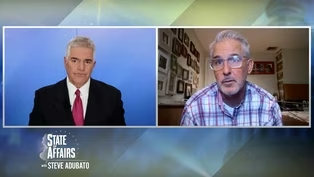
Building new, affordable housing for at-risk veterans in NJ
Video has Closed Captions
Clip: S9 Ep10 | 8m 6s | Building new, affordable housing for at-risk veterans in NJ (8m 6s)
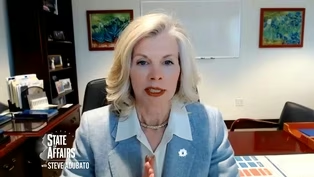
Hackensack Meridian Health Foundation's patient care plan
Video has Closed Captions
Clip: S9 Ep10 | 9m 12s | Hackensack Meridian Health Foundation's patient care plan (9m 12s)
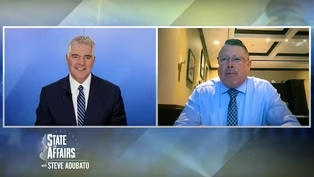
How apprenticeships are shaping the next generation
Video has Closed Captions
Clip: S9 Ep10 | 9m 20s | How apprenticeships are shaping the next generation (9m 20s)
Providing Support for PBS.org
Learn Moreabout PBS online sponsorship
- News and Public Affairs

Top journalists deliver compelling original analysis of the hour's headlines.

- News and Public Affairs

FRONTLINE is investigative journalism that questions, explains and changes our world.












Support for PBS provided by:
State of Affairs with Steve Adubato is a local public television program presented by NJ PBS