One-on-One
Joe Strupp; Angela Santomero
Season 2024 Episode 2738 | 26m 25sVideo has Closed Captions
Joe Strupp; Angela Santomero
Joe Strupp shares the story behind his true crime book, "Death on St. Charles Street," which delves into the mystery behind the chilling murders in his own family during the 1960s. Angela Santomero, Co-Creator of "Blue’s Clues," celebrates her career and highlights the extraordinary lessons adults can learn if they look at life from a child’s perspective.
Problems playing video? | Closed Captioning Feedback
Problems playing video? | Closed Captioning Feedback
One-on-One is a local public television program presented by NJ PBS
One-on-One
Joe Strupp; Angela Santomero
Season 2024 Episode 2738 | 26m 25sVideo has Closed Captions
Joe Strupp shares the story behind his true crime book, "Death on St. Charles Street," which delves into the mystery behind the chilling murders in his own family during the 1960s. Angela Santomero, Co-Creator of "Blue’s Clues," celebrates her career and highlights the extraordinary lessons adults can learn if they look at life from a child’s perspective.
Problems playing video? | Closed Captioning Feedback
How to Watch One-on-One
One-on-One is available to stream on pbs.org and the free PBS App, available on iPhone, Apple TV, Android TV, Android smartphones, Amazon Fire TV, Amazon Fire Tablet, Roku, Samsung Smart TV, and Vizio.
Providing Support for PBS.org
Learn Moreabout PBS online sponsorship- [Narrator] Funding for this edition of One-On-One with Steve Adubato has been provided by Johnson & Johnson.
Horizon Blue Cross Blue Shield of New Jersey.
Here when you need us most.
RWJBarnabas Health.
Let’s be healthy together.
The Turrell Fund, a foundation serving children.
New Jersey Sharing Network.
PSEG Foundation.
Valley Bank.
The Healthcare Foundation of New Jersey.
And by Kean University.
Where Cougars climb higher.
Promotional support provided by The New Jersey Business & Industry Association.
And by BestofNJ.com.
All New Jersey in one place.
- This is One-On-One.
- I'm an equal American just like you are.
- The way we change Presidents in this country is by voting.
- A quartet is already a jawn, it’s just The New Jawn.
- January 6th was not some sort of violent, crazy outlier.
- I don't care how good you are or how good you think you are, there is always something to learn.
- I mean what other country sends comedians over to embedded military to make them feel better.
- People call me 'cause they feel nobody's paying attention.
_ It’s not all about memorizing and getting information, it’s what you do with that information.
- (slowly) Start talking right now.
- That's a good question, high five.
(upbeat music) - Hi, everyone, Steve Adubato.
We kick off the program with a terrific journalist, a compelling author.
He's Joe Strupp, an author of his second crime novel, "Death on St. Charles Street: Discovering My Family's Murderous Secret."
Good to see you, Joe.
- Thanks, for having me, always good to see you.
- You know, Joe, we've had you on before.
What was the last book that you came on to talk about?
- Yeah, that was my first true crime, "A Long Walk Home," which was about Carol Ann Farino, Columbia High School student in Maplewood, who was strangled to death.
Crime is still unsolved.
There we're actually a new effort to get to case reopened by the Essex County Prosecutor's Office and pressuring them for a while, filing requests, and we're not finished.
That was the first one, two years ago.
And then this one, "Death on St. Charles Street," it's also true crime, but in my own family, related to my great aunt and great uncle.
My great aunt was murdered by my great uncle.
In 1962, he also killed two other children and then himself, and it was a big family mystery for years.
And I started delving into it almost 20 years ago and uncovered a lot of interesting pieces that also included mental illness and how his own personal problems and demons took over.
But there's still mystery as to why he did it, because he was not a violent man, did not leave a suicide note.
And a lot of people were left with a lot of questions, and I think I get into a lot of the issues that I think helped answer some of them and let people make their own judgements as well.
- What triggered you to become interested in and then write about this horrific family murder?
- It really started about 20 years ago, I was at a family reunion.
My aunt was showing slides and home movies, and there was a woman in the pictures that I didn't know.
And sure enough, she was my grandmother's sister.
My grandmother was one of six, and this was a sister who obviously died back in 1962.
I had never heard of her.
When I asked what happened, they said, "Oh, yeah, she died before you were born."
And then my wife actually asked how, and my aunt said she was murdered.
Now, of course, that lights off the reporter part of my brain to say, "What?"
And I started looking into it little by little, and then a few years ago after I did the other true crime book, I started to really research, went out to Rapid City, South Dakota, which is where it happened, where my aunt is and where my grandmother's from.
And really dug into the people involved and was able to find a lot of people who knew the family, who knew the couple, and were involved, as well as my mother and her sisters, who were around at the time and had a lot of information.
- This is the Bowman family circa early 1950s.
Your aunt's in this picture, the murderous uncle's in the picture, and two of the kids.
- Yeah.
They had three children, Jack, Maurice, and Bruce.
Jack, the oldest, was actually away at college, the University of Minnesota.
So, he escaped the murder spree.
But the other two were only, I believe, 14 and 16.
They were shot both in their beds while they were sleeping, then he shot his wife and then himself.
They were all found dead the next morning by two guests who happened to be staying in the house in the basement who discovered the bodies.
And they also talked to me and gave me a lot of insight.
And he had had a long history of emotional problems, mental illness.
She had been an alcoholic, but a lot of it was very kept under the wraps.
- And he was John Bowman, John Bowman.
- John Bowman, his wife, Alberta.
She was my grandmother's sister.
- Why do you think it took so long, and also for your entrepreneurial reporting to find this out?
Did your family not talk about it?
- It really was never talked about.
I did not even know it occurred until this reunion about 20 years ago when they just happened to be showing photos.
And I said, "Oh, who's that?"
You know, the reporter, nosy reporter in me always wants to know things.
I'd always been interested in my family history, and this was my mother's side, my grandmother's side.
I really didn't know a lot about them.
My grandfather's side, I knew more about, so they were all from South Dakota, but never really stayed there.
So the history was kind of unknown.
It just came up one moment where I asked a question, and that led to more questions.
And they were very willing to talk to me, which I was surprised and grateful.
And then they started looking into the history of what occurred, newspaper clippings, and actually got some mental health records from my uncle who was suffering from all this depression and anxiety issues, and even tracked down the priest who gave them last rites and people who responded for the funeral home at the time.
A lot of recollections that were very vivid and very helpful.
But yeah, it was not something that was talked about.
Maybe the family didn't really want to go there.
In fact, two of my aunts were very helpful, said they hadn't really thought about it in 40, 50 years, but they were very helpful.
They were very grateful, I guess, to kind of get it off their chest and find out things they said after they read the book that they didn't even know about.
And for me, it was just more connection.
You know, I've covered crime and news, but never, luckily, my own family.
It has that kind of connection as my other book did coming from Maplewood where I lived for 20 years.
So that, I think, personal link is what made it interesting to me.
But yes, it had been very hidden away, and it really wasn't even in a lot of the background of South Dakota famous crimes, even though it was one of the biggest mass murders in their history, for whatever reason, it didn't really get a lot of coverage.
The family didn't really delve into it or want to talk about it.
But when I brought it up, they were very willing to be involved and help me out.
- What happened to John Bowman?
- John Bowman?
Well, John Bowman, the father, killed himself after he killed his wife and the two children.
The oldest son, they called Jack, actually lived on.
They had some trouble times himself.
He went on to finish school, he became an airline pilot for a while, but then he kind of went off the face of the earth and he actually was found dead in 2001 in California.
But his family brought him back and he's buried alongside his brothers and his mother and father in the same cemetery.
- We're talking to our longtime friend, a great journalist, Joe Strupp, "Death on St. Charles Street: Discovering My Family's Murderous Secret."
Joe, the book comes out.
What kind of reaction did you get from your family?
- I was a little nervous because... And my wife was also a little nervous, you know, do you want to be getting into this dirty laundry and, you know, exposing your family's foibles?
But they were all very helpful in researching and the general reaction has been good.
My aunt had a few questions about some things she said she didn't know about, and some other relatives, my cousin called it gripping.
A couple others who aren't even big true crime fans said they liked the history.
There's a lot of history at the time about South Dakota, about life in the '40s, the '50s, you know.
The dust bowl that hit America in the Depression really started in South Dakota as far back as the teens, the 1915, '16s.
And the family, my grandmother's family, was very poor.
They lived on a sharecropper ranch.
They were really living hand-to-mouth in many ways.
Six kids.
My grandmother and her sister, this same sister, actually had to go away to school when they were in junior high school.
They had to go away to live in another town in their own apartment at 14, 15 years old because they were not near a good school where the family was.
- Joe, how much does it bother you that after all this research, all this terrific reporting, the risk, if you will, of writing about a murderous, horrific event in your family, that there are still... How challenging is it for you?
How frustrating is it for you that there's still so many unanswered questions?
- I think that's just the nature of the beast, you know, that not everything is 100%.
You know, all we know is John Bowman had depression issues, anxiety issues.
He had been hospitalized several times.
He had been medicated.
I didn't really know about the medication at the time.
- [Steve] What?
- Yes.
- What year was this?
- 1962, July 29th.
- So mental health.
Treated, addressed, dealt with or not very differently in 1962?
- Somewhat, but not.
I also talked to medical experts, psychiatric experts, criminal experts who said, "Actually for the time, there was interesting diagnosis."
He was diagnosed, he was treated with medication, and was deemed to be okay.
But no, you can't... And even today, some of the experts were telling me, as good as it is today, you still don't always know.
You still can't always predict how someone will act.
That is, as you know, I'm sure for the research you've done, that it's a sliding scale, it's a hit-and-miss.
One person's depression is different from another, it's different from another's.
And the treatment you get depends on who you have as therapists, who you have for medication.
But he was getting treated as far back as 1951 at the Mayo Clinic a little bit and at the Yankton State Mental Hospital there in South Dakota.
And it was still a mystery of why he would do this violent act.
He was not violent.
All the research I found and medical reports on him showed he was a very quiet, more inverted man.
And he left no note, but it was clearly some kind of crime of passion at the time.
And he used a .22 caliber rifle that was in the house.
Big hunting area out there, as you would imagine.
He had gotten rifles for both two of his sons.
And it was believed one of those was the one he used because it was right at hand.
It's not like he went out, and bought a gun, and planned it ahead.
It happened to be there.
Now, would that have happened if the gun had not been there?
Who knows?
But there are a lot of unanswered questions.
Even though we do know who did it, the question, of course, is: Why?
- To shift gears, and by the way, the book is "Death on St. Charles Street: Discovering My Family's Murderous Secret."
Got a minute and a half left.
You know media better than most.
You've written about it, you've profiled some of our work over the years.
How optimistic are you about where media is, where we are going, and its connection to democracy in a minute or less?
- I'm always optimistic because if you're not, why are we here doing this business?
But I am very concerned, yes.
The media lately, and you know, thank you for mentioning that in my first book, "Killing Journalism," that there is a continued growth of corporate oversight, of consolidation of media, and, as my first book said, laziness, and greed, and getting the easy story.
And with social media, as you know, something goes out on social media, it's hard to unring that bell.
A lot of misinformation is out there, and that's what has to be fought.
I'm optimistic, but I'm probably equally or even more worried that we're going down a tough hole in many ways, and I hope it can get turned around.
But I'm fearful, but also optimistic.
- Last question on this show.
Is there a place for moving forward this kind of in-depth conversation?
By the way, check out our website, steveadubato.org.
It'll come up, the previous interview we did with Joe on his book, "Killing Journalism."
It's a tremendous book, it's in my library.
- Thank you.
- Under the Media and Journalism section, I refer to it consistently.
Is there a place for meaningful dialogue?
Where do we have to do it?
30 seconds or less.
On social media.
- No, so there has to be meaningful dialogue, and there is a lot of outlets.
That's one positive.
Podcasts, websites, discussions like this are crucial, but people have to know that media literacy has to be taught and has to be engaged by the consumer to know how to find the right outlets that you can trust, not just assume anything out there online or on the air is valid because they're all not.
You have to be discerning.
- Joe Strupp, a terrific journalist, a long-time friend of our series.
You'll see this on One-on-One and maybe some other platforms.
But primarily One-on-One, we're featuring a whole range of authors doing really important work.
Books still matter.
"Death on St. Charles Street: Discovering My Family's Murderous Secret."
Joe Strupp, also the author of "A Long Walk Home" and "The Crookedest Street."
Check Joe's book out.
Check out his website and all this stuff he's doing.
Hey, Joe, thanks buddy.
Good to see you.
- Thank you always, Steve.
Be well.
- You got it.
I'm Steve Adubato, that's Joe Strupp.
Stay with us, we'll be right back.
- [Narrator] To see more One on One with Steve Adubato programs, visit us online at stateofaffairsnj.org.
If you would like to express an opinion, email us at info@caucusnj.org.
Find us on Facebook at facebook.com/steveadubatophd and follow us on Twitter @steveadubato.
- We're now joined by Angela Santomero who is co-creator of "Blue's Clues," you remember that series "Blue's Clues," and creator of "Daniel Tiger's Neighborhood," and the author of "Life Clues: Unlocking the Lessons "to an Exceptional Life."
Angela, great to see you again.
- So good to see you again.
- Tell people how far back we go and where you were in your career at the time when I did that first interview with you.
- I feel that we were just launching "Blue's Clues," and it was just getting really big, but I don't want to say how long ago that was.
- Don't do it.
Don't do it.
Don't do it.
So how about this.
I remember that interview.
I remember, I mean, our kids all grew up on "Blue's Clues."
Explain to folks your connection to "Blue's Clues," how that happened, and how it changed the trajectory of your life professionally.
- Well, thank you.
I have a master's in child developmental psychology, and I wanted to do an interactive game show that would have kids learn kindergarten readiness skills and that they would love and fall in love with Blue, a little animated blue puppy.
Anyway, it took my career into a whole other direction: 10 years, 80 people, full-time.
Then we took a little break.
We came back.
We did more productions.
And we just launched with season five of a reboot of "Blue's Clues & You."
- Could you do this?
As people who grew up in public broadcasting, Fred Rogers was and still is Fred Rogers.
But, for you, Fred Rogers, Mr. Rogers, huge impact.
Talk about that please.
- I was such a fan, like a real fan, right, as a preschooler.
And then, as I got older, I realized that he had a master's in child developmental psychology, and he really made sure that what he was telling kids was with respect, and he looked right into the camera.
Anyway, it really moved me, and so much so that we really did study "Mister Rogers' Neighborhood," and I got a chance to call him and talk to him and meet him, and we became friends because I would talk all the time about that show and his show, and he was such an impact on me as a person and then me as a career.
- What particularly inspired you about Fred Rogers?
- He looked through the camera in such a way that was so mesmerizing that it brought you in, and the kinds of conversations he was having on the show were so impactful.
He was talking about anger and divorce and, you know, just literally having big, big questions.
- And racism.
- And racism.
- Racism and prejudice.
- Brilliant, right?
So ahead of his time.
So brilliant.
So, it was like, it was a huge dream come true for me to do "Daniel Tiger's Neighborhood" in honor of his legacy.
- That was in honor of Fred Rogers!
How so?
- It's literally, it's the Neighborhood of Make-Believe, but we animated the whole thing.
We animated it, and all of the characters have grown up, and they all have preschoolers of their own, and we follow a little 4-year-old Daniel Tiger, and we also added a little real life street so that we could meet Music Man Stan, and we could meet Baker Aker and have all of these helpful adults in that world and mimic what, or be inspired by and mimic what Fred did.
And for the first seven seconds of the show of "Daniel Tiger's Neighborhood," it's exactly as Fred did it, where Daniel has a little red sweater that he zips.
He has little sneakers that he throws from.
It was a dream come true to work with The Fred Rogers Company and make that happen.
- Let's shift gears to the book.
"Life Clues: Unlocking the Lessons to an Exceptional Life."
So this is a quote from, I'm not gonna obsess over Fred Rogers, but I want you to take this and go with it because it's life clue number one.
"I like you just the way you are, every part of you, "your skin, your eyes, your feelings, "whether new or old, old or new.
"I hope that you'll remember even when you're feeling blue "that it's you that I like."
Fred Rogers. "
I like you just the way you are."
Why is that so important to you?
- You know, it still brings me to tears, those beautiful lyrics of that song and that idea that we can give that to kids, that you can literally look through the camera and say, "I like you just as you are."
It's such a beautiful self-worth elevating thing that we need as adults as well.
And I think that we forget that.
We forget that we need that, and it really does fill our cup.
And so that was why it had to be the first clue.
You know, having even just one person who believes in you can make such a huge difference.
- I want to ask you about other clues but real quick.
Social media.
Our daughter happens to be 13, and it's scary sometimes.
I look at her Instagram account.
I think she wants to block me, but she can't.
And I look, and I don't want to go into a whole big thing about this, but I do ask myself to what degree young men and young women, boys and girls, like themselves just the way they are.
And I know I'm complicating things, but I'm not convinced they do.
- It's hard.
It's a really hard time for them.
And I do think it's our support and us knowing what's going on as much as we can, and saying it as parents.
The weight of our words, no matter what's going on with friends.
You know, it's really important how many likes you have.
It's really important that they know that we believe in them, and we support them, and we love them.
And also that they control the social media on their point of view, right?
They can control it, what they're putting out in the world, how they're using it.
It's not controlling them, which I think is also a really important thing to remember.
- You're a parent.
How much does it impact the life clues you write about?
- You know, actually, these are the clues that I wanted my adult girls to take with them.
So, you know, they're lessons for preschoolers.
And then I kept thinking, "Oh my gosh.
All of this research that we put into this, these are the clues that I want the girls to take with them as they go out into the world as adults.
These are the things that they should still remember about how to deal with disappointment and anger and believing in themselves.
- Let stay on clues.
Give us a couple of other clues that, 'cause there's so many, and there's the book right there, "Life Clues."
Another clue that you say... You know what?
You know what, I'm gonna be more specific.
I'm a communication coach in my other life, and I studied this in my academic life, public communication, and you have such an interesting communication life clue.
"Pause before speaking, and be an attentive listener."
How the heck is that a life clue?
- It changes your perspective on everything when you can literally allow yourself the gift of focusing in on somebody and their conversation, and it is a gift that you're giving someone else.
And I think that we obviously communicate in so many different ways every day, probably every minute of every day, and to remember that it's such a gift to put ourselves into that space and be one-on-one with somebody, right?
We're not looking at our phone.
We're not multitasking.
We're literally just focusing.
And that five minutes can even be uplifting to you because you're making that connection with somebody.
So, for me, it's critical to living a joyful life, to living a life where you're feeling grounded in yourself.
- I'm pausing before I'm speaking.
(laughs) So how about this?
Is it harder than ever to be present?
- Absolutely, it is harder than ever to be present, and it's even more important to take that pause before saying yes to everything, before instantly gratifying and buying the next thing that you see on an Instagram ad, right?
It's like taking a minute to just kind of reflect whether or not you should say yes to something, whether or not you should say no to something.
We're multitask.
We're available 24/7.
You know, it's that kind of thing where I can put do not disturb on my phone, but my kids can break through that in case there's a problem.
(laughs) So you're always available.
- You have another one.
"Never stop playing."
- Yeah.
We are...
Right.
Life is so serious; life is so hard.
As an adult, we age so fast as soon as we really fall into it.
- Yeah, I noticed on my end.
- (laughs) You do!
And you get that fear, and it's true.
All of these things are true.
It's stressful.
We have a lot to do.
But if we can look at things through the lens of this is a journey.
We're gonna make mistakes, right?
These are all the things that you do when you play, right?
You're trying something new.
You never stop learning.
You're being a little bit more playful.
You're adding some of these really fun bonding questions when you're having a dinner party, like you're breaking the ice.
Like, it's just everything is so much more fun.
Even the things that are hard can be a little bit lighter.
- You have a quote here from Deepak Chopra under life clue number nine: cultivate routines.
"See the world as if for the first time.
"See it through the eyes of a child, "and you'll suddenly find that you are free."
Deepak Chopra.
Cultivate routines.
What do you mean?
- It's exactly what we do for little ones, right?
We make sure that they have snacks when they're hungry.
We make sure that they nap when they're tired.
We make sure that they have a specific type of routine that they do every day because there is such a relaxation to that security of knowing that.
And it works for adults as well, right?
Having a weekly meeting in the morning.
Figuring out what you're doing over your coffee.
Like, having these little routines and really remembering to eat when you're hungry and those kinds of things.
Like, those little routines and that ability to nurture yourself should never go away.
- Before I let you go, first of all, it is wonderful to see your success from the first time we talked to each other when you were just breaking in as a very, very young professional in the field.
To see the work you've done and that you'll continue to do is so exciting.
The passion that you have for what you do is off the charts because?
- You know, I love it so much.
I'm not really sure.
I'm such a kid advocate.
I love the process.
I love what we're saying to kids, and I love getting the feedback back from parents and adults when I write and the messages that I put out in the world.
So I do.
I just love it.
- Angela Santomero, co-creator of "Blue's Clues," creator of "Daniel Tiger's Neighborhood," and the author of "Life Clues: "Unlocking the Lesson to an Exceptional Life."
See you next time.
I'm Steve Adubato.
That's Angela.
- [Narrator] One-On-One with Steve Adubato is a production of the Caucus Educational Corporation.
Celebrating 30 years in public broadcasting.
Funding has been provided by Johnson & Johnson.
Horizon Blue Cross Blue Shield of New Jersey.
RWJBarnabas Health.
Let’s be healthy together.
The Turrell Fund, a foundation serving children.
New Jersey Sharing Network.
PSEG Foundation.
Valley Bank.
The Healthcare Foundation of New Jersey.
And by Kean University.
Promotional support provided by The New Jersey Business & Industry Association.
And by BestofNJ.com.
- [Narrator] To watch more One on One with Steve Adubato find us online and follow us on Social media.
- If you register as an organ donor, you have the potential of saving up to eight lives.
- My neighbor passed away.
His eyes were actually donated and that person now can see.
- Not only can you save a life, but if something should happen to me and I'm no longer here, I know that in some small part I'll live on in someone else.
- Say yes, save lives.
- Say yes, save lives.
- Say yes, save lives.
- Be an organ and tissue donor.
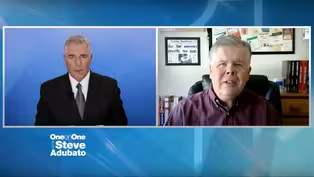
Author Joe Strupp Shares His Own Family's Murder Mystery
Video has Closed Captions
Clip: S2024 Ep2738 | 13m 54s | Author Joe Strupp Shares His Own Family's Murder Mystery (13m 54s)

Co-creator of Blues Clues Shares Important Life Lessons
Video has Closed Captions
Clip: S2024 Ep2738 | 11m 45s | Co-creator of Blues Clues Shares Important Life Lessons (11m 45s)
Providing Support for PBS.org
Learn Moreabout PBS online sponsorship
- News and Public Affairs

Top journalists deliver compelling original analysis of the hour's headlines.

- News and Public Affairs

FRONTLINE is investigative journalism that questions, explains and changes our world.












Support for PBS provided by:
One-on-One is a local public television program presented by NJ PBS