One-on-One
John El-Maraghy; Julie Flores-Castillo; Peg Wright
Season 2026 Episode 2933 | 27m 10sVideo has Closed Captions
John El-Maraghy; Julie Flores-Castillo; Peg Wright
John El-Maraghy, Co-Founder of Archangel Raphael’s Mission, discusses how he prioritizes health and hygiene for homeless individuals. Julie Flores-Castillo, Youth Organizer for the NJ Immigrant Rights Program for American Friends Service Committee, discusses uplifting immigrant voices. Peg Wright, CEO of The Center for Great Expectations discusses her mission to break the cycle of homelessness.
Problems playing video? | Closed Captioning Feedback
Problems playing video? | Closed Captioning Feedback
One-on-One is a local public television program presented by NJ PBS
One-on-One
John El-Maraghy; Julie Flores-Castillo; Peg Wright
Season 2026 Episode 2933 | 27m 10sVideo has Closed Captions
John El-Maraghy, Co-Founder of Archangel Raphael’s Mission, discusses how he prioritizes health and hygiene for homeless individuals. Julie Flores-Castillo, Youth Organizer for the NJ Immigrant Rights Program for American Friends Service Committee, discusses uplifting immigrant voices. Peg Wright, CEO of The Center for Great Expectations discusses her mission to break the cycle of homelessness.
Problems playing video? | Closed Captioning Feedback
How to Watch One-on-One
One-on-One is available to stream on pbs.org and the free PBS App, available on iPhone, Apple TV, Android TV, Android smartphones, Amazon Fire TV, Amazon Fire Tablet, Roku, Samsung Smart TV, LG TV, and Vizio.
Providing Support for PBS.org
Learn Moreabout PBS online sponsorship- [Narrator] Funding for this edition of One-On-One with Steve Adubato has been provided by The Russell Berrie Foundation.
Making a difference.
RWJBarnabas Health.
Learn More at RWJBH.org.
The Fund for New Jersey.
The Burke Foundation The New Jersey Education Association.
Rowan University.
The fastest growing public research institution in the Northeast.
South Jersey Industries.
The parent company of South Jersey Gas, and Elizabethtown gas.
New Jersey Sharing Network.
And by The Center for Autism Promotional support provided by New Jersey Globe.
And by Meadowlands Media.
A print and digital business news network.
- This is One-On-One.
- I'm an equal American just like you are.
- The way we change Presidents in this country is by voting.
- A quartet is already a jawn, it’s just The New Jawn.
- January 6th was not some sort of violent, crazy outlier.
- I don't care how good you are or how good you think you are, there is always something to learn.
- I mean what other country sends comedians over to embedded military to make them feel better.
- People call me 'cause they feel nobody's paying attention.
_ It’s not all about memorizing and getting information, it’s what you do with that information.
- (slowly) Start talking right now.
- That's a good question, high five.
(upbeat music) - Hey, everyone, Steve Adubato.
You want to know what this week is?
It’s Making a Difference week right here on One on One.
What is making a difference?
We’ve been celebrating people who have been making a difference for years, for three decades in cooperation with our partners At the Russ Berrie Foundation.
They every year hold the making a difference awards.
People who are unsung heroes, people who care, people who lead nonprofits, people who are not affiliated with any organization, but are making a difference in their community.
All this week, people making a difference, Russ Berrie Making a Difference awardees.
Three tonight, honorees all week, every one of them, making a difference.
Let’s check them out.
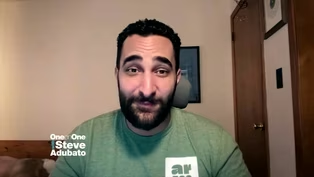
- We're honored to be joined by John El-Maraghy, who's founder of Archangel Raphael's Mission, otherwise known as ARM.
And John is a winner of the 2025 Russ Berrie Making a Difference Award, and I was honored to meet him at that event that I was glad, really proud to host.
John, how you doing?
- Good, how are you?
It was good to see you again, Steve.
Thanks for having me on today.
- That was a great event.
You and a whole range of other leaders making a difference.
Tell folks, as we put up the website for your organization, what it is and how it's connected and committed to hygiene access, which people don't talk about a lot but is important.
Go ahead, John.
- Absolutely.
Yeah.
So ARM is a grassroots organization that operates in Central and North Jersey.
We prioritize health, and hospitality, and hygiene as means of connecting to and supporting people experiencing homelessness and other forms of need.
- John, first of all, who are we talking about?
Who are you serving, and how do most folks wind up in a situation where access to hygiene services just doesn't happen?
- Yeah.
Absolutely.
So, you know, I always like to point out that there's about 500,000 shelter beds in the country.
It's about 100,000 feeding programs throughout the country.
And honestly, that's probably not enough, or we know for a pretty good fact that that's not enough.
But by our estimations, there's about less than 20 organizations like ARM.
So mobile hygiene, it's mobile showers and mobile barbershops.
So that is a particular need that we see in almost every community that we go in.
The overwhelming majority of folks that we serve are people that are experiencing homelessness or other kinds of material need, whether they be working class, literally homelessness or temporarily homeless.
- The mobile barbershop, talk about that.
- Yeah, so the mobile barbershop, it's actually my favorite program of the two that we run, for a couple reasons.
The first one is just a lot more inclusive.
So, generally speaking, folks that utilize our mobile shower program tend to be experiencing homelessness, whereas a lot of the folks that we serve with our mobile barbershop are children, working class families, everyday people.
So it's just, you know, it's just a much more inclusive form of service, and it's also the most visually transformative service.
You know, someone sits in a chair, 20, 30 or so minutes later, they look entirely different.
They feel entirely different.
And it's a really special thing to see.
- Hey John, where are these mobile services?
Where can people find them?
- Yeah, so ARM operates primarily in the warm weather months from about May to about October.
The mobile barbershop can deploy beyond that scope though.
And we operate in most or many cities in Central and North Jersey.
So New Brunswick, Newark, Jersey City, Hoboken, and we're actually gonna be expanding into Montclair this year.
- I know, my hometown.
There's been a lot of talk about that.
What is the initiative, Tap into Dignity?
Talk about that.
- Yeah, so one of the things that both as a challenge for us as a grassroots organization and something that we really prioritize, is getting to know people in the communities in which we work.
So when we kind of decided to put together... When we met up with some of the team in Montclair and we were putting together this service profile, we thought it would be fun to have just like a happy hour fundraiser that ended up being attended by about 50 or so people.
Mostly a combination of existing ARM supporters and local residents in Montclair.
And we were able to raise enough money for one deployment.
We're shooting for about four this year in Montclair, and it was at the Montclair Brewery.
It was a really great day.
- Montclair Brewery is a great place in town.
John, I'm curious about this.
How'd you get into this?
- Yeah, so I love talking about this because I feel like, you know, so many people that get into this work are personally affected by this work, and I'm honestly not.
I'm very lucky.
And it's part of that realization of luck.
When I was in college, I was honestly squandering my opportunities.
I wasn't very interested and I kinda came to the realization that the only reason that my decisions didn't have worse consequences was because I had a support system.
I had family and friends that pointed me in the right direction.
And I frankly realized that I was being selfish.
And so I decided to take the first volunteer opportunity that came my way, which my buddy was driving me down the street and he's like, "Hey, later today we're gonna go down to the train station and hand out some sandwiches.
Do you wanna come with me?"
So of course I did, and that ended up being part of the crew that ended up starting ARM.
- What triggered for you when you were handing out those sandwiches?
- I think it was a realization of, at the time I was studying public health and I was working in the restaurant industry, and there seemed to be a little bit of a disconnect between the way that we provide social services and the way that we provide other services in our community.
So you sit down at a restaurant, you know, you're greeted, you have, you know, steps of service.
There are all these things that make you feel special.
It's one of the reasons outside of delicious food and drinks that people go out.
And I didn't see that as much in social services.
And so, one of the things that we wanted to incorporate early on into our work was this sense of dignity and hospitality into the programs that we deploy.
- We're gonna put up the website again right now.
If people want to be helpful, they go on the website.
How can they do it?
- Yeah.
So you can visit www.Arm.Gives, no .com or .org after that, you know, can be a little messy with some people.
But there's a donate button and there's also a volunteer button.
If you live in one of these areas where we're gonna be operating this summer, I encourage you to check it out and volunteer.
If you're not in the area but you wanna support our work, the donation is always welcome.
- John, last question.
Many of the people you help struggle with housing issues, some of them are homeless, right?
United States Supreme Court made a decision that's allowing certain communities to vote through their municipal government to criminalize homelessness.
What's the impact of that for the people you serve?
- There's a massive impact, particularly from the hygiene lens.
I always like to point out when, you know, we all have... These are basic human needs.
So if you have to relieve yourself and you can't find a restroom, or if you need to wash up and you can't find a shower, you have to resort to other methods like relieving yourself outdoors or locking yourself into a bathroom.
And that has, you know, cascading issues in terms of legal involvement, and what that means for your self-sustainability.
- John El-Maraghy, founder of a terrific organization, Archangel Raphael's Mission, otherwise known as ARM.
To you, John, and to all the folks that I was honored to meet, 29th anniversary of the Russ Berrie Making a Difference Award, they've been honored for 29 years, to emcee that event and to work with so many great people at the Russell Berrie Foundation and to meet leaders like yourself who choose to make a difference, you know, as the late Russ Berrie said, these are unsung heroes, people who don't seek out attention, but they make a big difference, well done, John.
Thank you for your service.
- Thank you, Steve.
Thanks for bringing us on today.
- You got it.
Stay with us, we’ll be right back.
- [Narrator] To watch more One on One with Steve Adubato find us online and follow us on Social media.
- Hey folks.
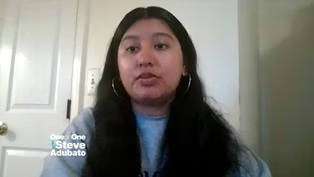
We're now joined by Julie Flores-Castillo, who is Youth Organizer at the American Friend Service Committee for the New Jersey Immigrant Rights Program.
Julie, good to see you again.
- Thank you so much for having me here today.
Really appreciate it.
- You got it.
And this is part of our "Making a Difference" series.
We're do in cooperation with the Russell Berrie Foundation.
You're a winner of the Making A Difference Award.
We're focusing on the next generation of leaders making a difference.
Tell folks exactly what the New Jersey Immigrant Rights Program is all about and the American Friends Service Committee, please.
- Through American Friends Service Committee and their New Jersey Immigrant Rights Program here in New Jersey has served for over 30 years providing legal services to the immigrant community and also pushing forward for advocacy and policies that help support immigrants here in the state.
And we also do different things with our social workers and also with youth.
- When you were 14, your life changed.
Talk about it.
- When I was 14, my father was deported during my freshman year of high school.
And after that experience, I experienced a lot of trauma and a lot of isolation.
But through the months pass, I actually met an organizer from AFSC, and that's how I was introduced to the world of advocacy and immigrant rights.
- So it's interesting, this horrific situation happens for you and your family.
You're isolated, as you said, you're dealing with trauma.
What caused you, Julie, to not simply get caught up in your own pain and suffering, but rather decide to help others?
- I think for me personally, it was a lot of factors, but one of the things that relates to the work that I do now with education immigration is my eighth grade teacher, Ms.
Cluck, who was a English teacher at Red Bank Middle School, and she talked about civil rights and the Farmer Workers Movement and to speak up for those who aren't seen and at a time without experiencing the trauma, I felt a sense of myself to do something, to learn more.
And I went up to the organizer for American Friend Service Committee here in Monmouth County, Itzel Hernandez.
And I decided right then and there to just share my experience.
Little did I know that it would completely change my life.
- Wow.
- You've said to our producers, you've said publicly that one of your goals is to humanize immigration.
People often talk about the numbers.
How many people crossing the border, how many people not crossing the border right now?
How many people have been detained?
How many people have been taken off the streets by ICE?
Be they here illegally or not, be they having a criminal record or not?
That being said, what do you mean by humanize immigration, Julie?
- In addition to the question that you just asked me, also seeing immigrants as in numbers, as in they provide this much in taxes or many of them make up this kind of workforce.
And when I speak about humanizing the issue, I mean bringing it down so that people who are truly impacted by what's going on every day, immigration is not just a certain issue on either side.
It's an issue that's been affecting people for decades and decades.
There's been no immigration reform in over 30 to 40 years.
And I think most often than not, people forget that these issues affect people that they know, their neighbors, their teachers, students who attend these schools.
And so by me sharing my story, I try and humanize this issue because it's often divided by rhetoric and other stereotypes.
So that's what I try and do by sharing my story and letting others know that I'm not just the only one who's experienced a deportation.
If not, I know other students and young people who have experienced this as well.
- I appreciate and understand that you don't wanna talk about your dad in detail.
I respect that.
We all do.
But there's another side to this that I've been wondering about.
When I first saw you at the Russell Berrie Making a Difference Awards, I've been honored to host MC for 30 years now, before you're even, well before you're even born.
But I'm curious about this.
You're 21 right now, right?
- I actually turned 22 in September recently.
- Congratulations.
- Thank you.
- How do you think, since you talked about humanizing the issue of immigration, how do you think this experience, this fight, this advocacy, has changed you as a person?
- It's changed me as a person in several ways, but I would say for the better because I've been learning about myself, but also learning about how to be a good leader by opening doors for other young people, telling 'em about other opportunities, showing that even when times are very difficult, especially right now, even for young people who have experienced something like I have, there is a sense of community.
There's a village who's willing to fight for me, for other people, for so many others.
And that through all this, resilience will always overcome.
So in that sense, that's how it's truly changed me through knowing that resilience exists in all different types of ways.
- Hmm.
This isn't a political question, but people will take whatever they choose to take from it.
But what would you say to, given your experience, not just personally, but also as an advocate, what would you say to the president?
What would you say to ICE agents, be they masked or not?
Saying all we're really trying to do is remove people who are here illegally.
That's it.
We're just abiding by the law.
You say what to them?
- I would say that this isn't just about immigration.
If not, what we're experiencing right now is a constitutional crisis, whether that be for immigrants and for residents and US citizens overall.
This isn't just an immigration crisis that we're experiencing.
This is a constitutional crisis where we have seen US citizens and other people who have been here legally, who have been detained and have been deported without due process.
So this is a constitutional crisis.
- Have you become more political through this?
- I've always been very political.
- Really?
- I've always been very political.
I would say, after my experience, that's what pushed me to learn more about immigration.
And not just that, but how this country truly works, how government works, but also how to get involved in local politics and also being a candidate myself.
- Are you running for office?
Are you thinking of running for office?
- I'm currently an elected county committee woman for the Red Bank Democratic Party, and I also just recently ran for Red Bank School Board as a- - By the way, that thumbs up was not for the Democratic Party, it is for Julie getting more involved.
Last thing before I let you go, message to other young people who say, "What's the difference what I do?
"The the world is going to hell in a hand basket," which is a weird expression, "But I can't make a difference."
You're making a difference, message to them right now.
Go ahead.
- My message to young people is to not fall into this nihilism, to not fall into this pessimistic attitude, but if not, truly see that there's other young people that are getting motivated and who are getting out and doing something, and to please not let what's going on discourage them in any way because there is so much more and there's always going to be a fight that's worth fighting for.
- Julie, I've said this a million times, well, not a million, but a lot.
I teach, coach, write and try to learn about leadership every day.
I'm pretty sure I know a strong leader when I see her and I see that leader in you, and I wish you all the best, your family all the best, and consider this this space a safe space to share your thoughts and to have a conversation moving forward.
Thank you, Julie.
Appreciate it.
- Thank you so much.
I deeply appreciate it.
- You got it.
I'm Steve Adubato, that's a real leader.
Stay with us, we'll be right back.
- [Narrator] To watch more One on One with Steve Adubato find us online and follow us on Social media.
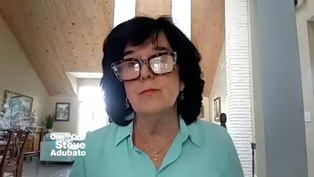
- We're now joined by Peg Wright, President and CEO of the Center for Great Expectations.
Good to see you, Peg.
- Thank you, it's great to see you, Steve.
- And you're also a Russ Berrie Making a Difference Awardee, correct?
- I am, yes, I'm proud of that.
- Yeah, tell us what the Center for Great Expectations is.
The website's up.
- The Center is a continuum of care for pregnant and parenting women that are presenting with substance use and mental health disorders.
So we do that in residential settings, outpatient settings, in home, child development, a whole continuum of care.
- Talk to us about government funding cuts, it matters.
What cuts, what are the cuts and how have they affected the people you serve every day, Peg?
- It's a bit of a nightmare.
We received SAMHSA funding, federal funding for 10 years, and then.
- Hold on, SAMHSA that's an acronym that not everyone knows, what is it?
- That's the Federal Substance Abuse and Mental Health Administration - Okay.
- At D.C.
And yeah, we received 500,000 for the last 10 years, which allowed us to serve Medicaid and underinsured individuals in our outpatient saying, that's gone.
I'm praying we have about $600,000 shortfall on the outpatient, which is a critical component of our continuum.
So I'm praying that we get that funding somehow.
We lost our state appropriation.
I'm hopeful that we can get a supplemental legislative appropriation in sometime in November.
That's roughly 1.5 million.
- It's interesting how some legislators and others are critical of those items that are added to the budget, those supplemental items.
As a former state legislator, I represented a district where there were dollars that we brought back to the district that we believe helping community members, helping municipalities, helping nonprofits like yours.
For those who say, hey, that's pork barrel stuff that they used to call them Christmas tree items.
Explain to folks why that is it 1.5 million?
- The legislators that had supported our appropriation really would like it to be a line item in the budget.
Maternal mortality is a critical issue in the state of New Jersey, and we are the premier provider of pregnant and parenting women presenting with substance use disorders.
So it's a no brainer for me.
- But I wouldn't call that pork barrel.
- No.
- Describe for us, Peg, the term trauma-informed care.
What does that look like?
- Well, the women that we serve have been generationally impacted by trauma, which includes poverty.
Complex trauma is, for example, living in a home with a mom that is using substances.
There's a tremendous amount of dysregulation going on.
There's, you know, food source is lacking, there are just a number of issues that create domestic violence.
So if you don't look at the underlying causes of substance use, it's a problem.
It's a big problem.
And, you know, we've been evolving a way of delivering care over the last number of years and collecting data.
We work very closely with Rutgers University, so it's just not my idea.
We have the data to prove it, and we're about to launch the Relational Recovery Model, which we've been working on for three years with Dr.
Denise Hien at Rutgers, and Dr.
Emily Bosque, who's the co-author along with my team.
So it's a big deal.
- Here's the thing that I'm not struggling with, but trying to make sense of.
We talk about these funding cuts.
We talk about certain programs that you and your team are leading at the Center for Great expectations.
We'll put up the website again.
Talk to folks about what happens to those women, those families, without those resources, if your organization can't provide those services?
- Well, the cycle continues.
And, you know, quite frankly, you know, living in the types of environments that the women that are referred to us live in without significant support.
And, you know, substance use is not an acute illness.
It doesn't, it's not one and done.
So someone doesn't come into my program for nine months and we just say, that's it.
They access outpatient care.
They access an in-home team that works with them for potentially 18 months in clinical case management, doula support, and peer support.
So we've recently partnered with Robert Wood Johnson University Hospital in providing their women with our care, which is really a big deal.
- Peg, how'd you get into this work?
- I'm a woman in long-term recovery.
You know, I was in a corporate setting.
It was the late 80s, you know, 90s.
I was selling diagnostic imaging equipment.
We partied hardy, and I had my, I got pregnant late in life.
And when I did, the light bulb went on and I said, I just can't live like this.
And ended up volunteering at Great Expectations Maternity Home, met Sister Rita Wilkie, and she changed my life.
- Wait a minute, you got help from the Center for Great Expectations?
- Not formally, no, you know, I was one of those lucky people, I didn't... and I'm not saying I did not get help at Great Expectations.
We were a maternity home at that point.
- Well, why'd you start volunteering?
- Because I was bored.
My son was at two years old then he was in preschool.
So it was a God thing, Steve, really it was.
And then I met Sister Rita, and she created a mission statement that spoke to Safe Place, Safe Presence, and Safe Path.
And that was in 1996 before people were even using the word trauma-informed.
- And PS, the Robert, excuse me, the Russ Berrie Foundation, being an awardee also means there's a grant that goes with it.
Those dollars matter, do they not?
- Oh, big time, that was just a magical day.
- It was, it was, - It was just.
- I was proud to host it with wonderful people like you.
- You did a great job.
And it was so wonderful to be with others that are impacting the community when it was really a tough, it's a tough time.
It's hard right now.
- Hey, Peg, you have an open invitation, we'll continue.
I know you're dealing with incredibly difficult fiscal challenges.
We will be here to continue to promote the work that you and your colleagues are doing and drive people to your website.
Thank you Peg, we appreciate it, all the best.
- Thank you very much, very grateful.
- I'm Steve Adubato, thank you for watching.
We'll see you next time.
- [Narrator] One-On-One with Steve Adubato is a production of the Caucus Educational Corporation.
Funding has been provided by The Russell Berrie Foundation.
RWJBarnabas Health.
Learn More at RWJBH.org.
The Fund for New Jersey.
The Burke Foundation The New Jersey Education Association.
Rowan University.
South Jersey Industries.
New Jersey Sharing Network.
And by The Center for Autism Promotional support provided by New Jersey Globe.
And by Meadowlands Media.
- (Narrator) Definitions are overrated.
They mean one thing.
They box you in.
They limit you.
But Rowan is built different, for people like you.
You want to put the world on notice.
You need more than what’s expected.
You thrive on your own terms.
You defy definition.
Rowan University, in person and online.
Breaking the cycle of homelessness and addiction in NJ
Video has Closed Captions
Clip: S2026 Ep2933 | 8m 38s | Breaking the cycle of homelessness and addiction in NJ (8m 38s)
Immigration activist discusses uplifting immigrant voices
Video has Closed Captions
Clip: S2026 Ep2933 | 9m 42s | Immigration activist discusses uplifting immigrant voices (9m 42s)
Prioritizing health for the homeless population in NJ
Video has Closed Captions
Clip: S2026 Ep2933 | 8m 37s | Prioritizing health for the homeless population in NJ (8m 37s)
Providing Support for PBS.org
Learn Moreabout PBS online sponsorship
- News and Public Affairs

Top journalists deliver compelling original analysis of the hour's headlines.

- News and Public Affairs

Today's top journalists discuss Washington's current political events and public affairs.











Support for PBS provided by:
One-on-One is a local public television program presented by NJ PBS