State of Affairs with Steve Adubato
John Schreiber; Ranjit Nair; Dr. John Bonamo
Season 5 Episode 24 | 27m 34sVideo has Closed Captions
John Schreiber; Ranjit Nair; Dr. John Bonamo
John Schreiber talks about the new arts and programming initiative around community health; Dr. Ranjit Nair discusses the key differences between leadership & management and the importance of humanization in the workplace; Dr. John Bonamo discuss the reasons why RWJBH is requiring all hospital staff to be fully vaccinated and the importance of updating COVID restrictions across the nation.
Problems playing video? | Closed Captioning Feedback
Problems playing video? | Closed Captioning Feedback
State of Affairs with Steve Adubato is a local public television program presented by NJ PBS
State of Affairs with Steve Adubato
John Schreiber; Ranjit Nair; Dr. John Bonamo
Season 5 Episode 24 | 27m 34sVideo has Closed Captions
John Schreiber talks about the new arts and programming initiative around community health; Dr. Ranjit Nair discusses the key differences between leadership & management and the importance of humanization in the workplace; Dr. John Bonamo discuss the reasons why RWJBH is requiring all hospital staff to be fully vaccinated and the importance of updating COVID restrictions across the nation.
Problems playing video? | Closed Captioning Feedback
How to Watch State of Affairs with Steve Adubato
State of Affairs with Steve Adubato is available to stream on pbs.org and the free PBS App, available on iPhone, Apple TV, Android TV, Android smartphones, Amazon Fire TV, Amazon Fire Tablet, Roku, Samsung Smart TV, and Vizio.
Providing Support for PBS.org
Learn Moreabout PBS online sponsorship- [Narrator] Funding for this edition of State of Affairs with Steve Adubato has been provided by Horizon Blue Cross Blue Shield of New Jersey.
Here when you need us most, now and always.
TD Bank.
The North Ward Center.
NJ Best, New Jersey'’s five-two-nine college savings plan.
Johnson & Johnson.
The Healthcare Foundation of New Jersey.
United Airlines.
PSE&G, committed to providing safe, reliable energy now and in the future.
And by Community FoodBank of New Jersey.
Promotional support provided by NJ.Com, keeping communities informed and connected.
And by The New Jersey Business & Industry Association.
[INSPRATIONAL MUSIC] - Hey folks, Steve Adubato here.
We welcome back our good friend down at the New Jersey Performing Arts Center, John Schreiber, who's the President and CEO.
How you doing my friend?
- I'm well, how are you?
- I don't know, why am I yelling?
I mean, we haven't been in the studio for a while, and I'm just a little out of practice.
Hey, John talk to us, as we are into the fall of 2021 going into 2022, what is going on in NJPAC today?
And what do you plan for the new year?
- So we are- during pandemic, we were really busy.
We never stopped producing, we never stopped working.
We delivered over 500 virtual events over the last 18 months.
Cultural events, education programs, conversations around social justice.
And what we discovered during pandemic, and I think many folks found the same thing, is that there's a huge audience, and a kind of huge yearning for information and for entertainment at home.
And so we learned how to be distanced deliverers of content, and the community really responded positively.
So now, happily, we are back to presenting live events in our theaters.
We're selling full houses.
We are saying to people that in order attend you need to either be vaccinated, or show proof of a negative test.
Folks are masked in the audience during performances.
And we have, you know, a host of health and safety protocols in place so that people feel good about coming back, and people really want to come back, we're selling tickets every day.
And the thing that, certainly is in my pool of worry, is how will the Delta variant advance?
Will it diminish, you know, in the weeks to come?
And hopefully when it does, will we see more and more folks out and about, getting vaccinated, and living as normal a life as they can live.
But as you know, 'cause you're in the news business, this is a story that changes every day.
So we're keeping an eye on it.
- Why don't we do this, as we put up the website for the New Jersey Performing Arts Center, so people can find out more on what's happening at any given time, in terms of safety protocols, in terms of programming, and where the Arts Center is, and what's happening or not happening.
Hey, John, it's interesting, you mentioned health, you mentioned public health.
And there's an initiative that the Performing Arts Center has in cooperation with Horizon, Blue Cross and Blue Shield, New Jersey, to disclose an underwriter of public broadcasting, an underwriter of our programming, particularly around health.
There's a $3 million grant from them to support arts, programming, and its connection to wellness.
Make that clear what it is, and why it matters, particularly in a city like Newark.
- What we have learned is that the arts are a driver of health and wellness.
You know, simply going to an arts event, on a very fundamental level, going to an entertainment event, and sort of getting out of one's own head, and experiencing a live program with an audience.
That can improve one's mental wellbeing, just on a basic level.
What we've also learned is this sort of integration of arts and wellness, right?
Whether that is art therapy, the idea that by being a creator of art, which we ask our kids to do, makers of art, that exercise gives them a chance to tell us who they are, to talk in their authentic voice about what's important to them.
And that is a confidence builder, and that increases one's mental wellbeing, you know.
In our arts education programs, where in a normal year we'll talk to, and reach, and work with over 100,000 kids and families.
What we've discovered is that when kids make art, sometimes that's a triggering experience, and art can surface difficult feelings.
And so we have social workers present at our Arts Training Program work with kids when uncomfortable feelings arise based on their art making.
And then we are- with Horizon's help, and with the help of the Cooperman family and many others, we are expecting to break ground within a year on the Cooperman Family Arts Education and Community Center, which is going to be a 60,000-square-foot facility on our campus.
And arts and wellness is gonna be an integrated part of what happens at the Cooperman Center.
So whether that is mindfulness, whether that is yoga, whether that is a culinary arts, all sorts of things that- nutrition programs.
Things that encourage healthy habits that make us feel better and live longer.
So we are creating a programming vertical, around arts and wellness, we're grateful to Horizon for their support for that.
And that programming vertical will operate across everything we do with the art center, whether it's on the main stage at the Cooperman Center, and our education programs, and our community engagement programs.
So, you know, as an anchor cultural institution for Newark and for the state, we feel like that's a good job for us to do, to sort of promote healthy habits.
- John by the way, one of the reasons I'm not interrupting as much as I normally do, is there was about a second delay, and it's irritating to the viewer.
So I wanna hold off- - My desire- You should know that my desire was to filibuster for this entire thing, (Steve laughs) - and break the Audobato record and just, you know.
The crew- - Why do you hurt me like this, we've been friends too long.
You can't hurt me publicly like this, just do it privately behind my back.
Hey, John, real quick on this.
We're very much involved, along with our partners in NJ, PBS, they're doing great programming around the gubernatorial race.
And by the way, this will be seen before and after.
Public awareness, public education on the issue, civics education, now more important than ever.
But NJPAC, even though this will be seen before and after, is involved in a debate.
Real quick, give me 30 seconds on the debate between the two gubernatorial candidates.
- September 28th, it'll be live, live-live at 7:00 PM on WABC channel 7, WPBI in Philadelphia.
- Don't be plugging commercial stations while we're in public broadcasting.
(laughs) - Well, I'm gonna be- do a very sort of punter-life thing and say the second debate is going to be hosted by NJ PBS.
So we encourage people to watch both.
But there are only two governor races in the country this year- - New Jersey and Virginia.
- Yep, there is a tremendous amount to talk about.
- That's right.
- The governor has a bunch of things to run on, and a bunch of questions to answer.
And I think his opponent, Mr. Ciattarelli, is a spirited one, and I think it'll be fun.
It'll be exciting.
And to your point, nowadays is more important than ever, indispensable, for citizens to be involved in the issues that are truly life and death issues these days.
- And having civil, respectful- - Absolutely.
- discourse and debate.
And that isn't just about the debate taking place at NJPAC, or the great work that NJPBS does, or what we're involved in.
Don't underestimate the importance of civic, civil discourse.
Just think back to January 6, and I'll get off my soap box.
Hey, John Schreiber, looking forward to seeing you at NJPAC for a whole range of shows that I'm excited about.
- Thank you.
- Hey John, all the best to you and the team down there.
- Likewise, thanks a million.
Keep up the excellent work, we appreciate you.
- Thanks John.
- Bye now.
That's John Schreiber.
Steve Adubato, we'll be right back right after this.
(grand music) - [Announcer] To watch more State of Affairs with Steve Adubato, find us online and follow us on social media.
- We're now joined by Dr. Ranjit Nair, who is Assistant Professor of Management at Caldwell University.
Good to see a doctor.
- Good to see you too, Steve, thank you for having me.
- It's great, listen, I'm a student of leadership.
I write about it, talk about it, make mistakes as a leader every day.
It's a question I've been asking forever.
You're a professor of management.
You wrote this wonderful book called Potluck Culture.
Is there a difference between leadership and management?
And if so, what is it?
- Yeah, lots of differences, but there's a lot of similarities too.
But leadership is about, you know, having a set of followers, right?
Management is about getting the organization, the people around it to execute against a set of goals.
Leadership is really about motivating.
It's about, you know, role modeling.
It's about having the character to lead, having the character to enable others to act.
- But I'm curious in these difficult times, as we tape this program going into 2022.
The new workplace combination, it's a hybrid.
Whose in person, who is remote.
We have great producers on our team, all over New Jersey and in other states right now.
My job as the leader, and when I say me, I'm talking about anybody who leads and or manages an organization.
Is it harder, and in what ways is it harder and or different to lead slash manage, in this new workplace?
- Yeah, absolutely.
It's a good question.
And, and, you know, COVID-19, 2020, 2021, we're still kind of in it.
It's really a watershed event for humankind and especially in the workplace.
So, new leadership skills, emerging leadership skills are sought after big time.
There was a study recently done by McKinsey in some of these big consulting firms, and they came out with this, what are the top two things that are keeping CEOs awake at night post pandemic.
And the biggest one that kind of surprised me, is that they don't feel that their own employees, yet, and the employees that they're looking to hire, have the requisite skills in the post pandemic era.
And when asked, what are these skills?
Number one on the list was resiliency.
And we know what resiliency is, the ability to stand up and stay firm and, and keep going in the face of adversity.
And so we've never seen adversity like we saw with the pandemic.
So, resiliency and being resilient, being adaptable, being flexible, you know, being, staying true to the narrative, your story, and sticking behind your story and sticking to your mission.
That's going to be really sought after going forward.
- Let me, let me play devil's advocate a little bit here.
And by the way, the book is called Potluck Culture.
And by the way, let's do, I'll do devil's advocate in a second.
The primary theme of the book is?
- It's about engaging the workplace and having gratitude, respect in the workplace.
We spend so much of our time at work, right?
So why don't we make that experience, that amazing experience as opposed to clocking in and clocking out.
While when you're there be the human being that you are at work and demonstrate everything you can do to be the best version of you can be at work.
- So important now more than ever.
So let me do this devil's advocate thing.
So a lot of us in leadership, those of us in leadership positions, we want to stay connected to our people.
We want to understand what they're experiencing, how to be supportive of them, how to be helpful, et cetera, et cetera, but if you're physically not in the same location, are there any tips and tools you have for those watching right now who run any organization who are leaders in any department division unit, whatever, how do we stay connected and engaged if we're not physically in the same office space?
- Yeah.
And that's a reality now, right?
We're going to move to a hy- at least at a hybrid environment, or certainly working remotely.
And I think to stay connected, to answer your question, is to stay human, right?
I don't know if you can see my background behind me.
I think there's a picture of John Lennon as- - I see it.
See John Lennon up top.
- I'm a guitarist.
I'm trying to make a human connection with you.
And we don't want to lose that when we are going remote, having sort of fake backgrounds and so on.
So there is, there's a character to who I am.
There's a humanity to who I am and certainly for you as well.
So that's one way to stay human, to stay connected while we're trying to be remote.
And one of the good things that came out of the pandemic is that we learned that pretty much everyone can work effectively from home.
You know, there's some nuances here and there, but we found that indeed, you know, when faced with the, instead of the unexpected outcomes of the pandemic, we were pretty resilient.
We were able to work from home remotely and, and that's going to be a mainstay going forward.
But what we don't want to lose, if we don't want to lose that human touch, you know, we don't want to lose that humanity, the personality.
And I think the more important thing there, Steve, is we have to be, you know, we often use the word empathy, you know?
- Yeah.
I was just kind of thinking of empathy and Dr. Daniel Goldman emotional intelligence, a big part of emotional intelligence.
I won't get on my soapbox, is this ability to empathize with other others?
Is it harder to empathize if you're physically not together, or if we're committed, I don't want to answer my own question, if we're committed to being empathetic and caring about others, it doesn't matter where you are.
You tell me.
- You know, we get Googled, right?
I mean, I Googled you and I, I'm sure you Googled me well, Googling can be part of empathy, right?
Putting yourself in the shoes of that person, learning about that person before you have that remote connection with them, or that remote work experience.
There's a lot that we can do to do our homework, to beef up our empathetic orientation.
And of course, while we're in the moment or in the video with that person, while at work, there's a lot of things that we can do to, to, you know, feel what are coworkers feeling, you know, asking them how their day's going.
What's bothering them and how they can be of help.
So empathy can go a long way, very broad and very deep.
- Real quick, by the, Caldwell University, a higher ed partner of ours, I've taught there for many years in a doctoral program for educational administrators who we did it remotely last year.
I'm hoping we can do an in person this year.
Before I let you go, do you differentiate between empathy and showing quote gratitude for your team members?
- I think it's both.
They both come hand in hand and empathy is, is, as they say, in a famous book, Atticus Finch, where he said to really demonstrate- - To Kill A Mockingbird.
- Exactly, you know, it's, it's a legend of a book.
And he said, something like to demonstrate true empathy, you got to crawl into the skin of that person.
There's so much we can do to get into who that individual is, what they're going through.
And most importantly, living their experience.
But gratitude goes hand in hand with that.
You know, as I mentioned before, we spend so much of our time in economic or business environments or college, or studying.
Less fun, more work.
Well, in that regard, it's always good to turn to someone and say, I really appreciate what you, what you've done and thank you for being here.
And, you know, I want to recognize you for what you've, what you've gone through and what you've accomplished.
The more we do that, the better it is for the workplace.
- You know, as I let Dr. Nair go, so interesting how he said that thanking people, showing gratitude, appreciation.
There's some people I have in my other life that I've coached over the years as leaders and managers.
You say, what do you mean, I'm going to thank someone for doing their job.
And I'm thinking you can never really say thank you enough.
And people don't get tired of hearing it.
So don't take it from me.
Take it from Dr. Nair.
Hey doctor, thank you so much.
I'm looking forward to hopefully seeing you on campus.
- Thank you, and I'm teaching in that leadership program tomorrow.
So same one you taught.
- Get them ready.
Thank you, doctor.
All- That's Dr. Nair from Caldwell University and we right back right after this.
(grand music) - [Announcer] To watch more State of Affairs with Steve Adubato, find us online and follow us on social media.
- We are honored to be joined by our longtime friend, Dr. John Bonamo, who is Executive Vice President and Chief Medical and Quality Officer, RWJBarnabas Health.
Jack good to see you.
- Good to see you, Steve.
- Let me ask you this, doctor, we're taping in September.
Things are moving very quickly with COVID, with the Delta variant, et cetera, et cetera, Impossible to predict, but let me ask you this.
Your organization has decided to mandate vaccines.
A, why; B, what do you believe the impact of that will be?
- So the "why" is pretty easy.
People who come to us are already compromised in different ways, and we have to be a clean source for them.
They can't come to us and think, "Well, I'm here for some other illness, but I could also get COVID from these people who are working with me in an intimate fashion."
So we believe that it is really essential that the healthcare workers protect themselves, their families, and their patients.
And so we think there's really not an option here.
- Let's talk boosters.
As we speak, literally, just taking my mom to get the booster as we're talking right now.
And right the day before, she heard something on the news, and she calls me, "What did I- is this the right thing to do?"
And it's not about my mom, it's about millions of people out there who have questions.
As of right now, what do we know about the- and there are different boosters; the Moderna booster, the Pfizer booster, J&J et cetera.
What do we know about, and what don't we know, Jack?
And by the way I call him "Jack," longtime friend, Dr. Bonomo goes by Jack, I'm sorry, doctor.
- No, no, no, you know me, I'm Jack.
You know, the booster has been a little bit confusing, maybe a lot confusing, for the general public.
And that the White House really said something, and then the FDA said something else.
The White House said, "Yes, we're gonna say, as of next week, you gotta- everybody's getting them."
But then the FDA did not come out and say that.
What they have said thus far is that people who are immunocompromised should get booster shots.
Those are people who have cancer, who are being treated for cancer, I've been recently been treated for cancer, have some other defect in their immune system.
People on chronic steroids for different diseases that depresses their immune system.
So patients who fall into those four or five buckets, all-around compromised immune system, they should get the shot now.
They should get it because if they were to get a breakthrough infection, that is an infection of someone who has already been vaccinated, again, they would be much more vulnerable.
And so that is the group that is currently being vaccinated with the third shot.
- By the way, we often put the date up that we're taping because we're trying to communicate clearly, that while we are not the news, check out NJPBS, our news programs, Spotlight News, and also Metro Focus for day-to-day events.
However, because this is a moving target, and Dr. Bonamo talks about what the White House says, what the CDC says, here's the larger question.
That's our role, is to try to take a bigger picture.
Look, Jack, isn't it- why is it so- I'll ask you this: why is it so difficult for the White House, for the CDC, for public health professionals, for our individual physician we go to, to be on the same page?
Is it harder than a layperson like me thinks?
- Yeah, it is, because this is unprecedented.
And with regard to- first of all, we've never had anything of this magnitude, of this severity, and we've never had a medical issue like this that has been so politicized.
And so now there are so many people who make decisions, and filter what they hear, in regard to the medical evidence through a political lens, and that doesn't get us to any place good.
That has gotten us to kind of where we are, with different camps believing.
Because I live in that camp, and I believe in the ideology of that camp, I'm gonna follow them medically, even though they are not, that's not what they're about.
And so that's really very new for us, and has caused a lot of problems, and in a pandemic of this size.
That having been said, New Jersey has really done a good job.
We are one of the most vaccinated states.
We're probably number five or six best states, in regard to a percentage of people vaccinated.
- But not where we need to be, right Doctor?
- We are not where we need to be, for sure.
Because in the last week we were one of the top three largest increase in patients with COVID.
And so- - As we tape this program, we went backwards, is that correct, Doctor?
- Yes.
Yes.
And so, yeah, that's a good- we could say some great things about today and yesterday, that yeah, we are the fifth or sixth best vaccinated state.
Last week, we had the 39th lowest death rate from COVID in the country, in our state.
However, also last week, we started to increase to the point where we have the third largest increase.
So we can't rest on the laurels of, "We did okay."
We're not done, we're not done by any means.
- A big picture question.
And by the way, RWJBarnabas Health is a supporter of public broadcasting, and an underwriter of ours.
Doctor, long-term, beyond the new information that's coming out every day, every week, the statistics, trying to follow the science, if you will, what do you believe, big picture, the long-term impact on the healthcare system will be because of this pandemic?
- So already there have been significant changes in the way we do business.
And you know, when we started, when we started the pandemic, our medical group, which is a very large medical group, really were not doing tele-visits, tele-health visits.
By one month into the pandemic, they were doing 20,000 tele-health visits a week in our system.
And that has not gone away now, even though people are coming back to their doctor's offices, significant amount of the medicine being delivered is being delivered through an electronic methodology.
We also learned to work somewhat better as teams.
Medicine is very hierarchical, and that's a problem.
That's one of the reasons errors occur in medicine, because people are afraid to speak to power, and there's a power distance between different people in the healthcare team.
So much of that went away during COVID, and people learn to work as teams in ways that they never had before.
And we've seen that, and we've seen that continue.
We've also seen people practicing at the top of their license in a way they had not before.
We had nurse practitioners and other advanced practice professionals, who probably were doing less than they could have done in the medical arena.
But the urgency and the overwhelming volumes allowed those people to step up and work at the top of their license.
And that won't change now.
- I wish we had more time, Dr. Bonamo.
We'll continue this conversation with you and your other colleagues.
And I would be remiss if I did not say, on behalf of everyone in the public television family, thank you to you and your colleagues, and to all the hospital and hospital systems, the frontline workers, the doctors, the nurses, the respiratory therapists.
We cannot imagine what you've been going through up to this point, and what you're gonna continue to face.
So thank you, Jack.
- Thank you, Steve, appreciate it.
- We appreciate you, and everything that you and your colleagues do.
I'm Steve Adubato, we thank you so much for watching, and we'll see you next time.
- [Narrator] State of Affairs with Steve Adubato Is a production of the Caucus Educational Corporation.
Funding has been provided by Horizon Blue Cross Blue Shield of New Jersey.
TD Bank.
The North Ward Center.
NJ Best, Johnson & Johnson.
The Healthcare Foundation of New Jersey.
United Airlines.
PSE&G, And by Community FoodBank of New Jersey.
Promotional support provided by NJ.Com, And by The New Jersey Business & Industry Association.
(gentle music) - [Announcer] Every day, nearly two million customers across New Jersey rely on PSE&G to provide natural gas.
And every day, PSE&G is committed to doing it safely.
That includes making sure you know what to do if you smell gas.
A natural gas leak smells like rotten eggs.
If you suspect a gas leak, leave your home immediately.
Get far away, then call 911.
Remember: smell, leave, call.
Protect the ones you love.
Learn more at pseg.com/gassafety.
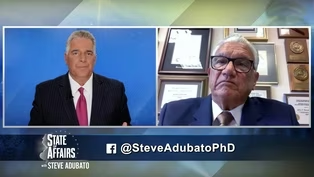
The Importance of Updating COVID Restrictions in NJ
Video has Closed Captions
Clip: S5 Ep24 | 9m 13s | The Importance of Updating COVID Restrictions in NJ (9m 13s)
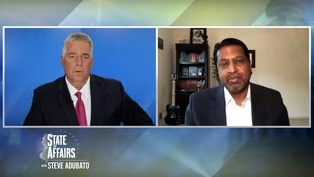
The Key Differences Between Leadership and Management
Video has Closed Captions
Clip: S5 Ep24 | 9m 26s | The Key Differences Between Leadership and Management (9m 26s)
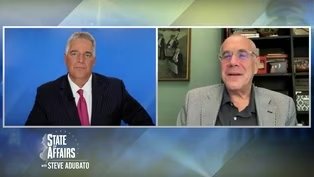
NJPAC's Community Health Initiative
Video has Closed Captions
Clip: S5 Ep24 | 9m 45s | NJPAC's Community Health Initiative (9m 45s)
Providing Support for PBS.org
Learn Moreabout PBS online sponsorship
- News and Public Affairs

Top journalists deliver compelling original analysis of the hour's headlines.

- News and Public Affairs

FRONTLINE is investigative journalism that questions, explains and changes our world.












Support for PBS provided by:
State of Affairs with Steve Adubato is a local public television program presented by NJ PBS