One-on-One
Jonathan Farina; Robert Garrett; Jessica Padilla Gonzalez
Season 2025 Episode 2872 | 27m 57sVideo has Closed Captions
Jonathan Farina; Robert Garrett; Jessica Padilla Gonzalez
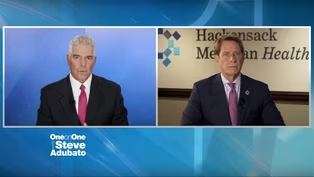
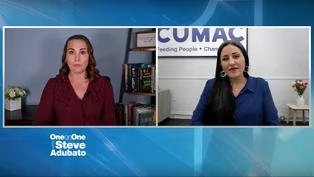
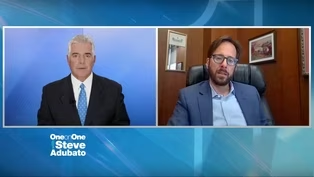
Jonathan Farina, PhD, Dean of the College of Arts and Sciences at Seton Hall University, explores how the university prepares students for today’s workforce. Robert Garrett, CEO of Hackensack Meridian Health, discusses artificial intelligence and the future of healthcare. Jessica Padilla Gonzalez, CEO of CUMAC, discusses trauma-informed strategies in supporting food-insecure families.
Problems playing video? | Closed Captioning Feedback
Problems playing video? | Closed Captioning Feedback
One-on-One is a local public television program presented by NJ PBS
One-on-One
Jonathan Farina; Robert Garrett; Jessica Padilla Gonzalez
Season 2025 Episode 2872 | 27m 57sVideo has Closed Captions
Jonathan Farina, PhD, Dean of the College of Arts and Sciences at Seton Hall University, explores how the university prepares students for today’s workforce. Robert Garrett, CEO of Hackensack Meridian Health, discusses artificial intelligence and the future of healthcare. Jessica Padilla Gonzalez, CEO of CUMAC, discusses trauma-informed strategies in supporting food-insecure families.
Problems playing video? | Closed Captioning Feedback
How to Watch One-on-One
One-on-One is available to stream on pbs.org and the free PBS App, available on iPhone, Apple TV, Android TV, Android smartphones, Amazon Fire TV, Amazon Fire Tablet, Roku, Samsung Smart TV, and Vizio.
Providing Support for PBS.org
Learn Moreabout PBS online sponsorship- [Narrator] Funding for this edition of One-On-One with Steve Adubato has been provided by The Turrell Fund, a foundation serving children.
Community FoodBank of New Jersey.
Myron and Elaine Adler private foundation, in support of the Adler Aphasia Center.
Congress Hall.
A Cape Resorts property.
PSE&G.
Powering progress.
New Jersey Sharing Network.
Johnson & Johnson.
NJM Insurance Group.
Serving New Jersey’s drivers, homeowners and business owners for more than 100 years.
And by Valley Bank.
Promotional support provided by Insider NJ.
And by NJ.Com.
Keeping communities informed and connected.
- This is One-On-One.
- I'm an equal American just like you are.
- The way we change Presidents in this country is by voting.
- A quartet is already a jawn, it’s just The New Jawn.
- January 6th was not some sort of violent, crazy outlier.
- I don't care how good you are or how good you think you are, there is always something to learn.
- I mean what other country sends comedians over to embedded military to make them feel better.
- People call me 'cause they feel nobody's paying attention.
_ It’s not all about memorizing and getting information, it’s what you do with that information.
- (slowly) Start talking right now.
- That's a good question, high five.
(upbeat music) - Hi, everyone, Steve Adubato.
We kick off the program with Dr.
Jonathan Farina.
He's the Dean of the College of Arts and Sciences at Seton Hall University, one of our higher ed partners.
Dr.
Farina, good to have you with us.
- Great to be here, Steve.
Thanks for inviting me.
- For those who do not know, explain what being the Dean of the College of Arts and Sciences at SHU is all about.
- Well, the College of Arts and Sciences is our biggest college.
It includes all of our hard sciences from physics and chemistry to biology, as well as all the humanities, English, history, philosophy, and social sciences, political science, psychology.
So as Dean, I'm responsible for managing all those programs.
They account for more than half of the students at Seton Hall.
As well as for fundraising, developing new curriculum, programming, and recruiting.
So it's a big job, but an exciting one.
- Absolutely, and we've been a long time.
I've taught at the university, at the Buccino Leadership Institute, and longtime Seton Hall basketball fan.
Looking forward to a good season.
We're starting this right before the season, or taping this before the season.
Dean, talk to us about the goal that you've expressed publicly, and our producers picked up on this, to connect liberal arts with real-world careers, such as humanities, business, philosophy, and law.
Historically, people thought, "Oh, liberal arts, I mean, what is that?
Like what do you do with that?
How do you get a job with that?"
Connect it all for us, Doctor.
- Sure, so yeah, it's one of the overarching strategic goals of Seton Hall as we move into our new strategic plan is actually to encourage more and more students to cross major in both a liberal art and a pre-professional degree that's more familiarly associated with a career track.
The liberal arts are named the liberal arts not because of their political connections, but because they were the forms of education appropriate for free people.
Literally, those forms of education that were thought to train you to be a citizen in a democracy, but also those disciplines that rounded out your humanity so that you weren't just that guy Steve from this particular town speaking this particular language believing these things, but instead, we expose the student to different languages, different cultures, different time periods beyond his or her present, so that they have a wider understanding of their context in the world and a responsibility to others.
So the way we're connecting these disciplines to jobs is through some innovative integrated programs as we call them, including a medical humanities program, and a business humanities program, and a BA in philosophy and law.
And what all of these do is they have courses that don't take for granted that a student is going to take a history course, for example, and know how what they're learning there is going to apply to the business world, say.
But instead, those classes actually give the students business content to understand and think about together as a historian to see how does understanding the history of this industry or this area make them a better potential business person moving forward.
How does being a better storyteller help them become a better doctor or nurse listening to a patient tell them about their symptoms or give them their diagnosis?
- Big picture question.
My older son Steven did his graduate work at Seton Hall in religion and theology, and for his mom and I and so many other parents are like, where's the jobs?
Where are the jobs?
You know, that whole question.
To what degree do you believe, for parents watching right now, listening right now, do you believe that it is the role a significant role of a higher ed institution, in this case, Seton Hall, to prepare a student for work, to get a job?
- So I think the university has two very important goals.
One is to give the student an education and the meaning of the term, which is to lead them out of themselves, edukire literally means a path out.
And that has little to do with the job.
That's more about finding who they are, what their loves are, exposing them to the full experience of what it is to be a human in this rich world.
And then absolutely, we also have the obligation to prepare them for a successful career, and not just a successful career the day they graduate to 10 years out, but when they graduate to when they retire, however long down the road that is.
Because as you know, a lot can change in 10 years, what career is popular and successful and so on.
- Including with artificial intelligence.
- Exactly, artificial intelligence and automation of all kinds.
Key point I always make with parents when we're recruiting is a major does not determine how much money you're gonna make.
It doesn't determine what jobs you're gonna get.
They're often connected because the person who wants to be a writer might choose English, might choose to be a writer, which is not a highly lucrative career, but plenty of businesses would gobble up someone who's an English major as long as that student does all the things they need to do to set themselves up to land a business job.
In fact, I think sometimes they're more competitive for those jobs than the business student is.
But starting day one, they have to take advantage of all the things the university offers to help them prepare.
- Absolutely, Dr.
Farina, talk to us about a very significant gift, financial gift from an alumnus, a late alumnus, Frank Rubino, a $10 million gift for a scholarship that will provide financial support to students pursuing degrees in traditional STEM, science, technology, engineering, and math fields.
Talk to us about that gift, how significant it is, and the impact it'll have.
- Sure, yeah.
So Frank Rubino graduated in 1964.
He had his Bachelor of science in mathematics from Seton Hall.
He was also a member of the ROTC and the math club, and went on to have a career in the US Army as a lieutenant in Germany.
After that, he became an actuary for many years, and not only in the Army, but afterwards, he had the experience of traveling in Italy.
So he had two interests with us.
One, he wanted to help more students have the kind of education he had so that they could have a long successful career.
He also wanted them to be exposed to the world like Italy.
So at his bequest, he left us $10 million.
The way our endowments work is that we take off four and a half percent a year to spend so that they will last forever.
And this gift will spin off 45 $10,000 scholarships per year forever.
For students, it prioritizes students with financial need, and they can be in any of those traditional STEM fields, so math, computer science, physics, biology, biochemistry, chemistry, any new engineering fields we create along the way.
And all they have to do is demonstrate a real interest in Italian.
So they can take Italian as their required language.
They can take coursework in Italian subjects, history, art.
They can do any one of our study abroad programs.
We have many study abroad programs that go to Italy.
And really, what's great about this gift then is it helps students of need.
Seton Hall's always been about giving a new access to social mobility to immigrants and to people with less money.
It gives them the career-worthy, you know, degree in STEM, which is a huge field of opportunity right now.
And the United States is not producing enough STEM graduates to meet the job demands, and it gives them that liberal arts kind of mindset that we want by exposing them to a different culture.
- Dr.
Jonathan Farina is the Dean of the College of Arts and Sciences, the largest college at Seton Hill University, one of our longtime higher ed partners.
Dr.
Farina, thank you so much for joining us.
We appreciate it.
- Thanks for your time, Steve, appreciate it.
- You got it, stay with us, we'll be right back.
- [Narrator] To watch more One on One with Steve Adubato find us online and follow us on Social media.
- We're joined once again by Bob Garrett, Robert C. Garrett, CEO of Hackensack Meridian Health.
Bob, good to have you with us again.
- It's great to be here.
Thank you, Steve.
- Bob, can we do this?
I wanna talk about artificial intelligence, consumerism, if you will, the "Amazon" culture and how it relates to healthcare in just a second.
But I want you to do this for us.
We're taping this interview at the end of September into October.
You recently lost your dad, and you've talked about your dad a lot.
Talk about your dad and his impact on you, not just as a healthcare leader, but as a human being.
- Yeah, thank you for that, Steve.
And, you know, my dad had a great run.
He passed away at 94, and he lived those 94 years in a really complete way.
And I learned so much from him, he was a great man in so many different ways.
You know, a couple things that, you know, that I learned from him directly was his sense of optimism, you know, his positivity.
You know, I remember stories when we were kids, we would go down to Florida for a vacation, it would rain four out of the six days we were there.
But all he could talk about for months after that were the two sunny days.
And that was kind of like his mantra.
He was very positive, very optimistic.
And, you know, as a leader, I think that's a really important quality.
And I've taken that away definitely from my dad.
The other thing, you know, was his work ethic.
He was sometimes at my mom chagrin, he worked long hours, you know, seven days a week as a pharmacist.
He was a pharmacist, a retail pharmacist.
And, you know, he valued relationships as well, I learned a lot about that in working with him, whether it was relationships with doctors, with patients, customers, with team members, with his own team.
I saw it firsthand.
And, you know, and he was tough because, you know, I used to work with him, he used to bring me in a little bit, and if I did well, he'd compliment me.
But if I didn't, the first thing I would get was he used to kind of bite his lip a little bit.
Like, you know, I get that, like, hmm, you know, look, and then I knew there was gonna be a statement to follow.
But I did learn, honestly, I did learn about work ethic, about hard work, and that it does produce results.
But in the process of that hard work, I learned how relationships are so important.
So, you know, I really, you know, we got great memories of my dad and we are celebrating his great life and certainly those lessons learned.
- Well said.
Best to you and your family on that, Bob.
- Thank you.
- And also condolences, which I've said privately.
I just wanna share that with the.
There's no good transition for this, Bob.
From your dad to artificial intelligence, right?
- Which was not part of my dad's era necessarily, but I think he would, if he were still with us, he would embrace it, yeah.
- Okay, so here's the thing.
The name of the book coming out is "Why Not?"
We talked about this in another segment.
I argue that AI is not an why not thing, it's, you have no choice.
Here's my question.
Either it's, I wanna frame it the right way.
I keep, because I struggle with, and I'm afraid of it, I'm concerned.
Either you lean in and engage it and use it or you get hurt by it.
Is that too simplistic, Bob?
- Not at all, I think you have to lean in.
Listen, it's a transformative technology.
Probably the biggest transformative technology that we've seen in a long time, if not ever.
And you know what?
We can't dismiss it, it's here, it's going to stay.
I mean, every new technology, every new innovation over the history of time, there were doubters at first.
But in the healthcare space, I mean, we think about it very strategically.
We think about it in a certain areas of focus where we can really, I think, transform healthcare.
So, just a couple examples.
We think AI has potential, tremendous potential to help clinicians detect disease earlier, like chronic kidney disease, which could avoid years of dialysis or even a kidney transplant.
In the era of cancer, area of cancer, it can really help us design precision treatment plans very specific to that patient's needs.
Not all patients are the same.
And you know, everybody has a different genetic profile.
It can help us streamline really administrative efficiencies, like help us on the revenue cycle, meaning our billing and collection process.
It can help us in the OR as far as scheduling.
And then the last thing I'll mention is, it can help alleviate burnout.
We are seeing that in healthcare a lot, physician burnout, nursing burnout.
So, as an example, you know, there's an expression in healthcare called pajama time, where physicians, you know, can spend some time with their families, or even spend more time directly with patients.
But through AI, there can be note summarization, there can be note-taking that saves hours of physicians doing that in a kind of old-fashioned way.
They get more pajama time, they get more time with their patients.
And in the nursing sphere as well, just on AI-driven virtual nursing program can free up nurses to spend more time with their patients, less time on charting on administrative tasks, that kind of thing.
And guess what?
That's why nurses went to nursing school, that's why doctors went to medical school.
They wanna spend time with their patients.
- So interesting, by the way, since you mentioned pajama time, is that right?
Is that what it is, Bob?
- That's right, that's what they call it, pajama time, yeah.
- Yeah, well, I was gonna ask you, because you and I talk about wellness and wellbeing all the time.
Real quick on this, the connection in your mind, whether you call it, forget about pajama time because there's a place for pajama time and wellness, but then there's also a place for wellbeing, fitness, and taking care of oneself, mentally, physically, et cetera.
You connect that to leadership, I know you do.
- Yeah, it's really important.
I mean, I think the most effective leaders out there, you know, are fit.
I mean, they try to be fit, they try to eat right.
I mean, I think it just adds to your effectiveness as a leader, you know, it helps you mentally, it helps you physically.
And you know, let's face it, leadership can be a very tough, you know, tough run and, you know, tough engagement.
So, you need to be, you need to have your health, and you need to have your sleep.
I used to say earlier on in my career that sleep was overrated, but I do not say that anymore, it's not true.
And my clinician friends corrected me on that, and they were absolutely right on that because it is important.
So, you know, I think that balance of work and lifestyle is also an important aspect of being an effective leader.
But yeah, I definitely wanna, you know, share with the audience that I'm a true proponent of health and its correlation with leadership.
- Well said, last question Bob, minute or less.
Consumerism and healthcare.
The so-called Amazon culture, connect it back to healthcare, minute or less, got a minute or so.
- Yeah.
Well, you know, Steve, that's a great point.
And you know, we have, as an example, at Hackensack Meridian Health, we have an organization that we partner with, which is called One Medical.
It's a division of Amazon actually.
And we are extending our primary care network through a partnership with Amazon.
We're gonna build up to 20 primary care centers in New Jersey.
And folks that are Amazon Prime members will actually get a discount by virtue of their membership, they get a discount in joining the One Medical network.
So to us, that's gonna extend primary care.
You know, in New Jersey, one out of three New Jerseyans don't have access to a primary care physician.
So, we applaud Amazon getting into this space and partnering with organizations like Hackensack Meridian Health.
- And lemme just, I should have disclosed this earlier.
Hackensack Meridian Health is a long time underwriter of our programming, particularly around vaccine awareness, a program we're doing in cooperation with the New Jersey Department of Health, creating information or providing information that's accurate and relevant.
And also dealing with public health and the public health infrastructure and trust in public health.
And also, I've done a whole range of leadership coaching at HMH.
Bob, thank you, we wish you all the best.
- Thank you so much, Steve.
- You got it.
Stay with us, we'll be right back.
- [Narrator] To watch more One on One with Steve Adubato find us online and follow us on Social media.
- Hi, I'm Jacqui Tricarico, Senior Correspondent for "One-on-One," and so pleased to be joined now by Jessica Padilla Gonzalez, the CEO of CUMAC, an essential organization working to feed people and change lives in Passaic County.
Jessica, it's so great to have you with us.
- Thank you so much for having us today.
- So CUMAC is celebrating 40 years of service, and I know you've been busier than ever before.
First, describe for us some of the services that you're offering.
- Great, so CUMAC has been around for 40 years, and one of the key things that we offer here is our Choice Pantry, which operates five days a week from 9:30 to 3:30.
We also have a mobile pantry that goes to every municipality at least once a month throughout Passaic County.
And then we also offer home delivery to guests that live within 10 miles of CUMAC that may be seniors, disabled, or dealing with some health issues.
- Full Choice Pantry, you mentioned that, we hear that a little bit more often now.
Describe what that model is and how it's really making a positive impact on the folks that are coming in to shop for food.
- Excellent, so CUMAC is very embedded in the idea of trauma-informed care and self-healing communities.
So being able to give our guests the opportunity to pick and choose the foods that they want and they need is part of being trauma-informed.
There's nothing worse than a family getting a bag of groceries or food that they don't typically, that they don't know how to cook.
So having somebody come in, be able to push a cart, touch and feel, look at the labels, and determine what it is that they really need for their household that day is part of what choice is all about.
- So they're coming in, they're shopping, they're able to get what they want, and then are there other services that are provided within that atmosphere?
Other things that maybe they can tap into that maybe they weren't even looking for when they first came in, when they're looking for food, but things that might be really essential for them?
- Yes, a hundred percent.
So CUMAC also became an official SNAP Navigator in 2023, so that means that we provide education around what SNAP is, who may qualify, and we also assist families with their applications.
We also have a space that we call the Collaboratory, where we bring in other essential nonprofits and other community providers to do all sorts of things.
We've had a health fair where we do screenings, we offer legal housing, anything you could really think about, we try to bring it here for our guests so when they have their appointment to shop our market, they have access to other resources that they may not be able to get to with their busy days.
- SNAP.
You mentioned SNAP.
It's definitely a buzz word, or a buzz acronym, if you wanna say that.
We've been hearing a lot in the news.
We're taping in October, mid-October, we don't really know what's going to be happening with the services, but can you help us understand that a little bit more?
Who benefits, what are some misconceptions and misnomers when it comes to SNAP benefits?
- So I think the biggest thing that people need to understand is that recipients of SNAP are typically seniors, working households.
Seniors specifically that are on fixed incomes, individuals who are underemployed, or just people that need a little bit of assistance during a trying time.
The key thing that I want everyone out there to understand is that SNAP applications are really difficult to process.
There are many barriers for people to get $6 a day for their families to eat, right?
It's not something that they put their name and address, there are many levels of verification that this involves, and sometimes it could take individuals anywhere from 60 to 90 days or longer to be able to provide that additional verification to get the SNAP dollars, which isn't really a lot of money, at the end of the day, for the household.
- Six dollars a day.
Like, how far can that even go?
- I, honestly, when I think about it, it breaks my heart.
So our team helps individuals process those applications.
We're also very fortunate that our Board of Social Services has decided to partner with us, and we have a full loop team here on site.
So we were looking at our numbers for this year, and we provided over $48,000 in SNAP to our community, to our guests.
And now that may be jeopardized with the shutdown.
So it's something that we are thinking about, had a staff conversation about it yesterday, like, how are we gonna be able to assist these families that now don't know whether or not they're gonna get those dollars in the next few weeks?
- And overall, federal funding cuts are impacting organizations like yours, as well as state federal funding cuts.
I know for 2026, CUMAC did make it into the New Jersey State budget, $250,000 allocated for your organization, but is that even enough?
- So we are so grateful that we made it into the budget, I think that's the first thing.
But no, it is not enough.
We're seeing record numbers this year.
We just kind of ran the numbers real quick.
We're seeing 10,000 individuals more this time, same timeframe last year.
And I think the scariest part about it is what's gonna happen November 1st if thousands, millions of families don't get their SNAP dollars refilled, right?
So I think that's something that we're really thinking about and preparing for.
So the 250, we're very grateful for it, but we're always looking for more donations.
We're trying to definitely make sure that our shelves are full so that families don't go hungry.
- How are you doing that?
How are you preparing?
And how important are those community partners that you're working with to get that food on the shelves for the people in need?
- So the ways that we get food to the pantry is we get some food from the community food bank.
Our team actively gleans, so that's food rescue, so excess food from supermarkets, things of that nature, and then individual donations or drives.
So we have three options now where individuals can, we have an Amazon wishlist, we have a Give Healthy, where people can buy food and it gets directly delivered to us.
But most importantly, we rely on the generosity of our community, at the end of the day.
And the funds that we've set aside to be able to buy complete meals for our family, because that's something that we do that's a little bit different than most pantries, is we're actually buying milk, eggs, canned goods, rice, pastas, so that people leave with a complete meal versus the random items that we may be able to rescue.
- You touched upon it a little bit before, but the mobile food pantry.
We're always talking about meeting people where they are.
How impactful has that been to bring that around to the communities in Passaic County?
- So the mobile pantry has been a little bit of a challenge, right?
Because we've realized that we're going out during the hours that most people are working, right?
So those people that are actually utilizing our pantries are employed, right?
So we're talking about people that have jobs, they have their appointments.
So we've started to partner with nonprofits that do provide services to the low-to-moderate income communities.
But we are going to where they are to make sure that they don't have to travel to Paterson, and that we're going to some of the furthest municipalities here in Passaic County to make sure they have access to food.
- There is an increase year-to-year for these types of services that you're providing.
What are your expectations?
What are you thinking 2026 is going to look like for you?
How many people are you expecting to come through your doors?
- If I could give you a number, I would love to say less than this year, but when I first started here at the organization and we said we were gonna hit 50,000 individuals, we said that's impossible that we're gonna be able to do that.
This year, we're on track to serve over 80,000 individuals, right?
So next year, with everything that's coming down, I have no idea what the number is, but I can say from the bottom of my heart that my team finds a way to make sure that their neighbors don't go hungry.
- We need people like you, like your team, boots on the ground, people working to make sure our neighbors don't go hungry.
It's just such an important organization, and we thank you so much for joining us, more about it.
We've had the website up the whole time so people can log on and learn more about what you and your team are doing, and ways that they can help.
So thank you so much, Jessica.
We really appreciate it.
- Thank you so much, again, for elevating this topic and making sure that people know what's really happening on the ground, thank you.
- Thank you.
And for Steve Adubato and myself, thanks for watching.
We'll see you next time.
- [Narrator] One-On-One with Steve Adubato is a production of the Caucus Educational Corporation.
Funding has been provided by The Turrell Fund, a foundation serving children.
Community FoodBank of New Jersey.
The Adler Aphasia Center.
Congress Hall.
A Cape Resorts property.
PSE&G.
New Jersey Sharing Network.
Johnson & Johnson.
NJM Insurance Group.
And by Valley Bank.
Promotional support provided by Insider NJ.
And by NJ.Com.
- How long you been waiting?
- About a half hour.
- Brutal.
This keeps up, I'm gonna miss my pickleball game.
- I've been waiting eight years for a kidney.
What can you do?
(gentle music) - [Narrator] Over 100,000 people in the US are waiting for a life-saving transplant.
But you can do your part in an instant.
Register as an organ donor today at NJSN.org.
CEO of Hackensack Meridian Health addresses AI in healthcare
Video has Closed Captions
Clip: S2025 Ep2872 | 9m 36s | CEO of Hackensack Meridian Health addresses AI in healthcare (9m 36s)
Debunking the common misconceptions about SNAP benefits
Video has Closed Captions
Clip: S2025 Ep2872 | 9m 20s | Debunking the common misconceptions about SNAP benefits (9m 20s)
How Seton Hall University prepares students in the workforce
Video has Closed Captions
Clip: S2025 Ep2872 | 9m 30s | How Seton Hall University prepares students in the workforce (9m 30s)
Providing Support for PBS.org
Learn Moreabout PBS online sponsorship
- News and Public Affairs

Top journalists deliver compelling original analysis of the hour's headlines.

- News and Public Affairs

FRONTLINE is investigative journalism that questions, explains and changes our world.












Support for PBS provided by:
One-on-One is a local public television program presented by NJ PBS