State of Affairs with Steve Adubato
Joseph Fiordaliso; Michele Siekerka; Tim Sullivan
Season 5 Episode 15 | 28m 14sVideo has Closed Captions
Joseph Fiordaliso; Michele Siekerka; Tim Sullivan
Joseph Fiordaliso talks about the current issues with gas pipeline security & cyber security and President Biden’s clean energy goals; Michele Siekerka discusses NJ’s hiring crisis and the impact of the lack of affordable child care on businesses; Tim Sullivan shares the importance of helping African American and Latino entrepreneurs and the need to attract film and tv production back to NJ.
Problems playing video? | Closed Captioning Feedback
Problems playing video? | Closed Captioning Feedback
State of Affairs with Steve Adubato is a local public television program presented by NJ PBS
State of Affairs with Steve Adubato
Joseph Fiordaliso; Michele Siekerka; Tim Sullivan
Season 5 Episode 15 | 28m 14sVideo has Closed Captions
Joseph Fiordaliso talks about the current issues with gas pipeline security & cyber security and President Biden’s clean energy goals; Michele Siekerka discusses NJ’s hiring crisis and the impact of the lack of affordable child care on businesses; Tim Sullivan shares the importance of helping African American and Latino entrepreneurs and the need to attract film and tv production back to NJ.
Problems playing video? | Closed Captioning Feedback
How to Watch State of Affairs with Steve Adubato
State of Affairs with Steve Adubato is available to stream on pbs.org and the free PBS App, available on iPhone, Apple TV, Android TV, Android smartphones, Amazon Fire TV, Amazon Fire Tablet, Roku, Samsung Smart TV, and Vizio.
Providing Support for PBS.org
Learn Moreabout PBS online sponsorship- [Narrator] Funding for this edition of State of Affairs with Steve Adubato has been provided by Holy Name Medical Center.
This place is different.
Choose New Jersey.
IBEW Local 102.
Lighting the path, leading the way.
The Turrell Fund, supporting Reimagine Childcare.
New Jersey Sharing Network.
Summit Health a provider of primary, specialty, and urgent care.
Eastern Atlantic States Regional Council of Carpenters.
Berkeley College.
And by Fedway Associates, Inc.
Promotional support provided by AM970 The Answer.
And by Northjersey.com and Local IQ.
Part of the USA Today Network.
[INSPRATIONAL MUSIC] - Hi, I'm Steve Adubato.
Let's kick off this program talking about energy and everything related to energy with a guy who knows that he's Joe Fiordaliso, President of the Board of Public Utilities in the great State of New Jersey, Joe good to see you.
- Good to see you, Steve, thank you.
- Joe let's start off with this.
Could you do the gas pipeline situation we're taping on the 20th of May keep our fingers crossed, the whole question of this pipeline problem, the Colonial Pipeline, other pipelines across the nation, cybersecurity.
What should we be thinking about?
- We should be thinking about hardening and monitoring hackers and our vital, vital enterprises, our grid.
We saw what the hackers did with the gasoline pipeline, caused gasoline lines in Southeast United States.
We are vulnerable.
We are in a situation where the next war is not gonna be with guns and bullets, it's gonna be with cyber.
And we have to be ready as a nation to protect our vital assets including our grids, including our electric and gas facilities, our water facilities.
We are or can be sitting ducks if we're not prepared-- But Joe we-- - Without being prepared.
- But hold on, Joe, sorry for interrupting.
But first of all, what does it mean to be prepared?
Second of all, why are we playing catch-up?
- Well, that's a good question and I think we have to look over the years of neglect at the Federal government also here.
And I know here in the State of New Jersey, Steve that our utilities monitor on a daily basis.
We have a tabletop exercises regarding possible hackers.
We have situations where we're constantly learning and protecting our vital assets from hackers, but it's a constant daily battle and we cannot fall behind.
We cannot fall behind on these hackers or countries that are after our vital assets.
And we could be brought to our knees very, very easily, if we're not prepared, if we're not a step ahead of them.
- And responding afterwards is necessary but that's not the solution.
Switch gears, Joe, you and I have talked offline about this utility moratorium shutoff.
We're taping as I said at the end of May but on June 30th, 2021, that ends, what is the moratorium?
What does it mean to have it end as it relates to utilities being potentially disconnected?
And what should people be doing?
By the way let's put up the BPU website so people can go there to find out who is vulnerable and what does it mean at the end of June?
- Well, good question and a very timely question, Steve.
The moratorium is scheduled to end June 30 and we currently have working groups, which includes our utilities to work out a process.
I don't want moratorium to end on June 30 and people get shutoff on July 1st.
We have to have some kind of grace period and this is what we're dealing with as far as utilities are concerned.
Utilities, I have to give them credit have been very cooperative over the past year and are very willing to assist.
What I'm asking folks to do also and we've had a massive BPU has, and utility a massive outreach to get people to call in, set up a payment plan.
If you're in that situation, utility-- - Can you give extension?
Again, sorry for interrupting Joe but I'm, can people get an extension on this?
- Sure and that's one of the things that we're working with the utilities on Steve, trying to extend from the moratorium time when payments can start to be made and when shutoffs can come back into existence.
We don't want people getting caught short here but people have to reach out if they're having trouble paying their bill.
If they can't set up a payment plan because they don't have the finances to do it, there are programs here at the state that can help.
I would invite them to go to our BPU website, find out how-- - I know the team is, Joe I know the team is putting up the website as you talk it through.
They go to the website, will they find a section there, hey, this is the utility shutoff moratorium program or whatever it's called, here's what you need to do.
- Exactly, exactly and in conjunction with DCA, Department-- - Department of Community Affairs.
- Right, there are programs, we fund these programs and the DCA administers them, helps people who are in need of help.
So I encourage, I know sometimes it's embarrassing particularly for those people who've never reached out before, but we're here to help you, we're in this together and the only way we're going to get out of it is together.
- Yeah, hey Joe, let's do this there's so many things to talk about.
If we don't get it done in this segment we'll do a follow-up segment.
But we've been involved in a public awareness initiative around "clean energy" through the clean energy program for the last couple of years.
Where are we today as we go into summer 2021 with the clean energy initiatives whether we're talking about solar, offshore wind, where are we right now?
- Great question and I'm always excited to talk about it.
So I thank you for the question.
It is, we are ready to award, our second solicitation in June, which is going to add another 1200 to 2,400 megawatts of offshore shore wind to our portfolio.
We already had solicitation one which is 1100 and this second solicitation.
So we are moving forward.
We are very, very encouraged by the Biden administration with their, well, let me say this.
We now have a president who talks about climate change.
- So you think with Jennifer Granholm who's the Secretary of Energy in the Biden ministration, you're saying and this is not a political show, it's a show about policy.
You're saying the policy differences between the Trump administration, vis-a-vis clean energy versus the Biden administration dramatically different.
- Yes, sir, yes, sir.
- What's the biggest difference?
- What's different is their cooperation, there before we've had very little, if any cooperation from the Federal government.
All of the initiatives, most of the initiatives have come up from the states.
Most of the financing has come up from the states but we're seeing a change in the agencies that deal with offshore wind as an example more than willing to wanna help us now, more than willing to get the permitting process on track, more than willing to look at various areas where they can be of assistance to the states.
And I'm very thrilled with the Secretary of Energy who is a no nonsense Former Governor as you know, from Michigan, she is on target.
So I'm very excited about that.
And with solar, Steve, we are continuing to move to release some of the burden on the rate payer.
We're transitioning to another solar program and keep in mind, all of these initiatives have economic benefits too, almost 7,000 people work in the solar industry today as we speak.
- Jobs.
- Jobs, economic development, offshore wind is gonna bring billions of dollars into this state.
- Joe, before I let you go can you give me 30 seconds on the nuclear situation?
Where are we?
- Yup, the board again has voted to subsidize-- - The Board of Public Utilities?
- Yes, subsidize the three nuclear plants here in the State of New Jersey and I'm going to tell you why.
We need bridges to get to our goal of 100% clean energy by 2050.
If we don't have those bridges and when I talk bridges I mean energy generating sources that are going to provide us with the energy we need until we have enough renewable energy to pick up that slack, nuclear power is one of them.
It's not only costs that we looked at Steve.
It was the whole picture, the whole picture as far as the policy is concerned.
And if we're going to achieve this, we need things like looking the power natural gas right now.
So that was certainly part of our thinking.
- I think you're saying you just don't turn off this picket and to clean energy.
- Exactly.
- Joe, every time you join us we learn something new.
And by the way, the Board of Public Utilities website was up throughout that initiative, the clean energy initiative there as well.
Find out more go on that site.
Joe thanks for joining us.
- Dave, it's always a pleasure and I thank you for the opportunity.
- You got it, I'm Steve Adubato that's Joe Fiordaliso.
We'll be right back.
(grand music) - [Announcer] To watch more State of Affairs with Steve Adubato, find us online and follow us on social media.
- We're once again joined by Michele Siekerka, President and CEO in New Jersey Business and Industry Association.
Good to see you, my friend.
- Good to see you as well, Steve.
- Okay, so we're taping on the 20th of May, being seen later.
There's a hiring crisis, help wanted signs all over the place.
You've said there's a perfect storm that has created this situation.
Describe that storm.
- Yeah, well the perfect storm is we have a Federal Unemployment Insurance Program that is right now paying a premium that competes with entry-level wages.
Add to that, we have child care facilities not at 100% capacity here in the state of New Jersey.
Meaning if we can't get our kids in safe places, we can't get our parents back to work.
Add to that, the J-1 visa crisis we have for our tourism industry.
And what we have is a hiring crisis that is just unprecedented here in New Jersey.
- So devil's advocate.
What do you say to those, including Governor Murphy who has said, and others, "It's not the unemployment compensation issue that needed to be done.
We needed to protect people who had lost their jobs early on in the pandemic."
Or I heard some people say in the administration and others, "Just pay them more, pay them more.
And so you could be competing more with unemployment benefits."
You say?
- Well, first of all, absolutely.
The unemployment program was significantly important for hundreds of thousands of people over the last year.
And let me be clear, those that still need to be on unemployment 'cause they can't get back to work, the safety net must be there.
We're not saying take their safety net away.
The issue is we have tens of thousands of people who are quote, unquote, available for work, who are not showing up, all right?
Because of that benefit has something to do with it, it does.
To those who say, "Hey, companies, pay more."
I'm talking about main street businesses that have been decimated over the last year, all right?
They're lucky that they're still open.
So what did we say?
"You know what Governor, number one, anyone who can pay more always does 'cause they wanna hire the best and the brightest.
Number two, help them to pay more so they can get their legs back underneath them.
And we could do that, right?
Two things we can do, Steve.
- Hold, okay.
I was gonna ask you what we could do here.
You're ahead of me, go ahead.
- We can take that unemployment insurance money, right?
And we can create a bonus or an incentive to get people back to work.
So we could say, "If you return to work tomorrow because you're available for employment, we will give you a bonus of" for example other states are doing $500, a $1000, $1,500, "as long as you continue to be employed through labor day."
Gets us through the peak season, okay?
So you're gonna get that bonus, if you will, which means it's gonna be an enhancement on your hourly income, which is gonna drive an incentive for you to come back.
We can also give our employers tax incentives if they're gonna pay higher than minimum wage so that they offset their balance sheet and give them the ability to do that.
- What response have you gotten from the Murphy Administration regarding those ideas and issues, whatever you wanna call them?
- No response, no response.
- What do you mean no response?
- No response.
Steve, we did a, in all fairness, okay?
We did a town hall, we had businesses speak - I know, we saw it.
- over a week ago.
Yes, okay?
We have op-eds out.
I've done more media requests on this issue that I can tell you.
- I called director of the town meeting and I said, "Let's do this."
- Right, we've had legislative leaders take up some of our issues.
That child care issue, this is an easy fix, all right?
The reason why we have the child care issue, number one is because our child care facilities are still at 50% capacity limits on their licenses.
The only state in the nation that has that.
Why are we not back up at a 100% capacity for our child care facilities, right?
And then help to bring that workforce back immediately.
We can't get parents back to work if we don't get kids into safe environments, okay?
So these are easy fixes.
No, no response, no response.
We sent a formal letter to the Governor, and no.
And we're waiting for a meeting to be rescheduled in all fairness to the front office waiting for a meeting to be scheduled.
- Two things, two things.
Number one, Michele Siekerka, and by the way we're media partners and colleagues, we share information, excuse me, we share content, just to disclose that.
But I wanna say this.
Number one, we have an initiative called Reimagine Child Care, which talks about affordable accessible child care.
Our website will be up, check that up.
But here's the other thing about the Governor.
And we constantly are being asked.
When people like Michele Siekerka or other legislators, these other people talk about the Administration.
Why have we not had Governor Murphy on?
And so I need to just put this out there.
Michele Siekerka says she's waiting for a response.
We had gotten initial response, I won't go into the weeks on this, months and months and months ago that the Governor would join us.
And he does a lot of media, he does.
I don't really know why he hasn't had a conversation with us.
We need to have that conversation.
We're gonna ask again and provide a dozen dates to get him because the Governor is the only person who can answer for his Administration.
Just don't ask me anymore, we keep asking.
- Steve, again, and with all due respect, we get acknowledgement.
We received your letter, thank you.
And then we do follow up, okay?
We schedule a call and then the call gets adjourned, all right?
We do follow up.
I can't be any more outspoken on these issues right now on behalf of the business community.
Our businesses can't be any more outspoken.
We did a member alert to invite our members to send their concerns directly to the Governor and the legislature, okay?
We had over 700 letters sent and over a thousand to the assembly.
I mean, people, (sighs) some will say that people are showing up, people are coming back, you'll pay them more, et cetera.
You know what other people are doing?
They're saying, "I'll come in for an interview," and they don't show up.
Number one, we hear that, I hear that everyday examples of it.
Number two, people are showing up and saying, "Pay me off the books so I can stay on unemployment."
This is, and I'm not, and please, I don't mean to generalize- - And we're not advocating anyone pay under their table or off the books.
Abide by the law.
But hold on, Michele.
- Exactly.
We're taping on the 20th.
What happens if the governor turns around and opens up in a way beyond, which he may likely do in terms of the mask mandates, insight, that's why we're dating ourselves.
This will be seen after.
What about if he does it, but what about if he says, "I've only done what I've done with child care centers in terms of half capacity and all the other decisions because of the science and because of the safety.
That's a legitimate argument.
- Steve, you know what I say, all along, we followed CDC.
We follow CDC for 15 months now.
CDC says we don't need masks in doors and we don't need to social distance.
New Jersey is only one of two states, Hawaii being the other.
- As we do it now, but say in two weeks he changes it.
Is it too late?
- That's one part of it.
Perfect storm.
It's one thing to open everything up, it's another thing to have a workforce to now deliver the products and services.
Do you know what I hear down the shore?
Okay, I hear restaurants only staying open for delivery for the entire season 'cause they don't have servers.
I hear restaurants saying.
"We will only open Thursday Friday, Saturday, Sunday 'cause I don't have a workforce from Monday, Tuesday, Wednesday."
This is real.
I'm not crying wolf here.
I'm not making this up, Steve.
You know me, I don't falsificate.
We're always on research and data.
- And by the way, the J-1 visa application, that's not an issue of the Gov.
Murphy administration though.
Is that not a federal issue?
- No, it's a much bigger issue.
I mean, this is a national issue, but- - Just to be clear, that's not all on the administration.
- No, it's not.
But we have asked the governor to send a letter directly to President Biden, saying how important this program is to the state of New Jersey, especially during tourism season.
Our entire federal delegation signed onto a letter to President Biden.
We're waiting, we're waiting patiently for the governor to send that letter.
- Hey Michele thank you.
And again, we implore the governor's team.
Please allow him to come on so we can have this conversation.
Yes, he has another places.
I know he wants to have it here.
I'm confident of that.
Michele, I can't thank you enough.
We appreciate your time.
To you and all your members, all the best.
- Steve, we're always here to be a good partner.
We just wanna get good things done.
Let's get it done.
Thanks, Steve.
We'll be right back right after this.
(grand music) - [Announcer] To watch more State of Affairs with Steve Adubato, find us online and follow us on social media.
- We're once again joined by Tim Sullivan, CEO of New Jersey Economic Development Authority.
Good to see you, Tim.
- Hey Steve, how are you?
Great to be here.
- Great to be with you.
Listen, let's jump right into this.
The role of the EDA, remind folks as we put the website up, what the role of the EDA is.
- Well we try to help create good, family sustaining jobs here in New Jersey, help direct investments to places like underserved communities where that investment can have the biggest impact.
Working on behalf of Governor Murphy to drive job creation.
- So let's talk about investing in communities of color.
Let's be specific and clear, what those programs are, so if people want to access them they can go to the website.
- Yeah, well one of the biggest things we're focused on right now, and this is part of Governor Murphy's budget proposal, is creating a Black and Latino seed fund for early stage companies that wanna grow here in New Jersey.
Across the country and here in New Jersey, the statistics are depressing and unacceptable.
About 1% of all the venture capital in America over the last 20 years has gone to companies founded by either African-American or Latino founders.
If it's women of color, it's like a 0.7%.
So Governor Murphy has proposed a $10 million fund just to focus on early stage companies, young companies, founded by people of color, by the African-American and Latino communities, to really help drive a new generation of entrepreneurs, success stories here in New Jersey.
That's one example.
- Talk a little- - What is the New Jersey Emerge program, by the way Tim?
- So New Jersey Emerge is a brand new program.
It was part of the incentives package and the recovery and reform package that Governor Murphy signed back in January.
This is a tax credit program that will hopefully, and I'm confident it will, attract lots of companies from all over the world and all over the region who want to make New Jersey their headquarters or a major location.
- And by the way, I need to have Tim do this.
He does not speak for the administration, he heads up the EDA, but I do wanna ask you this.
For those who have argued, and actually Michelle Siekerka, who is on another segment on this show, have argued that the governor, in spite of or in addition to all these programs, has not been sensitive enough to the business community and the needs, particularly, of small business.
From the EDA's perspective, how would you respond to that?
- Yeah, I'm happy.
I couldn't be prouder and more appreciative of the governor's leadership on every issue during this pandemic.
But one of the biggest issues is how he's been supportive of the small business community, in particular, during this pandemic.
He's allocated an extraordinary amount of funding in partnership with the legislature, legislative leadership and Senate president and speaker.
EDA's been responsible for a little bit more than $600 million of grant funding to support small businesses.
The number of different programs we stood up has been extraordinary and I think the governor has done exactly what is in the long-term interest of both the business community and the state at large, which is focus on public health, focus on the data, and the economy can only heal when public health heals.
- You know, we're taping this on the 20th of May, it'll be seen later.
So we always run the risk of dating ourselves because so many things are happening every day, every minute of every day.
The whole question, Tim, about not being able to get in the employees companies need, for a whole range of reasons.
Unemployment insurance being part of it, childcare being part of it education be a part of it.
Summer employment, the visa situation, it's complex, we know.
That's not the specific role of the EDA, but how do you take that into account when you're trying to be so supportive of businesses and some of them say they're struggling to get employees?
- Well, and you know, I'm optimistic that part of this is sort of a timing challenge as the economy's kinda opening up all at once, here in New Jersey and around the country.
A lot of people looking for work at the same time, a lot of companies looking for people at the same time.
That's good for employees, for the workers, because that means they're gonna have choices.
And if that means wages go up a little bit, or hopefully a lot, that's also not a bad thing for the economy and for those workers.
So I'm optimistic that's gonna sort itself out in relatively quick order as part of a normal recovery.
We've never had this kind of, or at least in our lifetime, this kind of economic crisis, which was so rapidly onsetting, and it's gonna end hopefully relatively quickly as well.
But there's gonna be some transition, where it is difficult for folks to find work and find workers.
- Tim, we've known each other for a few years now.
You really do sound very optimistic here.
Why?
- A couple of reasons Steve, and I am.
I think I feel as optimistic about the short-term and long-term future in New Jersey as I ever have.
You know, as we come out of this pandemic, again, I think the resources that the governor's made available, both for COVID relief and also that the governor and legislature have put into our recovery package, sometimes known as the incentives package, plus all the support that's coming from Washington.
You know, we have an administration and President Biden that is in lockstep with the big priorities that governor Murphy has, whether that's clean energy or so many other areas of alignment.
Infrastructure, big infrastructure investment.
There's a generational opportunity here with all this federal money to make big changes in our economy, to really restructure, make it work better for everyone.
- Let's go back to something you just said.
Also, I believe on the same show you're on the president of the Board of Public Utilities, Joe Fiordaliso, is on.
We're involved in a public awareness initiative around clean energy.
You mentioned clean energy.
What does that have to do with the state's economy?
- It has a lot to do with state's economy Steve.
One of the fastest growing parts of our economy has been clean energy jobs, particularly solar the last couple of years.
Tens of thousands of new jobs created in that industry.
The big one that's coming down the pike, and it's getting closer every day, is offshore wind.
We think that's another tens of thousands of jobs kind of opportunity, all throughout the state, with a pretty heavy focus and concentration in South Jersey.
Places like Salem County, Cumberland County, Gloucester County, Burlington County, where there's real need for that kind of job creation and job growth.
Extraordinary numbers of jobs around installing and constructing these facilities.
They're gonna be all good union jobs.
As well as maintenance, operations, and maintenance.
Manufacturing, assembly.
And then of course, R&D and all the professional services that come from it.
It's a brand-new industry and New Jersey is really poised to be the capital of American onshore, oh, excuse me, off-shore wind.
- Go back to something else real quick in the time we have left.
The EDA is actually supportive of an initiative we're involved in around innovation, right?
New Jersey's being called the innovation state, et cetera.
But when it comes to film and television, is it innovative to be in expanding and looking to secure?
Is that innovation?
For the EDA and others to look to have more film and television industry activities in the state?
Or is that the way it's supposed to be?
- Well I'd say film, television and digital media, which is the tax credit program that we have, it's all three, are certainly- - Talk about innovation, that whole new world.
- Yeah, are- - Are in the center of innovation.
You know, I still watch most of my television and media through kinda the traditional channels, but a lot of, whether it's YouTube or TikToK or various different platforms, there's so much innovation happening in media.
- It's not either or.
- Exactly, and we want all of it.
We're pretty competitive people and the governor is leading the charge of being competitive for New Jersey, wanting to the East Coast capital of, if not the national capital, of film, television, and digital media.
And we think with this tax credit program and a significant amount of interest from studios in building big facilities, potentially here in New Jersey, we have a shot to be a really strong player there.
- Tim Sullivan is the head of the New Jersey Economic Development Authority, their website has been up throughout this entire segment.
If you want to find out more about what they're doing, that's the place to go.
Tim, we thank you for joining us and wish you all the best.
- Thank you so much for having me, Steve.
Great seeing ya.
- I'm Steve Adubato, that's Tim Sullivan, and we thank you so much for watching.
We'll see you next time.
- [Narrator] State of Affairs with Steve Adubato Is a production of the Caucus Educational Corporation.
Funding has been provided by Holy Name Medical Center.
Choose New Jersey.
IBEW Local 102.
The Turrell Fund, supporting Reimagine Childcare.
New Jersey Sharing Network.
Summit Health Eastern Atlantic States Regional Council of Carpenters.
Berkeley College.
And by Fedway Associates, Inc.
Promotional support provided by AM970 The Answer.
And by Northjersey.com and Local IQ.
Part of the USA Today Network.
- New Jersey's early educators and childcare providers are more than twice as likely to live below the poverty line versus the general workforce.
Reimagine Childcare formed by a coalition in New Jersey is dedicated to improving accessibility, affordability and quality of childcare and re-imagining the way we support these essential providers.
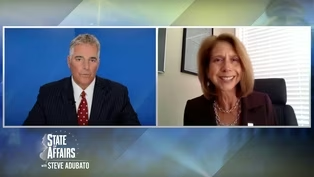
NJBIA CEO Discusses New Jersey's Hiring Crisis
Video has Closed Captions
Clip: S5 Ep15 | 10m | NJBIA CEO Discusses New Jersey's Hiring Crisis (10m)
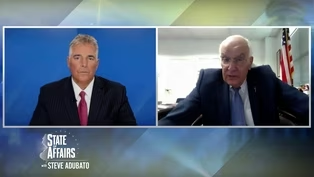
NJ BPU President on Gas Pipeline Security and Cyber Security
Video has Closed Captions
Clip: S5 Ep15 | 10m 31s | NJ BPU President on Gas Pipeline Security and Cyber Security (10m 31s)
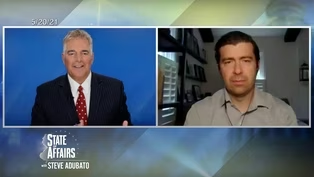
NJEDA CEO Discusses the NJ Emerge Program
Video has Closed Captions
Clip: S5 Ep15 | 8m 33s | NJEDA CEO Discusses the NJ Emerge Program (8m 33s)
Providing Support for PBS.org
Learn Moreabout PBS online sponsorship
- News and Public Affairs

Top journalists deliver compelling original analysis of the hour's headlines.

- News and Public Affairs

FRONTLINE is investigative journalism that questions, explains and changes our world.












Support for PBS provided by:
State of Affairs with Steve Adubato is a local public television program presented by NJ PBS