One-on-One
Joseph Lee; Chris Bautista; David Socolow
Season 2021 Episode 2469 | 25m 56sVideo has Closed Captions
Joseph Lee; Chris Bautista; David Socolow
Joseph Lee talks about the role of public media in supporting a safe democracy and the importance of diversity in public broadcasting; Chris Bautista sheds a light on the importance of organ donation by sharing his personal story of losing his son, Luke; David Socolow shares the impact of the pandemic on higher education and the programs available to make college more affordable in New Jersey.
Problems playing video? | Closed Captioning Feedback
Problems playing video? | Closed Captioning Feedback
One-on-One is a local public television program presented by NJ PBS
One-on-One
Joseph Lee; Chris Bautista; David Socolow
Season 2021 Episode 2469 | 25m 56sVideo has Closed Captions
Joseph Lee talks about the role of public media in supporting a safe democracy and the importance of diversity in public broadcasting; Chris Bautista sheds a light on the importance of organ donation by sharing his personal story of losing his son, Luke; David Socolow shares the impact of the pandemic on higher education and the programs available to make college more affordable in New Jersey.
Problems playing video? | Closed Captioning Feedback
How to Watch One-on-One
One-on-One is available to stream on pbs.org and the free PBS App, available on iPhone, Apple TV, Android TV, Android smartphones, Amazon Fire TV, Amazon Fire Tablet, Roku, Samsung Smart TV, and Vizio.
Providing Support for PBS.org
Learn Moreabout PBS online sponsorship- [Narrator] Funding for this edition of One-On-One with Steve Adubato has been provided by Horizon Blue Cross Blue Shield of New Jersey.
Here when you need us most, now and always.
University Hospital.
One goal, one passion, every patient, every time.
NJM Insurance Group.
Serving New Jersey's drivers, homeowners and business owners for more than 100 years.
The New Jersey Education Association.
NJ Best, New Jersey's five-two-nine college savings plan.
The North Ward Center.
PSE&G, committed to providing safe, reliable energy now and in the future.
PNC, Grow Up Great.
And by Caldwell University.
Promotional support provided by New Jersey Monthly, the magazine of the Garden State.
Available at newsstands.
And by The New Jersey Business & Industry Association.
- This is One-On-One.
- I'm an equal American just like you are.
- The jobs of tomorrow are not the jobs of yesterday.
- Look at this.
You get this?
- Life without dance is boring.
- I don't care how good you are or how good you think you are, there is always something to learn.
- I did do the finale, and guess where my trailer was?
A block away from my apartment, it couldn't have been better!
- People call me 'cause they feel nobody's paying attention.
- (slowly) Start talking right now.
- That's a good question, high five.
(upbeat music) - Hi everyone, I'm Steve Adubato, and it is my honor to welcome Mr. Joe Lee, who is the Vice President & General Manager of NJ PBS, which is the public television station, New Jersey public television station, in the PBS system.
Joe, thank you so much for joining us.
- Thank you, it's my pleasure to be here.
- Joe, by way of background, let everyone know how you come to NJ PBS with your very extensive media background, both on the air and behind the scenes leading, if you will.
- Yeah, I have a pretty much a 30 year history in public media, mostly in radio.
Started out as talent, was an overnight announcer, morning DJ in public radio in Baltimore, Maryland, my hometown, and then moved into managing content as a program director and content manager, and then eventually as general manager moving to Syracuse, New York, where I ran WAER at Syracuse University.
So, I've played a role as talent, as content manager, and as organization manager.
So, I got to understand the complexities of the organizations from multiple standpoints.
- Talk about your vision for NJ PBS, and for those who do not know, in July of 2011, the public television station in New Jersey, then named NJTV created our leader, the leader of the WNET Group, Neal Shapiro, and a group of other folks decided that we should have public broadcasting.
Name changes to NJ PBS, but your vision for what NJ PBS could and should be, Joe, talk about it, please.
- Sure.
The aspirational goal is to create a unparalleled public media experience for New Jersey.
So what does that mean?
As you know, we're sandwiched in between the markets of New York City and Philadelphia.
There's PBS coming out of both of those cities.
So, what does that mean for New Jersey?
You know, we could mimic what they do, and we don't wanna do that.
We wanna create a public media experience across all platforms that is centered and focused on New Jersey.
What does it mean to be in New Jersey?
What does it mean to be a part of the state in these communities?
How do issues impact and affect us?
And so, while we'll continue to serve folks with the great PBS programs that they've come to love, we're gonna focus a lot of our local productions and acquisitions on New Jersey-centered content.
- Well said, and also, if you want to check out what is going on in New Jersey every night, it's NJ Spotlight News at several times, but at six o'clock, if you will, again at 7:30 and later into the evening, also on the New York side for the region is Metro focus, produced by our colleagues at WNET and WLIW.
Let me try this, in terms of the news business, right?
There's other news, and we're not here to be critical of those in commercial broadcasting, but there's a distinct difference between what NJ PBS/The Nightly News NJ Spotlight news does and many other, if you will, evening local commercial station broadcasts.
What is that difference, Joe, in your view?
- Sure.
You know, the old adage for commercial TV and this could be dated.
So, if it bleeds, it leads is not how public media approaches journalism.
You know, we're here to hold public officials accountable, get them on record.
We're here to explore the issues that impact our communities and our state.
You know, we're here to convene and have conversation around issues.
And most importantly, you know, the way that I like to approach journalism is a solutions-based journalism approach.
So, not just reporting at people, but reporting with people, reporting with our communities and helping them to solve the problems and issues that impact their communities.
- So, in a lot of ways, Joe, it isn't just what NJ PBS puts on the air.
It's also what is going on there, it's not even behind the scenes, but in terms of community engagement and involvement.
Give us a couple of examples that makes that real for our audience.
- You know, there are opportunities to really engage people with, you know, with the issues that are impacting their community.
So, a little bit of what I did in Syracuse, when the headlines came out that Syracuse was the top ranked or the 10th poorest city in the nation with the highest concentration of poverty among Blacks and Latinos, you know, we chose as an organization and a news entity to explore that for the better part of a year.
So, we created a project called it was, you know, a project called City Limits.
And so, it was a multi-platform project that was part convening, having a round table discussions, not only with agencies and news makers, but with people who were impacted, exploring all the aspects of how poverty affects our community, and bringing in other community partnerships and leaders and organizations to have these discussions.
So, public media can really play an important part in community convening, having these big conversations that hopefully lead to some solutions and resolutions.
You know, I see us doing that at NJ PBS as well.
You know, obviously, some of the face to face stuff is going to be a while until things are better with COVID, but there are engagements and convenings that we can do virtually like with what our public, with what our parent company is doing with American Cities Rising.
So, that is bringing leaders together across the nation to talk about the issues that are affecting American cities and how we can look to innovation and what's being done to improve the economics of cities.
So, you know, as a place in a community convener, you know, this is a important role that public media plays that we just don't see commercial entities in that space.
Joe, let me ask you this.
We've been doing a series, Democracy at a Crossroads, for several years, let's say pre- well before January 6th, 2021.
The role, from your perspective, the role of public media in supporting a healthy, vibrant democracy that is struggling mightily as we speak.
- Yeah.
You know, as a part of the media landscape, you know very well that there are messages coming out from all over the place and in media on all of our platforms and it can be overwhelming to the American public.
Public media has always been a space that people can trust to get the information that they need, synthesize that information, contextualize that information, and know that what they're receiving from us is fact-based journalism and information gathering, so that they can make sense of what's happening around them.
So, avoiding these polarization situations that are happening in opinion-based media, you know, people know that they can trust public media to get the information and make their own decisions based on that information.
- Hey, Joe, I know you understand time issues in broadcasting better than most.
I got 30 seconds or less.
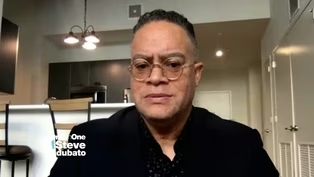
Real quick, diversity in public media, particularly at NJ PBS, the importance of it, please.
- Yeah, it's important that we make diversity, equity, and inclusion a foundation of what we do, not only internally, but externally.
How our diverse population shows up on our screens and in our content, both in positive ways and meaningful ways, making sure that people behind the scenes who are making these decisions are from diverse backgrounds and perspectives.
So, it has to be a part of the foundation of who we're going to be and what we're going to do, if we're going to build not only community trust, but expand our audiences.
- That is Joe Lee, who is the Vice President & General Manager of NJ PBS.
I want to thank you for taking time to talk to us.
Wish you and the team at NJ PBS all the best in the important work you're doing.
Thank you, Joe.
- Thank you for having me on the show.
It's a pleasure and an honor.
- Same here.
I'm Steve Adubato, and more importantly, that is Joe Lee.
We'll be back after this.
- [Narrator] To watch more One on One with Steve Adubato find us online and follow us on Social media.
(energetic cheerful music) - Hi folks.
I'm Steve Adubato.
We're in beautiful New Providence, New Jersey for the New Jersey Sharing Network 5k.
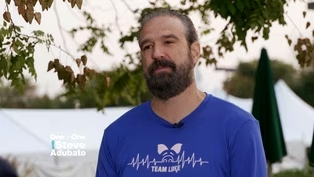
We're honored to once again, talk to our friend, Chris Bautista.
Chris Bautista is the chair of the New Jersey Sharing Network foundation board.
And your son, Luke Bautista, an organ donor and tissue donor.
Tell us about Luke, even though we've talked before, tell us about Luke and why he was such a special young man and the gift of life he gave to so many others.
- Well, I like to tell people, I didn't know that Luke's name meant "bringer of light", but he brought- - Does it?
- Yeah, it does.
And I didn't know that until he had passed, but he brought it.
He brought it when he was alive and he's bringing it now, you know, that he's deceased and he would just light up every single room he walked into, it was a joy.
We go food shopping, he's like, "what's next on the list?".
And he'd run to other aisles to get it real quick.
He'd be on a train and go over and talk to strangers.
He was just one of those people that was super engaged with life and everything around him at all times.
And it really, I mean, there wasn't a dull moment that we had while he was alive and now even in his passing.
- He was 15?
- He was 15 years old, 2016 he passed.
- Tell folks what happened.
- Well, he was home alone.
And you know, he was messing around with huffing basically.
And it went right into his brainstem.
He passed out as older brother CJ, who was 17 at the time, found him a few minutes later and, you know, saw that he was passed out.
Called 911, performed CPR, passed away a few days later in the hospital.
And, you know, then we were approached by the New Jersey Sharing Network about donating his organs.
- What was your first reaction?
- My first reaction, I was at work, I just, it was panic.
And I was on the phone with a state trooper who told me to drive as fast as I wanted to on Rte.
18.
And my first reaction was just, I was inconsolable.
You know, I remember it was a Thursday night and I was laying on the waiting room floor, just crying my eyes out, not knowing what to do.
Next morning, it was 8:35 AM.
We were told that his brain death test came back and that he wasn't going to be alive.
And the Sharing Network approached us, told us about, you know, organ donation and what we could do.
Next thing you know, I'm running around, passing out these green bracelets- - Yeah.
- and I had something I could control, you know what I mean?
You had that one moment, that one thing you control when everything else is spinning out of control.
And we just decided at that point on, my family and I just to make, you know, make the best of the absolute worst situation.
- Tell folks how many people were saved.
- Yeah, Luke was able to save five people with his organs and improve the lives of 75 others through his tissue donations.
You know, the moment that we were told by a transplant coordinator from the New Jersey Sharing Network that his heart was going to go to a 14 year old boy in New York, we were just like, you know, and she walked into the room and told us like, so like calmly and didn't want to disturb us.
Cause we were still with Luke while he's being kept alive on the ventilator.
And I looked at her and I said, "the next time you come with news like that, you better come in through the door and be excited about it because this is good."
"We want to hear that kind of positivity right now, more than anything."
Again, it was, you can't bring him back.
You can't bring a loved one back, but if you can make a positive spin on it or take a sad song and make it a little bit better, like The Beatles say, that's what we want it to do.
And so, as soon as we had that to grasp onto, I just, I ran with it and it got so involved.
We raised $86,000 at the first 5K with the Sharing Network.
- Hold on, let's get a couple of numbers, right?
You raise 86 grand, but you also raised if I'm not mistaken over five years, over 300 grand?
- Yeah, yeah.
- You're an advocate.
- Oh, big time.
- Because?
it means so much to so many people.
So the first time I came to one of these events, the first person I met, I didn't know at the time I was standing next to this young man, he was 22 years old.
And at that time he was a 10 year heart recipient.
And then, it was the first time I met somebody who was alive or that I knew that had an organ transplant and was alive because of that.
And it just became this like overwhelming feeling.
I'm like, "this is what my son has done for somebody else".
"This is what", you know, "he was able to do in his passing".
And you know, that's, it really, you know, Luke's mom Carla, always says it's mind blowing.
And it really is.
It's mind blowing to see someone else who's been saved by someone who's donated organs.
And we've had a chance to meet a couple of Luke's recipients- - You have?
- as well.
Yeah.
- You gotta tell us, what was that like?
- Again, overwhelming, but beautiful and such beautiful people.
I will tell you real quick that two people that we've met, we met Missy, who was Luke's pancreas recipient.
And she has diabetes since, before she was 10 years old.
She had it for 30 years.
- She had diabetes.
- Diabetes, and- - 32 years- she does not have diabetes anymore - Because of Luke's- - because of Luke's pancreas.
She wakes up every morning now, when she reaches over for her, you know, insulin pump,- - Right.
- and she's like, "oh, nope, Luke, I don't need it".
So that's the first thing she thinks about in the morning and it's,- - That's Missy.
- That's Missy, and then we also met Andre.
Andre received Luke's left kidney.
And the best story I could tell about Andre is that he and his wife, Erica, four months after that he received Luke's left kidney, They went to the doctor.
The doctor give him the clean bill of health, went home and celebrated.
Nine months later, had a baby, Amaya Rose, and we got to meet Amaya.
She's like four years old now and beautiful.
Yeah.
- Listen, before I let you go and get team Luke out there raising more money at this 5k run, the 5k, the annual 5k, it's a big event.
What would you say to folks about the Sharing Network?
'Cause you're all in now.
- Yeah, I'm definitely all in.
It's such a beautiful organization.
You know, it's a little odd because in some ways, I wish I'd never met anybody here- - Of course.
- because my son would still be alive, but fortunately I've met some of the most beautiful, just heartwarming, caring, giving people.
And it's really made a big difference in my life, you know.
I actually, I thank Luke because of what he was able to do, because of that opportunity, it's really, it's channeled my life into something more positive and fulfilling that I could ever imagine.
You know, if I could have him back, that would be my decision obviously.
But you know, again, we took sad song and made it a little bit better by doing what we're doing.
- It's helped a lot of people.
- Yeah.
- [Narrator] To watch more One on One with Steve Adubato find us online and follow us on Social media.
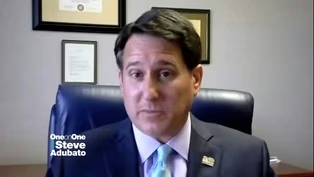
- We're pleased once again, to be joined by David Socolow, who is Executive Director of New Jersey Higher Education Student Assistance Authority.
Good to see you, David.
- Good to see you Steve.
- Okay, we'll put up the website for the authority, tell everyone what you do and why it matters.
- So we're the state agency that helps students and families get the financial resources, the money, as well as the information they need to afford college.
And we are all about governor Murphy's agenda to make college more affordable.
Key elements of that is reduced that net cost that students pay after all the grants and scholarships, including the ones that the state provides through HESAA, as well as helping them take out less debt in the first place by saving for college over time through our NJBEST program.
- Yeah, I'm, we're a 529 family on our end and people, Google 529 college savings plan and figure it out yourself.
if you're able to do that, you know, easier said than done, but it's important.
Hey, David do this first.
The impact of the pandemic as we do this program toward the end of 2021 on higher education overall, but also higher education affordability.
- So we have very important to try to help people because they faced greater costs.
Obviously people had more challenges paying for college with the disruption to employment, various kinds.
Both people working for a salary and the self-employed or business owners.
Those families had difficulty last year in particular, as huge amounts of jobs were, were impacted.
Students, of course also work.
And students are working while they're going to college and look at the kinds of jobs, many students do retail and hospitality.
Those are the kinds of jobs that students do while they're going to school.
In many cases, those jobs were disrupted.
And so our efforts to make college more affordable were even more important.
Luckily, there was some federal relief funding specifically for college students, emergency grants, but it's been obviously a very difficult time.
We also saw some students withdrawal.
We definitely saw enrollment declines during, the pandemic.
- You know, so interesting, this whole higher education discussion, we've been having with so many college presidents, people in the higher ed community, people on your end, folks who understand financing of investments that are important in our lives, particularly education.
Do you think David, I know that some, in some ways this goes outside of the scope of the authorities work, but that somehow this pandemic on some level has dampened a significant number of people's view of what higher education is, or is it if they really could, they would.
And it's just really an affordability question.
It's not, it doesn't matter anymore because I can't, particularly with two, one son in college, the other one about to go, I can't imagine that.
- No, listen, the jobs that were created in the recession, the jobs that held up best during the pandemic, those were the jobs requiring education after high school.
And so credentials, they are valued by businesses, valued by industries that you earn after high school, in a college setting or in some form of, you know, career training are more important now than ever before.
When you look at the jobs that did best, when you look at the jobs that gave people the greatest mobility, it's those that required education after high school.
And so college affordability is where it's all about.
And the key point is reducing that net cost that people pay.
And so we've got a bunch of things we're doing on that.
- Name a couple quick programs, David.
And again go to the website to find out more yourself.
Go ahead David.
- Yes, so listen, we've added funding to our Need-Based Financial Aid Grants, the Tuition Aid Grant and the Educational Opportunity Fund, the EOF program, and that's helping people pay less total for college because we're helping them pay some of that tuition.
We've also created a college promise, which is to give people a predictable net price, a price of zero to go to community college, no tuition and fees, free.
If you have a family income under $65,000, we started that three years ago and it's been incredibly successful more than 50,000 students.
Almost half of the students at community colleges are benefiting from the Community College Opportunity Grant.
And then third, we have expand, we are expanding that starting in fall of 2022, to pick up the third and fourth years of college for students at a four-year public institution in New Jersey, they too will now be able to get a garden state guarantee, a free tuition for years three and four.
at one of those public four year schools, if their family incomes are up to 65,000, and if their incomes are above 65,000, there will be a predictable discount off of that sticker price up to a sliding scale where it phases out.
- So is it fair to say, as we're running out of time David that many of the programs, if not, all of them are income-based meaning the need is clearly greater for lower income or families that are struggling on, on the lower end of the socioeconomic strata, if you will, that those programs are designed more for those folks to give them the opportunity that so many of us who have been so blessed and fortunate, and our kids have had, is that, I know it's overly simplistic?
- No, that's a crucial part of it because making college affordable really is about figuring out how we can get that net price lower.
But we also incentivizing college savings, including with our tax deduction.
So, families in New Jersey within comes up to $200,000 under its exciting new law that the governor signed in June, the College Affordability Act, they can deduct up to $10,000 in tuition that they pay.
They can deduct up to $10,000 a year that they put into a New Jersey Best 529 college savings plan.
And then we also have a matching grant program for people putting money into a 529.
- David, sorry for cutting you off, there's a time issue, right?
As always, we'll have you back.
David Socolow, Executive Director of New Jersey Education Student Assistance Authority.
Thank you, David, we appreciate it.
Important information.
- Appreciate it Steve, thank you.
I'm Steve Adubato, that's David Socolow, we'll see you next time.
- [Narrator] One-On-One with Steve Adubato has been a production of the Caucus Educational Corporation.
Funding has been provided by Horizon Blue Cross Blue Shield of New Jersey.
University Hospital.
NJM Insurance Group.
The New Jersey Education Association.
NJ Best, New Jersey's five-two-nine college savings plan.
The North Ward Center.
PSE&G.
PNC, Grow Up Great.
And by Caldwell University.
Promotional support provided by New Jersey Monthly, And by The New Jersey Business & Industry Association.
How do you create change?
By cultivating hope.
And we see that every day, in the eyes of our preschoolers, in the souls of the seniors in our adult day program, in the minds of the students at Robert Treat Academy, a national blue ribbon school of excellence, in the passion of children in our youth leadership development program, in our commitment to connections at the Center for Autism, and in the heart of our community, the North Ward Center, creating opportunities for equity, education, and growth.
The Impact of the Pandemic on Higher Education
Video has Closed Captions
Clip: S2021 Ep2469 | 7m 57s | The Impact of the Pandemic on Higher Education (7m 57s)
The Importance of Diversity in Public Broadcasting
Video has Closed Captions
Clip: S2021 Ep2469 | 10m 6s | The Importance of Diversity in Public Broadcasting (10m 6s)
The Personal Story of Organ Donation
Video has Closed Captions
Clip: S2021 Ep2469 | 8m 25s | The Personal Story of Organ Donation (8m 25s)
Providing Support for PBS.org
Learn Moreabout PBS online sponsorship
- News and Public Affairs

Top journalists deliver compelling original analysis of the hour's headlines.

- News and Public Affairs

FRONTLINE is investigative journalism that questions, explains and changes our world.












Support for PBS provided by:
One-on-One is a local public television program presented by NJ PBS