One-on-One
Joseph Nappi; Alisha De Lorenzo
Season 2024 Episode 2679 | 27m 44sVideo has Closed Captions
Joseph Nappi; Alisha De Lorenzo
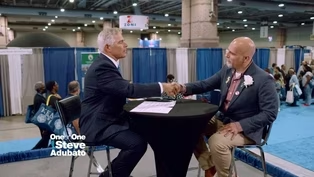
2023-2024 NJ State Teacher of the Year Joseph Nappi goes to the NJEA Convention to talk about his journey from being the self-professed “problem child” to receiving one of NJ’s highest accolades for educators; Then, Therapist and Executive Coach Alisha De Lorenzo talks about improving New Jersey’s education system by addressing the once taboo subject of teachers’ and students’ mental health.
Problems playing video? | Closed Captioning Feedback
Problems playing video? | Closed Captioning Feedback
One-on-One is a local public television program presented by NJ PBS
One-on-One
Joseph Nappi; Alisha De Lorenzo
Season 2024 Episode 2679 | 27m 44sVideo has Closed Captions
2023-2024 NJ State Teacher of the Year Joseph Nappi goes to the NJEA Convention to talk about his journey from being the self-professed “problem child” to receiving one of NJ’s highest accolades for educators; Then, Therapist and Executive Coach Alisha De Lorenzo talks about improving New Jersey’s education system by addressing the once taboo subject of teachers’ and students’ mental health.
Problems playing video? | Closed Captioning Feedback
How to Watch One-on-One
One-on-One is available to stream on pbs.org and the free PBS App, available on iPhone, Apple TV, Android TV, Android smartphones, Amazon Fire TV, Amazon Fire Tablet, Roku, Samsung Smart TV, and Vizio.
Providing Support for PBS.org
Learn Moreabout PBS online sponsorship- [Narrator] Funding for this edition of One-On-One with Steve Adubato has been provided by The New Jersey Education Association.
NJ Best, New Jersey’s five-two-nine college savings plan.
RWJBarnabas Health.
Let’s be healthy together.
Rutgers University Newark.
PNC Foundation.
New Jersey Sharing Network.
PSEG Foundation.
Robert Wood Johnson Foundation.
Working for a more a healthier, more equitable New Jersey.
And by NJM Insurance Group.
Serving New Jersey’s drivers, homeowners and business owners for more than 100 years.
Promotional support provided by Northjersey.com and Local IQ.
Part of the USA Today Network.
And by BestofNJ.com.
All New Jersey in one place.
- This is One-On-One.
- I'm an equal American just like you are.
- The way we change Presidents in this country is by voting.
- A quartet is already a jawn, it’s just The New Jawn.
- January 6th was not some sort of violent, crazy outlier.
- I don't care how good you are or how good you think you are, there is always something to learn.
- I mean what other country sends comedians over to embedded military to make them feel better.
- People call me 'cause they feel nobody's paying attention.
-_ It’s not all about memorizing and getting information, it’s what you do with that information.
- (slowly) Start talking right now.
- That's a good question, high five.
(upbeat music) - Hi everyone, Steve Adubado with my co-host and colleague Jacqui Tricarico.
Jacqui, let's tee this up.
We were down in Atlantic City late in 2023 for the New Jersey Education Association Convention.
There are two interviews here that I did.
You did so many others.
People should check out our website for the Jacqui Tricarico interviews with a whole range of folks from the NJEA Convention.
The first one's with Joe Nappi, the 2023-24 New Jersey Teacher of the Year.
Tell everyone who Joe is and what you took from that interview.
- Yeah, the state teacher of the year, you know, every year when we go down to the NJEA Convention, Steve, we get a chance to speak to the state teachers of the year.
And these are individuals that are really making such a difference in their classrooms, but in their communities as well.
Joseph Nappi, you had a great time speaking with him.
Joe is a educator here in New Jersey, high school history teacher, and he specializes actually in the Holocaust, in teaching about the Holocaust.
Something that you didn't get into with him during your interview is that he was actually part of this PBS special with Ken Burns, - Is that "The United States and the Holocaust?"
- Yeah, so he had his hand in that as well.
And I think that one of the most important things we take away from this interview is he talks about the fact that he did not really wanna be an educator.
That's not something he ever thought about, because he was not the kid that liked school.
He was the one getting kicked outta school, had a lot of trouble during his youth, and school was not his thing.
And then fast forward so many years later, becoming an educator, he says, was definitely his calling he never knew he had.
- There's so many things about this interview that strikes me, that still strike me now, and I want folks to look for it.
He talks about not just the Holocaust, but genocide.
The word genocide gets thrown around a lot, and I won't get on my soap box, but, I mean, Joseph Nappi talks about it from a historical perspective, and doesn't throw the word around loosely, because it's dangerous to throw that word around.
And so Joe talks about that extensively.
He talks again about, as Jacqui said, his path and teaching.
Jacqui, he teaches in, is it Monmouth Regional High School in Tinton Falls?
- Yes, that is correct.
- And so genocide, humanity, talks about the Holocaust.
And P.S., how the heck are they giving credits at Kean University?
- Yeah, so he has this program, one of the classes that he teaches on the Holocaust, Genocide and Humanity.
It gives students college credit at Kean University.
- High school students?
- Yeah, yeah.
You know, there's a lot of these programs within high schools all around the state where you're taking these more advanced courses that you can get college credits for.
So just a little jumpstart into that college education.
- Good stuff.
So this is an interview that I did with Joseph Nappi, the teacher of the year, New Jersey Teacher of the Year 2023-24.
Also to disclose the New Jersey Education Association, when we refer to the NJEA, that's who they are.
They're a big supporter of public broadcasting, an underwriter of ours.
Joe Nappi, a terrific teacher, AC, at the convention, check him out.
- All right, folks, you wanted to find out who the Teacher of the Year in New Jersey is.
He's in the house.
He's Joseph Nappi, New Jersey Education Association 2023-2024 New Jersey State Teacher of the Year.
Congratulations, my friend.
- Thank you so much, Steve.
Appreciate you having me on.
- Now, we're gonna talk about your teaching in just a moment, but I'm fascinated.
Our producer, Jacqui Tricarico, was telling me that you did not know, got some video, you didn't know that you were... How you've... How the heck did you find out you were a teacher of the year?
- So I showed up.
We had this assembly that was going on at the school, and it was very secretive.
Nobody kind of knew what the topic was or what was going on.
I asked a couple times for information.
Nobody seemed to give me a straight answer, which I thought was pretty odd.
And then when we walked down to the assembly, as I came into the gym, I started to see the dignitaries lined up in the front of the room.
And I started to realize, I'm like, I think- - Was Senator Vin Gopal there?
- He was.
Vin Gopal was there too.
I think the dead giveaway was my wife.
'Cause my wife, from the second I walked... Now, she's an English teacher.
She works in the high school as well.
But from the second I walked in the room, she was just beaming.
So, I was like, "All right, I think-" - This is down in Monmouth County?
- Exactly, yeah, we were in the gym at Monmouth Regional.
But it was so awesome.
We had all the kids who were out there with us.
So, it was so touching for me to have, you know, all the applause and the admiration from the kids.
It just really felt great.
- You know, but it didn't start out this way.
It sounds like this is your life.
I'm gonna date myself.
This is your life, Joe Nappi.
So the word on the street is, growing up, and I think you're in Bayonne.
- Right, right.
- He wasn't the greatest student.
You told our producers you weren't that great.
- Yeah, I was the problem child, you know what I mean?
- You we're the one?
- The bad kid, that was it.
I had a lot of problems as, from eighth grade on, I was really acting out.
My parents had been divorced.
I think I was looking for some more attention than I was maybe getting at home, and I started really acting out in school.
I'd always been very intelligent.
I was in honors classes, all those sort of things, but I sort of lost focus.
What... You know, the importance of going to school kind of was lost on me in eighth grade.
So eighth grade, I got sent home.
I wasn't allowed to participate in graduation.
My mom enrolled me in Catholic school.
She thought a change of scenery, maybe, you know, a little Catholic discipline would- - Trust me, I've been there.
- Right?
And I was booted out by Thanksgiving from the Catholic school.
I went to Monmouth Regional, where I teach at now.
- [Steve] How's this turn around?
- Really, it turned around at, with 9/11, was a huge moment in my life.
I was in community college.
I barely got out of high school with a degree.
I was chasing a paycheck.
You know, I enrolled in computer science, but I was completely miserable.
I didn't like the thing.
And my sophomore year, 9/11 happened.
And my two close family friends were killed.
It was a very traumatic moment for me.
Really made me reevaluate what I wanted to do with my life.
And my then girlfriend, she's now my wife, started pushing me that she wanted me to be a teacher.
She thought I should be a teacher.
And I kinda laughed her out of the room at the idea of like, you know, "Wait, I'm gonna go back?"
Like, I was so happy to get out of school.
Now I'm going back?
And she said something to me that really changed my view of education, which was, you know, "If you're in charge, it could be whatever you make it."
And that really set my mind turning about, you know, well, what was it that I didn't like about school?
How could I get a kid like me to wanna plug in and come to class?
How could we make it fun and exciting?
You know, really bring the joy back to education.
I feel that a lot of my teachers were super stressed with standardized testing and meeting certain benchmarks, and it kinda can take the joy out of the classroom, where it doesn't feel as personal as it should be.
And I really, I focus a lot on those personal connections with students.
I think trying to make them wanna come to school is really 90% of the battle.
- But, Joe, here's the other thing.
In terms of the specific area that Joe Nappi teaches in, the Holocaust- - Right.
- How and when does it trigger for you that this is your mission to teach, to help students understand and appreciate the significance of the Holocaust?
- It really, and this is something that I try to give to my students as well, really changed when I started to have interactions with survivors.
I had always been interested in the Holocaust.
And when I got into teaching, I got an opportunity to attend a workshop with Facing History & Ourselves.
That really changed my view about what was possible in my classroom.
They teach a method about choosing to participate, about, you know, getting involved, civic responsibility and things of that nature.
And I used some connections through them to get a chance to meet with some Holocaust survivors.
And really, hearing their stories just touched me so much.
And I really felt a personal responsibility to wanna try to pass on what I had learned from them within the classroom.
I got a great opportunity to teach a satellite classroom at Kean University.
So my kids are seniors, they take it as an elective, but they get college credits from Kean University.
And I've really infused all that sort of the philosophy that I have about personal relationships and really bringing them on a journey from just interacting with this highly emotional, highly traumatic, you know, history.
- Right.
- And trying to convince them that, you know, all throughout that, you know, and this is one of the slogans that Facing History & Ourselves uses, is that, you know, "People make choices, and choices make history."
And that really, I think, speaks to what I try to get across to my students.
That although it can often be overwhelming, all the things that are going on in the world, you do have a voice and you do have more power than I think you give yourself credit for.
- But, Joe, think about this.
We're taping at the NJEA Convention.
It's in November, 2023 on October 7th.
- Right.
Horrific, absolutely horrific.
- How did October 7th and the assault, the attack, the horrific attack by Hamas on the people and on the children and on the mothers and those who are going to a concert in Israel, and you've got a button that says hate with a line through it.
We get that on camera.
- Right, right.
- How does that impact your teaching, not to mention what's been going on since October 7th?
- Immediately.
And it's absolutely horrific.
I mean, I know for me, it brought back a lot of memories of September 11th, and it brought back a lot of the trauma that I felt early on.
And I immediately understood that some of my students are gonna be feeling the same thing.
And I think whenever you're dealing with a highly touching issue like that, I think it's very important for you to reflect yourself on where you're at before you get into the classroom.
This is something that I really struggled with in teaching September 11th 'cause it was a deeply personal history for me.
So, I have to be okay with where I'm at before I can really share that with my students or bring them into a safe space in the conversation.
So I spent some time reflecting on it.
We used some time in class to allow the students to reflect on it 'cause I didn't feel that I could do justice and talk about it from my- - And there are Jewish students in that class.
- Absolutely correct.
- There are Palestinian students in in that class.
- I was gonna say, we also have a large Arab population in our school.
- How the heck are you dealing with that?
- So for us, it's all about creating a safe space for conversations.
It's really good strategy that Facing History uses, head, heart, conscience.
That asks students to think about how we're discussing these sort of conversations from a place of, you know, "What am I feeling about this right now?"
And again, I think we have to give space for feelings in the classroom.
And we also have to have respect for the fact that, you know, I can't argue with your feelings, Steve.
You know, and you feel a certain way about something, and I need to validate those feelings.
I may not agree with the way that you're feeling, but there has to be a space for those feelings to be expressed before we can move on to the really important issues of historical context and what is a possible solution to this problem.
Because it's been...
I mean, so many of my students are touched by this.
They're bombarded with these images on social media.
So that's been really difficult.
And I also think as a history teacher, it's extremely important for me to give my students skills and knowledge of media literacy to be able to navigate through what they're seeing- - Make sense of it.
- Exactly, because there's so much misinformation.
And we live in such an instant gratification culture where we wanna know right now, we wanna have all the answers.
And sort of the unfortunate reality of war is that we're not gonna know the full truth about everything that's happening right now for quite some time.
That fog of war is very real and we have to be very careful about not being led astray by misinformation into making us, you know, make snap judgments and decisions that prevent us from having meaningful conversations.
- Last question, Joe.
One to 10, how much do you love your teaching?
- I'm an absolute 10.
I mean, the hardest thing...
I mean, it's been great, really amazing to have all this experience and to be honored and to go out and do this.
But really, the thing that's kind of bittersweet about it is the time that I'm away from my students in the class - You're an ambassador.
- You know what I mean?
Yeah, it's great.
Hey, listen, I'm very honored and I'm super happy.
I love this profession.
It changed my life.
You know, I have such a joy for what I do, and I bring that joy back, I share that with them.
And I really think we need more good people in the classroom and people who feel that passion to do this.
But again, it's all about the students for me.
So I'm, you know, as excited as I am to do the world tour.
I'm even more excited to get back and work with those kids in every opportunity I can have.
- That's Joe Nappi.
He's the state teacher of the year, 2023-2024, the NJEA Convention here in Atlantic City.
He's the guy.
Congratulations.
- You're the guy, Steve.
Thank you so much.
Appreciate it.
- Not when I'm with you.
Great stuff.
- Thank you so much.
- All the best.
- [Narrator] To watch more One on One with Steve Adubato find us online and follow us on Social media.
We continue meeting terrific educators, and also folks who were not formally educators, but they were educating people down at the New Jersey Education Association Convention.
Alicia de Lorenzo is a speaker, executive coach and therapist.
She was a keynote speaker at the convention.
Jacqui, what should people be expecting in the interview that I did with Alicia, which really is very powerful?
- Yes, Alicia, a educator for 20 years, but also a licensed therapist.
And deciding after implementing some special techniques and things within her school when she was an educator, to help her fellow teachers and support staff professionals in her own school deal with burnout, the mental health issues that our teachers face, to make them better educators so that they can implement that and put that forth onto the children that they are teaching.
So, you know, she saw a need for this after seeing what happened at her school.
She put teaching in, you know, the one sense of the way that we would think about teaching on hold, to really go around to over a hundred schools now in New Jersey that she's visited, to work with the educators, like I said, and help them with their mental health, and implement some special practices within the school, that in turn is really, she's seeing firsthand being so profound on the students that they're teaching.
- You know, Jacqui, there's a quote that she shared, said, I want...
This is interesting.
This is from Alicia.
"I want educators to know that they're valued.
As so many are, quote, 'tired and underappreciated.'"
I mean, you know, I have this, I'm not gonna get into this whole leadership thing, but there's Abraham Maslow, Maslow's Hierarchy of Needs if you research it, he was a great researcher and psychologist who came up with a theory that we all have these needs, these human needs, food, shelter, safety, but as you move up this hierarchy of needs, it's being appreciated, being acknowledged, being seen, being recognized.
Not overrated, Jacqui.
- Yeah, not at all.
And she saw the need for that.
She also says, "Teachers are my people."
And she's just thriving in that way.
And that was all part of her keynote address there at the New Jersey Education Association's convention this year.
And I know it was a really powerful message that she left with those educators, and those support professionals within our New Jersey community of teachers, those folks that are really our unsung heroes in so many ways.
And we know how important it is to support, and continue to support our educators and the work that they're doing.
- I promise I won't get on my soapbox on this either.
Do your kid a favor, do our school system a favor, do our teachers a favor and just say thank you.
Just let them know you appreciate what they're doing with our kids, even if you don't agree or like everything a teacher does.
That teacher, the vast, vast, vast majority of them are all in for our kids.
Underpaid, underappreciated, pretty tired.
Hey, for Jacqui, myself, you're gonna take a look at an interview we did down in Atlantic City with Alicia Di Lorenzo, a terrific educator, both formally as a teacher, and now as a motivational speaker and therapist.
Let's check it out.
- Hi everyone, Steve Adubato, and more importantly, Alisha De Lorenzo, a speaker, not a speaker, a great speaker, one of the keynote speakers here at the NJEA Convention, executive coach and therapist.
Good to see you.
- Thank you, good to see you too.
- Now, there's a reason why you're here.
One of the big themes, we just talked to the president of the NJEA, Sean Spiller, about the mental health, the wellbeing of our educators.
- Yeah.
- That's where you come in.
Talk about it.
- Yeah.
Yeah, so I've been in education for a long time, almost 20 years I was in education, but I'm also a licensed therapist.
So I got to see both sides of the table, not only for young people, but for our adults.
And this has been going on.
It's been a long time that our students' and our teachers' mental health has been challenged.
And quite honestly, for a long time, people didn't wanna talk about it.
They said, like, "We can't talk about this in education.
It's not the place for it."
And I think in this moment right now, we're saying that we can't not talk about it.
You know, the things that teachers are being faced with and the challenges- - Name them.
Sorry for interrupting.
Name the most challenging, difficult aspects of being an educator.
Listen, people choose to be educators.
The educators we talked to here love what they do, - [Alisha] Yeah.
- But that doesn't mean there aren't real pressures that are challenging on so many levels.
Talk about them.
- Yeah, there's so many challenges right now.
I think, like, to name that the system is quite broken.
That there's a sense that teachers don't have the freedom and the agency to really, like, take the kids, and what kids need in this moment, and really address that, because everyone has a voice, everyone has an opinion, everyone's pointing a finger.
So it really stifles that creativity, the relationships that teachers can have and build, which is some of the most trusting relationships that kids have in their lives, is like, that first, you know, relationship with someone who really sees them and gets them and, you know, values them.
Not that that's not coming from home, but like, teachers are the next best place where that's coming from.
And for what's happening right now to stifle that ability for teachers to show up fully for students, I think is, you know, something that we have to really be aware of.
- Do you think on some level teachers have become targets for some with a quote, unquote "political," and not so much an educational agenda?
I know that's a loaded question, but please.
- Yeah.
You know, education's always been political, but I definitely think that teachers right now have targets on their back because of, you know, the position that they're in.
There's some mandates here, right?
That they're being told are mandatory and the law now for them to teach.
And then if they do that, there's this risk socially and within the community to say, "You know, I don't agree with that mandate, and I'm gonna take it out on you."
- Mandates having to do with the LGBTQ community, mandates having to do what parents know, get to know, and don't know, and under what circumstances, mandates about teaching about race.
- Yeah.
Yeah, curriculum mandates.
Yeah.
- And do teachers come to you?
'Cause my understanding is you do a lot of traveling all around the state, around the nation talking about this.
- [Alisha] Yes.
- How do people find you?
- Yeah, so it's really been pretty organic.
I did some work in my district that was really transformative.
It was taking an integrative approach to education that didn't just focus on academics, but focused on all the other things that young people are bringing to the table that gets in the way of their academics.
Their mental health, that trauma.
- Is that positive disruption?
- We'll get there.
- Or is that- That's not that.
- That's not that yet.
- Okay, go ahead.
- But it is, in a sense.
So the work that we did in my district was really transformative, and we saw great outcomes with students.
A decrease in discipline over 60%, academic growth in some classrooms, three years of academic growth in one year.
And- - Your school district.
- Yeah, from- - Where was that?
- It was in Asbury Park school district at that time.
- Not an easy district.
- Not an easy district.
- Real challenges.
Urban community.
- Absolutely.
And my first four years of teaching were in Bergen County, in some of the, you know, most privileged communities, affluent, and here's the thing.
It didn't matter what the zip code was, kids were still facing incredible challenges.
They were faced with lots of mental health, you know, issues and stressors, that were getting in the way of their learning.
And if we're not gonna address that, right?
Then we really can't get to the learning piece of it.
But to get back to the question about how do people find me- - You started doing it in your district, - In my district.
- And then word got out, - Yep.
- "Hey, we need her?"
- Yeah, so school boards took me on a tour of the state, every county, to talk about what we were doing.
And Asbury was happy for me to share that story, because we were just seeing a real difference, a real change in this approach.
And went to every county and started talking about this work that we did, telling that story.
And then inevitably people were asking, "Well, like, can we work with you?"
And I was not able to while I was teaching, but eventually I looked at my calendar and booked a year out and schools across the state, a year out, I was booked for an entire year.
And that's when I decided, this is bigger than one district.
- You went all in.
- I went all in.
- Full time.
- Yeah, a hundred percent.
This is so much bigger.
- Why?
So hold on, I was gonna ask you about rewarding, but this gets my attention, 'cause disruption is always a fascinating word to me.
But then you put positive.
Positive disruption.
- Yeah.
- [Steve] Define it.
- Positive disruption.
It's the thing that you do uniquely different, just a little bit different, and get better results.
- For example?
- For example, there's teachers that are getting better engagement right now, in the midst of all the chaos, and they're doing just something uniquely different.
How they do that thing where they greet their students, they look 'em in the eye, they ask about, you know, their family, or a connection that they know, that one thing that they're doing that's uniquely different.
They have the same access and the same resources as their colleagues do.
They're in the same environment, with the same stressors, and that they're still getting better engagement.
How do they do that?
That's the question.
And in education, we don't look to those people who are positively disrupting.
Oftentimes those people, and I was a positive disruptor, if you cannot tell, I- - Without even coming up with the name.
Before you had a name for it, - Yeah.
- You were a positive disruptor.
- Already, absolutely.
Disrupting a system, disrupting the status quo, by just something uniquely different that we're doing, that oftentimes we don't even know is that uniquely different.
- Hold on a second.
I'm a student of and a teacher of leadership.
- [Alisha] Yes.
- And to me, you have a lot of names for what you do, but you're a leadership coach as well, obviously.
- Sure.
- So I'll often say, and I won't get on my soapbox, I promise you.
I'll often say, you know, we have to, we can't be on autopilot.
Do what you do every day, the way you do it.
That's what we do.
- That's right.
- This positive disruption forces you not to be on autopilot and go, "Hey, wait a minute.
How can I positively..." You help fill in the blanks.
- Yeah.
You know, if you are a positive deviant, right?
If you are a person who's doing that thing that's uniquely different, you might not even realize it.
But what it forces us to do is look at those people differently.
What do we do when there's a problem?
We have a negativity bias.
We look at the problem, we don't look at the people who are successful.
We're not looking at, oh, but how did, you know, Ms. Johnson, or, you know, Mr... How are they getting that out of their students during this time, and their peers are suffering?
So we don't often look at the solution, we look at the problem.
And this forces us to see it differently.
It forces us to say, "But wait a second.
There's wisdom right now, right here.
People have found a way amongst us to do it differently and get better results.
How do we learn from them?"
That's not happening in education.
- Where's your passion come from?
- Ah.
- I mean, don't tell me you're Italian American, 'cause we already talked, but, you know.
Is there a thing about our people that way?
They're very overtly passionate.
(Alisha and Steve laugh) - I think you can find a lot of people.
- This is not on the agenda, I assure you.
This is not what we were gonna talk about.
Is there something there in your family?
I did this right away with my family.
- You did, you did, you went right there.
- I did.
Family?
- You know, when I look back on my experience of life, I don't, I was very supported by my family, but I didn't get these foundations.
The justice, the foundation of justice that so drives me.
I mean, it fuels me.
They didn't necessarily come, but I was supported by my family.
For me, teachers were the people in my life who showed me things beyond what my family showed me.
And they heard me in a way that maybe was difficult for my family to hear from me.
- Are teachers your people?
- Teachers are my people.
- You found your people.
- I mean, they are my people.
I talk on big stages now outside of education, but teachers are my people.
- How much do you love it?
- Ugh.
This is, I was asked a question 10 years ago in grad school.
And the question was, "If you could do one thing and know that you wouldn't fail, what would you do?"
And my response, without hesitation, was, "Change the face of education."
That was a decade ago.
- That's what you're doing every day.
- It feels that way.
- Alisha De Lorenzo, check out, we've had her information up.
Find out more.
Executive coach, therapist, a great speaker, and an educator.
- And an educator.
- Thank you so much.
- Thank you so much, Steve.
- [Narrator] One-On-One with Steve Adubato has been a production of the Caucus Educational Corporation.
Celebrating 30 years in public broadcasting.
Funding has been provided by The New Jersey Education Association.
NJ Best, New Jersey’s five-two-nine college savings plan.
RWJBarnabas Health.
Let’s be healthy together.
Rutgers University Newark.
PNC Foundation.
New Jersey Sharing Network.
PSEG Foundation.
Robert Wood Johnson Foundation.
And by NJM Insurance Group.
Promotional support provided by Northjersey.com and Local IQ.
And by BestofNJ.com.
- Hello, I’m Donald Payne, Jr.
Congressman for New Jersey’s 10th District.
One organ and tissue donor can save as many as eight lives, and improve the health of another additional 75 people.
That is why I encourage everyone to register as an organ donor.
For more information about organ donation, please visit www.NJSharingNetwork.org
2023-2024 Teacher of the Year: The Journey of an Educator
Video has Closed Captions
Clip: S2024 Ep2679 | 13m 35s | 2023-2024 Teacher of the Year: The Journey of an Educator (13m 35s)

Addressing the Mental Health of Teachers and Students
Video has Closed Captions
Clip: S2024 Ep2679 | 13m 38s | Addressing the Mental Health of Teachers and Students (13m 38s)
Providing Support for PBS.org
Learn Moreabout PBS online sponsorship
- News and Public Affairs

Top journalists deliver compelling original analysis of the hour's headlines.

- News and Public Affairs

FRONTLINE is investigative journalism that questions, explains and changes our world.












Support for PBS provided by:
One-on-One is a local public television program presented by NJ PBS