Traverse Talks with Sueann Ramella
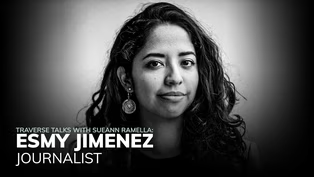
Journalist Esmy Jimenez
12/22/2021 | 43m 5sVideo has Closed Captions
Journalist Esmy Jimenez On Life As A Journalist And DACA Recipient.
Esmy talks about her life growing up in a rural part of central Washington as an undocumented immigrant, being the first in her family to attend college, and the fun and hardship of reporting on the never-ending news cycle. Esmy is currently reporting for KUOW but has reported for many other news outlets. In 2020, she won an Edward R. Murrow regional award in feature reporting.
Problems playing video? | Closed Captioning Feedback
Problems playing video? | Closed Captioning Feedback
Traverse Talks with Sueann Ramella is a local public television program presented by NWPB
Traverse Talks with Sueann Ramella
Journalist Esmy Jimenez
12/22/2021 | 43m 5sVideo has Closed Captions
Esmy talks about her life growing up in a rural part of central Washington as an undocumented immigrant, being the first in her family to attend college, and the fun and hardship of reporting on the never-ending news cycle. Esmy is currently reporting for KUOW but has reported for many other news outlets. In 2020, she won an Edward R. Murrow regional award in feature reporting.
Problems playing video? | Closed Captioning Feedback
How to Watch Traverse Talks with Sueann Ramella
Traverse Talks with Sueann Ramella is available to stream on pbs.org and the free PBS App, available on iPhone, Apple TV, Android TV, Android smartphones, Amazon Fire TV, Amazon Fire Tablet, Roku, Samsung Smart TV, and Vizio.
Providing Support for PBS.org
Learn Moreabout PBS online sponsorship(upbeat music) - [Interviewer] You've probably heard of Dreamers DACA recipients.
What if you're a reporter who covers immigration and you're a DACA recipient?
Esmy Jimenez is that person and she offers insight into what it's like.
Esmy was a reporter with NWPB and you may find what she says about science and wicked problems, very interesting.
(upbeat music) Okay, Esmy.
- Let's do this.
- [Interviewer] Let's do this.
Let's start from the beginning, darling.
What do you remember about coming to the United States?
- [Esmy] Oh, absolutely nothing.
I've only heard stories from my mom, I was one.
I was raised in the Yakima Valley.
- [Interviewer] And what were your parents like?
- [Esmy] My parents, my Mom is a hilarious woman, she is very, very kind.
I always have one, she's the kind of person that I would go out of my way to befriend her if she was not my mother already.
- [Interviewer] And what's your dad like?
- [Esmy] My dad is very calm, very sweet, very gentle.
They're a little bit of opposites in the sense that I feel like she's very much a firecracker and he's very much like, "Whatever your mom wants, I just wanna make her happy."
He bought chickens during the pandemic.
He was so happy.
He constantly sends me videos of the chickens.
They're just both very country people.
They grew up in rural Mexico but they still live in a rural part of Central Washington.
And to them, they've always been very connected to the land and how important our food is to just keep ourselves healthy.
- [Interviewer] I asked if you had any memories of coming to the United States, because you, Esmy are a Dreamer, a DACA recipient.
What has the last four years been like for you and your status?
- [Esmy] It's definitely been I think difficult to both hold something personally and then also reports on it.
I've reported on immigration issues before I became an immigration reporter at KUOW.
And so I think there were definitely times that I had to be like, "Okay, I have a personal stake in this, of course and I can make sure to let my editors know so that it doesn't affect the reporting process."
But I think by and large, I just see it as this thing that I... almost is like this vase.
Then I'm like, "I'm gonna put this vase aside.
I will come back to it."
but it's not something that I can deal with right now.
Right now, I just need to understand, how is this impacting other people?
What does the policy say ultimately?
How does it ripple out?
- [Interviewer] That doesn't sound easy to do though.
- [Esmy] I don't think it is but I think many reporters, and I'm seeing more talk about this now.
We always have had individual stakes in the game.
Whether that was gender, whether that was trans rights, whether that was a military person or your family comes from rural areas or they're business people, I think more and more people are realizing like, "Oh yes, we don't wanna be the story but we're ultimately never not part of society ultimately.
We're still very much effected."
- [Interviewer] Why did you decide to become a reporter?
- [Esmy] It was an accident.
I genuinely did not need to do that.
- [Interviewer] Because you have a science background, I think, right?
- [Esmy] Yeah, Environmental Science.
- [Interviewer] I see here you did, what was it called?
Give me a second to find it, paleoclimatology?
- Yes.
You worked at a paleoclimatology lab, that's just one thing.
But you have got to tell me what that was like first.
- [Esmy] That is great.
The first thing that made me think about is, I remember I was telling my mom 'cause I was so proud about working at this lab and she was like, "So what do you do?"
And I was like, "Oh, well, there's this old sediments."
And then we take G River, which is specific kind of four minute FRA.
And the idea is that you can carbon date this and look back 10,000 years ago and be able to essentially take that data and understand what the climate was like 10,000 years ago.
And she was like, "So you play with very old dirt?"
(laughing) And I was like, "You're not wrong."
I do, I play with very old dirt.
- [Interviewer] Leave it to a mom to succinctly put us in our place.
- [Esmy] Yeah, but reporting-wise, it was very much an accident.
I was the first to finish high school and the first to go to college.
I did not know what I was doing but I just loved learning.
I'll totally admit, I'm a huge nerd.
It's not cool at all.
I just like reading and understanding things.
And so at university I was like, "Oh my God, there's so much to study and so much to do."
But eventually they were like, "You can't have 10 minors.
You need to actually focus and study something."
So I picked environmental studies, a little bit of international relations too.
But I kept finding myself being like, "Why aren't we talking about this subject this way?"
So the first time that I told another friend of mine who was in the communications department doing journalism, I told her, "When people talk about organic produce, I really wish they actually would focus on a public health issue."
So one of the things that I found interesting was, when you look at pasture raised chickens and fresh eggs that way, they actually have a lower rate of salmonella than mass produced eggs.
And so it was like, "Rather than talking about this as animal rights and PETA and only vegans or bougieness or whole foods, why don't we talk about it in public health terms?
This is valuable.
I want people to know this."
And she said, "You should write an article about that."
And I was like, "Oh, I don't mean me.
I mean you, you're the reporter.
I'm telling you so that you do this."
And she's like, I tell you what, do a draft I'll look it over, we can submit it to the local paper."
And I was like, "Okay."
And that was a one-off.
I graduated, I very much intended to work in fisheries or some kind of science field where I was gonna be doing the thing that I thought I learned to do.
And I kept finding spots where someone was like, "You should write an article about that.
You should say that to someone."
And that led me down this very specific path.
And then with radio, the thing that was different is that, Phyllis Fletcher one day was like, "Hey, you should really consider audio.
You speak Spanish or from Central Washington, we could always use more folks out there."
And I very much was almost dismissive.
I was like, "I would never do that.
I don't listen to the radio.
NPR is just for white people."
And like, "Ooh, what does anyone know about NPR?
I don't know about NPR.
My parents don't listen to NPR.
And I hate the sound of my voice.
I would never do that."
She was like, "Well, just think about it, just consider it."
And then Carrie, Carrie reached out three months after meeting Phyllis.
And was like, "Phyllis Fletcher said that you would be willing to do radio."
- [Interviewer] Yeah, these are our people.
Just for our listener, Phyllis Fletcher is a well loved editor who used to work KUOW and for Northwest News Network.
And then Carrie, that you're referring to is our station manager here at NWPB.
Because we were looking for a Yakima reporter, and so he gave you a call.
- [Esmy] Yeah, and I was like, "Listen Carrie, I'm not saying Phyllis is sloughed.
I'm saying Phyllis was very liberal with her interpretation.
(laughing) My reporting abilities, I don't know.
I can point a mic at things, but I don't know how to mix audio.
And he pretty much was like, "Listen, it's three months, we just need to fill in person.
You can't screw it up that badly."
And I was like, "Okay.
(laughing) If you're willing to take me, sure, I'll do it."
- [Interviewer] Well, and I love that that happens because that opportunity has trampolined you too many other opportunities.
- [Esmy] Oh, absolutely.
So your folks, I'm curious when you were younger and they knew you were good at reading and writing, how did you find your path to college?
- [Esmy] Accidentally too.
I remember them sitting me down and being like, I think I was 14 yet 'cause it was at the very beginning of high school and the other kids are talking about college and PSATs and SATs.
And they were like, "We would love for you to do the things that you would like to do.
You were also undocumented and you don't have money.
So you're probably not gonna go to college.
And I'm sorry."
But I was like, "Okay."
It wasn't heartbreaking.
It was just a matter of fact just like, you're not gonna get a brand new Corvette or you're not gonna...
There were just certain things that I knew I was not gonna have.
And I was like, "Okay."
- [Interviewer] And then what happened?
- [Esmy] Well then I was like, "Wow, I'm sure, I'm very stubborn and I'm very contrarian.
So I think there was just times that I was like, "Well, who said?"
And I looked into how other people did it.
I was like, so I could get a scholarship.
I was really, really good.
I could get a scholarship and someone would pay for this so it would be less economically burdensome us.
And they were like, "Sure, go for it.
We can't help you.
We don't know how to fill out a FAFSA, but we're all about supporting you.
I'll make you food.
You tell me what the FAFSA is, you fill in stuff."
And I did that.
I was able to get a couple of universities, but effectively, the only reason I did actually go to college because even UDaB was too expensive for me.
The local university, Seattle U is gonna be way too expensive even with a half tuition scholarship.
Is that I did get a full tuition scholarship.
That's the only reason I went to college.
- [Interviewer] And it's in California, right?
- Yes.
What university was that?
- [Esmy] It was the University of Southern California.
- [Interviewer] Excellent, what was it like being away from home?
- [Esmy] I had never, I'm from some Prosser.
We had a population of 5,000 so to get the scholarship, you had to do an interview so I flew down to California by myself.
Got out of L.A. as a 17 year old and tried to hail a taxi.
Some person saw that I was struggling to hail a taxi 'cause I didn't know how to and they flagged it down for me.
The taxi driver is like, "Where are you going?"
And I was like, "USC," super proud.
And he's like, "But where?"
And I was like, "Oh, the University of Southern California."
He said, "No, no, no, no, which entrance?"
And I was like, "The main entrance, the one where people go to."
And he was like, "It's a huge campus, you do know that, right?"
And so I would start explaining to him, "I'm just lost.
I'm here, I don't know what I'm doing but I have an interview at 2:00 PM.
Please help me get there."
(laughing) And he was like, "All right, let's go.
I'll help you out."
- [Interviewer] Oh, well that's good.
- [Esmy] Yeah, thank goodness for him.
- [Interviewer] Oh, Esmy, I love this little imagery.
It sounds like a wonderful little movie.
Esmy me gets accepted to big college in California from the small town of Prosser.
And then just fun in your way.
It sounds like most of your life has been this way, finding your way, a bit of luck.
You've had support.
- [Esmy] Yeah, very much, that's why I chuckle.
I think a lot of times people are like, "Why's she laughing?"
And I'm like, "Because it's hilarious.
It's amusing and fascinating and interesting and curious that we're all here but functioning somehow making it happen on the daily."
What a blessed pleasure even when it's horrible at times.
- [Interviewer] It's a really good attitude.
(upbeat music) - [Announcer 1] At nwpb.org, you can find news, music, arts, and culture.
Never miss out on stories from your community by bookmarking nwpb.org, a website that engages, enlightens and entertains.
(upbeat music) - [Interviewer] Coming from a science background and then working now as a reporter, what are some things that you'd bring from your science background into your reporting?
- [Esmy] I think one of the first things that comes to mind is bringing some of the frameworks of analysis.
So for example, there's a term in environmental studies called, wicked problems.
And the idea about wicked problems is that, they are not actually rooted in one single subject or system.
And so by that, I mean climate change.
The reason why climate change is so hard to fix is because it's not about just the air or just the water.
It's not just about urban design or eggs.
It's about all of those things at the same time.
So effectively in order to actually solve 120 problems, you need 120 unique solutions.
And that's really, really hard to actually navigate and effectively roll out.
And so that's a term that I think about with homelessness.
Often I'll have people be like, "Why aren't reporters talking more about homelessness?"
Or like, "Why isn't the city doing this about that?"
And I'm like, "Homelessness is not just about housing people, right?"
We're talking about mental health issues.
We're talking about substance abuse.
We're talking about domestic violence.
We're talking about gender, we're talking about accessibility.
- Poverty.
Poverty.
So yeah, it's complicated.
And that means it's a lot of reporting and through different angles.
And if we dismiss it into this simple narrative of how homelessness is, we actually do a disservice to ourselves and others.
- [Interviewer] And then we create policies that don't really solve issues.
- [Esmy] No, and worst people think that there is gonna be a silver bullet that's gonna fix some of these wicked problems.
And I have to insist that if you think about it through this one dimension, you won't be able to fix it.
- [Interviewer] I like that, bringing that from the science world into your reporting.
With that said, how does one in your analysis address our immigration issue?
And if you were to take the wicked analysis, 'cause it's not just people wanna come to America because our streets are made of gold and there's milk and honey to be eaten, they're coming here for a lot of reasons.
- [Esmy] Absolutely, so with that, I would look at economics.
I would look at global migration.
I would look at human rights issues and certain policies that we already have in place.
And I would ultimately also have to look at race and identity.
There's a reason why whoever was last off the boat, metaphorically is the group that is targeted by the group that is here now.
- [Interviewer] I've not heard of that before.
- [Esmy] So I think about, if we look back historically about when the Irish came to America, there was actually terminology that was used, the Irish itch, which was smallpox mumps.
That was a term that other non-Irish Americans used.
And that when you saw other immigrant groups come in, that was actually changed to talk about that specific racial group.
So to me, it's indicative that unfortunately human nature, we do distinguish each other.
We do have judgments.
We do see differences and we have tribalism.
But at the same time, I think to not note those things, when reflecting, "Who was the last person that got off the boat?
The last groups that got off the boat, how do we think of them?
Even the language around migration, we say, thousands of migrants are flooding the border.
So this imagery of this tidal wave that's taking over, that framing tells us something about who we think has a right to land or how we think people should actually be moving.
- [Interviewer] Esmy, just on NPR, we heard headlines that last month, 19,000 unaccompanied minors were at the border and they're now being processed in the United States.
What are your thoughts about that?
- [Esmy] It's heartbreaking, the story is.
Once you actually dive behind the numbers and you see that there are children that are four years old, eight year olds coming over, that is tough.
And my first question is, what makes an eight year old decide to take a thousand mile wage trip alone or with other children?
- [Interviewer] I guess I would say it's really what made the parents decide to push them to go.
Your acronym, wicked, for science, right?
The issues that we're having with immigration to me have always seemed very complicated and then got a little more intense when you start seeing children as young as three or four or five being as gently as possible, dropped over the wall onto the United States side.
And instead of being angry at parents about this, I often wonder, "What would cause me to push my toddler into another country?
Home must be so bad."
That's just me speaking.
- [Esmy] No, I understand that.
I think that is the horrifying part.
I talked to this 14 year old and he was like, "Yeah, my mom told me to come meet her in the U.S. We're from Otomala.
And it was either that or I was gonna join a gang locally and I didn't want that.
I didn't want that."
- [Interviewer] And there there's this perception, even within my own family, that when they say, "Gang violence or whatnot," it's a bit dismissed.
Oh, why don't you fight back?
(laughs) And I'm like, "Ah, I don't think you would fight back the gang pay in Korea.
You would instead leave especially when you don't have the backing of police of your own government to help you.
Esmy, I'm gonna go back to my questions 'cause I just went way off the rails there now.
- [Esmy] That's okay, I think that's where the best conversations can happen sometimes, right?
- [Interviewer] Sometimes, yes.
So you've covered farm workers in Yakima.
You've done ICE immigrant youth jail losing its building contract recently.
That was a big story.
Racism facing Latinos in Eastern Washington.
You've covered immigration policy, but you yourself, like you mentioned earlier, you can't vote on these policies because you're a Dreamer.
So when you say you take those moments of yourself and put it on like a vase and set it aside and then do your job as a journalist, what are some things about who you are and your perspective that you bring to this reporting though setting aside part of yourself?
- [Esmy] I think that's where I try to just build trust with people.
So reaching out to someone at a detention center is really awkward because you find out their name through someone else, you look them up through their A number.
An A number is the alien number that's assigned to them as an identification.
They've never met you.
So this is much higher stakes than just like a man on the street kind of reporting.
Let's say his name's like John and I'm like, "I request a video call."
He responds to the video call.
He sees me for the first time and I'm like, "Hey, I'm a recorder.
My name's Esmy.
We have 15 minutes before this call disconnects.
Quickly, here's what I'm trying to do.
Is it okay if we talk?"
And a lot of times, they're confused.
Like, "How did you find me?
What are you looking for?
What do you do?"
And I try to explain it to them again in that 10 minutes that we have left.
I'm like, "I understand you actually are from Maryland and this happened and this happened and this happened.
Tell me about that."
And sometimes it works.
Sometimes they really just wanted someone to listen, to be able to share their story.
Other times, they're young men who have effectively been detained the last four years and don't really feel comfortable sharing with people.
So someone will respond and only like yes or no, one of the syllables.
And so it'd be like, "Just to let you know, my family is also undocumented.
I'm an immigrant.
Let me tell you a little bit more about myself."
And I just try to remind them and remind myself, honestly, there's not that much of a difference between you and I.
It could have easily been me.
Shoot, if I got a DUI or something, I would end up in a detention center.
- Wow.
That's the risk.
- [Interviewer] Yeah, Esmy, as I'm looking at you and we've worked together before, that never would have crossed my mind how quickly and easily you could fall into that.
- [Esmy] Yeah, I think sometimes with the Dreamer narrative specifically, we look at these young people who are not even that young.
A lot of them are in their late 30s who've been here for a while and are nurses and get PhDs or scholars or journalist.
And they're incredible but I think the problem with that narrative is that it almost has to be like you have to be an exceptional immigrant in order to be accepted.
I have to show you my 4.0 GPA, my awards and how I'm one of the good ones.
And I think I would be remissed to not note that.
That I think a lot of times people hold me up as a special example of how good immigration is.
And I would not say we're not.
I would just say, "Let's look at the way that we're talking about that.
- [Interviewer] That's a really good point.
In your own words, Esmy, can you describe what a Dreamer is?
- [Esmy] Yeah, a Dreamer is typically a younger person between the ages of 18 to 35.
They were brought into the U.S. either alone or with their parents and because of policy in 2012, under the Obama Administration, they were able to get Deferred Action for Childhood Arrivals and that is a kind of temporary, not status.
It's almost like a thing that says like, "You are not going to be on our list for deportation.
You don't have any actual status.
You're not gonna vote.
You're still gonna pay your taxes."
In most cases, you still have like a driver's license.
You're able to travel internally in the country but you're in this weird limbo.
- [Interviewer] With my Catholic, I have some Catholic upbringing, limbo isn't exactly a nice place to be.
- [Esmy] It's uncomfortable.
- [Interviewer] So then during the Trump Administration, when they tried to dismantle DACA, what was that like for you and your employment or your self security?
- [Esmy] I just remember the first thing I said as I sat down my editor and my news director, they knew this, but I was like, "Just to be completely transparent with you, you might lose a reporter in like three months depending on how this policy happens.
And I just want you to know that so that we can prepare for it or I can finish some stories on time.
There's ways to be strategic about the time that we have left if it is that we are running out of time."
- [Interviewer] Oh my gosh, you wanted to make sure you got your work done?
(laughs) - [Esmy] Well yeah, I was like, I have two feature but I can finish them.
If we need to, by the end of the week, we can make it happen.
- [Interviewer] When your life could have been completely up ended, you're like, "I gotta get these two features completed.
Here's my plan."
(laughs) - [Esmy] Well, I was just like, "Okay, we still need them, ultimately."
- [Interviewer] I love it.
Did you make a plan B or C if you were deported?
- [Esmy] Yes, there's a lot of informal Facebook groups too for undocumented folks.
Some of them scholars, some of them in the medical fields, some are lawyers and there's been folks who have chosen to self deport.
So they go back to their home country and they realize, "Now that I have an American education and I'm at the very least bilingual, I'm actually doing very well."
So I saw one person for example, left the U.S. from California back to Mexico, actually became like an exchange scholar, now has a master's degree that he's getting in Germany, doing relatively well.
And of course that's not true for everyone.
It's definitely coming from a place of, again, privilege being able to be educated by the American system.
And so there are times that I've been like, okay.
So back up, I would go to Mexico City.
I would try to get in contact with some NPR folks, see if I can file stories from there.
Maybe it could become a stringer.
Maybe it would do this.
- [Interviewer] Coming up with the plans.
Is it rude for me to ask how are you on your status right now with the Biden Administration?
- [Esmy] My status was actually gonna get expired.
So you have two years essentially this permit to be able to work legally and mine expired January 2nd, 2021.
So I remember thinking, depending on which administration enters, the time for receiving back my permit might be awhile on top of whether or not they choose to scrap the program altogether or build something new or just continue it.
But now, yes, I was able to reapply for my permit.
They extended it.
I now have it for another two years.
- [Interviewer] Did you have to pay a large fee to renew?
- [Esmy] Yeah, it's about $500 each time.
- [Esmy] Each time, $500?
- Yeah.
What is in the future now then you have your paperwork?
So essentially, like you said earlier, you won't be deported but it doesn't change your rights since you can't vote and what not.
So then what are the options for you?
Do you want to become a full citizen or can you?
- [Esmy] I don't have any legal pathway for citizenship currently.
I always joke that for some undocumented immigrants, especially as DACA recipients, you're like America's stepdaughter.
They don't really want you but you're there.
So you're like, "Well, one day mama will be into calling me daughter, daughter, not stepdaughter but until then, I can't hold my breath either."
So for me, I just very much tried to be like, okay, I can do my work.
I can do what I think is best.
I think there are times that I'm like, if I turn 45 and I'm still in the country without status, then I think I'd have to really be able to decide, "Okay, can I go somewhere else?
Is there a path for me elsewhere?"
(upbeat music) - [Announcer 2] Did you know that you can find us on the Apple Podcast app?
Just look up, Traverse Talks and have a great time listening.
(upbeat music) - [Interviewer] You reported for NWPV and KUOW, you have stories on national shows.
You recently won the Edward R. Murrow Regional Award in Feature Reporting.
So how does all of that feel compared to when Phyllis Fletcher in your early days suggested you look into radio report?
- [Esmy] Oh, I'm laughing now because it's funny, it's silly, it's ridiculous.
It's such a pleasure and privilege to get to do this job, even when I hate it.
Even when I'm like, "Oh my God, I'm on deadline."
Or like, the story needs to be two minutes longer, but they're only giving me a minute.
Or I'm frustrated by a source not calling me back.
I always try to remember, we have awesome jobs.
This is the best job I've ever had.
- [Interviewer] It's pretty a good gig.
But there are times where the work can get very upsetting.
Part of me resonated with me when you said you put a part of yourself on the shelf because when you host news or report on things that are difficult, like human interest stories of death or sickness or the migration of these children, and you are an empathetic person, it starts to wear you out.
So when you're covering some of these stories, Esmy, how do you deal with those, I don't know, stressful or emotional episodes?
- [Interviewer] I think it very much depends.
As you were talking about that, I was like, do you remember that when the ProPublica Tape came out?
There was the child crying in a facility.
- [Interviewer] Yeah, that was tough.
- [Esmy] Yeah, I just remember that got played a lot.
And for good reason, it was heartbreaking, incredible audio.
And the journalist on that team did a stellar job.
But I just remember that by the time, it was like 2:00 PM, I was like, "I have to go outside."
I can't keep listening to a child crying and be like, "Oh, policies.
Oh yes, it is what it is."
- [Interviewer] And now this clip of a little child crying for her mother (laughs) and going to the next thing though, it's never that easy.
It sticks with you.
It sticks inside.
There's been a couple of colleagues that I check in with every now and then and I think even during the Obama administration with migrants coming but also during Trump's administration, it was a relentless barrage of human stories that were starting to wear us out.
And so there are a couple of colleagues who were like, "I really got to step away."
Because your mental capacity to keep it in a vase or bottled up, it just keeps overflowing.
And then, it impacts your personal life a bit.
But I know what my therapist said was like, "You need to exercise.
(laughing) You need to have a buffer after work and before home.
That buffer is a good place to work things out.
And of course talking, talking about it with people.
Learning about it helped too.
But for you, Esmy, I know it depends, but you were covering "Black Lives Matter," rallies.
Were there ever moments that you were worried for your safety or moments where you went home and you just had a good cry?
- [Esmy] Absolutely, I think.
I was just talking to, they were two other reporters that did a lot of those summer protests and we were just reflecting back like, "That was nuts, huh?"
We were wearing bulletproof vests and gas masks and thinking like, "Okay, this is just what we have to do."
But then we did that for days on end and then it was months and you're right.
That vase, you keep filling it up and you keep filling up and being like, "I'll come to it later.
I come to it later.
I just need to finish this story.
I'll come to it later."
But the problem with the new cycle is that it never ends.
So if you play the game of filling the vase, the vase will, if not overflow, shatter.
And I think there were times that I was like, the base is very full and I know I need to do something, but I don't know what to do because the thing that I'm supposed to be doing is reporting the story.
But I think you're absolutely right.
The talking about it is really, really helpful, especially among reporters.
I think too at times that not dealing with the vase also makes you a worse reporter.
I remember I talked to my news director when this happened but there was a time when there was a protest.
Somebody got shot in the knee with a rubber bullet.
They started bleeding, the knee bleeds a lot.
And I remember I was just like, "Oh my God, should I put my hands over?"
I'm sure it isn't fine.
But people were rushing towards, some they were calling medics, polices started coming.
There's the helicopters overhead.
And I just had my mic there and I was like, "I can't believe that's who I am right now.
I'm the person holding the mic rather than helping.
Am I a bad person?"
And it made me think of the photographer who took this very iconic, but heartbreaking photo, probably like now a decade ago, about this child that was starving in some part of Africa with a bloated belly.
That photographer actually died by suicide later.
And he talked about how difficult it was to be the kind of person that witnesses things objectively but doesn't interact with scenes and what that does to someone is psyche.
And I think those are times that I remember telling Jill, the news director, "If that happens again and someone's really hurting, I'm sorry, I'm gonna try to drop my mic.
What does it mean if we get the story?
If I watch somebody in front of me potentially bleed out?
I'm not gonna do that.
I'm not gonna do that."
And she was totally on board.
She was like, "You're right.
You don't have to do that.
You don't have to go out at all, but don't worry about the story.
Just do what you find to be the right thing to do."
- [Interviewer] There are times when reporters become part of the story in instances like that.
And I think for me, as long as we acknowledge that, that is what happened and we explain, I don't think anybody ever faults you for being human.
- [Esmy] Right, I think we forget that though.
We're told like, "Don't be part of the story.
Just do this as well as you can."
And I think old school journalism is still...
I also think like, "Am I showing up subjectively if someone else was coming to the story for the first time and they saw how I moved through this, would they trust it?
Would they feel good about this kind of reporting?"
But then I have to be like, "Okay no, don't get stuck in old stuff.
You know how to do good reporting."
That's why there's also processing in place.
You're not doing this alone.
- [Interviewer] You have an editor.
- Right.
Yeah.
Speaking of that whole craft, Esmy, what are some things you wish people understood about reporting and journalism?
- [Esmy] And I think some audience members do get this, but how hard it is to get these stories done that same day and up on the radio.
You have to convince a stranger to talk to you about something intimate or go to an official who's just trying to tell you about how great everything is.
You have to actually find out what the number is.
Get that already, have someone critique it, be okay with that, fix it, have it up by 3:00, 3:30.
It's nuts, what we do is nuts.
Sometimes I think about that, that it's very much like, it's rolling the boulder up hill.
(laughing) It's really tough work.
- [Interviewer] I agree, and I've often found myself explain to friends and people who wanna know more about the industry is.
We're putting ourselves in our work out there for thousands.
Perhaps if we're lucky, millions of people to view or read, and there can be a mistake.
- [Esmy] Right, that is terrible.
I also to try to remind them but the script is a very specific reason that we said, may, as opposed to like, is.
There's a reason why we said- - Allegedly.
Allegedly.
There's a reason why we're using specific jargon.
And I think those are times that I wish we were a little bit more transparent about saying, we're saying this because of X.
- [Interviewer] Right, explaining it a little more.
That would take time though.
- [Esmy] And that's the thing.
We're always up against the clock.
- [Interviewer] So has there been a story for you that was disappointing after it was all done?
Or maybe something or a person, let's say, you thought this person was a good person but after doing a report, you're like, "Oh my gosh, this was not what I thought it would turn out to be."
- [Esmy] Kind of, I'm trying to think.
What comes to mind is the time that I did a story on solitary confinement at immigration detention centers.
And I found a guy that had been formally detained, was in solitary for about 20 odd days, I think.
- Wow.
He was deported and then was back in the U.S.
So one of the things that stuck out from his story is that, we were talking about the psychological impacts.
We had pulled some data that was really helpful with reflecting on how often people who are detained in those kinds of solitary situations.
One in four of them have mental health flags on their profiles.
And by and large, both the UN has rules about this.
The Mandela rules is what I'm talking about in terms of solitary confinement, any time over two weeks is considered inhumane.
And on top of that, mental health practitioners will talk about it as well.
But the thing that stuck out from his story that I wish I had somehow been able to craft better, is that, and one of our last interviews, I asked him if he was still scared or something, and he was like, "Oh no, no, I'm not.
I'm not scared."
And I was like, "Ah, because you feel free, you've defined your freedom?"
And he's like, "No, because I lost everything already, Esmy.
I don't have anything.
I was detained for two years.
I didn't see my kids during that time.
We grew apart.
My wife left me afterwards.
What can ICE possibly take from me?
They already took it."
And I didn't know how to include that segment of the story.
And I wish I had pushed myself to think about it better.
To be like, again, it's not just that it's a policy and this thing happens, it's the way that it echoes out for years for that person afterwards.
- [Interviewer] Do you feel like you're a journalist advocate?
- [Esmy] I think the word advocate is always very slippery and I think people mean different things by it, depending on where that person's taking the conversation.
I would say no.
All journalists are advocates.
We advocate for more time on the radio.
We advocate for certain subjects to be reported on that day.
We bring our own identities and we say, "Listen, as a mom, I really need to know how school reopening is happening."
And the Bellevue School system or the Yakima school system, we always push for those things.
We should be.
That's how we do our job well.
If you're talking about being in the front lines of a protest, that's completely different.
(upbeat music) - [Announcer 3] This podcast is brought to you by NWPB Donors.
A gift of $5 a month supports the production of this program and it makes you eligible for NWPB passport.
With passport, you have access to an on-demand library of more than 1500 episodes of PBS favorites.
Come to nwpb.org and click on the donate button at the top.
(upbeat music) - [Interviewer] So Washington State has about 1 million Latinos.
It's one of the top 15 states with pretty sizable Hispanic populations.
But I don't feel like it gets a lot of attention in national news when it comes to Farmers' Rights, Latinos Rights events.
Acknowledging that we have this big population in the state.
Esmy, because there is such a large population of Latinos in Washington State.
What are some storylines that you wish you could do if you had the time and resources?
- [Esmy] I think I would like to dive into complicated subjects.
One of the things that I think about was when we were doing a story at NWPB about one of the largest farm worker complexes for housing, HTA workers, which are temporary workers.
One of the things that stuck out from the interview with the farmer is that he was like, "I don't think enough people are realizing that the people that we used to have for farm labor, they are having kids here and those kids aren't growing up to be farm workers, they're growing up to be nurses, teachers, lawyers in which case you still are gonna have a labor deficit in 10 years.
And which case, what are we gonna do about that?
Who then is going to be a farm worker 10 years from now?
'Cause these farm workers are already in their 50s, 40s.
They will eventually retire."
And I was like, that's an interesting subject.
But yeah, my parents are farm workers, but I'm not.
- [Interviewer] And that's the whole point, is they don't want you to be.
- [Esmy] Yeah, and it's likely right.
That if I had kids, they wouldn't be farm workers either.
- [Interviewer] I'm speaking from my mother immigrants' whole mo is, I come to this country so my children will have a better life."
That's typically what I see.
And is that the way it was for your folks?
- [Esmy] Absolutely, I think like you said for many of us, shoot.
This happens for native born Americans where if you grew up in a Trailer Park, you wanna make sure that they don't do that.
You wanna make sure that they don't have loans.
You wanna make sure that they make it.
They get the house with the fence.
- [Interviewer] Yeah, no Esmy.
I don't know.
- The dog, or two kids.
- [Interviewer] Speaking from a Idaho resident, I don't know if that's always the case.
Darling, listen to this.
I was in Kooskia, Idaho, beautiful place, lovely school.
And the counselor told me that many families do not encourage their kids to go to what they called secondary school.
They didn't even call it college 'cause you don't say college or university.
- [Esmy] Yeah, and I'm sorry, what's this with white families, low-income families, rural families?
- [Interviewer] White families, low incomes, there was one meal left and they still didn't push for their kids to go to secondary school.
And that's maybe to become a plumber, electrician, all these other great high-skilled good paying jobs, they couldn't say community college because in their heads, it's you becoming an elitist or there's just some cultural differences in some pockets of America where they're typically white.
And even my husband comes from an area like this, where it's, "This job was good enough for me.
It's gonna be good enough for you."
And so that was a real cultural difference in shock to me that there are many places where the parents do not necessarily want you to have a better life than they do because, What's wrong with mine?
What's wrong with this life that we have?"
So I sometimes particularly feel that when we are closer to the immigrant part, it is literally your mom and dad and my mother, I feel the push is there because the pain to get here or the pain from the mother country was so intense, they didn't want their children to experience that.
- [Esmy] Right, I think though, the thing with those families that you're referring to though, is that that's more of a situation about identity and change.
- Interesting.
If you're seeing your town, I feel like the go-to example of what was used as like this mining town that's changing and no longer operating in your child's, could work at the mine but probably doesn't want to or would like to maybe consider something different.
I think there are definitely times that some things, quote, not good enough.
And I think that still happens in immigrant families.
I think at times that my parents had been like, "It's a good thing that you didn't become a farmer worker.
You're not very fast."
I was very bad at picking berries and I happened to be good at reading and writing and so I'm glad I found that.
But at the same time my parents' hope for me was that I finished high school without becoming addict or joining a gang or having a child at 15.
It's not that they didn't care about me going higher and further.
It's that when you're at the bottom of the bar, looking up is only so far.
You don't look at the top of the mountain and say, "My kids are gonna be at the top of the mountain."
You're like, "As long as they're not at the bottom of the worst valley, that's better than what I was."
- [Interviewer] It comes back to being better.
- Yeah.
Esmy, I don't know if you're aware but even Asians, there's 1.7 million Asians that are undocumented, who could be DACA recipients or qualify for DACA.
But I've read that many don't and it's because of some cultural issues.
One is stigma.
Did you find that that was the case for you or fellow other Dreamers?
Was there any stigma associated with getting DACA?
- [Esmy] I think there was fear more than anything.
Initially when we saw the program come out, my family was said, "Don't apply for it.
You have to give them all your information.
You have to give them every address you've ever lived at, every school you've ever been to.
Every job you've ever had on top of all your identifying documents."
So once you're in the system, you wholeheartedly gave it over all your life information.
And that also means effectively you're giving your family's information, which if they don't have status, that's a potential vulnerability.
So yeah, there was a while that I was like, "Maybe I shouldn't apply because I know that this gives them my parents' home address but also we need to be able to work and we need to be able to work legally.
And I'm gonna make more money working at the USC Library than I am gonna be rolling lawns under the table.
In which case I think it's actually a risk that I'm willing to take."
And my parents were not happy with it, but three months later, in 2012, I was like, "Hey, I have it.
I can legally work now.
This is huge."
- [Interviewer] And does it put your parents more at risk for deportation?
- [Esmy] It doesn't put them at risk for deportation.
I think the issue is that especially among immigrants and undocumented immigrants, we don't understand what the federal officials can do with our data.
And so I think the fear is just, you're giving them the option.
If someone wanted to take data from USCIS and triangulate something, they could.
I don't think they are and I'm not trying to spread misinformation but I think it's very reasonable issues.
It's like when some folks are worried about going to the Food Bank, I've heard this with some undocumented immigrants when the public charge rule was an issue, where they didn't want also give any kind of information.
And I'm like, "It's a food bank, you'll be fine."
Depending on which one you go to, you don't have to talk about your immigration status.
- [Interviewer] Your parents, are they looking to retire in the United States?
- [Esmy] I think, this is a good question.
I wish I had them here with me.
I think there are times that they're like, "We should go back.
If we saved up U.S. dollars, we'd a lot further in Mexico, even other parts of Central America.
But I think there's other times they're like, "That is no longer home."
I haven't been there for 30 years.
It's probably changed a lot.
The people that I grew up with or the family members I have, a lot of them had passed away so it's not really my home anymore.
- [Interviewer] This reminded me of another thing I wanna ask you.
What should we understand about Yakima?
- [Esmy] That it's a complicated place.
I think sometimes I'll see really incredible features from the New York Times that are overly simplistic.
And they'll just say like, "This small Apple Town with broken Latino families that are from sad places and are trying to make a living."
And I'm like, "Oh, oh, oh, is that what we are?
Is that what we're doing?"
And I think it's not just the New York Times.
It's journalists, that sometimes we wanna simplify things.
But I think we get caught in the trouble of making things too simple.
Life is not simple.
People are not simple.
Issues like immigration or climate change are not simple.
And even though we wanna make it simple for people to understand because we're writing it for audio or whatever, it's not the same thing as actually diving in and being like, "No, this is just a sliver of the big picture."
But good reporting is a mosaic and we contribute more articles to that.
That's what makes it clear.
- [Interviewer] Amen, Esmy, thank you so much for your time.
- [Esmy] Of course, thank you, Sueann Ramella.
I really appreciate it, and thank you, Greg.
- Here he comes.
Oh thank you.
I really appreciate it.
(upbeat music) - [Esmy] That's Esmy Jimenez, KUOW Reporter and DACA recipient.
Hey, thank you for downloading Traverse Talks and for listening and sharing this podcast.
I'm Sueann Ramella, until next time.
(upbeat music)
Journalist Esmy Jimenez - Conversation Highlights
Video has Closed Captions
Clip: 12/22/2021 | 3m 50s | Conversation highlights from journalist and DACA recipient Esmy Jimenez. (3m 50s)
Providing Support for PBS.org
Learn Moreabout PBS online sponsorship













Support for PBS provided by:
Traverse Talks with Sueann Ramella is a local public television program presented by NWPB