
Journalist Yevgenia Albats on Criticizing the Kremlin
Clip: 2/26/2019 | 15m 23sVideo has Closed Captions
Journalist Yevgenia Albats on what it’s like to criticize the Kremlin from the inside.
For over three decades journalist Yevgenia Albats has been a prominent investigative reporter in Russia, and since 2009 she’s been editor of the New Times Magazine, one of the only opposition publications within the country. She sat down with Michel Martin to talk about what it’s like to dare to criticize the Kremlin from the inside.
Problems playing video? | Closed Captioning Feedback
Problems playing video? | Closed Captioning Feedback
Journalist Yevgenia Albats on Criticizing the Kremlin
Clip: 2/26/2019 | 15m 23sVideo has Closed Captions
For over three decades journalist Yevgenia Albats has been a prominent investigative reporter in Russia, and since 2009 she’s been editor of the New Times Magazine, one of the only opposition publications within the country. She sat down with Michel Martin to talk about what it’s like to dare to criticize the Kremlin from the inside.
Problems playing video? | Closed Captioning Feedback
How to Watch Amanpour and Company
Amanpour and Company is available to stream on pbs.org and the free PBS App, available on iPhone, Apple TV, Android TV, Android smartphones, Amazon Fire TV, Amazon Fire Tablet, Roku, Samsung Smart TV, and Vizio.
Watch Amanpour and Company on PBS
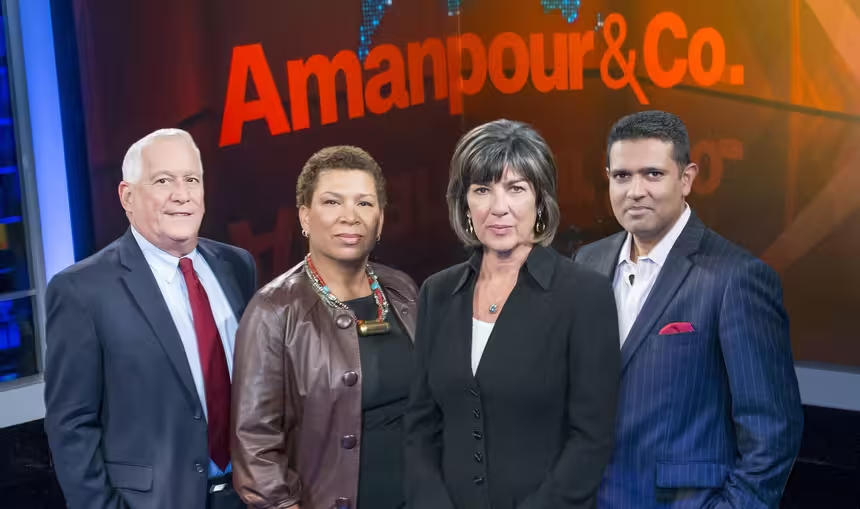
PBS and WNET, in collaboration with CNN, launched Amanpour and Company in September 2018. The series features wide-ranging, in-depth conversations with global thought leaders and cultural influencers on issues impacting the world each day, from politics, business, technology and arts, to science and sports.Providing Support for PBS.org
Learn Moreabout PBS online sponsorshipFor many people, Russia is synonymous with the Mueller investigation, with election tampering and of course, with President Putin.
But for the media organizations that dare to criticize the Kremlin from inside, the story is more complex.
For over three decades, the journalist Yevgenia Alberts has been a prominent investigative reporter inside Russia since 2009.
She's been editor of the New Times Magazine, one of the only opposition publications within the country.
Through her work, Alberts has covered everything from government corruption to Vladimir Putin's declining approval ratings.
And she sat down with our Michel Martin to talk about what it's like to report in Russia and why she thinks the Kremlin interfered in the 2016 US presidential election.
If getting Alberts, thank you so much for talking with us.
Thank you very much for having me here.
Just to remind people of your work that you are the editor of The New Times.
It's one of the largest and one of the few remaining opposition news outlets in Russia.
I think many people may remember that you were hit with this very large fine last fall that some feared would close your publication.
So what is it that the Russian government is so mad at you about?
You know, I think Russian government is mad about any publication which which doesn't praise Putin for being genius of him being great or for being the only leader possible for for Russia.
I think that the Russian government doesn't like any publication that is critical of Russian government, that exposes the Russian government that that is writing about corruption of the Russian government.
And, you know, all this kind of fraud that they commit all around the country and abroad as well.
I understand that it's hard to gauge because I don't know if there is any independent polling there.
Certainly isn't a lot of media apart from state run media, but.
Well, how do you assess President Putin's standing with the public right now?
What would how would you describe it?
You are right.
There are very few there is just one independent pollster.
All other pollsters are under this strict control.
However, judging even by the official numbers, Putin's ratings are going down the hill.
So he are his approval rating as of recently was 40 to 43%.
That's a lot by many standards.
But in the authoritarian country like Russia, where people basically 24, seven, they hear that Putin did their Putin are help them with that.
You know this Putin is is is what you know all the state propaganda media are talking about nonstop.
So however I think, you know, there is a slowly but surely people do get to realize that ah that this unlimited power is, is getting extremely dangerous for, for a the survival of Russian people.
And in fact, you know, for the fifth year on the road, Russians are losing, you know, their incomes.
Life is getting much more difficult than it was used to be.
The country is under sanctions.
It is it's getting on the sidelines of the world, politics and etc..
So I think that especially, you know, for business people, it's getting extremely difficult.
Are the sanctions having an effect on the day to day lives?
Can you give us an example of of you know, first of all, the access to capital is much more problems for businesses.
A lot of businesses, they are closing their operations.
They are living in Russia.
On top of that, there is growing what is now called Putin's exodus.
41% of young Russians said in the last poll they said that they want to leave Russia, they want to leave.
They don't want to live in Russia.
That's the kind of impact that, in fact, sanctions do have.
Can you give us a sense of how Putin rules?
How does he continue to hold on to power?
Putin is an autocrat, but it's all just that simple.
Putin is a graduate of the Soviet Union's political police, the KGB, the KGB, which was one of the most powerful organizations of the Soviet Union and the one that really never was reformed during the Soviet Union times.
These are people whose background and whose education and whose professional life doesn't allow for any democracy.
These are people who believe that ordinary Russians are not good enough or not educated enough to make their own electoral choices.
The reason that Putin is capable to govern the country for 18 plus years is that they don't allow for any real opposition to exist.
There is a very well known opposition leader, Alexey Navalny.
He could and they didn't allow him to run against Putin back during the presidential election a year ago.
They just kicked him out.
So they they're using all kind of dirty tricks so that the political field is getting totally empty parliament, which is supposed to to control the executive like it is in the United States.
That's not really exist in Russia.
The people who are elected there, they elected by the will of Kremlin, not by the will of the people and etc.
suddenly, you know, the democratic institutions are almost totally destroyed.
Is it true that there are actually more former KGB agents in the Russian government now than there were during the Soviet era?
Is using sort of an arrow there?
Well, almost none of them were in the government.
There was the support institution, the KGB.
However, there was ongoing competition between two major institutions of the Soviet rule, the one that was, you know, the the Communist Party, which wasn't party, but the form of government and the KGB.
Now, the credits of the KGB, they comprise almost 75% of all officers in the administration of the president of the Russian Federation and in the Russian government.
I cannot imagine another in that example like that when a political post, a Secret Service, takes over the way it did in our Russian Federation.
And it's very difficult to overcome because obviously the people from these type of organizations, they are accustomed to conduct the clandestine operations.
They cannot operate in open.
They don't allow for any open democratic politics to exist because they get right away.
They get exposed and so anyway, it's it's it's a very, very dangerous form of governance.
Now, as you know, the major papers, the major news outlets are very keen to cover the ongoing investigations into what role Russia may have played in the 2016 election.
And I was interested in how this plays where you are.
I mean, do you think that our concern is justified?
I think there are two sides to the story.
For one, it's not the first time that Russia or than it was the Soviet Union interfered in the American elections.
In fact, that happened where, you know, Reagan win went for reelection and there was a whole scale operation conducted by all three are residents, whereas in the United States, one in New York City, in Washington, D.C. and San Francisco that conducted the smear operation against Reagan under the slogan Reagan Means War.
So I don't think a lot of Americans remember this.
They probably don't remember, you know, but we know the outcome was quite the opposite.
And the landslide victory is he carried out 49 states, I believe, back then.
Ah, I think that it wasn't that much that Putin and his guys were helping Donald Trump as much as they were trying to create some sort of a chaos in the United States.
They wanted to portray that American democracy is a chaotic state of affairs.
However, you know, when sometimes I feel like, you know, it's a little bit overblown here.
Overblown.
Yeah.
Sting Tell me more about that.
I think that it's very easy to stop blaming another country or not only the leader of another country for what happens at home.
And sometimes it's becoming difficult to see problems that exist in your homeland.
Can you just talk a little bit more about that from your perspective?
Like, what would Putin get out of it?
Would it have been?
Or what would the Russian government have gotten out of it?
Was it to because they really did want to see Donald Trump get elected or they just really didn't like Hillary Clinton?
I mean, just based on your reporting to both, really, I think that Hillary Clinton was the best prepared president in the history of the United in the latest history of the United States.
Are and I think the Russians were pretty much aware that Hillary Clinton was very knowledgeable about this Trump points and the weak points of President Putin and his allies.
I think that Putin saw Clinton as somebody who was capable to withstand him, to stand against him.
So that was one of the reasons why they decided, of course, you know, to conduct this smear campaign using Facebook, Twitter, etc., against Hillary personally.
That's number one.
Number two, I think that that the most important goal was to show to Russian public and to people in the third world countries that American democracy is not about the will of the people, but about about this chaotic state of affairs.
You know, when there is God knows what's going on, on the ground that, you know, especially since Donald Trump are kept saying that there was election fraud, even though we do know that, in fact, you know, the election fraud is very limited in the United States.
In fact, it's almost nonexistent, unlike in many other countries like Russia.
So I think for Putin, it was very important to to show to Russians then democracy doesn't really exist.
What about now?
What do you think President Putin thinks of President Trump now?
Judging by what he does?
He probably is very upset because Trump was unable to deliver what he was expected to deliver.
You know, when Donald Trump won elections in November 2016.
I remember vividly that, you know, there was celebration going on almost in each and every Russian agency celebration, absolute bureaucracy was celebrating Donald Trump's victory.
They were drinking champagne.
The expectation was that Trump was going to renounce sanctions and everyone will go back to business as usual when it has it.
Should them have corruption?
You know, let's just be friends.
You know, we have a lot in common.
Do you think that we are giving President Putin more credit than he deserves in a way?
Are we in some way feeding him by giving him this kind of attention in the United States?
President Putin does not read any English, but I believe that he's given a digest of American newspapers.
And I think that each day he reads the American newspaper and he thinks that he he has become the rule of the universe, the king of the world, you know, the one who is running politics, not just in Russia, but across the globe, and especially first and foremost in the United States.
I think he feels himself very proud.
Journalists have been killed in Russia, including a colleague of yours in 2014.
And I do want to ask you if you are personally concerned for your own safety.
There were a lot of my colleagues who got killed in the line of duty, and one of my best friends on the Politkovskaya got killed in 2006.
And, you know, however, I really believe that journalism is a quite a dangerous profession all across the globe.
It's not just Russia.
So it's the kind of job that either you do it or you don't.
Each of us, we have, you know, the possibility to write about my things, like about cosmetics, right?
Flowers, fashion, and you're safe.
But if you decide to write about politics, then you're getting into somebody is you know, you're creating problems to some people and they don't like you.
Well, does it concern you then, when you hear the American president refer to the media as the enemy of the people, something that he has done on a number of occasions?
You know, when I first read that on Twitter and of course, I followed president of the United States on Twitter as probably everybody else in the world.
I was stunned when a person who is the leader of the free world calls our press as enemies of the people.
That reminds me about what Stalin used to say about any opposition in my country.
In fact, you know, my grandfather was executed during the Stalin's time just because he happened to start in the United States.
And he was an engineer and he was called the enemy of the people.
So this is a very dangerous one.
A leader of a huge country starts talking in terms of animus.
I just hope that the American political system is strong enough, its institutions are strong enough to overcome this, to protect the American democracy.
Yevgeny Alberts, thank you so much for speaking with us.
Thank you.
Thank you for inviting me.

- News and Public Affairs

Top journalists deliver compelling original analysis of the hour's headlines.

- News and Public Affairs

FRONTLINE is investigative journalism that questions, explains and changes our world.












Support for PBS provided by: