
Journey of Success and Service
Season 6 Episode 8 | 26m 48sVideo has Closed Captions
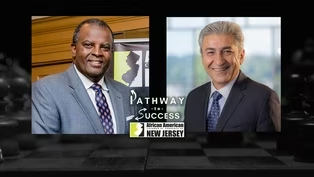
Al Maghazehe shares his journey from Iranian immigrant to President/CEO of Capital Health.
Host John E. Harmon, Sr., CEO of the AACCNJ, speaks with Al Maghazehe. Maghazehe shares his journey from Iranian immigrant to becoming President/CEO of Capital Health. He also talks about his need to give back, which was the impetus for creating the Trenton Neighborhood Initiative. AACCNJ's Pathway to Success highlights the African American business community.
Problems playing video? | Closed Captioning Feedback
Problems playing video? | Closed Captioning Feedback
Pathway to Success is a local public television program presented by NJ PBS
Journey of Success and Service
Season 6 Episode 8 | 26m 48sVideo has Closed Captions
Host John E. Harmon, Sr., CEO of the AACCNJ, speaks with Al Maghazehe. Maghazehe shares his journey from Iranian immigrant to becoming President/CEO of Capital Health. He also talks about his need to give back, which was the impetus for creating the Trenton Neighborhood Initiative. AACCNJ's Pathway to Success highlights the African American business community.
Problems playing video? | Closed Captioning Feedback
How to Watch Pathway to Success
Pathway to Success is available to stream on pbs.org and the free PBS App, available on iPhone, Apple TV, Android TV, Android smartphones, Amazon Fire TV, Amazon Fire Tablet, Roku, Samsung Smart TV, and Vizio.
Providing Support for PBS.org
Learn Moreabout PBS online sponsorship- Support for this program was provided by Horizon Blue Cross Blue Shield of New Jersey.
- Hello, this is John Harmon, founder president, CEO of the African American Chamber of Commerce of New Jersey.
And thank you for tuning in to Pathway to Success.
Today's guest is Al Magazine, president and CEO of Capital Health and Organization that is providing healthcare services throughout Pennsylvania and the New Jersey region.
Welcome to Pathway to Success, Al.
- Thank you so much, John.
- We're delighted to have you here.
And so let's start a little bit about your background.
- I was born in Iran, went to school there, and they came to us to continue my education and then completed my education here.
Had every intention of going back then there was a revolution and my family asked me to stay here, so I stayed, ended up staying here to the US as my permanent resident and citizen of the United States many, many, many years ago.
- So, you know, in the days times, citizenship has taken on a whole new meaning, and so we're just delighted and honored to have you here.
Where did you go undergrad?
- I went to Wagner College in Staten Island, New York.
And, and that was a pretty extensive program at the time, healthcare management was not known.
Columbia and Wagner were the only programs in New York, and I was in New York because my family was in New York.
And so that's why I went there.
But then I got to know an amazing person, person that probably has had the most impact on me.
His name was Dr. Marvin Cohen.
He was the head of the program at NYU and also led the healthcare healthcare management program at Wagner.
And he recommended that I should go to Wagner and I did, and luck would have it when I was looking for internship at that time, the school wouldn't assign internship to, you had to find on your own.
So prior to me, there was a ag student at Dan Halene Food Medical Center in Trenton.
And I contacted her and she said, why don't you just get in a car, calm down here.
And I did.
And quite frankly, I not had right suit to wear, I had to borrow one my friend suit and, and my friend's car actually.
So I drove down to Trenton, very poor.
I drove, I drove down to Trenton, interviewed by this gentleman, then Bill Payne, who actually hired me as the new resident.
And, and then after that he moved on.
He actually became COO of Pain Medicine, known as today.
And, and that's how my career started at, at, at Helene Food Medical Center.
Trenton.
- So speak a little bit about the residency.
What is that experience like?
- That is the most valuable experience in order for you to get to know what healthcare really is.
The residency gave me the opportunity to get to know how this system actually works.
So it's, it's really an essential part of this training.
- When you came to the US your goal was to get an education and then perhaps go back, do great things back home based on what you've learned in the states, and then ultimately you end up staying here.
How did that factor into your mind as you were matriculating through your professional development and career?
- John?
I'm a pretty hardworking person.
I, my expectation of me is much higher than anybody else's expectations.
I always to do more than I'm expected to do it, just my blood, my nature, because I feel like I knew I need to earn the money that I'm being paid.
And I learned that from my dad.
I grew up in a pretty disciplined family.
Education was always everything that we ever, we were ever taught that we need to learn.
We need to better ourselves.
So I decided to stay here and my family supported me.
You know, they thought that I should, but then while I was going through this, I was given incredible amount of opportunity by, by the leadership in Trenton.
Not just Henningfield Medical Center, but elected officials, community leaders.
I was given an amazing opportunity.
I never thought I would be given and made my business to actually focus on the place that trained me and tried to see if I can have an impact in long term, very long term.
- Why healthcare for you?
How did you choose that path?
- I was supposed to be in medicine and I had an uncle in New York who was extremely well known, 13 years in a row.
He was picked by n New York magazine as the, the best cardiovascular thoracic surgeon in New York City.
People came from all over everywhere for him to do their surgical stuff.
And I worked in his office.
I know he really took advantage of me.
I kept me there until 1:00 AM every day and he didn't pay me much.
But I guess that was part of the learning process for me also.
So I was thinking about doing what he was doing and maybe at some point, you know, becoming his partner.
But as I said, there was this guy, his name was Dr. Marvin Cohen, who I guess had studied what I was doing and had looked at me pretty closely, and he was an extraordinary person.
He said that you need to do healthcare management.
This is the area that I think you're going to, you're gonna excel.
And you know, he was a hundred percent correct.
- Did he ever share with you what, that it was in you that he felt that you were the right person to take these steps?
- As I showed a great deal of interest in disease management, but, but healthcare management sort of included disease management.
And he thought that, you know, if I wanna do medicine, disease management combined, that that was it.
Healthcare management was the way to go because I could have, I could actually use all of my skills and my education and so forth.
- Al can you walk us through the various positions you held leading up to the, becoming the CEO of Capital Health Systems and then we'll get into a little more of the, the transformation of the system from a certain point up to now.
- And I remember very clearly I was sitting on the floor in my living room, and then the phone rang and pick up the phone and it was my sister-in-law.
She said, well, the Tehran's airport was what was just attacked.
And Iraqis bombed the airport.
That was the beginning of Iran, Iraq War.
And they said, don't come back.
I mean, you know, I, I really believe in destiny and I'm gonna give you an, give you this next item that there is no, no other way of describing this.
But this was just my destiny.
I sat down and now imagine I'm not legal because I finished my student visa.
It was, was gone, so I'm not legal.
I can't even work in this country anymore.
And they just bombed a place that I was going to.
And I have a wife and a baby and $300 in my pocket.
And I'm sitting there wondering what's gonna happen to me.
Within few minutes, my phone rings again, pick up the phone.
It's the new CEO of Helen Ford Medical Center, who I'd worked with for about six months.
He said, Al, what are you doing?
I said, well, I - Was, I'm sitting on the floor.
- I said, I'm sitting on the floor.
This is my circumstances.
He said, well, come back.
I said, well, his name is Ken Kern.
God bless, solely passed away.
I said, Ken, I can't, I can't, I don't have, I don't have a work permit.
I I don't even know where I stand.
Of course, at that time, things were very different, you know, very, very different.
I mean, people were extraordinarily helpful.
Nobody wanted to hurt you.
Everybody wanted to help you.
He said, get in your car.
I said, well, I don't have a car.
He said, well somehow get here.
I said, okay.
So I made it back to the office.
He called Maryanne Hughes, director of personnel calls Maryanne, and says, come over here.
He said, listen, take care of this guy Al I don't know what his problem is.
He, he, he says he doesn't have paperwork to work here, so make it happen.
That's just how it happened.
He said, she said, no problem.
And she wrote a letter called somebody, I don't know what happened, but I had no idea what was going on.
And they, they filled an application, I signed it.
So my paperwork was submitted to the immigration office and that started the ball rolling.
So I felt that I could actually work.
'cause they said, temporarily you can, you can do whatever.
'cause at that time, Ken told him he has to stay here.
What he's doing, I don't have anybody else to do.
So that's Destiny.
And since at that time, you know, we did that and everything went through, I got approval on that.
I became citizen.
That's besides the point.
But in terms of my professional career, he made me administrative assistant.
So, and then from there I became as, as assistant administrator.
Anyway, at some point, I think I was probably two, three years later.
Eventually I became, I'm bypassing a lot of other things.
I became Chief Chiefing officer and then that's when I decided, you know what, I need to go talk to Mercer.
And that was the beginning of the merger, which I'm sure you're gonna focus on later.
- So we'll take a break here on Pathway to Success.
We'll be back in a moment.
- For more information, please visit our website.
- Welcome back to Pathway to Success.
Al talk about, you know, Helen, Helen Fooled that, that's one of the health systems that existed in Trenton during this time.
And then kind of share with our viewers a little, little bit more about the, the other systems that existed in the community at that time.
- The history is fascinating.
So I started in this hospital called Helene Food Medical Center.
That was the third rated hospital in Trenton.
There was another one called Mercer Medical Center.
Mercer Medical was known for its quality and the kinds of physicians that they had.
St. Francis was a Catholic hospital, and because of that was the busiest hospital in Trenton.
And Alien Food was almost like a government hospital.
It was a hospital that was supposed to close.
And also, keep in mind, Hamilton Hospital was started in Trenton, Hamilton Hospital, started an orthopedic hospital in Trenton, but then it, they moved to Hamilton Township.
So all four were actually in Trenton.
So I show up hopefully.
Good thing for Trenton.
At that time we had a CEO and God bless, he's passed away also.
His name was ihe.
So I sat down with Ira and I said, IRA, I am looking at what's happening in Trenton.
The businesses are leaving Trenton.
Many, many doctors have already joined St. Mary Medical Center in Bucks County and also Hamilton Hospital.
In Hamilton ship because the people that had the money are leaving Trenton and the businesses are leaving Trenton.
John, you remember we had the best restaurants in the world in Trenton?
Yes, the best of the best.
And people came from everywhere to eat in Trenton.
But those guys started moving their restaurants out to suburbia.
So Trenton was weakening very dramatically.
And I saw that there was no way these three hospitals were gonna survive.
They only had 80,000 people in Trenton.
Then I said, IRA, I know Chuck Bayer, who was the CEO of Mercer.
So I went and talked to Chuck and believe it or not, two, three meetings.
He was already, because Mercer was experiencing significant financial issues.
And the long story is we went through the whole process of the merger.
And so that's how Capital Health was formed.
Unfortunately, Chuck lasted six weeks and was terminated.
You talk about a, a crisis.
So all of a sudden I find myself being CEO of Capital Health.
One hospital is literally broke, which was Mercer.
Even though they had the best name from a Call of Care point of view, the other hospital, he fold, had the money.
So I combined the two and told the board to go away for six months, no board meetings, just phone calls, six months.
I had to unfortunately clean the shop very dramatically.
And then it got to a point where I did not see how I could support two hospitals in Trenton.
They were both half empty.
People were following the doctors who preferred to practice in suburbia.
And that's how I decided, you know what?
I need to build something outside of Trenton to support Trenton.
This is the most important point.
- Al talk a little bit about the whole certificate of need.
- Yeah, I'm gonna talk.
- Did I learn that from you in, in, in the war with the na with the community, if you will.
- Well, the war was with the competitors.
Communities just needed to be educated.
- There you go.
- Let me explain to you what Certific government really is.
So what we had to do is first to convince DOH that we need to close one of the hospitals in Trenton and we need to build a new hospital outside of Trenton.
And for that I need to have c Well, that was not an easy process to go through because the whole world went against me.
My best friend, mayor Palmer, you remember John?
- No, I remember - He was said, he called me.
He said, oh, my dead body, you're doing this.
I said, okay.
Everyone was against me.
What they did, they, this is probably the most significant accomplishment of my life, what they did, they typically have certificate that need meetings, estate sponsored meetings in Trenton, in a basement of a hotel.
And typically 2030 people attend and they just rubber stamp it in a gets done.
Well this one was in Plainsboro and I would say 500 people showed up and 12 people on the state health planning board that approves or rejects the application.
I counted the votes.
Nine were against me, three were for this particular project, but I had nine against me.
And every CEO could imagine showed up against this project.
Every elected official showed up against this project.
I stayed at that podium for six hours and at the end of the day, won that vote.
You know, I was turned.
Those people that were negative around to positive, that was the most significant accomplishment of my life.
I won by one vote and the game was over.
And I remember myself, then our general counsel and the VP planning got on the plane and went to Las Vegas for three days celebrating.
But that's how Capital Health was the new Capital Health was born.
- What's the significance of, of what you've, what you went through to, to establish Capital Health Systems as we know it today?
- The strategic thinking there was that if I could bring in patients that require emergency admissions to RMC, now RMC was getting full.
I changed the name to Regional Medical Center 'cause I wanted to bring that up in terms of its, its appearance and its credibility and its image.
I changed the name to Regional Medical Center, but I knew the only way I could make this work is to create a situation where emergency admissions came to RMC.
'cause elective admissions wouldn't, they always ended up in suburbia.
Being in Trenton, both hospitals being in Trenton didn't work because we're losing patients.
As I said, St. Maryanne Hamilton.
So three programs were put together for RMC, very, very tough.
None of this was easy.
And this is over a 20, 25 year period was trauma program was the first one that I had to fight for.
That required CN as well.
And everybody was against it.
My second big initiative was neurosciences.
There was a consultant that I actually brought in.
Her name is Suzanne Borgess.
And Suzanne and I worked on this project to create the largest neurosciences program in New Jersey.
Suzanne used to work for my buddy best friend, Alan Zuckerman, who had consulting firm in Philadelphia.
And I worked with him on just about everything.
And at that time, Suzanne was this very, very impressive lady who had joined Alan's firm.
And Alan said, listen, I'm gonna give you my best so Suzanne shows up, but I love Suzanne so much.
I ended up hiring her.
She's the chief strategist for Capital Health.
And Adam was very upset.
God bless his soul, he passed away as well.
And then the only thing was left was cardiac surgery.
So the idea really is to reinvest back in Trenton to bring everything back to, and that has led me to something extraordinarily significant.
And that idea was worn during COVID at that time.
I felt that I haven't done enough, not just in terms of healthcare, but in terms of people of transit.
I want to do something for the city of Trenton.
And, and Trenton Neighborhood Initiative was born that day.
It was a huge challenge that my management team took on and we developed this massive program.
Four pillars.
One is home ownership, the other one is education, the other one's growth and the other one's connectivity.
These four pillars have specific meanings.
I'm very, very happy to tell you that my goal was to raise $10 million in five years for Trenton Neighborhood initiative for these programs as just outlined.
I've already raised 7 million, which is extraordinary.
And we have put back in, I will say about reinvested in Trenton about three, three and a half million dollars.
So what does that mean?
That means that as I'm sitting here, close to 40 families own their own homes.
40 families were chosen, we helped them to get their credit score up, took a long time.
We gave them the down payment.
They're homeowners.
We've created over $6 million in home equity in Trenton already.
The stories are so meaningful and so impactful that I, I need to bring people that are actually in it to talk to you.
We started an educational program.
We've, I've met and my management team, Suzanne helping dramatically.
Suzanne is buying a lot of this that I'm talking about here.
We, I see Trent and kids, I see young professionals in my office.
I go out, talk to them constantly.
- There's a lot of potential adverse implications coming from cuts to Medicare, Medicaid, and research dollars from the federal government.
How is that gonna impact your plans and your, your, your system?
- If these cuts ever materialize, not only capital health is gonna get hurt, but every inner city hospital is gonna get hurt.
Every rural hospital is gonna get hurt.
Many hospitals are gonna close.
I think disaster is coming.
If this ever happens, you'll be dealing with millions of millions of millions of people without insurance.
And I don't know if people are looking at the implications, but you're gonna have a disaster on your hands that I don't believe America deserves.
I'm gonna give you 30 seconds.
The solution to this, if the government really wants this money, they have to make sure that they pay the hospitals for the hospitals.
They're gonna lose the amount that the hospital's gonna lose that make that, that pay them because we're still gonna take care of patients.
And then through creative process, you need to get these people who depend on Medicaid.
Maybe they don't have the right jobs.
Maybe you gotta give people a chance to prepare themselves for this.
You just can't show up and say, you know what?
I'm taking this out.
That does not work.
You're asking for trouble.
You've got to give people a chance to prepare for it.
And that's not gonna be in three months to four months or six months or a year.
It takes time and people need, need that opportunity.
Otherwise this is not going to work.
You're gonna have crisis on your hands.
- What does the future hold for Capital Health Systems over the next three to five years?
Be our final question for the day, - To be honest with you, I was, I am and I was extraordinarily optimistic until this, these cuts showed up.
We just have to be prepared.
Some things may have to change.
We'll see how bad it is.
But Capital Hill will continue to grow.
- Well Al thank you so much for being a guest on Pathway to Success today.
I really appreciate you stopping by.
- Thank you so much, John.
It's my pleasure to be here.
And thank you for giving us the opportunity to talk like Capitol Hill.
I'm, I can sit here, talk with the nails - Until the next time on your pathway to success.
This is John Harmon, thank you for joining us today.
Today's message is persevering through adversity.
As you know, the current environment is very tumultuous.
We're all Americans trying to coexist in a society is just creating a whole new paradigm.
So my word to business owners today, take some time to really take a hard look at, at your plan, look at your customer base.
How are you gonna retain?
How are you gonna attract?
Look at your cost structure.
How are you gonna be profitable?
Who are you dependent on for your supply chain?
It all boils down to having a connection and a relationship with those who have resources, opportunities, and information.
A very critical component of success.
No one successful in a vacuum.
This is not the time to guard out it alone.
Government provides opportunities and we've seen the disparity studies, those opportunities have not yielded much for different groups.
And so it is clear that you have to be very cautious about how much time you invest with those you wanna do business with.
Oh, you can still make it notwithstanding the headwinds, the omo, the opposition.
But you have to be more committed to your success today than ever before.
You know, working, putting in eight or 12 hours is one thing, but realizing that every minute counts is the most important thing.
Hard and smart, efficient, effective.
Know your numbers because your numbers don't lie to you.
Oftentimes you lie to the numbers.
- Support for this program was provided by Horizon Blue Cross Blue Shield of New Jersey.
Journey of Success and Service - Preview
Video has Closed Captions
Preview: S6 Ep8 | 32s | Al Maghazehe shares his journey from Iranian immigrant to President/CEO of Capital Health. (32s)
Providing Support for PBS.org
Learn Moreabout PBS online sponsorship
- News and Public Affairs

Top journalists deliver compelling original analysis of the hour's headlines.

- News and Public Affairs

FRONTLINE is investigative journalism that questions, explains and changes our world.












Support for PBS provided by:
Pathway to Success is a local public television program presented by NJ PBS