
Journey to Mount Katahdin and Untamable Nature
Clip: Episode 2 | 9m 22sVideo has Closed Captions
Leaving Walden Pond, Thoreau joins his cousin on an excursion to Mount Katahdin in Maine.
Leaving Walden Pond, Thoreau joins his cousin on an excursion to Mount Katahdin in Maine. On the journey through Maine to the mountain, Thoreau passes a Penobscot reservation and finds they have been marginalized and robbed of their territory. While he is unable to summit Katahdin, Thoreau experiences a revelation that true wildness can be felt all around us.
From
Problems playing video? | Closed Captioning Feedback
Problems playing video? | Closed Captioning Feedback
Episodes presented in 4K UHD on supported devices. Major funding for HENRY DAVID THOREAU was provided by The Better Angels Society and its members: The Keith Campbell Foundation for the...
Journey to Mount Katahdin and Untamable Nature
Clip: Episode 2 | 9m 22sVideo has Closed Captions
Leaving Walden Pond, Thoreau joins his cousin on an excursion to Mount Katahdin in Maine. On the journey through Maine to the mountain, Thoreau passes a Penobscot reservation and finds they have been marginalized and robbed of their territory. While he is unable to summit Katahdin, Thoreau experiences a revelation that true wildness can be felt all around us.
From
Problems playing video? | Closed Captioning Feedback
How to Watch Henry David Thoreau
Henry David Thoreau is available to stream on pbs.org and the free PBS App, available on iPhone, Apple TV, Android TV, Android smartphones, Amazon Fire TV, Amazon Fire Tablet, Roku, Samsung Smart TV, and Vizio.
Narrator: On August 31, 1846, Thoreau left Walden Pond to join his cousin, George Thatcher, on an excursion to Katahdin in Maine-- the highest mountain in the state.
♪ He brought along a small notebook and pencil to write about what he discovered there.
[Waves breaking] James Finley: He wanted to time travel, to see what Massachusetts looked like a few generations before.
And then come back and tell the tale of what he'd seen.
That feels like the exact opposite of what he has at Walden Pond.
It was a frontier that was very nearby.
James Finley: At the same time, he recognizes that it's not a pristine, untouched wilderness.
James Eric Francis Senior: You see industry.
Bangor was the lumber capital of the world.
Thoreau describes Bangor in 1846 as this cosmopolitan city right on the edge of wilderness.
He also recognized that he was going through spaces that people had worked, traveled, and lived on for thousands and thousands of years.
Narrator: Thirteen miles north of Bangor, Henry stood on deck as their steamship passed a Penobscot reservation on Indian Island.
♪ He watched a Native hunter get out of his canoe, carrying a bundle of fur skins and an empty keg of alcohol.
Henry David Thoreau: This picture will do to put before the Indian's history, that is, the history of his extinction.
I observed some new houses among the weather-stained ones, as if the tribe had still a design upon life; but generally they have a very shabby, forlorn, and cheerless look.
The church is the only trim-looking building.
Good Canadian it may be, but it is poor Indian.
These were once a powerful tribe.
I even thought that a row of wigwams, with a dance of powwows and a prisoner tortured at the stake, would be more respectable than this.
[Boat's horn blowing] Carol Dana: Oh, they're always saying that!
We're the last of this, the last of that.
If you knew what the hell we had to go through, yeah, we look woebegone.
This was our homeland.
John J. Kucich: These are people who have been robbed of their territory and forced to live a very impoverished existence on the margins of society, and what Thoreau cannot see is that he is part of this world as well and part of the process that makes this happen.
James Eric Francis Senior: Standing there with that postcard view of Indian Island, looking for that "noble savage," he's disappointed.
All his life, he's looking for relics.
He's looking for relics in people, too.
Thoreau is not coming to Maine really to engage with Native people at this point.
He's going to find the biggest, wildest mountain he can find and see what's on top and bring that back.
Narrator: Once they reached the wilderness, they continued under the guidance of two white settlers who knew the terrain well.
♪ On September 5th, 73 miles north of Bangor, they paddled across Quakish Lake.
♪ Henry David Thoreau: We had our first but a partial view of Ktaadn, its summit veiled in clouds, like a dark isthmus in that quarter, connecting the heavens with the earth.
Narrator: After three more days of paddling, they arrived at the base of the mountain.
Carol Dana: At the summit of Mount Katahdin, it's unpredictable weather up there.
If you are up there, be ready for anything.
You're gonna be tested.
Narrator: While the others set up camp, Henry tried to reach the summit alone but failed.
The next morning, the party set off together.
Thoreau scrambled upward in earnest, leaving his fellow travelers far behind.
♪ Henry David Thoreau: I was deep within the hostile ranks of clouds, and all objects were obscured by them... the cloud-line ever rising and falling with the wind's intensity, the mist driving ceaselessly between it and me.
It was vast, Titanic, and such as man never inhabits.
Rebecca Kneale Gould: He's freaked out.
He was scared up there in a way that he had not been scared anywhere before.
Narrator: Henry never made it to the summit.
He was forced to turn back.
His companions were waiting for him below, and, following a stream, they made their way to a meadow farther down the mountain.
There, Thoreau made an exhilarating discovery-- far more transcendent than what he had hoped to experience on the summit.
♪ Laura Dassow Walls: He has this eerie feeling of displacement that really throws him.
He's thinking about the fields in Concord and the field on the side of Mount Katahdin.
These two places together, familiar and strange.
I'm not even sure he quite understood what had happened to him at the time, because it's not until he's down the mountain and really letting it sink in and reflecting on it that he actually writes the memorable passage "Contact!
Contact!"
♪ Henry David Thoreau: I most fully realized that this was primeval, untamed, and forever untamable Nature.
Here was no man's garden, but the unhandselled globe.
It was the fresh and natural surface of the planet Earth, as it was made forever and ever... I stand in awe of my body, this matter to which I am bound has become so strange to me.
Talk of mysteries!
Think of our life in nature-- daily to be shown matter, to come in contact with it-- rocks, trees, wind on our cheeks!
The solid earth!
The actual world!
The common sense!
Contact!
Contact!
Who are we?
Where are we?
[Insects calling] John J. Kucich: You can see Thoreau finding language failing him.
"Who are we?"
and "where are we?"
aren't questions you want to answer; they're questions you want to live.
♪ Henry David Thoreau: Not till we are lost, in other words not till we have lost the world, do we begin to find ourselves, and realize where we are and the infinite extent of our relations.
Rebecca Kneale Gould: The membranes between him and nature are completely dissolved.
That sort of mystical, scary experience he brings with him.
Narrator: After two weeks in Maine, Henry arrived home.
As he looked upon the familiar landscape that surrounded him, he realized what he had experienced at Katahdin could be experienced everywhere.
Laura Dassow Walls: And it was a feeling of "wildness."
And his writing starts to bubble with all the extraordinary observations he's able to make.
Robin Wall Kimmerer: Nature is all around us.
It's right in the tree that you have walked by every day of your life, and then you see something new that you've never seen before.
It blows you away.
♪ Michael Pollan: Speaking of autumn leaves, he said, if this had happened only once, it would've gone down in mythology as one of those events we read about in Greek myth or whatever, that suddenly all the leaves turned red and yellow... [Laughs] and the forest was on fire.
But, of course, it happens every year and, you know, we take it for granted.
This is the wonderful way in which Thoreau sometimes shocks you into an awareness that you should have had yourself, but you didn't.
♪
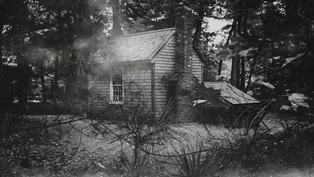 New
NewHenry David Thoreau Moves to Walden Pond
Video has Closed Captions
Clip: Ep2 | 11m 14s | On July 4th, 1845, Henry David Thoreau moves into a 10x15-foot house on Walden Pond. (11m 14s)
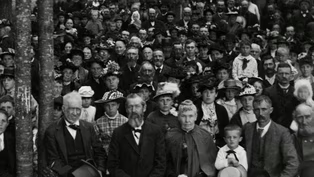 New
NewThoreau Challenges Justice with His Essay "Civil Disobedience"
Video has Closed Captions
Clip: Ep2 | 7m 14s | Thoreau's refusal to support what he saw as injustice culminates in his essay "Civil Disobedience." (7m 14s)
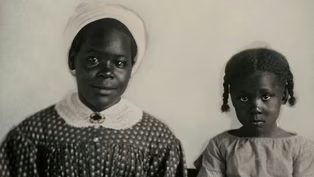 New
NewThoreau Tells the Stories of the Black Community in Concord
Video has Closed Captions
Clip: Ep2 | 5m 50s | While slavery is illegal in Massachusetts, Black communities are forced to the margins of society. (5m 50s)
Providing Support for PBS.org
Learn Moreabout PBS online sponsorship













Support for PBS provided by:
Episodes presented in 4K UHD on supported devices. Major funding for HENRY DAVID THOREAU was provided by The Better Angels Society and its members: The Keith Campbell Foundation for the...