
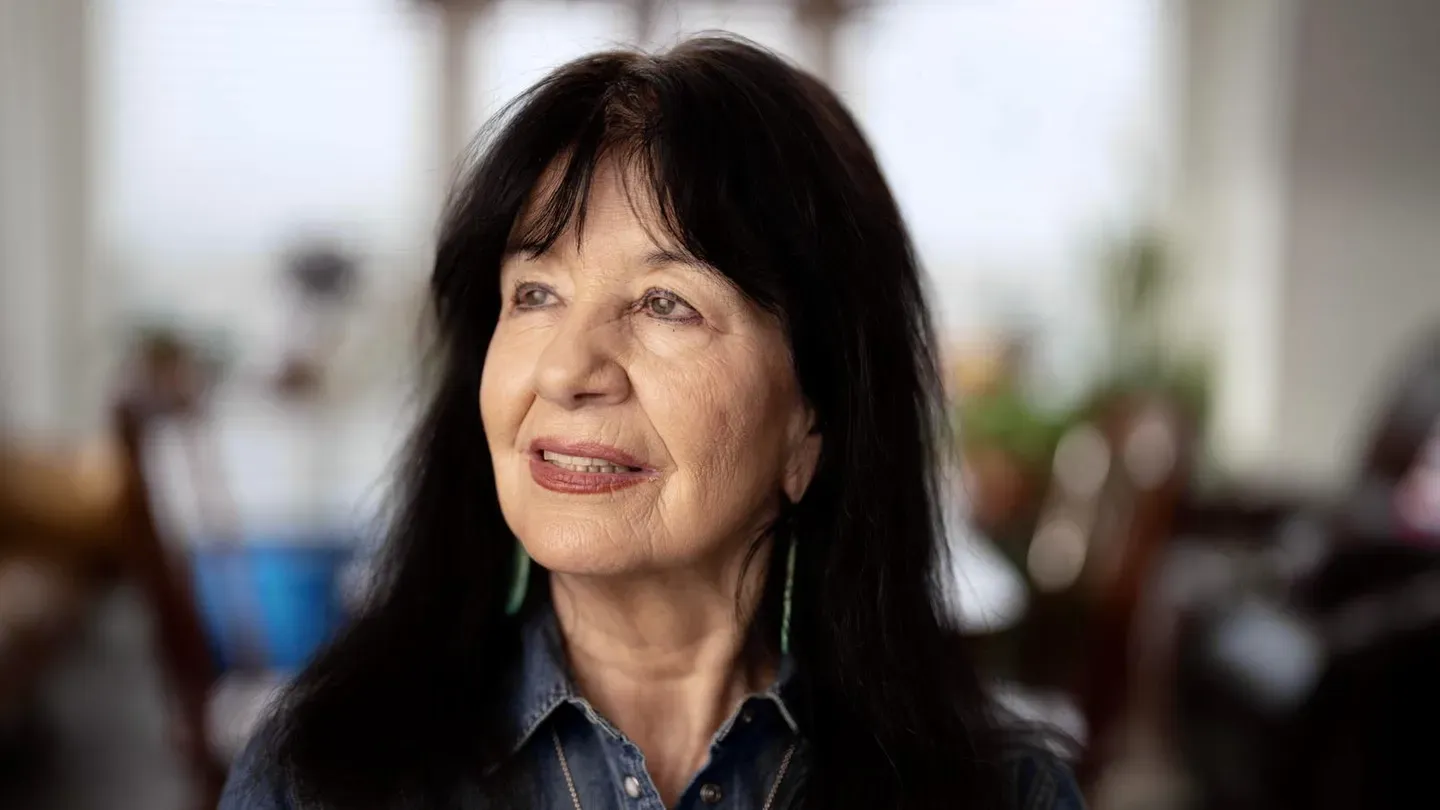
Joy Harjo, The Power of Poetry
7/1/2026 | 27m 19sVideo has Closed Captions
Poet Joy Harjo discusses growing up in Oklahoma and learning stories from elders of the Muscogee.
Joy Harjo, the first Native American chosen to be our nation’s Poet Laureate and the 2024 recipient of the Frost Medal for distinguished lifetime achievement in poetry, is a dream weaver. In this mesmerizing conversation, she describes growing up in Oklahoma and learning the stories from elders of the Muscogee.
Problems playing video? | Closed Captioning Feedback
Problems playing video? | Closed Captioning Feedback
The Thread is a local public television program presented by WETA
Joy Harjo, The Power of Poetry
7/1/2026 | 27m 19sVideo has Closed Captions
Joy Harjo, the first Native American chosen to be our nation’s Poet Laureate and the 2024 recipient of the Frost Medal for distinguished lifetime achievement in poetry, is a dream weaver. In this mesmerizing conversation, she describes growing up in Oklahoma and learning the stories from elders of the Muscogee.
Problems playing video? | Closed Captioning Feedback
Where to Watch The Thread
The Thread is available to stream on pbs.org and the PBS app.
-We're here for a reason.
And in the Muscogee way, it is not because all the resources were given to us by God.
It's like we are here as citizens of a larger -- of an incredible, diverse place of beings and ideas and thoughts and so on.
So storytelling is what we do.
♪♪ ♪♪ -Can you tell me about how you learned that you became the 23rd U.S.
Poet Laureate?
-Yes.
I was living downtown.
We had an apartment given to us by the -- I was a Tulsa Artist Fellow.
And Rob Casper, who is head of the poetry and literature center at the Library of Congress -- Well, I knew Rob.
We all did.
I remember I had a book, "An American Sunrise," coming out, so I got a call from him, and he says, "You're on speakerphone.
He says, "I have the Librarian of Congress, Carla Hayden, here, who wants to speak with you."
And then she said -- asked me if I would be the 23rd U.S.
Poet Laureate.
And it was like lightning.
I mean, I didn't -- But my thinking mind -- I'm very analytical, even as I'm very intuitive.
My thinking mind started thinking, "You're so busy.
How could you do this right now?
You're already too busy."
I had just told my agent "Please don't book me any more interviews.
I don't like doing -- Please don't give me any more interviews."
You know?
And then -- And I'm thinking -- So, that's what went through my mind first was, like, "How?"
But then I knew I had to because, you know, I'm very service-- I think we're all in service positions.
And I knew it was important.
And it was important for Native people.
And I said yes.
I mean, I couldn't say no.
-I'm gonna jump around a little bit.
I want to go back to 1975, when you published your first book, "The Last Song."
Can you tell me about that experience?
-Yes.
I wound up in creative writing classes, which I -- it was different for me.
But there was something that took hold.
And that first little book -- it's called a chapbook, which is a small book of poems.
And I illustrated it.
But that was exciting to have something like that.
By then, I was a creative writing major.
That surprised me.
But there I was writing poetry.
And I remember we were all thinking about graduation and people were concerned like, "Why are you taking poetry as a major?
You should be taking education.
You can write poetry any time."
But something in me, something larger than myself, knew that there was something in me that I knew I had to follow it.
It's like knowing the truth of something, and you may not -- It may be a hard road to follow it.
You don't know, and it's not usual, but something that wiser self knows.
And if you go against it, you always suffer.
I mean, I didn't go into poetry because I didn't want to suffer.
I went into poetry because it became using words, which is something I was never that good at in regular life.
But using words in what I would call a sacred and powerful manner overtook me.
And to use them even in situations that seemed impossible or dire became important to me.
-How did your family settle in Oklahoma?
Can you tell me the origin story of coming to Oklahoma back with your great-great-grandfather?
-Yes, that's one story I know pretty well.
There's other family lines that I don't know as well.
But from the time I was conscious in this place, you know, I've always been -- You know, I was close to my father.
A lot of daughters are, you know?
I was really close to him.
And he was so proud of being Muscogee Creek.
And that was important to him.
And it was also important to me.
One of my Muscogee Creek lines was through Menawa He fought against Andrew Jackson in the Battle of Horseshoe Bend, along with many others.
He lost one of his wives at that battle -- and children But he made it to Oklahoma.
My Aunt Lois Harjo told me a story of how, once he got here, they were in the town of Okmulgee, and he saw a white man beating his wife in the middle of the street.
And he went and took the whip away from the man and beat him with it.
He had to go into hiding because they were looking for him to kill him.
And I know where his grave is.
When I wrote "Poet Warrior," I left out particulars to finding it exactly because I didn't want people over there or desecrating or -- But it's in a small family Muscogee family cemetery not far from Eufaula.
And where he's buried, there are seven cedar trees around his grave.
-Have you visited?
-I've visited the -- Yeah, I've been over there.
-Can you tell me some of your earliest memories of the Muscogee gatherings and rituals?
-Well, if I think of Muscogee gatherings and rituals, I just think of my dad [chuckles] you know, my dad, because we weren't really social.
I think the social thing came with parties at the house, and the bootlegger lived next door, you know?
I think Oklahoma was dry because of the evangelicals or the church, the power that the church has over the state -- and still does.
And, um -- Although it's not drawing anymore.
[ Chuckling ] And, uh... And so, yeah, most of, um -- most of that was just family.
You know, most was just family.
-Can you paint a picture of what it would be like to experience joining one of these parties?
-Well, it could be fun.
It's like any party.
It could be really fun, and then it could get out of hand, you know, where people are drinking -- because of the bootlegger -- but having a good time.
I remember "The Twist."
Remember that?
It was Fats Domino and the song "Blueberry Hill" and all of that.
You know, I just -- I remember those songs.
Most of the music we got then was radio, was from the radio or LPs or 33s and 7-- A few 78s.
We -- I'm not -- I'm kind of not the 78 generation.
And so there was a lot of music.
And I liked that.
My mom wrote songs.
She often had some of the well-known country swing players.
I mean, Tulsa was very known for its music and country swing.
And the movers and shakers, so to speak, of country swing -- they often came to our house and played music.
And so that was cool.
So, when I think of those parties, I think of music and I think of dancing.
My parents were really good dancers.
And I remember years ago being at some friend's house at Taos Pueblo, and their grandfather -- at that age, he was pretty old.
He was probably in his 80s, with white hair.
And I remember I met him for the first time, and he says, "You know, those Creeks are -- You guys are really good dancers."
Because that's crucial to that origin story.
And it has everything to do with Muscogee Creek people, with Menawa, with, you know -- The music is all embedded in the history.
Yeah.
-Absolutely.
Can you tell me what it means to belong to Hickory Ground?
Can you tell me about that?
-Yeah.
That's my family's ceremonial ground, especially on that line, and our people are on the rolls at removal for Hickory Ground.
And I didn't come there.
I was at another -- You know, sometimes people move around at the grounds.
Often they might belong to another ground and go to their wife's or, you know, partner's ground.
And I had been at another one.
And it was really powerful to go back because so much of the stories are there.
So many of the stories are that connection.
And there are connections that are without words.
And so it was like coming home for me to family because we're all related.
Ultimately, everybody is.
But you know, there's an old, old relationship and stories that -- It was finding a connector point.
You know, it's sort of like finding the right connection.
And there it was.
-In your family, was race ever discussed?
Did you ever just openly talk about race?
-Not really.
The word "ra--" People didn't -- It was everywhere, though.
I mean, this is the South.
I lived in neighborhoods with Native and whites.
I remember I went to one year of high school here.
Then I went to Indian boarding school and art school and that saved my life.
But it was not a topic.
I didn't know about the Tulsa race massacre until probably much, much later, long after I left Oklahoma.
And that was the poet Adrienne Rich, Adrienne Rich, who turned me on to the story of the Tulsa Race Massacre, which happened, you know, just miles from where I grew up.
I was talking with -- I get into a lot of conversations with taxi drivers and drivers.
And this was during, you know, the anniversary of the race massacre that happened a couple of years ago.
And I asked him, I said, "So, growing up, did you know about it?"
They said, "They wouldn't talk about it.
I knew about it, but they said, 'Don't talk about it.'
It's dangerous to talk about it because it might happen again.'"
Yeah.
And of course, with Natives, I saw my father go through -- You know, things would happen.
You could see things happen.
I'm a lighter-skinned Native.
I didn't get it the way that some of my darker relatives -- you know, what other relatives and people went through.
You know, the darker you are, the more you -- There was discrimination.
I remember people calling my dad "Chief."
You know, he's not a chief.
And, you know, those kind of subtle -- There was a lot of subtleties that -- a lot of subtleties and not-so subtle.
-I want to start at your beginning, Joy.
I'd love to just hear your story about your birth, what that means to you, and just a little bit of context into that story, if you don't mind.
-Well, I was born in Tulsa, Oklahoma St.
John's hospital.
I came early, according to my mother.
I was supposed to come in at nine months and she went into labor when I was seven months.
And that was 1951.
And she said -- She'd always tell me, "Well, you almost didn't make it."
You almost -- She would say, "You almost killed me."
And that always strikes you, you know?
You almost killed your mother.
And, um -- But we both survived.
That's the next part, is that we both survived.
And I always remember her saying the doctor said, "Well --" I guess they were taking me off the ventilator, and he said, "Well, if she does okay, she'll make it," you know?
And I made it.
But I think I was still back and forth about whether I wanted to take this story on or not.
I think every story has brokenness in it.
Every family has a theme.
And I'm not sure exactly what I came here to do, except that I know that -- I knew when I was really young, that there was something given to me to do, and it was not going to be easy.
But I made it and grew up here in Tulsa.
I grew up in Tulsa until I left for Indian school.
But even early on, very, very early on -- I mean, I think I always experienced this place as part of the spiritual realms.
It's not the, um... It's not one of the upper colleges, you might say.
You know, Earth is, you know, down and out, slug 'em out, you know, kind of -- You know, you want to really learn, then you'll get dirty and you'll, you know... The Earth is that kind of place.
But it was in, I think, my dream life, too, even as -- even before words was incredible and intense.
And I could walk into story fields of places far away.
And -- Like my grandmother, my mother's mother.
My mother said that she used to dream novels And that's how she would entertain the children.
So, early on, that place -- you could call it the place of imagination -- was immense to me.
And it also became my hiding place, you know?
It became my place because I could go and I would know the truth.
Whether I could confront it or say anything, that's another thing, given, you know, situations.
But, you know, it was -- You know, in that field, in that immense field, there are other people there, there are other stories, and they all connect in some way.
Some of them are difficult, some not, but it was -- That's always been at the root, I think, of all my creativity.
It always has that -- it's that place or -- Which is us.
I mean, it is us.
It's always -- It was so ultra present.
So, what I used to do with it -- I used to spend a lot of time alone when I could.
I mean, a little house with four children, so my hiding place was outside, far away from everyone.
I could go out into just a little yard anywhere I went and could find horned toads, snakes, all kinds of creatures.
And those were my friends when -- Or the closet, which, you know -- Or the garage -- I had art drawn all over the walls and in the closet.
I didn't start writing till I was much older.
-And I want to talk a bit about your mother.
You describe her as being a fire, but I'd love to understand who she is and what she meant to you, and kind of paint a picture for me of your mother, if you can.
-Yes, in that passage, I say that my mother was fire and my father was water.
And what do you get?
I always wonder -- What do you get when you put fire and water together?
It's not like earth and water.
More like fire and air Or it's a whole different configuration.
But fire in the sense is that they are there -- they burn, they're out there, they're alive.
Their fire is burning inside them.
They're alive.
And I think about that with her.
She was outgoing.
She was very perceptive.
And you can be perceptive and still make mistakes.
She did not have a good track record with men.
But she connected to everyone.
She had a great compassion in her.
One of the things I remember, she was working in the kitchen, running the kitchen in a restaurant in town.
There was a man working washing dishes who just died one day.
Nobody -- They didn't know his family.
And she had a funeral for him.
She bought him clothes and made sure that he had a, you know -- She took care of him in his passing.
And that's the kind of person that -- That's how I remember my mother, was that kind of person.
And... you know, there were difficulties.
I mean, with her choice of men.
I love my father.
But he wasn't the most supportive type for her.
You know, he was young.
He was incredibly attractive and charismatic.
And women -- they couldn't contain themselves, it seemed like.
Of course, he gave them encouragement.
But, yeah, he had really movie-star good looks.
Just a beautiful man.
I think he had a very deep knowing.
My mother did,too.
But he didn't really quite know how to access it.
And I think for him -- He would drink.
I don't know -- I don't really -- When I think back, I don't know that he was an alcoholic, per se, but I think -- And this isn't my original thought.
I cannot remember the man who first said that when we were in a circle of -- probably with some Native wisdom keepers.
And he said, you know, that people -- you know, alcoholics are just looking for a vision.
And that's always made a lot of sense to me, you know, with any kind of addiction, is that you need some kind of vision to save yourself.
But he was difficult.
I mean, if he came in and he was drinking, he could be violent.
I remember reaching up.
If I held my arms straight up, I could put my hands -- I remember putting my hands in his pockets, trying to pull him off my mother while he was hitting her.
And I wonder what he thought about after that.
I think he would do make-up - probably make-up gifts or chocolate covered cherries.
But, um, you just had to be careful because you didn't know when it might happen.
And so I remember that.
I remember hiding under the kitchen table so he wouldn't find me.
And yet, you know, people are complicated.
We're full of contradictions.
All of us are.
And then there was the father who I knew loved me.
They had four children, one right after the other.
I don't know that he was up for that.
And I don't know that my mother was, too.
Sometimes I think people follow scripts they were given.
You know, for my mother, it was four children, two boys, two girls.
That's what she got.
But it was complicated.
I don't know that he wanted children or certainly not that many all at once.
He didn't know how to maneuver that kind of life because he didn't have it.
He didn't come up with a sense of a family in the sense of being surrounded by this -- you know, a warm community and people looking out after you.
But there was so much about him I didn't know.
I knew the history.
I mean, I know a lot more now than I did.
I was compelled because what I saw in him was someone who also had a connection, a deep connection to the story field, and can enter it the way that I did.
But he did not know.
He didn't have the means or the -- He -- I think there was too much hurt for him to go there.
He left us when I was about 9.
And that means my sister - My brother was 7.
He was 18 months younger.
My sister was 5, and my little brother was 3.
And I was the one that had to take care of them.
-Can you paint a picture?
Were you a rich child growing up?
-That's another story I want to go into, because I've discovered that my great grandfather had Harjo oil company.
and was one of the wealthiest people in the area.
I think he had the first car, the first car in Okmulgee.
And educated.
My grandmother and my aunt both got BFAs in art, you know, early 1900s.
My father was raised in a 21 room house where the Oklahoma State University is now in Okmulgee.
You know, that's from oil money.
My father had oil money.
That's what he bought his really cool cars with.
You know, he always had a Cadillac, you know, a truck.
He was a Ford person.
And then it dwindled, so that when he passed, my brothers and sister and I were getting oil royalty checks, but they were like $36 a piece.
And then we got a letter saying that he had sold his mineral rights.
I always thought we were, like, middle-class, but now that I've been out in the world, I think we were lower middle class And, you know, my mother came from sharecroppers.
So some of that -- You know, some of that was part of my experience.
-I want to talk about creativity a little bit more with you.
You discussed how you would draw on the walls as a child, talked about being outside and inside in the closet and all these different places.
And when you would imagine things, what kind of things do you recall?
What kind of things would you paint, would you draw as a child?
Where did this passion and creativity come from, and how did you express it?
-That's interesting to -- It's interesting to think about what I drew.
I was thinking about that image I drew.
It was kind of a design of people holding hands in a circle, but it was in a way that made a kind of cool design.
And, um, I was always interested in houses and architecture then, too.
I had a whole cartoon series I drew with a hippopotamus, I think.
Um...I would just -- I got into trouble.
I would do caricatures of teachers.
[ Chuckles ] You know?
I would do drawings for hire from, you know, the kids in my class in one class.
I probably wrote some little -- a little line to go with it.
Not with all of them.
Most of the teachers were pretty nice.
But, um, yeah.
I didn't -- That one... You know, I don't remember much happening with that.
But when I was in sixth grade, that's when I had a piece of art in the Philbrook.
The Philbrook Art center here used to have a yearly art show of art from the public schools.
And I was in that, and I remember going to that show and seeing my art up, and that was cool.
And then my grandfather, my mother's father, saw a piece of mine in a traveling show of students that came to his town.
And there was my piece.
It was an illustration for a book.
You had to make an illustration for a book.
And I don't remember the name of the book, but the girl was washing her horse.
-You once wrote, Joy, that, "I often feel more awake in my dreaming life than I do in this corporeal reality, and I still do."
Do you still feel this way?
-Yes, I do, I think.
I mean, I feel absolutely awake right now.
But that reality is where we're going.
It's where we come from, you know?
You've been at birth.
I've been at several births and deaths.
That's -- That's who we are.
We're here for a while to tend to the story and to make sure that we add to the story and that we take care of it, but we're only here for a little while.
-Joy, you are one of the oldest relatives in your family, and you've said, "This is why I am remembering."
Can you please tell me why storytelling is so important?
-Well, storytelling is who we are.
We're storytellers.
I mean, think about it.
All of us are.
What do we do when we get up?
We usually -- You know, we start talking.
We answer - When I was growing up, it was the telephone, you know, answering the telephone and checking in.
And now the younger kids don't even want to talk to you.
It's texting.
But it's all about story gathering.
"Where are you?
What's the weather?
Oh, today it's icy.
I'm glad you made it."
[ Chuckles ] And, uh, anyway, that's what we humans do.
But I think about a system.
The difference between stories at a kitchen table or going over to see my cousin, who I miss dearly, George Coser Jr., and sitting at the table or sitting with people, I always get stories and hear things, and even going into history, especially if you're here at home in the Creek Nation, about -- There's always history.
And genealogy is history.
Versus kids sitting far away from any of the story keepers in their family, instead watching, you know, TikTok and these short videos, which, you know, there's merit to everything.
But on the other hand, it cuts into your ability to concentrate or to think deeply.
And what does that do to the story field?
And what does that -- How does that shift story gathering?
-If you were in a classroom, Joy, with a bunch of young students, what story would you want to tell them?
-I would want -- I am not sure ex-- It would depend on the classroom, the time, the age, but I would want to give them a story in which they would see themselves as included, that would plant something in them that says, you know, that you are a human being.
You are made of contradictions.
You are made of beauty.
You were made by a creator who loved you.
And I would want to plant opportunity in them.
I would want them to see that, no matter what is going on in the world or if things are being bombed, or, you know, if they were refugees or having a hard time or even coming from the best families, I would want them to see that they were given gifts that are valuable.
and that when you have these gifts, it's important to take care of them even as it's important to share them, that that's essentially what we all came here to do.
And there's a lot of stories to get there.
♪♪ ♪♪









Support for PBS provided by:
The Thread is a local public television program presented by WETA