
Judson Center celebrates 100 years with Centennial Gala
Clip: Season 52 Episode 42 | 10m 37sVideo has Closed Captions
Judson Center in metro Detroit celebrates 100 years with an upcoming Centennial Gala.
Judson Center, a metro Detroit nonprofit human services agency, celebrates its 100th anniversary this year. Host Stephen Henderson talks with Judson Center President & CEO Lenora Hardy-Foster about the agency's origins and its evolution in response to community needs. Hardy-Foster also talks about the center’s vision for the future and its upcoming Centennial Gala set for November 1.
Problems playing video? | Closed Captioning Feedback
Problems playing video? | Closed Captioning Feedback
American Black Journal is a local public television program presented by Detroit PBS
Judson Center celebrates 100 years with Centennial Gala
Clip: Season 52 Episode 42 | 10m 37sVideo has Closed Captions
Judson Center, a metro Detroit nonprofit human services agency, celebrates its 100th anniversary this year. Host Stephen Henderson talks with Judson Center President & CEO Lenora Hardy-Foster about the agency's origins and its evolution in response to community needs. Hardy-Foster also talks about the center’s vision for the future and its upcoming Centennial Gala set for November 1.
Problems playing video? | Closed Captioning Feedback
How to Watch American Black Journal
American Black Journal is available to stream on pbs.org and the free PBS App, available on iPhone, Apple TV, Android TV, Android smartphones, Amazon Fire TV, Amazon Fire Tablet, Roku, Samsung Smart TV, and Vizio.
Providing Support for PBS.org
Learn Moreabout PBS online sponsorship- The Human Services Agency Judson Center is also celebrating a huge milestone this year.
The organization is marking 100 years of helping children, families, and adults live better lives.
Judson Center offers autism, foster care, adoption, behavioral and physical healthcare and disability services.
It's Centennial Awareness Campaign is titled, "Where Care is an Art."
(soft music) - She always does this with me.
- It's beautiful.
- I spoke with Judson Center President and CEO, Lenora Hardy Foster, about the agency's history and how it is transforming lives in our community.
So a hundred years of the Judson Center, that is an awfully long time.
Tell me what this centennial anniversary means for the center and for the many, many people that it serves.
- You know, we are so excited.
When you think about being a nonprofit human service provider that has been able to sustain ourselves for a hundred years, that means so much to us.
I think if anything, it tells about a nonprofit that has been creative and innovative over those hundred years.
We first started in 1924, opened the doors as an orphanage for boys and girls.
And the birth of Judson Center came from a group of Baptist ministers that wanted to do good for children.
And we remain true to that to this day.
One of our core programs is foster care and adoption.
But when I think about, Stephen, over these hundred years, the difference that we have been able to make in the lives of so many children, adults, and families, we serve over 14,000 annually.
So think about 1924, small, small nonprofit.
The name was the Detroit Baptist Home for Children.
And 60 years into this wonderful organization, we changed the name in 1984 to Judson Center.
And if I could just share the things that we have been able to accomplish over the hundred years, which is so remarkable, and I think that's where all of our pride and joy comes from, to know that being an agency that really believes in working with children and trying to help them find that forever home is so important to us.
But we're about community.
What are other things that we can do within community that is really gonna make a difference and be able to impact so many lives?
Over those years, we've expanded into disabilities.
We believe in individuals with a disability, no matter what it may be, if they're diagnosed with a mental illness, if they're on the autism spectrum, if they are in a wheelchair, that they should be given an opportunity, the same as you and I, to become an employee one day.
So our disabilities program provides soft skills training, supported employment, and help them to find and secure a job.
Then we expanded into behavior health.
And today we're so proud.
We have an integrated care model.
And we are one of the CCBHCs here in the great state of Michigan that stands for Certified Community Behavioral Health Clinic.
It's an integrated model that includes behavioral health, primary healthcare, and substance use disorder.
And then our autism program.
We're so proud that we can make a difference in the lives of so many children that are diagnosed with autism.
We have five locations.
And so over those hundred years, we've expanded.
We started right there in Oakland County, in Royal Oak, the corner of 13th and Greenfield, a hundred years ago.
We're still there today.
That's our largest campus, but we have almost 10 locations that are spread over five counties.
We moved into Washtenaw, to Wayne, to Macomb, to Genesee.
And we have one program, which is a foster care program that is statewide.
The Mayor, the Michigan Adoption Resource Exchange.
We're proud of the success and things that we've been able to accomplish over the hundred years and the joy that we see in the faces of the people we serve.
- Yeah, yeah.
So talk about what the needs look like now in the places that you serve and how those have maybe changed over recent years.
I mean, there's a lot of things that are changing in this community.
There are a lot of challenges that are presenting themselves that are new or different.
How does that look from the Judson Center's seat?
- Absolutely.
So some of the changes that we've experienced, if I start with foster care and adoption, is being able to have support programs in place.
Think about our foster parents.
They need to be provided training and education on how to be a foster parent, you know?
And so we have grants that provide that service as well as other supports, you know, for that population that we serve.
We know that today we live through and still living through much better and pandemic that none of us was prepared for truly impacted our ability to provide the services that we were so accustomed to.
So living through that and really trying to ramp up to get to a level where we used to be has been very challenging.
With our autism program, it requires face-to-face service.
We can't provide an autism service, you know, over telehealth.
You gotta see that child in person.
So there are things that we were forced to pivot, being able to make sure that our professional staff in the behavior health program and primary healthcare, that we had to train them on how to use telehealth, you know, so that they could work from home during the pandemic.
And now some of those things that have changed, here it is a human service organization opened the door, our 400 employees, we've so used to them being in the office.
We had to learn a little bit, that was a challenge.
How can we also learn to allow staff to work remotely?
Because everybody wants remote work nowadays.
So there are things that we've had to look at how we could change, but still be that strong organization, the Judson Center, you know, that care about.
Number one, we're here to provide quality care to all of the children and adults and families that come to us.
- Yeah, yeah.
And so let's look forward a little bit, the next 100 years, but of course, starting with the next year and the next five years.
But what are the things that you anticipate that the Judson Center will need or will need to do going into that second century?
- Absolutely.
And Stephen, one of the things that we were able to do, we took this year right before we reached 100 years and we put together a very good plan.
You know, what is this gonna look like?
What do we need to do to get our message out?
You know, so I think that we've been very successful in sharing that story about 100 years.
And on November 1, a few weeks from now, we're having a huge celebration.
You have to celebrate that milestone.
So 100 years, a gala, Centennial Gala, with guests coming, 500 plus people will be in attendance and they will get to hear what we've been able to do over those 100 years.
And we're gonna share with them what the next 100 years is gonna look like.
Starting small, because it's kinda hard to project 100 years from the day where you're gonna be.
But what we're saying, 100 years from now, we wanna still be an organization that is here, doing good in the communities that we impact.
But let's say doing those first five years.
Right now, we have a major capital campaign that's taking place.
That location, 13 mile in Greenfield, where we've been for 100 years, we have a capital campaign that we really want to redo that campus.
It is time for a major overhaul, an uplift, to expand on that location, to fix up that location, to make sure folks know who we are and what we're doing.
So that's huge for the first five years.
In addition to that, I talked about the CCBHC model.
That is a model right now that was really started by our very own Senator Debbie Stabenow, was able to get that passed through Congress back in 2015, her and Senator Roy Blunt out of Missouri.
That model is being adopted right now in about 40 states.
Everybody loves that model.
So what we see, our challenge for the next five years, our largest integrated program operates out of Warren, Michigan in Macomb County.
We are replicating that in Royal Oak.
So that's a part of that capital campaign.
We wanna make sure that we can have an integrated model.
We do behavioral health there now, but we wanna expand it with primary healthcare and substance use disorder.
Stephen, when we talk about things that have happened during the pandemic that has impacted us and things that we've learned that needs more attention, substance use disorder.
- Yeah, yeah.
- Our children and our adults, very high in Macomb County.
So high numbers of children and adults that need those services.
- Yeah, yeah.
- And we're also gonna replicate it in Wayne County.
- Yeah, yeah.
Well, 100 years is an awful long time.
And that means that you guys have a tremendous impact on this community and a number of things that you have achieved.
So again, congratulations on reaching that 100 years.
And we look forward to celebrating that 100 years and to watching what the Judson Center is gonna be able to do in the next century.
It was really great to have you here with us.
Thanks so much for joining us on AmeriCorps.
- Thank you so much.
- Thank you, Stephen.
Greatly appreciate it.

Church of the Messiah Detroit celebrates 150th anniversary
Video has Closed Captions
Clip: S52 Ep42 | 11m 7s | The Church of the Messiah marks 150 years of service and community building in Detroit. (11m 7s)
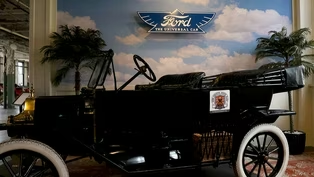
Ford Piquette Avenue Plant Museum preserves Detroit history
Video has Closed Captions
Clip: S52 Ep42 | 2m 23s | The Ford Piquette Avenue Plant Museum is working to preserve Detroit’s automotive history. (2m 23s)
Providing Support for PBS.org
Learn Moreabout PBS online sponsorship
- News and Public Affairs

Top journalists deliver compelling original analysis of the hour's headlines.

- News and Public Affairs

FRONTLINE is investigative journalism that questions, explains and changes our world.












Support for PBS provided by:
American Black Journal is a local public television program presented by Detroit PBS