NJ Spotlight News
Health commissioner says local COVID monitoring to continue
Clip: 5/11/2023 | 8m 31sVideo has Closed Captions
Interview: Judy Persichilli, NJ Department of Health commissioner
Thursday marks the official end of the federal COVID-19 health emergency. Despite the drop in the number of confirmed cases and deaths, the challenge continues to persist. “COVID is not going away,” Judy Persichilli, the commissioner of the NJ Department of Health, said. “It's still a public health challenge, but it's at levels that we feel are manageable.”
Problems playing video? | Closed Captioning Feedback
Problems playing video? | Closed Captioning Feedback
NJ Spotlight News is a local public television program presented by THIRTEEN PBS
NJ Spotlight News
Health commissioner says local COVID monitoring to continue
Clip: 5/11/2023 | 8m 31sVideo has Closed Captions
Thursday marks the official end of the federal COVID-19 health emergency. Despite the drop in the number of confirmed cases and deaths, the challenge continues to persist. “COVID is not going away,” Judy Persichilli, the commissioner of the NJ Department of Health, said. “It's still a public health challenge, but it's at levels that we feel are manageable.”
Problems playing video? | Closed Captioning Feedback
How to Watch NJ Spotlight News
NJ Spotlight News is available to stream on pbs.org and the free PBS App, available on iPhone, Apple TV, Android TV, Android smartphones, Amazon Fire TV, Amazon Fire Tablet, Roku, Samsung Smart TV, and Vizio.
Providing Support for PBS.org
Learn Moreabout PBS online sponsorshiptonight a covid-19 milestone for the nation the federal pandemic Health Emergency is officially over today the Declaration being lifted by the Biden Administration as positive cases deaths and hospitalizations have all dramatically declined that's due to the availability of vaccines treatments and widespread exposure to the virus the order has been in place for 37 months it took billions in government spending and more than one Million Lives nationwide at least 36 thousand people in New Jersey have died as a result of the virus Governor Murphy lifted the public health emergency back in March of 2022 so the federal change could mean less for residents here but New Jersey Health commissioner Judy persicelli says it's not time to let your guard down I sat down with the woman who needs no introduction commissioner it's good to see you thanks for giving us some of your time let me start with what I think most people want to know what does the end of a public health emergency mean for New Jersey well at this point we know that covet's not going away so it does not mean that covet is behind us it's still a public health challenge but it's at levels that we feel are manageable so for New Jersey what it means more than anything is that we want people to remain Vigilant that it is still with us but um in terms of the Department of Health our surveillance activities might change a bit because the reporting Cadence that we expected through the federal government is changing so we will be using Hospital admissions as an indication of the spread and severity of the disease and we will continue our uh syndromic uh surveillance in our emergency rooms for Respiratory illnesses of all types but certainly as a early warning sign or early indication of spread of disease in a community so how does that monitoring differ or does it differ from how the department typically tracks infectious diseases some of the biggest changes are the immediate reporting of all Hospital admissions um on a daily basis seven days a week we've been doing that for three years at this point in time and because we have seen Hospital admissions decreasing substantially uh we believe we can go down to a weekly Cadence uh in in that regard um we'll also see uh some changes in the reporting from our commercial Laboratories right now the commercial Laboratories report all positive cases in all negative cases so we are able to predict directionally uh positivity rates so that might change a bit as well I mean obviously the disease is not going anywhere as you said there are still new strains that were monitoring so how should the public decipher this will there be a point where maybe you'd have to go back to some of that more robust survey I guess in that question embedded in that question is you know have we reached an endemic stage because an endemic stage is a stage where the Cadence of the of the disease the levels of the disease are added at a level that can be that we can handle that we can handle without uh severe uh significant severe illness uh what we're still waiting for is to understand the Cadence of the disease we really do believe we're on a level uh where the disease is still present but not causing uh the amount of deaths that we saw with the prior surges the Cadence however similar to what you see with flu or RSV where you see you can almost predict when the surges will occur we're not quite there yet so the department will be continuing to work with our local Health departments we'll be continuing to put out alerts if we see any indication of spread in our communities so just to clarify you would or would not classify Us in an endemic stage I've seen some immunologists and and an epidemiologists say that we are in fact in that stage I think most people would say that we're in the beginning set stages of endemicity uh and uh we'll be monitoring for surges uh and the Cadence of the disease going forward uh which will help us uh be more predictive in um future responses okay commissioner let me ask you then just quickly about access what this means for access to testing vaccinations and treatment um so let's start with testing at the department we have enough tests through mid-2024 to support our our needs we also have uh we also will continue sending tests to um some of our congregate settings our long-term care facilities our Correctional Facilities we have stockpiled enough to be able to uh handle that uh and also our federally qualified Health Centers so we believe we have enough tests uh but we will monitor the availability of tests going forward and we urge everyone to go to uh the um Federal Government website and Order their tests because there are still tests available for that distribution and what about for vaccinations and will they remain free for now uh right now that vaccinations will be free the federal government did purchase enough to continue vaccinating individuals for free once it becomes commercialized uh our biggest concern will not be with Medicare on Medicaid they will continue to cover and Commercial Insurance will also cover our biggest concern is for the underinsured or the uninsured and HHS has announced a new program The Bridge access program it's a public-private partnership 1.1 billion dollars to work with pharmacies to provide vaccines for uninsured adults and children that are uninsured will continue eligible children will continue to get vaccines through the vaccine for children's program so essentially from now until 2024 access to those will be free how much does it concern you though that the uptake for you know the bivalent booster is still low and presumably if it's not free or that access changes it will remain low well that's the biggest concern that we have frankly is that people really want to put covert behind them we do also um but it's not behind us and the best defense right now proven defense is vaccination and we cannot we will continue we cannot urge people enough get your bivalent booster it is effective against the variants that we're seeing it is effective against severe uh disease hospitalization and death Health commissioner Judy persicali thank you so much for your time thank you Brianna are you still surprised commissioner that about that uptake I mean we've talked about it um a bit you know over the last year and a half or so um but uh it it surprises me anyway just uh from from this perspective that the numbers remain so low where I'm really concerned about it it's we we have I guess overall it's about a 20 uptake and um it especially for the elderly and immunocompromised uh individuals uh it's it's an issue because they are getting sick and in the deaths that we do see although they are they're significantly down the deaths that we do see are are in that age cohort so we will continue our our public awareness campaigns around that yeah that vulnerable population of course um commissioner thank you again Rihanna it's always a pleasure thank you thanks take good care you too [Music]

AG releases 'major discipline' report on NJ police
Video has Closed Captions
The state Department of Corrections reported the most disciplinary action taken (1m 12s)
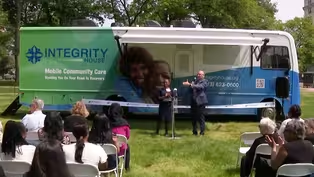
Mobile addiction treatment vehicle launches in Newark
Video has Closed Captions
Offering a variety services -- including health screenings and harm reduction assistance (3m 43s)
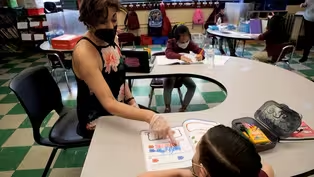
New package of bills are aimed at reversing teacher shortage
Video has Closed Captions
Addressing individual issues by removing barriers, addressing costs and adding resources (3m 43s)

NJ nurses rally for more staff, lighter workloads
Video has Closed Captions
A proposed bill would set enforceable nursing staff ratios at different levels (4m 1s)
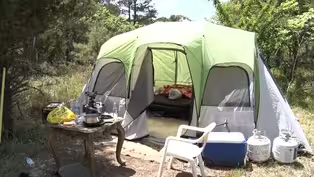
Ocean County homelessness risk without transitional housing
Video has Closed Captions
Ocean County has affordable housing, but the waitlists can run for years (4m 14s)
Providing Support for PBS.org
Learn Moreabout PBS online sponsorship
- News and Public Affairs

Top journalists deliver compelling original analysis of the hour's headlines.

- News and Public Affairs

FRONTLINE is investigative journalism that questions, explains and changes our world.












Support for PBS provided by:
NJ Spotlight News is a local public television program presented by THIRTEEN PBS