
Julia Child's Best Bites
2/27/2026 | 54m 35sVideo has Closed Captions
Celebrate Julia Child with Martha Stewart, Jacques Pepin, Vivian Howard, Marcus Samuelsson and more.
Celebrate the first lady of cooking with Martha Stewart, Jacques Pepin, Vivian Howard, Marcus Samuelsson, Jose Andres, Eric Ripert, Rick Bayless and more. Chefs and celebrities share personal insights as they screen Julia's most-beloved episodes.
Problems playing video? | Closed Captioning Feedback
Problems playing video? | Closed Captioning Feedback
Julia Child's Best Bites
2/27/2026 | 54m 35sVideo has Closed Captions
Celebrate the first lady of cooking with Martha Stewart, Jacques Pepin, Vivian Howard, Marcus Samuelsson, Jose Andres, Eric Ripert, Rick Bayless and more. Chefs and celebrities share personal insights as they screen Julia's most-beloved episodes.
Problems playing video? | Closed Captioning Feedback
How to Watch Julia Child's Best Bites
Julia Child's Best Bites is available to stream on pbs.org and the free PBS App, available on iPhone, Apple TV, Android TV, Android smartphones, Amazon Fire TV, Amazon Fire Tablet, Roku, Samsung Smart TV, and Vizio.
Providing Support for PBS.org
Learn Moreabout PBS online sponsorship(female narrator) Julia Child taught a nation how to cook, eat, and drink well, paving the way for today's culinary celebrities who sauté and purée on hundreds of cooking shows around the world.
Relish every morsel of Julia's Best Bites, all-star commentary, and unabashed appreciation of the First Lady of cooking.
(vibrant music) ♪ (Julia) B uf bourguignon.
French beef stew in red wine.
We're going to serve it with braised onions and mushrooms and a wine-dark sauce, it's a perfectly delicious dish.
(energetic theme music) ♪ (Carla) When she says "b uf," you know, if I was young, I'm like, "Wait, what's that word?"
(laughter) (Sara) Well, at least she said "beef stew" also.
(Carla) Yes.
-You worked with Julia.
-I did, I did.
She was the funniest person practically I ever knew, and it was because she was so refreshingly honest, and you can see that in her shows.
Like, if something goes wrong, she'll say, -"Oh, that doesn't look right."
-That's what makes her human, and then also what--that's-- because she will call out something that she's doing wrong, it makes it approachable -for the home cook.
-Yes, this is absolutely true.
Hello.
I'm Julia Child.
Welcome to The French Chef and the first show in our series.
(Sara) Now, one thing that's interesting: She's not smiling.
And she came to be so good at that.
-Right!
-...show to begin our series on, because it shows you so many useful things about French cooking: how to brown meat... (José) I cannot believe this is her first show.
(Éric) Yeah, she's very comfortable.
But she's going directly for the kill.
-"I want you to learn."
-Yep.
But she's very charismatic, huh?
It's something magnetic about her.
(Julia) And this is called the undercut of the chuck, so it's like the continuation of the ribs -along... -I love also that she would always show you on her where it was.
(Julia) ...into pieces about like that.
(José) They are big chunks!
-Which is how it should be.
-Yeah, it should be like that.
(José) Today, you find them sometimes very small chunks.
(Éric) It's not a bourguignon.
But before you sauté anything, you want to make sure that you have it good and br-- good and dry.
So I just take a whole lot of paper towels, like that... (Sara) Now, here, there is probably, in the early shows, there were people underneath her, passing her things.
And I think that was absolutely a pass.
She does have a shelf under there, but that was definitely a pass.
-Okay!
-'Cause she didn't even look, she was sort of like this, and suddenly, the paper towels miraculously fall into her hand.
The oil is hot, and that's a very important point, too.
'Cause you can't sauté anything in meat-- in oil that isn't hot.
(Carla) So even there, right into the pan, and you can see the meat -starting to cook.
-The overhead shot, -very cool.
-Yeah.
(Julia) And I'm not gonna crowd the pan, either, that's... (José) Oh my God, do you remember -your first show?
-Yeah.
-I was so nervous.
-Me too.
You were amazing on TV when you had the show.
-I was making a gazpacho.
-You had the number-one show.
(José) And I forgot the tomatoes, the green peppers, and the cucumbers.
That's how nervous I was!
She looks like, "No problem."
(sizzling) So while you're watching me do this, remember, you could do lamb or veal or chicken.
(Sara) Now, remember, this is a big deal.
This is her trying to make French food seem very accessible.
You could do veal or lamb or chicken exactly the same way!
(Julia) ...Burgundy, and that's where this dish was invented, in Burgundy, and they usually used Burgundy wine with it.
(Éric) So she's really advertising French, 'cause the French wine, French recipe, French technique, everything French.
...into the casserole.
Now, we have in here this nice sort of brown bit here that's left over from the browning.
And this is part of your treasure of cooking.
(Sara) She sometimes looks at the wrong camera.
Or it's possible she's looking at her producer.
They would hold up a sign saying something.
(Carla) Oh, okay.
Would that sign be -talking about the next step?
-Yes.
Okay.
They would also hold up when to smile or whatever.
(Julia) ...have a lot of flavor in it.
-And I'm... -I'd say she's looking at the wrong camera or at somebody else at least 50 percent of the time!
-She's looking over there.
-Yeah.
-And she's got a-- -And then suddenly, she-- -There she goes!
-"Here you are!"
(Sara) Ooh yeah, there's the camera.
(Julia) ...is very good, too.
Then, because this is a bourguignon, we have garlic.
So here's a garlic press.
You just put the whole garlic in there and go, "Unnhh!"
-Unnhh!
-Ohh!
Ohh!
It's amazing she will put voices to the ingredients.
...simmer here.
We want to give it a little taste to see whether we've got enough salt in it.
You want to be very careful -not to oversalt.
-I love this--wait-- -when she tastes it.
-The sauce is gonna reduce.
Doesn't taste good now.
(laughter) (Sara) I know--then why did you taste it?
Oh, 'cause she's figuring out the salt.
-Yeah.
But I love that.
-She's honest.
That's why, ultimately, she was so funny.
Now that's half a simmer... (José) You know why I love her?
Because I see myself in her so much.
Lookit.
She put the salt, whatever, she goes to her-- to her body to clean the hand.
These braised onions are something that you can do.
They're awfully good served with a stew, or you can serve them just as a plain vegetable with just parsley on them.
(José) She didn't stop.
To be in front of the camera, to have to do it for a certain time, and is not one cut yet, it's like nonstop.
Then, there are peeled onions, and we're gonna cook them in a pan like that.
And then you cover them.
I don't have a cover, I'll use this and pretend we have one.
As we don't have 25 minutes, I've got some that have already... -That's the first swap!
-The first swap.
(Sara) Yes, um... ...because this is the first real big show.
-Yes!
-And when they're done, then you just put them aside, and.. you can do them the night before, if you want.
Now we're gonna do the mushrooms.
(José) Hey.
Take a look at this.
She's tidying, she's cleaning as she goes, she puts in the back and they don't cut, -she keeps cooking.
-There's no editing.
(Julia) This is the--this is the way you always sauté mushrooms if they're...
-"So-tay."
-I know, the "so-tay."
(Sara) I know--what's that about?
-It was a Julia-ism.
-There are two mushrooms, -these are both fresh ones.
-This is cool.
She's such a good teacher.
How to tell a fresh mushroom from a less-fresh mushroom, -if the stem, you know... -...feel fresh.
Now that butter's hot enough, the foam has gone down, so in go the mushrooms.
(Sara) And a few fall out, -and they always did.
-I love this.
(Julia) Almost... ♪ (Carla) Right now, because the cooking on television is so perfect, people are intimidated, because they think that this is how it should be.
But if you were real and you allowed yourself to mess up, you teach more -through the mess-up... -I couldn't agree more.
-...than the perfection.
-I couldn't agree more.
I-I-I do-- I mean, we do.
If you're doing it naturally, you do.
(Carla) I'm like, "You want me to mess up, -because I can recover."
-Right!
Well, she didn't mean to, in the beginning, but after a while, I think she attempted to.
By the time I met her, which was way be-- much later than this, she would go out of her way to make a mistake so she could fix it and show you.
(Julia) ...and that's just what this is.
Well now, this is ready to serve right now.
(Sara) Okay, let's see what we're gonna serve it with.
(Carla) She is--she's smiling now, -because it's almost over.
-She's like, "Phew!
I'm doing it, I'm doing it, it's happening."
We have our b uf bourguignon, -and we have... -You can tell how tall she is now for that table.
(Sara) Yeah.
That table's tiny.
(Julia) And also, we have a red wine... (Sara) Now this, I love, 'cause this was very avant-garde.
(Carla) Well, they had decanted it, too.
(Julia) ...very nice wine.
Or if you have lots of money, you can buy a fine Burgundy, except with... (José) "If you have a lot of money, you can buy a fine Burgundy."
(laughs) It's one of the really great French soups, and it's fun to make and wonderful to eat.
Okay, here we go.
"Bon appétit!"
There we go.
♪ -Bon appétit, Julia!
-Bone appétit, Julia.
(Éric) Wow, that was cool.
-Huh?
-I'm gonna make b uf bourguignon tonight.
(José laughs) (twinkling) Julia Child presents The Chicken Sisters!
Miss Broiler, Miss Fryer, Miss Roaster, Miss Caponette, Miss Stewer, and old Madame Hen.
I think I watched pretty much every single one of the 200 or so episodes of The French Chef.
We all did, we all had our televisions tuned on, and public television was our favorite station.
And she was my first teacher, I would say.
We're roasting Miss Chicken!
Today, on The French Chef!
(music, clucking) (Vivian) There are so many things that strike me here.
-Yeah.
-I mean, first, -there's a lot of raw chicken.
-Yeah.
And also, I had no idea that there were so many different sizes of chickens.
That chicken that she's gonna focus on looks almost like a turkey to me.
Yeah!
You know, we speak of a covey of quail and a gaggle of geese and a pride of lions.
Well, this is known as a peep of chickens, that's their official name when they're in group -as they are.
-She was everybody's ideal of a home chef that took you into the realm of highest haute cuisine and made you feel comfortable with it.
Is this chicken a roaster and why are these others not roasters?
(Martha) What Julia did with her television show, that really was the beginning of the craze for food on TV.
The names depend on their age and their size.
(Marcus) I mean, I'm just in love with the way-- how she fully just touches and embraces her hands with the raw chicken, which is, like, so what you're not supposed to do.
-and I-- -She's massaging and slapping them.
(Julia) And there's another bird called a caponette, and it's a beautiful bird.
(Marcus) It is really informative.
There's no prettiness here.
It's just, like, the food, the knife, the camera, and Julia, right?
And this is-- this is amazing to watch it.
It's really like watching a documentary -on how to.
-Yeah, and it's watching someone do something that no one else has done, -so there's no rule book.
-...so you can see that this is just cartilage.
(Martha) Julia taught us the importance of cooking skills, knife skills, the way to stir, the way to whisk, the way to chop, the way to cut.
(Vivian) One of the things that's interesting to me is, like, this is happening, what, 1970-something?
-Yeah.
-And at that time, like, my mom was, like, taking a class on how to cook in the microwave, and, like, trying to-- you know, consuming convenience kitchen culture, like, very fast.
And she is pointing out, like, prime ingredients.
-Sure.
-Here's how to shop for things, here's how to make the absolute best food that was gonna take you a while.
So it's like in contrast to really what's happening, like, culturally at the moment.
Now here's one more thing that you can do if you want, and that is to take out the wishbone.
It's covered, and you bare the breast... (Vivian) I'm gonna show this to my cooks at my restaurant.
I mean, this is so informative.
Like, I feel like I've never roasted a chicken before.
And a great many French recipes, they just don't stuff the chicken at all, they just put in flavoring.
And I rather like that system, because I think the chicken cooks more easily, and unless you want to make a chicken go very far... (Martha) We loved the way Julia was kinda casual about teaching very complicated methods.
And she was always at ease, not only with the camera but with the recipe.
And the first thing that you want to do is to truss it.
And I'm going to-- I like to do the French system with a needle.
That's a trussing needle.
It's just an iron needle with a big eye.
I think a camel could practically pass through that.
If you don't have a trussing needle... -You never see this.
-I've never done that.
(Marcus) No, no, that's like-- that is France-France, like, this is like... -France-France?
-France-France.
It's not just France one time, it's double-time France, because that is-- it's been a minute, you know?
Push the knees under the armpits.
(Martha) Julia persuaded us to try things, new and different things, that we could even pronounce the French dishes.
We could read French menus, finally.
And French restaurants started to pop up more and more.
(Julia) And pull this through... (Vivian) Looking basically like a compact roast.
-Yes, it stands up.
-None of the juices can leach out.
And it looks great when it comes out.
And then, at this point, now is when, if you're going to stuff it or flavor it, -you put the stuffing in.
-Now you can stuff it.
Now it's opened up, it's great.
Bit of butter is just gonna roll around inside the chicken and baste the interior, and then a little bit of salt-- about, say, quarter of a teaspoon, and just pour it right in there.
It really--it has to be salted.
And then, some kind of an herb.
-I'm gonna put in about... -I love that she's kind of, like, fancy free about, you know, "You can do this, you can do this."
It's not like, "Here's the recipe, you will fail if you do something else."
Her talent was to make all of us feel more comfortable with a complicated recipe.
She was able to make fun of disaster, of problems in the kitchen, and those things made us feel more comfortable in our kitchens.
Now we have to truss the legs.
(Vivian) I can't get over is, you know, this whole episode is about how just to roast a chicken, and because she's so laser-focused on that one task, we get all this detail that is not meant to be entertaining, but it's incredibly entertaining.
And then, no matter what way you're gonna cook it, it should have a butter massage.
(Marcus) I told you she's coming back with that, I knew that, I knew it.
-A butter massage.
-Yeah.
(Julia) You have rendered chicken fat.
-That's a great move, though.
-That is.
I've-- a raw chicken has never made me hungry before, but I am starving.
And we're gonna roast it on the spit, because that is not only the most ancient but also the most modern way.
(Vivian) The most ancient and the most modern.
(Marcus) Mm-hm, yeah.
I think it's useful to know how to put the chicken on a spit.
Then you always start on from the neck in.
-(Julia grunts) -(chefs laugh) (Marcus) I liked that, little sound effect, yeah?
(Vivian) You could tell she had to work for it.
(Julia) And that's supposed to go right square into those... (Marcus) So after all that work, how are you not supposed to love that chicken?
-Right?
-Best chicken on the planet.
(Julia) Screw that up tight.
And I always believe in having plenty of tools in the kitchen, so I think the thing to do is to get a pair of pliers and really hold that on.
(Marcus) So her knife set has more things to it, right?
It's just not a sharpener and a bunch of knives.
It has pliers, it has all kinds of-- like, she's prepped in a completely different way.
-She's a working, working... -Yeah.
It could be a car, it could be a bike, but it could be a bird, too.
-She's handy.
-Yeah.
You lift it like that, and the last drops that drop out of the vent of the chicken should be clear yellow with no trace of rosy.
(Martha) I don't think Julia ever took herself too carelessly.
She was very serious about her art and her craft.
(Julia) It's awfully hard to get pork fat and pork fat sheets in this country, so I've suggested blanched bacon.
Now, this you wanna tie on so that it will stay on and also so it won't drip into the...into the machine.
(Marcus) She loves her rope.
-She's good with it.
-...and the string on here.
And then just hold it up and wind it around, and then tie this down here, -and now the bacon... -Do you think she's done?
Or are we like, -no more, we don't know?
-I don't know, we've used all the string.
-Look at that.
-...rotisseries... (sprightly music) ...so that you can see how it looks.
♪ This will take about two and a half hours.
And I've found a cardinal rule in roasting, 'cause it's so awful when you have people for dinner and the chicken isn't done or the lamb isn't done.
In anything like this, I take it half an hour longer than the longest estimate.
(Vivian) Listen to that!
I like that tip right there, Julia.
And she's really teaching you things that technology can't, right?
Feel the bird, yeah, what to look for.
-What it smells like.
-Exactly, and these are, like, things that even today in cookbooks, you don't find them, so this is amazing.
And I'm gonna show you how to carve it.
From here, you start with the leg.
(Martha) It's an incredible, incredible influence that one woman had on the eating habits and knowledge of food that Americans developed.
So that's all for today on The French Chef.
This is Julia Child.
-Bon appétit!
-Bon appétit!
-Oh, wow.
-Yay!
-Where's our chicken?
-That was amazing.
(vibrant music) (chopping) (Julia) I'm chopping onions for French onion soup.
We're gonna brown them in butter and simmer them in stock and then gratiné them like this.
This is French onion soup, exactly the same kind you'd get if you were in Paris, France, and you can make it yourself.
(upbeat music) ♪ I'd met Julia several times, but more in passing, and then when I had the opportunity to go to her house and actually film in that legendary kitchen that's now at the Smithsonian.
I was almost speechless, which is not a great thing for somebody that's going on TV, because I just had so much reverence and respect for what she had done over many, many decades and how much she had taught me about cooking and about how to actually do a TV show.
It takes a lot of onions to make onion soup if you're a do-it-yourself... (Jacques) I went a few weeks ago with a food historian who said, she said that there was 405 cookery shows on television now.
They all come back from the first Julia show, as she put.
French soup, usually French onion soup... (Martha) Julia opened up the world's cuisine, not just French, but all the cuisines of the world.
...at the beginning that you can get extremely good canned and packaged soups, which are already made, but what I want to show you is how to... I cry every time I cut onions!
♪ But first I'm gonna talk about chopping onions.
-You see how... -She's gonna cry.
Yeah, that's challenging, right, on TV when you start to cry, you imagine?
(Julia) Bum, bum, bum, bum, all the way down, -which is easy to do... -Wow!
(José) "Bum, bum, bum, bum!"
You want a good, sharp knife.
I always use knives of ordinary steel... (Rick) Typically I would use a chef's knife which would be 8 to 10 inches in length, but she's using a little--what we would call a utility knife, and she's just flying through those onions.
Thumb and forefinger, and grip the top of the blade like that, and then hold... (Jacques) Julia adds an element of fun in her show, but there is always the serious part of it where she was teaching people the things she wanted people to do.
You chop, your fingernails are pointed away, because you don't want to cut your hands off or your fingers off, and your knife... (José) The good thing about cutting is that we have five fingers.
-Like that.
-You don't get that kind of technique training hardly ever on television anymore.
I mean, usually it's all about the big fire scenes, you know, the blazing this, the blazing that, people running into each other in some sort of competition show, but you never get real training!
(Julia) We say we cook them in butter... (Martha) I have always been impressed by her ability to teach a thorough recipe, and it's been an incredible education for me.
(chopping) ♪ (Rick) She cut the top and the bottom off of each half of the onion, and then she cut in the direction of the root end to the top end, she cut across like that.
That makes a huge difference in making French onion soup than if you were to turn it 90 degrees and cut it the other way where all of the onions will just fall apart.
I'm gonna show you one more quick, and what I'm gonna do is to cut down this way, cut across that way, and then cut down, and it will fall into dice.
(José) And there, in her nails, you can see that she was a chef.
-Yes.
-Look at--you can see that she really cooks, she got burned.
...off, and then I'll show you how to get the onions off your hands, which is often a problem.
♪ Now, if you use hot water, you're gonna set the onion, so rinse your hand first in cold water... -What?
-...and then rub them in salt... -What?
-...wash off the salt... -I never heard that.
-...in hot water and soap.
-Me too.
-How many tips are in her 200-plus shows?
You really have to keep stirring them up about every-- every two or three minutes.
-I'm already hungry.
-Yeah, me too.
-Hungry, and... -And she's only cooking onions!
French cooking became probably a bit more known, but it was Julia who brought that type of cooking to the camera and showed people that they could do something at home without too much fuss, without too much complication, just by using the regular supermarket, and cook something good for the family, and she thought it was a very novel occupation.
(Julia) You pour in about that much.
Well, you can tell from tasting it how long to cook it.
(Éric) See, she's teaching people how to taste by herself tasting, talking about it, and so on.
(José) Yeah, don't follow the recipe.
You just find the answers on your own.
(Éric) You taste.
(Julia) ...down there.
So I shall take those off.
(Jacques) People ask me, how was she off camera?
She was exactly the same as she was on camera, and it was fun going to a restaurant with her because she always wanted to go to the kitchen, say hello to the kitchen, shake the hand of everybody, including the dishwasher and all of the cooks.
(Julia) And a little bit of vinegar.
This can be ordinary white vinegar, about a tablespoon.
I can't seem to get it open.
If I bang it, it'll open.
(clanging) (Rick) Just think about what she did!
She banged it upside-down.
She could've broken the bottle, but she banged it on the countertop and then she whacked it with the back of a knife, but the fact that she's doing it on national television is hilarious.
Now, this soup... (Rick) And she's so relaxed, which I think puts everybody completely at ease.
It's what we all love about Julia.
(Julia) This is a mixture of parmesan and Swiss.
You can use all parmesan or all Swiss.
(Éric) You have to be focused and follow the recipe, but she ignores the camera a lot, or she talks to the camera when she has a message, but if not, she's into her... (Julia) It's not quite done.
You want to have the yolk liquid and the white just set.
(Rick) Perfection for Julia.
(Julia) ...I'll put these into the bowl, put these into the oven, and gratiné them.
When you've taken them out of the water, the cooking stops because they're in cold water, and if you're gonna do eggs in aspic, you'll do it exactly this way and then put them in ice... (Rick) She knows so much!
And she's just sort of letting it all flow out.
Like, if you pay attention, you can get the graduate-level course on French onion soup making here.
(Julia) And you ladle your soup onto it.
This is done a great deal in France.
(José) It's a lot of soup, I like it.
I love onion soup.
It's one of my favorite soups.
(Éric) Especially in winter.
(José) It's obviously a Spanish invention, as you know.
(Éric) Yeah, of course.
That's why it's called The French Chef.
(Julia) Now, you can also... You'd think there'd be enough onions now, but a little raw onion gives a little-- the French call it a je ne sais quoi.
(Rick) Now I gotta go home and I gotta make French onion soup à la Julia, and I gotta grate a little bit of fresh onion in there and serve it with the poached eggs and a lot of cheese.
I think that's gonna be good.
(Julia) ...eight ounces, I guess.
You can also add a little bit of cognac... (Rick laughing) (Rick) There she goes again!
And...your oil.
You know, I keep using vermouth instead of oil.
There's our oil.
-I'm using... -She's--she's got it all down, but it is so much fun to see that she is just as fumbly as I am sometimes in the kitchen.
Now, this is a final enrichment.
Oh, there goes the brandy.
(Rick laughing) There.
Now, I guess we're through with everything I can show you about onion soup, and we've really, as you can see, taken French onion soup about as far as it can go.
(Jacques) At the end of each of the shows, she would say, "Okay, what did we teach today?"
The television was a vehicle, in a sense, you know, to carry the teaching that she would want to do with cooking.
Well, that's all for this time.
This is Julia Child.
Bon appétit.
(cheerful music) ♪ (twinkling) I went to three different markets to find unsliced sandwich bread, and I couldn't find any.
That's the bread dilemma we face unless we make our own, and here it is!
The Good Loaf, pain de mie and raisin bread, today on The French Chef.
(energetic theme music) (Sara) She did over 200 shows in 10 years, and you could see she's just comfortable.
(Vivian) Wow, I wonder why she's throwing it around like that.
(Marcus) Yeah, there is a reason, you know there is a reason.
Welcome to The French Chef.
I'm Julia Child.
These two loaves are pain de mie, and this is a raisin bread loaf.
It's made very much like French bread, regular, the long loaf French bread, which is made out of flour, water, yeast, and salt, and pain de mie is made out of flour, milk, yeast, salt, and a little bit of butter, and it's the same kind... (Marcus) Do you think she ever cooked without butter?
(Vivian) I don't think so.
I don't she ever points without a knife either.
(laughing) We have Julia to thank for so many things.
If you think about French cooking at that time, right, it was, nine times out of ten, -a man... -Yes.
...with a tall hat, with a French accent, and joy and casual and fun was not part of it, right?
And then all of a sudden, this lady shows up.
Food was always domestic, and it was like work, and she was the first person, I think, that showed people that it was really fun.
I mean, she's very clearly having fun.
This is game-changing.
One pound of flour, and that's about three and a half cups.
Even the measuring that she's doing is so great.
(Sara) And that she's making a complete mess the whole time.
(Julia) That's three and a half cups.
Here's the half cup.
-Look at that, bang.
-Measure it just like that.
And now we're gonna start kneading the dough by hand, and when you knead, you want some kind of a scraper, like that, or a stiff spatula, or just buy a painter's spatula at a hardware store.
(Vivian) Just go to the hardware store, Marcus.
(Julia) ...to scrape the dough up off your surface with.
-I'll do it with a painter's... -Yeah, I hate that we, today, like, think that if we don't have the specific, like, piece of equipment, we can't do the task, but, like, she's empowering you.
(Julia) Use your left hand, keep that clean, and then begin working things with your right hand.
Slap it down and turn it over... -Slap it down!
-Yeah.
(Julia) ...completely mixed up, and particularly what you're trying to do is to get the gluten molecules to join... This is a great thing to do if you're not in a good mood.
(Sara) No, the kids have really made you mad or you had a bad day at the office, you come in and throw around some dough.
(Julia) And this dough is gonna remain quite sticky, but we just knead vigorously.
You're wanting to get the lumps out of the dough.
It's beginning to smooth out a little bit, can you see that?
And it's beginning to draw back.
(Carla) I think it's-- it's the ridiculous, but she is actually showing you the texture of the dough which is so beautiful.
That is why, I mean, I think you feel the same way, after watching this, it's like, "I might have to make that."
(Carla) I was thinking the very same thing!
-I know!
-And then after these two-- the restings of these two doughs, they're going to have butter kneaded into them.
(bowl clanging) (Carla) It's always--this is so classic, working live.
(Sara) Yeah, just, or live to tape.
(Carla) Yes.
(Vivian) I love that she's struggling with that.
(Marcus) We're all struggling with that.
(mellow music) ♪ I do think that I could teach her one thing.
-Oh!
-I know... Why would I even say that?
-How would you walk that in?
-I wouldn't.
-I'm just telling you.
-Yeah, okay, you can tell me.
So, she needs to put a damp towel underneath that surface so it doesn't slide around.
I'm sorry, Julia, I just can't help myself.
(Julia) Cold but malleable.
-Oh!
-Oh!
(Marcus) Wow!
I didn't-- -Did you see that coming?
-This is not gonna be good -for mixer sales.
-No.
(Vivian) Everyone's gonna want to do this by hand.
(Julia) This is the good part of this.
We put a little bit of the butter in first like that, and then with the heel of your hand, begin squishing it around.
(Carla) The way that she's cooking, I feel that she-- you can feel her 63-- the wisdom of a 63-year-old, but she also has the energy of someone much younger.
(Sara) Oh, yeah, absolutely.
(Julia) ...is the gateway to brioche.
I love this, the gateway to brioche!
-Yes!
-Like, oh no!
(Julia) If you want some really messy dough, you start adding three times as much butter as this to a dough, and that's great fun.
(Marcus) What I love about this recipe and so much of her cooking is that it shows that if you're gonna make something great, you can't cut corners.
And this is gonna have three rises.
It has two rises in a bowl and then one rise in a pan just before baking, and it's this-- and these are to be long, slow rises, and that's what gives the bread a beautiful texture and flavor.
Up to that point, it has a soft, lovely, puffy quality.
(upbeat music) And then you deflate it, and the deflation is important because this is what's gonna give it its texture.
She never did a retake, even though we made three times backup for every part of everything.
She was that good by the time I got to her in 1979.
(Carla) So what happened to that food?
-We ate it.
-Okay, nice.
(Julia) And then turn it over, and then I'm sealing those edges, and then turn it over again and make a trench down the center, and turn it over again.
What we're trying to do is to make a nice, smooth top.
That isn't a smooth top.
(Carla laughing) This has actually risen a little bit too much.
(Sara) That's good, too, that she says, "When you do it, do it better," instead of pretending this is the way it's supposed to look.
(Carla) Yes, yes.
(Julia) Buttered foil on the top of it.
♪ That's just an old cookie sheet, and then any kind of a weight, like a brick or an iron.
-Look at this.
-I love this.
(Sara) You know, who has one of those -just kicking around?
-I do.
-What?
-I have my grandmother's.
(Julia) ...75 degrees.
Oh... (laughing) (Sara) Which swap am I looking for?
(Julia) Raisin bread.
And I don't think that's gonna make very much difference.
This, again, goes into the 435-degree oven, and it doesn't have any topping at all, any glaze.
It just bakes as is.
It's really about 40 minutes, and now when it's ready, here's how it looks.
(Vivian) She was, I guess, the first person to-- I guess she invented the magic of television, like, "This goes in the oven, and it takes 35 minutes," but magically this comes out and it's ready.
♪ This one has some floor tiles on it to keep it down.
♪ Here's your cover off.
♪ And out... (Sara) Hey, listen, this is a nightmare of a show with all those risings, to end up with the exact moment that it would all be done to show.
Yikes.
(Carla) This thumping is so nice.
(Vivian) She likes to pat her food.
Then, let it cool.
I think it's best to cool it on its side 'cause it gets more air around.
And it's gonna taste much better if it's cooled-- really completely cooled down, although it's always exciting to eat it hot from the oven.
I love that.
"It's always exciting to eat it hot from the oven."
-Ain't that the truth?
-But don't!
I know.
And this keeps very well when it's completely cool.
Wrap it airtight and refrigerate it or freeze it.
It freezes perfectly, also.
A nice slice of that.
♪ And what is wonderful about this, this is fairly fresh, but even so, it slices very thinly.
And here is the... (Carla) This is hilarious.
Wait.
Oh, oh, wait.
(Julia) It's a little too thin.
(Carla) I love that she calls it out, a little too thin.
(Julia) But--but how wonderful to have complete control over the thickness of your slice of bread.
It makes marvelous, absolutely marvelous toast.
And it's just so good in itself that it makes perfectly beautiful just plain bread and butter.
So that's all for today on The French Chef.
This is Julia Child.
-Bon appétit!
-Bon appétit!
(Vivian) Yay!
(vibrant music) ♪ (energetic theme music) (Rick) She is wicked with that knife.
♪ I had the opportunity to watch the very first season of The French Chef back in 1963.
I was ten years old.
And I sat notebook in hand and wrote down everything she did because it was like magic to me.
I went to France not to cook.
I did not cook, but I started cooking when I was there just to say thank you to people who were allowing me to surf on their couches.
And then I picked up one of Julia's books, -and that's how I started.
-You got started.
-Yeah.
-Wow.
I was very lucky to work with her in the late '70s and then at GMA.
And then I got to do a special on her before she died, which was really nice.
We had these wonderful dinner parties.
A bunch of us would be there.
And in the middle of the whole thing, when we were cooking, we'd all prep together... -Nice.
-...she'd turn to us and say, "Aren't we having so much fun?"
(Julia) Welcome to The French Chef.
I'm Julia Child.
Today, we have the great potato show.
-Potatoes... -First of all, she shows amazing technique in how fast she can slice those--those potatoes, just like she sliced the onions for onion soup.
And then she just throws out all of this crazy history.
Potato flowers, leprosy, and then the potato famine, and let's get cooking.
I counted over 200 potato recipes in a French book the other day, and we're gonna do four lovely ones.
(Sara) It was at a time when people were into frozen food.
That was the convenience.
Women shouldn't be in the kitchen and TV dinners.
She said, "No, no, no, no, no.
You can do better, and you must do better.
And besides, it's so much fun!"
(Julia) Now for slicing potatoes, I always recommend that you learn how to use your knife.
Just come straight down like that.
And after you practice, you can go very fast.
(Rick) She really did look around to see what could make life better for cooks because her goal was obviously to get us all to cook.
She's the one that animated all of that whole movement of the '60s and '70s about adopting good food.
Then I'm gonna put a little bit of garlic in, too.
That's always part of this dish.
You can put cheese in, too, but I like it just plain.
There's a whole clove of garlic in the press and it goes "click."
(Carla) I love that.
I mean, I think that someone, a woman of her stature who can laugh at herself and not take herself too seriously, that was part of her brilliance.
(soft music) (Julia) And then you just put a little butter on.
(Rick) So, everybody talks about Julia always using so much butter and cream and all that sort of stuff.
This is actually one of my favorite dishes in the world.
I do it with cream, so I think she's actually going very lean in this thing to cook it in milk and then just put the dotting of butter over the top of it.
(Julia) I'll just put a little more cream on.
This is awfully good.
We don't care about calories.
I remember she used to say, "You know, dearie, if you go to the supermarket and they don't have shallots or leeks, you go to that grocery guy and you just tell him, 'I want my shallots and my leeks!'"
I mean, so that was a good message even all the way back there.
If you don't like what you're handed, then go and make a difference.
Now, you just take your fork.
You see how useful that is.
You just mash the potatoes like that with it.
(Rick) In spite of the fact that she uses very simple equipment, was always an early adopter.
I mean, she's the one that taught the U.S.
about the food processor.
She brought the first ones over from France and told people about all the things that they could do with it.
(Julia) Then it's always a good idea to taste it 'cause you want to be sure you've got enough salt and pepper in.
That's good.
Nothing like butter.
And then just put the potatoes in.
(Rick) I think she should have called this episode, other than the "potato episode," the "butter and cream episode" because there is liberal use or suggestions of use of butter and cream in every single one of these dishes.
Pour some very heavy cream and sprinkle a little cheese on top of it, and then bake that in the oven for about-- in a 375 oven for about 30 minutes.
That makes a perfectly delicious dish.
When you flip anything, you really-- you just have to have the courage of your convictions, particularly if it's sort of a loose mass like this.
Oh, that didn't go very well.
See, when I flipped it, I didn't-- I didn't have the courage.
(Rick laughs) (Rick) First of all, you don't do that on live TV unless you are super confident, but I mean, she seems like a very confident person, right?
And so that could have been browned a little more on that side.
I shall consider that that's browned, and we'll put this in an oven dish like this.
(Carla) Because she will call out something that she's doing wrong, it makes it approachable for the home cook.
(Sara) Yes, this is absolutely true.
I'm seeing how our gratin dauphinois is doing.
(Carla) She would always use the French terms.
-Absolutely.
-You know, because it was about educating us in culture, because you're going from frozen TV dinners to, now, this French meal.
(Sara) We're dining, we're not just eating.
Yeah, the whole thing, you're right.
You can either do a great big-- a great big one, or... I've got my heat on so high, I'm just getting boiled.
(Rick chuckles) (Rick) Julia getting boiled is pretty classic.
Pretty classic.
And as always, we put in a little bit of oil and some butter.
(funky music) There we are.
♪ Now that makes a very nice luncheon dish or a supper dish.
(Rick) And when it gets to the table, you can see just how comfortable she is actually serving food like that.
This is nothing that she's made up.
It's what--it was in her bones.
I mean, she had really spent her time in France learning how to do this and lived there for so long that it became her food.
So that was a really cool last little moment.
Out of 200 French recipes, we've done four very nice ones.
We've done our--we've done two potato casseroles in main dishes and two potato dishes that you can serve with meat.
So you only have 196 recipes to go.
Courage!
And bon appétit!
This is Julia Child.
(soft music) (twinkling) You're gonna see me and a French female fish professor fixing fancy fish, today, on The French Chef.
(energetic theme music) ♪ (José) That was 1963.
I wasn't born.
You were not born.
(José) 1963!
Julia really made me think about cooking has to be fun.
And that you respect cooking doesn't mean that you have to be very tight up.
She kind of made it relaxing and easy.
You mentioned the French.
She really brought French cooking to America, and she was promoting French cooking on television.
She was the best ambassador for French cooking in this country.
(José) So, already, she was cutting edge -in the way she was presenting.
-Look what she does.
She, like, just--it's dramatic.
(Julia) ...belly, usually, which is lying in the sand.
(laughing) (Éric) She's patting the fish.
(José) She likes patting.
(Éric) She's very sensual in her teaching, right?
(Julia) ...flatfish family, and most of them are called sole.
There's a West Coast rex sole.
(Éric) But, now, people were watching because it was entertaining because nobody could find the right sole.
(José) But look at that.
You are the number one restaurant in America, without a doubt the most popular, famous fish restaurant in America.
She was doing already marketing for you and for the love of New Yorkers and Americans for fish before you're even born.
(Éric) Thank you, José, for the promotion.
(José) You should be paying her for every fish dish you sell.
And all flatfish, whether they're flounder or sole, have the same bone structure.
(Éric) I mean, she's not intimidated at all by the products, right?
Like, she puts her hands in it, like, she has slimy hands and so on.
She came many times, for lunch especially.
One day, she--I go to the table after she-- And I did seared tuna with a truffle salad and something.
And you know we serve tuna rare.
So she said, "Uh, Éric?
Can you come, please?"
So I'm going to the table.
"Uh, you forgot to cook the tuna."
And I was like--I didn't know what to say.
(José) That's better than if she told you, "You don't know how to cook."
(Éric) "You forgot to cook the tuna."
You can see if you look here at this dab, spelled D-A-B, you'll notice this line that comes right along from the tail on up to the top of the gills, and that's the line that you follow.
People were watching.
It's not just for the entertainment.
There's no way they were going to do that at home.
She had so much fun on--on TV.
It's almost like if the cameras were never there.
(Julia) ...outlining it, and then you come up to the neck part up here.
(José) She's not talking to you, to me, to a professional chef.
She's talking to the millions of Americans that were watching her.
And only she wanted to make everybody probably be comfortable and showing them that they were going to be facing "problems."
-This is very good.
-Yeah.
It's excellent.
You can make a beautiful white wine fish fumet with the bones.
This is called the fish frame... (José) What I love is how much she loved to be touching the product.
(Éric) I know.
She's, like, hands-on.
(José) Now sometimes in cooking shows, they are so aseptic.
Like, like... (Éric) Everything has to be cut already.
You just pour, bim, bim.
(José) Look at this.
-This is hardcore.
-Yes.
(speaking French) (Julia) This is a bass.
Atlantic bass.
(José) To me, what is fascinating is that she's going to an expert, a woman that does this every day in the market, but then she goes and she shows, "And I'm doing it myself."
So, here's--here's one that is clean from--like hers, with all the insides out and everything is closed.
And then here is the usual cleaning which is the slit belly.
(Éric) But you see, you're learning something.
I mean, for sure you're learning something, like, it's for the viewer, it's... -Oh, wow, she's generous... -Okay, she's adding the salt even without looking at the-- (Éric) Ooh, she's putting a lot of salt.
(José) Yeah, she likes salt.
(laughing) Yeah, but... -It has the skin and... -Sauté it in butter, and I've just put some salt on the inside.
(José) I love how much she loves to pat.
She's treating them like they're pets!
She's treating them like they are her pets.
You see, like, so much love.
(Éric) It's good to say hands-on.
(Julia) ...in too hot, and you want to keep watching it as you sauté the fish to make sure that the butter isn't burning.
(Éric) She gives good tips, right?
(sizzling) (Julia) Here are our truite meunière, our sautéed trout.
I've just turned them over, and they need three or four minutes more of cooking.
Now that's fun, isn't it, that Madame Pascque's way of fixing those little fish.
You can fix any small fish that way.
And I'm gonna show you how to cook them.
Now here is your-- and I've done these both on little trout, and there's your truite en lorgnette.
(Éric) Whoa, I didn't even know that term.
Truite en lorgnette.
-Lorgnette is like... -Lorgnette.
(Éric) ...the glasses, yeah.
(mellow music) -Man, she likes butter.
-Oh, yeah.
(Julia) ...both sides of the fish with butter.
♪ And then they're going to be seasoned.
♪ (José) They're going to be seasoned.
I want to see how much salt she puts in this one.
(Julia) A little salt and pepper on them.
♪ (Éric) Oh, man.
This is cured!
(José) This is salt like in the '60s.
(Julia) And then here is the lorgnette.
(José) You see, I told you that this was a very "easy" recipe for 30 minutes.
She's using the time to teach all their techniques.
(Éric) Yes.
(Julia) And this is en colère.
I'm going to have to take my impeccably clean purple towel to push that tail through the mouth there.
Here she comes.
-There.
-Oh, do you see what she did?
(Julia) A very amusing thing to do.
(Éric) A very amusing thing to do!
(laughing) (Julia) ...a little bit and then it should have -a little bit of... -Of butter.
(Julia) ...and then they go to the oven.
-More butter.
-...on the butter.
And then they're going into a 375-degree oven.
(Éric) And she was not afraid of making a mistake or having something not perfect.
(José) All the Food Network chefs, of all the chefs out there doing TV, I wonder how many could do a show almost nonstop like this.
Those are long segments of five, ten minutes, nonstop.
And add also a little bit of butter on top, and that's the whole fish story today on The French Chef.
This is Julia Child.
Bon appétit!
(energetic theme music) (twinkling) (funky music) ♪ (Martha) She made us feel that we could do it, that we could transform our cooking into something really special.
B uf bourguignon.
Who made b uf bourguignon before Julia Child?
(Marcus) If that is about improving people's life, that is specifically what this is because if you know how to roast a chicken like that, your Sundays are good.
(Sara) She does these very complicated shows.
I mean, she says, "Oh, it's so easy."
No, it wasn't.
I mean, you know, after 500 steps, you're like, "I don't think so," but, yet, it was so much fun.
It was contagious.
(Vivian) Her accent is so mesmerizing.
It's like she's almost singing.
-It's a high pitch.
-Yeah.
(Rick) It's widely known that Julia had French onion soup for her very last meal.
Bon appétit, Julia.
Bon appétit.
(Jacques) I miss you, Julia.
I think you should be here with me sharing a glass of wine, sharing a good story.
(Éric) Julia, we miss you a lot.
(José) I cannot imagine where-- what you are cooking up there.
I'm sure--I'm sure everybody is having a feast.
This is Julia Child.
Bon appétit!
♪ (mellow guitar music) ♪
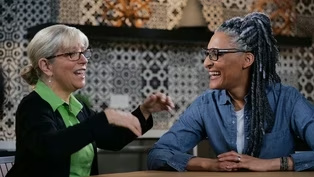
Julia Child's Best Bites Preview
Video has Closed Captions
Celebrate Julia Child with Martha Stewart, Jacques Pepin, Vivian Howard, Marcus Samuelsson and more. (30s)
Providing Support for PBS.org
Learn Moreabout PBS online sponsorship

- Food
Christopher Kimball’s Milk Street Television
Transform home cooking with the editors of Christopher Kimball’s Milk Street Magazine.











Support for PBS provided by: