One-on-One
Juliet Polcsa; Marylou & Jerome Bongiorno
Season 2024 Episode 2734 | 27m 49sVideo has Closed Captions
Juliet Polcsa; Marylou & Jerome Bongiorno
Steve sits down with Emmy®-nominated costume designer Juliet Polcsa to reflect on her impressive career in design and experience filming the HBO hit series, The Sopranos. Then, Filmmakers Marylou and Jerome Bongiorno of Bongiorno Productions, discuss their new documentary series, American Women Saints, which examines the legacies of Elizabeth Ann Seton and Frances Xavier Cabrini.
Problems playing video? | Closed Captioning Feedback
Problems playing video? | Closed Captioning Feedback
One-on-One is a local public television program presented by NJ PBS
One-on-One
Juliet Polcsa; Marylou & Jerome Bongiorno
Season 2024 Episode 2734 | 27m 49sVideo has Closed Captions
Steve sits down with Emmy®-nominated costume designer Juliet Polcsa to reflect on her impressive career in design and experience filming the HBO hit series, The Sopranos. Then, Filmmakers Marylou and Jerome Bongiorno of Bongiorno Productions, discuss their new documentary series, American Women Saints, which examines the legacies of Elizabeth Ann Seton and Frances Xavier Cabrini.
Problems playing video? | Closed Captioning Feedback
How to Watch One-on-One
One-on-One is available to stream on pbs.org and the free PBS App, available on iPhone, Apple TV, Android TV, Android smartphones, Amazon Fire TV, Amazon Fire Tablet, Roku, Samsung Smart TV, and Vizio.
Providing Support for PBS.org
Learn Moreabout PBS online sponsorship- [Narrator] Funding for this edition of One-On-One with Steve Adubato has been provided by RWJBarnabas Health.
Let’s be healthy together.
NJM Insurance Group.
Serving New Jersey’s drivers, homeowners and business owners for more than 100 years.
The North Ward Center.
Seton Hall University.
Showing the world what great minds can do since 1856.
The Turrell Fund, a foundation serving children.
Citizens Philanthropic Foundation.
The New Jersey Education Association.
PSEG Foundation.
And by The Fidelco Group.
Promotional support provided by Insider NJ.
And by Meadowlands Media.
A print and digital business news network.
- This is One-On-One.
- I'm an equal American just like you are.
- The way we change Presidents in this country is by voting.
- A quartet is already a jawn, it’s just The New Jawn.
- January 6th was not some sort of violent, crazy outlier.
- I don't care how good you are or how good you think you are, there is always something to learn.
- I mean what other country sends comedians over to embedded military to make them feel better.
- People call me 'cause they feel nobody's paying attention.
_ It’s not all about memorizing and getting information, it’s what you do with that information.
- (slowly) Start talking right now.
- That's a good question, high five.
(upbeat music) - Hi everyone, Steve Adubato.
If you ever wondered why the great series, "The Sopranos," wasn't just a great series, but what everyone was wearing, James Gandolfini, Edie Falco, the great Steven Van Zandt, "Sylvio Dante," what they wore mattered and what they wore was put together by costume designer for, "The Sopranos."
Juliet Polcsa, Juliet, it's so great to have you with us.
How you doing?
- I'm great, thank you for having me.
- Juliet, first of all, how the heck, Where'd you grow up, first of all?
- I grew up outside Boston and came to New York City to go to school, and right after graduation I moved to Hoboken.
- How did you get hooked up with, "The Sopranos?"
- Oh, had known one of the producers for many, many years.
And at the time I was kind, started in theater, and I was starting a film career doing independent film, which was kind of a big thing then.
And she had called me to interview for this TV show, which I didn't really wanna do.
At that time, TV wasn't thought of how it is today.
TV was more of kind of like the second cousin.
But she was always great and she was very supportive of me, so I agreed to do the interview and had an interview with David Chase and got the job.
And I thought, okay, well this is my first time ever doing TV, so pretty much a pretty unique experience.
- Why'd you quit after the first year?
- Because I had never done TV before.
I had only done independent film, which is everything was much smaller scale and I was understaffed, I didn't know it.
So I was really working huge amount of hours per day, working weekends and just having a nervous breakdown just to be able to get everything done that needed to be and I just couldn't keep up the pace anymore.
I wasn't used to it.
And at that point I had the show up and designed, all the characters had closets and basically I was an idiot, I didn't know, I thought I was doing something for my own wellbeing and it was very amicable, it was no problem.
And then the show aired and it became this huge hit, and I thought, well, I really am an idiot.
(both laughing) - How'd they get you back?
I heard that they wanted you, some of the cast members wanted you and they got you back.
- Yeah, to my surprise, I mean, I thought once you quit, that's it.
And one of our producers came back to me and he said, "We want you back."
And then I thought, oh God, now I know what I'm going into.
And it's a different pace, it's very stressful and I thought, oh God, like, do I wanna go back to this?
But on the same hand, I really loved the show and I loved the cast and everything about it.
And I went back and forth and I couldn't decide what to do and I thought, oh, if decision isn't automatic, then I should say no.
So I said, no, again, like an idiot.
And much to my surprise, the producer said, "Well, we don't accept that as an answer."
And apparently the cast had asked him to get her back, which was very heartening to me, so I said yes and it gave me a little bit more bargaining power.
I got a little bit more help that I needed, which kind of made it all doable.
And then I was very grateful and I stayed to the very end.
- Juliet, it is the corniest thing in the world, but I'm about to say it anyway.
Did they make you an offer that you- (Juliet laughing) No, I can't do it, I'm sorry, nevermind, nevermind.
Okay, let's go through this.
I'm fascinated, by the way, go on our website and the great Jacqui Tricarico, my colleague, we did a half hour feature at the New Jersey Hall of Fame that honored and recognized inductee David Chase and we interviewed the entire cast of, "The Sopranos."
And I'm gonna go through some of the cast members and I want you to talk to me first, the great late James Gandolfini.
What was it like to put him in what he was wearing?
Northern New Jersey, mob stuff, "Italian American," nothing you grew up around, I imagine, I know you're in Boston, but Boston's not New Jersey, no disrespect, Yankees are the Yankees, Red Sox the Red Sox, that's not really relevant.
How the heck did you capture Gandolfini and what he needed to be wearing in all those different kinds of scenes?
- Well, the biggest thing with Jim is that he needed to be comfortable.
So I never wanna do anything that restricted him or made him feel, 'cause he's such an intense actor and any small thing can just take him out of it and I didn't want my work to interfere with that at all.
So comfort was a big factor, hence those short sleeve print button down shirts, they were comfortable.
He also liked these prints because he always felt like he's a sad clown, laughing on the outside, crying on the inside.
And when I was doing my research and kind of figuring out what the rest of this crew was looking like, it was important that he didn't mimic that.
He had to kind of stand out from that a little bit.
But at the same time, the show was not just a mob show, it was a family show, and he was a husband and a father and a suburban dad and he still had to kind of walk all those paths and fill all these different roles.
So there had to be something fairly accessible about what he was wearing.
Yet at the same time, he had to look different than his cohorts and have a certain stature.
- Speaking of the cohorts, I'm gonna talk about Edie Falcon in a second, who, again, we had a great interview with her on the red carpet at New Jersey Performing Arts Center for the New Jersey Hall of Fame induction Ceremony for David Chase.
I'll talk about her in a minute, but go to the cast.
Steven Van Zandt, honored to do a great interview with him, check it on our website.
Sylvio Dante plays the Consigliere.
He had a certain look that was totally different from Gandolfini's.
- And a lot of that came from Stevie.
Stevie comes from music and entertainment was a little bit, and Stevie's personal style is a lot more colorful and wild.
And so we wanted to try to pull some of that into Sylvio Dante.
And we looked to, The movie "Casino".
and the way that Robert De Niro was dressed, he had a lot of color to him, so that gave us a little bit of a pass, a little bit of a template and then we just kind of took it and ran with it a little bit.
- Dare I push you a little bit on Paulie Walnuts?
(Juliet laughing) Who, the actor, away, I mean, what an interesting guy.
Let me ask you this, the gray on the side, was that really his hair?
- Absolutely and he did his own hair.
- He did his own hair?
- He did his own hair.
He wouldn't let anybody touch it, it was very sacrosanct, his hair.
He would get up hours before he had to come to set.
- Stop, Juliet, this can't be true.
- Just to do his own hair, yeah.
- So the hair people did not touch his hair?
- They might, I mean, I wasn't in the hair trailer, I mean, they might have attempted to, but he was very, you know... - Got it, by the way, we're talking about the great Tony Sirico.
Can we do this?
Edie Falco and also Adriana, I wanna get to in a second, who's talked a lot about how extraordinarily you dressed her and how that looked in many ways, in many places, sustains today and just know that I grew up in Newark, New Jersey, in the northern section of the city, virtually all Italian American and let's just say there were folks in the neighborhood, we knew who they were, you didn't talk to them and they dressed a certain way and we never really knew what they did for a living.
That being said, Edie Falco, a northern New Jersey, Italian American mother, wife or mob wife, both?
- Probably both, yeah.
- So then, was it a pants suit?
What was going on there?
Very rarely wore a dress.
- No, she didn't wear a dress.
Because at that point, to me, I remember, I had a girlfriend, a coworker.
She grew up in New Jersey with an Italian mother and her mother never wore pants and to me that seemed a little dated.
Olivia never wore pants.
- The mother?
- The mother.
- Nancy Marchand, passed away after the first year.
Go ahead, I'm sorry.
- Yeah, so Edie, like, I looked at myself, I very rarely wore dresses.
So pants just seemed to be, when she got dressed up, she would wear dresses and skirts and things like that, but her everyday was pants as a lot of women did, it just seemed normal.
She had a very, let's say, color coordinated outfit-ey type of look to her, that was of the time.
There was a store that I found in the malls in New Jersey called Cache, and I walked in there and I just thought, oh my God, this is it.
This is where this woman would shop.
- Which mall?
Hold on.
(Juliet laughing) - Well, I have to say the Garden State Plaza was my kind of home base, but- - At Willlowbrook county.
- Yeah, Willowbrook was also a big favorite of mine and Short Hills, we basically hit them all.
- Okay, so Adriana.
Michael Imperioli, again, wonderful interview with him, out of Lincoln Center, the WNET studio.
Check that out on our website.
But his girlfriend, wife, he did marry Adriana, I don't even remember, that look, she was sexy in a certain way, but help us understand that look.
- When she started out, she was such a minor character.
She was like a hostess in a restaurant.
- Vesuvio, she was a hostess in Vesuvio, I think.
- Exactly and they gradually kind of wrote more for her and the more they wrote and the more where you got an idea of kind of who she was and then there was the actress, a lot of the characters, we took pieces of who the actors were and incorporated some of that into their character.
Not all, but some.
But Drea herself has a very sexy way about her and she kind of took that with Adriana and kind of ran with it.
Drea is more kind of rock and roll, which Adriana was not, but when she took over the Crazy Horse and was kind of managing that, it gave a little more of a platform, should I say, for some outfits that I guess became memorable.
But she was some of the things I couldn't do with Carmela, because Carmela was like a mom and you didn't wanna kind of see that in a mom.
Adriana was just completely unabashed and I could do all that sexy stuff with her.
- Juliet was a costume designer of "The Sopranos."
She helped make this show the iconic TV experience that it continues to be.
Juliet, I can't thank you enough for joining us, we appreciate it.
- Thank you so much for having me.
- Oh yeah, my team wants to ask, what happened to all the clothes after the show ended?
- Well, they all kind of flew into different directions, different people's closets, but there was a big bulk of them that were curated and they're at Warner Brothers as an archive in California.
And so, a lot of them are in storage there.
- Great question, team, even better response.
Juliet, thanks so much, we appreciate it.
- Thanks very much, bye-bye.
- We'll be right back.
- [Narrator] To watch more One on One with Steve Adubato find us online and follow us on Social media.
- Welcome back, folks.
We welcome Marylou and Jerome Bongiorno, filmmakers at Bongiorno Productions, who put together a two-part documentary series.
It's called "American Women Saints," Elizabeth Ann-Seton and Frances Xavier Cabrini.
It aired on PBS, a whole bunch of other places.
Good to see you, Marylou and Jerome.
How we doing?
- Great.
Great to be here.
- Great, Steve.
- Thank you.
- Thanks a lot.
- You've been with us many times talking about your films.
Who are these two women and why are they so important to make this film?
Marylou?
- Well, Elizabeth Ann-Seton was born in the United States in the late 1700s.
She was born into wealth, and she became a widowed mother of five children.
So, after she converted from being a Protestant to a Catholic, she founded a school and a Catholic congregation of women called The Sisters of Charity, educated St. Peter's School by these powerhouse women.
- Marylou, where did we go to grammar school?
- St. Peter's School in Belleville New Jersey.
- St. Peter's, and who, and the nuns heading them up.
The Sisters of Charity.
- Yes.
- Do you remember sister Mary Lois?
- Absolutely.
I was gonna say-- - Okay.
sorry.
I'm sorry.
I won't go down that road.
Okay.
And tell us about the Mother Cab...
I call her Mother Cabrini.
Why do I call her Mother Cabrini?
- Yes.
Because it's common for both actually.
- Who was Cabrini?
Give us more on Cabrini.
- Yes.
So, born in Italy in the mid 1800s, also born into privilege.
She founded the congregation of the Missionary Sisters of the Sacred Heart of Jesus.
But she is most, for me, very close and noted for the fact that she was sent from Italy to New York to the United States to help the Italian immigrants assimilate.
So, while she's here doing all this great work, she became a major real estate developer.
Constantly establishing schools, hospitals, orphanages and the most notable, of course, is Columbus Hospital.
Columbus-- - 13th Street.
In the old neighborhood on 13th Street in Newark, right?
- Yes, that's right.
- She was a key to that?
- Absolutely.
So, she was instrumental in taking the realm in the (indistinct) and creating this space for Italian immigrants to not only have Italian food served at these hospitals and have Italian speaking doctors, and dispensing all these supplies like food and medicines.
She really was holistic in her approach and a major, major real estate developer.
- Yeah.
She had three hospitals built.
One in New York, one in Chicago, and eventually one got built in Seattle.
And these weren't small hospitals.
These were major state-of-the-art hospitals.
So she was a bona fide real estate developer.
- Lemme put this in perspective.
I should disclose that Marylou and I grew up in the same neighborhood in Newark, New Jersey on Tiffany Boulevard.
Her brother Dominic and I grew up together.
And there's a whole group of us in the old neighborhood, if you will.
Columbus Hospital, where I was born it was disproportionately Jerome and Marylou.
It was for, largely for Italian Americans.
My grandparents who came from Naples, that's where the only place they would go.
There were Italian American doctors where you couldn't find anywhere else.
This hospital was a key to the community right Jerome?
- Yeah.
You have to do that for communities.
Whoever lives in the community, you have to serve those people.
And for Italian Americans, they didn't speak English.
So, you had to have the English speaking or you had to have Italian speaking doctors.
Otherwise, doctors can't figure out what's going on with them.
- Yeah.
Marylou do this for us.
Put Elizabeth Ann Seton in context and be clear on the Seton Hall University is named after Elizabeth Ann Seton.
Most people don't know that.
What made her such a powerful and effective leader, please?
- Well, I think both of these women, but I'll speak to Mother Seton.
She was a strong-willed woman who gave up this privileged life, but had benefited from all that privilege.
She was highly educated, she was well connected.
Alexander Hamilton being a neighbor.
Marrying into the Seton a merchant family.
I mean she had it all.
And also these five children.
And that was a condition for her to start her order that she was going to continue to be a mother to these children.
So, she was, and remember, both of these women are in a male dominated patriarchal church, Catholic church.
And they had to assert themselves not being in the position even as priests would to have that kind of power.
So, you're talking about leadership and starting, this fledgling group of women and being their model and learning and converting from her faith to the Catholic religion.
- I'm thinking about this right now.
The Catholic church, which we'll not go into.
Whole 'nother story those of us who are raised Catholic.
Let's just say some of us have conflicted feelings.
Let's just leave it at that.
Male dominated more so maybe today than ever.
Question, how could Elizabeth Ann Seton and Francis Cabrini, how could they have, would they have been able to be effective and influential in the church with the Vatican being what the Vatican is today?
Jerome, your thoughts?
- Oh, absolutely.
- Yeah.
- Yeah, I mean their whole thing was to serve others.
So, no matter what the church thinks or what the church thought back then, or it didn't matter to them, they're going to serve others.
And the reason why they served others is because, you, know, God was behind them.
So that made them excited for everything they had to do.
And they weren't worried about the future because they were fearless.
They were fearless once again, because God was behind them.
And that's something else, that's another reason why we made this film.
What are these women thinking?
What should we be thinking?
Not just as Catholics, but what should we be thinking in our lives in order to serve other people?
Shouldn't we be excited about that?
Shouldn't we be fearless about that?
- Yeah.
And I believe that they had their share of challenges then.
And I think that not-- - Yeah.
Yeah.
- If you realize what they we're contending with, yes it was hard.
- How headstrong?
How persistent, gritty, one of my favorite words, grit and headstrong were both of these women, MaryLou?
- Completely.
Devoted to their passions.
Not stopping from going through the channels all the way up to the Vatican, to the Pope to in the case certainly of Mother Cabrini of, persisting in what she wanted.
Pope Leo wanted her to go to the west.
She wanted to go east, she wanted to go to China.
So, she had to work within that structure to get her mission out.
And then, she went global.
I mean she did what she needed to do, and always doing it in such a creative way.
Always using, paying schools or hospitals to fund the hospitals or the schools for the poor.
I mean really just-- - They were entrepreneurial?
Were they entrepreneurial?
- Oh yeah.
- Absolutely.
- Yeah, absolutely.
Look at Cabrini.
What did she do for a lot of her life?
She went after money, 'cause she had to.
If she wanted to create something for the poor, she needed the money to not only create it, but to maintain it.
So, she knew that that was a big deal and she went after it.
- As filmmakers, artist, Steven, I'm sure you could empathize with this.
We're always seeking money.
- No.
- No.
- I have no idea.
I have no idea what you're talking about.
- I know.
We'll put it aside.
And when I read what Mother Cabrini and Seton, Mother Seton did.
Constantly, Seton going to her rich friends and relatives and others.
But Mother Cabrini, she was, she said, I have to get the rich to pay for this, and they should be grateful for this opportunity I'm giving them them to help the poor.
- Yes.
- Let's be clear, there were no foundations at the time.
There were no corporations that were like, "Let us be philanthropic."
They went to rich friends and made the case that it was the right thing to do, a good investment in helping those who had less.
- Absolutely.
- Yes.
- What was in it for these rich people?
- And she met certain key people, like the Chesseles who were the, he was at the time the director of the Metropolitan Museum of Art.
He couldn't share, this was interesting.
He couldn't share his donor list, but she knew and found out that it was public information just like it is today.
And she had her sisters go through that list.
When she saw the name Carnegie, she said, "Oh, I just saw that Carnegie gave this much money to," - Wow.
- "School."
"You go call him up.
Do we know people that know him or to get to him?"
Because she needed this, let's face it, you need resources.
- Hold on, hold on.
I'm gonna be clear on something.
So, I often think it's hard for people to appreciate this.
And by the way, for those who wonder why I'm obsessed with this topic other than where my family came from in Italy, look at our program on Sacco and Vanzetti, you'll get a sense of why I am a bit obsessed.
At the time for Italians, Italian Americans, those who came from Italy, whatever.
To raise money, and I won't use the neighborhood term for the kind of folks we're talking about, the Carnegies.
You know the term.
They're otherwise known as White Anglo-Saxon Protestant WASP.
In our neighborhood, we call them "Medigans" which and you're laughing because you know.
It was Americans who were not ethnic, let's just say.
How the heck did they raise money from people outside of the Italian-American community in these rich, very white, old money, that establishment?
How'd they break into that?
- Yeah, that's a good, that's a great question.
And they had to break into it because usually what you do, if you have a church, if you wanna build your own church, you have to take it from your own people.
And then, these Italians are coming from Sicily poor.
So they're not going.
- That's why they were here in the first place.
- And there's prejudice against them also from Catholics.
- From other Catholics.
- Absolutely.
- Why?
'Cause they were charged, they were charging admission to St. Patrick's Cathedral to go to mass.
- Right.
- Because they knew that the Italian immigrants and others couldn't afford it.
- And what was the prejudice about?
A lot of it, much of it, probably 98% of it was people didn't wanna share work with them.
They didn't wanna share their space with them.
So, and that goes on today.
So, we understand that.
- Obviously when you think of how we treat neighbors and people coming in from other countries.
Absolutely.
- Right.
- Absolutely.
- By the way, check out the Bongiorno documentary on... You did one on the Newark Rebellion riots right?
- Yes.
Revolutionist.
- Benedict's Prep?
- Yes.
The Rule, we have to talk about living saints.
So, you gave us the perfect entry to that because a lot of the reason why we made this film too is because we all know these living saints right here in Newark and many places, but yes.
- Right.
And if you think St. Cabrini at St. Francis, I'm sorry, St. Seton and St. Cabrini aren't the same as those monks down in Newark.
Well then you just don't get it.
- So, you're saying you think Father Edwin Leahy is gonna be a saint soon.
We'll find out.
Okay.
- He already is.
- He already is.
In my book he is.
Listen, by the way, the team is telling me the documentary is now streaming on pbs.org through July.
Check it out.
Marylou, Jerome.
- Through August, end of August.
- My bad.
Okay, so it's fake news.
No, we got that right.
Listen, Marylou and Jerome, thank you so much.
Check out the film.
It's an important one.
It's American Women Saints, Elizabeth Ann Seton and Francis Xavier Cabrini.
Great stuff.
Thanks everyone.
See you.
See you next time folks.
- [Narrator] One-On-One with Steve Adubato is a production of the Caucus Educational Corporation.
Celebrating 30 years in public broadcasting.
Funding has been provided by RWJBarnabas Health.
Let’s be healthy together.
NJM Insurance Group.
The North Ward Center.
Seton Hall University.
The Turrell Fund, a foundation serving children.
Citizens Philanthropic Foundation.
The New Jersey Education Association.
PSEG Foundation.
And by The Fidelco Group.
Promotional support provided by Insider NJ.
And by Meadowlands Media.
The North Ward Center continues to expand their services and outreach in Newark, from the childhood years to the golden years, Offering programs like preschool, youth leadership development, Casa Israel Adult Medical Day program our Family Success center, as well as a gymnasium.
And most recently Hope House, a permanent home for adults with autism, supporting and nurturing our autism community with Hope House 2 coming soon.
The North Ward Center.
We’re here when you need us.
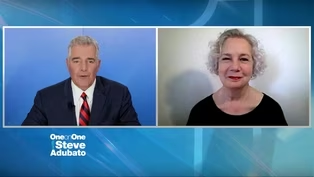
Costume Designer of The Sopranos Highlights Her Time on Set
Video has Closed Captions
Clip: S2024 Ep2734 | 13m 29s | Costume Designer of The Sopranos Highlights Her Time on Set (13m 29s)
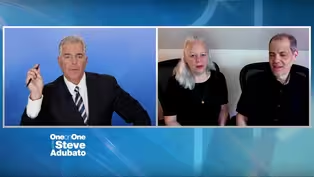
The Legacies of Elizabeth Ann Seton & Frances Xavier Cabrini
Video has Closed Captions
Clip: S2024 Ep2734 | 13m 52s | The Legacies of Elizabeth Ann Seton & Frances Xavier Cabrini (13m 52s)
Providing Support for PBS.org
Learn Moreabout PBS online sponsorship
- News and Public Affairs

Top journalists deliver compelling original analysis of the hour's headlines.

- News and Public Affairs

FRONTLINE is investigative journalism that questions, explains and changes our world.












Support for PBS provided by:
One-on-One is a local public television program presented by NJ PBS