
July 1, 2026 - Full Show
7/1/2026 | 26m 48sVideo has Closed Captions
Watch the July 1, 2026, full episode of "Chicago Tonight."
Chicago’s top cop, Larry Snelling, announces his retirement. And the separation of church and state is under fire from a White House commission.
Problems playing video? | Closed Captioning Feedback
Problems playing video? | Closed Captioning Feedback
Chicago Tonight is a local public television program presented by WTTW
WTTW video streaming support provided by members and sponsors.
July 1, 2026 - Full Show
7/1/2026 | 26m 48sVideo has Closed Captions
Chicago’s top cop, Larry Snelling, announces his retirement. And the separation of church and state is under fire from a White House commission.
Problems playing video? | Closed Captioning Feedback
Where to Watch Chicago Tonight
Chicago Tonight is available to stream on pbs.org and the PBS app.

WTTW News Explains
In this Emmy Award-winning series, WTTW News tackles your questions — big and small — about life in the Chicago area. Our video animations guide you through local government, city history, public utilities and everything in between.Providing Support for PBS.org
Learn Moreabout PBS online sponsorship>> thanks for joining us on Chicago tonight.
I'm Brandis Friedman.
Here's what we're looking at.
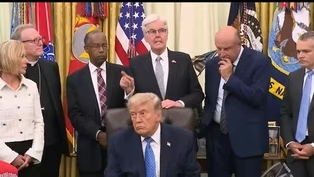
A Trump appointed commission says the separation of church and state is not in the Constitution.
We hear from Chicago area religious leaders.
And it was a time of deep Division.
Know we're not talking about our current political climate.
What about the American Revolution?
We revisit our conversation with filmmaker Ken Burns on his recent series.
>> First off tonight, Chicago's top cop, Larry Snelling says he is retiring from the force effective July 15th snowing a 34 year veteran of the department was appointed as superintendent in 2023 by Mayor Brandon Johnson.
He previously served as head of CPS Bureau of Counterterrorism First Light.
In a statement, snowing writes, quote, I am closing out this chapter of my life with a heart full of gratitude for every Chicago in and every community partner who embraced me during my time at the Chicago Police Department.
Thank you.
Does not fully express my appreciation for you.
The people of Chicago.
I ask that you continue to extend the same warmth and support to every member of the department.
Meanwhile, interim Superintendent Fred Waller will take snellings place as the community Commission for Public Safety and Accountability begins its search process for CPS next leader.
In a statement, Mayor Johnson thanked snowing and praised him for his service.
That extreme heat warning across much of northern Illinois extends through tomorrow night as temperatures today reached up to 95 degrees with the heat index at a toasty 105.
The National Weather Service says the Heat index tomorrow could get up to 102 degrees with another high of 95.
Comed is asking people to conserve energy as the utility experiences increased demand.
It recommends closing shades and curtains waiting to run the laundry or dishwasher until later and setting the thermostat 4 degrees higher than normal.
>> The Illinois Department of Transportation is asking residents to keep an eye out for pavement.
Buckling were tire blowouts, which can happen with little warning during periods of prolonged heat and humidity.
Meanwhile, volunteers with my block my hood, my city donated 300 box fans and 300 cases of water, 2 elderly and disabled residents who requested their help.
>> Any time the city is overwhelm a mother If there's a heat wave, we're snowstorm.
Elders have oxygen.
Tanks will have walkers that newer path that they can't get out the houses.
So they need our support.
It just seems like it's warm weather, but it could turn dangerous real fast.
So we have volunteers from all over Chicago.
We got 920 request.
>> Founder Jahmal Cole says because the group received so many requests for assistance, they are still seeking donations.
Up next, a look at whether or not the separation of church and state has become in obsolete idea.
That's right after this.
>> Chicago tonight is made possible in part why the Alexander and John Nichols family.
The Pope Brothers Foundation.
And the support of these donors.
>> The separation of church and state is quote, the biggest lie that's been told in America since our founding.
That is what the chair President Trump's Religious Liberty Commission said when the group was formed.
Now that commission has issued a 224 page report calling for what amounts to at least blurring the line between religious expression and public life composed almost entirely of conservative Christians and a single Orthodox rabbi.
The commission signals the direction the Trump White House may be trying to shift the country.
Here's committee chair Texas Lieutenant Governor Dan Patrick.
>> Again, the separation of church and state is not in the Constitution.
from this day forward, if anyone says that to you and there in public office, serving agency in any official capacity.
They have to point out exactly.
Where you have violates the Constitution because you have not.
from this day forward.
Phrase should have no power over people all faiths ever again, America.
>> So joining us, our Josh Wiener, chief advocacy officer at the North American North American Values Institute, a nonprofit which says it's focused on combating extremism and Anti-Semitism in K through 12 schools.
Reverend Quincy Worthington, pastor at the Highland Park Presbyterian Church.
Hassan Ali and Islamic Scholar and founder of the Key on Institute, a nonprofit that promotes Islamic values through education and rabbi emeritus, Michael Siegel of the Arch and that synagogue in Lakeview.
Thanks to all of you for joining us.
We appreciate it.
So first, I want to get all of your reactions to what we just heard from Lieutenant Governor Dan Patrick, that the separation of church and state is not in the Constitution.
Josh Winder.
Let's start with you, please.
>> Well, I think he's technically correct that that phrasing is not in the app in the Constitution, by the Constitution out lays out lies and the establishment clause a two-way street on this and it is true that Thomas Jefferson did have a speech in the early 18, 100's about building a wall between church and state.
But the interesting coffee at around that is the history is that at that point, states actually were allowed to have religions, not the federal government.
And that wall was actually referring to in Massachusetts are in Connecticut.
They were worried that the federal government would infringe on their ability to have a state religion.
And Thomas Jefferson was talking about that long.
That context being to prevent that now in, you know, 1947, there is a Supreme Court case that did away with that.
And I think that's personally from from my point of view for the better.
But I think it's disingenuous to say that the separation of church and state is an a important legal argument that we have and that we should be very considerate to how they the Constitution is interpreted relative to Reverend Worthington.
Yeah, I mean, I echo pretty much exactly your sentiments on It was based off of the Virginia Amendment and Constitution.
And it just it's funny to me how >> these people original intense when it comes to supporting things that they're in support of in the Constitution.
But the minute minute original intent doesn't suit their needs, it just goes right out the window.
It was on.
>> I look at and I think it's easy claim that so many things that were practicing in this country, exist and in the Constitution.
so I believe that the genius of the and then it can cause it to show system is that it allows avian each citizen who lives in this country to practice own religion with the freedom and dignity.
But at the same time put evinced states too okay.
that won the division and fail to win the division over another religions and this is video of the U.S.
everyday life we do in America.
The deadline.
>> Whether or not the separation of church and state is in the Constitution or not.
The fact is we've been living in this country with that separation and with the great benefits of that is that United States of America is the most religious country amongst industrialized countries in the world.
And that's because we have allowed in this country, religion to flourish.
Privately.
Not through state, not to us established religion.
And I'm very conscious when we start using terms like Bridges.
While we are involved in what I think really important conversation to be having as our country celebrates its 200 50th anniversary.
This is very powerful issue.
In 17.
76, Maryland transition from a colony to state.
And it created another constitution that was ratified.
And in that constitution, there was a Christian oath.
That was required.
That meant that any non Christian would not be allowed because of to take public to hold public office.
Because of that oath, they could not become a lawyer because of that oath.
They couldn't join the militia.
They have is another anniversary.
We should be aware of hand.
50 years later.
That was recent.
So 200 years ago that constitutional peace was rescinded.
So this is an important issue will it?
So I want to get into some of a little a little bit more about what the report says it well, because it says as well, because it argues that the principle of separating church and state has at times.
>> Been used to suppress religious expression in public institutions from schools and hospitals to the military revving Worthington.
Where should that line be drawn?
How can institutions remain secular while also honoring and protecting individuals, freedom to express their own religious beliefs.
>> I think we're going to be careful about this mean we already see the Department Defense.
Taking 200 different known religion's now get them in saying we're only going except 30.
Right?
So I think what we have to do is open up space for people to.
Freely express in practice a religion without inhibiting it.
But then we also have to be careful that not doing me like in this case.
It's a it's a matter of students.
Being able to freely express or religion.
But then when you bring in teachers and people in power, you run the risk of them trying to enforce or promote a religion on to them.
And I think that's where the danger comes from.
Is is allowing people to express their religion without having religion shoved down their forced upon them.
And so that's that's a very nuanced conversation.
>> So with the commission, it's made up, as we entirely of Christian commentators, activists, some public officials except for one Orthodox Jewish rabbi and many of the examples of the religious discrimination that are detailed in the report are against specifically Christians and Jews.
do you think this administration and this Commissioner Diaz concerned about discrimination against Muslims and Muslim American mother think concerned about discrimination about Muslims or even other diligence.
We?
>> You know, I mean, we're not not the division who has no to present presentation in this committee.
>> We have a lot other divisions in America, minorities, people who practice that on the divisions, the have temperance, the have places of worship to have children who go to school is in the public schools.
And I think order have even a discussion about something that is special like this, something that it's from them into our community and society has faith communities.
We have to have a presentation.
A presentation from old the May know that he's an old of the groups, including Muslims, Sikhs Hindus and and other people and even also to include the people who have no face because live in this country.
And to have that, I too, you know, have own input making such a policy.
>> I'm Josh critics say that the Trump administration has done everything short of an explicit endorsement of Christianity.
How do you see it?
>> I think that they were pretty careful and to a certain respect of really saying that they should allow Bible study in school.
I think we're in institutions.
I think that they they straddle the line.
That's I may be allowing something put it this way we have and I use education because this is where, you know, I do my work.
We have state education standards known oil around, culturally responsive education.
Our organization is concerned that one of the pillars of cultural, responsive education, critical consciousness is being used to bring a political agenda into classrooms.
So when I see that allowance of bringing the Bible in the classrooms.
I see that potentially is a mechanism by which teachers could bring their own political or religious views in the classrooms.
And I think a place that I'm concerned about.
in particular, in taxes, we see that they've adopted standards that actually list bible stories and versus Texas schools.
And I worry that certain teachers will take it upon themselves to go beyond teaching Bible as history relative to American history and start teaching Bible as scripture in the classroom.
So that's a concern, especially as a Jewish person to May.
>> Rabbi Segal said the administration have included other folks from other religions in this commission without question.
The fact that we're using.
The King James Bible as as the gold standard.
Creates a problem for Catholics.
It creates problems for Jews.
And so.
What happens?
When the Bible is made into the established book in the state of Texas for Religion.
It's the danger.
And here I would add one other thing.
Children are free to get up in classrooms.
If they do not want to be part of that conversation, that's part of this as well.
The mansion, what would be like for a Hindu or Sikh or a or a Muslim child to stand up look at the teacher and say I'm not comfortable with this conversation.
This religious coercion in a way that should make all of us feel uncomfortable I am not anti Bible, not for a long shot.
I believe in the Bible.
And I also believe in its lessons for us, it's how he is administered.
Why are the conversation can take place where we can express respect for different religious traditions and passages from other holy books.
So you just mention something, Josh, you know, because these developments are happening at a time when Texas is implementing that new law requiring Bible verses to be read in public schools.
>> On the state has already passed a law requiring the 10 Commandments to be displayed in every classroom.
Reverend Worthington, you know, do these laws reflect religious liberty or inserting religion where where was not already?
>> Well, I guess my main concern is what we see here is a promotion of specifically White Christian nationalism very narrow definition of what Christianity is, which is one that I tend to find to be the greatest idolatry and heresy of our time and probably the biggest threat religion.
And so I think we need to be very careful and speak out very plainly and clearly on that.
And it seems to me that if the government wants to help.
People practice their faith.
They should help us feed the hungry.
They should help us honor the immigrant us a precious child of God that they are.
They should help us visit those who are imprisoned.
They should practice of justice.
And I think that would be the better place to start them or they're starting with this.
>> I mean, you know, we talk the 10 Commandments being displayed in the classroom, for example, have the courts not already settled this issue?
With regard to exactly has signed.
We've got about it.
But go ahead.
You are.
we've got a minute left.
I think.
>> Having the 10 Commandments in a classroom could amount to the implying that the school actually endorses the 10 Commandments.
I do think, though, it's important that we have a real conversation about this country's founding and how woven religion is into that founding.
The Declaration of Independence talks about endowed by our creator Right for Life, Liberty and the pursuit of happiness.
These are things that do come from have break double taxed.
And I think teaching that history is important, but we certainly need to be careful about straying into indoctrinating students with the belief that this is what you should believe or need to believe because the schools telling yourself.
All right.
Well, we're out of time.
That's where we'll have to leave My thanks to all of you for joining us.
Josh Weiner River in Quincy Worthington, Hassan Ali and Rabbi Michael Siegel.
Thanks, everyone.
>> Thank you very much.
Thank you.
>> Up next, filmmaker Ken Burns on his newest film series, The American Revolution.
Legendary filmmaker Ken Burns latest epic production is the American Revolution.
The film premiered this past fall on PBS and will run again here on W T Tw this Sunday in marathon fashion.
Starting at 06:00AM and running until 07:00PM in November Burns and one of his co filmmakers, Sarah Butts teen joined us to talk about it.
Here's another look at that conversation.
Beginning with a clip from episode one.
>> Long before 13 British colonies made themselves into the United States.
The 6 nations of the Iroquois Confederacy Seneca.
Okay.
You got Onondaga Tusk, Oneida and Mohawk had created a union of their that they called the hold in the show me a democracy flourished for centuries.
>> Joining us now with more about this monumental project.
Our filmmakers, Ken Burns and Sarah Botstein.
Welcome to Chicago tonight.
Glad to have you both here.
It's good to be back there grass on this massive project is not quite the word cover and longtime sure it has.
So as we just heard, you begin with a different confederation of states, not so much the colonies that we know becoming benighted states, but specifically Native American nations that long predated the American revolution.
How important was it to begin with that context, Timbers?
Well, I think, you know what we're taught in grammar school is that the American revolution is about taxes and representation.
And that's true.
But it's also about.
>> Native American land.
And I I thought it was interesting as we learn more and more about it, that Benjamin Franklin had himself been inspired by the Hood initiative.
this Iroquois Confederacy and they're model that had worked for a long time as a model for the United States.
And he convenes 7 of the 13 colonies in Albany to a picture of the snake cut into pieces under dire warning.
Join or die.
And then we just realize maybe that shouldn't be in the body of the film.
It may be at the very beginning so that we could realize that with the revolution is is a World War, a civil war and a war essentially over the prize of North America.
And what is the prize?
This land?
What?
And that land is already occupied by 13 British colonies super imposed over the land of British of Native nations and to the anymore.
Native nations that are extraordinarily complicated groups, each individual and is different from one.
Another is say France is from Belgian and we want to make sure that was understood that at the heart, then this is about moving into this new space Laney.
It for our own.
It's got so much more fun than many of us really And and many people don't fully appreciate.
Once you get into the war part, right?
Just how savage that conflict is.
>> Here's a clip discussing the aftermath of the battle of Bunker Hill in June of 17.
75.
>> It's for the most awful hours of combat in American military history.
There are 1000 British casualties that day.
There are 220 some British debt.
40% of the attacking force was killed, 2 injured.
40%.
That's horrendous.
The high casualty rate.
It is the highest casualty rate for the British Army for the state.
Some in 1916.
>> It is unbelievably it.
>> about time we hear from one expert who says part of the Revolutionary War report of the Revolutionary History has been sanitized.
What are we misunderstanding or forgetting about the revolution?
>> Well, I think, you know, we forget that the American revolution at least 2 things happening at the same time.
One is is huge revolution of ideas and how government might be structured and who might lead that government and who might be responsible in selecting coup rules that government and the other is a terribly broody brutal.
Very complicated as Ken was just saying, 18th Century war in 18 th-century war is really terrible and awful and and scary and violent and dark and in order to really understand our founding story.
I think you really have to brave the 2 together.
You have to understand the revolution for war of ideas and ideals and then the war that was fought for those ideals and principles to have a have a run.
>> Buchanan, other conversations.
You talked about democracy being sort of an unintended consequence of the revolution.
What mean by So the idea is, first of all, there's a quarrel between Englishman that gets broken out into natural rights.
It's the and so they're thinking of arguments about why Britain is wrong.
And all of a sudden they're no longer saying where you said this and you deserve But human beings themselves by being human beings deserve that natural Jefferson is going to say all men are created.
Equal value owns other human beings.
The cat is out of Now.
Human beings are going to have to be equal even though it takes 4 score 9 years have been in the United States.
That's over.
So things are beginning to change and more in the world.
And the American revolution is leading that change of how these ideas are moving.
So this sumption of democracy is that these people are going to come together and create a republic.
They mean of an elite almost like the example that kind of we inherit from from Greece and to a lesser extent, Rome.
But the people are going to fight and die and win this war or so-called ordinary people and they're going to have to they're going to deserve something.
So you can say that democracy is not an object of the American revolution.
It's a consequence of that.
And there's a big difference of that.
And we are all the beneficiaries of that big difference.
>> So obviously lots of voices, reenactments footage over 9 years of work.
We hear a number of very familiar celebrity voices how do you think the series is different from any other document reviewed?
And well, you know, first of all, goes back to what Sarah and you were talking about with with the violence.
You know, if you've got to photographs, if you get the newsreels, the violence is proven.
But if you've got a painting and 70's got Havana and maybe there's even a little trickle into field they seem different for us.
>> It is.
They are very much like us.
So I I think this is a story about how you tell all the real story of the revolution and you get under the surface of it and and forget the distance and time and a lot of it doing reenactments.
A lot of it is asking.
>> The finest actors in the world to read off camera.
And I think we have that better cast than any film that's ever been made or television series ever.
That helped bring alive.
Not just the familiar top down folks and you get to know Washington a little bit better with more dimension.
dozens scores of other people that you've never heard of.
Sometimes they're teenagers, sometimes a Native American.
Sometimes free or enslaved black people.
Here women who are half the population and are central to the success of the revolution and to keeping the resistance alive, whose stories are told, but also all the other players in this group, global struggle, the French, the Dutch, the Spanish English, all of their soldiers.
>> All of their kings, all of their ministers.
And so what you do is by having all of these different voices, you give a sense that this is what really took place.
And instead of putting your thumb on one side or the other, you're an umpire calling and strikes and everybody's got their play.
Everybody understands their role in it and you can make it the complex.
I think most interesting story we've ever tried to tell.
>> And that's our show for this Wednesday night.
You can stream Chicago tonight on our You W T Tw YouTube channel every evening and catch up on any programs you may have missed and join us tomorrow night at 5, 30 10 now for all of us here at Chicago Brandis Friedman, thank you for watching.
Stay healthy and safe and have a good thing.
>> Closed caption made possible by Robert a cliff and Clifford law Chicago, personal injury and wrongful death that
Chicago Faith Leaders React to Trump's Religious Liberty Commission
Video has Closed Captions
The commission is composed almost entirely of conservative Christians and a single orthodox rabbi. (13m 27s)
Providing Support for PBS.org
Learn Moreabout PBS online sponsorship New Episode
- News and Public Affairs

Top journalists deliver compelling original analysis of the hour's headlines.
 New Episode
- News and Public Affairs

Today's top journalists discuss Washington's current political events and public affairs.
 New Episode
 New Episode

 New Episode


 New Episode
 New Episode

Support for PBS provided by:
Chicago Tonight is a local public television program presented by WTTW
WTTW video streaming support provided by members and sponsors.