
July 10, 2024 - PBS News Hour full episode
7/10/2024 | 57m 46sVideo has Closed Captions
July 10, 2024 - PBS News Hour full episode
July 10, 2024 - PBS News Hour full episode
Problems playing video? | Closed Captioning Feedback
Problems playing video? | Closed Captioning Feedback
Major corporate funding for the PBS News Hour is provided by BDO, BNSF, Consumer Cellular, American Cruise Lines, and Raymond James. Funding for the PBS NewsHour Weekend is provided by...
July 10, 2024 - PBS News Hour full episode
7/10/2024 | 57m 46sVideo has Closed Captions
July 10, 2024 - PBS News Hour full episode
Problems playing video? | Closed Captioning Feedback
Where to Watch PBS News Hour
PBS News Hour is available to stream on pbs.org and the PBS app.
Providing Support for PBS.org
Learn Moreabout PBS online sponsorshipAMNA NAWAZ: Good evening.
I'm Amna Nawaz.
GEOFF BENNETT: And I'm Geoff Bennett.
On the "News Hour" tonight: More lawmakers and big name donors call on President Biden to exit the 2024 race, as a new batch of polling raises questions about his ability to win critical swing states.
AMNA NAWAZ: Michigan Governor Gretchen Whitmer defends Biden's candidacy, dismissing the idea that she could be a potential replacement.
GOV.
GRETCHEN WHITMER (D-MI): A lot of people are playing fantasy football.
They're coming up with, I like this person, this person, this would be a great team.
None of that is really relevant at this moment because the only person that decides whether or not Joe Biden stays in this race is Joe Biden.
GEOFF BENNETT: And as NATO leaders gather in Washington, we speak with the president of the Czech Republic about Ukraine's path forward and what a potential second Trump presidency could mean for the alliance.
(BREAK) GEOFF BENNETT: Welcome to the "News Hour."
There is growing pressure today from congressional Democrats for President Biden to step aside as the party's nominee.
That's despite his repeated pledges to stay in the race.
AMNA NAWAZ: Earlier today, former House Speaker Nancy Pelosi, a longtime Biden ally, praised the president, but stopped short of endorsing his candidacy.
QUESTION: Does he have your support to be the head of the Democratic ticket?
REP. NANCY PELOSI (D-CA): As long as the president has -- the president -- it's up to the president to decide if he is going to run.
We're all encouraging him to make that decision, because time is running short.
QUESTION: He has said firmly this week he is going to run.
Do you want him to run?
REP. NANCY PELOSI: I want him to do whatever he decides to do.
GEOFF BENNETT: And George Clooney, the actor and major Democratic fund-raiser, wrote an opinion column in The New York Times calling for the president to end his reelection campaign.
AMNA NAWAZ: Our congressional correspondent, Lisa Desjardins, and White House correspondent Laura Barron-Lopez are here to discuss more.
So, Lisa, walk us through here.
What exactly is Pelosi saying here and how much could it matter?
LISA DESJARDINS: This was a fireball that hit Capitol Hill this morning when this first came out.
I will tell you, first of all, from Pelosi world what they say she was trying to do.
They say she wanted to send two messages, one to the president and his team to not dismiss concerns that are real among Democrats on Capitol Hill, two, a message for Democrats on Capitol Hill basically to hold their fire in that interview, she said, until after NATO is over, basically setting Friday as potentially a key date.
Now, the interpretation is very different, because Pelosi is known as a master strategist.
Her folks say this interview was planned way in advance because of the NATO summit, but others say she had to know, certainly knows, the pressures around the president right now.
She clearly was going to choose her words carefully.
And this is being interpreted as a kind of deadline-setting by Pelosi and indication that maybe she could some time call for the president to step aside.
So, all of that comes amid new calls from other Democrats for the president to step aside, just a handful still.
But let's look at the folks on Capitol Hill who have said that either Biden cannot win, as Senator Michael Bennet did,or that he should step aside.
And now we have Pat Ryan, a congressman from New York in a very tough election battle, who has also joined that.
Now, at the same time, the Biden administration says it will send three of the top campaign aides -- I'm sorry -- it's the campaign -- to talk to senators tomorrow in a private meeting.
Campaign manager for the Biden campaign will meet, as long -- as two senior advisers who are well-known on the Hill.
But, Amna, I have to tell you, one of the senators who wants Biden to step aside told me they actually think that's dismissive, because it's not Biden himself.
AMNA NAWAZ: Laura, I know you have been talking to Democratic donors.
What are they saying about this George Clooney op-ed calling for Biden to step down?
LAURA BARRON-LOPEZ: Multiple donors and advisers to donors that I spoke to today said that they don't think that the president's position right now is sustainable.
And when they looked at George Clooney's op-ed, they said that one line in particular stuck out to them and captured kind of their unease.
And that's that George Clooney wrote: "It's devastating to say it,but the Joe Biden I was with three weeks ago at a fund-raiser was not the Joe 'Big Effing Deal' Biden of 2010.
He wasn't even the Joe Biden of 2020.
He was the same man we all witnessed at the debate."
And that was a recent fund-raiser in California that George Clooney co-hosted.
And also Rob Reiner, actor-director, followed that up, saying that he agreed with George Clooney and that Joe Biden needed to step aside.
Donors acknowledge this -- the alternative is complicated, but they really do believe, most of the ones that I spoke to, that President Biden should step aside.
The campaign, of course, thinks that right now big donors aren't as important to them.
They're trying to put a focus on small-dollar donations, saying that they have had some of the best fund-raising at the start of July that they have had so far.
AMNA NAWAZ: Lisa, Clooney also said most Democrats he speaks to privately worry that Biden cannot actually beat Trump.
If that's true, if most Democrats are unhappy with Biden as the nominee, why aren't more saying so publicly or forcefully?
LISA DESJARDINS: It's the eternal question.
Two reasons.
One are concern that perhaps there's not a better option.
Others want to give him the chance to get out gracefully.
But I think, overall, there's really kind of a lack of certainty and also lack of political conviction by many of these members.
One thing I do know, on Capitol Hill, there is a -- I have to tell you that if the -- they do not move soon, folks in the Biden campaign say that every day is a win for him.
It helps him secure the nomination.
AMNA NAWAZ: Finally, what's the Biden team saying about this, both publicly we're seeing in messaging and also privately to Democrats?
LAURA BARRON-LOPEZ: The Biden campaign aides that I talked to today said that they're not delusional, that they hear Democrats' concerns, that President Biden has been holding calls, even some that we haven't -- don't know about, that haven't been read out yet, across lawmakers, donors, party officials across the board, trying to prove to them that his candidacy is still viable.
They say that the voters -- that the voters that they're talking to, that their internal polling shows that things haven't changed since the debate.
They pretty much say that the polls that we're seeing publicly, are all wrong when you try to press them on that.
This is going to be a big week for President Biden, the next two days.
He's going to have a solo press conference on Thursday.
And that -- all Democrats I have talked to say they are going to be watching that solo press conference at the end of NATO tomorrow very closely, could set up a big moment for the president on Friday, where we could very well see, if he performs poorly at that press conference, we could see more come out on Friday, Amna, saying that he should step aside.
AMNA NAWAZ: Laura Barron-Lopez, Lisa Desjardins, thank you to you both.
LAURA BARRON-LOPEZ: Thank you.
AMNA NAWAZ: And new data is now forecasting that an electoral map that's leaning more heavily towards Donald Trump, adding to those concerns about Biden's candidacy.
GEOFF BENNETT: To walk us through these new numbers and the current electoral landscape, we're joined by Amy Walter of The Cook Political Report With Amy Walter.
It's great to have you here.
AMY WALTER, The Cook Political Report: Great to be here.
GEOFF BENNETT: So your organization is forecasting some major changes in six key states.
They're all moving closer to Donald Trump, including three battleground states that include Arizona, Georgia, and Nevada.
That leaves three toss-ups remaining, Michigan, Wisconsin, and Pennsylvania.
Walk us through what's happening here and then help us understand how you arrived at this, especially given what Laura reported where the Biden campaign is saying, the polls -- the polls are all wrong.
AMY WALTER: Yes.
That's right.
Well, even if the polls are wrong, what we know before the debate was those three states that we moved from being toss-up, which in our parlance means anybody can win, it's so close, we can't -- we really can't put a thumb on the scale either way, from that category to more Republican, is that Biden was trailing by a pretty significant amount in those three states.
Part of the reason that we kept it in that toss-up category is, we know how close the race had the potential to become, especially post-election - - I mean, sorry, post-debate.
The debate was going to be the opportunity, which we heard time and time again from the Biden campaign, for them to make their case that once the voters who right now maybe they're leaning toward Trump, maybe they are thinking about voting for a third-party candidate, once they see the contrast, once they understand what's at stake, those voters are going to come home to Joe Biden.
It's clear now that those voters, at least again, at this moment in time, are probably, at best, stuck and, in some cases, we're seeing moving a little bit further away from him.
So, those states -- as I said, those states that were already problematic for Biden pre-debate, they sure look a lot harder for him post-debate.
So now we talk about the three states, Wisconsin and Michigan and Pennsylvania, those Midwestern states, that have always been critical for control of the White House.
Those -- also, we're seeing, again, Trump has been ahead in some of those states, but really by a closer margin.
GEOFF BENNETT: Well, to further illustrate your point, if we look at the national polling average so far, the two candidates had been neck and neck for the most part, but then you see that greatest difference after the debate.
AMY WALTER: Right.
GEOFF BENNETT: Still, though, this is a contest that's on the margins.
AMY WALTER: That's right, and that's the whole -- that our politics has been on the margins for quite some time, but certainly since 2016.
So, when the Biden campaign talks about, well, the polls have barely budged -- and it is true, if you look at these national polling averages, which we also put together at The Cook Political Report, you will see that the race has basically moved just two points in Trump's advantage at the national level.
But these last two elections have been decided at the Electoral College level by basically less than a point in three states, right, so, 79,000 votes in 2016 in the three closest states and 40,000 votes in 2020 in the three closest states.
So two points is actually pretty significant.
The real question and what we're seeing in the polling right now -- and, again, there will be a lot more in the battleground states in the coming week, but at least in the national polling -- the one bit of good news for Biden is that what we're seeing are people moving off of Biden, but they're not necessarily moving to Trump.
So these are voters who are basically saying, if you ask them, are you going to vote for Biden today,they may be reticent to say they're voting for him, but they're not saying, oh, this has changed my mind, I'm now voting for Trump.
That's the group of voters that's going to be critical.
GEOFF BENNETT: Yes.
Well, our team heard from a group of undecided voters.
This is an undecided voter in Pennsylvania who voted for Trump in 2016, President Biden in 2020, but this voter in particular has some reservations this time around.
JESSICA, Pennsylvania Voter: Trump is way too control-hungry, and Biden doesn't seem all the way there.
So, mentally, I don't think he can deal four more years.
We watched the debates in my household.
We're still all undecided at this point.
TRAE, Pennsylvania Voter: One guy is basically brain-dead and the other one tried to take over the Capitol.
It's not very -- giving people an optimistic view of the future, I would say.
GEOFF BENNETT: So that's a fairly bleak assessment.
AMY WALTER: Yes.
GEOFF BENNETT: I mean, how reflective of that... AMY WALTER: Very.
GEOFF BENNETT: How much does that reflect the electorate?
AMY WALTER: That's very reflective of where the electorate is right now.
And this actually -- going into the next week - - remember, we're going into the Republican National Convention.
We have talked a lot about Biden and how he talks to those folks.
I'm very curious to see how Donald Trump talks to those voters.
Does he convince them that the things that they just said about him, he's power-hungry, the Capitol, January 6 event, does he convince them that maybe that's not as big of a problem as their worries about Biden?
Or do they walk away from that convention saying, gosh, I just can't vote for either one?
GEOFF BENNETT: And here's one more voter from this panel that Sarah Longwell convened.
This is a Black voter in Georgia who is supporting the president and she explains how she's thinking about the race.
JAZMIN, Georgia Voter: I don't really consider a vote for Biden, a vote for change.
I consider a vote for Biden a vote for continuity and the status quo, which is, gosh, that's fine right now, because the 2016 was just insane.
I don't want to see that again.
So I'm fine with -- if the next four years absolutely, nothing improves or changes, I wouldn't even care, as long as it doesn't get worse.
GEOFF BENNETT: And in some ways, this illustrates why the Biden campaign was trying to make this an election that was a referendum on Donald Trump and how this debate performance really complicated that, yes?
AMY WALTER: It made it -- exactly, made it much more about that.
Which is the riskier bet, going with Biden, who looked very shaky, or going with somebody, as this woman said, who she knows has been more about chaos?
GEOFF BENNETT: Amy Walter, thanks so much, as always.
AMY WALTER: Thank you.
GEOFF BENNETT: Turning now to the day's other headlines: Israel is ordering all Palestinians to leave Gaza City in the north as Israel's military steps up airstrikes.
Dozens have died in a wave of Israeli attacks, even as U.S., Egyptian and Qatari negotiators meet with Israeli officials in Qatar for cease-fire talks.
John Yang has the story.
JOHN YANG: Across Gaza today, mourning for loved ones.
Community members pray, and a father, Nael Hussein, weeps and trembles while holding the lifeless body of his son, Odai.
"How many have gone?"
he says.
"How many have died?"
Odai was killed yesterday in an Israeli airstrike on the Bureij refugee camp, just one of several during a deadly 24-hours in Gaza.
Caught on eyewitness video, another attack late yesterday outside of a school near Khan Yunis where displaced people were sheltering.
One moment, boys play are playing soccer in the school yard.
The next, they're running for their lives.
At the scene today, witness Ghazal Nasser said the attack came without warning.
GHAZAL NASSER, Witness (through translator): Everything was normal.
People were playing.
Suddenly, a rocket fell over there.
Everyone started running.
I witnessed this, people thrown around and body parts were scattered, blood.
JOHN YANG: Hospital officials say at least 29 people were killed, most of them women and children.
The IDF says they were targeting a member of Hamas who took part in the October 7 attacks on Israel.
It comes amid the ongoing push for a cease-fire deal.
Today in Jerusalem, U.S. Mideast envoy Brett McGurk met with Israeli Prime Minister Benjamin Netanyahu.
And in Doha, Qatar, CIA Director Bill Burns met with Egyptian, Qatari, and Israeli negotiators.
But on the ground in Gaza, fighting goes on.
Today, Israel ordered all Palestinians in Gaza City to move south, perhaps in preparation for a renewed offensive there against Hamas.
It all adds uncertainty to the prospect of reaching a cease-fire agreement.
Earlier this week, Hamas said that new Israeli escalations could have disastrous repercussions on negotiations.
For the PBS "News Hour," I'm John Yang.
GEOFF BENNETT: Also today, what's left of Hurricane Beryl is pushing farther north, bringing severe thunderstorms across the Midwest, and at least one tornado.
The storm tore down trees and ripped off roofs in Indiana, and drenched places like East Lansing, Michigan, with heavy rains and flash floods.
In Texas, where Beryl made landfall on Monday, nearly 1.7 million homes and businesses are still without electricity.
No power means no air conditioning and no refrigeration.
And with the heat and humidity near Houston hitting up to 106 degrees, some residents there are growing desperate.
ERICA ROBINSON, Houston, Texas, Resident: I'm about to lose the resources that I have and I'm about to lose all the energy that I have trying to survive.
GEOFF BENNETT: Dangerous heat spans the country, coast to coast, but especially out West.
the high temperatures are in responsible for at least eight deaths in Oregon.
And in Las Vegas, temperatures have posted a record fifth straight day above 115 degrees.
Lawyers in Alec Baldwin's involuntary manslaughter trial delivered their opening arguments today.
The 66-year-old actor sat at the defense table, as prosecutors argued that he -- quote -- "violated the cardinal rules of firearm safety" when a gun he was holding went off during rehearsals for the film "Rust."
The movie's cinematographer was killed.
Baldwin's lawyers countered that the film's safety experts were to blame, saying he -- quote -- "committed no crime.
He was an actor acting."
If convicted, Baldwin faces up to 18 months in prison.
He has pleaded not guilty.
U.S. Secretary of State Antony Blinken said today that F-16 jets will be flying in the skies of Ukraine this summer.
That comes after a joint statement from the U.S., Dutch, and Danish governments saying that the transfer of jets to Kyiv is finally under way.
Meantime, Ukrainian President Volodymyr Zelenskyy has been making the rounds on Capitol Hill, drumming up support for his country's military effort.
He's in town for the ongoing NATO summit.
Earlier, he used his daily video address to say more deals are on the way.
VOLODYMYR ZELENSKYY, Ukrainian President (through translator): There will also be two new security agreements.
These agreements include support for sanctions against Russia, support for our accession to the E.U.
and NATO, support for our defense, our soldiers, all our people, and reconstruction.
All of this is taken into account in the security agreements exactly as needed.
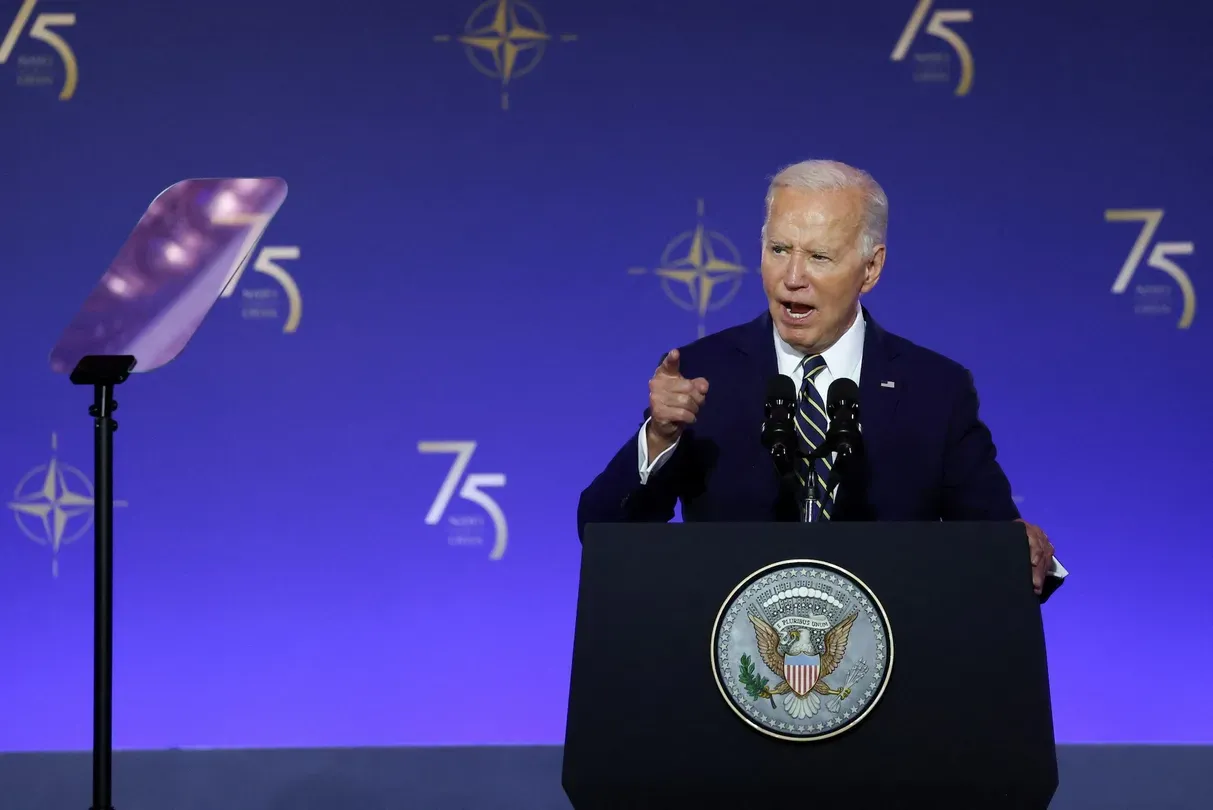
GEOFF BENNETT: As NATO leaders gathered in Washington to mark the 75th anniversary of the alliance, U.S. and European officials said today that Ukraine is on a -- quote -- "irreversible path to membership."
But Secretary-General Jens Stoltenberg added that its too early to say exactly when that will happen.
The House of Representatives today passed a bill that would ban noncitizens from voting in federal elections.
That's already illegal.
Today's measure would make states require that people present documents in person to prove they are a U.S. citizen during voter registration.
It also calls for states to remove noncitizens from voter rolls.
The bill passed with almost entirely Republican support.
It comes amid unsubstantiated claims from former President Donald Trump that people who crossed the border illegally could cast ballots.
It'll likely hit a dead end in the Democratic-controlled Senate.
On Wall Street today, markets rose across the board.
The Dow Jones industrial average jumped more than 400 points to close within sight of that 40,000-point level.
The Nasdaq posted its seventh straight record close, adding more than 200 points, and the S&P 500 ended above 5600 for the first time ever.
And an update now on a longer-than-expected trip to space.
Two astronauts who should have returned to Earth weeks ago expressed optimism today that Boeing and NASA will bring them back safely.
Suni Williams and Butch Wilmore were the first to ride Boeing's Starliner capsule to the International Space Station early last month.
Their test flight was supposed to last eight days, but a number of leaks and thruster issues delayed their trip back home.
Engineers are still testing the spacecraft, but the pair remains optimistic.
SUNI WILLIAMS, Starliner Test Flight Astronaut: I feel confident that, if we had to, if there was a problem with the International Space Station, we can get in our spacecraft and we can undock, talk to our team, and figure out the best way to come home.
Yes, we've -- like I said, we have practiced a lot, so I have a feeling, I have a real good feeling in my heart that the spacecraft will bring us home, no problem.
GEOFF BENNETT: Boeing hopes this test mission will lead to regular astronaut flights following the recent success of its competitor, SpaceX.
Still to come on the "News Hour": a neurologist addresses the concerns voters have about both presidential candidates' age; the president of the Czech Republic discusses the ongoing NATO summit and the uncertain future of the alliance; and how a nationwide competition is teaching students to think critically about history and its lessons for today.
AMNA NAWAZ: Michigan's Governor Gretchen Whitmer has been a rising star of the Democratic Party, sometimes mentioned as someone who could one day occupy the White House.
I spoke with the governor earlier today about this presidential race and her book "True Gretch: What I've Learned About Life, Leadership, and Everything in Between."
Governor Whitmer, welcome back to the "News Hour."
Thanks for joining us.
GOV.
GRETCHEN WHITMER (D-MI): Thank you.
Good to be with you.
AMNA NAWAZ: So let's start with the news of the day.
I'm sure, as you have seen in your state, in Michigan, polls actually show that President Biden is doing better over time and is now leading former President Trump.
Earlier in the show, we did report on the fact that they have seen this shift post-debate in six states, including three battleground states, away from President Biden towards former President Trump.
You have also now seen folks like Senator Bennet coming out and saying he believes Trump could win in a landslide, that the Republicans could control not only the White House, but also the Senate and the House.
Help us understand your position right now, which is to square the messaging to say beating former President Trump is existential, to save democracy, but also I'm continuing to back the candidate that seems to be losing by more as time goes on.
GOV.
GRETCHEN WHITMER: Well, listen, I am from one of the swingiest of states, the state of Michigan.
And I can tell you I don't get upset about polls where we're down a couple points.
I do not celebrate polls that - - where we're up a couple of points.
I know this is going to be a close race.
It always was.
It will continue to be so.
Obviously, the president did not have a good debate performance a couple weeks ago.
It was pretty lousy.
I think we all recognize that.
And yet I have gotten time with him a few times since the debate.
I have got confidence in this president that he's up to this task.
And I am a co-chair of the campaign.
And I'm going to work my tail off to help make sure that he and Vice President Harris are successful in November.
And we do have our work cut out for us, but we can do this, because President Biden has receipts.
President Biden has delivered for people.
We also know the contrast, someone who represents a real clear and present danger to our democracy, to our fundamental rights, to our economy.
And so I think this has always been a close race.
It will continue to be.
But it's real high stakes.
And that's why I'm not wavering in my support.
AMNA NAWAZ: Governor, as you have seen, though, it's not just necessarily one bad poll.
It's a number of polls that show the trend moving the wrong direction, that a close race seems to be actually opening up a lead for former President Trump.
He's -- President Biden has downed six points in Wisconsin in the latest poll.
Does that trouble you, that it's trending that direction?
GOV.
GRETCHEN WHITMER: well, President Biden was up in polls just two months ago in Wisconsin as well.
And I think that -- I'm not trying to downplay.
I think polls are an important data point.
But we know that we're about to see the Republicans go into convention.
We still don't even know who Donald Trump's running mate is going to be.
He was recently convicted of 34 felonies.
He is the person that, when he was president, surrounded himself with a Cabinet of cronies, and some of them crooks.
I think that it's important that we not forget that we have got to remind the American voters what's at stake here.
AMNA NAWAZ: Well, set the polls aside for a second and talk to me and talk to the people out there who say that they actually want a different choice.
I'm sure you saw the op-ed from George Clooney today, who basically said he loves Joe Biden, but he does believe he should step aside.
And one of the things he revealed in that piece was that every single person he spoke to, every Democrat, every governor, every senator, every member of the House, has privately expressed to him the same concern about Biden losing to Trump, even if they're not doing so publicly.
It sounds like, privately, there's much more widespread concern than is being expressed publicly.
Do you see that?
GOV.
GRETCHEN WHITMER: I have a lot of respect for George Clooney, but I will say this.
I haven't talked to him.
And I went to a meeting at the White House with a lot of governors, and they came out.
I think we were unified, and they did a press conference after.
I had to jump on a plane, but I put a statement out in support of the president.
So has Gavin Newsom.
So has everyone from Josh Shapiro to Andy Beshear, J.B. Pritzker, Tim Walz, et cetera.
You see that there's a lot of support for the president, and we recognize there -- a lot of people are playing fantasy football.
They're coming up with, I like this person, this person, this would be a great team.
None of that is really relevant at this moment, because the only person that decides whether or not Joe Biden stays in this race is Joe Biden.
He's made his decision, and it's time for us to not wring our hands, but let's roll up our sleeves and let's do the work.
AMNA NAWAZ: You write, among the many lessons of leadership in your book, about a lot of time you spent being one of the most powerful messengers on this key Democratic issue of reproductive rights and abortion access.
You write in the book very personally about the time that you chose to share on the statehouse floor your own story of being raped in college when you were opposing a related bill, then repealing that bill 10 years later as governor.
The further we move from Roe, though, from Roe being overturned, I wonder, do you think the issue is still potent enough to mobilize that key voting bloc of women that Democrats need this fall?
GOV.
GRETCHEN WHITMER: I do, Amna.
I recognize that.
We have had some great victories in Michigan around reproductive freedom.
We have seen the people of Ohio weigh in, Kentucky.
I mean, this is an issue that mobilizes people and that we find common ground with folks who might not consider themselves Democrats, but recognize a woman's fundamental right to make her own decisions is crucial.
I write about it in my book because I think it's important that people have some light and some inspiration in this really heavy, tough election cycle.
I knew it was going to be heavy.
I had no idea all the things that we will confront.
And, certainly, there will be turns you and I can't anticipate right now.
But the intent of writing this book is to share 10 things from my governing philosophy that I have learned at a point in my life that I have utilized over the last six years to get through tough times, from a plot, to a pandemic, to threats on my life and incredible flooding events and challenge after challenge.
How do I stay optimistic and positive is what the question I get the most is.
And that's why I put this book out there.
"True Gretch" is really kind of hoping to give you inspiration or maybe a laugh at my expense or maybe just some light reading in a heavy time.
AMNA NAWAZ: You can't have known that this was the news cycle you would be releasing your book into when you wrote it.
I think that's fair to say.
But it's also fair to say this is the kind of book that people write, with a little bit of background story and laying out a declaration of values, a get to know you kind of book, when they are seeking some higher office.
They want more people to know who they are.
So I just wonder if you think, whenever that time comes, do you think that you would make a good president?
GOV.
GRETCHEN WHITMER: Amna, I haven't thought about running for president.
Despite my name showing up in some articles, that's not something that I have spent any energy on.
I really am focused on the state of Michigan.
I have made a pledge to the people of my state that I will serve out this term.
I have got another two-and-a-half years and a lot of things that I want to get accomplished.
And so it's an honor to be listed amongst some of my incredible colleagues as potential future leaders, but it's certainly not something that I'm spending any energy on.
AMNA NAWAZ: That is the Democratic governor of Michigan, Gretchen Whitmer, and the author of the new book "True Gretch: What I've Learned About Life, Leadership, and Everything in Between."
Governor, always great to have you on.
Thank you for joining us.
GOV.
GRETCHEN WHITMER: Thank you.
Good to be with you.
GEOFF BENNETT: While much of the focus is on President Biden right now, there are concerns around the age of both Biden and former President Donald Trump.
Many of those questions have focused on cognitive skills, memory lapses and how they speak in public.
Stephanie Sy looks at some of those concerns.
STEPHANIE SY: Geoff, polls show that Americans have been concerned about this throughout the campaign.
The numbers have been worse for President Biden.
Polls have shown up to 80 percent of voters think he's too old to serve another term.
For former President Trump, up to 56 percent of voters say he's too old for the job.
We spoke to a couple of older voters with different perspectives this week.
ROBERT TERRY, Massachusetts Resident: I admire Biden for what he has done and what he is.
But, see, my age is 93 -- 92, by the way.
And I guess I had to be concerned.
During the debate, it seemed fairly clear to me that he was having some difficulties from time to time.
Despite the fact that I sympathize with President Biden and his health, the fact is, just like me, he's not getting any younger.
KARL KINDEL, Washington, D.C., Resident: He may talk slow, he may stutter, he may walk slow, but he does know what he's doing.
And he is -- knows enough that he's getting good staff to compensate for any slowdown that he may physically have to get the job done.
STEPHANIE SY: Let's talk about some of the questions voters have with an expert in aging, cognition and memory.
Dr. Brad Dickerson is a neurologist at Massachusetts General Hospital and Harvard Medical School.
Dr. Dickerson, thank you so much for joining the "News Hour."
Before we even start this conversation, let's just get out of the way that neither of us wants to be making ageist generalizations here.
We all know there are 94-year-olds out there who are sharp as tacks.
Having said that, what concerns and questions have come up for you about the abilities of the two presumptive nominees for president?
DR. BRAD DICKERSON, Professor of Neurology, Harvard Medical School: Yes, Stephanie, I think you make a good point, which is that, as a neurologist, I have seen 60-year-olds that really have significant cognitive impairment, and I have seen 85-year-olds that are sharp as a tack, as you just said.
I feel like the biggest issue is that, as we all get older, it's more and more common that diseases associated with aging may start to take hold in the brain.
And they can often be very insidious as they first do that.
STEPHANIE SY: Dr. Dickerson, I want to play two clips here.
The first is President Biden from the recent debate where he seemed to lose his place during an answer about the national debt.
The second piece of sound is the former president at a rally back in January when he confused the names of former Speaker of the House Nancy Pelosi and his primary rival, Nikki Haley, when talking about security issues tied to the January 6 assault on the Capitol.
JOE BIDEN, President of the United States: We'd be able to right -- wipe out his debt.
We'd be able to help make sure that all those things we need to do, childcare, elder care, making sure that we continue to strengthen our health care system, making sure that we're able to make every single solitary person eligible for what I have been able to do with the -- with the COVID -- excuse me -- with dealing with everything we have to do with -- look, if -- we finally beat Medicare.
JAKE TAPPER, Moderator: Thank you, President Biden.
President Trump?
DONALD TRUMP, Former President of the United States (R) and Current U.S. Presidential Candidate: Nikki Haley, you know they -- did you know they destroyed all of the information, all of the evidence, everything, deleted and destroyed all of it, all of it because of lots of things.
Like, Nikki Haley is in charge of security.
We offered her 10,000 people, soldiers, National Guards, whatever they want.
They turned it down.
They don't want to talk about that.
These are very dishonest people.
STEPHANIE SY: Dr. Dickerson, when you hear those clips, do you see two men simply battling normal aging?
And should that in itself be worrying?
Or do you see the potential presence of neurological disease such as dementia or Parkinson's, which would, of course, be worrying?
DR. BRAD DICKERSON: Yes, Stephanie, I think we all recognize that it's common as we get older for our thinking processes and our movement to slow down.
And that can be particularly evident when people are trying to speak rapidly, especially in the setting of a debate.
So I don't necessarily think we need to read too much into isolated incidents like this.
And it's also very common for fatigue or other things that make us all feel a little bit under the weather to magnify issues that people have as they're getting older.
I think the question really is, how consistent are these changes relative to each of the candidates' previous baselines?
STEPHANIE SY: And we do have some idea of their baseline because they have both held office, Trump for four years and Biden for many years before that.
I'm sure that you have seen sort of their previous performance in previous years.
So what is your assessment of whether we should be concerned?
DR. BRAD DICKERSON: Yes, I mean, I think that they have changed both of them relative to their previous baselines, as we have seen.
I think that's what's really getting everyone's attention, is, this seems a bit out of character for both of them in some ways.
And so I do think it's legitimate to be asking, should we be having cognitive assessments that we might use for any leader that's coming into a position of power or a position where they have responsibility?
Of course, in many business sectors, candidates for CEO or, of course, as we know, pilots are examined and assessed for a variety of issues before they take over those jobs.
STEPHANIE SY: Supporters of both Mr. Trump and Mr. Biden point to the accomplishments in their first terms, but the argument I have heard is, what will a President Biden be like in 2026 or a Trump in 2026?
Is there a specific cognitive test that both men could take to help elucidate that for voters?
And what clues could a cognitive test provide us?
DR. BRAD DICKERSON: Yes, so the cognitive test that people talk about a lot is the Montreal Cognitive Assessment, or the MoCA.
And there are similar tests that are 30-point cognitive screening tests that take about 10 minutes and are often performed by primary care doctors to screen for a decline in memory or language or other thinking abilities.
Healthy older adults typically score above a 26.
But it's important to keep in mind that these tests need to be considered in the context of all the other information we know about people.
They shouldn't be interpreted in isolation.
It's also common for patients who have a high level of education or occupational attainment to pass these tests, even if they may have symptoms of cognitive decline.
And, in that case, people would typically be referred for more specialized evaluations by a neurologist or a neuropsychologist.
STEPHANIE SY: When we talk about cognitive decline, I'm reminded of one of the voices we heard earlier who acknowledged Biden is slowing down.
He sympathizes, he said, with him.
But are these lapses in being able to express oneself publicly necessarily indicative of one's cognitive abilities?
DR. BRAD DICKERSON: I think speech and language is becoming very clearly a marker that we're investigating as an indicator of early cognitive impairment.
But we also recognize that we have to compare people that we might be studying for that question with what we call age-matched control, so people of similar age that don't have the neurological illness that we might be studying.
So I think we see that there are lots of variability in people's speaking abilities as they simply get older, even if we know that they do not have neurologic disease.
But we also know that speech and language changes can be early features of certain neurological diseases.
So I think it's very difficult to separate just simply on the basis of speech and language alone.
STEPHANIE SY: Dr. Brad Dickerson with Massachusetts General Hospital and Harvard, thanks so much for your expert opinion.
DR. BRAD DICKERSON: My pleasure, Stephanie.
Thank you very much for the invitation.
GEOFF BENNETT: It's the second day of the NATO summit in Washington, D.C., where leaders from around the world have gathered to address pressing international challenges.
At the top of the agenda is how to sustain Western military support for Ukraine.
And perhaps few leaders understand Ukrainian challenges and the NATO alliance as deeply as Czech President Petr Pavel, a former Czech army chief he previously served as chairman of NATO's Military Committee and rose to the presidency earlier last year.
I spoke with him in Washington earlier today and began by asking him whether he thinks Ukraine can expel Russia from the Ukrainian territories it now occupies.
PETR PAVEL, President of the Czech Republic: This should be not only Ukraine's, but our ultimate goal, that we all understand that the reality on the battlefield is different from our wishes.
It will be unrealistic to expect that Ukraine, with all our assistance, will be able to liberate all the occupied territories in a short time.
We should strive for full sovereignty, for full control of internationally recognized borders, but it will most probably take time.
GEOFF BENNETT: When you say it will most likely take time, how long should Ukraine expect to have Russia occupy some 20 percent of its country?
PETR PAVEL: I believe, first, we have to stop the war.
And at this moment, Russia has no interest in stopping fighting, because they believe they can succeed on battlefield.
And once they realize that there is no chance of getting more ground, they will be only losing manpower and equipment, then the time comes for negotiation.
We can provide Ukrainian support that will convince Russia that they cannot get any further success.
And that will move them to an understanding that the only way out of this conflict is at the negotiating table.
And, of course, the result of that negotiation will depend on which position fighting countries will find themselves.
And our intent and our interest should be that Ukraine is in the best negotiating position as possible.
GEOFF BENNETT: The U.S. and other countries have given Ukraine long-range missiles that allow them to fire on Russian forces in Crimea.
Should the U.S. allow Ukraine to use those same weapons to fire deeply into Russia?
PETR PAVEL: Well, there was such an authorization that Ukrainians may target military targets in Russia, not deep, but along Ukrainian border.
I think it's natural because Russia concentrates its forces and ammunition, equipment just behind the border.
And they should be allowed to make deep strikes to defend themselves effectively.
GEOFF BENNETT: Part of the agenda at this week's NATO Summit is to advance Ukraine's membership into NATO.
Is it realistic to expect that Ukraine could become a member of NATO so long as it's involved in this conflict with Russia?
PETR PAVEL: It's hard to expect that Ukraine would become a full member in a short time before the war ends.
But all the allies stress that the integration of Ukraine into NATO is irreversible process.
So it will continue through bilateral cooperations.
It will continue through meeting NATO standards.
It will continue through reforms on Ukrainian side.
But once this conflict is over, I believe that we should proceed as quickly as possible with full integration.
GEOFF BENNETT: Is NATO supporting Ukraine enough, in your view?
PETR PAVEL: NATO is supporting Ukraine increasingly as a coordinating actor.
Ukraine cannot get full guarantee as a NATO member.
It cannot be covered by Article 5.
Those bilateral arrangements, and the number is growing day by day, give Ukraine a predictable picture of what they can rely on in the case of hostilities or another crisis.
It's a period that will reach this time from today to full membership.
I think it is the maximum what we can do today, because raising expectations that Ukraine may become a member of NATO at this summit is obviously unrealistic.
GEOFF BENNETT: The Czech Republic is surrounded by Hungary and Slovakia, which, as you well know, are both pro-Putin right now.
What does that mean for you, for your leadership, and how do you fend off these populist trends?
PETR PAVEL: We are trying to be as open and as transparent as possible to our public, and not to let ourselves be distracted by their narratives that are quite often misleading.
It's not the case in Hungary and Slovakia.
These countries are probably more attracted by Russian narratives, in expectation that some time in the future, they will restore good relations with Russia.
It should be in our interest to have good relations with Russia, on the condition that Russia respects international norms and order based on rules.
Until then, it's hard to have any meaningful relationship with Russia because it doesn't keep promises.
GEOFF BENNETT: How closely are you following the U.S. election?
PETR PAVEL: Well, with great interest, of course.
The democratic world is always looking for a leader, someone to look at in times of crisis and difficulties.
And the United States are naturally leading the democratic world, because it's the most powerful country of this family.
It doesn't mean that we should be all dependent on the United States.
I think it's about a true partnership.
Europe should be able to provide much more in terms of its own defense and capabilities.
GEOFF BENNETT: Why hasn't it been able to?
PETR PAVEL: Because it was comfortable, yes.
After the Cold War, when everyone believed we are now facing times of cooperation and building prosperity, European countries had a tendency to spend less on defense.
Unlike U.S., you see a number of challenges around the world which were not so close to Europe.
Decades ago, the share was roughly 50/50 between European allies and the United States.
Over time, it turned to 75 percent for the United States and only 25 for Europe.
It's not fair.
And we should come back to the reasonable share of our responsibility.
GEOFF BENNETT: In your view, what would Donald Trump winning back the White House in November mean for the future of the NATO alliance and the security of individual NATO countries?
PETR PAVEL: Well, I believe, with the experience that we had from his term from 2016 to 2020, he had a number of strong expressions.
But, in reality, he pushed the alliance in the right direction.
GEOFF BENNETT: In what ways?
PETR PAVEL: We may criticize the way, how he presented the arguments, but the arguments themselves were fair, because what he wanted was the fair share of our responsibility.
A number of countries are now meeting the commitment to spend at least 2 percent of GDP on defense.
A number of countries are heavily investing into modernization.
So, I think his message came through.
If Donald Trump gets elected again, I don't think it will mean any disaster for Europe or Ukraine, because the United States are aware that they need Europe, the same way as Europe needs the United States.
GEOFF BENNETT: Is that a view that is shared among other NATO countries?
PETR PAVEL: I believe so, because a number of countries understand the rationale behind these calls on NATO European allies, because we were truly spending much less than was necessary.
And we all realize that, with Russia being the most urgent and imminent threat to European security, we need, effectively, to do more.
So even without any strong calls from the United States, we are doing that in our self-interest.
GEOFF BENNETT: Petr Pavel, president of the Czech Republic, thank you so much for your time.
We appreciate it.
PETR PAVEL: Thank you.
AMNA NAWAZ: Every year for 50 years, some 500,000 middle and high schoolers from across the country have competed in a contest called National History Day, using arts to portray their research stories.
Jeffrey Brown spent a day with the finalists at the University of Maryland in College Park to see how this year they defined the very timely turning points in history.
The story is part of our new series Art in Action, exploring the intersection of art and democracy, and our ongoing Canvas coverage.
(SINGING) WOMAN: Welcome to the National Human Genome Research Institute.
JEFFREY BROWN: It was history brought alive through performance such as this one titled "Turning the Tide of Hatred: The Killing of Vincent Chin," through documentary films, and with eye-catching exhibits on the widest range of topics, including the birth of Children's Television Workshop, how the Dust Bowl revolutionized agriculture, the Manhattan Project.
Some 3,000 students from around the country presenting work based on research topics that had taken the better part of a year to complete.
CATHY GORN, Executive Director, National History Day: The most important reason why we teach history and we believe that it is absolutely crucial, as important as STEM education is, is because it helps build quality, thoughtful, engaged citizens.
They want to do something a little bit different.
So, they get to be creative and present that information in different ways.
And that's part of the fun.
And it is fun.
How are you doing?
STUDENT: Pretty good.
CATHY GORN: Nice to meet you.
JEFFREY BROWN: Historian Cathy Gorn, executive director of National History Day since 1982, has developed the organization into an acclaimed international academic program, integrated into curriculum.
MAN: The hat is a different story.
JEFFREY BROWN: Throughout the year, students met with advisers and honed their skills, then competed in local and state contests before these national finals, where the competition and energy was most intense,as finalists gathered with their families and practiced their lines, and judges scored the displays, all following in the footsteps of thousands of previous competitors over the past half-century, including alumni such as current National Security Adviser Jake Sullivan and Pulitzer Prize-winning classical composer Caroline Shaw.
High school sophomores Emma Hua Josephine Calzada, And Chloe Crable from Needham, Massachusetts, produced a documentary on the infamous Tuskegee syphilis study.
STUDENT: Their malicious intent was never revealed to the subject and some were never even told they had syphilis.
JEFFREY BROWN: From 1932 to 1972, the U.S. government conducted research on nearly 400 African American men with the disease.
The men weren't informed of the nature of the experiment.
More than 100 died who could have been saved.
The students found echoes to today.
JOSEPHINE CALZADA, Student: Tuskegee instilled a lot of distrust in Black Americans and marginalized communities in general of the government.
So there is still this idea that vaccines, for example, which there's a lot of concern now, that there are nefarious purposes behind it.
EMMA HUA, Student: As we did further research, I think the primary sources we saw were really like a lot of images of doctors' handwriting, doctors' notes, and the correspondence between doctors and officials.
It was really, like, eerie and it's really uncomfortable to see.
And I think that's something that really shocked us all.
JEFFREY BROWN: You know, you're also all growing up at a time of incredible divisions in the country and a lot of people fearing for the future, the future of democracy in this country.
And I wonder how this project -- did it offer any special insights into that?
CHLOE CRABLE, Student: Looking at what happened in the past and I guess just applying it to what's happening today to, like, avoid making the same mistakes, I think that's one of the main points of studying history.
EMMA HUA: Knowing that us as high school sophomores, as 15-year-olds can just do that and make an impact in people's lives, I think it brings me hope that knowing that, like, everyone can kind of make an impact in the world.
JEFFREY BROWN: That's music to the ears of Gorn.
CATHY GORN: They found out that people can make change.
Ordinary people can find triumph out of unspeakable tragedy, that they will look for compromise.
And they learn that we're all in this together.
And that's what democracy is about.
And that's what history teaches.
In the process, it's teaching, empathy.
And, right now, we need a lot of empathy.
JEFFREY BROWN: Thirty-year-old Hayden Washegesic of rural South Haven, Michigan, is part of the Little Traverse Bay Bands of Odawa Indians.
We watched as he performed before a roomful of judges, family, and fellow students "AIM: The Natives Fight Back."
It tells of the founding of the American Indian movement in 1968 to address poverty, discrimination, and police brutality against American Indians.
An actor from age 5, Hayden sees performing as a tool for conveying history.
HAYDEN WASHEGESIC, Student: I really feel it can be more powerful because it changes every time.
It's that one set show.
And with acting, I just -- I can kind of walk around, I can yell, I can change it up based on how I feel it'll fit the room.
And I really feel like just performance gives a way more powerful -- a way of showing that and conveying the message.
TERRY KALDHUSDAL, Teacher: I remember that character.
JEFFREY BROWN: Heather Damario of Alaska and National Teacher Hall of Fame member Terry Kaldhusdal of Wisconsin see those light bulbs go off in their classrooms.
HEATHER DAMARIO, Teacher: They choose something that is of interest to them and they have to show its connection to other parts economic, social and political causes, impacts and changes, which allows them to learn about other parts of history.
They learn about different parts of the world, when they look at of the world.
TERRY KALDHUSDAL: In history, a lot of times, we say, here's what happened.
Now tell me what happened.
Excellent.
You get an A.
That's not doing history.
So these kids are digging for sources.
Am I trying to train them to be historians?
No, I'm trying to train to be more critical thinkers, deeper thinkers.
And this is the tool that not only gets them engaged in history, gets them engaged to be deep readers.
These are all skills they're going to be using no matter what path they take in life.
KEN BURNS, Documentary Filmmaker: You all represent a kind of front line in all of the work that we're doing.
JEFFREY BROWN: Also on hand, filmmaker Ken Burns.
KEN BURNS: We are trying to tell a true, honest, complicated past that's unafraid of controversy and tragedy, but equally drawn to those stories and moments that suggest an abiding faith in the human spirit.
JEFFREY BROWN: Students eager to learn about the art of filmmaking, peppered them with questions.
STUDENT: How do you figure out what to include and not to include in order to convey a cohesive story?
STUDENT: How do you research when you have to look at what isn't being mentioned and draw conclusions about a time period from that?
JEFFREY BROWN: I asked Cathy Gorn, if the study of history can bring us together, why is it so much under attack today?
CATHY GORN: Why is that happening now?
Because we're not teaching enough about how we overcome our issues and our problems.
We think that there are solutions that are just so easy and there are single answers to things.
And history teaches us that life is complex.
We're helping to create informed citizens, informed patriots, not blind patriots.
JEFFREY BROWN: In the end, there were winners in many different categories.
CATHY GORN: Taking home the silver from St. Paul, Minnesota, Zania Hierlmaier.
JEFFREY BROWN: The larger hope, the research and performances and other work shown here will have lasting impacts on these students and the rest of us for years to come.
For the PBS "News Hour," I'm Jeffrey Brown at the University of Maryland.
AMNA NAWAZ: And congratulations to all those winners.
And that is the "News Hour" for tonight.
I'm Amna Nawaz.
GEOFF BENNETT: And I'm Geoff Bennett.
Thanks for spending part of your evening with us.

Competition inspires students to explore history through art
Video has Closed Captions
Competition inspires students to explore history through art (8m 11s)

Czech president on NATO's future if Trump wins
Video has Closed Captions
Czech president on Ukraine's fight against Russia and NATO's future if Trump wins (9m 16s)
More Democratic lawmakers, donors call on Biden to exit race
Video has Closed Captions
More Democratic lawmakers and donors call on Biden to exit the 2024 race (5m 30s)
Neurologist on concerns about age of presidential candidates
Video has Closed Captions
Neurologist weighs in on concerns about the age of presidential candidates (8m 7s)
Polls show Biden slipping behind Trump in critical states
Video has Closed Captions
New polls show Biden slipping further behind Trump in critical swing states (6m 25s)
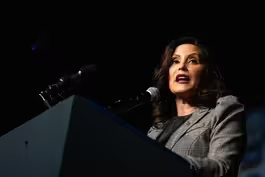
Whitmer says 'Biden has delivered,' supports his decision
Video has Closed Captions
Whitmer says 'Biden has delivered for people' and supports his decision to stay in race (7m 22s)
Providing Support for PBS.org
Learn Moreabout PBS online sponsorship New Episode
- News and Public Affairs

Today's top journalists discuss Washington's current political events and public affairs.

- News and Public Affairs

FRONTLINE is investigative journalism that questions, explains and changes our world.

 New Episode
 New Episode
 New Episode
 New Episode
 New Episode
 New Episode

 New Episode
Support for PBS provided by:
Major corporate funding for the PBS News Hour is provided by BDO, BNSF, Consumer Cellular, American Cruise Lines, and Raymond James. Funding for the PBS NewsHour Weekend is provided by...