Vermont This Week
July 10, 2026
7/10/2026 | 26m 46sVideo has Closed Captions
Scott issues healthcare executive order | Brattleboro Hospital plans birthing center closure
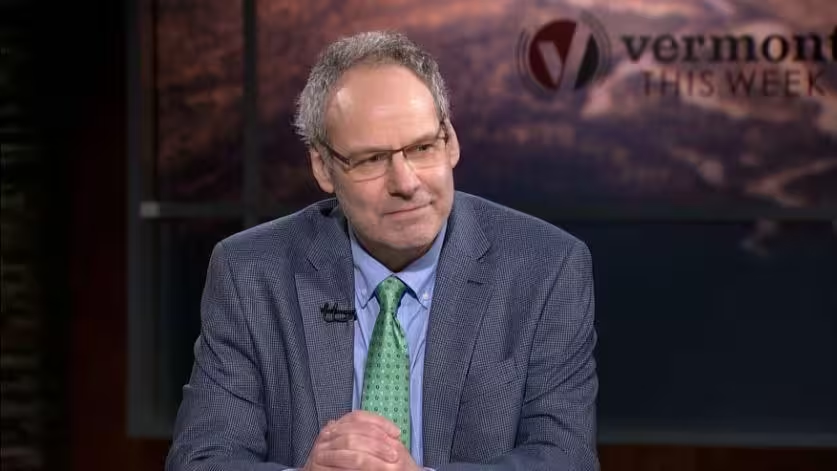
Scott issues healthcare executive order | Brattleboro Memorial Hospital plans birthing center closure | Green Mountain State poll | Moderator - Mitch Wertlieb; Lola Duffort - Vermont Public; Hannah Bassett - Seven Days; Derek Brouwer - Vermont Public.
Problems playing video? | Closed Captioning Feedback
Problems playing video? | Closed Captioning Feedback
Vermont This Week is a local public television program presented by Vermont Public
Sponsored in part by Lintilhac Foundation and Milne Travel.
Support provided by:


Vermont This Week
July 10, 2026
7/10/2026 | 26m 46sVideo has Closed Captions
Scott issues healthcare executive order | Brattleboro Memorial Hospital plans birthing center closure | Green Mountain State poll | Moderator - Mitch Wertlieb; Lola Duffort - Vermont Public; Hannah Bassett - Seven Days; Derek Brouwer - Vermont Public.
Problems playing video? | Closed Captioning Feedback
Where to Watch Vermont This Week
Vermont This Week is available to stream on pbs.org and the PBS app.
Support the crew
Help Mitch keep the conversations going as a member of Vermont Public. Join us today and support independent journalism.Providing Support for PBS.org
Learn Moreabout PBS online sponsorshipAfter vetoing the legislature's latest attempt at health care reform, Governor Scott this week sought to advance his own vision with a wide ranging executive order in launches, the first phase of a broader health care affordability initiative, and directs my administration to use every executive and regulatory authority authority we have to make health insurance more affordable.
Plus, Brattleboro Memorial Hospital says it plans to close its birthing center, and a new poll shows a significant increase in the number of Vermonters looking to leave the state.
All that and more ahead on Vermont this week.
From the Vermont public studio in Winooski.
This is Vermont this week, made possible in part by the Lintilhac Foundation and Milne Travel.
Here's moderator Mitch Wertlieb.
Hi, I'm Mitch Wertlieb.
It's Friday, July 10th, and with us on the panel today, we have Lola Duffort from Vermont Public.
Hannah Bassett from seven days and Derek Brouwer from Vermont Public.
And thank you all so much for being here today.
Well, let's start with the big news on health care, a topic we have tackled so many times on this program.
Lola Duffort I want to start with you, the governor, talking about this big executive order he made.
He's got plans for health care in Vermont, trying to make sure it's more affordable.
I want to ask, though, by starting checking out what he said no to, because he did veto some things before he put out his own vision.
Right.
So he vetoed a bill last month that really would have concentrated whatever savings we think that regulators are going to be able to get during the hospital budget setting process that's coming up.
It would have really concentrated those savings in the the Affordable Care Act marketplace, right.
So that's individuals buying on the exchange and also small businesses, but also in school employee health plans would have affected about 100,000 Vermonters.
And the idea was we want to direct savings there because the ACA marketplace is really struggling.
And if we save money on employee health, on school employee health insurance, that puts downward pressure on property taxes.
So that was the pitch for that bill from Democrats.
Phil Scott vetoed that and said, no, I don't want to sign on to something that does not spread out savings equally.
It's like everyone needs to get the same amount.
And so that's what he said no to.
What did he say yes to.
What's his vision.
Yeah.
So his vision he put out this this executive order, which in and of itself doesn't actually do much.
What it does is it directs administration officials to explore a whole bunch of proposals.
This is a pretty wide ranging EO.
It's a potpourri of ideas.
But, you know, if I can oversimplify, it's a general please do.
It's health care we're talking about.
Here is a generally more deregulatory vision.
What he wants to do is introduce kind of new insurance options.
Wants to make it easier for employers to go self-insured.
He wants to open the door to association health plans, which is a type of health plan that businesses can kind of band together to buy.
He also wants to reintroduce the idea of age rating in Vermont, which is allowing commercial insurers, not Medicaid or Medicare, but allowing commercial insurers to adjust premiums based on age.
Right, because older people generally use more insurance.
And the idea his theory here is that if we do that, younger people get a better deal, they're more likely to come into the insurance pool, even though we are kind of risking, right, older Vermonters getting a worse deal, we think maybe we could mitigate that with more people coming into the pool.
So that's his.
That's his vision.
Hannah Bassett, one of the things in that vision, as Lola was talking about is, you know, the governor says he'd like to spread out these savings.
Small businesses seem to be something he was very focused on here, saying that, you know, people with healthier employees may get a better deal and they should be able to seek out these association health plans.
But again, what are the risks associated with that?
I think the equity issue is part of it.
These association health plans were in Vermont previously 5 or 6 years ago.
So this isn't a totally new concept.
Somewhat similarly, the the kind of age adjusting mechanism that he proposed is common in almost every other state.
I think for Mont and New York are the only two that don't have that at the moment.
So the question is, who is coming into our health insurance networks and who is leaving it, and how does that impact the the overall cost burden that everybody is meant to bear?
If if more young people who are healthy come in?
That has the potential to lower those health costs.
But to Lola's point, if the older folks leave, or are those proportions just don't stay in a healthy balance, it can have negative implications for everybody.
Who else?
Who's else in the system and well, the default.
Sorry, but this is not new, right?
I mean, this stuff has been floated before.
Yeah.
I mean, he floated this at the beginning of the legislative session last year.
Right.
So lawmakers went through a lot of these proposals already.
And, you know, they weren't necessarily dead set about dead set against all of these ideas.
For example, the chair of the House Health Care Committee was like, I'm open to age rating.
If we really think it's going to make the pool healthier.
The criticism I heard from lawmakers at that time is like, we never saw any real numbers, right?
Like it kind of remained sort of idea, like it was an idea and it wasn't a full, fleshed out proposal.
The other thing I heard was that right.
Association health plans, another big concern, and also for more folks going self-insured, is that when that happens, fewer businesses go into the exchange.
And specifically it is businesses with healthier employees, fewer claims that choose these options.
And so that destabilizes the ACA exchange, which is already basically the most expensive in the country.
Right.
Like it's it's not it's it's already really sick.
And so the big concern that I heard from lawmakers to especially Democrats was that we are really and also the health care advocate, Mike Fisher, is that if you do that, you really threaten the ACA marketplace, which is already more vulnerable because of those federal subsidies going away.
Right.
That we heard about, there are still some subsidies, but the enhanced subsidies went away.
And then on top of that, right.
Something else I heard from the House Health Care Committee chair was you're proposing age rating because you think that's going to stabilize the ACA marketplace, draw more young people in, but you're also proposing association health plans, which would do the opposite.
So there's this concern that, you know, you would have one thing kind of acting against the other.
And plus, as you pointed out, I believe in your article, you know, to even implement this, the state of Vermont would need federal approval and the changes in the state legislature to.
Right.
So the legislature has to say yes to a lot of this, not all of it.
The association health plans.
Yes.
Lawmakers would have to say yes to this age rating.
Technically, no.
But the administration has said they don't want to go forward with age rating unless they also apply for this federal waiver.
Very complicated.
Would draw down money if we can get it.
There are a bunch of this there but that they would need legislative approval for, and lawmakers have already indicated they don't like quite by that.
That is a strategy that's going to pan out.
And so yeah, I mean, right now we have a legislature and a governor who have sort of kind of very different visions and are sort of preparing to have the same conversation that they had last year.
It does sound a little bit like a rinse and repeat, and we're not getting anything definitive yet on bringing down these health care costs completely.
I mean, do you see us having this exact same problem next year, for example?
Are we still going to have a health care system that's in crisis next year?
Yes.
Yeah.
Okay.
That's kind of what I was getting at.
Yeah.
I feel pretty confident and predicting that.
Well, yeah.
Sides here are saying that there isn't enough evidence to back up the cost saving claims.
That was one of the reasons why Governor Scott vetoed S1 and what the Democrats had largely supported during the session and brought to his desk.
But those same critiques and questions are also out there with these proposals as well.
Yeah.
So we're going to have to wait and see what happens.
But I really appreciate the update on that.
Both of you.
Thank you so much.
I want to turn to you, Derek Brower, now, because you wrote a story first of Vermont Public that's a little bit disturbing.
I want to just caution folks that, you know, some of what we're about to discuss contains some discussion of sexual allegations that folks may find disturbing.
There is a gentleman named Gregory Garcia that you were writing about.
He came from California.
He's practicing something called structural integration here in Vermont that led to some sexual allegations.
What can you tell us about the story?
Yeah.
So Mr.
Garcia has pretty active structural integration business in Burlington.
And I spoke with a woman who said that he had made a variety of of sexually tinged comments during his treatment with her, but then also suggested something he called internal work, which entailed put using a glove and putting his hand inside of her vagina for a few seconds.
He did this twice, and after the second time she told me she felt very uncomfortable with with what he was doing and had felt violated by this.
She complained to the state about his conduct, and that is triggered a long running regulatory proceeding that is actually still under appeal right now.
But the the gist is here, this this practitioner has never been registered with the state of Vermont to do any of this, this work.
And he's not required to be.
Well, you're required to register.
Yeah.
However, you are not required to show any credentials that you essentially you have to fill out a form to register, but you don't have to prove that you know what you're doing to do this kind of work.
And that came to play in this situation as well, because this internal work, as he calls it, is not sanctioned by any of the professional organizations that set standards and codes of ethics for this kind of this kind of work.
Structural integration.
Is that an alternative medicine?
How would you describe what it actually is?
Yeah, you can think of it similar to massage therapy.
It's geared toward pain relief.
Typically, however, instead of working on the muscles, it works on connective tissue in the body.
And so it's regulated very similarly or identically actually to massage therapy in the state, which is to say very, very lightly regulated.
Vermont is sort of an outlier when it comes to this certification in these alternative type of therapies.
Right?
Yeah, it is in 45 states to do massage therapy or structural integration or Rolfing as it sometimes known.
You have to be certified, which generally means proving that you have either passed a test or you are a member of a in good standing with a professional organization that has its own standards for for this Vermont.
And there are three states that don't require any registration at all in Vermont is one of is really the only state, actually that has this regime where where you have to register but but not demonstrate any competency.
Well, I urge people to go look at the article of Vermont public again, because you're bringing to light here some stories that were difficult to get.
And I appreciate the sensitivity you took as well in speaking with the people who eventually agreed to speak with you.
Because it took a while, right?
Yeah.
I mean, this was really sensitive for for these folks.
It was traumatic for for this woman who is whose story is and is included in my reporting here.
And there was a lot of fear about speaking out about this.
Very much appreciate the reporting, Derek, a little differently.
Turn back to you.
We already know about the closing of Gifford Birthing Center in Vermont.
Copley I'm so sorry.
Yes.
Thank you for correcting me there.
I appreciate that, but the story now is that Brattleboro Memorial Hospital may be planning to close its birthing center.
What can you tell us about that?
Yeah.
So, late last week, the leadership there announced that their board of directors or board of trustees had approved plans to close the birthing center within the next 6 to 9 months.
And they've started the regulatory process that you would need before you wind down a program such as this.
There are also, frankly, kind of sending out mixed messages because they're saying this is sort of the this is the plan.
But, you know, if either the state comes through with some, some ongoing funding to keep us alive or if we see a bunch of private donations come in.
Maybe we can stay alive, right?
And so they're also kind of putting out a plea for help at the same time as they're saying, you know, this doesn't happen, then we are closing down.
But basically this birthing center is losing a ton of money.
And that is not surprising because birth centers generally lose a ton of money, particularly in rural hospitals where you have fewer births occurring.
And that's because labor and delivery is expensive to deliver.
It's a 24 seven service that requires specialized staff, right?
You cannot schedule a lot of births.
And so that means that your fixed costs are really high.
And as we all know, rural hospitals across America and certainly in Vermont are in very precarious financial situations.
As a matter of fact, let's hear from a certified nurse midwife who works at Bartlett Memorial about the importance of this birthing center.
We already have patients that drive an hour to get to us, so to add on, even an extra 30 minutes could be life or death for some people and really worried about that.
I mean, that's that's pretty serious, you know?
And again, this is a quality of life issue two for a lot of people that may want to move to Vermont and are looking at having a birthing center available in their area.
Yeah, I mean, it is when I was writing this story, I landed on this stat and like, my mouth fell open.
Like only about 40% of rural hospitals in America still offer labor and delivery services.
Only 40%, only about 40%.
And that is a shocking reflection of our priorities as a nation when it comes to maternal health, children, and also just rural America.
But yes, it is a huge quality of life issue.
It's a little bit of a chicken and egg problem, right?
Fertility rates are dropping, people are leaving rural areas and then services that are necessary for them are then leaving.
And that compounds.
Right.
And, but but yes I think we talk a lot about things closing down or going away in rural parts of the state.
But birthing centers are probably one of the most elemental ones, right?
Like you need a safe place to get birth.
Yeah.
No question about it.
And then, you know, this kind of leads to something that we wanted to talk about as well, when we're talking about these quality of life issues.
A new Green Mountain State poll came out recently talking about a whole bunch of different things.
You know, we're going to start with talking about the political outlook of the state, but it also got into some things that we were just talking about here with Vermont as a place to live.
But let's start with the graphic.
Taking a look at the Democrats who are running for governor and lieutenant governor.
And there's a bit of a surprise here.
One of the names that I think people know in the state is Aly Richards, because she did a lot of work with Let's Go, kids.
She is running for the Democratic primary for governor, but she's behind to Amanda Janoo, Amanda Janoo putting up 20% numbers right now, Ali Richards at 12%.
But of course, the big number for those who are listening can't see the graphic.
Those who are undecided on potential Democratic pick up to 64%.
Any surprises here in this poll for you?
Derek, let me start with you.
I mean, that's 64% undecided.
Is is the big one.
I mean, it shows it to me that this is still wide open at this stage of the game.
And what do you think kind of were you surprised to see Amanda Janoo coming out in front of Aly Richards when you looked at this poll first?
I think it's notable.
To your point, Aly Richards has had a presence in this state that a lot of people might be familiar with through her Let's Grow kids work.
So name recognition is a huge part of the battle in a primary race.
And with this way, the way it shaking out now, I think might have caught people off by surprise a little bit, but very much to Derek's point 64%.
Being undecided, I think speaks to a lot of people still do not know either name or either of their platforms well enough, and we're about a month out from the primary, and there's a lot of a lot of campaigning yet to be done.
I mean, Democrats have been kind of in the wilderness looking for the person they think that may be able to take on Governor Phil Scott.
We're going to get to some of his numbers in just a moment.
In fact, Governor Scott, job approval rating.
Now, he has enjoyed an incredible amount of job approval.
In fact, at one point, I think he was considered the most popular governor in the country.
But there's been a bit of a dip.
If we take a look.
There's been about a five point drop in his overall approval rating.
Does this spell any trouble?
Do you think just sort of looking at the tea leaves here for Governor Phil Scott in a general election?
Let me start with, you know, that was pretty great.
Yeah.
Look.
Yes, you if you look at this, there's evidence that the bloom is coming off the rose, which is not surprising because Governor Scott has been in office for ten years.
And the longer you govern, the more people resent you for it.
But he is still a that's pretty strong when you are the governor in the minority party.
Right?
And as we previously discussed, his likely challengers remain completely unknown to the electorate.
Right.
And they have some time to make that up, but not a ton.
And so, no, I do think that look and we're going to be talking about this right.
Polling indicates that people are really worried about the direction that the state is going in, about affordability.
And that seems to be dragging down his poll numbers, a somewhat significant amount.
I don't think that that's not happening, but I don't.
He he is still the overwhelming, overwhelming favorite.
One thing I do want to note, Derek Brower, you were telling me before we went to air, you did a little deeper digging on this and found that some of that dip in Scott's performance rating didn't come from what I would have intuitively thought, which is Democrats and liberals, but actually from conservatives in Vermont.
Is that right?
Yeah, that's that's true.
The pollsters noted that people who identified as Republican or conservative were less likely than than they have been to approve of Scott's performance right now.
It's hard to know exactly what to make of that, but it would seem to point to the polarization we're seeing nationally here as well.
And, you know, Scott has always had to strike this, this moderate line in Vermont, particularly on social issues.
That's not supposed to affect us here in the bubble of Vermont.
Derek, what are you talking about?
I can't believe that we're not totally immune.
No.
Apparently not.
Let's get to some of the numbers that Lola was referring to, sort of the overall rating of Vermont as a place to live.
And we're seeing some alarming numbers there, too.
The number of people who were, you know, were seeing a dip in Vermont as a sort of an affordable and desirable place to live.
And then there's the likelihood of moving outside of Vermont within five years.
And those numbers seem to be trending up.
Hannah, you know, again, we were talking about things like birthing centers and young people and the attractiveness of moving to Vermont.
What do these numbers sort of speak to you, and what do they say to you when you see them?
I think there are a couple of different ways to look a little more closely at this.
There's a difference in the populations here.
Younger people might have a very different thought process to staying in Vermont than people who might be a little older, looking to buy a house right away.
So that certainly influences some of this data that we're looking at.
But if we're trying to get relatively younger people into this state, fill our public schools, balance out our health care system.
It's hard when then there are not birthing centers.
There's a lot of talk about small local schools consolidating.
These are just some of the things, realistically, that people are first to scan for when looking to stay in a community or move to a community.
And I think these are all at play and people deciding whether or not Vermont is the right long term home for them.
Yeah.
And I do wonder, you know, people talk about, well, you know, Chittenden County is a desirable place to live, but it is so and getting more unaffordable.
We've talked about the housing issues and some of the school issues you're talking about here.
I mean, I'm wondering about these numbers and what we just talked about with the political aspect of it.
What do people running for governor have to do to look at these numbers and say, is there something they can latch on to here and say, I'm going to make this a topic that I can actually run on?
I mean, do you think there's any opportunity here?
Sure.
Well, I mean, I think all everyone's kind of making the same pitch.
Everyone's using the word affordability here, and I mean nationwide.
And so yeah, that is the that's the pitch that everyone is making.
Amanda New has leaned really heavily into kind of the tax the rich tax second home owners rhetoric, which is working in a lot of places, particularly in Democratic primaries.
Right now, we have this insurgent kind of populist progressive left.
And you could definitely see her candidacy and early signs of success in, in that.
And then you have Ali Richard saying, I made our historic health care.
Sorry, not health care.
Child care bill happen.
Right.
And so I know how to direct the levers of government to make meaningful differences in people's lives.
And then of course, you have Phil Scott that is saying I've been talking about affordability for ten years.
I'll keep talking about it for two more.
I mean, it's going to be fascinating to see how it all shakes out in the general.
I want to get folks updated on a story that we have been talking about over the last few weeks.
Derek Brower, the family of a man who was fatally shot by a state trooper.
The state trooper did not have any charges brought against him.
They are now suing the Vermont State Police.
What can you tell us about that?
Yeah, they this is the family of Scott Garvey's, a man who has had schizophrenia, who was shot in his apartment when police came to do well for check.
There were some disturbances in the in the apartment building.
And the family has maintained since this happened that this was an avoidable event and that the state police did not show enough care and patience and understanding in the situation.
And they they are planning to do to bring as much attention to this as they can nationally and in the state to try to to, you know, force some change.
And, you know, as I recount the details, it's an all too familiar story in Vermont.
The family is well aware of that.
And I think they are they are hoping that this is a way they can make a difference.
I appreciate the update on that story.
I want to point people to we don't have time to get too deep into it now, but you did a great story about estrogen therapy in Vermont and about how now it is being sort of brought back into favor a little bit.
Things have changed over the last 20 years, right, about the effectiveness for women under the age of 60.
Yeah.
In this past winter, the FDA changed some of its labeling guidelines, removed one of its most severe black box warnings from the label.
That's just the latest in these changes.
About 20 years ago or so, the recommendation was largely for women premenopausal not to seek out estrogen therapy.
There was a study that showed some adverse effects, but that study has since been relook at reconsidered.
And for younger women who are pre menopause or within about ten years of menopause, often these are great, great medications to treat those really difficult paramount apostle symptoms which include hot flashes of course, but also brain fog stress anxiety.
But the challenges having enough access to that medication and access to providers who are able to hear patients out on that, absolutely.
Check out the story in seven days.
And finally, just want to let people know that the Major League Baseball draft is happening tomorrow.
Katie McCarthy of Chester, Vermont, may go in the top three rounds, is expected to.
If he does get picked in the first three rounds, that will be the highest that a player from Vermont is ever been picked in the Major League Baseball draft.
We'll have to leave it there.
I want to thank our panel so much today, Lola Duffort from Vermont Public, Hannah Bassett from seven days, and Derek Brouwer from Vermont Public.
Thank you so much for watching.
I'm Mitch Wertlieb.
See you again next Friday for Vermont this week.
 New Episode
- News and Public Affairs

Top journalists deliver compelling original analysis of the hour's headlines.

- News and Public Affairs

FRONTLINE is investigative journalism that questions, explains and changes our world.




 New Episode
 New Episode



 New Episode
Support for PBS provided by:
Vermont This Week is a local public television program presented by Vermont Public
Sponsored in part by Lintilhac Foundation and Milne Travel.