
July 11, 2024 - PBS News Hour full episode
7/11/2024 | 57m 46sVideo has Closed Captions
July 11, 2024 - PBS News Hour full episode
Thursday on the News Hour, President Biden holds a critical press conference amid calls that he should step away from the campaign. In an exclusive interview during this week's NATO summit, Germany's chancellor says he has not seen anything to make him doubt Biden's ability to lead. Plus, we examine religion and political polarization by visiting a church known for its hardline views.
Problems playing video? | Closed Captioning Feedback
Problems playing video? | Closed Captioning Feedback
Major corporate funding for the PBS News Hour is provided by BDO, BNSF, Consumer Cellular, American Cruise Lines, and Raymond James. Funding for the PBS NewsHour Weekend is provided by...
July 11, 2024 - PBS News Hour full episode
7/11/2024 | 57m 46sVideo has Closed Captions
Thursday on the News Hour, President Biden holds a critical press conference amid calls that he should step away from the campaign. In an exclusive interview during this week's NATO summit, Germany's chancellor says he has not seen anything to make him doubt Biden's ability to lead. Plus, we examine religion and political polarization by visiting a church known for its hardline views.
Problems playing video? | Closed Captioning Feedback
How to Watch PBS News Hour
PBS News Hour is available to stream on pbs.org and the free PBS App, available on iPhone, Apple TV, Android TV, Android smartphones, Amazon Fire TV, Amazon Fire Tablet, Roku, Samsung Smart TV, LG TV, and Vizio.
Providing Support for PBS.org
Learn Moreabout PBS online sponsorshipGEOFF BENNETT: Good evening.
I'm Geoff Bennett.
AMNA NAWAZ: And I'm Amna Nawaz.
On the "News Hour" tonight: President Biden holds a critical press conference amid calls for him to step away from the campaign.
GEOFF BENNETT: And in an exclusive interview during this week's NATO Summit, Germany's chancellor says he's not seen anything to make him doubt President Biden's ability to leave.
OLAF SCHOLZ, German Chancellor: I think it would be a big mistake to underestimate the president.
AMNA NAWAZ: Plus, Judy Woodruff examines the intersection of religion and political polarization by visiting an evangelical church known for its hard-line views.
(BREAK) AMNA NAWAZ: Welcome to the "News Hour."
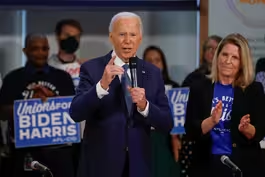
President Biden is facing a high-pressure moment, preparing to hold his first solo press conference in several months at the NATO Summit in Washington.
It's a major public test for the president's reelection campaign as he faces questions over his stamina and his health.
GEOFF BENNETT: Earlier today, three of the president's top campaign advisers met with Senate Democrats behind closed doors to address concerns over his political future.
Some lawmakers expressed skepticism before and after the meeting.
QUESTION: What's the main objective in the room today?
To find consensus?
SEN. JOE MANCHIN (I-WV): To make sure the health and well-being of the president is able to be judged.
SEN. MICHAEL BENNET (D-CO): If things stay as they are, it's likely that Donald Trump will win the election and that we will lose the Senate and we will lose the House.
SEN. RICHARD BLUMENTHAL (D-CT): He has to continue to allay those concerns that have been expressed by the American people.
More than myself or my colleagues, the voters are what matter.
AMNA NAWAZ: And our White House correspondent, Laura Barron-Lopez, is at the NATO Summit and joins us now.
So, Laura, what has been the response from the Biden team to these latest calls from more lawmakers for him to step aside?
LAURA BARRON-LOPEZ: Amna, President Biden, some of his closest advisers went up to the Hill today to meet with senators.
That included campaign chair Jen O'Malley Dillon and two of his top advisers in the White House, Steve Ricchetti and Mike Donilon.
Now, we -- senators were pretty mum coming out of that meeting.
They weren't really offering much, but we know that what those advisers were trying to communicate to the senators was that they still have a pathway to 270, multiple pathways, they say.
And we got a taste of what the Biden administration -- excuse me -- what the Biden campaign's argument is in a memo that Jen O'Malley Dillon, the campaign chair, sent out to supporters today and also sent internally to the campaign staff.
And in that memo, O'Malley Dillon says that there was no sea change after the debate and that they have multiple pathways to 270.
She said -- quote -- "Right now, winning the blue wall states, Michigan, Wisconsin and Pennsylvania, is the clearest pathway to that aim.
But we also believe that the Sun Belt states are not out of reach.
The consensus being across internal and public polling is that everything remains within the margin of error for the president and that he can ultimately still win this."
AMNA NAWAZ: Meanwhile, Laura, every moment for the president becomes kind of high-stakes test.
You're about to go walk in to this press conference he's going to give at NATO at during this summit, the first time he's taken questions from a group of reporters since the debate.
What do you expect to happen in there?
LAURA BARRON-LOPEZ: This is a really critical moment for the president, Amna.
This is a high-stakes press conference, one that the White House calls a big boy press conference.
And it's -- he's expected to take a number of questions on his own from reporters.
He's going to be met with a pretty probably aggressive press corps that is going to be asking about why he thinks he should remain in this race, especially as more and more House lawmakers, in particular, House Democrats, come out saying that they think he should step aside.
A number of House Democrats were texting me today saying that they think that, no matter how he does in this press conference, that more and more Democrats are going to call on him to step aside, especially as NATO allies leave.
AMNA NAWAZ: So, Laura, after this press conference, what else can we expect to see from the Biden White House, from the Biden campaign, as they work to quiet these concerns?
LAURA BARRON-LOPEZ: President Biden's team just keeps maintaining that he is in this and that he is not exiting the race, despite all of the lawmakers that are saying that they think that he should step aside and donors that privately are saying that they think he should step aside.
They say that the vast majority of Democrats are still behind him, including the delegates.
So the president is going to be campaigning more, they said.
They put him out there more in the past week.
They said they're going to continue doing that.
And they're also putting him out with the press more.
He is going to have a sit-down with NBC on Monday that a number of Democrats tell me they're also going to be watching closely.
AMNA NAWAZ: All right, that is our White House correspondent Laura Barron-Lopez joining us from the NATO Summit.
Laura, thank you.
LAURA BARRON-LOPEZ: Thank you.
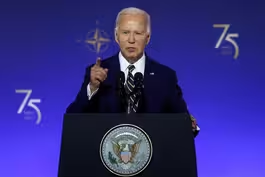
GEOFF BENNETT: For more analysis of President Biden's upcoming press conference and his political standing, we're joined now by Democratic strategist and former adviser to Hillary Clinton Philippe Reines.
Philippe, thanks so much for being here.
PHILIPPE REINES, Former Clinton Adviser: Thank you.
GEOFF BENNETT: What, if anything, can President Biden do in this press conference tonight to quell concerns and end these calls for him to exit the race?
PHILIPPE REINES: Honestly, I would say nothing because everyone is so dug in, that there's confirmation bias.
And that if you want him to have to leave, you're going to find plenty of things in what he says and how he says it and how he looks to walk away with that.
Before the press conference even started, he accidentally called President Zelenskyy President Putin.
So you have half of Washington already lighting up their phones.
GEOFF BENNETT: But he caught himself and made the correction.
PHILIPPE REINES: He caught himself, yes.
I don't think it's a big deal.
I mean, the fact that he even knows world leaders, I mean, most Americans wouldn't catch that, but this is how Washington, as you know, works.
The issue here is, why are we all sitting around with bated breath watching a press conference for a NATO Summit?
If Joe Biden is going to salvage this, which he absolutely can, he's got to go out and do his job without there being these huge moments in time that can blow up, because you know what?
These huge moments in time aren't going to save him.
They can only go bad.
He needs to go out there on a regular basis, maybe just go to the hamburger store with Vice President Harris with the Ray-Bans on, have someone yell a question at him, or be in the Rose Garden and sign something.
It needs to be regular, not, OK, we're doing this big interview with George Stephanopoulos, this big interview with Lester Holt, this big press conference.
I could tell you right now, I have been to a ton of NATO and other kind of press conferences.
Half of that room is foreign press.
They're going to raise their hand and they're going to ask something actually about NATO.
And the American press is going to be livid, because that's not why they're there.
GEOFF BENNETT: As we mentioned, top campaign staffers met with Senate Democrats today to address their concerns.
If you're a Biden campaign adviser, what's your best argument to some of these worried Democrats as to why Joe Biden should stay in the race?
PHILIPPE REINES: I think it's a couple of things.
First, listening to Jen O'Malley Dillon laying it out, that's obviously the first place to start, that there are many ways to get there.
I'm sure she did it in the room, but, obviously, you need to hear how.
The how is what's missing right now.
Everyone is focused on the damage, not how to move on.
We're all mired in it.
I -- what's missing here is this notion that moving away from Joe Biden, which we should all remember is entirely his decision -- the entire country can decide it shouldn't be him and that doesn't make a difference -- that there is a cost to that.
There are people who support Joe Biden who would be upset by that.
OK.
It would rationally and logically be Kamala Harris, the vice president, his partner, to be the nominee.
Now, there are lots of people playing fantasy football who then want to say, you know what, it should be Gretchen Whitmer or Gavin Newsom or maybe them together or maybe them reversed.
There's a huge opportunity cost there, a huge risk.
Every iteration you go out, you have to do the cost/benefit analysis.
So, frankly, to some extent, the argument you're making is, it is not cost-free to just suddenly uproot who the nominee is.
There's an argument -- first of all, he's the only person that's beaten Donald Trump.
So maybe we just stick with the horse that we rode in on.
But there's also an argument that, if Joe Biden were to lose, which I don't think is the fait accompli, but, if he were to lose, there would be less carnage.
There'd be a lot of very upset people, yours included, that there would be less carnage than if it went through the process of some various cockamamie schemes that alienated multiple demographics and subsets of the party to end up in the same place,losing the White House.
That could linger for a long time.
GEOFF BENNETT: What do you think it means then that the Biden campaign, its data team, according to The New York Times, is poll-testing Kamala Harris against Donald Trump right now?
PHILIPPE REINES: I know that looks -- that's an attractive thing to look at.
I don't think that's abnormal.
I think that that's prudent.
I think they need to test every single thing they can.
In 2012, Barack Obama tested Hillary Clinton as vice president.
You just do these things because you need to understand.
And I think part of that is an interesting point, is that, if you look at the arguments that are being made to President Biden, one of them is the data, and it is polls.
And they're not necessarily a slam dunk.
The national polls are in no way dispositive of what's been going on.
The state polling is starting to crater.
But you need to know these things.
You need -- if the party, which isn't as monolith -- but if there's going to be a decision by the president to take an extraordinary step, it needs to be as well-informed as possible, not just for himself, but for the vice president, for the vice president's supporters, for all of us, because, at the end of the day, we want to keep Donald Trump out of office.
So if they just add a question an existing poll, great.
GEOFF BENNETT: You're a veteran Democratic strategist.
How much damage do you think these last two weeks, since this debate, has done, not just to President Biden, but to the ticket, the Biden/Harris ticket?
PHILIPPE REINES: The first week after the debate was very damaging, because it was essentially silence.
This past week, before Nancy Pelosi pretty much reignited the fire, was effective, in that he called into cable shows.
He was very strong about it.
He sent a very smart and clever letter to the Hill.
The issue here to me is, this is salvageable, but not the way the White House and the campaign has been fighting or not fighting over the last two weeks.
They are not meeting the conversation where it's happening.
And I think that's going to be the problem with this press conference, is that, one, he's going to look the same.
So that's 0 for 1 one right there.
He's going to not be talking about this in a health context.
And that's 0 for 2.
And that's tough.
GEOFF BENNETT: Philippe Reines, thanks, as always, for your insight.
PHILIPPE REINES: No, thank you for having me.
GEOFF BENNETT: Appreciate it.
AMNA NAWAZ: We begin our look at the day's other headlines with the latest NATO support for Ukraine.
Leaders spent the third and final day of their summit in Washington, discussing the state of the alliance and Ukraine's goal of becoming a member.
The U.S. announced another $225 million aid package for Ukraine.
President Biden reaffirmed America's commitment during a meeting with Ukrainian president Volodymyr Zelenskyy.
JOE BIDEN, President of the United States: And made it clear Russia will not prevail in Ukraine, will not prevail in Ukraine.
Ukraine will prevail.
And I want you to know we're going to be with you every step of the way.
AMNA NAWAZ: Zelenskyy welcomed the support, calling it strong news, but he added that Ukraine needs the U.S. to lift limits on firing its weapons deeper into Russia if it hopes to win the war.
In the Middle East, Israel said its negotiating team is heading to Cairo for continued talks for a possible cease-fire deal with Hamas.
That comes as Israel presses its offensive in Northern Gaza.
More displaced Palestinians fled Gaza City today to head south following the latest evacuation orders from Israel.
Also today, Prime Minister Benjamin Netanyahu told the military graduation ceremony that Hamas is to blame for any lack of progress in those cease-fire talks.
BENJAMIN NETANYAHU, Israeli Prime Minister: I am committed to the framework deal for freeing our hostages, but the Hamas murderers are sticking to demands that contradict to the framework that endanger Israel's security.
The way to release our hostages is to continue pressuring Hamas with all our might.
AMNA NAWAZ: At that same ceremony, Israel's defense minister called for a state inquiry to investigate Netanyahu and his entire Cabinet, including himself, for security failures around the October 7 Hamas attacks.
Yoav Gallant said that the probe -- quote -- "must be objective.
It needs to investigate all of us, those who make decisions, and those who carry them out, the government, the military, and the security agencies."
There is relief in France tonight, after firefighters put out a blaze at the city of Rouen's medieval cathedral.
Cell phone video captured smoke billowing from the spire around midday.
Authorities have not provided a cause, but reported only minor damage after the fire was put out.
The cathedral was a favorite subject of impressionist Claude Monet and is considered one of the finest Gothic churches in France.
The scene was eerily similar to the 2019 fire that devastated Notre Dame Cathedral in Paris.
The landmark is set to reopen in December after a major restoration.
The storm system that was Hurricane Beryl has now pushed into Canada, but not before dumping torrential rains on Vermont.
At least one person has died, and more than 100 others had to be rescued after more than six inches of rain fell in some parts of the state.
Roads became rivers as rushing water slammed into businesses and homes.
ART EDELSTEIN, Vermont Resident: I don't even know where this water -- how much water came from where, because, I mean, there's just mud everywhere now.
And I haven't -- I haven't been inside.
I don't know what's going on.
This is, in my impression, catastrophic.
I have just never seen anything like this.
AMNA NAWAZ: The images today echoed scenes from when the state was swamped by deadly downpours at exactly this time last year.
In the meantime, in Texas, energy officials say that half-a-million customers still won't have power by next week.
Beryl knocked out electricity to 2.7 million homes and businesses when it made landfall there as a Category 1 hurricane on Monday.
Frustration has been growing over the pace of getting power restored.
The U.S. House of Representatives rejected a Republican effort to hold Attorney General Merrick Garland in inherent contempt for refusing to turn over recordings of President Biden's interview from his classified documents case.
The lawmakers wanted to fine Garland $10,000 a day until he did so.
Four Republicans joined all Democrats in rejecting the measure.
It was the latest such effort by GOP members who voted last month to hold Garland in contempt of Congress.
Even if the resolution had passed, it was unclear how it would have been enforced.
U.S. consumer prices dipped last month for the first time in four years.
The Consumer Price Index, measuring the costs of everyday staples like gas, groceries and rent, fell by a 10th-of-a-percent from may to June.
That's the first monthly decline since May of 2020.
Prices are still, though, 3 percent higher than the same time last year.
But the cooling prices are welcome news for Federal Reserve officials as they consider whether to cut interest rates.
And on Wall Street today, stocks struggled following that inflation data.
The Dow Jones industrial average added about 30 points for a minimal gain.
The Nasdaq dropped by more than 360 points after hitting records for seven straight sessions.
The S&P 500 also fell back from a recent all-time high.
And a passing of note.
Actress Shelley Duvall died in her sleep at her Texas home, according to her longtime partner.
Duvall was a protege of director Robert Altman, starring in seven of his films, including "Nashville" and "3 Women."
But many fans will remember Duvall for her role opposite Jack Nicholson in Stanley Kubrick's "The Shining."
In the 1980s, Duvall started producing children's television shows, before leaving Hollywood in the 1990s for her home state of Texas.
She lived the rest of her life mostly away from the public eye.
Shelley Duvall was 75 years old.
Still to come on the "News Hour": Judy Woodruff examines the role religion plays in political polarization; and a first-of-its-kind fashion show highlights the work of indigenous designers.
Today is the final day of the NATO Summit here in Washington.
At the top of the agenda this week, sustaining and expanding support for Ukraine.
Not on the official agenda, concerns about the U.S. election and its potential outcomes.
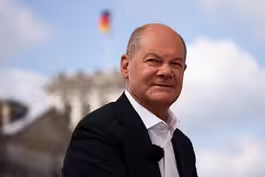
Earlier today, I spoke exclusively with Chancellor Olaf Scholz of Germany to discuss how NATO leaders are preparing to tackle some of the biggest geopolitical challenges facing the world, what he thinks about his counterpart President Biden, and the prospect of a return to power by Donald Trump.
Chancellor Scholz, welcome to the "News Hour."
Thank you for being here.
OLAF SCHOLZ, German Chancellor: Hello.
AMNA NAWAZ: Let's begin with Ukraine, which is clearly top of the NATO Summit agenda while you're here.
You and others resisted language in the communique to extend Ukraine an invitation to join NATO.
Can you explain to us why that was?
Are you worried that that would send Russia a signal of some kind of escalation?
OLAF SCHOLZ: No, it's not about this.
We are supporting Ukraine.
As you know, Germany is the second biggest donor of also military support to Ukraine after the United States.
And we will continue to be strong in our support for Ukraine.
And during the war, no one expects Ukraine to enter NATO.
It is now that we do what we can say today, and this is the language which we worked on in Vilnius, which was the right way of saying that there is a path to NATO for Ukraine, and it is irreversible, as we say today.
And I think this is the right message.
AMNA NAWAZ: You know, of course, Russia is watching with great interest the messages from the summit.
Dmitry Medvedev just tweeted this morning saying - - or commenting on this language about the irreversible path of Ukraine.
And he wrote this - - quote -- "For Russia, two possible ways of how this path ends are acceptable.
Either Ukraine disappears or NATO does, still better, both."
What's your reaction to that?
OLAF SCHOLZ: Oh, the comments of Medvedev are becoming more and more strange, to be very honest, but, in a way, it shows that our language is absolutely clear.
And so it's good to hear this after we have talked in the beginning about the language of the NATO meeting here.
It's a strong message about the irreversible path, and it's the right thing to do.
AMNA NAWAZ: If the goal continues to be to get Ukraine everything that it needs to win this war, then, there is the question of why you haven't yet authorized sending the Taurus missiles, those long-range German cruise missiles, because the U.S. has sent their versions in the ATACMS.
The U.K. has sent their version.
So why isn't Germany sending yours?
OLAF SCHOLZ: As I already said, Germany is the second biggest supporter of Ukraine.
Also, when it comes to weapons, we delivered everything which is important for air defense, three Patriot systems, the biggest number from all countries, and we invite many others to do more.
We have delivered howitzers and tanks, and we continue to do so.
So this is our way of doing support.
And our decision is that we will not deliver weapons which have a long range and where we do not have enough control about what will happen, if they will be used at aims that are far away.
AMNA NAWAZ: But I take that to mean, just to put a clear point on this, you would not trust Ukraine not to use those longer-range weapons in a way that you fear could escalate the conflict?
OLAF SCHOLZ: I trust them, and we are working together intensely, and we took all the necessary decisions for Ukraine that they could defend the country, also together with the United States, giving them the chance to be more effective in defending their own country, so that they can go against Russian troops.
AMNA NAWAZ: We know that you and the other NATO allies and the rest of the world are watching this upcoming U.S. election with great interest.
It was last month you said that you believe President Biden is likely to win a second term.
You have said this week that you don't have any concerns about his health, as other folks have raised questions.
We have -- since that debate performance, though, we have seen the biggest shift in polls here in the U.S. away from him and towards former President Trump that we have seen to date.
Do you still believe that he is likely to win?
OLAF SCHOLZ: I'm not someone that is able to say how will be the outcome of American elections.
But I think it would be a big mistake to underestimate the president.
He is successful in doing the necessary things, for instance, in organizing the NATO alliance.
And his leadership was very important in the last years and months, and also preparing this very meeting here in Washington.
And he is also a successful campaigner.
So I think it is the American people that will take a decision.
And I just can tell you, from my perspective, as someone that is speaking with Biden, he is very focused, and he is very intensely doing what the president of the United States has to do for leading the alliance.
AMNA NAWAZ: You have been in a sort of unique position this week.
You have been meeting with him.
You're watching him work.
Have you seen any moments at all in your latest interactions with him that tell you in any way he is not up to another four years?
OLAF SCHOLZ: No.
AMNA NAWAZ: And can I also ask, did you watch the debate that has created so many headlines here?
OLAF SCHOLZ: Yes, I did.
AMNA NAWAZ: You did?
OLAF SCHOLZ: To be honest, everyone in Europe is very much interested in the politics within the United States, because the United States are the strongest superpower in the world.
And it's our most important ally.
So we are trying to understand what goes on.
AMNA NAWAZ: And, as you watched it, nothing that you saw gave you any concern or reason for pause?
OLAF SCHOLZ: I think that he made his points, and he argued why it is necessary to work on a good cooperation globally with our friends and allies of democracy -- democratic states.
And he was very clear and focused on questions of national politics.
AMNA NAWAZ: Mr. Biden, as you mentioned, has been a strong and a vocal defender of NATO, of its role in the world.
How much do you think is at stake for the alliance in this upcoming U.S. election?
OLAF SCHOLZ: The alliance is important for the security of the United States, of Canada, and all -- of all the European states on the other side of the Atlantic.
I think it is necessary that we understand that, though there might be differences between the states joining the alliance, it is not about the basic principles of how to run a country and about democracy, as I said.
AMNA NAWAZ: Under a potential second Trump presidency, however, does your view on that change?
I mean, this is someone who sent mixed messages on the alliance.
He's previously called it obsolete.
He's explicitly warned that the U.S. would not step in to defend NATO allies who haven't met that 2 percent of GDP defense spending target.
What happens to NATO under a President Trump?
OLAF SCHOLZ: I met during all the years many people from the Congress, bipartisan, from all parties.
I will say that there is constantly a clear understanding of both parties, that NATO is in the interest of the United States.
And this commitment is very strong.
So I think that this is how American politicians who are in the security community think about this question, and I'm sure that this will continue for the next decades.
AMNA NAWAZ: Do you believe Mr. Trump shares that view of NATO's importance?
OLAF SCHOLZ: In the end, this was the experience we had during the last presidency of Trump.
But it is nothing where I would speculate about.
I'm just knowing that Republicans and Democrats are very clear in this question.
AMNA NAWAZ: Have you yourself been in touch directly with former President Trump?
OLAF SCHOLZ: I met him when he was president.
AMNA NAWAZ: And not since then?
That's a no?
OLAF SCHOLZ: I met him when he was president... AMNA NAWAZ: OK. OLAF SCHOLZ: ... as a mayor and as a finance minister and vice chancellor at that time when my predecessor was visiting together, going together with me to these meetings of G7 and G20.
AMNA NAWAZ: But not since he left office here in the U.S.?
OLAF SCHOLZ: No.
AMNA NAWAZ: I do want to ask you about the other major war.
And that is, of course, Israel's war in Gaza.
Your foreign minister recently just condemned Israel's strikes this week that were at both tent areas for displaced Palestinians outside a school in Southern Gaza.
Those were called unacceptable by your foreign minister.
And she said that the repeated attacks on schools by the Israeli army must stop.
The question is, how do you get them to stop?
OLAF SCHOLZ: We have a clear understanding of what about the situation.
The first is that, after the brutal attack of Hamas against Israeli citizens, Israel has the right to defend itself against Hamas.
And right from the beginning, we were very clear, saying that this has consequences for the way of doing this war against Hamas, reducing the civilian casualties.
We discussed about the need for humanitarian aid to get to Gaza.
We discussed about the question of West Bank and that there should be not an enlargement of settlements and that there should be no attacks against Palestinian civilians in the West Bank.
We were very clear on the perspective, and we are clear that there must be a two-state solution which gives the chance for Israel and a Palestinian state consisting of West Bank and Gaza to live peacefully together.
AMNA NAWAZ: At the same time, Chancellor, there have been expansions of the settlements in the West Bank, and there have been tens of thousands of civilians killed.
So, what can be done at this point?
OLAF SCHOLZ: We have to be clear.
And, as friends of Israel, we have to be especially clear.
And this is what we do, the United States do, as far as I see it, and many others also.
So that's what we can do.
AMNA NAWAZ: I'd like to ask you also about our colleague in journalism from The Wall Street Journal Evan Gershkovich, who is being held in Russia.
There's a convicted Russian assassin by the name of Vadim Krasikov who remains jailed in Germany.
And there were reports that you were willing to trade him for Evan and for Alexei Navalny when he was alive, before he ended up dying in a Russian prison.
Can you confirm those reports?
Were you willing to make that trade?
OLAF SCHOLZ: You don't really expect that I will be very clear on questions like this.
We are very active to help those who are imprisoned in Russia.
And this is one -- this is an activity we are doing together with others.
And, yes, that's what I will say here.
AMNA NAWAZ: I guess the question is relevant today because there remain so many Westerners and Americans jailed in Russia.
If it was a possibility to trade someone like Krasikov before, could there be a deal on the table to trade now for Evan Gershkovich and Paul Whelan, who's also still in Russia?
OLAF SCHOLZ: As I said, there are aspects of international politics which I -- have to be done in a very pragmatic way and without debating them.
And this is what we -- what you should have in mind.
So we try to get prisoners out, but it's very difficult.
And it's nothing for speculating about this.
AMNA NAWAZ: But a trade is potentially one way these men could be freed; is that fair to say?
OLAF SCHOLZ: It's not fair to say, because you're trying to get an answer from me, where I said I won't give you an answer.
AMNA NAWAZ: Fair enough.
Chancellor, I want to ask you about issues back home in Germany and across Europe.
The rest of the world has been watching recent elections there with great interest as well.
You expressed some relief that the far right in France did not prevail in their recent elections.
Germany is, of course, reckoning with its own rise in a far right party in the Alternative for Germany Party.
How worried are you about the rise of those far right forces in Germany?
OLAF SCHOLZ: I'm worried about the rise of far right forces all over the world, and especially in many of the rich countries.
We have to understand why this is happening.
We have always to understand that the big majority of people is not agreeing with them in all these countries.
And -- but we have to develop a strategy which is making it more sure that the support for them will decrease.
But it is a time where we have to organize that the change will be successful, not just on an abstract perspective, but also if we look at the individual perspective of people who look at themselves or those who are like them.
AMNA NAWAZ: I found it interesting, in reaction to the success of some of those far right parties in recent European elections, you called it a decisive turning point in politics, and you attributed much of that to really a public loss of trust in mainstream politics.
So how do you and other leaders facing this similar challenge, how do you get that trust back?
OLAF SCHOLZ: We are living in times where there is a lot of insecurity.
So, hope and the view that there is a good perspective for everyone is key for fighting against these right populist parties.
I think we have to go away from this idea of a zero sum game.
We have to be more optimistic about the future.
This is the basis for getting our societies together and for social coherence, which I think is important.
AMNA NAWAZ: German Chancellor Olaf Scholz, thank you so much for your time, for being here today.
Really appreciate it.
OLAF SCHOLZ: Thank you.
GEOFF BENNETT: We turn now to religion in America and the political divide.
In her last story, Judy Woodruff reported on the decline among white Christian churches and the influence of politics.
Tonight, she visits an evangelical church in Tennessee that's bucking that trend, seeing strong growth as its leaned into hard-line politics.
It's part of her ongoing series on divisions, America at a Crossroads.
JUDY WOODRUFF: In a country where many pews increasingly sit empty, twice a week in Mount Juliet, Tennessee, outside of Nashville, hundreds gather to sing, worship, and find community in the converted tent of Global Vision Bible Church.
They're led by Pastor Greg Locke, a one-time fundamentalist Baptist who gained fame and followers over the past decade while taking hard-line positions on issues like gender-neutral bathrooms in Target stores.
PASTOR GREG LOCKE, Global Vision Bible Church: What you are targeting are perverts, pedophiles, people who are going to harm our children.
JUDY WOODRUFF: Calling COVID-19 a hoax.
PASTOR GREG LOCKE: If they go through round two and you start showing up in all these masks and all this nonsense, I will ask you to leave.
(CHEERING AND APPLAUSE) PASTOR GREG LOCKE: I will ask you to leave.
JUDY WOODRUFF: Claiming that Democrats could not be Christians.
PASTOR GREG LOCKE: You cannot be a Christian and vote Democrat in this nation!
They are God-denying demons that butcher babies!
JUDY WOODRUFF: And spreading election fraud claims.
MAN: Global Vision Bible Pastor Greg Locke told me he was at the U.S. Capitol getting to the steps, praying and preaching while the insurrection went on behind him.
PASTOR GREG LOCKE: There was a time, I think, that maybe I felt it was my responsibility to play to the division a little bit more maybe than I do now.
I'm very demonstrative.
I'm very conservative, very well-known and outspoken for my political and religious beliefs.
But I think we're at a place that if we don't figure out now how to bridge the chasm, we're never going to.
JUDY WOODRUFF: You consider yourself an evangelical?
PASTOR GREG LOCKE: Yes, although that is a hijacked term, I think, in the day and age in which we live, because there was a time that if you said you were an evangelical, it really meant a handful of things.
You believed in the inerrancy of Scripture, the second coming of Christ, Jesus Christ as the only way to heaven, and you shared your faith.
But now if you say you're an evangelical, well, then that means you vote a certain way, you dress a certain way, you're a certain denomination.
And so I think it's been hijacked by a political agenda in some ways.
JUDY WOODRUFF: That political agenda dates back decades, to the late 1970s and the rise of Baptist Minister Jerry Falwell and the Moral Majority.
In 1980, white evangelicals abandoned fellow evangelical Democrat Jimmy Carter and voted for Ronald Reagan, who embraced Falwell and his culturally conservative agenda, starting a trend that has only grown.
Three-quarters of white evangelicals voted for George W. Bush, John McCain, and Mitt Romney for president, and eight in 10 voted for Donald Trump in 2016 and 2020.
RYAN BURGE, Eastern Illinois University: So the church had about 100 people by 1996.
JUDY WOODRUFF: American Baptist pastor and political scientist Ryan Burge.
RYAN BURGE: Today, churches have become so homogeneous.
You know, white evangelicalism is 80 percent Republican today.
If you go to a white evangelical church, you're probably not going to find a single Democrat in the congregation.
And the pastor is probably also a strong Republican as well.
So you're going to hear one message and one understanding of the world.
JUDY WOODRUFF: And that trend, he says, was only accelerated by COVID-19 and the way the pandemic response was politicized.
RYAN BURGE: Pastors have always sort of, like, dodged land mines during their sermons because they don't want to wade into these issues.
The problem with COVID was, you couldn't dodge the land mines anymore.
You had to make a decision, mask or no mask, distancing or no distancing, all online, all in person.
What do we do?
JUDY WOODRUFF: Pastor Locke refused to close down his church during the pandemic, defying state authorities, and warned his members not to wear masks, nor to get vaccinated.
PASTOR GREG LOCKE: The fact that without the grace of God, we would all be in hell.
But I think COVID showed us there's a lot of people that are not willing to say anything when the government stands up and says, this is the way that it should be.
Well, we became very quickly well-known for, no, no, no, that's not the way it's going to be.
We're going to put our feet in the ground and we're going to draw a line in the sand and say, no, no, no, this is what the Bible teaches.
And come hell or high water, we're going to believe the Bible.
ANDREW FLESSA, Member, Global Vision Bible Church: There's a lot of fake in the world today.
JUDY WOODRUFF: That was a message that strongly resonated with some of his members, like Boston native Andrew Flessa, who first came to this church in 2022 through the Reawaken America Tour, a right-wing religious revival.
He then moved from Texas to Tennessee to join Greg Locke.
ANDREW FLESSA: There's a lot of misinformation.
There's a lot of confusion.
So, when you find a voice that you can tell has a lot of truth coming out of them, then you do start to realize, OK, this is a move of God.
He's a mouthpiece of God.
So I want to be a part of this.
JUDY WOODRUFF: Billie Kennedy started coming to Global Vision more than a decade ago, and found a personal connection with Pastor Locke.
BILLIE KENNEDY, Member, Global Vision Bible Church: He explains everything from top to bottom, line by line.
He just makes it so easy, and the freedom just flows.
TRACY WELLS, Member, Global Vision Bible Church: We moved here in 2022.
JUDY WOODRUFF: Tracy Wells also moved to join this church, in her case, all the way from Oregon with her husband.
TRACY WELLS: At that time, we had been looking in Oregon for a church, and, with COVID, everything just closed up.
So, there were no churches.
And we started following online every Sunday and every Wednesday.
And, finally, we said, why do we want to be in Oregon, when we really want to be in the church?
So, we sold everything and we moved here, and we have not looked back.
MILO WRIGHT, Member, Global Vision Bible Church: There's so much divisiveness in this country right now.
JUDY WOODRUFF: Milo Wright is a lifelong Tennessean who found this church nearly 15 years and found a community too.
MILO WRIGHT: Whether it be political, whether it be religious, there's just too much lukewarmness in the church, where people aren't firm in their beliefs, they are not firm believers of the Bible, because they allow things to creep into the church that shouldn't be there.
JUDY WOODRUFF: For this group, their church and their faith greatly inform the way they view politics and their choices in this year's presidential election.
ANDREW FLESSA: It's whoever stands with Israel.
And at least in President Trump's last go-around, he was much more close with Israel, much more pro-Israel.
And Biden has not been very strong in terms of Israel.
And that's one of the commandments in the Bible.
You know, whoever blesses Israel, whoever protects Israel will also receive my blessing, will also receive my protection.
TRACY WELLS: There are many issues in the church that we look at biblically.
We don't look at them politically.
Abortion is one.
God says in the Bible it is life.
It begins at conception.
That is righteous.
And if someone is going to stand for that, I'm going to be with that person.
JUDY WOODRUFF: Pick up on that, Milo, on this question of what former President Trump believes about reproductive rights.
If one believes abortion is wrong, his view is that it should be up to the state to decide.
Is that a position you're comfortable with?
MILO WRIGHT: I'm very comfortable with that, because each state contains a different demographic.
So each state should be controlled by their demographic.
That's the way our government works.
JUDY WOODRUFF: At the same time, they pushed back against the idea that someone who supports reproductive rights, as President Biden does, could be considered a Christian.
MILO WRIGHT: Does his practicing Catholicism line up with his pro-abortion stance?
I ask you that.
It doesn't really pass the smell test in my book.
JUDY WOODRUFF: Their support of former President Trump was also qualified, a question of choosing between the better of two imperfect choices.
BILLIE KENNEDY: There was a time that there was no doubt.
It was all Trump.
It was Trump, Trump.
Well, I feel that Trump -- I don't know who will be president, but at least he loved the country.
ANDREW FLESSA: There's no magic bullet.
Trump's not a magic bullet whatsoever.
So it just kind of depends on how much faith you put in the Bible or how much faith you put in a man, a politician.
MILO WRIGHT: I don't think either man could be held to a high Christian standard.
JUDY WOODRUFF: For Milo Wright, the critique is broader than religion.
MILO WRIGHT: Border was pretty tight when Trump was in.
The economy was pretty good pre-COVID when Trump was in.
The stock market was way up.
With Biden, I don't see any results.
PASTOR GREG LOCKE: I'm not nearly as Trumpian in some ways as I used to be.
But is he better for the nation than Joe Biden?
Oh, 10000 percent.
Joe Biden's ruined the nation.
He has destroyed the economy.
He can talk about how much the economy is doing better.
The economy is worse now than it has been in the history of any of our lifetimes.
And it's only going to get worse.
JUDY WOODRUFF: Despite evidence showing a strong U.S. economy, Greg Locke says many in his congregation are suffering.
And yet he's also dismayed by Trump's unwillingness to support a national ban on abortion.
PASTOR GREG LOCKE: Biblically, I believe there is never a time that we should opt for abortion.
Adoption over abortion 1,000 times every single time.
JUDY WOODRUFF: How much do you plan to advocate for him this year from now until the election?
PASTOR GREG LOCKE: I don't plan to advocate for him at all, except going to the voting booth.
JUDY WOODRUFF: So, it's different from 2020?
PASTOR GREG LOCKE: A hundred percent different.
I'm bored with politics, because politics is not going to save this nation.
Politics are going to be corrupt until Jesus comes.
And so I thought, you know what?
I have wasted a lot of energy on tying to change something that I'm not going to change.
JUDY WOODRUFF: How do you see the country working its way through this divide right now?
Do you see people coming together?
Do you see one side weakening?
PASTOR GREG LOCKE: I don't know that either side is weakening.
I think both sides are emboldening themselves, and I think that is going to be dangerous.
I don't know what that looks like.
Inevitably, I know I don't want some kind of conflict.
I don't want some kind of civil war.
I don't want secessionism people break out.
I don't want all that.
But, at the end of the day, I'm not sure that we can fully bridge the gap that we've created.
I mean, we are more divided now than we have ever been.
If Donald Trump gets in the White House, is that going to change?
Probably not.
And I have been part of that problem in the past, that it's either Democrat or it's either Republican.
No, I am pretty messed up about both of them at this point.
JUDY WOODRUFF: What caused you to rethink that?
PASTOR GREG LOCKE: I tell people, I used to fight Democrats.
Now I fight demons, right?
I used to fight the left.
And I'm like, you know want?
I want to see people set free, and I don't care what side of the aisle they're on.
And so I had to get to a place where I was like, you know what?
Republicans aren't going to save us.
Democrats aren't going to save us.
As far as I'm concerned, they're two heads of the same snake.
They both have their problems.
RYAN BURGE: I think that's interesting.
I always wonder, as a political scientist, how many decisions are made strategically and how many are made spiritually?
JUDY WOODRUFF: For Pastor and political scientist Ryan Burge, Greg Locke's journey raises some familiar questions about faith and following.
RYAN BURGE: You have seen a lot of people do this.
They have really gone hard in one direction and then backed off over time.
Even if you looked at Billy Graham, for instance, he used to preach a pretty fire-and-brimstone message, but near the end of his life, you got a lot softer on a lot of Gospel issues.
I think a lot of people realize, like, you can build up an audience, but what's it worth long term for the health of my soul and me as a person?
JUDY WOODRUFF: So you're saying its hard to believe that he's sincere?
Is that what you're saying, or... RYAN BURGE: Any time a public figure changes their direction, it's always a question of, what's guiding -- what's directing the ship?
What's guiding the show?
I can't see into Greg Locke's heart.
I hope to God that he finds a Gospel that's redemptive, that's salvific, that brings people together, not pushes people apart, that realizes that Christianity is a religion that builds bigger tables, not taller walls.
Unfortunately, the message of taller walls and keeping people out tends to do really well in America.
JUDY WOODRUFF: For the "PBS News Hour," I'm Judy Woodruff in Mount Juliet, Tennessee.
AMNA NAWAZ: A first in the fashion world happened in Santa Fe, New Mexico recently, putting a burgeoning fashion sector on the map.
Special correspondent Megan Thompson had a front row seat for our arts and culture series, Canvas.
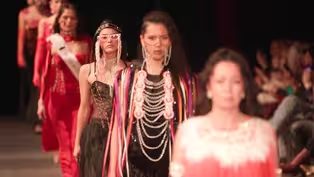
MEGAN THOMPSON: It was what you might expect of a high-end, standing-room-only fashion show, stunning clothing, booming music, and a decked-out crowd recording every minute on their phones.
But what made this runway show different, all the clothing was created by indigenous designers from the U.S. and Canada.
The event was put on by the Southwestern Association for Indian Arts, or SWAIA.
JAMIE SCHULZE, Executive Director, Southwestern Association for Indian Arts: SWAIA Native Fashion Week is the first indigenous fashion week held in the United States.
We have been very invisible or very minimal in some of these industries.
So we are creating a platform to highlight these voices in the world.
MEGAN THOMPSON: Over four days, designers, models, media, and more than 2,000 fashionistas and fans packed photo ops, pop-up shops and more; 17 designers presented at two different runway shows.
The original design of North America is based on indigenous art, technique, design, culture, everything.
AMBER-DAWN BEAR ROBE, Native Art Historian: We're making history here.
MEGAN THOMPSON: Ten years ago, Amber-Dawn Bear Robe produced a single runway show for SWAIA during it's annual Indigenous Art Market.
She says interest has grown so much, she had to create this much larger event.
But Bear Robe, a Native art historian, says what's happening here isn't necessarily new.
For thousands of years, indigenous people have been creating couture, fashion-speak for clothing that is custom-made.
AMBER-DAWN BEAR ROBE: You do not get more couture than hunting an animal, gutting and cleaning intestine to make this pristine, beautiful, exquisite material to make a one-of-a-kind gut skin garment.
MEGAN THOMPSON: Some designers put a modern spin on traditional materials like beads and feathers.
Canadian Helen Oro is Plains Cree from Pelican Lake First Nation.
HELEN ORO, Designer: One of the questions when I first started was, do you have to be indigenous to wear beadwork?
It's for everyone.
MEGAN THOMPSON: For creators who don't have brick-and-mortar stores, the event gave them a chance to sell directly to customers.
Orlando Dugi designs luxury women's and men's wear, all hand-made in his Santa Fe studio.
ORLANDO DUGI, Fashion Designer: The beading, I do all of that myself.
MEGAN THOMPSON: His work is inspired by the stars, which hold important spiritual and cultural meaning for the Navajo.
ORLANDO DUGI: How the stars show up in my work is through a lot of beading and embroidery, lots of sparkles.
And I chose evening wear because its usually worn at night under the stars.
MEGAN THOMPSON: Dugi's new collection, which he's planning to launch next year, is called Stargazer.
ORLANDO DUGI: It's a crew in a ship traveling the galaxy.
I want to represent my culture, my heritage, but without being very literal in translation.
One of the challenges is my work not being Native enough for non-Native people and also Native people.
PATRICIA MICHAELS, Fashion Designer: There are expectations of what a Native designer should be, and I have run away from that concept my whole life.
Beautiful.
MEGAN THOMPSON: Taos Pueblo designer Patricia Michaels has been in the business for 40 years.
And she says she's always dealt with ignorance and stereotypes, including in 2013, when she was the first Native American on the long-running hugely popular TV show "Project Runway," where she made it all the way to the final.
PATRICIA MICHAELS: Being Taos Pueblo, living matter is important to us.
So, many of the imagery that I have on my hand-painted silks and different fabrications of my textiles are ideas that come from nature.
TANTOO CARDINAL, Actress: Amazing.
(APPLAUSE) MEGAN THOMPSON: Michaels recently made a dress for actor Tantoo Cardinal, who starred in the Oscar-nominated "Killers of the Flower Moon," to wear to the Cannes Film Festival.
PATRICIA MICHAELS: I thought of an eagle headdress.
And that's the biggest honor.
So I took it from the man's head and I flipped it, and I put it at her core, and I wanted her to feel like she was in flight.
TANTOO CARDINAL: I remember when it was shameful to be wearing anything Indian.
And now to see what's happened with our industry, oh, my God.
(CHEERING AND APPLAUSE) MEGAN THOMPSON: But excitement and interest can lead to cultural appropriation, when non-Native designers profit from Native patterns and motifs without permission or acknowledgement.
Ralph Lauren came under fire in 2022 for using indigenous Mexican designs.
PESHAWN BREAD, Filmmaker and Model: And we're working on getting Native people into every department.
MEGAN THOMPSON: Filmmaker and model Peshawn Bread has been working with Ralph Lauren to increase inclusivity.
Last year, the brand announced its first artist-in-residence, Navajo Weaver Naiomi Glasses, who has created two collections so far.
Bread, who is Comanche, Kiowa, And Cherokee, hopes fashion events like this will continue the progress.
PESHAWN BREAD: I really hope that this opens the fashion world's eyes into our world, and successfully creates a bridge where we can collaborate with different brands or anything that we dream of as designers.
MEGAN THOMPSON: This is Bread's first runway show as a designer.
Their collection is an ode to the 1970s, when federal law finally guaranteed Native Americans the right to religious freedom.
PESHAWN BREAD: It was such a politically charged time for indigenous people, for Native people around the country.
So I wanted to imagine, what if we weren't always fighting?
What if we could have some joy?
What would we wear to the disco?
MEGAN THOMPSON: When Saturday's runway show began, Bread's were the first looks to come down the runway.
Seven more designers followed.
For many of the spectators, the show was about more than beautiful clothes.
WOMAN: It became very emotional.
WOMAN: I'm speechless.
WOMAN: This is history in the making.
MEGAN THOMPSON: Patricia Michaels' designs ended the evening, her signature hand-dyed and painted garments receiving a standing ovation from a devoted crowd.
PATRICIA MICHAELS: I see how its evolved so that every Native tribe now can have their story told in a very modern, contemporary sense, without ridicule, but celebration.
MEGAN THOMPSON: For the "PBS News Hour," I'm Megan Thompson in Santa Fe, New Mexico.
AMNA NAWAZ: And, remember, tonight you can watch President Biden's full press conference online at PBS.org/NewsHour and on our YouTube page.
GEOFF BENNETT: And we will have more analysis of the state of the presidential race both online and tomorrow night here on this program.
And that is the "News Hour" for tonight.
I'm Geoff Bennett.
AMNA NAWAZ: And I'm Amna Nawaz.
On behalf of the entire "News Hour" team, thank you for joining us.
Biden faces public test as more call for him to end bid
Video has Closed Captions
Biden faces major public test as more Democrats call for him to step aside (4m 12s)
Democratic strategist warns changing nominee 'not cost-free'
Video has Closed Captions
Democratic strategist warns changing presidential nominee 'is not cost-free' (6m 58s)
Fashion show spotlights work of Indigenous designers
Video has Closed Captions
Groundbreaking fashion show spotlights work of Indigenous designers (6m 55s)
German Chancellor on NATO's future and supporting Ukraine
Video has Closed Captions
German Chancellor Scholz on NATO's future, supporting Ukraine and working with Biden (14m 18s)
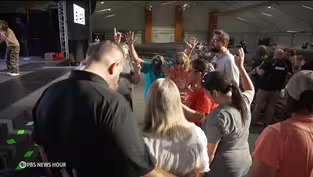
Tennessee church thrives by leaning into hardline politics
Video has Closed Captions
Tennessee church thrives by leaning into hardline politics as attendance falls nationwide (13m 37s)
Providing Support for PBS.org
Learn Moreabout PBS online sponsorship
- News and Public Affairs

FRONTLINE is investigative journalism that questions, explains and changes our world.

- News and Public Affairs

Today's top journalists discuss Washington's current political events and public affairs.

 New Episode





 New Season
 New Episode
Support for PBS provided by:
Major corporate funding for the PBS News Hour is provided by BDO, BNSF, Consumer Cellular, American Cruise Lines, and Raymond James. Funding for the PBS NewsHour Weekend is provided by...