
July 12, 2024 - PBS News Hour full episode
7/12/2024 | 57m 46sVideo has Closed Captions
July 12, 2024 - PBS News Hour full episode
July 12, 2024 - PBS News Hour full episode
Problems playing video? | Closed Captioning Feedback
Problems playing video? | Closed Captioning Feedback
Major corporate funding for the PBS News Hour is provided by BDO, BNSF, Consumer Cellular, American Cruise Lines, and Raymond James. Funding for the PBS NewsHour Weekend is provided by...
July 12, 2024 - PBS News Hour full episode
7/12/2024 | 57m 46sVideo has Closed Captions
July 12, 2024 - PBS News Hour full episode
Problems playing video? | Closed Captioning Feedback
How to Watch PBS News Hour
PBS News Hour is available to stream on pbs.org and the free PBS App, available on iPhone, Apple TV, Android TV, Android smartphones, Amazon Fire TV, Amazon Fire Tablet, Roku, Samsung Smart TV, LG TV, and Vizio.
Providing Support for PBS.org
Learn Moreabout PBS online sponsorshipAMNA NAWAZ: Good evening.
I'm Amna Nawaz.
GEOFF BENNETT: And I'm Geoff Bennett.
On the "News Hour" tonight: President Biden's news conference fails to quiet his Democratic doubters, who are uneasy about his reelection prospects.
But our new poll shows his potential replacements might not fair fare .
AMNA NAWAZ: A look behind the curtain of the Trump campaign's monthslong strategy to seize on Biden's missteps.
TIM ALBERTA, "The Atlantic": The advertisements that they're cutting, the fund-raising ploys that they're making, the viral Internet videos that they have been churning out, they're all designed around Joe Biden.
GEOFF BENNETT: And the struggle to restore power to more than a million people sweltering in the Texas heat after Hurricane Beryl.
(BREAK) GEOFF BENNETT: Welcome to the "News Hour."
President Biden is facing more calls from Democratic lawmakers to step aside as the party's nominee since his Thursday night press conference.
AMNA NAWAZ: Five House Democrats, Jim Himes, Eric Sorensen, Scott Peters, Brittany Pettersen, and Mike Levin, have all issued statements asking for the president to step down.
They joined 15 other congressional Democrats who've made similar calls earlier this week.
Our White House correspondent, Laura Barron-Lopez, has the latest.
JOE BIDEN, President of the United States: Thank you.
Please be seated.
LAURA BARRON-LOPEZ: With all eyes on his high-stakes press conference... JOE BIDEN: I'm not in this for my legacy.
I'm in this to complete the job I started.
LAURA BARRON-LOPEZ: ... President Biden played defense Thursday night, trying to prove that he's still fit to run for reelection.
JOE BIDEN: A lot can happen.
But I think I'm the best qualified -- I know -- I believe I'm the best qualified to govern.
And I think I'm the best qualified to win.
LAURA BARRON-LOPEZ: And while there were gaffes and slip-ups.
QUESTION: What concerns do you have about Vice President Harris' ability to beat Donald Trump if she were at the top of the ticket?
JOE BIDEN: Look, I wouldn't have picked Vice President Trump (sic) to be vice president if I think she's not qualified to be president.
LAURA BARRON-LOPEZ: He gave detailed answers on foreign policy and national security.
JOE BIDEN: China has to understand that if they are supplying Russia with information and capacity, along with working with North Korea and others to help Russia in armament, that they're not going to benefit economically as a consequence of that.
LAURA BARRON-LOPEZ: And went after Donald Trump on his plans for a second term.
JOE BIDEN: Do you think democracy is under siege based on Project 2025?
Do you think he means what he says when he says he's going to do away with the civil service, eliminate the Department of Education?
We have never been here before.
And that's the other reason why I didn't, as you say, hand off to another generation.
I have got to finish this job.
LAURA BARRON-LOPEZ: But it wasn't enough to stop some Democrats from urging him to step aside as the party's nominee.
Immediately after the press conference, Connecticut Representative Jim Himes, the top Democrat on the House Intelligence Committee, issued a statement calling on Biden to step away from the presidential race and urged Democrats to act fast.
REP. JIM HIMES (D-CT): This is not about one press conference, one debate, one speech.
This is about the presidency of the United States.
This needs to be resolved, I don't know, in the next five to seven days, because we just went 10 days where the story was not Donald Trump promising totalitarianism.
It was, how is Joe Biden going to do in the big boy press conference?
LAURA BARRON-LOPEZ: Despite the growing number of congressional Democrats calling for Biden to drop out of the race, longtime allies like Congressman Jim Clyburn reaffirmed their support for the president.
REP. JAMES CLYBURN (D-SC): I would hope that we will focus on the substance of this man, rather than these sometimes misspoken words and phrases, and how he has run this country.
I'm riding with Biden no matter what direction he goes, no matter what method he takes.
I'm with Joe Biden.
And if he were to change his mind, I will just answer the question that I would be all in for the vice president.
LAURA BARRON-LOPEZ: As Democrats figure out what to do about their nominee, House Minority Leader Hakeem Jeffries said he met with the president shortly after Thursday's press conference.
In that meeting, Jeffries said that he directly expressed the full breadth of insight, heartfelt perspectives, and conclusions about the path forward that the caucus has shared.
In an attempt to assuage fears, Biden himself virtually met Friday with some members of the Congressional Hispanic Caucus and the Congressional Asian Pacific American Caucus, and planned to speak with more Hill Democrats over the weekend.
For now, the president has no plans to step aside, unless his advisers say otherwise.
JOE BIDEN: Unless they came back and said, there's no way you can win, me.
No one's saying that.
No poll says that.
There are other people who could beat Trump too.
But it's awful hard to start -- start from scratch.
LAURA BARRON-LOPEZ: And members of the president's inner circle, like former White House Chief of Staff Ron Klain, say yesterday's press conference are reason enough to end the freak-out and unite behind Biden.
Hitting the campaign trail today in the battleground state of Michigan, the president showed no signs of backing down.
His next test, another cable news interview on Monday and campaign stops next week.
For the PBS "News Hour," I'm Laura Barron-Lopez.
AMNA NAWAZ: Despite Democratic concerns about Biden's candidacy, new polling out today shows the state of the race has not drastically changed since the debate.
To walk us through these new numbers, I'm joined now by NPR's Domenico Montanaro.
Always good to see you.
DOMENICO MONTANARO, Political Editor, NPR: Good to see you too.
AMNA NAWAZ: So as more lawmakers are coming out calling for him to step aside, the question has been how voters look at this.
The latest numbers from PBS/NPR/Marist polls actually show that Mr. Biden is now leading former President Trump 50 to 48 in a head-to-head matchup.
When third parties, however, are factored in, he slips slightly, but it's still a statistical dead heat there, with Trump at 43 percent, Biden at 42.
What stands out to you about those numbers?
DOMENICO MONTANARO: Well, I mean, it's been a marginal race the entire time.
Not much clearly has changed nationally when it comes to Trump versus Biden.
I also think we still have to take into consideration that there's humongous antipathy toward Donald Trump.
I mean, you easily could see in all these numbers that more than half the country doesn't want Donald Trump to be president again, but it's really less Joe Biden versus Donald Trump somewhat and Joe Biden versus the couch.
AMNA NAWAZ: So, should we take these numbers to mean that voters don't actually have the same concerns about Biden's age or his mental acuity as Democratic lawmakers who are asking him to step down to?
DOMENICO MONTANARO: Not necessarily.
And the other question is, what are their choices, right?
But when we look at some of the numbers inside the survey, actually, two-thirds of respondents said that Biden does not have the mental fitness to be president, but character may matter more; 68 percent said that it's more concerning to have a president who doesn't tell the truth than one who might be too old to do the job.
So, pretty remarkable numbers.
And I think that really says something about these two candidates and what people think is important.
Yes, we saw, like we just showed, two-thirds of people saying that Biden lacks the mental acuity.
However, at the same time, if you think somebody isn't telling the truth, doesn't have the character to serve, and that's what we're seeing, that Biden has more points for character and honesty than Donald Trump.
AMNA NAWAZ: OK, so some of Mr. Biden's critics also argue that another younger Democratic candidate might inspire more enthusiasm or could more easily beat Donald Trump.
Is that showing up in the polling?
DOMENICO MONTANARO: Well, look, I mean, we tested four people, President Trump, Vice President Harris, Michigan Governor Gretchen Whitmer and California Governor Gavin Newsom.
Everybody did about exactly the same.
Now, maybe that's because they're a generic Democrat and they sort of test that way.
There are slight nuance differences between each of the candidates.
Newsom does a little bit better with independents.
Partially, that could be because he does appear on FOX News quite a bit and there's more exposure to some of those Republican-leaning independents.
Vice President Harris does much better than President Biden, by the way, with nonwhite voters and younger voters.
Gen Z millennials, she does 12 points better than Biden and, with nonwhite voters, 10 points better.
So, something to consider there, especially when you think about who has electoral prowess or not.
Now, when these candidates start to actually run, if they were to run, if they were to replace President Biden, then they get to make the case for themselves, or they also get a lot more media scrutiny too.
AMNA NAWAZ: OK, so let's add some context here, because viewers will have seen Amy Walter of The Cook Political Report here just a couple of days ago walking us through some of their polling at the state level.
And what she showed us was that we saw voters in six states, six states that were previously tossups or likely Democratic states move closer to Trump after the debate.
Those include the battleground states of Arizona, Georgia, and Nevada.
How do you square that at the state level with what we're seeing in these polls at the national?
DOMENICO MONTANARO: Well, not that surprising, to be honest, because national polls reflect what the country feels at large.
But we are not in a situation where you have the popular vote determining who the president is.
And because Democratic votes are so concentrated on the coast, one in five Democratic votes come from California and New York.
That's it.
So if you have that kind of concentration and you don't have the Democratic votes spread out into some of those swing areas, then those swing areas, those swing states are slightly more conservative.
So, frankly, President Biden has had this sort of lead with Trump or within the margin.
A two-point lead for a Democrat nationally is not really that good for somebody like Biden, because it needs to be probably a little bit bigger than that to translate to electoral vote success.
AMNA NAWAZ: OK, I do want to get your take on what President Biden had to say about the polls himself last night.
Take a listen.
JOE BIDEN: How accurate does anybody think the polls are these days?
I can give you a series of polls where you have likely voters, me versus Trump, where I win all the time.
When the unlikely voters vote, he wins sometimes.
The bottom line is, all the polling data right now, which I think is premature, because the campaign really hasn't even started.
DOMENICO MONTANARO: Well, the campaign's been going on for two years.
He's actually right that those who say that they're definitely voting are doing better for Biden.
But I will say, politicians always say that the polls are wrong when they're not good for them.
AMNA NAWAZ: That's NPR senior political editor and correspondent Domenico Montanaro.
Always great to see you.
Thank you.
DOMENICO MONTANARO: You too.
Thank you.
GEOFF BENNETT: Let's shift our focus now to the Trump campaign.
A new piece in "The Atlantic" offers a rare behind-the-scenes look at Donald Trump's reelection effort.
Staff writer Tim Alberta embedded with the campaign this past spring and spoke with Trump campaign co-managers Susie Wiles and Chris LaCivita for a piece titled "Trump Is Planning for a Landslide Win."
Tim Alberta joins us now.
Thanks so much for being with us.
TIM ALBERTA, "The Atlantic": Hey, thanks, Geoff.
My pleasure.
GEOFF BENNETT: When you write that Donald Trump and his campaign are planning for a landslide, what accounts for that level of confidence?
What is it rooted in?
TIM ALBERTA: Well a couple of things, Geoff.
I think, first, the context matters quite a bit here.
When you think about the past two presidential elections, 2016 won very narrowly by Donald Trump, we're talking about a difference at the end of the day of 77,744 votes spread across three states.
That was Donald Trump's margin of victory in 2016.
And then, in 2020, it was actually even tighter.
Joe Biden won by a combined 42,918 votes spread across three states.
So we have had these consecutive nail-biters in the Electoral College.
And the Trump campaign looks at 2024 in that context.
They are now running a campaign that is far more sophisticated, far more efficient with its money, far more professional from the top down.
And they also believe that they are running against the weakest candidate in any of those three elections.
So, to be clear, Geoff, the confidence is really not rooted in Donald Trump.
It is rooted in Joe Biden.
The Trump campaign believes that Biden is a fundamentally flawed candidate and that they are actually sort of building a campaign that is specifically designed to draw out and exacerbate his key weaknesses as an opponent.
And, to be clear, all of this was well before the debate in late June that has the Democrats now wondering whether Biden should even be their nominee.
GEOFF BENNETT: Well, your reporting that the Trump campaign is optimized to run a very specific race against a specific candidate, Joe Biden, how are they responding to this potential change of the ticket?
And I should underscore and emphasize the word potential because President Biden says he's not stepping aside.
TIM ALBERTA: I think they're pretty anxious about it, Geoff.
To be clear, the Trump campaign will tell you, at least on the record, that they are happy to run against anyone, that any Democratic replacement would inherit Joe Biden's flaws and his weaknesses.
But that's not true.
And they know that it's not true.
They recognize that this is a campaign, as you just said, that's been designed around beating one very specific opponent.
And everything they have been doing, the targeting that they have been doing of voters, the advertisements that they're cutting, the fund-raising ploys that they're making, the viral Internet videos that they have been churning out, they're all designed around Joe Biden.
So if suddenly he were replaced at the top of the ticket, I think in many ways it's back to square one for the Trump campaign.
They recognize this.
And I think they're deeply unnerved by the possibility of a switcheroo at the top of the Democratic ticket.
GEOFF BENNETT: Trump's previous campaigns in 2016 and 2020, certainly well-funded, not as well organized, or as well-disciplined.
What does Susie Wiles and Chris LaCivita bring to the 2024 effort?
TIM ALBERTA: I think that you have to realize that, in politics, there are people who are sort of practitioners, there are folks who will sort of latch onto campaigns and maybe offer some advice on polling or on strategy or speechwriting or whatever else, but then there are sort of a select class of people who are truly the sort of the brains behind an operation, the people who can really run campaigns at a tactical, mechanical level in a way that few others can.
And Susie Wiles, in particular, is someone who has earned that reputation over a number of years.
I think I'd mostly point, Geoff, to the fact that Florida, which had for decades been regarded as the nation's top electoral prize, is no longer even on the table.
Democrats have conceded the state of Florida in this election.
They're not even playing there.
And when you wonder why, the answer is Susie Wiles.
She, more than anyone, had engineered campaigns on behalf of Republicans in Florida that effectively made the state not competitive anymore for Democrats, because Republicans were winning so many nonwhite voters in those elections.
She has taken some of that same modeling, some of that same targeting approach and put it into practice in this Trump 2024 campaign.
And then I think her partner, Chris LaCivita, he is best known as the ad maker who created the Swift Boat Veterans for Truth campaign that really devastated John Kerry back in 2004.
And LaCivita is best understood as a shrewd and ruthless operative who really understands how to target an opponent's weaknesses.
And that is really the combination, Wiles and LaCivita, these unique skill sets, they are two of really the most feared operators I have ever been around in politics.
And, together, they have really, I think, streamlined the Trump operation.
And, also, I think that they have streamlined Donald Trump a little bit.
I think that they have been able to bring him into alignment with their goals as a campaign in ways that no one else has been able to.
GEOFF BENNETT: What is their preferred path to victory?
I ask because the Biden campaign put out a memo this past week that said there are multiple pathways to 270 electoral votes.
Right now, they write winning the blue wall states -- that's Michigan, Wisconsin and Pennsylvania -- is the clearest pathway to that aim.
Does the Trump team see a path that is equally as narrow?
TIM ALBERTA: You know, I think the one thing both campaigns would agree on at this point is that Biden's path to 270 has gotten smaller and smaller.
And, really, what the polling has shown, the polling that's publicly available, the polling that's been done by both parties, suggests that Michigan, Wisconsin and Pennsylvania, the three states that Trump flipped in 2016 and that Biden flipped back in 2020, that those three states really are the pathway for Joe Biden to get reelected and that, if any one of those three states is taken off the board by Trump, the math at that point becomes pretty much unworkable for the Democrats.
GEOFF BENNETT: Tim Alberta of "The Atlantic," thanks so much, Tim.
We appreciate it.
TIM ALBERTA: You bet.
Thanks.
GEOFF BENNETT: The lingering impact of Hurricane Beryl starts the day's other headlines.
More than 800,000 customers in the metro Houston area still don't have power.
That's left many hot and frustrated during what has been a blistering heat wave this past week.
With no power and no air conditioning and perhaps none before next week, many residents in and around Houston are reaching their own boiling points.
WOMAN: How in the world can it take almost a week, and then you're talking until Saturday, maybe Sunday, maybe next week?
How is that possible?
GEOFF BENNETT: CenterPoint, the primary electric utility in the area, which is working to restore power, said more than 400,000 businesses and homes might not have electricity even by early next week.
Many are struggling to find refuge from the sweltering heat or have access to food and clean drinking water in some cases.
ERICA ROBINSON, Houston, Texas, Resident: I'm about to lose the resources that I have and I'm about to lose all the energy that I have trying to survive.
RAQUEL DESIMONE, Houston, Texas, Resident: I have been here since 2000-something.
So I went through Rita and Ike, Imelda, Harvey.
And then this year, my complex has lost power twice without hurricanes, so sort of used to it.
It's really frustrating.
GEOFF BENNETT: Many Houston area hospitals and emergency rooms have been jam-packed for days, since many patients could not be released home safely.
And some were treated at makeshift clinics at the NRG Park sports complex.
CenterPoint says it's restored power to over 1.4 million customers, faster than other utilities have during similar storms.
It also says it pledges to restore power to 80 percent of those who were affected by Sunday night.
PAUL LOCK, Manager of Local Government Relations, CenterPoint Energy: I know it's hot.
I'm thankful for the rain to cool things off.
Everyone here is exhausted, but we will continue to work around the clock to get everyone restored as quickly as possible.
GEOFF BENNETT: But the company is getting heavy criticism from residents, businesses and lawmakers who argue it should have been better prepared.
Lieutenant Governor Dan Patrick, who is acting governor while Governor Greg Abbott is away on a work trip, says he plans to hold CenterPoint accountable for their mistakes.
LT. GOV.
DAN PATRICK (R-TX): But, right now, I want every person at CenterPoint to have one job.
Get the power back on.
We will talk about what happened before the storm later.
Just get the power back on.
GEOFF BENNETT: Hurricane Beryl is the latest in a number of storms that have wreaked havoc in the Houston area in just a few weeks.
A series of winter storms in 2021 also crippled Texas' energy grid and left millions of people without heat or power for several days.
Michael Webber, a professor of energy resources at the University of Texas at Austin, says climate change is accelerating the problems in Texas and for the national energy grid too.
MICHAEL WEBBER, Professor of Energy Resources, University of Texas at Austin: A lot of our grid was built up decades or a century ago, when the weather was milder, and the weather is becoming more intense and frequent with its storms, which includes wind and water and drought and freeze and heat wave and everything.
And so we have to build that grid of the future.
GEOFF BENNETT: CenterPoint is proposing a $2 billion resiliency plan to improve the grid.
Webber says steps like strengthening transmission poles with steel or concrete or moving some power lines underground may be necessary.
But, to do that, he says, voters and politicians have to acknowledge and confront the realities of climate change in a state where that's not always popular.
MICHAEL WEBBER: The investments to harden the grid are expensive.
They cost billions of dollars.
But they save lives and they avoid outages and they save money in the long run.
And we have to choose between paying money up front to make the system better or paying money later, when the system fails.
GEOFF BENNETT: After thunderstorms this weekend, which could slow repairs, temperatures are expected to return to the 90s starting on Sunday.
The lasting effects of Beryl are also being felt nearly 2,000 miles away, in Vermont, where cleanup has started after devastating and deadly flash floods.
Beryl dumped a half-foot of rain on parts of the state this week.
At least two people died when their vehicles were submerged in the floods.
Entire neighborhoods are still underwater.
Where the floods have receded, roadways had fallen into sinkholes and communities were caked in mud.
Vermont was hit by flooding at exactly this time last year.
GRANT NELSON, Vermont Resident: What I'd say is that anybody that denies climate change can get a dose of this and decide for themselves.
GEOFF BENNETT: Vermont's governor says it'll take several more days to know the full extent of the damage.
In the Middle East, Israeli forces have pulled back from Gaza City, leaving behind scenes of destruction.
Fires were still burning today, as Palestinians returned home to check the damage.
Civil defense workers say that dozens of bodies were found on the streets and in collapsed buildings.
Earlier in the week, Israel ordered all Palestinians to leave the area, saying Hamas militants had regrouped there.
Most of Gaza City's population fled earlier in the war, but the U.N. estimates that some 300,000 people remain in the surrounding area.
AT&T said today that a security breach in 2022 affected nearly all of its cell phone customers and many users of its landline and wireless networks.
The company says roughly 109 million customers' accounts were affected.
Their data was downloaded to a third-party platform over a five-month period in 2022.
AT&T says the compromised data includes records of phone calls and texts, but it does not involve the content of those calls or sensitive information like birthdays or Social Security numbers.
In New Mexico, the judge and Alec Baldwin's involuntary manslaughter trial has dismissed the case against him.
Baldwin's defense team had alleged that prosecutors hid evidence about the ammunition that killed the cinematographer on the film Rust in 2021.
Baldwin had been holding the gun when it went off during rehearsals.
Judge Mary Marlowe Sommer agreed with the defense, saying that -- quote -- "The sanction of dismissal is the only warranted remedy."
Baldwin faced up to 18 months in prison if convicted.
The 66-year-old had pleaded not guilty, saying he did not know the revolver contained a live round.
Officials in Tulsa, Oklahoma, have announced details of the first person to be identified from a mass grave stemming from the city's 1921 race massacre.
C.L.
Daniel was a World War I veteran who was passing through Tulsa at the time of the attack.
Forensic experts have collected DNA from a total of 30 sets of remains.
They're from the more than 120 graves that were found during searches that started back in 2020.
As many as 300 people were killed when a white mob destroyed what was then known as Black Wall Street.
City officials hope today's announcement will bring some comfort to his family.
G.T.
BYNUM (R), Mayor of Tulsa, Oklahoma: As a parent, I can't help but think about his mom, Mrs. Daniel, who knew her brave son had been killed, but never knew what became of his remains.
Today, I hope that this generation of Tulsans can appreciate that you have helped this family find their relative after he was missing for 103 years.
GEOFF BENNETT: The city of Tulsa and field experts will start a fourth excavation at the Oaklawn Cemetery starting the week of July 22.
On Wall Street today, stocks rose on bets the Federal Reserve will cut interest rates in September.
The Dow Jones industrial average touched an all-time high during Friday's session before closing just before -- just above, rather, the 40,000-point level.
The Nasdaq jumped more than 100 points to close near an all-time high, and the S&P 500 also posted gains to wrap up the week.
And a passing of note from the field of health care.
Gail Wilensky has died.
Wilensky oversaw the Medicare and Medicaid programs during former President George H.W.
Bush's administration and was a senior adviser to the president.
And she appeared many times on this program, including this clip from 2009 with Judy Woodruff.
She would join us to talk about the Affordable Care Act, Medicaid expansion and more.
Gail Wilensky was 81 years old.
Still to come on the "News Hour": the death of a Black man killed by security guards in Milwaukee draws comparisons to George Floyd; David Brooks and Jonathan Capehart weigh in on President Biden's campaign; and a concert celebrates NATO's 75th anniversary with music from its member nations.
AMNA NAWAZ: Police have referred felony murder charges and a case involving a Black man who died last month after being held down by security guards outside a Milwaukee hotel.
According to the city's police department, 43-year-old D'Vontaye Mitchell entered the Hyatt Regency and -- quote -- "caused a disturbance," ending up in an altercation with security guards as they attempted to detain him.
A warning, this disturbing video was taken by bystanders and shows what happened next.
Four individuals restrained Mitchell outside while he was lying prone on the concrete and shouting repeatedly for help.
At least one man can be seen with his knee on Mitchell's back.
Police say he was unresponsive when they arrived and was later pronounced dead.
This week, his widow, DeAsia Harmon, spoke at a rally outside the county courthouse.
DEASIA HARMON, Widow of D'Vontaye Mitchell: To see them beat him repeatedly over and over and over again, they didn't stop.
They could have stopped.
They could have let him go, and they didn't.
To do him like that and to embarrass him like that, to destroy his character, to just take away his dignity, that was so wrong of them to do.
AMNA NAWAZ: For more now, we are joined by attorney Ben Crump, who's Mitchell family, and by Nayisha Mitchell, who is D'Vontaye's sister.
Welcome to you both.
And, Ms. Mitchell, let me just begin by saying how incredibly sorry we are for you and your family's loss.
I just want to begin by asking, how are you doing?
NAYISHA MITCHELL, Sister of D'Vontaye Mitchell: Well, first, I want to say thank you for that.
And it's been rough.
It's been hard.
It's been a long past week-and-a-half since it happened.
It's been a lot going on.
It's exhausting.
My brother's gone.
He's no longer here with us.
We no longer have him with us, with the family.
His kids no longer have their father.
My mother no longer has her son.
So it's been rough.
It's been hard.
And it's going to be some adjustments here for us all.
Right now, we're just trying to get through this, this time.
And we're going to keep on moving forward.
And we're not going to rest.
And we're just going to be tired until we get justice here for my brother.
AMNA NAWAZ: And, Mr. Crump, I understand that you and members of the family have had a chance to review some security camera video from inside the hotel, which is showing you more than has been publicly released so far.
Does any of that offer you any insight into how this incident began in the first place?
BENJAMIN CRUMP, Mitchell Family Attorney: Well, it's a heartbreaking video from the security cameras inside the hotel.
It starts with him being chased.
And he's chased through the hotel.
He runs into the gift shop, and then he runs into the ladies' bathroom.
And the two women that were in the bathroom said he wasn't trying to harm them or anything.
It was as if he was afraid, he was scared, he was trying to get away from somebody.
We now know that was the security, apparently, that was chasing him.
And then they went into the bathroom and they drug him out.
And while they were doing so, the video shows him being punched and kicked while he's on the ground, being dragged.
And it's just heartbreaking.
They have a metal baton that one of the security guards take out that you see on the bystander video.
And he's hitting him.
And it looks like he's hitting him in the head.
And you ask yourself, why would you do that?
It's just heartbreaking, when you think about George Floyd was in that prone position with knees on his back and on his neck for nine minutes and 29 seconds.
Well, D'Vontaye Mitchell was in that prone position for at least eight, we believe as long as 10 minutes, with a knee on his back and at times a knee on his neck.
And you had all the punching and kicking and the baton, which makes his tragic video as outrageous as George Floyd's video.
AMNA NAWAZ: And, Ms. Mitchell, Mr. Crump has said previously this raises so many questions about the use of force here, and particularly in the case of people who are having a mental health emergency of some kind.
What should we understand about what about your late brother's mental health or his condition at the time?
NAYISHA MITCHELL: We really don't know what was happening and what was going on at that time, when he was down at the Hyatt.
But what I'm saying here is that, as far as mental issues go, my brother did suffer from having depression.
Again, I'm not exactly sure what was happening down at the Hyatt when this all transpired.
And if they're saying that he was in there causing a disturbance, that's where I come in and say, maybe he was having a breakdown.
Whatever he was running from, whatever caused this all to happen, we still don't know.
We -- that's what we're trying to find out.
We're trying to find out why he was running.
We have learned that he was running from the security guards, but why was he running from the security guards?
But as far as mental health, again, D'Vontaye, for the most part, was suffering from depression.
AMNA NAWAZ: Mr. Crump, can I just get your reaction to this latest news now?
We know that police have referred felony murder charges to the district attorney.
The DA's office says they're investigating Mr. Mitchell's death as a homicide.
Is that what you want to see happen at this point?
BENJAMIN CRUMP: Well, we want the state attorney to go ahead and bring the charges, but we're grateful that the Milwaukee Police Department did refer murder charges to the state attorney.
But we know this is only the beginning of the journey.
We know from history that, until they charge them, until they're convicted, African Americans can never take for granted that we're going to have equal justice play out when there's a dead Black person laying on the ground.
We have got too many examples of them doing the bait-and-switch.
So, we have to keep vigilant and keep focused.
Before last week, they wasn't even investigating this matter as a criminal investigation.
It wasn't until the family and the activists started saying, no, did you all see the video?
How can you say that they shouldn't be held accountable for how they killed her brother?
And so it's a first step, but we have to continue to keep pressing forward.
Two many examples in the Black community of the police and quasi-police getting away with unjustly killing our children.
AMNA NAWAZ: To that point, Mr. Crump, I think one of the reasons this video has resonated so deeply is because of how hauntingly similar it is to George Floyd, who I know -- his family, I know you represented four years ago.
And I just wonder how it strikes you that you are having to have this conversation again in two such similar cases four years apart?
BENJAMIN CRUMP: Yes, obviously, it's very personal, because we watched the George Floyd tragic torture video for 10,000 times.
And now we're having to break this video of the killing of D'Vontaye Mitchell frame by frame.
And it does remind you at times of George Floyd and the inhumanity of the situation, a man who's begging to his very last breath, please help me.
And none of them would help him.
And so that's what we have to learn, America.
How many more times do Black men in prone positions having breathing problems have to plead for their life before America hears them?
How many more times?
It was Eric Garner.
It was George Floyd.
It was Irvo Otieno in Virginia.
It was Frank Tyson in Ohio, and now it's D'Vontaye Mitchell.
And when you look at all these videos, they are Black men on prone positions with law enforcement on their backs with their knees on them, and all of them died.
How many more?
AMNA NAWAZ: Attorney Ben Crump and Nayisha Mitchell, sister of the late D'Vontaye Mitchell, thank you so much to you both for joining us.
NAYISHA MITCHELL: You're welcome.
BENJAMIN CRUMP: Thank you.
NAYISHA MITCHELL: Thanks for having us.
GEOFF BENNETT: On the week's major political stories, from President Biden's struggles within his own party, to the Republican National Convention next week, we turn to the analysis of Brooks and Capehart.
That's New York Times columnist David Brooks, and Jonathan Capehart, associate editor for The Washington Post.
Thank you both for being here.
JONATHAN CAPEHART: Geoff.
GEOFF BENNETT: So, President Biden's press conference last night might have reassured some Democrats, but it has not come close to ending this ongoing conversation about whether or not he should withdraw from the race.
Jonathan, how do you assess this current moment?
JONATHAN CAPEHART: We don't have enough time for me to climb up on my soapbox and climb back down.
Look, ever since that disastrous debate performance two weeks ago last night, Democrats have been tearing their hair out, self-immolating, and saying what they need to see from the president to make them assured that he is up to the task.
He needs to show some life and some vigor.
He does a rally in Raleigh the very next day.
He needs to sit down with the press and do an in-depth interview.
He sits down with George Stephanopoulos a week ago tonight.
He's sitting down with Lester Holt at NBC on Monday.
He needs to be extemporaneous and do things like that.
He goes to the AFL-CIO, speaks with them, microphone, no teleprompter.
He did it again today in Michigan.
He did it.
He needs to talk to the press.
He needs to take questions from the press.
He's been ignoring us -- 59 minutes last night, he answered questions, particularly an impressive question from your colleague David Sanger at The New York Times, which I thought -- I'm sure he didn't do this on purpose, but was devious in how it -- in the question that he asked, a multipart, very complex foreign relations question that the president answered, to the point where the press conference got boring, because he got so deep in the weeds.
I raise all of these things because people keep putting up these goalposts.
He meets them, and then they move them again.
Clearly, people are - - they're not satisfied.
They want someone else, as if they're living in some Aaron Sorkin fantasyland that everything will work itself out in the end with one really good speech, one really great candidate at the end of the hour.
This is real life, and real life is scary.
GEOFF BENNETT: What about that, David, that these Democrats who are critical of President Biden are effectively seeing what they want to see?
And how do you view this?
Should he stay in the race or is he on track to losing the White House, with Democrats potentially losing the House and the Senate?
DAVID BROOKS: Well, first of all, I look at the press conference.
It was -- it reminded me when I used to watch Reagan and when I'm back when I was a young Reaganite.
And I would, like, watch the press conferences through closed -- like my hands up, like, what's he going to say now?
I hope it's not bad.
I hope it's not bad.
But when you looked at the judgments that he made about world history and historical events, in my view, Reagan's judgments were sound about the Soviet Union.
And I felt that way with Biden.
He's not what he was a year ago.
He's certainly not what he was 10 years ago.
I think the Biden we saw at the press is the Biden that is there, which is a little mentally slow, a little cumbersome in his articulation, but basically with sound judgments.
Now, will this get him out of the woods?
He's got to show some way to win this thing.
And that's getting harder and harder to see, when you have swing states, The Cook Report switching them, swing states, over to the Trump, when you see states that should not be swing states like Minnesota being switched over to swing states, when you have Democrats in New York state panicking, that's pretty bad.
And so, to me, it's less about how he performs on any given day, but what's the plausible strategy to victory?
And I just don't see that out of the Biden campaign right now.
GEOFF BENNETT: Jonathan, adding to the polling that David mentioned, our new poll, 55 percent of voters want Joe Biden out of the race.
In some ways, that has been the story of this election cycle, where the majority of Americans have said that they don't want to see a match-up, a Trump-Biden match-up, and yet here we are.
How does this campaign, how does the White House turn the page and focus their attention Donald Trump and his agenda and his vision for the country?
JONATHAN CAPEHART: Well, one, start talking about Donald Trump and his agenda for the country.
But the other thing is, everyone is focused on the number that shows how many people want him out of the race, how many people think he's too old, how many people think he's not -- he doesn't have the mental acuity that he had 10 years ago, and not focus on the other numbers in the polls.
For instance, that -- the NPR poll, this poll that we're talking about -- Biden is up 50-48 in The Washington Post poll that was released yesterday.
For the disastrous debate performance that happened two weeks ago, this poll is -- was conducted after that.
Despite that, Donald Trump and President Biden are tied.
They are tied.
If this race is lost, if it's so disastrous, why don't these two poll numbers, these two polls that I just talked about, why haven't they cratered?
And that's the thing that's driving me absolutely crazy.
These scaredy-cats, scaredy-crats, that are out there screaming that the house is on fire, we're going to lose everything, and yet we now have two national polls that don't reflect that reality.
I want those people who are saying he should get out of the race, please tell me, what are the numbers you are using?
What do you see that the rest of us don't see?
Tell us, because if you can show me, if you can back up your conjecture that we're going to lose the White House, lose the Senate, lose the House, then show me the numbers, and then maybe, maybe I will set my hair on fire too.
GEOFF BENNETT: David, I want to get your take on this -- on the national conversation and our coverage of it.
And I raise the question because I was talking to a top Democrat this morning who said that there's too much focus on performance and not enough focus on substance, and that we, we in the media, have basically failed to learn the lesson of 2016, and that, when President Biden was giving that press conference last night at NATO, Donald Trump was in Mar-a-Lago alongside Hungarian President Viktor Orban, who is this anti-democracy icon of the far right, and that there's no focus on that.
There's focus -- there's a focus on whether Joe Biden should have a neurological test.
DAVID BROOKS: Well, I think there's some credence to that.
All of us in the media have one thing in common.
We're all in the communication business, and so articulate -- smooth articulation is super important to all of us.
And when we see Joe Biden not smoothly articulating, we assume it's an indictment on his entire cognitive abilities.
And I think that's a little overstretched.
On the other hand, in my -- I will just speak for myself.
The Biden we saw at the press conference, I think, is an adequate president.
He would make the right judgments, his staff would do the things he needed to do, and he'd be an adequate president.
But nobody's worried about 2024.
They're worried about 2025 and 2026 and 2027.
And we have all had relatives and friends who've declined.
And often the pattern is gradually, gradually, all at once.
And so the decline is genuinely worrisome.
So I don't think we're -- we're -- we're paying attention to nothing here.
We're paying attention to whether the president of the United States has the ability to do the hardest job in the world.
And so I think that's legitimate.
JONATHAN CAPEHART: I'm worried about 2025 and 2026 and 2027 as well, but worried about it if Donald Trump is president of the United States.
And if President Biden is reelected with Vice President Kamala Harris, and God forbid something were to happen to the president, the nation would be in good hands with Vice President Harris if she were to have to step in and become president of the United States.
That's the other thing that is driving me crazy about this conversation.
People are acting like there's no succession plan, that there's no one out there.
They're right there.
It's the president and the vice president.
And, look, I have interviewed President Biden on October of '22.
I interviewed him just this past March.
That man we saw at the NATO press conference yesterday is the same person I talked to both those times over the spread of two years.
I am not worried about him, his abilities, his performance or his mental acuity.
GEOFF BENNETT: We have got a couple of minutes left, so let's look forward to the Republican National Convention next week.
The big thing we're basically waiting for is, who is Donald Trump going to pick as his vice presidential nominee?
The reported finalists include Senator J.D.
Vance, North Dakota Governor Doug Burgum, and Senator Marco Rubio of Florida.
Who do you think has the greatest shot?
DAVID BROOKS: We had Tim Alberta on the show earlier.
In his "Atlantic" piece, the Trump campaign kept talking about, we're going to run a visual campaign.
It's got to look pretty.
And we know Biden - - or Trump -- now I'm doing the Biden thing.
(LAUGHTER) DAVID BROOKS: President Trump, he loves -- wants somebody to look the part.
He picked Jim Mattis to look the part.
And so I think Doug Burgum looks the part of a business executive who's going to give you a strong economy.
So I'm going with the guy from the Dakotas.
GEOFF BENNETT: Jonathan?
JONATHAN CAPEHART: He's cribbing my notes.
(LAUGHTER) JONATHAN CAPEHART: Because I have said that.
I think I even said it here.
Absolutely, I think of the three, it's Governor Burgum.
The other thing that Governor Burgum has that the other two don't have is seeming ambition for the job themselves.
And Marco Rubio, Senator Rubio ran for the job himself.
J.D.
Vance, Senator Vance, I'm sure has aspirations, especially if he gets chosen.
Governor Burgum, he's a wealthy man.
He's doing this apparently out of public service.
I don't -- maybe he will have ambition, but I think David is right in quoting me from a while back.
(LAUGHTER) GEOFF BENNETT: Well, final question, David.
Nikki Haley has released her delegates to Donald Trump, but she won't be at the convention because she wasn't invited.
Now, that could change, but as we sit here and talk right now, she's not planning to go.
Was that a mistake?
Was that an unforced error of the Trump team not to invite her?
DAVID BROOKS: Kindergarten level politics is, you try to unite your party, so you invite Nikki Haley.
But Donald Trump does what Donald Trump is going to do.
And I have to say, I'm mystified by how well they're sitting.
I think the Republicans are just sitting pretty and feeling it.
And God is good, omniscient, and omnipotent, and yet somehow he seems to want Donald Trump to be reelected, because there's just been a string of events that have lined up for Trump, whether it's DeSantis being a bad candidate, whether it's the indictments, whether it's the Democrats imploding in the middle of the Republican Convention.
Trump.
GEOFF BENNETT: David Brooks and Jonathan Capehart, we will see you in Milwaukee.
JONATHAN CAPEHART: Yes.
GEOFF BENNETT: Last night, a symphony orchestra at the Library of Congress commemorated NATO's 75th anniversary with an evening of music from its member countries, songs symbolizing hope and solidarity in a trying time.
Here's a look and a listen for our arts and culture series, Canvas.
The concert by the American Pops Orchestra, organized in part by the Atlantic Council, featured professional members of the Pops playing alongside student musicians, composers, and singers hailing from the 32 countries that make up the NATO alliance.
The founder and conductor of the American Pops Orchestra, Luke Frazier, conceived of the idea himself and shared with me earlier this week why he gathered these student artists.
LUKE FRAZIER, Founder and Conductor, American Pops Orchestra: You know, I think all too often we forget to include younger members of our culture in a discussion about foreign policy and especially those that are not in government or policy spaces.
And I think there's no better group to include the musicians, who are used to bringing people together of many different backgrounds.
So when you marry all those ideas together and my personal commitment to the next generation of musicians, it all came together into this NATO Symphony Orchestra.
GEOFF BENNETT: Tell me more about the students.
What has this experience been like for them?
LUKE FRAZIER: They're getting an experience that's unlike any other, not only in their exposure to this diplomatic community, but also in the musical breadth and depth.
And when you're pivoting all the way from Dvorak to Whitney Houston in one concert, it's quite the experience for many of these students, who will never get the chance to do that otherwise.
GEOFF BENNETT: What do you hope they take away from this experience?
LUKE FRAZIER: I hope that they know that they are playing a pivotal role in the future of our world, that by sitting in that orchestral section and telling a story through music, they're helping bridge the divides among so many of the people in this world, and they're helping to make this world a better place.
GEOFF BENNETT: Well, as you mentioned, I mean, just looking at this repertoire, it's an incredible range of music, both in terms of style and origin, from Chopin to The Weeknd.
What was the message you were trying to convey in choosing that selection of songs?
LUKE FRAZIER: Well, what I wanted to make sure is that we're representing the breadth and depth of music in our world.
So many students that are being a part of this process are used to a very strict conservatory training, which is mostly focused on classical music.
And I must confess, my whole background was classical music, and I love it.
But I want to make sure that we are making classical music relevant to new generations.
And we do that by pairing classical music with popular music.
And what's fun is, we're creating this interesting musical dialogue amongst the students and for the audience with this concert.
GEOFF BENNETT: That musical dialogue was on full display during the orchestra's rendition of ABBA's '70s hit "Dancing Queen," which followed this traditional Slovenian folk song.
I know from my own experience, having played in the orchestras when I was a student, there's always one song that everyone loves to perform the most.
What's that song for this group?
LUKE FRAZIER: You know what's fascinating is, one of the pieces that the students seem to be responding the most to, there are two, in particular, that I find them the most compelled by.
One is a beautiful operatic piece, the "Intermezzo" from the "Cavalleria Rusticana."
And the other is Whitney Houston's "Greatest Love of All."
And what I love is that we have a group of students that are open and able to cover so many styles of music and be excited and inspired by it.
GEOFF BENNETT: Why is it important, in your view, for a momentous occasion like this marking the 75th anniversary of the most successful alliance in history to have music at its core?
LUKE FRAZIER: I think one of the best examples that the diplomatic community can learn from is the musical community.
So many times, we have to come together from many different walks of life.
And particularly with this orchestra, they're coming from all over the world for just two days of rehearsals to bring themselves to a common purpose, a common musical purpose.
And so what I find so inspiring, as the conductor, is to bring all of these many different backgrounds together and say, look what we can do even in our own musical space.
And if we can take the lesson from the students, that's how we can start bridging these divides.
GEOFF BENNETT: And our thanks to maestro Luke Frazier for spending some time with us.
His American Pops Orchestra has been featured in 30 national broadcasts here on PBS.
And be sure to tune into "Washington Week With The Atlantic" tonight for a look at President Biden's fight to stay atop his party's presidential ticket.
AMNA NAWAZ: And on "PBS News Weekend": how extreme heat is warping train tracks and causing drawbridges to get stuck, causing major travel woes.
GEOFF BENNETT: And, as we mentioned earlier, next week, Republicans are holding their national convention in Milwaukee.
And we will be there covering it all.
NARRATOR: The 2024 campaign heats up.
DONALD TRUMP, Former President of the United States (R) and Current U.S. Presidential Candidate: We're going to fire crooked Joe Biden.
We are going to make America great again.
NARRATOR: Can former President Trump convinced voters to send him back to the White House?
DONALD TRUMP: This election is a choice between strength and weakness.
NARRATOR: How would he take on the challenges facing America at home and abroad?
A PBS News special, "The Republican National Convention."
Coverage begins on Monday, July 15, at 8:00 p.m. Eastern.
AMNA NAWAZ: And we hope you will tune in and join us.
In the meantime, for tonight, that is the "News Hour."
I'm Amna Nawaz.
GEOFF BENNETT: And I'm Geoff Bennett.
For all of us here at the PBS "News Hour," thanks for spending part of your evening with us.
Have a great weekend.
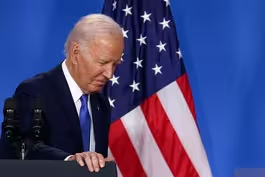
Biden fails to quiet doubters as more express concern
Video has Closed Captions
Biden fails to quiet Democratic doubters as more express concern about his prospects (4m 50s)
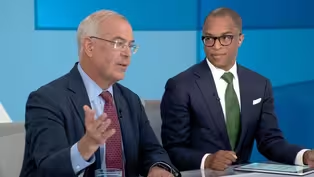
Brooks and Capehart on Biden's battle to stay in the race
Video has Closed Captions
Brooks and Capehart on Biden's battle to stay in the race (10m 50s)
Police refer felony murder charges in death of Milwaukee man
Video has Closed Captions
Police refer felony murder charges in death of Milwaukee man held down by security guards (9m 7s)
Poll shows potential Biden replacements might not do better
Video has Closed Captions
New poll shows potential Biden replacements might not fare better (5m 23s)

Symphony celebrates NATO's 75th anniversary
Video has Closed Captions
Symphony celebrates NATO's 75th anniversary with music from member nations (5m 52s)

The Trump campaign's strategy to seize on Biden's missteps
Video has Closed Captions
Inside the Trump campaign's strategy to seize on Biden's missteps (7m)
Providing Support for PBS.org
Learn Moreabout PBS online sponsorship
- News and Public Affairs

FRONTLINE is investigative journalism that questions, explains and changes our world.
 New Episode
- News and Public Affairs

Today's top journalists discuss Washington's current political events and public affairs.

 New Episode
 New Episode

 New Episode
 New Episode
 New Episode
 New Episode
Support for PBS provided by:
Major corporate funding for the PBS News Hour is provided by BDO, BNSF, Consumer Cellular, American Cruise Lines, and Raymond James. Funding for the PBS NewsHour Weekend is provided by...