
July 15, 2026 - Full Show
7/15/2026 | 26m 47sVideo has Closed Captions
Watch the July 15, 2026, full episode of "Chicago Tonight."
The cost of some goods declines as inflation cools — but uncertainty remains. And a Justice Department memo could have major implications for people with disabilities.
Problems playing video? | Closed Captioning Feedback
Problems playing video? | Closed Captioning Feedback
Chicago Tonight is a local public television program presented by WTTW
WTTW video streaming support provided by members and sponsors.
July 15, 2026 - Full Show
7/15/2026 | 26m 47sVideo has Closed Captions
The cost of some goods declines as inflation cools — but uncertainty remains. And a Justice Department memo could have major implications for people with disabilities.
Problems playing video? | Closed Captioning Feedback
Where to Watch Chicago Tonight
Chicago Tonight is available to stream on pbs.org and the PBS app.

WTTW News Explains
In this Emmy Award-winning series, WTTW News tackles your questions — big and small — about life in the Chicago area. Our video animations guide you through local government, city history, public utilities and everything in between.Providing Support for PBS.org
Learn Moreabout PBS online sponsorship>> Hello and thanks for joining us on Chicago tonight.
I'm Nick Blumberg.
Brandis Friedman has the evening off.
Here's what we're looking at.
Inflation drops.
But will it last as the country's war with Iran reignites?
We hear from the head of Chicago's Federal Reserve Bank.
And less in-home care.
More institutionalization is what disability advocates fear.
A new Department of Justice memo signals.
>> First off tonight pointed questions for President Donald Trump's pick for the next United States attorney General, acting Attorney General Todd Blanche face the Senate Judiciary Committee in a hearing earlier today after the death of Senator Lindsey Graham.
Just one Republican defection could sing clinches nomination.
And Texas Senator John Cornyn who was defeated by a Trump-backed primary challenger, appeared skeptical of Blanche.
So too, was Democratic Illinois Senator Durbin press plans to meet with 10 Jeffrey Epstein victims who were at the hearing.
Lynch says the DOJ already has a point person to meet with victims and Blanche claims he couldn't do so personally.
If they had legal counsel.
>> I think you want to be in the room because you want to hear this.
You've had singular responsibility for these files.
There's a delay in meeting the statutory requirement disclosure.
You were involved in that.
I think you want to be part of this and I definitely part of it.
And I have been from day one and it will be done within the next 30 days.
I I can keep on repeating myself, but I said it could get done as soon as today.
It could have gotten done.
Last week we remain available to meet with any victim or the representative that any time.
>> Blanche also faced questions about President Trump's pardons of January 6th.
Rioters, immigration agents at polling places.
Subpoenas issued to journalists and sweeping protections granted to the president and his family from tax audits.
>> Senate Republican leaders say they plan to call a vote on Lynch's nomination before the August recess.
Tiffany, a funding freeze and a week, a furlough days.
That's a Chicago public schools plans to close a huge budget gap.
The district is facing next year.
Officials released a 9.8 8 billion dollar budget proposal today to close a 732 million dollar budget Gap.
Cps CEO Macklin King says the spending plan relies on 200 million dollars in tax increment financing.
Funding from the city.
It will also implement a mid-year spending freeze across the district.
CBS also expect some 760 teachers and 801 support personnel to be laid off, though.
They say the district has typically rehired around 75% of affected employees in past years.
And it's changing 5 professional development days into unpaid furlough days.
Officials say those furlough days were a last resort option and won't affect instructional time.
We've got more details on our website.
Chicago City Council members passed a 425 million Dollar plan to subsidize the new Chicago Fire stadium.
The funds will come from the area's tax increment financing or TIF districts.
The 22,000 seat soccer stadium broke ground in the South Loop back in March.
The money will be used to connect the stadium to the city's street grid.
Prepare the river wall, improve nearby metro tracks and fund an underground parking garage.
A public plaza will be built on top of the garage and 6 acres of Parkland will be open to the public, according to the plans.
Up next, the head of Chicago's Federal Reserve Bank on the latest inflation numbers and what they mean for consumer costs.
That's right.
After this.
>> Chicago tonight is made possible in part by the Alexander and John Nichols family.
The Pope Brothers Foundation.
And the support of these donors.
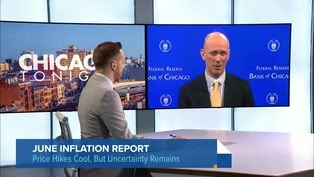
>> Inflation has been a thorn in the side of many Americans over the past 5 years making matters worse.
Is the recent uncertainty from tariffs and the around war.
Meanwhile, changes afoot at the Federal Reserve Bank.
Kevin Warsh was confirmed as the new chair and the central bank may be updating how it communicates rate changes here to break down what it all means for the country.
And for Chicago is Austan Goolsbee, the president of the Federal Reserve Bank of Chicago.
Thank you very much for joining us.
We appreciate your time.
>> Yeah, my pleasure.
Thank you for having me.
>> So what do the latest inflation numbers tell us?
>> Well, you never want to make too much hay out of anyone number.
You know, as as I would say, one month is no months.
You want to get several months.
But it before you think it's a trend we've been going the wrong way with inflation for several months in a row.
But this newest these newest numbers that we got this week.
We're encouraging the slowing down a little bit of the inflation that that we've seen over the past several months.
And if we got more months like the ones that that we got this week.
People I think would be feel.
Perhaps bit more comfortable.
>> And how does the Chicago area compared to what we're seeing nationally?
>> In Chicago, the inflation rate, it tends to be about the same in most parts of the country.
We've been deal.
And as you know it throughout the Midwest Chicago, but a color that population growth has been slower in the Midwest.
Then it has been in the rest of the country.
And so we have been the little bit with that on on the job market side.
But on inflation, that tends to be.
But there's a similar inflation rate everywhere.
>> mentioned the conflict with Iran at the top.
What sort of effect is the uncertainty over the Strait of Hormuz having on prices?
>> And not nothing good.
You know, it ever sense of where we're began.
But everybody that's driving a car.
Look out the window unit.
You know what's what's been happening to into inflation, especially on energy and gasoline prices.
Now, that was supposed to be going away started going away.
As you add these uncertainties that the conflict flares back up in my last a fair bit longer than what people had had been anticipating or than the market.
Futures contracts had been forecasting.
I think that's part of why you're seeing consumer confidence being as weakened as it is in these measures of consumer confidence that people are weighing the uncertainties.
That may be the price of gasoline is going to stay much higher than then where they thought it was going to be for for longer than that.
It has.
>> And beyond oil, be on gas prices.
Are we seeing any supply chain issues related to the war?
>> A little bit, but not much yet because in the run-up to the conflict, people had a little bit an idea that this was coming and they had built up some inventories.
So you haven't seen as much of an impact call it broader supply chain measures you will see, likely if the conflict continues for months and months more.
Now that said impact of higher energy prices is most directly felt at the gas pump or flying on airlines.
Anybody who's using the fields, but then you will likely see that work its way through the economy spill over onto the whatever the cost of FedEX packages, people who are using the vehicles, you'll see it in logistics.
Shipping transportation.
And so the thing the way that factors into broader inflation outside of just that energy sector, you are likely to see that continue a bit.
And even if all the conflict ended by tonight.
It's still going to take some time to re-establish.
And once the conflict in re establish that production capacity, some which were blown up so I do think we want to be realistic about how quickly we can return to normal even when the uncertainty is resolved.
>> Yeah, well, you another question that a lot of folks have of when things might get back to more of a normal baseline, even with tariffs no longer in place.
Are they still impacting consumer prices?
>> And that is hard to say, you know, because that there's still another shoe to drop that the administration some tariffs were disallowed and ma'am, and there might even be refunds.
But they've announced that they intend to replace all of those tariffs at approximately rates that they were before.
So to the extent that that still hangs over us.
I do think you're seeing that Hart least still factoring in kind of the consumer calculus that said.
Done as a one and done tariff tariffs are supposed to raise the prices, the level of prices once, but they're not supposed to be an extended inflationary thing.
And part of the dilemma, let's call it that.
The war began before the tariff impact on inflation and kind of worn away.
We're still living with that and hopefully the drop down of the inflation rate can still take place, at least for the tariff part in regardless of what happens in the from the from the oil shock part.
Yeah.
>> You know you your district spans 5 states in the Midwest.
What what are you seeing in the labor market in our region?
>> Mostly the labor market, these 5 states kind of heart of the Midwest, as you say, most of Iowa, Wisconsin, Illinois, Michigan, Indiana, the labor market has been stable but hasn't has been It it's not deteriorating.
It's not getting better and it's there's conflicting measures.
The hiring rate is extremely low as low as what's normally corresponds with the recession.
But the layoff rate is also extremely low.
What normally corresponds with the the height of the boom.
So we're still kind of trying to wrap our heads around this labor market where those 2 things are happening simultaneously.
It's very unusual.
I think that's because of their big because of the degree of of uncertainty the businesses are facing, then we'll let go of people that it took them a long time and it was hard to get.
But they do want to bring in new people because what if the paraphrase change?
What if the geopolitics changes in the short run?
So we're in a little bit of a holding pattern.
I think that mostly characterizes the labor market throughout the Midwest is that stable without being that that strong?
>> As we mentioned at the top of Kevin Morris was confirmed as the chair of the Federal Reserve.
what's your working relationship like with him?
>> pretty good of.
I knew I was in the first term of the Obama administration during the financial crisis.
And that was when governor was was was at the Fed is as a Fed governor and I kind of went through the financial crisis working pretty closely with him.
I welcome all institutions.
It's helpful to have some some knew rethinks and his task force is where he's going to look at 5 major issues facing the Fed like the measurement of inflation and how we communicate.
And that would discuss rates and the nature of the data and size, the balance sheet.
It's good that with that, think those things true.
Let's let's have a discussion about reforming the the way the Fed does business rent.
I think he's a serious guy.
I saw I saw as his actions in a moment of real stress in the economy.
In 2009, 10, 11 certainly hit battle So so I'm optimistic.
believe that's a Before we run out of time.
You know, one of the potential changes here is that Warsh announced the end of what's called forward guidance from the central bank.
What's the significance of that?
Can you tell us what that means?
>> Yeah, he did indeed, whether that's fancy central bankers phrase for discussing what the committee or the the central Bank thinks is going to happen in the future to rates.
That's the forward guidance.
Giving guidance.
The committee thinks it will do X, Y Z in the future.
He wants the do less of that and I'm sympathetic to doing less of that.
I say speculating about rates is runs the risk that you can undermine the credibility of the central bank anytime the central bank is saying we think we're going to do what?
You don't know what the conditions are going to be when it actually comes to that circumstance.
And then if you end up not doing it.
The market and the public say.
They made us a promise and then they didn't carry it out.
So your credibility takes a hit.
So I personally I'm not supposed to speak for anybody else.
Only for myself on the say I welcome that.
Let's let's rethink a bit.
The forward guidance and and says some of the speculation about the future.
>> All right.
Austan Goolsbee of the Federal Reserve Bank of Chicago.
We thank you for your time.
>> Yeah, great to see you again.
Coming up, our civil rights protections for Americans with disabilities at risk.
>> We explore that next.
The Justice Department memo is raising new questions about decades of civil rights protections for Americans with disabilities.
The memo challenges the Americans with Disabilities Act integration mandate, which requires states to provide services that enable people with disabilities to live in their own communities rather than institutions.
The memo itself isn't legally enforceable, but a new federal case challenging the integration mandate could eventually reach the U.S.
Supreme Court.
Joining us to discuss more are market Shock, CEO of Threshold to nonprofit that provides mental health services in the Chicago area.
Karen Stanley, CEO of Access Living a nonprofit that helps Chicagoans with disabilities live independently or at home.
And Barry Taylor, a law lecturer at the University of Chicago specializing in disability rights.
Thank you all for being here.
We appreciate Thanks for having So very Taylor.
If I can start with you, please.
Can you break down what's in the memo for us?
What is the Justice Department arguing here?
Well, the memos trying to relitigate the case called Homestead.
And that's a really Seminole case that the U.S.
Supreme Court decided in 1999.
Justice Ginsburg issue an opinion that basically said that unjustified isolation and segregation is discrimination under the ADA and she pointed to a DOJ regulation that said that as you mentioned, people should be certain the most integrated setting.
And what we're seeing in this memo and I won make clear.
It's a memo is not regulation is not a change in the law.
Only Congress can change the law.
The memo saying maybe this spring court and get it right.
Maybe all the courts across the country didn't get it right.
Maybe DOJ 3.
Decades of of enforcing the 88 again right?
Maybe we should we look at this thing and it's it's really wrong-headed and its approach because it's bringing up something that makes no sense.
If you look at the ADA, if you look at Justice Ginsburg opinion and if you look at all the cases undecided over the last 27 years, so a pretty significant reversal there.
Karen Stanley, can you walk us through, you know, the kinds at-home services for people with disabilities that are targeted by this Sure.
I think the thing we're most concerned about is the right of folks with disabilities to live at home in the community with the supports that they need.
>> So things like assisting someone getting out of bed, bathing dressing Neil preparation, all the things.
The key people living independently living in their own home with the ability then to go out and get a job to participate in our community to go to church, to socialize.
It's a real threat the disability community is rightfully concerned about this.
Yeah.
Are you concerned we could see some states stop providing those sorts of at-home services for folks It because of this memo.
That's the concern.
Unlike Barry said, while this is not law.
>> We are concerned that this memo could be used as a justification not home community-based services or use it as a defense.
If states are challenged around the integration mandate in.
So that's the real concern for us is how this memo is going to be used and, you know, we already know that there are some examples where it is being used as a defense or concerned about how it can shape public opinion.
And just knowing that DOJ doesn't necessarily have our back anymore.
when it comes to fighting for community inclusion is serious concern.
Micah shot.
Why is it important for folks with disabilities to be as integrated into their communities as possible that?
Yeah, exactly.
So this also includes people >> Invisible disabilities, people with mental illness.
And as Barry said on state, got it right.
And we in Illinois have gotten it right for the last 16 or 17 years special.
Just one of the largest providers of community-based mental health services in Illinois and the last 16 years, we've moved almost 1800 people from institutional settings, nursing homes, specialized nursing homes for people with mental illness into the community where they have lived and thrived, lived independently.
Many people have gone back to work, reunited with family and friends.
The road to mental health recovery.
Is in the community and we have shown that this works.
You know it.
You know, as we've been discussing this, you know, the Homestead case that the Supreme Court decided, you know, even if this doesn't have the effect of lot, you know, as as as Ken was mentioning, are there concerns potentially that people could see this as some sort of official guidance from the Department of Justice or at least treated way, even if it doesn't necessarily carry that weight right at that.
I think it's really important for us to be talking about this, that that is not a change in the law and people should recognize that.
Interestingly, DOJ memo itself says that their memo is out of step with president across the country out of step with the Supreme Court out of step with the law.
And they also states that if you follow our memo, you could get sued for disability discrimination.
So not only doesn't that will not make any sense why any state would rely on this memo when they could be subject to litigation for disability discrimination makes no sense whatsoever.
So this whole thing is it's really a distraction.
I think more than anything and the biggest concern I have is that not only but states try to use that to support their position, to avoid integrating people disabilities.
But we're also going to lose.
Doj is committed implementation of the ADA.
They have cases across the country that they worked on world.
Thousands of people have gotten into the community and I'm afraid that DOJ take a step back, least under this current administration and not do what they are charged by Congress to do, which is to implement enforce U N. Does feel like to continue to sultan poor and marginalized communities absent?
That's what it feels like to me like this memo is so similar to the Medicaid reform that we're facing, where millions of people will lose their Medicaid coverage in this country.
Hundreds of thousands in Illinois, the assault and permanent supportive housing that has allowed people to live independently in the community with support services that excess living in thresholds and our partners survive provide.
So this is this is part of a pattern of of targeting the most vulnerable people in the community.
And it's not based in evidence.
It's not based in science.
We know that supportive housing with wrap-around services in the community works for people with disabilities and for people with mental illness.
We have we have a threshold.
70 years of evidence to prove this.
>> Well, and I also think that as we're seeing more pressure on states, particularly with HR one and the cuts to Medicaid states are going be forced to make some really difficult decisions.
Very potentially harmful decisions.
And I think what's also concerning is that home and community-based services are optional.
Under Medicaid wears institutionalization is an entitlement.
And so when the state has more financial medic, he pressure, what are we going to potentially using?
Not just Illinois, but any state in the country we could lose home and community based services and our fears that this now I will just be one more justification you know, to cut and to justify home and community-based services.
So that's another concern.
Yeah, I mean, and how prepared you see Illinois being to to keep providing these sorts of at-home services for the flexibility, the dignity they were talking about.
>> Yeah, I mean, I think, you know, we want the governor to stand strong around the right of people with disabilities in Illinois to be able to live in the community.
We know it's more humane.
We know it's exponentially cheaper to keep people in their own homes versus and institutions.
And so we can actually save money by community services and it's what people want they don't want to live in segregated settings where they're subjected to isolation, potentially abuse neglect.
That's been our history as a community.
And we don't want that We don't want to go back and good news is yes, you can carry out.
Just gonna say the good news is that when this memo came out.
>> You know, Governor Pritzker to put out statements saying that disability rights are civil rights and that they were not going to back down from their commitment to integration and inclusion.
>> And we hope that that's that holds true because state is in the process as Mark reference to implementing 3 major consent decrees that are integrating thousands and thousands of people with disabilities.
This memo should reverse really important work that's being done.
All This is about real people think this is not just about the thousands of people that we have collectively safely into the community.
>> This is about Chan.
Barry knows Chand.
Well, 16 years ago, we hope move out of a nursing home.
She's been in her own apartment for 16 safe and healthy and Hyde Park.
She's working.
She's an artist.
This is Rihanna in Kankakee, in a nursing home.
She moved out 10 years ago.
We moved her safely into the community.
She's about to get her bachelors in social work.
She's going for her master's degree.
She's got a job.
She's an artist.
She lost 100 pounds and took care of herself in her life.
This is transformative.
So this is thousands and thousands of people were talking about.
But these 2 examples, you know, should really hit home with people.
This is about is about real people.
And certainly, you know, we heard about the commitment from Governor Pritzker.
It is somewhat of a difference, you know, matter and other states, you know, I know there's a multistate federal lawsuit, Texas, we Kennedy, that's going through the courts right now challenging the and a look at that well, they've already when this memo came out, they did say we want to supplement arguments and add this memo to the next for the judge to look at so.
>> They are there are states that are using this memo.
Again, we think it's just a memo.
It really doesn't have any kind of presidential our enforcement authority.
So we're hopeful that the judges are going to take the bait and that they'll recognize that what for what it is, which is really policy that that makes no sense and is contrary to Supreme Court precedent.
Yeah, we've got just about 30 seconds left, but I mean can't.
And we are you hopeful that that argument and those many years of evidence of the positive effects of funneling in the community will win the day.
I do.
I am hopeful and we're fighting for that every single day.
Not just access living in thresholds, but the disability community across the country is very much on top of this.
And >> doing everything we can to 2 push back against this memo.
Death.
Certainly an issue very close to a lot of folks hearts.
That's all the time we have for this conversation.
Unfortunately, market shot Karen's family.
Barry Taylor, thank you very much for sharing your expertise.
We appreciate Thanks for having Thanks so much.
>> And that's our show for this Wednesday night.
Join us tomorrow night at 5, 30 10 local groups reflect on Larry Snellings tenure following his retirement as Chicago's top Now for all of us here in Chicago tonight, I'm Nick Blumberg.
Thank you for watching.
Stay healthy and safe and have a good night.
Closed captioning is made possible by Robert a cliff and Clifford law offices, a Chicago personal injury and wrongful death that
 New
NewChicago Fed President Austan Goolsbee on Inflation, Economy
Video has Closed Captions
Inflation has been a thorn in the side of many Americans over the past five years. (10m 4s)
 New
NewDOJ Memo Raises Questions About Protections for Americans With Disabilities
Video has Closed Captions
The memo challenges the Americans With Disabilities Act's "Integration Mandate." (10m 46s)
Providing Support for PBS.org
Learn Moreabout PBS online sponsorship New Episode
- News and Public Affairs

Top journalists deliver compelling original analysis of the hour's headlines.

- News and Public Affairs

FRONTLINE is investigative journalism that questions, explains and changes our world.
 New Episode
 New Episode

 New Episode
 New Episode

 New Episode
 New Episode
Support for PBS provided by:
Chicago Tonight is a local public television program presented by WTTW
WTTW video streaming support provided by members and sponsors.