
July 16, 2024
Season 3 Episode 32 | 27m 30sVideo has Closed Captions
Lawmakers revisit merits of DEI in higher education.
Lawmakers revisit the merits of DEI programs in higher-ed and question the rollout of a new vehicle registration program, what organizers hope to gain from a new climate conference, helping Black americans with dementia access care, and how some Lexington artists are painting the town.
Problems playing video? | Closed Captioning Feedback
Problems playing video? | Closed Captioning Feedback
Kentucky Edition is a local public television program presented by KET
July 16, 2024
Season 3 Episode 32 | 27m 30sVideo has Closed Captions
Lawmakers revisit the merits of DEI programs in higher-ed and question the rollout of a new vehicle registration program, what organizers hope to gain from a new climate conference, helping Black americans with dementia access care, and how some Lexington artists are painting the town.
Problems playing video? | Closed Captioning Feedback
How to Watch Kentucky Edition
Kentucky Edition is available to stream on pbs.org and the free PBS App, available on iPhone, Apple TV, Android TV, Android smartphones, Amazon Fire TV, Amazon Fire Tablet, Roku, Samsung Smart TV, and Vizio.
Providing Support for PBS.org
Learn Moreabout PBS online sponsorship♪ >> Help is on the way that aims to KET police officers safe and the line of duty.
>> I want us to move to partner with the caregivers the coming hour going to be able to fill.
I love that we had for each other.
>> How one woman's experience as a caregiver has helped her lead.
A support group and west to Louisville.
>> Paint the town is kind of the celebration.
Lexington away.
>> And a celebration highlighting local artist and how they're finding inspiration from nature.
>> Production of Kentucky Edition is made possible in part by the KU Team Millennium Fund.
♪ ♪ >> Good evening and welcome to Kentucky EDITION for this Tuesday, July 16th.
I'm Laura Rogers filling in for Renee Shaw.
Thank you so much for joining us.
>> Efforts to remove diversity, equity and inclusion from Kentucky University's failed during the previous legislative session today lawmakers revisited the merits of dei programs in higher education.
Kentucky additions Ju Leffler has more in tonight's legislative updates.
>> Many Republican lawmakers and Kentucky's higher education leaders are not seen eye to eye on diversity, equity and inclusion.
>> As a mother of a 17 year-old who is now looking it colleges.
Any mention?
You want to make sure everybody feels welcome there and they learn about their culture.
And I see, you know, black graduates, celebrations as the black student welcomes.
I don't see white anything.
So I just I I'm having a problem understanding.
What the justification is.
When we use the terms diversity to exclude very specifically.
My son.
The specific groups that we've talked and you read about in the dei materials are.
>> You read about those because they were asked about and that's what was presented in provided if you asked about the full array of programs that are offered at the university, you would certainly have a much longer report to read.
And so I think that if you looked at a daily operation of the student union or any academic building on campus.
You see you would see the people's University.
You would see everyone.
>> Legislation to Remove Dei resources from Kentucky.
Colleges gained momentum but didn't make it across the finish line.
That fight could reemerge next session.
Right now lawmakers in colleges do have to change how they think of, quote, underrepresented students.
>> And so if you're looking race and ethnicity, then that might be your students of color.
>> A year ago, the Supreme Court ruled race cannot be a factor in admissions.
Attorney General Russel Coleman back that claim up and lawmakers almost unanimously responded.
>> What House Floor Amendment 2 would do.
He would strike the word of minority from statute.
What would be left is under represented students.
Would also a state that show not include any race-based metrics are targets in the formulas.
>> Kentucky colleges get more money for bringing in underrepresented students and helping them succeed.
>> And as we evolve and we start looking at where we're moving and broadening that terms.
It may those adult learners.
It may also that is your first generation students.
>> The working group under the Council on Post-secondary education, which includes 2 lawmakers is required to come up with new metrics by December to present to the governor and members of the General Assembly for Kentucky edition.
I'm June left leg.
>> A fellow from the national libertarian think tank.
The Goldwater Institute also presented to lawmakers today saying Dei is harmful to education for all.
If you found yourself waiting in a long line at your county clerk's office recently, you aren't alone this year, Kentucky started registering vehicles in a new way.
It has come up plenty of bumps in the road.
Here's Kentucky additions, Clayton Dalton to explain more.
>> At the beginning of this year, Kentucky adopted a new vehicle registration system.
The state transition from its old system referred to as a vis to a new system called Cave U.S..
Okay.
This is supposed to modernize and streamline vehicle registration, but the transition has been riddled with technical issues causing backlogs at county clerk's offices and months long waits for customers.
According to testimony at this afternoon's interim Joint Committee on Transportation Car dealerships are taking the biggest hit.
>> The smaller dealerships are drowning.
And they bring in a lot of packs.
Payer money in the state.
The Commonwealth.
And I do believe they deserve better.
I can give, you example, after example here today.
only character taking the truth.
And that is okay.
This one, it work.
I pray that it could work, but so far in my opinion, it's been a disaster.
>> State Representative Thomas Huff owns a car dealership he says the transition to cave us has been terrible for business.
>> In our case, we do put them up for sale until we actually have the approval.
So my holding lot is starting a little later than my my car looks.
MTA had a a member of leadership staff about a lot the other day and asked me what I want.
Why my lot with solo showing this rose about 25 cars that are waiting for approvals.
The 49 year-old system ABS.
We're getting approval about 5 to 7 days.
And now I'm waiting 2 and a half months.
>> But even amidst reports of long lines, disgruntled customers and busy work days for county clerks, staffers, some remain optimistic.
>> The team that has built cases created a product that will improve as it is used as the users and the clerk offices and PBA offices in our partner clean up to 40 years of data.
That migrated from the ancient lake.
When the ancient language was spoken to the modern language of modern computers.
And the developers continuously and steadily improved and show their dedication to improvement and commitment to improve the product.
We will have a system that will improve efficiency and constituent service for many years to come.
>> For Kentucky edition, I'm Clayton Dalton.
>> The Kentucky Department of Transportation says it is working to help county clerk offices, process backlogs and trouble shoot technical issues as quickly as possible.
Body armor is on the way to more police departments and the state.
The attorney general's office just announced a 15 million dollars effort after the Kentucky General Assembly created the Body Armor Grants program.
The money will go to body armor, weapons, ammunition, body cameras and more.
It is estimated that 20% of Kentucky's law enforcement officers either have expired body armor or none at all.
Today, weather and climate professionals throughout the state are meeting in Frankfort for the Kentucky Climate Services Summit.
This is the first year for the conference and hopes to improve public safety and economic efficiency through better coordination and collaboration among weather and climate service providers.
>> We've got that too deadly major disasters in One that was severe weather related this catastrophic tornado outbreak of December 2021 and then more recently the floods of 2 years ago and eastern Kentucky that killed dozens of people.
It seems we're getting an uptick in the extreme number of big events in Kentucky, whether it's flooding, whether it's tornadoes as population increases, even rule areas.
We have to find ways to mitigate those disasters.
Whether there one related, whether they are severe weather related.
So it's important to have these these conversations and collaboration is with other folks, including the boat with know where the National Weather Service on how to better prepare for that next natural disaster that we know is going to occur.
>> The conference continues tomorrow.
Organizers hope to make it a yearly event.
♪ ♪ What's the status of a new bridge linking Kentucky to Illinois.
>> And there's a need for help keeping tabs on the commonwealth's wild Turkey population.
Our tell begins has those stories in our Tuesday.
Look at headlines around Kentucky.
♪ >> A new report on housing across the state shows that housing challenges could become worse as economic development projects increased.
The Hop town Chronicle reports the Kentucky Chamber of Commerce's Center for Policy and Research study found that less than 12% of the state's housing units were built in 2010 or later, the research Center's executive director Charles, all says the senator has her growing concerns about housing from employers and officials.
Nearly 90% of leaders said in the report they didn't think their areas could meet the housing needs of the development.
Bringing 1000 jobs.
I plan to replace the U.S. 51 Ohio River Cairo bridge with a taller and wider bridge is moving forward after a recent community meeting.
The Paducah Sun reports the bridge currently connects Cairo, Illinois, the Wickliffe Kentucky, the replacement bridge will be placed 1000 feet north from the Cairo Bridge, construction of the bridge is not set to start until 2028 based on funding.
The project is expected to take 4 to 5 years.
The safe haven baby boxes been installed in Pikeville and officials say it's the first one in the area.
The Appalachian News Express reports the Appalachian Pregnancy Center raised $18,000 for the Safe Haven Baby Box to be installed.
The baby box allows parents to drop off their baby to a safe location and relinquished parental rights without facing charges.
Officials with the Kentucky Department of Fish and Wildlife Resources say that he'd help observing wild turkeys to the summer months.
The how the Enterprise reports the department is using an online portal to learn more about their population trends that Turkey program compiles data from the sightings and staff into a statewide index for biologist can determine reproductive success, which is important to the sustainability of the Turkey project.
With headlines around Kentucky.
I'm told begins.
>> Thank you so much, Toby.
According to the Alzheimer's Association, Black Americans are twice as likely to develop dementia than white Americans and to do to socioeconomic challenges.
They don't always have the access or resources to get treatment or even get a diagnosis to address that gap.
Jackie Floyd volunteers with the Alzheimer's Association to lead a group for caregivers in West Louisville.
>> The last I experienced in the past was my husband.
>> He passed in 2013.
He had Lewy body dementia.
He also had park a son.
He had colon cancer.
So he went downhill rather fast.
My mother, she just had dementia with have blood pressure single lasted about 10 years.
Okay.
I was a slowly the K*** for high with the husband.
His was a sort of wrap it because I think it was like with the 3 years that was assess of time.
In my life.
But I was caring for both of them.
I didn't know anything about all timers.
I didn't know anything about didn't need to oust this really everything about it.
But what I've noticed.
Is that we did have a support group in the West and in the black community, all the support groups work one way out.
This is like.
I'll kind of this program started in the file.
The gala support group.
It's not going to educate, but to that that support and I'm talking about, I didn't want to be where they would come me and we're talking to them and given them the information I wanted to hear from them.
How we can work with them to meet their needs.
I just want us to be a true supporter group that they could college out.
They can connect with each other.
They call it the o'clock that morning.
You know, if they want, if they all they want to do is just listen to that of the first class on the telephone because we you feel this court.
You know that you can call somebody how you can meet with the matter for Kyle thing.
It just feels so good that you not somebody else is going to do that.
But you've got to, you know, need that.
He told that to you.
You don't need those complicated terms of that.
Pray sales, blah, blah, Blau, you know, they by 8 Akron kitchen.
He'll write them.
>> But what about the last fall?
Get ready.
That aside.
>> And get your needs met so you can make sure that your loved one.
Is it a safe environment?
And take care of USF if it means taken alone high sour.
I sitting on the from poor.
You're losing your loved one.
If you care for them, yes, lonely.
Removing there.
And it's important that you lose is selfish and losing them.
>> Vice from is Floyd there.
The group meets the first Tuesday of the month at 11:00AM.
at elder serve in West Louisville.
♪ ♪ Another school year is approaching and many hope the summer slide doesn't result in further declines in areas like math and reading more than half of Kentucky students are below grade level in reading while Hancock County Schools and Western Kentucky.
We're working hard to improve this.
They still weren't seeing growth until they adopted a curriculum with an evidence-based approach built on the science of reading last week, Renee Shaw caught up with the assistant superintendent of Hancock County Schools at the Bluegrass Music Hall of Fame and Museum.
To learn more as Kentucky edition goes on the road.
>> Point or thank you so very much for taking some time to meet us here at the Bluegrass Music Hall of Fame and museum.
Thank you for having not such a far drive from Hancock County is not just a 20 minute drive.
Yes, so tell us about the success of Hancock County Schools and turning around some low performing schools.
Where are you now and how did you get there?
So I learned that we need to educate our teachers.
And so we started with the science of reading.
>> And that was one of our first approaches because, as you know, programs don't teach.
The teachers do right.
So we really had to get that knowledge base for our teachers to understand the whys and hows of what we had to So we we.
100% of Hearst.
Our teachers have gone through the program of the science of reading and that sparked the urgency of understanding that we were really basically teaching them the wrong way.
Their scores were not progressing very rapidly.
Unfortunately, that's kind of a trend in the United States.
If you look at the U.S. Department of Education report card of 2023.
It shows that 68% of our 4th grade students are not rating on proficient You put that in numbers and that's 25 million students.
Well, you know, that's heartbreaking.
Yeah, that's right.
And when you take it down to the Kentucky level.
2023 report card wasn't much better it showed that 42% of our elementary school students were profession reading, which is not a very high number.
But what is more disheartening is the only 2% growth was shown the year.
So knowing that and knowing what we have done in Hancock County to develop the the foundation and understanding and bringing in their curriculum that is very robust to show how students learn how to read and write.
It is exciting because our of growth and had cut Kenny has been 28% deficient.
We have decreased 28% of our struggling with struggling leaders too, are struggling readers.
And increased by 23% proficient readers.
Oh, wow.
So in one year's time.
>> In 2 years, time 2 years just took us a long time because when we first started, we didn't know what kind of curriculum we're dealing with right?
So 28, we've decreased the struggling readers by 28% and increased the proficient readers by 23%.
So what is the formula?
What's the secret sauce and the science of reading that can produce numbers like that, OK?
So what I have to take our backbone has been when we found a I am se, which is the center or multi century education.
We call it and see right.
And they had developed a curriculum problem.
And you heard of or telling us, OK, so that started back in 1930, with Samuel Orton, who was a as pathologist and a neurologist and in Gillingham who was and educator and a psychiatrist.
They 2 together worked on a program to help what they called it.
That time weren't blindness.
Today we call that dyslexia, Huawei.
So this started way back in 1930, right?
But when they formulated that program that has been used globally, they found that they could rewire the brain on how to learn to read it.
Now.
And so today we use that through the emcee approach of reading because they have taken what they developed into a small group instruction and a whole group instruction for teachers to be able to deliver that systematically and explicit instruction along the way.
Yeah.
So for school districts who may be watching this interview thinking, how can we replicate the success of Hancock County?
Tell them how to get started.
First of all, I would say all means off.
You just rain, one person and an expected to spread.
We have to very systematically.
And continuously.
Provide the professional development for the teachers in order for that.
To take effect for students.
There's a lot of alignment issues.
If you don't look at every grade level and how it next, it's not going to work.
That's why I say the backbone of our success basically lives on.
I am a C because when we took letters and we learned about the science of reading, we've got the philosophy very well.
Down, Pat.
We understood that.
But when they get done with that, the room like now, what?
We did it, but what we use and how do we do it?
So Im?
He came along and they have the methodology that the teachers needed.
That was another 30 hours of professional development, which no teacher complaint.
Wow, because they wanted to have that in their hands.
They needed that in their tool kit.
They wanted to know exactly how to approach that.
And there are explicit instructional strategies that I I M S E. Delivers and coaches you on.
And it's just beautiful to see health from one grade level to another.
It built upon another.
And he started as early as a child is learning to read, right?
That's right.
We have included our preschool teachers.
They are now doing a lot of the community can win us and I guess to give you a foundation 100% of our teachers are letters training, which is a 60 hour commitment.
They are important Dillingham trained, which is another 30 our commitment.
And this year we're live hearing and other layer which they're ready for from second grade to 10th grade on morphology which means morphology basically breaks down the word into Latin or Greek like the prefix is so that this isn't the root word interest.
And yes, well, it's been a pleasure to learn about this and they want to follow you, you know, follow back up with you next year.
>> To say what kind of gains that you continue a lot of graduations on the commitments because it is a commitment from all to make it work or right.
You're right.
Yes, what?
Thank you, Rob.
And I appreciated him up.
♪ ♪ ♪ >> A group in Lexington called Arts Connect has a mission to create more visibility and opportunities for local artists through events, resources and community engagement.
Its annual event paint the town does just that.
>> I've been participating for about 3 years on enough.
Just love it.
It's a a way to get out into nature and see other folks who are trying to.
Make this world a better place, their different artists who have.
The building to go to a block 20 blocks or so with boundaries from 8, maybe AM until 02:00PM.
We paint and then 2 o'clock.
We frame it ourselves.
>> like this is going to be mad, told us.
It is interesting to me and the fans are just friends we use when you play couple of times, you know, you're for the exhibit can produces buddy a this is a great time to face with the probably my 5th or 6 year.
I think it's an excuse to paint.
>> For an extended period of time without being interrupted.
It refreshes >> your high.
Just getting out.
And painting from life is always informative.
Watching the like change.
And the colors that you.
See with the eye.
But you can see the camera.
It's a tremendous challenge.
I mean, especially I think urban painting the urban landscape is very challenging.
We've got to deal with perspectives and architecture.
Not easy.
We cannot look at the same thing and see different perspectives.
>> You know, it's just the way you look at it.
Nobody is wrong.
Everybody can just.
Feel free to do what they like.
It doesn't matter what medium they use.
>> A lot of color.
Acrylic drawing passed down.
And just get giving up the need to show.
You know, doing your best and trying to make a difference and seeing what light.
Effects different in doing acrylic.
And so want to face paint.
And them.
Enjoying it on campus.
>> missing in the water colorist.
I use water color sometimes for experimental or if I want some change, then I used was also I started to say you're doing that.
I'm still learning.
But the water, the Moose Lake.
I Google makes a gun is a big plus when it comes to support for Vargas and that a lot Gary's in here where I exhibit and my some of my work.
>> I think they've done a good job.
I really do.
We have to connect with the point where we are there.
Different studios, valuable.
We we have the gallery hop which is every other month.
And that just a lot of fun and it gets people involved with what's going on in in the community.
In Lexington, Fayette County, in the surrounding area.
>> We live in a really fabulous city.
I think.
Paint the town.
He's kind of a celebration of Lexington the way.
>> More than 30 artists participated and this year's event.
Tomorrow will head to a theater that's been promoting Kentucky Coulter for 75 years.
>> In 1949, Pioneer Playhouse started at the Kentucky State Mental hospital.
And sometimes we think things have really changed for solo crazy here.
>> Join us center stage to see how they are aiming the spotlight on the arts in the bluegrass.
That's Wednesday Kentucky Edition.
We do hope that you'll join us again tomorrow night at 6.30, eastern by 30 central for Kentucky edition, where we and form connect and inspire.
You can find more content online at KET Dot Org.
E-mail your story.
Ideas to public affairs at KET Dot Org.
>> And also follow us on social media.
Facebook, x and Instagram.
Thank you for joining us.
Have a wonderful evening.
♪
Video has Closed Captions
Clip: S3 Ep32 | 3m 10s | Lawmakers revisit the merits of DEI programs in Kentucky's universities and colleges. (3m 10s)

Headlines Around Kentucky (7/16/2024)
Video has Closed Captions
Clip: S3 Ep32 | 2m 36s | Headlines around Kentucky for 7/16/2024. (2m 36s)
Impact of Alzheimer’s on African American Communities
Video has Closed Captions
Clip: S3 Ep32 | 3m 4s | A Louisville woman on a mission to educate Black community about Alzheimer’s and dementia. (3m 4s)
Video has Closed Captions
Clip: S3 Ep32 | 3m 5s | Kentucky's new system for registering vehicles got off to a bumpy start. (3m 5s)
Video has Closed Captions
Clip: S3 Ep32 | 1m 15s | Weather and climate professionals gather for first-ever Kentucky Climate Services Summit. (1m 15s)
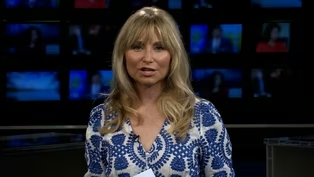
Video has Closed Captions
Clip: S3 Ep32 | 1m 5s | Local artists hit the streets of Lexington to create art and community. (1m 5s)
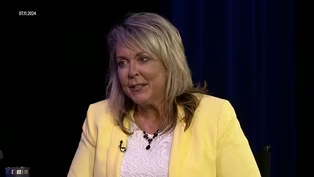
Video has Closed Captions
Clip: S3 Ep32 | 7m 48s | Students in one Kentucky school district succeeding with science in reading approach. (7m 48s)
Providing Support for PBS.org
Learn Moreabout PBS online sponsorship
- News and Public Affairs

Top journalists deliver compelling original analysis of the hour's headlines.

- News and Public Affairs

FRONTLINE is investigative journalism that questions, explains and changes our world.












Support for PBS provided by:
Kentucky Edition is a local public television program presented by KET