Compass
July 2021 Edition
Season 5 Episode 10 | 28m 47sVideo has Closed Captions
Construction trades, a collab laundry service, Elevate Business Academy and youth regalia.
Learn about the Cankuya construction trades program collaboration between the Lower Sioux, Minnesota West and the SW MN Industry Council; watch the first in our series about aging with dignity about a collaborative laundry service; witness the first class to graduate from the Elevate Business Academy in Willmar; and learn about the youth regalia class at Dakota Wicohan.
Problems playing video? | Closed Captioning Feedback
Problems playing video? | Closed Captioning Feedback
Compass is a local public television program presented by Pioneer PBS
Compass
July 2021 Edition
Season 5 Episode 10 | 28m 47sVideo has Closed Captions
Learn about the Cankuya construction trades program collaboration between the Lower Sioux, Minnesota West and the SW MN Industry Council; watch the first in our series about aging with dignity about a collaborative laundry service; witness the first class to graduate from the Elevate Business Academy in Willmar; and learn about the youth regalia class at Dakota Wicohan.
Problems playing video? | Closed Captioning Feedback
How to Watch Compass
Compass is available to stream on pbs.org and the free PBS App, available on iPhone, Apple TV, Android TV, Android smartphones, Amazon Fire TV, Amazon Fire Tablet, Roku, Samsung Smart TV, and Vizio.
Minnesota’s Alt-Meat Revolution
“Minnesota’s Alt-Meat Revolution" is a year-long video and print journalism collaboration project, looking into the roots and impact of the plant-protein phenomenon that’s exploding across the globe.Providing Support for PBS.org
Learn Moreabout PBS online sponsorship(bright music) - Funding for "Compass" is provided in part by, the Otto Bremer Trust, the McKnight Foundation, and members of Pioneer PBS.
Thank you.
Hi, I'm Amanda Anderson.
Welcome to the July edition of "Compass", the regional public affairs show on Pioneer PBS.
Thanks to everyone who suggested story ideas.
This refreshed version of Compass is meant to be audience-centered.
We also regularly post stories when they're completed on our website and social media.
Head over there to see what we've been working on and to comment and tell us what you think of each story as you watch.
First, a one of a kind collaboration is taking place between Minnesota West, the Cansayapi Lower Sioux Indian Community and the Minnesota Private Industry Council.
The Cansayapi community recently identified construction trades as a needed educational pathway in the community.
The first class of the Cankuya Construction Trades Program just graduated.
- We're on the Lower Sioux Reservation in carpentry class.
(bright music) I think this is important because stuff breaks all the time and people need someone to fix it, or like people need stuff built all the time and it's just good knowledge to have.
- [Amanda] It's hard to overstate how much community input and thoughtful planning went into the Cankuya project, the construction and trades program partnership between the Lower Sioux, Minnesota West and the Southwest Minnesota Private Industry Council.
- We know there's a major housing shortage at Lower Sioux.
And we're also facing the opportunity of this young growing population who's going to need even more housing.
So there's great opportunity for the community to put resources into developing housing and housing jobs and housing innovation.
- [Amanda] Every year the Lower Sioux community conducts an annual community survey.
Directors and council members ask questions to help identify the community's priorities.
And in 2016, they developed nine strategic goals, including a focus on education.
- And within that educational goal, there was an idea that emerged from the community to create training pathways into high demand careers that could be useful both to each individual, but also useful to the community as a whole.
And construction trades was one of those areas.
- [Amanda] Construction trades was identified as a number one area of interest for people aged 18 to 39 years old.
And the eight month program started in October of 2020.
- [Nora] And Min West was just fantastic.
And they were also very open to bringing the training right here to Lower Sioux.
So rather than having numbers go drive to Marshall or drive to Pipestone or drive to Granite, which can be daunting.
And many, many times of the year, given the condition of the roads that they would come here to Lower Sioux to provide the training.
- Our motto is that Minnesota West is our community's college.
And so the Lower Sioux community is one of our many communities that we have.
We have agricultural communities and farming communities and nursing communities, but we just want to make sure that we're meeting the needs of all of our students and our workforce.
And so this is a project that has never been done in this manner before.
- [Amanda] Minnesota West already has a carpentry program, it's offered out of their Pipestone campus.
So it was a matter of adapting it to fit the 19 credit certification program onsite at the Lower Sioux.
- Meeting them where they're at.
We're very innovative in how we do our approaches.
Innovation and nimbleness is something that is not oftentimes associated with a state institution, but being a community college, that's a small community college.
We have the ability to recognize the needs within our community.
And this is a recognized need.
- [Amanda] Another community recognized need was to develop their volunteer run educational committee into a department with a paid coordinator.
Jesse Kodet is the education coordinator at the Lower Sioux community.
- I'm the coordinator making sure the instructors and the students have everything they need.
I line up projects that they can do to fill the lab portions.
I actually give the reigns to the instructor as far as attendance and everything like that.
- [Amanda] Kodet said that he didn't think his educational path was ideal.
Because of this he wants to be a mentor to the students and guide them on their own educational pathways.
- [Jesse] There was such a stigma for the construction and trades over the past handful of years that we were trying to just see what that area had to offer.
- [Amanda] When the weather was less than ideal Kodet helped to identify a covered space for the students to work outside.
They started by building sheds for the elder's complex, where they learned about building a floor walls, roofing.
- Shingle, siding, soffit, fascia, and install a door.
So they got a little taste of pretty much everything for the rough framing and exterior of buildings.
Right now, we're working on a couple of decks.
- [Amanda] The decks are located behind the government center.
Isaiah Piotter is the instructor of the class.
This is his first time teaching, but after completing the two year carpentry program at Ridgewater College in Willmar, he's been a foreman and worked in the field for 15 years.
- Yeah, like measure right here, and then just do the same down here.
And this other handle right here.
So our day to day is kind of, in the mornings we had been doing a little classroom.
About an hour and a half to two and a half hours of classroom.
And then in the afternoons we'd work on our lab, which is our projects.
- I really like working with my hands so building the shed and wall framing has been my favorite so far.
It's really cool to see a pile of lumber turn into something.
And I just really liked that, building things.
It's cool.
(laughs) - A lot of the stuff that the students do, you know, it takes, you have to do it to learn it.
You know, you can't just talk about things and expect them to show up and be able to do the job right.
You kind of need the experience.
You need the hands-on, you need to do it once, learn how to do it correctly.
And along with that comes with mistakes.
And you kind of need to make mistakes, to learn.
- [Amanda] Piotter listed the many benefits of carpentry trades and of teaching, like meeting different people, sharing his gained knowledge.
- I like not having to do all the work.
(laughs) - [Amanda] When the class started in October of 2020, there were 13 students.
Eight students completed the course and received their certificates on June 23rd.
Of those eight, two are young women.
- Well, there was as more women in the class before, when it first started.
But that was definitely one of the reasons that I did want to take it because you don't see very women in trades, specifically carpentry.
I even asked, we had like a little job interview panel thingy this morning and I asked about women in trades.
And one of the companies said that 98% of his workers are male.
So, and he said, most of the women that do work with his company are secretaries.
Like they're not actually out on the job or anything like that.
So that is a big motivator to me.
- [Amanda] Funding for this program came through a grant from the Minnesota Department of Employment and Economic Development, received by the Southwest Minnesota Private Industry Council.
Eriann Faris is a youth program manager at Southwest Minnesota PIC.
- The private industry council has been doing career pathway training for adults and youth for over a decade.
And so I felt strongly that we would be able to bring together kind of a construction pathway programming for some of the members at Lower Sioux.
- [Amanda] She said that this type collaboration is the model that she's used in her 15 year career with PIC in Southwest Minnesota.
- And you learn real quick, I think.
Especially in Southwest Minnesota, or more rural areas that you can't do it alone because we just, we all have so many things that we can bring to the table and leverage.
- [Amanda] Faris said, PICs career pathway programs tend to be geared towards non-traditional students.
Outschool youth, immigrant and refugee populations.
And because of this, there's often a wraparound support piece.
And to provide true support, Faris said that everything that goes into it has to be student and community centered.
Every morning the Cankuya construction trades class would spend about an hour in Jackpot Junction Casino for class time.
During one of their classes, PIC taught the students employability skills and about crafting self-promoting elevator pitches.
- But it's interesting because these elevator speeches, that we've learned that they're not a self promoting culture.
It's more about how am I going to help my community and not me going to work for myself.
And we wanted to be sensitive to that, and we didn't want to push it, like this is what you have to do or how it has to be done.
But yet at the same time, just knowing that it is kind of the norm, as far as getting a job outside of the community.
Well one thing we definitely learned is the student has to come first and you have to identify what their needs are.
So I don't think any model we've done over the last 13 years has looked the same because the people in it aren't the same.
- [Amanda] And for this particular collaboration, the needs identified by the community were to create community-based employees for community-based employers.
- There's a community need for employment.
There's a need for a skilled people or skilled workers in those trades.
And there is also a need for us to have our own local businesses where our money is being outsourced outside of the community.
So we want to have our own plumbers and carpenters and everything like that.
So the funding stays in the community.
- [Amanda] And in fact, the next class will be plumbing, Minnesota West will be offering a plumbing certificate to students at the Lower Sioux starting in summer of 2021, Minnesota West is also working through the logistics of making the Lower Sioux a Minnesota West site, because when classes are offered at one location for more than two semesters in a row, that location must be an officially designated Minnesota West site.
So the college doesn't lose its educational accreditation.
- This is very important for us with the idea that we don't want to just come in and do some quick training and be out with this one.
Our commitment is stronger here.
And so with the colleges saying that they were interested in making the Lower Sioux community as a site, it's demonstrated a longer term commitment and that we want to build a relationship with the community.
- [Amanda] So much like the intricacies of a construction project, measure twice, cut once, use the right tool for the job, the same applied to getting this program established.
Community listening, data gathering, and getting the right people in the right position.
(drums beating) - [MC] Congratulations.
Pilot program, construction and trades, Cankuya.
(crowd clapping) (crowd whooping) (drums beating) - A special thanks to Bruce Helsper at the Lower Sioux for getting video of the graduation ceremony and congratulations to the graduates.
Next we've been working on a series of stories about various programs and partnerships in our region designed to help people age with dignity.
This first story in this series looks at a special collaboration between the city of Adrian, Rock County Opportunities and Essential Senior Services.
Laundry, doing it is something that some of us might take for granted.
But think about where the cleaning facilities that you use are located.
Are they in your basement, at the laundromat across town?
As people age, doing various chores, like laundry can become increasingly arduous.
Jill Wolfe is the administrator clerk treasurer for the city of Adrian.
She previously worked for the Minnesota River Area Agency on Aging, where she developed a passion for helping older adults.
She's carried that passion to her work at the city, helping residents over the age of 60 with their laundry in collaboration with Rock County Opportunities.
- And we get to talking, we both became aware of this chore and household grant that MnRA currently had through the CARES Act funding and Beth and I had a conversation that it would be great if we could offer laundry services to older adults, which would help them out on some of their day-to-day tasks of doing laundry, keeping them able to live in their homes longer with that assistance.
- [Amanda] This program has a number of moving parts.
Beth is Elizabeth Schear.
She's the executive director at Rock County Opportunities.
RCO is a nonprofit in Laverne that serves people with disabilities.
Using this grant money, the city of Adrian contracts with RCO, they have the washer dryer and do the laundering.
- And wet clothes, gonna stick them in the dryer.
- [Amanda] RCO received a separate MnRA grant to build a new laundry room.
- So the partnership that we have with Joe Wolf and Mariah Aggen and MnRA to get the grants is allowing us to provide jobs for the people that we serve, who have disabilities, who otherwise would not necessarily be able to maintain their independence in the community.
- I love it.
- And then it also has that double win of allowing the seniors a little bit more time in their homes because we've got somebody who can deliver, drive and go pick up and drop off their laundry, and we can actually do the laundry.
- [Amanda] A MnRA grant also funds Mariah Aggen's business, Essential Senior Services, which she started in December of 2020.
Aggen does personal shopping and errands for her clients.
And she's the one who picks up and drops off laundry at RCO.
- It did not intend to be an intertwined grant process whatsoever initially, you know.
It was three separate groups hoping to do three separate things.
And then we found we could all really jive together and way we're serving more people.
- [Amanda] Think of it like a Venn diagram, the city of Adrian, Rock County Opportunities and Essential Senior Services all have a number of programs they offer to their clients and not all of them overlap, but this laundry project just so happens to intertwine all of their organizations in this beautifully collaborative way.
- And in this instance, we have the collaboration of city government, a nonprofit agency and a private contractor.
And the partnership that we've created with the three, it's like a three legged stool, none of us could really offer this program on our own.
- [Amanda] This service is free for those who use it through the city of Adrian or as a client of Essential Senior Services.
But the laundry service is open to the public through RCO and the cost can vary.
Schear says that it averages to about $13 per load.
- Not to mention the fact that then Mariah's coming in and the transportation piece of it allowed us to not have to charge for that delivery.
So we were charging customers an additional fee to pick up and drop off their laundry.
And that actually deterred a couple people from either having their laundry done by us, or they would bring it in when it was, it looked like it was maybe not safe for them to be trying to carry their big loads of laundry in here.
- [Amanda] Aggen serves clients within a 50 mile radius of Rushmore, and that also applies to laundry delivery.
She says that clients' needs can come up on a moment's notice.
- Having clients as your priority is probably the most important thing.
You can't do this to make money.
It's really about helping people have their needs met.
And I think the part that I really love is building that relationship with my clients so that, you know, knowing that I'm helping someone that can't do these things on their own.
That's what's really rewarding about this.
Now I have one client that doesn't allow me to see him at all.
I drop his laundry off outside of his door and he waits until he sees me down the hall before he comes out.
He just has a little bit of fear with COVID.
Hi Bob, how we doing today?
So the thing I still get to make that connection with him because he'll yell down the hall, "Hey, Mariah, have a great day, thanks for your help."
- [Amanda] That client is Robert Israel and for whatever reason on this day, he came out of his apartment to chat.
Aggen said that this was the first time that's ever happened.
- Well for old geezers like me, you know, we can't get out there much to go to the laundromat.
- [Amanda] Mm-hmm.
- It's a good service, come right to your door.
They deliver it, it's perfect.
No matter what I put in there, I even tell her to put those rubber bands around my socks, you know, cause I don't like them rolled up, they lose the elastic.
- Into the washer - [Amanda] Schear said that RCO is just about at laundry capacity with the number of machines they have.
- We can fit one more washer and dryer in that new laundry room, but then that's it.
And so if we ever wanted to add more machines, we would need a different facility.
- [Amanda] And finding enough staff is hard for everyone across the board right now, but she's confident.
- We'll be able to hire again and build back up to full steam.
We might even be able to hire people without disabilities, to work strictly in the laundry, just doing laundry, alongside people with disabilities, which would be a great integrated community employment.
I think the biggest success with any of the jobs.
And I've seen it here, and you saw it today too, working with Erica, the sense of accomplishment and the sense of purpose and the pride that our individuals are able to take in the work that we bring to them to do.
And it serves a really needed purpose and they recognize that.
They can see that, you know, I did laundry today for somebody who wouldn't be able to do their own laundry.
- Green, here.
Now I'm done.
- Funding for this series on aging with dignity is provided by the Minnesota River Area Agency on Aging.
Next, Elevate Business Academy in Willmar is a 12 week immersive program designed to create economic opportunity for all business owners and aspiring entrepreneurs in Kandiyohi County.
(crowd yammering) Students can be anyone from a current small business owner.
- My business is grocery, halal grocery.
- [Amanda] To a person with a dream.
I'm going to open a grocery store.
- [Amanda] Abdilahi Omar and Hte Hte Hta Rue are two of the five 2021 graduates of Elevate.
A community-based business academy with the mission to elevate businesses for success through education and mentorship.
The program is aimed at helping underserved and female identifying entrepreneurs and entrepreneurs of color.
- Yes, the program is to elevate, exactly as you can see its name and support our business owners and the new businesses starters.
- Abdusalaam Hirsi is an assistant instructor for Elevate, funded by the Southwest Initiative Foundation.
The first Elevate cohort started class all virtual in March of 2021, the five students of Elevate known as the fabulous five all graduated on June 16th.
- [Announcer] Abdiqani Mahamed, Abdilahi Omar, Hte Hte Hta Rue, Stephanie Thompson, and last but not least, Abdiweli Yusuf.
(crowd cheers) - [Amanda] In the speech during the graduation ceremony, Scott Marquardt senior vice president of SWIF, said that this night was a product of two years of planning.
He said that SWIF was introduced to Rising Tide Capital about two years ago.
Rising Tide Capital is a nonprofit organization based in New Jersey that founded the course and curriculum.
After visiting New Jersey and seeing a class, Marquardt wanted to start a program in Willmar.
- We believe in you, we believe in your dream.
We believe in what you want to do for this community and this region.
And we're honored to start with you and to be part of your journey.
- [Amanda] Over the duration of the 12 week course, the students met once a week for two to three hours.
Rue said that initially she had some hesitations.
- I first think that, oh, I don't speak English.
So I think I'm not going so.
But is very good for business.
So, and then I, "Okay, I try that."
That is really good class.
This Elevate class is very useful for business who are studying business or own a business.
So we like it, we love it.
- The second elevate cohort class will start in the fall of 2021.
The Kandiyohi County and City of Willmar EDC, and SWIF are working to organize a second elevate class beginning in September.
Informational sessions will be held in July and August.
Check elevatebusinessacademy.com for specific dates by mid July.
Finally, Pioneer PBS's Tanner Peterson visited Dakota Wicohan in Morton to learn about their youth regalia class.
(bright music) - So this project started in 2019.
We applied for a grant from the First Nations Development Institute out of Colorado under their native youth culture fund initiative.
And so we got a grant to do the youth to do their own dance regalia.
And that staff here Dory Stands and myself would help them and mentor them and coach them through creating that.
So Dakota Wicohan does revitalizing the traditional art forms.
Regalia making was one of the art forms and we decided to do the youth and not the adults, just so that we're teaching a younger generation, the skills, the sewing skills and the design and how to put to what all the pieces are.
We had initially thought we'd have 10 spots and we put it out to our youth.
There was such a great interest, we had over 20 youth sign up.
And so we didn't want to turn anyone away or discourage anybody.
So we decided we would take it on and we'd find the additional funding.
- My friend actually asked me if I wanted to do it.
I'm like, that sounds like fun.
And like a little thing we could all do like together.
- Well I really don't have a regalia at home.
So I had an old one from when I was like seven and that doesn't fit me so I decided to sign up for this and make my own.
- When COVID hit, we had to stop and halt all in-person working.
So it's been awhile.
And so we're looking forward to finishing up this in the next few weeks.
We've actually asked some elders and some parents to come in to help.
- They had called me when they had already started and asked if I wanted to and I said, "Yes, definitely."
I've been making regalias since I came back here 30 years ago and my grandchildren is when I started doing it.
I've taught a few of these ladies that are doing it now.
I've taught them how to do it.
And they've got a lot better than me.
(laughs) (bright music) - My favorite part about like the whole process is just like doing it all together and like getting to interact with like everyone.
- My favorite part is my friends, the people who are here, they're are a lot of fun.
- I liked coming back because then I could see like everyone again, I learned a lot more than I used to.
- My favorite part of this whole program was just seeing all the beautiful designs that they came up with on their own and all their colors.
I was just so amazed by how creative they were on their own.
And so it's been amazing to see them come to life.
- I'm always impressed with them, you know, because of what they pick out and helping them in the finished product is always so nice to see the look on their face.
Just really proud of the girls and really proud of the work they do.
And now we're towards the end and they want to stay later.
Like they want to keep sewing.
So that's good.
(bright music) - Thank you for watching this July edition of Compass.
We encourage audience interaction and feedback.
So head over to our social pages and website and interact with us.
And a heads up the August edition of Compass will air on August 12th on Pioneer PBS.
See you then.
Funding for Compass is provided in part by, the Otto Bremer Trust, (relaxing music) the McKnight Foundation, (relaxing music) and members of Pioneer PBS.
Thank you.
(relaxing music)
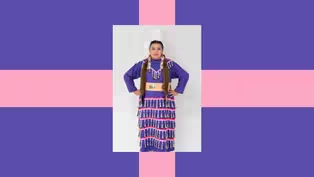
Video has Closed Captions
Clip: S5 Ep10 | 5m 5s | Dakota Wicohan's youth regalia class. (5m 5s)
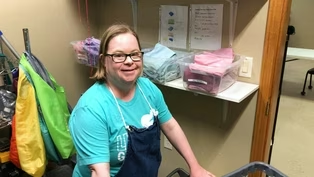
Aging with dignity: laundry service
Video has Closed Captions
Clip: S5 Ep10 | 6m 25s | A laundry services designed to help people age with dignity. (6m 25s)

Video has Closed Captions
Clip: S5 Ep10 | 11m 15s | A one-of-a-kind collaboration: the Cankuya construction trades program! (11m 15s)

Preview: S5 Ep10 | 36s | Watch the July 2021 Edition on July 8 at 9 p.m. on Pioneer PBS or on the PBS Video App! (36s)

Video has Closed Captions
Clip: S5 Ep10 | 2m 35s | Elevate aims to create opportunities for all businesses owners & aspiring entrepreneurs. (2m 35s)
Providing Support for PBS.org
Learn Moreabout PBS online sponsorship
- News and Public Affairs

Top journalists deliver compelling original analysis of the hour's headlines.

- News and Public Affairs

FRONTLINE is investigative journalism that questions, explains and changes our world.












Support for PBS provided by:
Compass is a local public television program presented by Pioneer PBS