
July 2021: Historic Architecture
Season 2021 Episode 7 | 26m 45sVideo has Closed Captions
We explore the value of historic architecture through the lens of two organizations.
In this episode of Up Close, we explore the value of historic architecture through the lens of two organizations in West Central Florida: Architecture Sarasota and the Historic Hernando Preservation Society. Learn how these organizations contribute to the archaeological and historical records of our area and also work to educate local residents and visitors about the buildings of our past.
Problems playing video? | Closed Captioning Feedback
Problems playing video? | Closed Captioning Feedback
Up Close With Cathy Unruh is a local public television program presented by WEDU
July 2021: Historic Architecture
Season 2021 Episode 7 | 26m 45sVideo has Closed Captions
In this episode of Up Close, we explore the value of historic architecture through the lens of two organizations in West Central Florida: Architecture Sarasota and the Historic Hernando Preservation Society. Learn how these organizations contribute to the archaeological and historical records of our area and also work to educate local residents and visitors about the buildings of our past.
Problems playing video? | Closed Captioning Feedback
How to Watch Up Close With Cathy Unruh
Up Close With Cathy Unruh is available to stream on pbs.org and the free PBS App, available on iPhone, Apple TV, Android TV, Android smartphones, Amazon Fire TV, Amazon Fire Tablet, Roku, Samsung Smart TV, and Vizio.
Providing Support for PBS.org
Learn Moreabout PBS online sponsorship- [Narrator] This is a production of WEDU PBS.
Tampa, St. Petersburg, Sarasota.
- History is not found only in books.
Many times history can be conveyed through a physical location.
And through cultural tourism, local residents, as well as visitors, learn about the past.
Learn about two organizations in west central Florida, dedicated to preserving historic places and sharing their significance with wider communities, coming up next.
(upbeat music) Cultural tourism, it's about learning, discovering and experiencing.
It's oftentimes about history and heritage and includes visiting physical structures.
But cultural tourism isn't relegated to trips around the country or abroad.
You can engage with cultural attractions right in your own community.
The organizations featured today share how that is made possible.
The Historic Hernando Preservation Society oversees the historic markers, archaeology, architecture, preservation efforts, and local history of Hernando County and more.
The organization hosts events and tours to share the area's past with locals and visitors.
Architecture Sarasota aims to educate, advocate and celebrate the irreplaceable buildings and spaces in Sarasota County.
Through preservation efforts and tours, this organization highlights the areas, architectural movement and celebrates Sarasota history.
We'll learn more about these organizations and the importance of preserving the past through historic buildings.
Welcome to Up Close, I'm Cathy Unruh.
Today we are joined by Jo-Anne Peck, who is a board member of the Historic Hernando Preservation Society.
Also with us is Anne-Marie Russell.
She is executive director of Architecture Sarasota.
Thank you both for being with us today.
We mentioned cultural tourism.
Let's just talk a little bit about what that is.
Anne-Marie?
- Cultural tourism is something that I think is really a reflection.
It's something that people have always done, gone on the grand tour back hundreds of years ago, throughout Europe, et cetera.
But I think we saw a big push in cultural tourism when the financial crisis of 2008 happened, and people began to care more about experiences than objects.
And we've really seen this wonderful gift flourish, especially through the pandemic.
So the idea of traveling and investing money and time and energy into an experience, into learning something as opposed to acquiring something, I think is really at the root of cultural tourism.
All around the world, there are wonderful sites sometimes right next door, sometimes thousands of miles away, but there's something from the past or something from the present that has a cultural component that you can engage with in a significant way as a tourist.
- That's why this can happen right in your own community as well.
Oftentimes we don't know much about where we live, correct?
- Oh yeah, we have so many transplants, people that have moved to Florida from other places and they don't know what the history of Florida is, but when we have our historic buildings, our historic sites, and we promote all of that, it gives people a tangible link and something that they can really touch and feel and experience and understand that people have been here, living really exciting lives for many, many years.
- Tell us about the mission of the Historic Hernando Preservation Society.
- It's really, really a broad mission.
We're supposed to be preserving and promoting, educating people about Hernando's rich history.
We have an anthropologist on our board who will talk about how there were mastodons that roamed this area.
We have a rich architectural history, particularly in Brooksville, which is the only historic downtown in all of Hernando County.
We have obviously more fun resources that we promote like Weeki Wachee.
We have just so many things around here and we try to do, we bring in guest speakers, we do historic home tours.
We have quite a few things that we bring.
We try to bring Hernando's history to people's front of their minds.
- And that extends sometimes into Citrus and Pasco counties as well?
- So Hernando historically encompassed multiple counties and was later subdivided.
And so I will say we concentrate on Hernando the most, but we try to take all of Hernando, what was the original Hernando, which yes is Citrus, and some of the other counties, Pasco.
- And Anne-Marie, there was a big merger just this spring, which resulted in the current name of Architecture Sarasota.
Tell us about that.
- It's wonderful.
It's a uniting of visions and missions from two great organizations in Sarasota, the Sarasota Architecture Foundation and the Center for Architecture Sarasota.
So the Sarasota Architecture Foundation's primary mission was to steward the legacy of the Sarasota School of Architecture, a wonderful group of architects who were practitioners in the forties, fifties, sixties, and seventies, who really focused on good design in this environment and the mission of Center for Architecture Sarasota, focused on good design and the principles laid down by those practitioners up to the present day.
So we've united those missions under Architecture Sarasota so we both steward the legacy of the Sarasota School of Architecture historically, and continue to celebrate great design in our community and around the world that is based on those principles.
- And make the distinction for us between archeology and preservation for each of your organizations, Anne-Marie first.
- Well, that's a great question.
I think they are aspects of a similar thing.
Preservation, archaeology would be the exploration of older things and preservation is our commitment to making sure they stay around for future generations.
Jo-Anne, how would you differentiate archeology and preservation for your organization?
- Well, yeah, preservation usually deals with the things that you can still see that are above ground and then archaeology obviously deals with the things underground.
Some of them are prehistoric things all the way up to things that we have a written history for, but we don't have the buildings anymore.
So maybe you just have the foundation, the footers for where something was.
For example, we have a place called Centralia that was, we call it our ghost town.
It was an entire city that was bigger than most places around and now it's totally gone.
And so they do a lot of archaeological digs to find some of the locations for these things that have been lost over time.
- Jo-Anne, you mentioned mastodons at the top.
So I have to ask you, do you have any relics or anything relating to mastodons?
- I do not, but one of our board members used to work for MOSI.
He's a paleontologist and he speaks regularly at our meetings.
They're always very well attended and he brings bones that you can actually touch and it's amazing.
- Okay, when I say you, I'm sorry, I meant the society.
So he's a member of the society, so in essence society, the society does have evidence of mastodons.
- Oh yes.
- What is the definition of historic architecture?
We see the markers, we say that's a historic building, but how does one get there?
- Well, it's interesting.
I think as Jo-Anne probably has been involved in helping try and preserve many historic structures, when history begins, when life ends and history begins is an interesting question.
There are various dates that are set for when something qualifies for historic preservation and there are 50 year marks and there are 25 year marks, et cetera, for various different designations.
But I think the idea is it's less about a time period because certain things that are very significant don't necessarily fall within those designations.
And that can be very tricky if you're close to the deadline, but you know something is really important to preserve.
So I think making a case for something that is important to preserve, but perhaps is not actively involved in daily life today, I would say that's when history begins.
- And Jo-Anne, this happens basically through the Florida Department of State getting the historic markers, how difficult have you found that?
- It's not that difficult.
You need to do your research and make sure that everything's accurate, that it's provable, but the markers have been a wonderful thing for tourism explaining places.
We usually do them for places that are no longer there, you know, there's no built environment anymore.
But the historic markers, there's grants for them and the state is very, very good at making sure everything's accurate and the like.
- And I would imagine of course, that whatever is involved in preservation necessarily differs in difficulty, length of time, et cetera, from place to place.
- Depending on how a building has been treated over time definitely makes a difference in how much work it needs to be done.
Some buildings really they've been preserved.
It's a perpetual thing.
Other times you need to go through a full restoration because somebody is not maintained it over the years.
And so you can be talking about two houses, same size.
One of them needs a new coat of paint.
The other one needs a new foundation and a new roof and a bunch of restoration, wood replaced and the like.
And it really has to do with how it's been treated over the years.
- And have either or both of your organizations had to deal with situations where there's a historic building, you want to keep it, but a commercial interest wants to destroy it or move it in order to put something up new?
- Well, that certainly happens all the time.
I think we can't save everything, so I think some healthy, substantive, public debates and criteria around what is worth saving are always a good idea.
I don't wanna go too far afield.
We have some wonderful preservation success stories here in Sarasota.
I think the most significant one of course is the old 1926 Sarasota High School on Tamiami Trail, which has a significant Paul Rudolph Building.
Paul Rudolph was one of the practitioners of the Sarasota School of Architecture.
That building was saved.
The Sarasota High School, new building was saved by Paul Rudolph in the 1926 M.Leo Elliot Building was also saved and now it's a contemporary art museum.
So that was a building that developers were certainly eyeing, that would be a gorgeous building for fancy lofts, and the location was wonderful, but the community really rose up and really communicated to the powers that be that this building was really significant in the history of Sarasota and it had a higher and better use than simply being a condo development project.
So I think it's wonderful when a community speaks up and celebrates the treasures within that community.
- Jo-Anne, do you have an example like that to cite from Hernando?
- So the Historic Hernando Preservation Society has not engaged in a restoration on their own, but they partner with and support other organizations.
Right now we are talking to the Brooksville Main Street is considering trying to move the oldest house in Hernando County.
And we are certainly in full support of that.
There's several museum societies that are around for some of our historic properties and we do all our best to promote and encourage the preservation of these structures.
- So it's important, it sounds like, that the community get behind these efforts.
How do community members engage?
Anne-Marie?
- Well, there's so many different ways.
And I think what I really wanna emphasize is that some of the great success stories are really great public private partnerships that involve a variety of entities.
We're all concerned about economic development and the economic health of our communities and balancing the interests of preservation and economic development can be a very easy thing to do if you've got everyone at the table and everyone is really participating in those conversations.
So yes, community engagement is deeply important, but I think the success of all of these projects is really a result of getting government, the nonprofit sector, the private sector, and the community engaged together and balancing everyone's interests.
- Jo-Anne, do you agree and if so, how do you engage the larger community?
- I'd have to say the biggest thing our organization does is education.
Letting people know what's out there, promoting, we spent a lot of time disseminating information, telling people where they can go to get more information on their particular projects and the like.
But it really is such a, you know, project by project sort of thing.
- And do both of your organizations offer tours?
- Yes, our organization has been offering tours for some time.
We took a small break as we were focused on the unification of the two organizations and we'll be resuming our tours this summer on June 26th, Saturday.
One can tour the Paul Rudolph's umbrella house.
One of the most important residential structures in the world that's celebrated piece of architecture and also Paul Rudolph's cocoon house, which is a wonderful little experimental house, right on a Bayou in Sarasota.
So both of those tours are available and you can do them together.
And it's a wonderful, wonderful brief window into the Sarasota School of Architecture.
- And Jo-Anne, what are tours like with the society?
- So we are in the middle of redoing all of our self-guided tours.
Most of them are focused in Brooksville but we're expanding out.
Right now, there's a couple of tours that you can do that you can just arrange, but they're mostly based on the murals, which show historic elements of our downtown, but we're going to have some historic architecture tours that are self-guided and driving tours that we're updating right now.
- And so do folks get to go inside many of the buildings?
- We try to do that once a year, usually in conjunction with the May Stringer House Museum where we do have some homeowners that are willing to open their homes and let people come through.
Of course, due to COVID, we haven't been able to do that for a little while, but yes, we do historic home tours occasionally.
- And Anne-Marie you've mentioned a couple of times the Sarasota School of Architecture.
My layperson's understanding of that is that it maximizes use of the environment when building and placing a home.
Would you like to expand on that a little bit?
- Absolutely and if you don't mind, I'll segue from the tourist because once a year, the organization puts on the MOD weekend in celebration of the Sarasota School of Architecture practitioners, and ideas around that.
Last year, we celebrated Karl Abbott.
We also had kayak tours, which is a wonderful way to apprehend a lot of the homes because seeing from the water view is a really special way to experience them.
This year, we're honoring Philip Hiss, who was sort of the impresario of the Sarasota School of Architecture.
He was actually a visionary, innovative developer who first developed a lot of these neighborhoods and hired these young architects.
He actually had spent time in Bali and throughout the tropics and related subtropical environments.
And he learned how indigenous communities built in harmony with their environments and he brought those ideas here to Sarasota.
- And who's the target audience for your tours and for learning about the school of architecture?
Is it local, tourists, both?
- Everyone in that Sarasota is known globally.
We have a pilgrimage, people make pilgrimage to Sarasota from all around the world in a cultural tourism fashion to see some of these buildings.
It's a globally renowned heritage.
So we, I would say everyone, but also, you know, little kids to seniors and everyone in between, we have educational programs targeted at every age group.
So I guess all would be our target audience, everyone.
- Jo-Anne, how about the society?
- Well, so that was very interesting to listen to because I think about how you're dealing with so much with mid-century modern and the areas that we have are, you know, we certainly have some elements of that, but the majority of the homes that people tour around here are your Southern historic 1880's kind of homes.
It's an entirely different environment that we promote around here, architecturally.
- Well, I think that's so interesting.
I think there's maybe a lot more in common because most of the Sarasota School of Architecture homes were designed before air conditioning and they took their lessons from the homes you're talking about from a century before.
And whether it's the dog trot or the overhangs, I think they're actually some great lessons of how people built prior to active energy systems and employed passive energy systems.
So there might be a little bit more in common with the 1880's architecture and the 1940s architecture than our general audiences might think.
It might be fun to partner and maybe do something together and uniting that idea.
- So that's a bit of a case study in why knowing history is important in a particular profession.
Jo-Anne, why is it important for just anybody to understand history or to care about historic architecture?
- Some people are just fans of pretty architecture and, you know, we certainly have some gorgeous, gorgeous homes.
Sometimes it's because of the events that happened there that somebody can actually go and see, you know, you can hear something in a history book, but if you can actually go to the site and you can get, you know, touch something then I think that's very important for people it's, you know, for me, a lot of it's aesthetics, that's how I got into historic architecture to begin with.
But there are, you know, you were talking about architecture and the like, why you have big, wide porches on things.
People can understand more of what it was like when people first came to Florida and you know, it was not, it was kind of the wild west originally.
You know, when people started coming here in the 1840's it was, you know, every bit like it was, if somebody was going out west.
They even had oxens that pulled carts to bring them all their goods down.
It was, you know, and I think when people start seeing things up close, they really can understand what it took a little bit more.
Definitely different than touring a subdivision.
- (laughing) Yes and to what degree do you engage volunteers with your mission?
- For us we're entirely volunteers.
We're an all volunteer board.
Most of our guest speakers are volunteers that come in, run our Facebook page.
Everything is all run by volunteers.
We do occasionally try to get some grants and the like to help finance things, but all in all we're grassroots as they come.
- Anne-Marie?
- We engage many volunteers.
I think they're the lifeblood of both organizations as we've come together.
And we're just developing more professional staff to help lead some of the volunteers, but they were super important in an exhibition that the two organizations prior to even talk of a merger produced together in a collaboration called Designing Sarasota.
And it was a history of Sarasota architecture beginning back with the indigenous communities and the shell mounds and the structures that were created on the shell mounds.
So we looked at a few hundred years of Sarasota architectural history together, and that was largely driven by wonderful volunteer research efforts and a big collaborative effort of the whole community.
And that exhibition will actually be able to see if you visit the building I'm in right now is the McCullough Pavilion, which was designed by Joe Farrell and William Rub.
And it was originally a furniture store and it houses our exhibition space and our education space.
And in the windows this summer, we won't be doing an exhibition this summer.
We're taking a little hiatus, but the, and the windows this summer, you'll be able to see that designing Sarasota exhibition.
- And to the communities in which you reside and work, do they come to you as sources of historical data?
Do they come to the society, Jo-Anne?
- We definitely field a lot of questions.
Our organization does not have an archives though.
So we actually have to pass a lot of people on to the local museum where the archives were kept.
But yes, there is no question that, you know, almost every day, there's a question through Facebook or through our website.
When somebody wanting to know either the history of their own home or how to get restoration advice.
That's, now, there's quite a bit of inquirers.
- How similar is that to the experience at Architecture Sarasota?
- Certainly, the community, we're so grateful, is always coming forth with information, with documents, et cetera.
We also don't have an archive, but that's probably something that we'll be looking at in the future.
But the resource of the community is extraordinary because this wasn't, this is fairly recent past and you know, people are still alive or their parents, or they have family photos of something.
So I would say that the crowdsourced knowledge in our community is one of the richest resources of our organization.
- Let's look beyond these two organizations and tell me, do most communities have organizations that are similar to yours?
Or is there a society of preservation societies?
What exists in the larger universe?
- Well, I think Jo-Anne, that you would agree with me that across the country, every community, whatever size has some degree of something.
Sometimes it's just one devoted person in their living room trying to keep track of things.
Sometimes there are larger, you know, the New York Historical Society of course, but everywhere in between.
I don't think there's a community in this country of any size or scale that doesn't care about its history and doesn't make an effort to preserve it.
I think it's ingrained in our spirit to wanna connect with our past.
Cause I think it helps us navigate the presence and implies a future.
- Preserving history is everything from, you know, somebody who is doing their own individual, family, genealogy research, and just trying to preserve maybe their grandparents home or the like up, you know, to organizations like ours, then there's statewide organizations up to the National Trust for Historic Preservation.
There's so many levels and so many different degrees and so many different aspects that people are interested in.
So, I mean, it's when you really start talking to people about history, there's just, there's always a facet that somebody seems to be interested in and is doing their part about.
- So 30 seconds for each of you closing thought, I know it's hard to believe we're there already, but Anne-Marie, closing thought.
- Well, we're most excited about launching our new organization this fall.
We've got our annual MOD weekend devoted to Phillip Hiss and we'll have a companion exhibition at the center here devoted to Philip Hiss.
He was an educational visionary.
He believed that human beings couldn't learn well unless they were in beautiful environments.
He served on the school board, he created new college, he brought I.M.
Pei in to be one of the architects of new college.
So we're gonna celebrate his vision as a visionary developer and civic leader.
So that's gonna be a great way to launch our organization with the history of the Sarasota School of Architecture.
- Jo-Anne?
- I think the thing that our organization would like everyone to know is just how much history is available here and how much there is to explore, you know, and the, all the areas that are available that you can see.
You can go to a pre-civil war plantation house here and learn about really fascinating history from that time period up through, you know, we have a Sinclair dinosaur, it's an entire gas station that looks like a dinosaur.
So there's kind of something for everyone from the, you know, kind of silly and fun to things that are really, you know, the history is still being played out today.
- Well, that was very motivating.
Go see a gas station that looks like a dinosaur.
That's fascinating.
You both sound like you have a lot of good things coming up and we appreciate you sharing with us today.
Thank you both for joining us today.
- Thank you for having us.
And I encourage everyone to be a tourist in their own town.
- Thank you, this has been fun.
- I'm glad, it was fun for me too.
And for more information for everyone, you can visit hernandopast.org and also saf-srq.org.
This episode of Up Close may be viewed in its entirety at WEDU.org.
Thanks for watching.
I'm Cathy Unruh and I'll see you next time on Up Close.
(upbeat music)
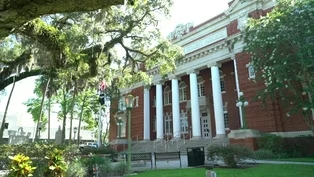
Preview: S2021 Ep7 | 29s | We explore the value of historic architecture through the lens of two organizations. (29s)
Providing Support for PBS.org
Learn Moreabout PBS online sponsorship













Support for PBS provided by:
Up Close With Cathy Unruh is a local public television program presented by WEDU