July 2021: Paul Sanberg
Season 2021 Episode 5 | 26m 41sVideo has Closed Captions
For nearly 30 years Paul Sanberg has played a leadership role at USF and local business.
For nearly 30 years Paul Sanberg has played a leadership role in expanding research and innovation at USF, and helped build the infrastructure of the entrepreneurial ecosystem. From 2010 to 2020, USF has been one of the top 10 public universities in the country in new patents awarded….and among the top 20 public universities in the world.
Problems playing video? | Closed Captioning Feedback
Problems playing video? | Closed Captioning Feedback
Suncoast Business Forum is a local public television program presented by WEDU
This program sponsored by Raymond James Financial
July 2021: Paul Sanberg
Season 2021 Episode 5 | 26m 41sVideo has Closed Captions
For nearly 30 years Paul Sanberg has played a leadership role in expanding research and innovation at USF, and helped build the infrastructure of the entrepreneurial ecosystem. From 2010 to 2020, USF has been one of the top 10 public universities in the country in new patents awarded….and among the top 20 public universities in the world.
Problems playing video? | Closed Captioning Feedback
How to Watch Suncoast Business Forum
Suncoast Business Forum is available to stream on pbs.org and the free PBS App, available on iPhone, Apple TV, Android TV, Android smartphones, Amazon Fire TV, Amazon Fire Tablet, Roku, Samsung Smart TV, and Vizio.
Providing Support for PBS.org
Learn Moreabout PBS online sponsorship- [Announcer] This is a production of WEDU PBS, Tampa, St. Petersburg, Sarasota.
- Why are some cities better at attracting high-growth companies than others?
What isn't just one thing.
It requires a special blend of talent, resources, and innovation to create a vibrant entrepreneurial ecosystem.
On the West Coast of Florida, the University of South Florida is a vital catalyst for the growth of business startups and high-growth companies.
You're about to meet an academic entrepreneur who's played an important role in this area's innovation ecosystem.
Next on the Suncoast Business Forum.
- [Announcer 2] Suncoast Business Forum brought to you by the financial services firm of Raymond James.
Offering personalized wealth management advice and banking and capital markets expertise.
All with the commitment to putting client's financial well-being first.
More information is available at raymondjames.com.
(serious music) - From 2010 to 2020, the University of South Florida has been one of the top 10 public universities in the country and new patents awarded and among the top 20 in the world.
In 2019, USF's Research Park infused nearly $600 million into Florida's economy.
For nearly 30 years, Dr. Paul Sandberg has played a leadership role in expanding research and innovation at USF and help build the infrastructure of the entrepreneurial ecosystem.
Paul, welcome to the Suncoast Business Forum.
- Thanks Geoff, it's an honor to be here Really looking forward to it.
- [Geoffrey] Likewise.
For a number of years, you were senior vice president of Research, Innovation and Knowledge Enterprise at USF.
Tell us about that role.
- Well, that was a really good role.
I enjoyed it a lot.
It really was to oversee all of the research that goes on and that includes compliance issues, because we get it from the federal government, the state government, companies, philanthropy, and it also involves looking at the faculty that are involved in this and the students and how the training goes in research.
And also how they can become entrepreneurial and innovative.
And that was the part that really, I enjoyed a lot.
How do you make this university, with all these great, creative talents, do new innovative things?
And that's where the Knowledge Enterprise comes in.
All this new knowledge.
- For nearly a decade, you were CEO of the USF Research Foundation.
Tell us about that and about USF's Research Park.
- [Paul] In many universities, you need to have an arm of your university that can interact with the community.
Can take stock options if they have companies, can do other things that are related to commercializable interests that you might have.
And so I think that's originally why it was formed.
In addition, it's right on campus, right on Fowler there.
And so it has this good interaction that you can have with the community, and to build that community up and to create jobs and workforce and have an output there of students and faculty.
To be able to go there and interact with folks that are doing companies and commercializable inventions, and you name it.
- How's the paradigm shifted from universities as research and educational institutions to actually becoming economic engines.
How has that happened?
- Think about it.
When you look at cities that have universities, those universities have a lot of money.
Of course, a lot of it's in salaries, but they have a lot of money and they have a lot of grounds keepings, and they have a lot of other things that they do, and they get a lot of research dollars.
That's enormous economic engine.
In addition is, all that money that comes in, hopefully it can be converted to new ideas, new opportunities, new ways of relationships with the community to create new kinds of businesses, new kinds of innovations.
And so that just kind of enhances it even more.
So, most research universities now are moving in that direction.
- In your role over the years, how have you worked with inventors and researchers, and entrepreneurs and investors to grow the entrepreneurial ecosystem?
- Well, you know, in my role as an administrator, we were very involved in meeting with most of the companies that would wanna come down here.
So whether it was a Bristol Myers Squibb, or when J&J put a building in or something, and they're interested in the workforce.
Clearly they wanted a workforce that they can hire.
They're used to being in places that probably have workforces that are designed, develop for their kind of work.
If you look at New Jersey area for pharmaceutical companies and things like that.
We do need some more dollars coming in.
We need dollars that are really in line with a lot of the things that help high-tech, and that can be in medicine.
It can biotech.
it could be in AI, which is a very important area coming in.
It can be in aviation, aerospace, you name it.
We are a great place to be.
Great place to invest and funds should look here.
A university does have academic freedom and that academic freedom in professors minds is, "I can invent whatever I want, as long as I got the money to help them do that."
And so we see inventions and all sorts of things, you name it from all sorts of fields.
And so there's a really cornucopia things to come in and look at.
What you need to do is get them to come here and say, "You know, you don't need to go to Austin.
You don't need to go to New York or Boston or Silicon Valley.
You'll come here, see what Tampa Bay has and see what the State of Florida has.
- Now you've really had a hybrid career.
You've been a research scientist.
You've been a university administrator.
You've been an entrepreneur.
You've been in economic development.
Let's take a look at your personal life.
Let's look at your formative years.
Tell us about your family and where you grew up.
- Well, I grew up very simple.
I was born in Florida.
I'm a Florida native.
I was actually born at Doctor's Hospital in Coral Gables, but I didn't live in Coral Gables.
We lived in a small house in Hialeah at the time.
I grew up, I thought, at a fascinating time because it was during the space race right at the beginning, and that's what intrigued me the most.
When we would send up things from Cape Canaveral, I was like, "This is so cool."
As a little kid, five years old or whatever, but in growing.
But it was just the coolest thing.
And first time, we sent up Explorer, which was our first satellite.
Things like this, those were a lot of fun.
My father, (clicks tongue) his business when in my birth certificate says, Bernie's Ice Delivery.
And what that means is that he had a business where he would take chunks of ice and carry them and he'd go to people's air coolers.
And that's how they cool their houses down in stuff in those days.
And he had a truck that would go from Miami down, I guess, to the keys and back.
And then air conditioners, I guess, came out pretty common and that business went down and he got into the floor covering business.
Used to do those big terrazzo floors in hotels down there.
We eventually moved to visit family in California who were in because of job for him, and so I grew up after that in Southern California and really enjoyed that scene as well.
- You went to college at York University in Toronto.
What did you study and how did that influence your career?
- [Paul] I went there and I ended up wanting to study science, and they had a Liberal Science Program in those days.
And it's hard to believe when you look back in the 70s, the program was unique because the courses that you took, weren't just organic chemistry, it was organic compounds and issues.
There was pollution, you talked about at another course.
I mean, we have the same issues we're talking about then and those days were so big.
But I did find this professor that I really enjoyed taking a brain and behavior course with, and I ended up working with him.
And so I switched my major and I went into anything I could do with the brain.
And so, there was no neuroscience courses in those days so I took every psychology course that had anything to do with it.
And I took any biology course that kind of had anything to do with it.
And really kind of made my own program.
- What is it about neuroscience and the brain that really captivates you?
- [Paul] I was just amazed at this organ that we have and how it really infected behavior and movement.
And not just in people.
I mean, when I took ethology courses in biology, which are animal behavior courses, and I took comparative psychology courses in psychology, which are animal behavior courses, just all the different species and how things worked.
In fact, I did a thesis on helping show that there was a rudimentary nervous system in a plant.
The mimosa plant, when you touch it, the leaves close, and that there's actually a specialized cells that respond with electrical signals and stuff, kind of like a rudimentary neuron.
And so I always liked the fascination of that.
I was working in an area of what I would call, the model of epilepsy at the time at York U, and one of the best people in that field was at the University of British Columbia.
And when I got there, I got accepted.
And when I got there, lo and behold, he was on sabbatical.
So I remember a very famous professor came to me and said, "Oh, you're the new new kid in town.
And you're gonna sit over here and we're working on this now."
It was just fortuitous.
It was just helping develop a new Animal model of Huntington's disease at the time, and why brain cells die in the brain in different ways.
And so I continued doing that.
I ended up doing my PhD thesis in Australia.
And one of the examiners was someone who was also developing similar science to me at Johns Hopkins that I had developed at University of British Columbia, as well as kept doing it in Australia.
You have to kind of outside examiners in the British system when you get a PhD, it's mainly outside examiners outside of your university that examined you.
And so he came all the way from Johns Hopkins to Australia.
His name was Joe Coyle, who's becoming emeritus at Harvard this year, and he then offered me a job.
It was hard to refuse when you're down under and you see that one of the best places in the world wants you to go.
I was like, "This will be exciting."
So I went there, worked with him, worked in with a number of other professors and had a great time.
A great, great institution.
And we're lucky to have one of the Johns Hopkins institutions, the All Children's Hospital down here that they took it over over the years.
The people there are just incredible.
Incredible scientists, incredible doctors.
So had a great time there.
- From 1983 to 1990, you were in Ohio.
You were doing neuro-science behavioral research.
- [Paul] Uh huh.
- Tell us about that.
- I went to Ohio and I ended up going up the ladder and eventually becoming really, I think, kind of chair of neuroscience at University of Cincinnati and really enjoyed it a great deal.
And then I think that point, I thought some really unique discoveries and I worked with some great people.
It was a good time.
I think the Midwest is a really good place for people to be, and I'm glad I spent that time there.
It's a different lifestyle.
I think all over this country, there's different lifestyles and that's a good lifestyle, I think, in the Midwest.
And I was able to do some really good research there.
Looking at, again in Huntington's, I started to move into transplantation research at that point and realized that that was an area that I wanted to focus in because I've been working on why do brain cells die, now I wanted to work on how do we replace brain cells that have died.
And so that's where my research really went.
At that time, there was fetal transplantation as you know.
So at that time, I really moved into more ethical approaches to transplantation because fetal tissue was, it some questions in regards to ethics.
I had personal questions in regards to that.
And I wanted to start looking at alternatives that might work.
- In 1990, you transferred to Brown University up in the Northeast to do more research.
Tell us about that.
- Well, I had been one of, I guess, early leaders in transplanting things into animal models of very serious brain diseases, and looking for opportunities to take it to clinic.
And that there was a company being started, which was the first, what I would call, cell therapy company for brain disorders.
We're also looking at diabetes at the time.
And so it was based at Brown and I decided to go and work with them.
I decided I'd give up complete tenure.
I would take a chance.
I felt here, I worked my whole life up to that point, wanting to be secure in academic and all this kind of stuff, and I took a jump and I said, "You know, security is in me."
And so I ended up doing that and becoming a research professor there, but I focus mainly on the company.
And it was really being supported a lot by one of the leaders of the university who really believed in entrepreneurship as well.
And that encouraged me to take a lead in that approach.
- So you moved from Brown up in Rhode Island to the University of South Florida in Tampa.
1992, you were with the USF Medical School at the time.
Tell us about your role at USF.
- Well, I headed up research in the Department of Surgery, and my point was really with the Neurosurgery Department though, 'cause with neuro was a division at that time within surgery.
It became a separate department, which it is now.
It's now called the Department of Neurosurgery and Brain Repair, one of the few in the country.
The original chairman, great person, Dave Cahill, and the current chairman, Harry van Loverin, is probably one of the best neurosurgeons in the country.
And he and I had worked together in Cincinnati.
He used to be in University of Cincinnati and so I knew him from a long time ago.
So that journey has gone full circle and it's been wonderful.
So I did that and I helped to create and build research within there.
And then the Dean at the time, the Vice President Dean said, "You know, I'd like to really build neuroscience up in the whole medical school."
He said, "Can you do that?"
And so then I kind of headed up neuroscience and really develop that and tried to build, get hires in all the departments that were neuroscientists and really boosts neuroscience research at USF.
And we did.
And in fact, after I moved over to the main campus to do other stuff, it has kept to growing.
And I would say that the current vice president Dean, Charlie Lockwood, probably would agree that the Neuroscience Institute now at USF is a really great institute.
And it's really developing and growing more and more.
- In 2008, you left the USF College of Medicine and you took a new role in Research, Innovation and Economic Development.
What led you to leave this area where you developed a great deal of expertise to undertake this new endeavor?
- The Dean of Medicine, about four times ago, said, "You know, I could use an associate dean to kind of lead research, but really focus on biotech development.
So you have experience in biotech."
Because I took that experience from Rhode Island going into the company, and when I came down here, I continued that.
I continued to patent, I continued to start companies, I continued to develop that side of me.
And he said, "Could you do that?"
And I said, "Sure, I'll help."
And so I ended up doing that over in the medical school for awhile.
And this whole thing that you asked in one of your questions was about how did USF go into more and more research over time and more and more entrepreneurism.
And again, it was from the recession.
I really think that was a big part in those days.
And so I was asked to, could I help do that more for the university.
And Judy Genshaft, I worked in right for her, and then she wanted to really boost research.
I mean, it was really her that said, "You know, research has to be a big part of this university."
It was nice.
She really was a strong supporter of it.
- In 2010, you founded the National Academy of Inventors.
What was the inspiration for that?
And did you realize at the time that you were igniting the spark of something that was gonna spread all around the world?
- When I took over research and here I'd spent a lot of years wanting to take my research and get into human trials, work with companies, patent things, bringing money too.
Of course you got the money to do the research, but to me it's not all about the money.
It's all about what you're accomplishing and what's significant and what impact you're making.
And do you have the tools in which to do it.
and that's why I felt a lot of us don't have the tools.
I knew nothing about patenting until I went to Rhode Island, really.
And then these venture capitalists said, "Well, it's not about publishing now.
Now we need some intellectual property that we can protect things with."
So I thought, "Who else is in this area?"
'Cause I think I mentioned earlier to you that I felt that that was a side of my life that was kind of behind closed doors.
I was in a closet, and how do I get out of that closet, and who else is there?
And so I had a lunch and I remember having help from my staff.
And I said, "If you have a US patent, and you're on the faculty staff or student, and I would love to talk to you.
Come and have lunch."
We had a hundred people show up, either faculty staff or students.
Hundred.
And we had this lunch and they all felt the same way.
They felt that this was a side of their life that wasn't supported by academics so much, but yet it needed to be.
Because if universities are gonna make this impact and they're gonna make an impact and helping companies, and they need to understand the tools of the trade.
And so we decided we'd start the Academy of Inventors of USF.
I like organizing things, so let's do that.
I told the other vice presidents, friends of mine, at different universities what we had done.
And they said, "Oh my God, that's exactly what we need to do."
So we went and we talked to the United States Patent and Trademark Office and we talked to the Associate Commissioner, and he said, "You need to talk to the Undersecretary."
Because we are trying to figure out, when we've gotten this thing during the recession, we know who the independent inventors are, we know who the corporate inventors are.
The IBM's have master inventors that they give recognition to and all these people, but we know nothing about the university inventors hardly at all.
We know that companies come out once in a while and they're big hits and corporations take them, but we don't know a lot about it.
And so we ended up, then they said, "We'd like a national academy."
So they came down here to, believe it or not, to Tampa and the Undersecretary inaugurated the National Academy of Inventors, and I think we had 50 universities at the time, maybe about that.
They came down for the first meeting.
And now 10 years later, we're having the 10-year anniversary at the new JW Marriott in November.
We have fellows, that's like members of the National Academies of Science and stuff equivalent.
We have over 1500 now, 10 years later.
We have over 250 universities affiliated with us.
And when you become a fellow of this academy, you're not just a great scientist, but you have to have patents and you had to have done something with that.
So you have to be at the peak of your career as an academic, but plus.
So it's really a neat challenge, but it's given people an opportunity to say, "I'm an inventor, and I got a pin that kind of shows that.
And it's okay for me to be this at a university and teach students how to do it, and teach postdocs how to do it."
- In 2013, you founded the Florida Inventors Hall of Fame, something altogether new.
Tell us about that.
- So being in my role as president of the National Academy of Inventors, I was invited to the National Inventors Hall of Fame.
So I met this big gala event and there's a book about this fat, must've been, and I'm looking through the pages and I got to tell you, Geoff, I don't think I saw a Floridian in there or one that I would really say as a native Floridian, by any means.
Maybe there was, and I'm like, "What?"
Here, I'm trying to change that.
I know there's great inventors in Florida.
And so even Edison and Henry Ford at the Henry Ford Edison Museum in Fort Myers, half of their inventions about, or maybe not quite, are from their time in Florida.
And so I thought, you know what, I looked around and a few states had inventors hall of fames.
And I talked to some politicians and I talked to Judy Genshaft, who just extremely supportive.
And we said, "Why don't we do one?"
And so we put in, in the Senate, the Florida Senate did a resolution giving USF the Inventors Hall of Fame.
And we have done that and have a gala every year.
We have a committee all across Florida that helps select who goes in.
And it's just a wonderful, wonderful event.
And there's some great Floridians that get in.
For some reason, they put me in, but that one I might've skipped by, I don't know.
- Are there more opportunities to stimulate innovation and to stimulate invention than most people realize, and do younger people get that more than older people?
- I think the young people are really good at that.
I'm just amazed.
This is part of their DNA in lot of ways.
You put them into looking at problems and solving things.
They've got a solution for it, and they're not afraid to do it young.
I think one of the issues about invention in academics has always been professors wait until they're full professors, until they start inventing, until they want to be creative.
'Cause there was all about getting money and getting promoted in a lot of ways in teaching.
The young ones really want to get in early and they wanna do it early.
And I'll tell you where we're really lacking is diversity.
Diversity is absolutely the key.
We need to have young women get into this more.
You talk about STEM.
Women in STEM is much less than men in STEM.
You talk about invention, you divide that in half, it's even much less.
You talk about Latinos and Blacks in invention, it's very, very low, but yet we need all that because you're talking about creativity now, and also what their perception of what are the problems.
Your perception of a problem and what the fix is a lot different than someone else's perception in a problem, so we need all of their mindsets and all of their perception of what's important in life to come out there and make great inventions.
And so I've been really focusing on this with the academy.
And that's when I wanted the biggest parts of the United States Patent Trademark Office is pushing and we're pushing as an academy is how do we get a really more diversity into this area and show them that these are the tools you need, and it's not hard to do it.
- Well, Paul, I'd like to thank you so much for being our guests today.
It's been great having you.
- Oh, well, thank you so much.
I've enjoyed this.
I've enjoyed talking to you.
So thank you very much.
- If you'd like to see this program again, or any of the CEO profiles on our Suncoast Business Forum archive, you can find them on the web at wedu.org/sbf.
Thanks for joining us for the Suncoast Business Forum.
(financial music)
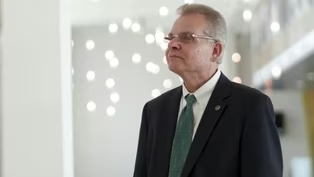
Preview: S2021 Ep5 | 30s | On the next Suncoast Business Forum, meet USF and local business leader Paul Sanberg. (30s)
Providing Support for PBS.org
Learn Moreabout PBS online sponsorship
- News and Public Affairs

Top journalists deliver compelling original analysis of the hour's headlines.

- News and Public Affairs

FRONTLINE is investigative journalism that questions, explains and changes our world.












Support for PBS provided by:
Suncoast Business Forum is a local public television program presented by WEDU
This program sponsored by Raymond James Financial