
July 2025
Season 9 Episode 5 | 26m 1sVideo has Closed Captions
Blue interviews Bart Sullivan of the Falls Free Press, visits Akron History Center and more.
Blue learns about the Falls Free Press in an interview with interim Editor-in-Chief Bart Sullivan; visits the Akron Recording Company for a behind-the-scenes look at how music and audio projects are brought to life; explores the Akron History Center; and talks to Josh Bixler, president of Flite Test, about educational drone and aircraft building.
Problems playing video? | Closed Captioning Feedback
Problems playing video? | Closed Captioning Feedback
Around Akron with Blue Green is a local public television program presented by WNEO
July 2025
Season 9 Episode 5 | 26m 1sVideo has Closed Captions
Blue learns about the Falls Free Press in an interview with interim Editor-in-Chief Bart Sullivan; visits the Akron Recording Company for a behind-the-scenes look at how music and audio projects are brought to life; explores the Akron History Center; and talks to Josh Bixler, president of Flite Test, about educational drone and aircraft building.
Problems playing video? | Closed Captioning Feedback
How to Watch Around Akron with Blue Green
Around Akron with Blue Green is available to stream on pbs.org and the free PBS App, available on iPhone, Apple TV, Android TV, Android smartphones, Amazon Fire TV, Amazon Fire Tablet, Roku, Samsung Smart TV, and Vizio.
Providing Support for PBS.org
Learn Moreabout PBS online sponsorshipHey all you Akronites, welcome once again to Around Akron with Blue Green and yes, you guessed it.
We have an amazing show ahead of us today.
I'm going to learn all about citizen journalism and storytelling.
Then it's over to the Akron Recording Company to see what they've been up to.
Then we're off to downtown Akron to learn all about Akron's 200 year history at the Akron History Center.
Then it's off to Malvern, Ohio to learn all about Flite Test.
Then I kick this show off today I'm going to head over to Cuyahoga Falls to talk to Bart Sullivan.
He's a reporter, he's a storyteller, and he works for the library.
Let's go see what Bart Sullivan is all about.
- I still have a copy of Snoopy Versus the Red Baron.
It wasn't a little Golden book, but it was in that type of, you know, format.
I am a librarian, I am a newspaper reporter, I am a storyteller, and overall, a book addict.
At one point, we bought a giant, stone statue of a Brontosaurus.
Why?
Why not?
It was actually the first time since high school choir that I had really gotten up on a stage.
I was nervous about my storytelling.
In fact, when I walked out of journalism in my first year of college, I went into English and I felt more comfortable.
Because it was all about writing, and it was writing on my own terms versus having you get something out on a deadline.
Getting up on stage there, it took me a couple tries.
But Kyle and Benji, they were great at helping me.
You know, I didn't completely get over my fear, but I was more willing to get up there and tell the story even if I was making it up.
You know, as I stood there.
It's called the, Falls Free Press.
This started off as a small little project about, six or seven years ago.
I think it's been that long, really.
It was a small group of us who got together down at the former Studio 2091.
And we wanted to get...
There was no local, real local newspaper around.
The Beacon had gotten bought out.
It was owned by a company in Florida.
There, the Falls News Press and all the record carrier newspapers were also purchased by the company that bought The Beacon.
Like the closest we had was The Plain Dealer, and even that, you know, is owned by so-and-so, who owned so-and-so.
There was no real local, local paper anymore.
But we decided, you know, we're going to change that.
And it started off where we were writing articles.
There was there was probably about 10 of us at the time.
And our editors would sit down and look at our different articles from people.
We had plans to print it.
We were going for every two months to be printed.
And we learned that it's very difficult to get sponsorships to the paper and get ad sales.
And after about three issues, we decided to call that part quits and continue just strictly online.
I would say libraries are still here for you to come in and get the information that you need.
Even if we can't get a physical book, we can still get you that information.
That’s what public libraries are for.
And I feel that like in this 25 years since, you know, I first started shelving books that it went from, this is just where you go to get your books and maybe even check out a VHS tape.
Again, it was video videotapes back then.
To now, you don't even have to come in.
You can get all your ebooks, you know, delivered straight to your device.
You could subscribe to magazines and have them come, and they're all free.
Or, you know, get on one of the digital streaming services the library has, or you come in and you use the library’s Makerspace.
Makerspace has become so big.
Not just libraries, but just in general.
You know, come in and use the supplies.
And I feel that there's more and more that people are coming to the library for.
Come in and, well, I want to watch something on Netflix, but I can't afford Netflix and I don't have anything to play it on other than my computer.
Oh, I’ll go check out a Roku.
And, you know, oh, they have Netflix, okay.
And I'll both binge the latest season of Stranger Things and then return it.
Or you know, suddenly your power goes out and you need to get your work done.
And I see so many libraries now have mobile hotspots.
You know, come to the library.
You can't work at the library, you have to work at home, you know, take the internet with you.
You can go in and check out, you know, one book, you know, planning on going on vacation, come and check out five books.
And you could be, you know, you could take 20 trips with a bag of books.
You know, you can sit there and go, be nowhere and go on 20 different vacations.
- It's been seven years since my last visit to the Akron Recording Company.
Let’s go see what they're all about.
This building right here in the valley on the north side.
Built in 1893 and originally housed the Akron Soap Company.
- We've been down here on Furnace Street for seven years.
We've technically been around for about eight years.
We were in another location for a year prior to moving the Furnace, so.
Yeah, we're celebrating our seventh year down here this June, so.
Bands are a great majority of what we do, you know, we do tons of recordings, live recordings with bands.
But really, with Covid, since 2020, we really started to transition and offer a lot more video production, not just for bands, but for brands and local companies and small businesses too.
It was kind of a blessing in a lot of ways, because, you know, that need for digital content was just at an all time high.
And since we had a space and we already have the audio kind of covered, people knew that, bands knew that, organizations that were trying to book bands maybe for the summer festival season.
All of a sudden they're trying to pivot and try to figure out what can we do still to reach people.
So, you know, of course we did like a socially distanced and everyone was masked up and we tried to take as many precautions as we could, but we kind of were able to keep the show still going through that time.
And yeah, it was kind of just continued that momentum since.
So Volume Four is out.
And we have Volume Five in the works, basically we have I think all the songs are recorded, but we just have to do some post-production and then, you know, celebrate the fifth year.
We want to make it special somehow.
So we'll probably revamp the artwork a little bit and, you know, maybe throw a party or something to commemorate that.
The variety is nice.
It's nice to, you know, sit in the studio all weekend with a band and, you know, help them with their album.
But, it's also fun when we've been able to go over to like, the Akron Art Museum and film some of their art that they have on display.
You know, a little diversity, honestly, kind of keeps things fresh.
We also do a little live sound.
So, you know, we've done the bicentennial at Kenmore for the bicentennial.
And doing live sound for festivals and local community events has also been something because it's fun.
You get to go out, you get to have a fun day, experience some live music, vendors, you know, good food and all that, so.
I think it's a great tool.
You know, I think just like anything, it's just another tool.
I don't think it can replace, like what an audio engineer does or what a recording engineer does or even what a musician does.
But I think it can...
It's either a great tool to fix a problem.
Some of the AI stuff that we've used is just help us solve a problem, a lot quicker than maybe traditional means or what we've been used to.
And then I think, it's also like can to me is an asset in terms of creativity.
You know, I don't necessarily agree with, like the resources the AI needs.
And, you know, I'm not someone who, like, tries to rely on it, you know, because it's not like great for the environment or something.
So I don't really love that.
But yeah, I think it's just another tool.
Like I've used it to try to come up with new ideas for a song and maybe just pull one idea from that, or use it to kind of recontextualize an idea or to like, maybe spit out a couple different variations of that same idea.
But then I've also been kind of let down by AI, when trying to use it for various projects like, oh, maybe there's an AI program that can help me accomplish this.
And I've been let down several times.
So I think it's a great tool, it's amazing, I think you can get some amazing stuff.
I know, like professional producers are using it in some capacity too, and so there's a lot of potential.
But, and I think, you know, just the beginning of it for sure.
Our biggest competitor I often say is people recording themselves, people recording at home, people doing it DIY because, I mean, that's what we did.
That's why we're here because of DIY.
And that's still something that we try to keep, like in our mission, is that we still have an element of DIY.
I'm not, you know, above doing something maybe in a different way than I would normally do it, you know?
And so, if it's for the right aesthetic or for the right projects, sometimes, you know, it doesn't have to be this perfectly produced thing.
(singing) - Oh girl, you can have those things and rule this world.
- Next up, it's off to downtown Akron to visit the amazing Akron History Center.
Let's go see what the Akron History Center is all about.
- Early 1900s, so 1909.
So, this is the Bowery Project.
So the Whitelaw Building or the Whitelaw Cafe, which is now The Knight Stage, was the first building in this stretch on South Main Street after people rioted and blew up City Hall in 1900.
And so these buildings kind of (inaudible) when this one was constructed was 1909.
It was originally a meat market.
It was the first meat market in Akron to display its meat under glass and have refrigeration.
So it makes you think, how are they selling meat before and what were they using to preserve the meat?
So this was kind of like...
I don't want to say high tech of the day, but, it definitely was something new that Akron had never seen.
And then other small grocers kind of came in, so.
You know, and then it became Siff’s Shoes in the 1950s, and then Jay’s Drugs and then the whole Bowery Project sat vacant for like 20 years before they were able to revitalize it.
The city, you know, really took part in the revitalization.
We have 92 apartments above us in the whole project and a thriving community down here, so.
Right behind us is Lock 4.
So we're right next to Lock 3 Park, which the city just redid.
And it's amazing to see a lot of people ask how the Locks worked.
And I mean, obviously a lot has been redone since city has taken, you know, an active interest in revitalizing the canal.
When you look at it, people have a hard time imagining how you got a boat down the canal.
So when you go down to the first floor here in the museum, there's a plat map of what it looked like with all of the the canals, the Locks, and what the city look like.
And it kind of shows you how they put boats in a waiting line and where they would be stationed to drop off goods, and how they kind of maneuvered back to a canal and the lock.
So it's fascinating the engineering that it took to get it done.
Akron wouldn't exist without the canal.
In all honesty, it took 45 minutes to get through a lock.
So imagine the commerce that was coming through the city.
You had all of these Locks that took 45 minutes to go up to the Summit faster, obviously to go down, but without that, there wouldn't have been the taverns or the grocers, the homes, the lumber yards.
I mean, Akron really was built literally around the canal.
The first floor is kind of the pre-history and the founding of Akron.
So we talk about Native Americans, the fact that we're on a confluence.
So a lot of people don't know we're a confluence here.
So at Youngs, where Youngs restaurant used to be off 93, the water flows two different directions.
So that kind of was key also with canals.
Then we talk about the Perkins family as well as Middlebury, which is the first settlement, and then north and south Akron and the conflict they had.
And then how we became one Akron.
And from there, the growth of the city.
And then we talk about the Civil War.
John Brown, who is probably one of the most consequential people to come out of Akron ever.
And the Civil War and then as you go up the stairs, we have 20 steps of social justice.
That brings you to the second level, which is Boomtown.
So it's kind of Akron's industrial history.
We talk about everything from Akron's first manufactured product, which is whiskey, to the founding of AA, immigration, the labor movements.
We have an Akron Originals case, which is essentially everything, or I wouldn't say everything because there's so much more.
But a sampling of what Akron produced that wasn't rubber.
So you have farming equipment, fishing equipment, books, marbles, clay products.
I mean, a lot of people don't realize that the first place sewer pipe invented here in Akron.
So the sewers in New York and other major cities at the time wouldn't look the same without Akron's invention.
And then we talk about rubber and as you can see behind me, we have a case filled with rubber toys and other rubber things that were made besides tires.
And then we have our Lighter Than Air exhibit, which features zeppelins and blimps and the history of that here in Akron.
More modern Akron or cultural Akron.
So we have our Akronites who have impacted America.
So everybody who was either born in Akron, lived in Akron, educated in Akron or kind of like calls Akron home.
There will be over 56 biographies up there.
We have our Rhythms of the Rubber City exhibit, which is our music history.
Our aviation history, our role in flight as well as space travel.
And then, things like the first one of the original waffle cone makers.
And we talked about the World Series of Golf.
So it's kind of like a sampling of everything that's more modern, more... Kind of like what people who don't know a lot about Akron would know about, so.
- Now, to wrap this show up today, it's off to Malvern, Ohio, to learn all about remote controlled airplanes with Flite Test.
Let's go see what Flite Test is all about.
- Flite Test is a community of over 2 million, community members all over the country and all over the world.
We do a YouTube show that basically teaches people how to fly, how to build.
Obviously, how to crash, how to design, and then do the whole process over again.
Our whole focus is really just connecting people through flight, whether it's in the school, whether it's in the community, through festivals, like what you see here, or whether it's just in their own homes where they can connect as families.
I had a really incredible dad, and we've always been enthusiastic and loving flight.
We grew up in a small airport, in the backyard of a farm.
And once we got too big to basically be able to fly out of that, we started model aviation and I was about seven years old at the time.
And my dad and I would sit there for months and build airplanes, stick by stick.
And I would proceed to take that kit that we spent months over building, and I would destroy it in a matter of seconds.
And I don't remember the successful flights but I do remember was my dad basically help me pick up the pieces, the words of encouragement and just those memories we made together.
And about three years later, we were flying together and just making some of the most incredible memories while building and flying.
As you fast forward a little bit, my wife and I were in ministry, and we saw a lot of families having difficulty connecting with each other, and I was like, you know what?
Let's do what my dad did with me.
And so that way we were able to give them the ability to have this hobby.
But it took a long time.
It wasn't the cheapest thing to do, and the crashes were terrible.
So what we did is we decided to start making common, simple materials of choice and doing build techniques.
So instead of four months of building and hundreds of dollars for the price of a video game, you can basically take common materials like foam board from a craft store, hold it together like origami, and you're flying in an afternoon with something that flies great.
And if you can build, and you can fly when you crash, you get to do it all over again.
So you grow as a builder and as a pilot.
Once we started basically putting out this YouTube content teaching you how to fly, the community really rallied around the vision of just connecting around flight.
And that's where we started growing in numbers.
And it's really worldwide.
We have people all over the country and all over the world building and flying.
We also produce free downloadable plans so someone doesn't have to build or buy our kit.
They can actually take the patterns from our plans, go to the craft store and as little as $10, build something incredible.
I mean, a lot of these planes that are built out of foam board, if you downloaded our free plans, the airframe would be less than $10.
And the whole set up, less than a video game concept.
- Big builds you can start going now.
Go ahead big builds, go ahead big builds.
- This had a combat where we send about 200 airplanes into the sky at one time, and the last person flying wins.
The reason we're sitting under these huge build tents is because basically, people will pick up the pieces and in three hours they'll repair what they destroyed, and they'll be back out there.
And one of my favorite things to see is kids and young adults, they become innovative.
They say, wow, okay, I have two broken wings, but my baseline is good.
Let's build a new style wing that can do a little bit better.
So it's not just about getting people to fly, but it's getting them to attack problems.
We also have a STEM program that we started because problem solving in schools is huge.
Aviation in schools is huge because there's so many job opportunities when they graduate.
So we started teaching kids at a very young age how to build, how to fly, how to create, and then basically how to assess situations when they fail.
That's a good thing because then they get to try it again and learn something new.
Thousands of spectators and I think close to a thousand pilots.
And the funny thing is, is people will come in and we'll have a certain number of pilots beginning of the day.
By the end of the day, these people have come in never flying before, and they've gone from knowing nothing to literally building at this table to having full success.
So this year we have 12 different countries represented from France, we have Kazakhstan here, that's a new country for us.
Germany, Italy, Canada, South America and so many more.
Well, this is basically a work in progress.
I am blessed with the most amazing team members right here that we work with every day.
But also in this event, there's over 100 people that volunteer their time.
So they basically spend the money to travel out here.
And then they put on these orange shirts and then they serve others.
So this event wouldn't be possible without those people basically going around.
You'll see in every build tent, there will be people with orange shirts, you see on the flight line, orange shirts.
These people are experts in what they do.
So if someone's getting in a hobby and they have a difficult issue, they can come in right and there and help them.
If someone's flying for the first time, they can go ahead and help them get flight and get success.
We even have volunteers that are working in the Learn to Fly tent, where people don't have to spend anything or basically buy anything.
They just come, they take another person's airplane, they have these things called Buddy Boxes where they hold one transmitter the other person has the other one.
And if they get in trouble, they can get rescued and then reset and do it all over again.
So crashes are completely removed from the situation.
Nothing but success and an amazing experience, so.
The volunteers and the amazing team members of Flite Test.
It starts around January when we start setting up and planning for this event here in June.
Flite Test started as a YouTube channel, so basically we started doing airplane reviews, started doing build videos.
Imagine like a Bob Vila, but with foam board and electronics and airplanes versus wood.
And, the community really gathered around as the YouTube channel started growing.
We started designing more and more aircraft for them to have a new experience.
And I'm happy to say we are the largest aircraft manufacturer for model airplanes in the United States.
We do over 36,000 kits a year right here in Minerva, Ohio.
Malvern, Ohio is where we have Flite Fest.
Minerva, Ohio is where we get to basically manufacture.
And we also have a smaller air park where people can come out and learn to fly.
You know, the real treasure of what Flite Test is, is honestly the community.
It grows every day, but from the very beginning, when we were very small, it was people wanting to help people.
People want to encourage and serve.
And that has not changed from the time we were in a small one car garage, doing this all the way to where we are today.
And as people want to learn more or even experience, this is obviously Northeast Ohio.
We have a whole location called Edgewater Airpark where people come out, they can learn to fly.
It's right in a beautiful golf course right next to it.
And basically people can come out and during the summer we teach people how to fly on Thursday nights.
This is not something you have to look at from a distance.
Or maybe you miss this opportunity to come to this festival.
You can actually be able to learn to fly right here in Northeast Ohio.
- Thank you for watching this episode of Around Akron with Blue Green.
If you have any questions or comments, you can catch me on social media.
Thank you, and have an amazing day!
Thank you for being you.
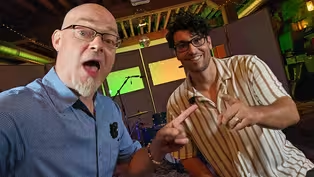
Preview: S9 Ep5 | 30s | Blue interviews Bart Sullivan of the Falls Free Press, visits Akron History Center and more. (30s)
Providing Support for PBS.org
Learn Moreabout PBS online sponsorship













Support for PBS provided by:
Around Akron with Blue Green is a local public television program presented by WNEO