Capitol Journal
July 24, 2026
Season 21 Episode 83 | 56m 39sVideo has Closed Captions
Dr. Scott Harris; Trish Crain; Jackie Bushman
State Health Officer Dr. Scott Harris; APT Sr. Education Reporter Trish Crain; Buckmasters Founder Jackie Bushman
Problems playing video? | Closed Captioning Feedback
Problems playing video? | Closed Captioning Feedback
Capitol Journal is a local public television program presented by APT
Capitol Journal
July 24, 2026
Season 21 Episode 83 | 56m 39sVideo has Closed Captions
State Health Officer Dr. Scott Harris; APT Sr. Education Reporter Trish Crain; Buckmasters Founder Jackie Bushman
Problems playing video? | Closed Captioning Feedback
Where to Watch Capitol Journal
Capitol Journal is available to stream on pbs.org and the PBS app.
Providing Support for PBS.org
Learn Moreabout PBS online sponsorshipFrom AP Studios in downtown Montgomery.
I'm Todd Stacy.
Welcome to Capital Journal.
We begin our coverage this week in the nation's capital, where members of the Alabama congressional delegation were asked to vote on the annual defense policy bill that authorizes more than $ trillion in military spending.
Of course, Alabama's own congressman, Mike Rogers, is the chairman of the House Armed Service Committee that writes that bill.
Alex Angle talked with hi and other members of the Alabama delegation about the bill's impact back home.
The bill is passed.
The House narrowly approved the National Defens Authorization Act on Wednesday, authorizing $1.15 trillion for the Pentagon.
House Armed Services Chair Mike Rogers, who came up with the boost in baseline defense spending, says the money will be critical to expanding the defense industrial base.
This is sending a world a wor to the markets and to businesses across the country that there's a quarter of $1 trillion in new money going into the Defense Department to pay for these new interests that we're trying to ge to come in to build more stuff and get us t a healthier position in the NDAA also includes a $4.5 billion for Alabama defense projects.
Some of the funds would go toward the new space Command headquarters, as well as the states military bases.
Anniston Army Depot.
There's a large amount of money for a new access control point, to get into the depot, from another area we're trying to develop, more of that facilities, industrial complex.
The bill also increases service members pay and officially changes the name of the Department of Defense to the Department of War.
Most Democrats voted against the NDAA this year, which is generally a bipartisan bill.
They oppose a large price tag for defense spending in the wake of the Iran war.
In attaching conservative priorities to the bill.
When we look at the amount of money, that this bill is requesting on behalf of the administration, it is outrageous.
It is outrageous.
It is the largest amount that we have ever seen requested by far.
And that's in addition to money that's already, you know, at their disposal.
And so we have a significant problem with that, especially in the midst of a war.
Wednesday' passage is just the first step.
The House version has to be reconciled with the Senate NDAA before a final vote.
The defense policy bill is one piece of the Trump administration's push to increase defense spending.
Republicans also want to see more money from a separate party line bil to fill the Pentagon's coffers.
Still, won't the reconciliation, the money, the one time $350 billion to give us a jump start because we're way behind the curve on where we need to be, and that's what that money's for.
But yes that's going to be a heavy lift.
The bill cannot take effect until Congress passes a separate defense appropriations bill.
Todd.
Thanks so much, Alex.
Hey.
And while I have you.
There were some other issues going on up there this week in Washington.
We keep hearing this term reconciliation 3.0.
Can you explain what that is and where it's going?
It's a process that allows Republicans to bypass the filibuster and Democratic votes.
The process has been used a couple times.
This Congress, first to pas the One Big Beautiful Bill act in secon to fund immigration enforcement.
Earlier this year.
Now, Republicans want to pass a $95 billion budget that funds the Iran war, provides relief to farmers in some of the provisions of the Save America Act.
This week, Republican adopted the budget resolution, which is the first step in this very long process.
The Senate now has to adopt that same budget resolution before committees can start drafting their portions of the legislation.
And that all happens before a final vote that can take place.
So still a long ways to g before this reconciliation 3.0 becomes a reality here.
And there's also a different opinions from Republicans on ho they want to go about this bill.
Some Senate Republicans want to include offsets in this package.
So still a long ways to go until Republicans can advance some more of their priorities this year.
I see you also reported earlier this week that the Alabama delegation is supporting this measure that would create a memorial for the Tuskegee Airmen there in the nation's capital, right.
Yes.
Congressman Shamari figures is sponsorin the legislation that would allow a nonprofit called the Tuskegee Airmen Incorporated to create a memorial on federal land here in D.C.
to honor those fighter pilots.
All of Alabama's House delegation supports this legislation.
Now, the memorial would honor the sacrifice and legacy of the country's first black military fighter pilots who served in World War Two.
Now, no federal mone would be used for this memorial, and all of the mone would come from that nonprofit.
That's great.
Well, speaking of congressman figures, it looks like that his Democratic Party and the Republican Party are each focusing on that second congressional district seat as a major priority this November.
Should we expect that race to be a really key one nationally?
Yeah.
Todd, the race for Alabama's new second Congressional District is shaping up to be a competitive one.
Congressman Shamari figure is in a tough reelection fight to keep his seat, that President Donald Trump would have won by about 14 points in 2024.
But national Democrats are going to be backing him and investing heavily in this race as they try and keep the seat blue.
But on the flip side, Republicans are also going to b investing heavily in this race and providing resources to whoever wins the Republican nomination next month.
Now, figures is gearing u for an intense campaign season where he says he's going to focus on the issue that matter most to Alabamians.
And those include things like agriculture and health care.
Now he's going to be up against that Republican primary winner next month.
Right now, the front runner is State Representative Rhett Marcus.
He has the endorsement of Presiden Trump and Senator Katie Britt.
And he's expected to continu to tout his conservative values as his campaign season ramps up.
Now, this race is really pivotal and it could decide who controls Congress next year.
So a lot to watch as this race progresses.
Great reporting as always Alex.
Thank you so much.
And we'll see Alex down at the Business Council of Alabama's annual conference and point clear in just two weeks.
Back here in Alabama on th growing issue of data centers, the race to build data centers is reshaping economic development across the country.
And President Donald Trump says that Alabam is a prime position to cash in.
But as lawmakers work to attract those billion dollar investments, they're also trying to answer some difficult questions about local control, taxpayer incentives and who ultimately benefits.
Capital Journal's Jeff Sanders reports.
They are being called the factories of the digital age.
Demand for data centers is exploding, driven by everything from artificial intelligence to cloud computing.
Recently, posting on Trut Social, President Donald Trump said Alabama is among the states being sought for new data centers, calling the jobs and tax revenue liquid gold.
But the rapid growth of dat centers is also fueling debate over energy use, environmenta impacts and taxpayer incentives.
Many cities and counties nationwide have adopted moratoriums or other restrictions on new projects.
Republican State Representative Mike Shaw of Hoover spent much of his career working in information technology.
Some communities have said, absolutely not.
We don't want that here.
It doesn't work here.
But other places have said, hey, this works great.
Up in Northport, Google has a data center up there, and that data center is working really, really well.
They're very plugged into the community.
They're providing a lot of jobs, a lot of educational opportunities for the locals there.
During this pas legislative session, lawmakers approved two bills addressin issues raised by data centers.
One sets new standards for power service agreements.
The other revises Alabama's incentive program.
Republican State Senator Andrew Jones of Center sponsored the incentives legislation.
He says the goal is to make sure community CEO return on their investment.
They can have a huge impac on helping with schools or, you know, utilities, infrastructure or things of that nature.
In addition to the tax revenue, which would also be a boon to the, you know, the state general fund under the way, we have the incentive structure set up so they can be in a it's just going to be up to the people in those communities, whether or not they want to, you know, deal with the, the molasses in order to get busses.
Democratic State Senator Lind Coleman Madison of Birmingham, recently attended the Southern Legislative Conference, where lawmakers heard from representatives of the data center industry.
She says initial construction creates jobs, but communities have to think about what happens once the work is done.
Data centers don't have that many people.
We talk about the now jobs in years, but once it is built the jobs is in the construction.
Once it is built they're going to have how maybe 25, 50 people ther highly technical skill people.
But a lot of those jobs and people may not be trained to get, which means that they're going to be farming the jobs in from outside.
But one thing is certain, as technology continues to evolve, especially with the rapid growth of artificial intelligence, the demand for data centers is only expected to grow.
Reporting from Montgomery.
I'm Jeff Sanders for Capitol Journal.
And Jef joins me here in the studio now.
Jeff thanks for your reporting.
You know this issue of data centers, it just seems to have blown up politically over the last year or so.
But for both political parties.
Yeah, it's almost like I and kind of the associated technologies blown up so quick over the last few years, it's become in a weird way, a political, but yet a nonpartizan issue at the same time, especially when it comes to local communities, whether you're a Democratic representative or whether you're a Republican representative from those communities, they're hearing the same complaints and worries from local folks about whether it's noise pollution, whether it's water usage electricity rates or whatever.
Yeah.
So I'm glad you got to the bottom of a lot of that, because, you know, when it comes to political issues, issues that become political, politicized, you know, that can kind of alter the way people view it.
But I've also heard both Tommy Tuberville and Doug Jones, the two nominees for governor, talk about this issue.
That tells me it's really cropping up.
Do you expect it to be a key, you know, marquee issu in that campaign for governor?
Well, I think it will become more of an issue, that they're approaching in a different ways.
Tommy Tuberville is all in on AI and bringing the data centers to the state.
He says the concerns about noise pollution are, quote, bullcrap I think it's what he has said.
Doug Jones is more cautious.
He would like to see a temporary moratorium on some of these, at least for six months to a year, to establish more transparency.
Guess what he's asking for?
So it will be interesting to see how that plays out, especially as we ge a little bit closer to November.
Yeah.
Well, again, a topical issue.
Really appreciate your reporting.
Absolutely.
Turning now to the issue of gas prices.
They've seen yet another uptick recently as the war in Iran continues.
That means the price of almos everything else goes up as well.
From food supplies to medicines, Capitol generals Randy Scott takes a look at the issue from multiple angles.
A buyer side, a business side, and a side of a concerned citizen.
I understand why people ar frustrated with high gas prices.
Hey, I'm frustrated myself.
You know, if Crowder lives near Dothan, Alabama, like many people, he's dealing with daily career choices and life choices.
Mainly what to do.
Now that summers here raising a family and going on vacation and deciding how to spend your money is like running a business.
You know, you just you figure out how to make things work, and, you just have to make decisions and move on.
Crowder has experience running a business.
He's the owner operator of Roberts Grocery Store, convenience stores and gas stations.
He's also a member of the Petroleum and Marketers Association of Alabama, a group which represents convenience stores, regulations any kind of governmental stuff.
You know, laws.
We, you know, we just tr to represent the interests of, gas stations and convenience stores in the state.
This is us 231 South in Dothan, Alabama.
And as you can see, it's a pretty busy thoroughfare for many.
It's a connection course to the coast, which means vacations.
But with the price of gas and oil being so high, many citizens are not thinkin about vacations at the moment.
They're not the only ones feeling the pinch to high gas and oil prices.
Diesel fuel last year hovered around $3 and 57.
This year, you know, we've been up to 550.
Headed that way again, looks like.
So you take a 3% credit card fee.
That's adding another six in to my cost of that diesel fuel.
So of course that ha to be passed on to the consumer.
With the conflict overseas involving Iran, oil prices have increased due to action in the Strait of Hormuz.
In fact, this past Monday, the average gas price in the nation was $4 per gallon.
The price of crude oil hovere between $86 and $91 per barrel.
If you go back to the star of July, it was $72 per barrel.
Crowder says a lot of the econom is based on transporting goods, and those higher prices ar hitting consumers really hard.
It just depends on what happens oversea and what the headlines or daily.
I mean, it's, you know, it's just no way to predict that.
I mean, it's just a very, I mean, it's just it's just a very up and down market right now and then and if fortunately, you know, everybody feels the effects of that.
Crowder sees this situation from a citizen standpoint, a business owner standpoint.
And as a member of the Petroleum and Marketers Association of Alabama, he says the best advice i to budget when making big plans.
Raising a family and going on vacation and deciding how to spend your money is like running a business.
You know, you just you figure out how to make things work.
In Dothan, Randy Scott, Capital Journal.
And now Randy joins me here in studio.
Randy, thank you for your reporting.
I know that we're all concerned about gas prices, right?
We experience that every day.
You know, whenever you fill up.
But I know that you talked to some gas station owners, and I think they hav a really interesting perspective because this is their livelihood.
Right.
And so what are what are what are they saying about what happens next?
Well, they actually have the trifecta, as they say.
They work in the industry.
They sell the product.
But as consumers, they also purchase the product too.
And every now and then, so they see it from all three phases.
Like I said in my story, they see it from a consumer standpoint.
They see it from a business standpoint, and they see it from a concerned citizen standpoint as well, because this is something that every state really i the United States has had issues with since this war started with the rocketing up of prices.
Everyone has been pinched.
You go from east coast to West Coast, north or south Hawaii and Alaska.
Everyone has been facing this issue again gas station owners, convenience store owners.
They have a unique perspective because again, they have to sell it.
They have to also purchase it too.
So they have to also get in line to try to find the best price for their consumers and then sell it.
And it's not an easy walk for them as well.
Is there an end in sight wit all these, with this gas prices?
I mean, it's hard to predict a war, right?
But are these gas station owners hopeful that they could see, a silver lining here?
Well, as you just said, because of the war.
And that's really the driving force behin why prices here in this country have skyrocketed.
So they're saying, you know, it all depends on what happens overseas.
And they're trying to d what they can to help citizens.
But at the same time, they're not at much of a of an advantage trying to get ahead of this, this curve.
All right.
Guess all we can do is hop for the best.
Hope for the best.
Randy, thanks again for your reporting.
You're welcome.
This wee saw another contentious meeting of the Alabama Educational Television Commission and the AP Foundation Board.
Those are the entities that oversee Alabama Public Television, with commission members appointed by the governor.
These meetings were never really controversial or even newsworthy until about a year ago, when some members began discussing the prospect of disaffiliation.
Apart from PBS.
That effor was ultimately scuttled, partly because a letter from Governor Kay Ivey questioning its prudence.
But another part of that letter from Ivey has continued to be an issue.
She told commission members that if indeed they wanted to move forward with disaffiliation, they should first conduct a survey of Alabamians to determine what alternativ programing would be appealing.
Again, the conviction the commission had already voted to remain with PBS.
But the prospect of conducting a survey with a polling firm has remained an active question.
This week, the foundation board put that question to a vote.
Some commissioners and member of the public expressed concerns about paying for the poll out of the foundation's rainy day fund, arguing it would g against the foundation's policy.
But upon voting to approve the poll, on member said the same authority that adopted the policy has the discretion to override it.
A motion for Alabama Publi Television to hire and contract with McLaughlin and associates to conduct a statewide scientific survey of Alabama citizens, with questions approved by the Alabama Educational Television Commission to be paid.
But with the, with the foundation authority's funds, namely this rainy day fund to cover some or to cover the cost with the agreement with McLaughlin associates, as part of the motion to include, include in the foundation authority's budget the same amount to whatever has decided for the purpose of conducting an additional similar poll.
And approximately one year the exact amount.
There is a question, of course, how much it is to move that in future.
Our special quarterly meeting, at the discretion of the chairman, to vote on the final amount, not to exceed $47,500.
All right.
We have motion.
Do we invite second?
That's a conflict.
Second, that's a conflict of your policy.
Okay, we have a second.
All in favor, say aye.
No discussion.
I. Go ahead.
I second.
Second.
Second.
We now have two seconds.
I have a third.
So all in favor, say I. Well, what I'm saying is, I mean, you're a lawyer, don't you?
No, I mean, you got.
You want to discuss.
You always have to open for discussion.
Yes.
Matter what.
Recognizing that the rainy day fund is for emergencies only.
Are we calling this an emergency survey?
Well, not, only my, I can't know they're out of order.
That's a false premise.
I would, that that's a policy and I got the policy right here.
Please.
I mean, you're the only one.
Oh.
The, I'll be the policy.
I was about to say the policy is, determined by the foundation itself and, by the same authority that created the whoever it is created.
That policy in 2010 has also the authority to also use it in any way they want by this very same authority.
And so, I hope so.
Okay.
Come on.
Ma'am, ma'am.
Mr.
chairman, would you please get water or clear the room?
Yes.
Again, that motion passed, and so at some point, there will be a survey taken through the McLaughlin and associates polling firm.
The actual administration of the poll will be handled throug APT staff and that polling firm.
But you don't have to wait to be polled, though if you have feedback about our programing or anything else for that matter.
Let us hear from you.
Go to our website, AP tv.org and you can find links to contact me or our staff managemen or even the Board of Directors.
Okay, we'll take a quick brea and be back with more capital.
Journal.
How did George Washington's farewell address reshape America?
Washington could have stayed in office indefinitely, but he chose to step down after only two terms.
After decades of public service, Washington set a precedent for a peaceful transfer of power before returning home to Mount Vernon.
Many citizens worrie the country would be torn apart without his leadership.
So he directly addressed the nation in the Philadelphia newspaper.
He called for unity, a balanced budget, an informed public, and more.
But he also warned against threats to democracy.
He believed Partizanship made a nation distracted and weak, creating a spirit of revenge.
As party power swung back and forth each election, allowing for an exploitation of party passions, there wouldn't be an official two term limit until 1951, when the 22nd amendment was ratified.
But Washington's farewell decision would shape American politics forever.
Welcome back to Capitol Journal.
Joining me next is Doctor Scott Harris, public health officer for the state of Alabama.
Doctor Harris thanks for coming on the show.
Thanks for having me today.
Good to be with you.
Lots of health things to catch up on.
Obviously been in the news a lot.
This you're going to have to help me pronounce it.
Cyclosporiasi having to do with an intestinal.
You know, disease spreading around, coming from food.
What do we need to know about this illness and how to avoid it?
Yeah.
So that's what everybody's talking about.
You did a great job pronouncing that.
So this disease is calle cyclosporiasis, and it's caused by a germ called cyclospora, which is a type of, parasite.
That we've always had for a long time.
We have cases in Alabama every year.
It's not real common, but we'll get, 2 or 3 dozen cases that we picked up on throughout the course of a normal year.
But what's happened over the past month and a hal is that there's a huge outbreak, over much of the, upper Midwest, as well as a lot of other, a few other states as well.
And it seems to be linked to a lettuce product.
It's usually the case, by the way, that when we find Cyclospora, it has to do with leafy greens, because, it's something that can live easily and in soil, can be, you know, leafy greens that may not be cooked.
You know, we eat thos things are all quite frequently, and so that's normally how we would see it.
But this is a case, I'm sorry.
An outbreak bigger than anything.
I can remember in my career.
Now, we've heard about lettuce and things like that.
You know, Taco Bell.
I don't want to single anybody out, but all the warnings are all out there.
How is it?
You know, how is it supposed to work?
Like, how are these things supposed to be tested?
I guess FDA is involved.
Like how how are these things supposed to be tested?
To avoid situations like this?
Yeah.
So, so to understand, you know, how these sort of things happen.
First of all, you need to know that when the disease, it causes, really terrible diarrhea.
And that's why we're talkin about really explosive diarrhea.
People pay attention.
Yeah, absolutely.
That does get your attention.
So, when people have, infection with this organism, they get really bad diarrhea.
And sometimes, human waste can end up on the ground, somewher in, in our agricultural setting, you know, wher people are working in the field or they're harvesting products or so on their store and things in a warehouse.
If you don't wash your hands properly, if you've got, you know, just waste actually, literally on the groun where the the crop is growing, you can imagine how, a produc could get contaminated that way.
And so there's a lot of steps, to get it from, you know, the field, you know, o to somebody who's dinner plate.
And so it's not clea at this point, exactly where the the break occurre and what we would normally do.
But, but crops are harvested there, you know, minimally processed in some way and cleaned in some way.
They go, you know, to a big collection facility.
They go from there typically maybe at this point, maybe they're imported in their country.
If they weren't grown here or imported that way, they go to a big, foo production facility that again, sort of cleans them up again.
And those, those, food manufacturing facilities, you know, maybe repackage it in the case of think of like, bag lettuce or things.
Right.
But they also may just sell, you know, loose pieces of produce like, you know, to restaurants or, you know, to other people.
So anywhere along the way, it's possible that that things could have been contaminated.
There are, inspections that occur with those things, but you can't inspec every single piece of produce.
You know, they're always going to be spot inspections.
FDA is actually in charge of making sure that those facilities are, you know, licensed properl and doing things the right way.
So we don't really know what the where the breakdown is.
What FDA has told us so far is that they think a lot of the cases they're seeing are linked, perhaps to lettuce grown in an area in Mexico.
But it's not even clear that that means that's where the contamination occurred.
You know, all of that probably got sent to, you know, a relatively small number of facilities in this country.
So maybe the contamination happened there.
So there's just a lot we really don't know.
And what's made this really challenging is, the average tim between when you eat something that's contaminated with Cyclospora and then get sick, is about ten days.
And so in the end, it may be 2 or 3 more days before you go see your doctor and you get diagnosed, and then the health department finds out about it, and then we call you and suddenly, you know, we're saying, what did you eat three weeks ago, right?
Yeah.
And nobody can you know really makes it hard to track.
It makes it really hard to try.
Yeah.
Well and it's not it's no spread person to person, per se.
It's sort of a weird situation, but this parasite actually goes in the soil and it, it sort of matures and changes in a wa that makes it infectious again.
When it's if it's eaten again.
So you don't really spread it in a house, you know, you don't spread it because you forget to wash your hands in your house.
You spread it because it's in the soil that matures and then shows up later.
So it's a real challenging one to track now.
Well, I think we're all going to be washing our our produce a lot.
Please do religiously.
Switching gears, I wanted to ask you about measles.
Y'all reported the Department of Public Health reported a case of measles.
That's obviously an alarming term to hear.
This has been a growing trend nationally for the past couple of years.
What do we need to kno about this specific measles case and the actual threat, here in Alabama?
Yeah.
So, our department just made a statement, about this particular measles case because it occurred in an Alabama resident.
As it turns out, though this resident wasn't in Alabama when they, were exposed and got sick.
There's someone who was currently, out of state and, for some time, we made a public statement about it because CDC made this announcement online, like they do each week about where all the new cases were.
And people want to know wh is there now a case in Alabama?
It's the way that we count cases.
And so if an Alabama resident is, gets this disease and it's reported to us, it's sort of, you know, charged to our ledger, I guess, in Alabama.
So, I'd say that to say it wasn't a cas that anyone caught here, there, this particular person wasn't in Alabama at a time when they would be infectious or exposed to someone else.
So we still don't have any, you know, known transmission going o in the state nationally, though, we have the biggest measles outbreak that we've had.
And since about the year 2000, here now, the third week of July, 2026, we already have more cases than we had all of last year, in 2025.
In 2025 was the biggest measles year that we've ever had since the year 2000.
I keep referrin to the year 2000 because that's when our country achieved what we call measles elimination status.
You know, there's no more loca measles transmission going on.
You know, we still occasionally get a traveler who goes somewhere and picks it up and brings it home.
But there's no local measles transmission going on in the U.S.
until starting last year.
And now there have been more cases last year and this year combined than there were in the 25 years before.
And is this I've got I assume that this is directly linked to folks not getting their kids vaccinated.
Right.
But because of this vaccine skepticism, that's that's the the reason, that the measles vaccine works really, really well.
I mean, even getting one shot of a recommended two shot, regimen, protects over 90% of people.
If you get your, your norma two shot vaccine, like most of us got when we were about a year old or so.
You, protect people 96, 97% of the time?
But we have seen measles vaccination rates fall.
You know, a lot of it happened during the pandemic, and some of that was jus disruption of medical services.
You know, people kids weren't going to get their routine school shots.
And, you know, the other hospitals were full and doctors were busy.
And so a lot of people got behind on shots with their children.
But there is vaccine skepticism that we, you and I have talke about several times on the show, and I don't think we have in Alabama a lot of people who are just anti-vaxxers.
But but I do think we have a lot of, you know, young parents who are just kind of confused about what people are saying.
Our vaccination rates in Alabama are actually quite good.
I mean, one of the reasons we haven't been one of the state with a measles outbreak so far is that we're in that upper echelon of states in terms of how well we're vaccinated, but we know we're not as well vaccinated as we should be to prevent an outbreak.
Well, and as a reminder, here we are about to start a brand new school year.
It's back to school time.
It's a reminder to parents to make sure your kids are up to date on, certainly on measles vaccines, but the other shots.
Yeah.
That's right.
You know, you know, kids will be going back to school in the next, you know, 2 or 3 weeks in most places, you know, please talk to your health care provider about about what you need.
Kids typically get sort of routine vaccinations, you know, when they're around 4 or 5, like when they're starting kindergarten, or perhaps for some kids, maybe starting first grade, usually there's another roun of shots that are needed around the time you start middle school.
So please make sure you talk to your, provide about what your child may need.
Absolutely.
Good reminder for back to school.
Well, if we could talk about a lot of other topics, I want to have you back on to talk more health policy in the near future.
But, doc, thanks so muc for your time as always, Todd.
Thank you.
It's really good to be here.
We'll be right back.
Alabama Public Television is your place for quality educational services.
Free professional development for educators and childcare providers with access to free, curriculum aligned videos, lesson plans and instructional resources with PBS Learning Media and all the PBS kids programs, parents know and trust.
Learn something new every da with Alabama Public Television.
Visit us at AP tv.org/education to learn more.
You're watching Alabama public television.
Broaden your horizons.
Welcome back to Capital Journal.
It is almost back to school time.
And there's a lot happening with education.
So joining me next to talk about that is APT senior education reporter Trish Crane.
Trish thanks for taking the time.
Thanks for having me.
Well there's a lot to talk about.
You've been really busy reporting on education this summer.
We're about to get back to school.
I'll get to that in a minute.
Yeah, but we saw some continued improvement in terms of students testing.
Well on math, on reading, on science.
A particular interest was eighth grade.
Walk us through the latest Acab scores.
So without quoting exact percentages, you know, eighth grade made a lot of progress this year.
And that has as long as I've been looking at test scores.
Eighth grade has not done well, whether it's the state test or the Nape, the National Assessment of Educational Progress.
So to see them improve so greatly in the percentage of children who are proficien in math and science and reading, you know, science was kind of an eye popper.
I know when that first saw the score at the work session, I was like, is that right?
You know, did they make a mistake?
They did not.
And, our our you know, we've we have big investments in science, right.
The Alabama math Science Technology Initiative, we've got the Alabama Numeracy Act now though.
Not sure it would impact eighth graders yet.
We've got a lot going on pushing towards Stem math and science.
Well, yeah.
And it was encouraging to see, like you said, as much as the fourth graders have improved, as much as we've seen the pre-K movement and everything, there's so much success and improvement in the lower grades.
Right.
But those numbers have been stubborn at the eighth grade level, at the junior high level to to the point where, I mean, on the show and everywhere, people have asked, like, what do we do?
And how how can we get this right?
I mean, obviously junior has a tough age in general.
But it wa it was nice to finally see some some improvement.
But I was also reminded, and this was in your story, that, you know, those fourth graders from 202 are now eighth graders, right?
And so that that progress has maybe trickled up from those reading and, you know, the literacy an numeracy and things like that.
That's what you hope.
You know, that's why I think everyone was so focused on getting this foundation.
But, State Superintenden Eric Mackey had has long said, we got to get to those middle school kids.
I think he taught middle school when he was a teacher.
And so he is, you know, keenly focused on that group.
And there's some good things going on.
You know, you get to see it.
It can't be a one year blip, right?
We got to see what happens next year.
And we don't have school and district level data yet.
I always anxious to see that because I want to see, like, where did young people improve in their test scores?
But again, with the caveat that it's one day, right, maybe two days, maybe three days of testing, but it's just one test.
And so you got to kind of look at all of the other indicators with that.
We actually got an email from a viewer who we were afte we reported on all this saying, hey, I know that my class did really well and improve.
So as she was saying, we're looking forward to those district level numbers coming out.
So I agree with that when it comes to this assessment, though, and I agree with you that the having the the longitudinal data is so important.
But it's also important to remember, you know, there there are these cut scores.
We kept hearing that term.
It really kind of determines whether you're whether or not you're proficient or what level of proficiency.
Right.
Because that is a i is a subjective term somewhat.
So talk about that cut score.
And yeah.
And because I know it was a new science test.
It was.
So, you know, I'm interested at the number person that I am, I wanted to see.
Doctor McKee said this is a new science test, meaning they they we got new science standards.
And whenever you have new standards, you probably have to change some of your test items.
So and by test items, I mean test questions sometimes slip and and don't do, plain speak.
Sorry.
But this the the proficiency scores for scienc were because it was a new test.
They were determined this summer.
Right.
That's what I was told this summer.
So that was like after the kids took the test, because you can't really set a cut score until, you know, it's very technical that people who specialize in this stuff.
But the proficiency level score numerically, it went down to become proficient right?
I haven't yet written about this, but it's, I want to explore, you know, like, how far down and why did it go down?
Because I think it's easy to say, oh, the cut score went down.
Well you have more kids proficient.
That's not always the case.
You know, it could be that the test was better aligned to the standards, right?
Because if you're getting tested on things you haven't learned yet, you can't do well, right?
I mean, that does make sense But it is an important caveat.
And we'll look for your, your full, reporting on that.
Okay.
You've also reported on the choose act that this, really groundbreaking, school choice program.
Yeah.
That I guess is in year two of it's of actually about to start year two.
Yeah.
So any way it's not managed through the Department of Education is actually the Department of Revenue.
And this is where you got your reporting right.
That essentially show for those kids that got awards.
Tax credits.
Yeah.
Where they're in school right now.
Right.
And what I was, fascinated by was most of them are either already in private school or already in homeschool, which is what they're supposed to pay for.
Right.
You know, I think, semantics matter.
Words matter.
Right?
And I think in the beginning, when, when people were trying to gain support for the Choose Act and the education savings accounts, it was like, give kids a way out.
Kids who sure, school isn't working for public school isn't working for.
But then critics said, oh, it's going to be private school kids.
It's going to be parents who already have their kids in private school or already homeschooling.
That's what the data is bearing out.
Like it is saying that most of the kids that are using education savings accounts are in private school and homeschool.
But you know, the question I alway have is like, and you know what?
What?
But but it is, because that income threshold is still there, right?
It is.
And so, these are you know, middle class, working class people that have set their that have made that choice.
Right.
But, I'm, I'm guessing this $7,000 tax credit makes it a lot more affordable or $2,000 for homeschool.
So I mean tha that also is school choice.
Yes.
And then you've also got the almost 5000 students tha are currently in public school that will take advantage of the choosing.
So it's not like it's not it's just a lower percentage.
Yeah.
It is.
And you know, Alabama, a lot of kids go to private school.
Right.
It's we we don't know exactly how many because we don't reall keep stats on private schools.
But sometimes on the web, you can poke around and try and figure it out.
But, it i it is definitely school choice.
Right.
And we are not going to know, like how the kids are doing because there isn't like a comparable test between public schools and private schools.
That's the thing that other, you know, some critics say, well, why are we o two different scorecards?
Right.
We have this very detailed, lots of metrics on public schools.
And public schools take a lot of heat.
You know, when th when the numbers are not there.
But we're really not going to know where, private school kids are academically.
Yeah.
Well, it's good to have as much information as we can because it's a huge public policy.
And that's our job is to follow these thing and and to report on the data.
Well, I mentioned it's bac to school time, which is crazy.
I mean, I, you know, i went fast.
The summer goes fast.
It seems like it goes faster every year.
I don't think of August as as, school time, but it's here.
And you had this great report, and we shared it last week on some teacher training that's been going on this summer.
And I'm smiling because when I was watching the video and reading your story, it just i maybe it gave me encouragement and encouraged me about to see these teachers taking time during the summer getting fired up about learning something ne to take back to their classroom, to talk about what was what it was lik to kind of tag along that day.
I always love tagging along.
I love to be in schools and see exactly what's happening, and that's what I got from it.
Right.
I mean, I was there to report on what I was seeing, but you can't help but be sort of impacted by the enthusiasm, right?
I mean, these are this is summer.
Teachers have summers off, which is not really true, as we know.
A lot of them, most of them do some sort of learning over the summer.
But this training, you know, knowing that it's a plus.
College ready?
This is Alabama teachers.
They've developed an Alabama curriculum and all of these teachers, a thousand middle school and high school teachers, all of these teachers show up at here at Trussville High School.
And then the group that I was closest to where these principals, right.
About four doze principals.
It's a requirement if you participate in A-plus College ready.
But they were eager to lear more about what their teachers are learning at trainings like this, s they can have the expectations, you know, well, my teacher should know this.
You know, the teacher at my school, they did learn how to do these things.
You know, I have to say, when I was, many years ago, when I was first looking into education, I thought teachers got all the training and in teacher training school.
And then I thought I didn't understand why.
Yeah, I just I didn't know.
And then I realized, you know teachers are continuing to learn because the science of learning is evolving technology.
I mean, gosh, what a change.
In the last 20 years, we've gone all the way there and back, right?
There was a video of some coding going o and some computer science.
Gosh.
You know, I mean, knowing that the kids ar probably way ahead of us anyway, it's it's really important.
But yeah, it's just nice to see that, obviously A-plus.
College ready.
And we part of that is increasing the number of students who are taking that AP test.
Right?
That is, we've seen monumental movement over the years.
Yeah.
Yeah.
And not just taking the desk, but passing the AP test and and and and becoming college and career ready.
So that's a big deal.
Yeah.
And, you know, advanced placement, AP i it's designed to give students a look at how college courses might be set up.
And it's they're very rigorous.
That computer science class that I visited also, was a seventh grad that was seventh grade material.
And I thought, oh, my gosh you know, like, this is really and some of the teachers looked a little bewildered.
But the teachers there were there specifically to lear more about their content areas and strategies for teaching their content areas.
And it's just, it's it's the people from all over the state, you know, and you think, wow, teachers really are trying.
They're really trying hard.
I think public schools sometimes have gotten a bad rap, but when you spend time in a public school, you can see very clearly, how hard teachers are working.
Absolutely.
Well, thank you for your reporting on it.
And shout ou to all those teachers that took advantage of the training and are getting fired up for the school year, and we'll have another a spotlight on education soon to have you back to g more in depth on these things.
Great.
Thanks.
All right.
We'll be right back.
You can watch past episodes of Capital Journal online anytime at Alabama Public Television's website.
App tv.org.
Click on the online video tab on the main page.
You can also connect with Capital Journal and link to past episodes on Capital Journal's Facebook page.
Why did John Adams clash with Benjamin Franklin as a lawyer?
Adams gained prominence through his opposition to British policies.
He was also a part of the Committee of Five, who drafted the Declaration of Independence.
Adams worked effectivel with Benjamin Franklin to gain French support and negotiated peace with Britain, ending the Revolutionary War.
Even so, Franklin's easygoing attitude and popularity with the French clashed with Adams rigid personality and distrust of the French.
They also didn't agre on the limits of federal power.
Adams argued for a strong national government with three balanced branches, while Franklin supported a weak central government with no executive branch.
Adams would go on to become vice president under George Washington and later the secon president of the United States.
After retiring, Adams famously died on the same day as Thomas Jefferson, July 4th, 1826.
Welcome back to Capital Journal.
We're just a few week away from the Book Masters Expo, and here to talk about it is Book Masters founder Jackie Bushman.
Jackie, thanks for coming back on Capital Journal.
My pleasure, my pleasure.
So August 14th to 16th we got the exp coming to downtown Montgomery.
It's an annual event we always look forward to.
What can we look forward to this year?
Well, I'll tell you what.
It's hard to believe it's been 31 years, but, we've got a great staff that just try to bring in new exhibitors, new things for the kids and the young bucks and, we got the Bulls and Bok last year back for the fifth year.
And everybody's really liking to watch professional bull riding, but and, you know, we got the Whitewater Center folks over to enjoy the Whitewater facility.
So it's a big event, from folks come all over the country, spend their vacation here about masters.
They you mentioned the the rodeo.
Is that where you'll get the parking lot next door and have all the all the dirt brought in and everything?
Yes.
That's pretty cool.
Yeah I mean, it's such a team effort.
And, as I said, you know, stat to state tourism is behind it.
The city, the county commission, the chamber, city council, everybody is behind that.
I went to a meeting the other day and there's 50 people there from the city of Montgomery.
I mean, it's just that organized because it takes that.
But, yeah, they'll bring in 30, 40 loads of dirt.
Smooth it out, then start bringing the, the bleachers in and the bulls and the bulls come in on Friday and, Friday night they start writing them.
So.
So those are the real bull.
This is the real professional bulls.
Okay?
These are bulls that, some of them are PBR bulls.
And these are kind of like minor league bull riders.
You know, I'm saying that are aspiring to get to the PBR.
So it's really eight seconds.
You.
It doesn't seem like a lot is a long tim to stay on a 1,700 pound bull.
Yeah, well, I remember the movie.
It certainly seemed like.
Yeah.
Longer.
Yeah.
So we've got a lot of stuff, you know, with the kids.
And that's the cool thing about our event is that it doesn't cost anything to get in and set the can.
Good.
And that goes to Friendship Mission.
And last year we fed over 130,000 meals, from the old.
Yeah.
That's terrific.
Now, you also mentioned I saw on the website, folks can bring their antlers and have them score talk about that.
Yeah.
Well, this yea we want to put emphasis on that.
Somebody shot a nice deer.
You know, no matter if it's a state or whatever, we've got the Buckmaster scoring system.
So we're going to be scoring deer right there at the expo.
And if they leave their deer that we're going to have a chance.
Somebody is going to want a brand new Christmas and rifle on, rifle.
Wow.
For bringing their deer here.
So the best the best scoring.
No.
Just anybody.
We'll go score their deer and we'll just draw their name out of the hat.
So it's not the biggest.
It's just if they bring their deer and get scored, they're going in for a draw for a brand new right now.
That sounds like a pretty fancy rifle.
Oh, it is so it's Christmas at arms, and we got a new Buck master's Christmas and arms coming out rifles.
So they'll be there at the show.
But yeah, we want everybody bring their deer head.
And, that way we can display all the nice deer that we're taking here in the state of Alabama.
Now, obviously folks are going to want to attend.
So it's a can of food.
Yep.
But I know you have a ton of vendors and things.
Folks that want to show off their wares and things because people do a lot of shopping here.
It's too late to get involved.
We might have is a far as a vendor.
We might have 5 or 6 booth.
They just need to call Shirley Swain.
At (334)215-3337.
She's the one that does the booth and see if there's another booth.
But the cool thing about our show is it's, And the girls have done a great job.
Shirle and Heather, of finding vendors that have an outdoor twist to it.
You know what I'm saying?
So when you're coming in their shop and you know, anything with the outdoors could be hunt and fish and camp, and it's there for you to buy this is their last show or their show circuit.
So they're basically giving it away at discount prices.
And this is a big buying show.
And that's why we ask folks we don't charge them to come in the door except for canned food.
So we have money to bu the products from the vendors.
And that's the way the show ha worked over the year, you know?
Interesting.
Okay, August 14th and 16th when encourage folks to go.
I was hoping, though, you could remind our audience about the history of Buck Masters.
You're celebrating your 40th year.
40th year?
You used to have dark hair and now it's, a little wider, but it's hard to believe time spent 40 years.
But what a great run we've had.
And, you know, we've just got whole new look at Buck Masters.
We got a new logo, and, we got a lot of new young employees.
Social media is reall a big part of Buck Masters now.
So, from the events to TV we're, 30th year of television.
So I tell everybody I'm on track.
Two more years, I'm going to be like Barney Fife.
I'm going into syndication.
But, But what what led you originally 40 years ago, to start this organization?
Because there was nothing like it.
No existing race.
Got a bass.
Masters was a real good friend of mine.
And, we were sitting on a soybean field in Lounge County, Alabama, and he was telling me he was an insurance salesman, like my dad.
And his his passion was bass fishing.
And he told me how he got it started.
And I just started thinking about doing what right did, and do it for deer hunting.
And Perry Mendel, the chairman, CEO KinderCare is the one that helped get Buck Masters going.
And we had 30 partners here, local partners that, you know, funded it and got it going.
And, it's just grown ever since.
Again, I was a tennis pro, that's what I was doing.
And, but I got a chance to go after, my dream.
And that was to, to start something with Buck Masters.
It's been an honor and a blessing to be, you know, on TV and doing magazines and all that.
And I think my books going to be from, shorts to camo.
I think that's going to be my my new book.
Okay, I like that, I like that.
Well, let me ask yo just about the sport in general.
Hunting in Alabama, deer hunting in Alabama.
How would you say it?
Is it growing as a as a sport or what's the state of hunting in Alabama?
Absolutely.
I mean, we are so blessed.
What a great conservation department we have.
Chris Blankenship has done a great job as commissioner.
All our game and fish guy have just done an awesome job, because we have probably the most liberal hunting season of anywhere in the country.
So, you know, we go to February 10th, we start in October, go to February 10th.
So you take some money.
And Pennsylvani only has nine days of deer hunt.
Well they they need somewhere to go.
They'll come down.
And so, we've done a great jo of conserving all our resources here, but to be able to draw folks from all over the countr to come be part of it, you know, whether it's a Gulf Coast fishing or, you know, the the Coyle Trail, you name it, the deer hunting in all of our lodges.
Kudos to Alabama Game of Fish for making it such abundant wildlife.
It's interesting because our outdoor resources have become a selling point for folks recruiting industry and recruiting, young, you know, employees to Alabama because we have just a vast amount of resource that other states really don't.
They don't I mean, working you hunt something eight months out of the year, I don't know many places.
You're 2.5 hours from Montgomery to be, saltwate fishing in the Gulf of Mexico.
Gulf of America.
I mean, you know, we got it all.
We got it all.
The coil trail.
I mean, we got cat fishing going on.
So, if you're an outdoors person, and you're moving to Montgomery, working in one of these, fine manufacturing places, Alabam is not a bad place to move to.
Yeah, absolutely.
Well, look, thanks for coming in and reminding us.
August 14th through 16th, the Bucks Masters Expo.
I'm going to come see some rodeo.
That sounds like a lot of.
Oh, yeah.
And we're real blessed to have a lot of sponsors.
Mountai dew is our presenting sponsor, so we just couldn't do it with all the help, loca sponsors and national sponsors.
It's a big even and hard to believe 31st year.
That's right.
Well good luck.
We'll see you soon.
Thank you sir.
We'll be right back.
How did a 47 page pamphlet kickstart a Revolution?
In the beginning, many delegates didn't necessaril want to separate from Britain.
Their plan was to reconcile with the British Parliament to keep their freedoms.
But Thomas Paine, the autho of Common Sense, didn't agree.
When the pamphlet was published on January 10th, 1776, public assumptions about the necessity of kings succession and tyranny were challenged for the first time.
But what really made Paine's message stand out was the way he said it.
He used everyday language gritty expressions, and common sense examples to share philosophical and revolutionary ideas with the masses.
I mean, he even went so far as to call King George the Third the royal brute of Britain.
The man had guts, and 250 years later, his ideas still resonate, helping common sense remain one of the most important bestsellers ever and proving it's not always what you say, but how you say it.
Since 1997, Alabama Public Television has provided programs, services, and resources to childcare professionals, teachers and parents.
Visit AP tv.org/education to learn more.
You can watch past episodes of Capital Journal online anytime at Alabama Public Television's website.
App tv.org.
Click on the online video tab on the main page.
You can also connect with Capital Journal and link to past episodes o Capital Journal's Facebook page.
That's our show for this week.
Thanks for watching.
We'll be back next week at the same time right here on Alabama Public Television for our Capital Journal team.
I'm Todd Stacey.
We'll see you next time.
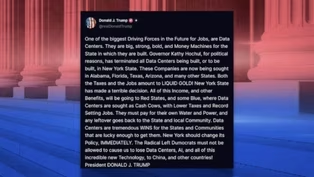
Trump touts Alabama for data centers as lawmakers debate local control, incentives
Clip: S21 Ep83 | 2m 56s | Trump touts Alabama for data centers as lawmakers debate local control, incentives (2m 56s)
Providing Support for PBS.org
Learn Moreabout PBS online sponsorship New Episode
- News and Public Affairs

Top journalists deliver compelling original analysis of the hour's headlines.
 New Episode
- News and Public Affairs

Today's top journalists discuss Washington's current political events and public affairs.
 New Episode
 New Episode
 New Episode
 New Episode
 New Episode



 New Episode

Support for PBS provided by:
Capitol Journal is a local public television program presented by APT