
July 25, 2023
Season 2 Episode 39 | 27m 30sVideo has Closed Captions
UPS and the Teamsters reach a tentative agreement to hold off an impending strike.
Good news for a big Kentucky industry as UPS and the Teamsters strike a deal, experts discuss the grim assessment of Kentucky’s drug problem, the Western Kentucky floods continue to cause problems, Toyota’s Driving Possibilities program comes to three new counties, and a non-profit in Louisville is helping students earn their pilot’s license.
Problems playing video? | Closed Captioning Feedback
Problems playing video? | Closed Captioning Feedback
Kentucky Edition is a local public television program presented by KET
July 25, 2023
Season 2 Episode 39 | 27m 30sVideo has Closed Captions
Good news for a big Kentucky industry as UPS and the Teamsters strike a deal, experts discuss the grim assessment of Kentucky’s drug problem, the Western Kentucky floods continue to cause problems, Toyota’s Driving Possibilities program comes to three new counties, and a non-profit in Louisville is helping students earn their pilot’s license.
Problems playing video? | Closed Captioning Feedback
How to Watch Kentucky Edition
Kentucky Edition is available to stream on pbs.org and the free PBS App, available on iPhone, Apple TV, Android TV, Android smartphones, Amazon Fire TV, Amazon Fire Tablet, Roku, Samsung Smart TV, and Vizio.
Providing Support for PBS.org
Learn Moreabout PBS online sponsorshipThere are 124,000 Kentuckians who work in transportation and warehouse.
Good news for a big Kentucky industry instead of a strike.
UPS and the Teamsters are striking a deal.
The opioid epidemic is the gravest existential crisis that this state has faced since the end of the 19th century.
A grim assessment of Kentucky's drug problem.
But what can be done to fix it?
Plus, what if I told you there were high schoolers flying those planes?
The unique way a Louisville nonprofit is helping these teens take off.
Production of Kentucky Edition is made possible in part by the KET Endowment for Kentucky Productions, the Leonard Press Endowment for Public Affairs and the KET Millennium Fund.
Good evening and welcome to Kentucky Edition on this Tuesday, July 25th.
I'm Renee Shaw.
Thank you for spending some of your Tuesday night with us.
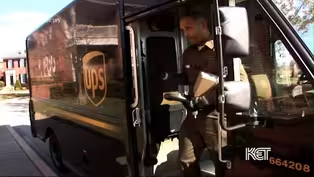
Good news tonight for about 10,000 Kentucky workers and everyone who receives packages.
U.P.S.
has reached a tentative agreement with the union representing its more than 340,000 workers nationwide, avoiding what would have been the largest single employer strike in U.S. history.
The current contract was set to expire Monday.
Under the new five year agreement, existing full and part time ups, Teamsters will get $2.75 more per hour in 2023.
And $7.50 more per hour Over the length of the contract.
Starting pay for part time workers will go from $16.20 an hour to $21 per hour and up.
Before the talks broke down earlier this month, UPS reached tentative agreements with the union on issues including installing air conditioning and more trucks, ending unwanted overtime on drivers day off and getting rid of the two tier wage system for drivers who work weekends and earn less money.
Members began voting on the contract agreement on August the third.
Kentucky has become a prime location for package distribution companies in addition to UPS.
Kentucky is also home to Amazon, FedEx and DHL facilities.
Jason Bailey with the Kentucky Center for Economic Policy says when things get better for U.P.S.
employees, they also get better for other workers.
Well, you know, the distribution industry, the logistics industry has one of the fastest growing in all of Kentucky.
Our location right smack dab in the middle of the eastern half of the United States means a lot of packages have to come through here.
So we are a major UPS employer.
It's the has the largest sorting facility here.
But there are also big facilities for Amazon, for FedEx, for for DHL that have located in Kentucky.
And, you know, the wages and working conditions at U.P.S.
impact the wages and working conditions at their competitors as well.
They're 124,000 Kentuckians who work in transportation and warehousing.
So the conditions in which they come to an agreement or or if there's a strike and the conditions afterwards for these workers affect not just them, but many other elements of other Kentucky workers who are employed in similar work.
You know, Kentucky also heavily subsidizes ups.
We've got over $150 million in tax breaks just since 2005.
And so this is an employer that all Kentuckians have helped pay for their success and their profits are higher than they've ever been with the increase in online shopping.
And so the stakes as to whether, you know, that money from better wages flow into Kentucky and flow into our economy matter not just to those workers, but to really every Kentuckian who has helped subsidize the company.
Profits at UPS have grown more than 140% since the last contract between the company and its workers.
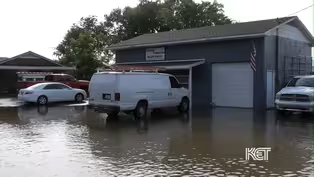
UPS ships an average of 24 million packages every day, six days after record setting rain caused flooding in western Kentucky.
Some areas still have problems and the number of people affected appears to be bigger than first thought.
Our Christy Dutton has an update now that the flood waters are going down.
Many in Maysville, Kentucky, are dealing with flooded homes in washed out roads.
Ryan Drane from the Mayfield Graves Long term Recovery Group joins us.
Ryan, what is the biggest task at hand?
What is the biggest thing you all are dealing with now in this recovery?
Well, I think that one of the biggest things that we're learning now is that the damage is a little more widespread than some of the initial reports.
For example, our number of people that were need assistance yesterday was at about 40 to 45.
Well, overnight, that number is doubled to more than 80.
And so our immediate needs is we're needing folks who can come and help clean out the houses, tear out the drywall, the sheetrock, the insulation, get rid of some of the big furniture pieces and stuff like that that's just been contaminated in the floodwaters because, as you know, floodwaters also include bacteria, sewage, stuff like that.
So if it's floodwaters, it's best to be thrown away, unfortunately.
Yeah.
And this is the same community that had to deal with the devastating EF four tornado a year and a half ago.
And now historic flooding.
We've got two natural disasters in less than two years.
How are people coping with that?
Where's is there any help for them?
Emotional mental support?
Yeah, well, actually, the long term recovery group, we provide spiritual, emotional, mental support to all of our survivors at no cost.
We have licensed therapists and pastors that are part of our group that, you know, talk with survivors because, you know, the thing is, you have the emotional duress of the initial disaster, but then you have the grueling long term recovery piece of it that weighs heavily on all families.
And our hearts just go out for those, you know, the you know, according to our numbers right now, almost 40% of the people that we've spoken to directly are also impacted by the tornado.
Wow.
So if somebody wants to reach out and help, what where can they go?
What can they do?
Who do they contact?
So if they want to reach out and help, they could go to our Web site, recover Mayfield Graves.
Dot com.
We're trying to keep our main telephone lines and everything open.
And our obviously our main website pieces for those survivors of the flood.
Okay.
All right.
Ryan Drain from the Mayfield Graves long term recovery Group, thank you so much.
Thank you.
Thank you, Christi.
On the other side of the state, the rebuilding continues after devastating floods ravage more than a dozen counties in eastern Kentucky last July.
It was a year ago this week that flooding in that region impacted nearly 9000 homes.
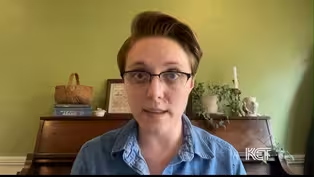
Ivy Brashear is a native Perry County and who's reported on the floods aftermath for the Institute for Rural Journalism.
I talked with her earlier today about the State farm created to bridge the gap for homeowners needing help with repairs or even rebuilding.
Ivy Brashear, thank you so very much for a few moments of your time.
We appreciate it.
We are at the or approaching the anniversary or the one year mark of those devastating floods there.
And you have written a piece for the I we just call it the institute that talks about how one year later, organizations can now start applying to get some of those state funds that the Kentucky General Assembly had approved.
And many would say, why has it taken so long?
Yeah, I think, you know, a lot of people are concerned about that, about how long it's taken and are ready to get back into stable housing.
But, you know, this process just takes a long time.
It takes a long time to figure out how to spend these dollars and how to get them out to the housing organizations that will then use them to build those homes and get people back into housing.
They had to the Kentucky Housing Corporation had to start an advisory committee to accept those applications and decide which ones they would approve.
And that just takes take some time.
Yeah.
And so some would ask, so this money goes to organizations who are part of the rebuilding process, not to individual homeowners, correct?
Yes, that's correct.
So the process will be the housing organizations will apply for these funds.
It's on a tiered system based on the kinds of repairs or new construction that's going to happen.
That advisory board will take those applications and decide whether or not they'll approve that.
And then that money will be disbursed to those housing organizations.
So how much money is up for the taking here?
So there is $10 million total in the fund in the Rural Housing Trust fund.
The money that can be applied for is anywhere from up to $60,000 for home repairs on structures that don't need to be demolished up to 140,000 that can be used to demolish structure and rebuild a new house on a home on land that the homeowner owns.
So when we think about I've seen some of the situations where people may not be able to afford their own home made for the repairs.
I mean, we talk about and we have talked about how those situations have been pretty bleak for people.
140,000 may seem like a lot of money, but it really may not be enough to either repair or start over again.
So this is just to fill the gap, right?
Not to completely make someone whole.
Yes.
The intention of the Rural Housing Trust Fund really is to fill that gap or to be a bridge toward more federal dollars.
So federal buyouts that are happening through FEMA and through the USDA's Natural Resources Conservation Service, which applications are still open for that until August 18?
And that money, those buyouts will be a significant amount that will help homeowners to be able to cover the rest of that amount that they'll need.
But that and the Rural Housing Trust Fund, again, is just a bridge to sort of help it there.
But those federal dollars could even be even longer coming right off the application process if that's in August.
And we think about all the steps that have to happen after that.
Do is there a projected timeline about when the dispersal of those funds could happen?
So I was told the dispersal of those funds could take up to nine months.
That's not a guarantee.
You know, it could change a shift and change a bit.
But, you know, it is a long time.
But, you know, I just remind folks that government moves slow and getting this money out is a slow process.
I think everyone that I've spoken to about these buyouts and even about the Rural Housing Trust Fund are just grateful that something is being done as fast as it is and that this money will be coming, that it's promised to this region.
And it's expected to come here, you know, within the next year.
So they're just really grateful for the promise of this money to come in.
Yes.
This region has a special place in your heart.
Tell our viewers why.
Yes, it definitely does.
I'm from Viper in Perry County, one of the counties that was really hard hit in the flood last year.
My family's been there a really long time for five generations.
And, you know, my roots run really deep in this region.
It means a lot to me.
It's been my entire career and will continue to be my career as I study media in Appalachia in my Ph.D. program at Duke.
Well, we wish you the absolute best.
Thanks for all your great work with the Institute, and we look forward to calling you Dr. Ivy Brashear very soon.
Thank you so much.
Thank you so much, Renee.
Turning now to education news.
Toyota is planning to spend nearly $6 million on new stem programs and several Kentucky schools.
Toyota USA Foundation announced it's bringing the company's Driving Possibilities program to students in Fayette.
Scott and Kenton Counties.
The program helps close educational gaps through hands on programing focused on science, technology, engineering and math.
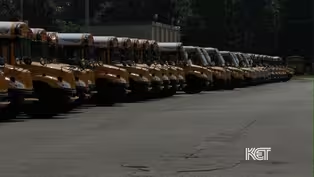
School starts in Jefferson County on August 9th, and most schools have new start times in order to make better use of bus drivers and avoid students missing any class time.
Some parents have complained.
The superintendent, Marty Polio, says he understands the complaints, but says this had to happen.
I mean, we we have the majority of our schools changing their start times and we know it's not easy.
We know it's caused some inconveniences for families.
But getting kids to school on time, not missing instruction, is our number one goal as we do this.
And that's what we are accomplishing.
Superintendent Polio says this is the first time in years the school system has more bus drivers than bus routes.
Now turning to health news, drug overdose deaths dropped 5% from 2021 to 2022 when Kentucky, it's the first decline since 2018.
But that still means more than 2100 people have lost their lives.
A panel of policymakers, drug recovery advocates and treatment providers were on hand last night for disrupting addiction at Forum Live in front of a studio audience here on KCET.
Our panel talked about the problem, the new trends, the state's response, and what more needs to be done to successfully fight this problem and save lives.
Brian Hubbard is the executive director and chair of the Kentucky Opioid Abatement Advisory Commission.
He didn't mince words about the seriousness of Kentucky's drug crisis.
Let's begin with the notion and the concrete reality that the opioid epidemic is the gravest existential crisis that this state has faced since the end of the 19th century.
When I came into this job, I thought I had a good handle around this issue.
But there is not a week that goes by that I am not shocked by the nature and scale of this problem as it now continues into its 27th year.
If we take the beginning at 1996, which is when OxyContin was introduced into the mountains, the opioid epidemic, I believe we would all agree, is something that we have to beat by any and all humanitarian means necessary.
And here's something you didn't see last night.
After the broadcast ended, our panel took questions from the audience.
I was curious if there was something even maybe in the legislature about decriminalizing addicts, because we do end up putting them in jail.
And SL is not is not a place where you should be withdrawing from.
So is there something that we can do to decriminalize addicts?
Well, I can take part of this.
One initiative that we're working on right now is we've started the Kentucky Judicial Commission on Mental Health and Addiction, and it's looking at a sequential intercept model that really meets individuals where they are in their act of drug use perhaps, and where they're intersecting with the criminal justice system.
So the intent is not to incarcerate individuals, but to get them treatment.
And we do have many jails that have treatment in the jail.
I know in in our area in Clinton County, we have really a national model of treatment in jails so that, you know, if an individual is involved in the criminal justice system, we still want to get them help.
But of course, the the objective is to help them before they're ever justice involved when the term diversion is used.
That's exactly what we're trying to get at, right?
It is you're diverting from jail, prison, whatever, to treatment.
So Senate Bill 90, what we're trying to do with mobile crisis, that kind of diversion, pre post arrest, that is to try to get folks getting out of the jails and into the health system.
A lot of great information was shared last night.
You can see the full program disrupting addiction at forum online on demand at CNET dot org.
There's news today about tire removal, seismic activity in Kentucky and nursing home inspections.
Our Toby Gibbs has that and more.
And this look at headlines around Kentucky.
More than 70% of Kentucky's nursing homes have gone for more than two years without an inspection, according to a special report by the Herald-Leader.
The newspaper reviewed data from the U.S. Centers for Medicare and Medicaid Services and found as of June, 73% of Kentucky's 277 nursing homes were listed as going more than two years without a so-called annual inspection, far worse than the national two year backlog average of 11%.
The newspaper said a dangerous shortage of inspectors in the state is causing the backlog and putting patients at risk.
For an in-depth look at what's being called a system in crisis.
Check out the Herald-Leader.
An official with Kentucky Power told regulators last week that the utility will not have enough power for both residential customers and a proposed crypto mining facility beginning in 2026.
That's according to Louisville Public Media.
Yvonne International, a Chinese owned company, proposed building a $250 million computing complex on 55 acres leased from Kentucky Power at the Big Sandy Generating Station.
Kentucky has been trying to attract cryptocurrency companies, including passing legislation that became law in 2021 that provides tax and sales incentives.
The City of Bowling Green has updated its injury leave policy for employees who've been hurt on the job, according to the Bowling Green Daily News.
The Board of Commissioners approved changes giving city employees recovering from an on the job injury.
The alternative to be paid their regular rate for their scheduled hours if they agree to turn their indemnity checks from their worker's compensation carrier into the city.
The policy revision comes following the shooting of Bowling Green Police officer Matt Davis.
The Bowling Green Daily News reports during last week's meeting, the City Commission shared an update on Davis, saying he had been moved out of the ICU to a rehab type unit in Nashville following several surgeries.
Seismologists with the Kentucky Geological Survey are heading into a northeast Kentucky cave to monitor underground seismic activity, WQ said earlier this year.
A size monitor was set up in a cave in Mammoth Cave National Park to monitor the New Madrid earthquake fault activity.
Now the Geological Survey has launched a project at Carter Caves near Olive Hill to investigate rare earthquakes in a more stable part of the state.
The Geological Survey tells WVXU the Carter Caves Project should be completed by the end of the year.
Several agencies are planning a massive tire removal event in Pike County at the level.
It's a fork of the big sandy River, according to the Appalachian News Express.
Pike County officials said In the approximately eight miles of waterway, there are over 2500 tires.
The officials tell the newspaper the tires are not only an environmental concern, but cleanup is needed to promote adventure tourism.
They're asking for volunteers to help in the cleanup event on August 26.
With headlines around Kentucky, I'm Toby Gibbs.
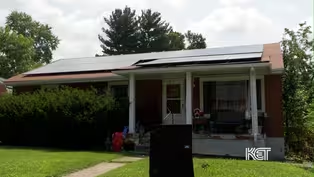
A Lexington woman is one of dozens of homeowners getting power from the sun.
Salaries Lexington Assist homeowners and other property owners and purchasing and installing solar panels at a discounted rate and troubleshooting the installation process.
The city celebrated the program's success and the progress today.
Homeowner Denise Leitch spoke about her experience.
I was amazed at how quick, professional, courteous everybody was.
We had to have inspections done by the state once the solar was installed.
So from start to finish, it took about six weeks.
We went live at the end of the first week of May, and the savings on my utility bills are just unbelievable.
I went from like 175, 200 a month down to 20 a month.
If we don't change what we're doing, there may not be a sustainable world.
In my opinion, you know, with all the we recycle, we use as much natural resources as we possibly can.
And I think it's important that the Kentucky Solar Energy Society partnered with the City of Lexington for the Solar Rise Lexington program.
It also launched similar programs and Frankfort and Louisville.
They say a human being can jump into the water and learn how to swim, but they can't jump into the air and learn how to fly.
Well, flight Club 502 is a nonprofit, Louisville, helping teens defy gravity, turning them into pilots and into leaders.
If you can graduate high school and already have a private pilot's license, you're you're and shoulders above so many others.
Flight Club 502 whose mission is to use aviation and STEM education to teach goal setting and success for young people.
You begin with your young eagle introductory flight, and then you get a you get a flight instructor.
They start working through the program with you.
You have to take a written exam and pass that written exam so that we know you have the subject matter knowledge before you fly solo.
The certified flight instructor will take you up in the plane and you will work together to fly flights, and they will determine when the right time is for you to solo.
It varies from person to person.
The Organization for Black Aerospace Professionals, otherwise known as Oh Barth, is a terrific organization and they partner with us to do their summer camps.
We also work closely with the Academy at Shawnee High School that has an aviation program, and both Obama and Shawnee have been able to extend the reach and the possibility of aviation to minority groups.
I joined through the oh, that program.
I'm currently flying planes now, so I have 10 hours in the air and I'm working on navigation and I plan on becoming a pilot for UPS.
It was very nerve wracking because my instructor was like, Yeah, you have at it.
So it was very nerve racking that I got to fly.
And my first time I got on the plane.
It's not just learning how to fly, but it's having an experience providing a clubhouse and opportunity where young people can come and excel and learn about leadership and decision making skills and critical thinking skills and problem solving.
I've been involved in Flight Club for about two years now, since my sophomore year of high school, and I started off just as a member and I decided that I wanted to take on more of a leadership role.
I personally learned how to run a meeting and manage a club, create agendas and timelines as well as responsible decision making physically in the aircraft.
Flight Club really prepares you to take on any career you're interested in, even if you don't want to pursue aviation necessarily, and you just want to continue to fly or you're interested.
I've learned so many valuable skills that will help me in whatever career path I might choose.
There's a unique opportunity in this time in America where aviation needs young pilots and there is a great deal of resources being put towards cultivating that next group of aviators.
And we're just so happy to be part of it, be such a vital part of it.
The sky's the limit for those times.
Flight Club 502 offers a rotating 22 week program so students can join at any time.
They currently have just under 500 members.
A professor at the University of Kentucky is using his talents to make food that's out of this world, literally.
So we're looking not just at the food, but everything about it.
This UK professor is helping to create a healthy and tasty menu for astronauts in space.
Made him tomorrow night on Kentucky edition, which we hope we see you for at 630 Eastern, 530 Central, where we inform, connect and Inspire.
You can connect with us all the way as you see on the screen through Facebook, Twitter and Instagram.
Watch full episodes and clips at KET dot org and download our app on the PBS video app on ours, on your smart device or television.
Thank you so much for watching.
I'm Renee Shaw.
Take care and I'll see you tomorrow night.

$6 Million for STEM from Toyota
Video has Closed Captions
Clip: S2 Ep39 | 27s | Toyota is planning to spend nearly $6 million on new STEM programs. (27s)
City Celebrates Solar Energy Program
Video has Closed Captions
Clip: S2 Ep39 | 1m 31s | A Lexington woman is one of dozens of homeowners getting power from the sun. (1m 31s)
Video has Closed Captions
Clip: S2 Ep39 | 5m 28s | Organizations can soon apply to the Rural Housing Trust Fund. (5m 28s)

Headlines Around Kentucky (July 25, 2023)
Video has Closed Captions
Clip: S2 Ep39 | 3m 30s | Headlines Around Kentucky (July 25, 2023) (3m 30s)

High School Students in the Air
Video has Closed Captions
Clip: S2 Ep39 | 3m 31s | Flight Club 502 teaches teens how to fly. (3m 31s)
Long Term Recovery Group in Western KY
Video has Closed Captions
Clip: S2 Ep39 | 2m 56s | Long term recovery efforts for those affected by flooding in Western Kentucky. (2m 56s)
Video has Closed Captions
Clip: S2 Ep39 | 50s | Superintendent Marty Pollio addresses the new start times for JCPS. (50s)
Video has Closed Captions
Clip: S2 Ep39 | 3m 16s | Good news for about 10,000 Kentucky workers and everyone who receives packages. (3m 16s)
Providing Support for PBS.org
Learn Moreabout PBS online sponsorship
- News and Public Affairs

Top journalists deliver compelling original analysis of the hour's headlines.

- News and Public Affairs

FRONTLINE is investigative journalism that questions, explains and changes our world.












Support for PBS provided by:
Kentucky Edition is a local public television program presented by KET