Vermont This Week
July 26, 2024
7/26/2024 | 26m 45sVideo has Closed Captions
Flood Recovery Update | 2 Vermont tax sale lawsuits settled, new law adds protections
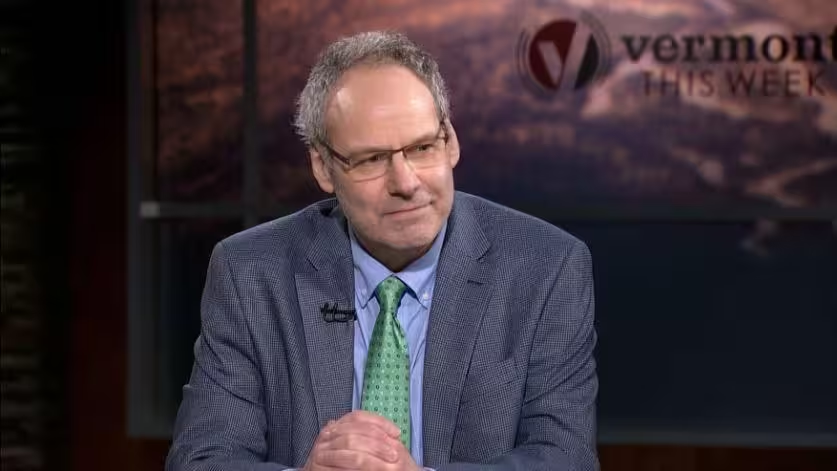
Flood Recovery Update | 2 Vermont tax sale lawsuits settled, new law adds protections | St. Johnsbury Revitalization | Panel: Mitch Wertlieb - Moderator, Vermont Public; Calvin Cutler - WCAX; Anne Wallace Allen - Seven Days; Liam Elder-Connors - Vermont Public.
Problems playing video? | Closed Captioning Feedback
Problems playing video? | Closed Captioning Feedback
Vermont This Week is a local public television program presented by Vermont Public
Sponsored in part by Lintilhac Foundation and Milne Travel.
Support provided by:


Vermont This Week
July 26, 2024
7/26/2024 | 26m 45sVideo has Closed Captions
Flood Recovery Update | 2 Vermont tax sale lawsuits settled, new law adds protections | St. Johnsbury Revitalization | Panel: Mitch Wertlieb - Moderator, Vermont Public; Calvin Cutler - WCAX; Anne Wallace Allen - Seven Days; Liam Elder-Connors - Vermont Public.
Problems playing video? | Closed Captioning Feedback
How to Watch Vermont This Week
Vermont This Week is available to stream on pbs.org and the free PBS App, available on iPhone, Apple TV, Android TV, Android smartphones, Amazon Fire TV, Amazon Fire Tablet, Roku, Samsung Smart TV, and Vizio.
Support the crew
Help Mitch keep the conversations going as a member of Vermont Public. Join us today and support independent journalism.Providing Support for PBS.org
Learn Moreabout PBS online sponsorshipCleanup efforts continue across the state, with mental health experts encouraging those impacted by flooding to prioritize self-care.
Not being able to sleep.
Not remembering to eat.
Not being able to make decisions about what resource you might need.
How to contact them.
How to ask somebody else for help.
Those are all signs that you need to slow down, take a breath and reach out.
Plus, two Vermont Tech cell lawsuits are settled and a new law adds protections.
And what's led to the revitalization of Saint Johnsbury?
That and more ahead on Vermont.
This week.
From the Vermont Public Studio in Winooski, this is Vermont this Week, made possible in part by the Lintilhac Foundation and Milne Travel.
Here's moderator Mitch Wertlieb.
Thanks so much for being with us.
I'm Mitch Wertlieb.
It's Friday, July 26th.
And joining us on the panel today, we have Calvin Cutler from WCAX.
Liam Elder Connors from Vermont Public.
And joining us remotely today Anne Wallace Allen from Seven Days.
Thank you, everyone, so much for being here.
Well, it's been another week and unfortunately, we really have to start talking once again about the flooding because it has been a while now.
It's another year of this, but things are not better.
And for a lot of people, they're worse.
Kevin, I want to start with you asking about this federal disaster declaration.
And I think a lot of people in Vermont have been waiting for it's not yet here.
And also, of course, for us, the difference between assistance for individuals and for businesses and such.
Yeah, for sure.
I mean, it's remarkable to think that it's only been two weeks.
And in part, you know, Governor Scott addressed that this week, that FEMA, because we didn't get as much national attention this time around.
I mean, there wasn't, you know, CNN and NBC cameras, you know, in downtown Montpelier for the flooding.
Because of that, the there is not as many eyes on it.
And the FEMA process is moving at its normal pace.
Right.
So right now, we're still waiting on this emergency federal disaster declaration, which would open up individual assistance for homeowners and individuals that have been affected by the floods.
You know, it's really to get people's recovery started.
So it's about $40,000 that people would be eligible for again, if they get the maximum payout for FEMA.
But it also would open up assistance for farms and for businesses as well.
But they can't access direct cash grants as we've seen in the past year.
Farms and businesses are eligible for low interest loans through the Small Business Administration, and that's something that we've heard over the past year from many that are still recovering from last summer's floods that they really couldn't or didn't want to take on because, you know, having taking on more debt for some of these businesses was a real challenge.
So, yeah, here we are two weeks later and places like Plainfield, Lyndonville, you know, you fill in the blank of some of these communities that were just rocked by the floods.
They are still very much in the early stages of recovery.
Well, you know, we heard at the top of the show about the mental health aspect of this and what people are really hurting about this.
And and I know that you live near this area.
You're seeing a lot of this stuff happening on the ground.
I mean, what are you seeing in these communities and what are people telling you about what they need?
One of the more unfortunate consequences of the flood was that when I went to Plainfield the morning after, I recognized that look of shock on people's faces, people looking stunned.
It just reminded me of last year and people who are you know, it's I live near Plainfield and it is I live I know a lot of people there.
And one of my friends who lives there, whose home was very badly damaged was just saying, I don't know what to do.
What should I do?
And that's so yeah, the mental health aspect of this is clear.
And there's Plainfield has had a lot of young people move to it in the last couple of years, and they're a little bit they might be a little bit more open than other generations to talking about trauma and how this is affecting them and how it might affect them in the future.
So it's it's good that there are those resources for them available.
I find another interesting thing that the governor said at his press conference yesterday was he was talking about trash removal.
He was saying, please, if your neighbors need help moving their stuff to the curb, please help them.
And I thought that was very telling, that Vermont still is this place where neighbors come out in force to help each other.
And that happened in Plainfield immediately.
Well, before there was any possibility of FEMA or even the state providing aid, neighbors were coming down the hill with their buckets and their shovels and their wheelbarrows to help.
They knew what was needed and water and food and stuff like that.
But the unfortunate fact remains that a lot of people in Plainfield, no matter how much help they've been able to get, they've lost their homes either.
Their homes literally fell in the river for the people who lived in that apartment building known as the Heartbreak Hotel.
And so they lost their clothes.
One young man was telling me how, you know, he invested a lot of money in winter clothes over the years.
He has all of his winter clothes and he's he's like, how am I going to replace those?
You know, they're really expensive.
And other people lost their homes because their homes are no longer inhabitable.
And a lot of people have made much more money than they asked for or expected on Go Fund Me so much that they're directing people, possible donors to give to other go fund me but there is no there's not there's no way that you can replace the value of a home that has been that you've paid off the mortgage.
You might be elderly and living there on a fixed income.
Even a FEMA buyout, which will give you the assessed value before the flood, is not going to enable you to find another place to live in Vermont.
So there's a lot of people there who are getting assistance from neighbors and are able to use the resources that have come to town, but are wondering there's right now they're staying with people and they're living in one place for a few weeks.
And then they have and they have the possibility of living in another place for a couple of weeks, but they don't have a stable home to go to.
And that is causing a lot of unhappiness.
Does does the resources you're talking about include some of the flood recovery centers which we know have been open?
I have to imagine that you're seeing a lot of traffic come through there.
Well, you know, there were before the flood recovery center opened, I think it was was yesterday.
There were there were a lot of other people providing assistance in town.
And you saw those telltale stacks of Red Cross buckets that contained brooms and other flood cleanup supplies and so the emergency assistance has been there since day one in terms of food and counseling and there's been great big community meals.
So I actually have not seen a lot of traffic at the Emergency Assistance Center.
And I want to stick with you for a moment and talk about because this Segways do something that's happening.
Another story you're covering with Goddard College.
Now, there's been some big news about this because there was supposedly a buyer for that closed campus, but now that deal has fell through.
What can you tell us about that and what people are talking about now in terms of how that campus may be used in the future?
Yeah, this is really interesting timing because Plainfield has this campus, Goddard College, it's much loved and a lot of people have emotional connections to it.
And the college is closing before the coming semester.
So the campus is available and for sale for $3.4 million.
And a buyer did emerge.
This buyer was a is a commercial real estate developer who has a lot of properties in Vermont.
He never actually confirmed he was the buyer and neither did the college.
But Plainfield residents who are deeply invested in Goddard released a video of a people marching to his house to ask him what he planned to do with the college and asking him to back out from the purchase.
So it seems like he was the buyer, but he actually backed out of the purchase.
So now the school has put out a request for other proposals to buy the campus.
And there's a there's a social justice group called Cooperation Vermont that wants to buy it and put educational programs and affordable housing there.
And there really is an opportunity because there's a lot of dorm rooms that are right now either empty or some of them are being rented to Cabot Creamery for their workers.
There's a lot of other buildings on campus, although they're historical and they're not in great shape.
And they would need to be fixed up.
And there's there's, you know, more than 150 acres of land.
So a lot of people in Plainfield are meeting there and talking about how they can use the dorms there.
Some people who were displaced by the flooding living in the dorms now.
But it's it's expensive to upgrade.
And the campus, which this is critical, it's on time, water and sewer, but it's expensive to turn dorms into apartments.
They're not really made for that.
So it's a long and complicated problem.
But this community is very invested in finding a way to keep the young people that have been moving there from leaving to go somewhere else.
So there's there's a lot of dynamic conversations about it.
And there are people who say that they have the money to buy it and turn it into something else.
Interesting.
Well, we'll keep watching your reporting on that.
And thank you for the update.
Liam Elder, I want to turn to you because this is a story we wanted to get to, too, for a while that you've been reporting.
Apparently, two Vermont Tech SEAL lawsuits have now been settled and one new law is adding some protections.
What can you tell us about that?
Sure.
I think maybe it's helpful to talk a little bit about what a tax sale is.
And I'll do that as briefly and concisely as I can, because it's a little complicated.
Sure.
But essentially what a tax sale is, it's a way for a municipality to collect back taxes from a resident who's delinquent on their their municipal taxes.
And what happens is, if I, as a taxpayer, fell behind on my municipal taxes, the town could sell my home at an auction to cover the debt that I owe the town to cover the taxes that I haven't paid investors.
It's a good deal for investors because they can put their money into into this this account.
They could and get interest on it.
And then if I don't pay back the debt that I owe the town within a year, the person that bought my debt or the at the tax sale would get my property.
So for the investors, it's a really enticing offer because they either make 1% interest a month on their investment or they get a property out of it.
And usually they're getting these at a much lower price than they're actually worth.
Advocates have raised concerns about this process and that it generally is bad for low income Vermonters and it can then every town can do it a little bit differently.
So this new law actually codifies practices around the state that requires more notice be given to residents before attack sale takes place.
And it also requires towns offer repayment plans before going to attack sale.
So just trying to add some guardrails to make the process more similar across the entire state.
And I've written about this a few months ago, there were two lawsuits that I was looking at briefly.
I can explain one of them, the village of Orleans, had seized a woman's house for a 60 $500 tax bill, and she had alleged that she wasn't given proper notification and didn't even really have an opportunity to repay her taxes before having that the deed for her house taken away.
And then, in other words, a family in Greensboro who were dealing with another kind of complicated issue around tax bills, it feels almost to me like an eminent domain kind of thing, like when the state can take land.
But this is more personal, really.
Yeah.
And it's a little bit different, too, because, you know, you have a third party coming in and buying essentially the property and the town is trying to, you know, the town needs the taxes to cover their bills.
Right.
And that's the argument of the Vermont League of Cities and Towns is that towns need to be able to do this and because if they don't, then it's going to burden other taxpayers who are paying their taxes.
So, you know, it's kind of a little complicated in that a town does need to pay its bills, but is there a more equitable way to be doing that?
And that's what advocates are hopeful is going to happen with some more protections in place.
Well, thank you.
You did summarized that very well.
I know talking about taxes is not the sexiest thing in the world, but you did a great job of explaining that.
Thank you.
I want to talk and move on to something that's happening in Saint Johnsbury.
And while sound, you've been writing about this, there is a kind of a revitalization going on there.
Is that fair to say?
Yes, it is indeed.
So Saint John Brewery has a really interesting story.
You know, like a lot of Vermont towns, it flourished in when farming was strong and natural resources were strong, logging and areas like that.
And then Saint John's, we also had the Fairbanks Skills Company, which at one point was the largest maker of industrial skills in the world, and that company flourished for 100 years.
And Saint John and family was really generous and built a lot of beautiful Redstone buildings that I think a lot of people in Vermont will be familiar with.
Like the Fairbanks Museum Museum and the Saint John's Pre Atheneum.
They also built the Saint Johnsbury Academy, which is a private school that has 900 students and brings in people from all over the world.
Boarding students.
But they also fell on hard times.
Like a lot of Vermont towns or towns across the country, people stopped shopping in downtowns.
They and also towns deemphasize the downtowns and put the development out where you needed to drive to it.
So and then Fairbanks Gaels moved out to the Midwest, leaving just a small vestige of itself in the back of its business in Saint Jay.
So around the 1960s and seventies, Saint Johnsbury fell on hard times for a complex of reasons, and it struggled financially for decades.
And the downtown emptied out there were a lot of empty industrial buildings along the rail line and empty storefronts.
But at the same time there were people drawn to Saint John's Street because of its gorgeous, absolutely beautiful surroundings, its downtown topography, its the wonderful institutions left by Fairbanks Scales Command Arts is one that started 50 years ago by Jay Craven and kept up an arts present presence in town and attracted a lot of hardscrabble sort of artists who were living in surrounding areas.
And in more recent times, what has happened is that Saint Jay has been kind of discovered.
So people who might have grown up in the area and lived away for years have started moving back.
Other people who are looking at maybe climate refugees or just looking for a safer or quieter place to raise their kids have started moving back.
And also real estate is actually affordable there or slightly lower rents maybe, and lower rents, lower home prices.
And they had about ten years ago, they started opening businesses downtown just at around the same time that a period of rocky city governance smoothed out a little bit.
They hired a very competent city manager and assistant city manager who worked cooperatively with the Selectboard to invest in downtown.
Like a more very recent example of that is they took their ARPA money and decided to use it as grants to help with housing projects and local downtown businesses.
And the result is that Saint Johnsbury is suddenly having a moment its visitors to Dog Mountain, which is a very popular attraction nearby.
Stephen Unique.
Oh, I know it well, yeah.
With a dog chapel and some wonderful hills and ponds where people can take their dogs.
That has gone up 30%.
And so to the visitors there, so and downtown, there's hardly an empty storefront to be seen.
There are restaurants that there's a very large kind of emporium that always has a ton of people in it.
Moose River Lodge and cattleman Art is planning a great big expansion.
They just got a whole bunch of different funding to buy some big buildings.
Rural Edge, which is the affordable housing developer, is building a big senior housing project in an empty space that was once occupied by some buildings that burned down there.
Saint James City feathers.
I guess you would call them, are partnering with the Northern Forest Center to develop some market rate housing, which is really very scarce anywhere in Vermont.
There's you almost never hear about private developers building market rate housing.
Sure.
So do it.
So they've actually tapped into impact donors who want their investments to make a difference to the community.
So all of these kind of interesting ideas.
There's also the Royal Valley rail trail ends about 7/10 of a mile from downtown Saint Jay.
And the city manager and assistant city manager are working on extending that to what they call the riverfront the six ever so that people will be able to take the trail all the way into town all the way and, you know, have drinks on a death by the river.
So and they have this new is very active chamber of commerce that has a an event called final Fridays during the summer a street festival with ethnic different kinds of food and artists and performances.
So that is really, really popular.
So yeah, Saint J is having a moment for sure.
That's nice to hear that.
Thank you.
And I want to broaden the scope out now a little bit.
And Calvin Cutler, obviously some huge national news since President Joe Biden announced he would not run for reelection.
Kamala Harris is having a moment, I think, even bigger than Saint J.
We can say for months.
Democratic delegates all backing Kamala Harris at this point.
What can you tell us about that situation?
Yeah, this is, of course, been one of those political stories that starting with last weekend, has just evolved hour by hour.
And it really kind of took on a life of its own.
You know, Vermont has roughly over two dozen delegates, 24 or 26 or so that we sent to the DNC.
And we've got pledged delegates who already had cast their vote or pledged for for Joe Biden.
And there were unpledged delegates as well, since Joe Biden stepped back.
That meant that every delegate potentially could could vote for whoever they want if the party were to have an open convention and if there were to be a challenger at the convention, free agents, if you will.
Free agents.
Exactly.
Yeah.
Maybe not as fun as baseball, but.
Yeah, so it's there is you know, it's been a really fascinating process.
And like with other states, what we saw of just the Democratic Party really coalescing around Vice President Harris and saying that, you know, they will or will cast their ballot for her.
You know, it started with on Sunday night, there was a meeting of national chairs and co-chairs of state democratic parties.
David Glidden and Amanda Gustin said that they would vote for Kamala Harris at the convention.
And then I believe it was Monday night or Tuesday during the day.
Basically the rest of the coalit you know, said that they would vote for her.
It's interesting looking at, you know, our congressional delegation as well as Congresswoman Baca bound immediately came out and endorsed Senator Peter Welch, who was the first U.S.
Senator to call for Joe Biden to step aside in the November election.
He waited a day or two and then he endorsed Kamala Harris.
But as far as we know, Senator Sanders says he supports her and he'll work for her, but he has yet to fully endorse, so to speak, at the time of this taping.
Yes.
And this could change by the time you're seeing it.
But that's interesting to me.
And Leon, feel free to weigh in on this as well, because I'm wondering, how important is Bernie Sanders endorsement for Kamala Harris given his progressive credentials?
Incredibly important.
Bernie Sanders represents a very key, really large part of the Democratic coalition.
And, you know, young voters, progressive voters, pro-labor voters and, you know, Senator Sanders potentially withholding his full throated endorsement of the vice president, potentially could be seen as a way to try to leverage influence over whether it be the party platform that they'll be voting on at the convention next month in Chicago to try to include more policies about oversight of corporations or pro-labor minimum wage type of issues or, you know, influencing the platform or potentially policies from a Harris administration should she win the election in November.
So there definitely is a strategic angle here to to Senator Sanders, you know, really kind of withholding his full throated endorsement.
But it is worth noting that previously he did tell, I believe he wrote in an op ed or he said on one of the talk shows that, you know, he fully endorsed President Biden and he said that Biden would win if he focused on pro-labor issues.
And so I think this is a very strategic choice from Sanders to to kind of navigate through this.
You know, it's going to be fascinating and hardly surprising to I mean, I don't have too much to add.
I think you covered it all, Calvin.
But I also like when I first saw the news of all of this, it was like Senator Sanders is going to take a little while to get there because he knows that this is an important time for him to push his many of his policies and things that he's believed in and talked about his entire political career.
So it would have been very surprising to me if he did not do something like this and withheld and withholding his endorsement.
So I imagine that will change, but we'll see.
We'll see.
Yeah.
And Liam, I want to stick with you as we now get our focus back to Vermont here, because you've been covering a fascinating story about this Franklin County former sheriff John Ross Moore, who, in fact.
I'm sorry, the current the current sheriff.
Yes, that's right.
Okay.
It gets confusing to me because of all the different twists and turns this has taken.
He's been on trial.
This trial ended in a mistrial for folks who aren't too familiar with the story.
Recapped for us what he was charged with, why he was on trial.
Yeah.
Sheriff John Grace Moore in Franklin County was charged with simple assault, which is a misdemeanor assault charge.
And he was charged based on an incident that happened actually before he was sheriff when he was a captain at the department in August 2022.
And the video shows him kicking, handcuffed and shackled detainee in the groin in this during this August 2022 incident.
And so he's charged with assault based on his conduct there.
The trial this week is the culmination of a very long process.
There have been a number of investigations, including by the criminal the Criminal Justice Council, which is the accreditation body for Vermont law enforcement.
They actually yanked his law enforcement credentials based on his conduct, saying that he used excessive force and that wasn't a criminal trial.
Right now we're talking about the criminal charge here.
And this week, Chris Murphy asked a jury and there was actually the criminal trial where they were looking at whether or not he had broken the law when he kicked Mr. Jeremy Burrows in August 2020 to Chris Morse, defense was that it was the his actions were in self-defense because he believed Jeremy Burrows was going to spit on him and spitting on a law enforcement officer was actually a criminal offense in Vermont.
So that was the case he made, whereas the prosecutors were arguing that it was excessive, unreasonable and caused pain to Mr. Burrows.
Was he not on duty at the time that the incident was happened?
Yeah, he had come in.
It was a it was a weekend.
And he was in working on some paperwork.
He was actually in shorts and a t shirt wearing a baseball cap, according to the video of the incident.
So so this trial ended in a mistrial.
The jury could not come up with a unanimous verdict.
Interesting side note to this.
Apparently some of the jurors were brought into this trial in a most interesting way.
Yeah, it was sort of an unusual circumstance where not everybody that was called for jury duty showed up to the Grand Isle County Courthouse when they were picking a jury.
And so they ran out of potential jurors.
And the judge instructed the Grand Isle County sheriff to actually go out en route to by the courthouse and pull over people.
And if they were Grand Isle County residents, to send them in the courthouse to potentially be on the jury.
And this does sound kind of like a strange story, you know, not something we see every day.
But the court is allowed to do this under their rules.
A judge can order a sheriff to do something like this in a situation where they need prospective jurors maybe pulling people over is and I'm not super comment, are they allowed to say no?
You know, that's a good question.
I'm not sure.
I mean, I think you are you need to show up when you're called for jury duty.
There's actually you can you can be issued a fine if you don't show up.
So I would assume there there's there's it's hard to say no.
And briefly, Lehman, there will be another trial.
Do we know when that's going to be?
Yeah, a second trial for John Mars looks like it's going to be in the fall.
Jury trials scheduled for late September with the trial beginning in early October.
Okay, we have some debates coming up that we want to let you know about.
We recently covered the Democratic primary governor's debate here on Vermont public and lieutenant governor.
Debate is coming up for the Republicans on July 30th.
It will be Tuesday at 7 p.m.. And you can see the lieutenant governor Democrats debate as well the following day.
That's coming up Wednesday, July 31st.
And Calvert, I know that you're doing a lot of work with this pro flying a lot of candidates lately.
Yeah, for sure.
I mean, it's you know, these are really the three races to watch, lieutenant governor for both the GOP and the Democrats and also the governor's race as well.
Certainly.
I mean, it's the candidates.
It's the next generation.
Like there's, you know, questions about generational divides and whatnot, but also, you know, politically where do the parties stand and factions of the party, too.
So it's really fascinating stuff.
And we'll have to leave it there for today.
Thank you so much to our panel, Calvi n Cutler from WCAX, Liam Elder Connors from Vermont Public.
And joining us remotely today was Anne Wallace Allen from Seven Days thank you all so much thanks at home for watching and listening.
And I'm Mitch Wertlieb, but I hope that you'll tune in next week for Vermont.
This week.

- News and Public Affairs

Top journalists deliver compelling original analysis of the hour's headlines.

- News and Public Affairs

FRONTLINE is investigative journalism that questions, explains and changes our world.












Support for PBS provided by:
Vermont This Week is a local public television program presented by Vermont Public
Sponsored in part by Lintilhac Foundation and Milne Travel.