
July 27, 2023
Season 2 Episode 41 | 27m 29sVideo has Closed Captions
One year later, Kentuckians reflect on the catastrophic flooding in Eastern Kentucky.
Resilience and recovery in Eastern Kentucky one year after getting hit by catastrophic flooding, Somerset Mayor Alan Keck reflects on his unsuccessful gubernatorial run and voters’ response to him, the role ‘transportation to treatment’ plays in fighting Kentucky’s drug crisis, temperatures continue to rise in parts of the Commonwealth, and good news about Officer Nickolas Wilt.
Problems playing video? | Closed Captioning Feedback
Problems playing video? | Closed Captioning Feedback
Kentucky Edition is a local public television program presented by KET
July 27, 2023
Season 2 Episode 41 | 27m 29sVideo has Closed Captions
Resilience and recovery in Eastern Kentucky one year after getting hit by catastrophic flooding, Somerset Mayor Alan Keck reflects on his unsuccessful gubernatorial run and voters’ response to him, the role ‘transportation to treatment’ plays in fighting Kentucky’s drug crisis, temperatures continue to rise in parts of the Commonwealth, and good news about Officer Nickolas Wilt.
Problems playing video? | Closed Captioning Feedback
How to Watch Kentucky Edition
Kentucky Edition is available to stream on pbs.org and the free PBS App, available on iPhone, Apple TV, Android TV, Android smartphones, Amazon Fire TV, Amazon Fire Tablet, Roku, Samsung Smart TV, and Vizio.
Providing Support for PBS.org
Learn Moreabout PBS online sponsorshipThose stories began to define the flood in very human rights, resilience and recovery in eastern Kentucky.
One year after getting hit by catastrophic flooding, folks saying, Well, we really like cake.
We like its ideas, we like its approach, but is not viable yet.
And so we maybe should go somewhere else for now.
Somerset Mayor Alan Keck reflects on his unsuccessful gubernatorial run and voters response to him.
A lot of times they can get a judge to agree to an opportunity to go to treatment, but we have to get them there.
And the role transportation to treatment plays in fighting Kentucky's drug crisis.
Production of Kentucky Edition is made possible in part by the KET Endowment for Kentucky Productions, the Leonard Press Endowment for Public Affairs and the KET Millennium Fund.
Good evening and welcome to Kentucky Edition on this Thursday, July 27th.
We're one day away to the weekend.
I'm Renee Shaw.
Thank you for joining us tonight.
Very good news tonight for Officer Nicholas Wilt, the Louisville police officer shot in the April 10th mass shooting at Old National Bank.
Officer Wilt will be released from rehab and will go home tomorrow.
You have health says he is still recovering from a traumatic brain injury and will continue his therapy on an outpatient basis.
Good news this week marks the one year anniversary of the deadly eastern Kentucky floods that killed more than 40 people.
Full coverage of that in just a few minutes.
But first, Governor Andy Beshear reflected on the anniversary during his news conference today from hugging survivors that very first day when literally all they had were the clothes on their back to comforting those that had lost to standing and counting at the site where those kids were washed away.
I want to thank everybody for everything they've done, being the good neighbors that we are living out, the golden rule, being there for one another.
Over this past year.
Remember, this is the toughest rebuild, I believe, in the history of the United States.
But it's happened to the very toughest of people.
The governor is also urging people to pay attention to the heat.
The next couple of days, as the heat index could go as high as 115 degrees in some parts of Kentucky.
Still no word from U.S.
Senator Mitch McConnell about what happened yesterday at the U.S. Capitol when he stopped talking in mid-sentence and had to be led away by his Republican colleagues.
McConnell returned later and said he was, quote, fine.
USA Today reported today that McConnell has used a wheelchair on some occasions.
Somerset Mayor Alan Keck was one of the dozen candidates in May's Republican gubernatorial primary.
He placed sixth, earning just 2.4% of the vote.
Mayor Keck talked to us yesterday about his first statewide run for office.
Any future political ambitions?
And if he was asked about being the running mate to Republican nominee Daniel Cameron, how do you assess how you performed in the primary?
What were the lessons you learned?
This was your first big race wide.
So many lessons, candidly.
One is, you know, I made a pledge to be authentic.
I'm glad for that.
You know, I never deviated from that.
I made a promise to never pander.
And we didn't we talked about issues that mattered.
I think we're still talking about it.
You know, you get into elections to win, though.
And so while I've been complimented across the state and people thank me for my messaging and the debates, I said, you know, it seems as if I did well at all of it, except the whole getting votes part.
And I wish that I would have been more successful there.
But I am happy to see us talking about workforce and reentry, welfare reform, things that I think will move our state forward.
We're talking about public safety in a big way.
And so from that standpoint, I wasn't a failure at all.
So do you wish you had gotten in the game a little earlier to be able to raise the money to get a little higher?
I do.
You know, I was running for mayor while a lot of the folks were already out campaigning and having fundraisers in my community.
And that did make it challenging.
You know, as I reflected, you know, Commissioner Corales had been on the ballot that my number.
Number five in Polaski County, General Cameron, that was the third time he had been on the ballot in our county.
You know, I'm the mayor and been elected twice in Polaski County.
It was the first time they'd ever say now and kick on the ballot just like the other 120 counties.
And so I think that was perhaps more of an uphill battle than I realized.
I've been accused of being naive and being a dreamer.
That's okay.
I'm glad I did it.
You know, folks asked if I regret it.
The only thing I regret is not doing a little bit better.
But I loved the experience.
I loved getting to meet folks, being able to tell our story and then hearing theirs.
Were you disappointed at where you ranked in terms of the overall ranking?
Yeah, I was.
I was.
I mean, if you look at the KSR debate, most folks said that we won that at your debate or forum or whatever you want to call it, the consensus feedback I got is that we had a great night and so that didn't translate into votes.
I think it did.
It morphed into a competition of who actually could win, and I think that hurt our overall finish.
I don't know that I was going to win regardless of that, but I think it probably stifled my numbers of folks saying, well, we really like we like his ideas, we like his approach, but he's not a viable yet.
And so we maybe should go somewhere else for now.
Yet is the key word there.
Right.
Why did you get in when you got in?
I wanted to make sure that the issues that I cared about, you know, again, public safety, education, workforce development, we're going to get talked about.
I saw the potential for it to just become a a national issues discussion.
And I didn't think that was good for Kentucky.
It's easy for us to turn on Fox News or CNN and think that's what everyday Kentuckians care about.
I don't believe that as mayor, I'm living it every single day.
The struggle, the joys, the trials.
And I wanted to make sure that got talked about.
I think this became a very issue's focus.
We saw Commissioner Corales, obviously a brilliant guy, get a lot of degrees, you know, come out with this this idea that he was the issues candidate.
I was okay with that.
Well, I thought we kind of had taken that man so early.
He was then talking about things that really mattered.
It became a campaign about substance and maybe someday we'll shift the focus from personal attacks and tearing people down and talking about issues that can improve lives.
Well, oftentimes when political neophytes and that's not what you are because you've been a two term mayor, but those who were new to this state stayed.
Yes, right.
People get in knowing that, okay, my chances may not be all that good, but I'm building.
Building the name recognition, building that profile.
So the question obviously, obviously, is what next?
Right.
I appreciate that.
I always tell folks I'm flattered when they ask, are you going to run for governor again?
Are you going to run for Congress?
You know, we've got a congressman who doesn't show any signs of stepping away.
You know, Congressman Rogers, the dean has done an incredible job for our region.
And I always want to be respectful of that.
And so right now, my focus truly is on Somerset.
It's been nice to get back on the horse as the chief executive of my hometown and start kicking butt again.
Will I seek higher office?
I'd say very likely.
I still think I have some skills to bring people together and get big things done, solve complex problems, cast a vision that I think is unique and that is not my town.
You know, I've pledged publicly that we're going to try to help General Cameron get over the hump.
It's going to be an incredibly tough election.
Governor Beshear still very popular and a lot of positions, a lot of areas in the state.
And so my future is cemented for the next three and a half years, if you will.
You know, I'm going to be the mayor from there.
I don't know.
It's a it's a faith walk.
Tiffani and I have talked a lot about trusting the Lord in that process.
There's countless scriptures about not being anxious in that uncertainty.
And sometimes maybe that was the lesson is for the Lord to say, you know what?
I'm in control of your future and your destiny.
You just need to be a good steward day by day.
And so right now, that's the plan for me in Somerset.
You know, so many people talked about who was going to be the number two on the ticket with Daniel Cameron before he announced his state senator, Rob Mills, would be.
Did you ever have a conversation with Attorney General Cameron about being his running mate?
The answer was, yeah.
And then actually, Smith started before I ever announced.
You know, I knew Daniel was thinking about it, and I think he had heard I was thinking about it.
And so we had a discussion.
Does it make sense to possibly I want to be candid, he never offered.
He never even said that I could be that person.
But we did have a conversation about, you know, what, it makes sense to set him up beforehand.
And so after the election that we didn't we never had a formal discussion about me running with him.
And a future broadcast of Kentucky Edition Macek, we'll share more about the future political post he could be eyeing and whether his message and policy platforms resonate with Republican voters.
Monday night on Kentucky.
Tonight, we brought you disrupting addiction to form.
It was a discussion about Kentucky's ongoing drug overdose crisis and what can be done about it.
After the program, our panel took questions from the audience, including this one.
Transportation is an issue, as you talked about what's happening in eastern Kentucky, even in urban Louisville, even in Lexington.
Access to services cannot happen if we don't do something about the transportation and people being able to have more mobile responses and things like that.
Are any of you working on, even in the funding realm, of providing more support around transportation and services?
You're right.
I mean, as Secretary Freelander and Director Hubbard and I traveled around the state before the debate was kicking off.
Transportation came up at every city We visited that along with recovery, housing.
One of the things my office has done is granted some money to the Department of Corrections.
And we said anybody who's on probation and parole and needs a ride to a job, appointment to a treatment appointment, we'll provide that.
We've expanded that to the Department for Public Advocacy, and they're sentencing alternative sentencing workers.
A lot of times they can get a judge to agree to a opportunity to go to treatment.
We have to get them there.
But we have made things hopefully easier in terms of being able to access that transportation.
What we've done is we've said we used to say you couldn't use it for methadone treatments.
We've taken that away.
We used to say if there was a car somewhere in the family that you couldn't access the transportation pieces.
Well, what if somebody going to a job?
What if the car doesn't work?
So we have tried to make access a really important point for what we do.
We partnered with the General Assembly on like when an ambulance goes out or first responder of that type goes out instead of forcing them to take somebody to hospital.
We are now working on allowing them to maybe do a little treatment where they are if they have that skill set.
And then as well as not necessarily taking somebody to a hospital but taking somebody to treatment.
You can see the full hour long program Disrupting Addiction at Forum online on demand at CNET dot org.
It's been almost a year since eastern Kentucky was hit with rain described as unprecedented, catastrophic, unimaginable and devastating.
For five straight days, rain fell on the region more than a foot and a half by the time it stopped.
More than ten inches fell in a 24 hour period beginning the night of July 27th, triggering flash floods and mudslides and overwhelming rivers and creeks.
45 lives were lost.
More than 1400 people had to be rescued by air or by boat after becoming trapped by the floodwaters.
26 counties received a major disaster declaration as flood damages totaled more than $1 billion.
Here's a look at what Eastern Kentucky has experienced in the year following the flood.
It's hard to plan for for anything of this size and magnitude.
70% of our community has been flooded in one way or another.
If it wasn't the water that came rushing in, it's the mudslides off the mountain and the water coming out of the hollers that have just washed people out.
We didn't think this was going to happen to us.
You go to bed one night and you you're fine.
You have everything that you've worked your whole life for.
And then the rain comes in.
It's just wiped away your craft and your own victory.
We had a little baby a month old.
Rescued by helicopter.
Had a lady here, 94 years old, rescued by helicopter.
She came in here barefooted for no songs.
When this water goes down, we ain't.
None of us ain't going to have a place to go.
All their belongings, their homes, everything they owned got washed away in these floods.
People had nothing.
We need help.
We need boots on the ground.
We need people to help them come in and help these people dig out.
Of the 12 to 18 inches of mud that took the back half of my house, which is standing there in like 30 feet up in the air.
People are living in all sorts of different situations.
We know people who are staying in houses that are not completely repaired.
We had one wooden bridge, one way in, one way out.
And when the bridge was completely gone, the only way across was the creek sale, straight back with two armfuls of groceries, which is probably $300 worth of groceries.
And I just sit there the creek and cried.
Yeah, it was bad.
That was the turning point.
And more than anything right now are people need help.
We all of the people, the state of Kentucky, when things aren't going right to help lift them up.
And here we are.
This is for the kids.
Hopefully, we continue to help.
That's the characteristic of Appalachian people like you help your neighbor.
If my house is messed up, I'm still going to come over and help with your work because that's just what we do.
Everything was gone.
And to be able to actually have something have a roof over our head, you know, and have something to cook on, have a place like my head and sleep at night, it's a blessing.
It really is.
We had a housing crisis before the flood.
Having you took a bad situation and made it a lot worse.
When we talked about long term recovery and talking about building thousands of houses, that's not something that can happen overnight.
It's going to take a big miracle and a lot of money to go there and get people to where they used to be, you know, to where they're actually comfortable towards.
They're actually feel like they're at home again to make them feel human again.
You know?
By some counts, more than 80% of homes damaged or destroyed by last year's flooding were outside the designated high risk areas.
On the Federal Emergency Management Agency, flood maps.
The maps are used to determine insurance coverage for property owners with federally backed mortgages and how communities regulate development.
But there are a growing number of complaints about FEMA flood maps being inaccurate and even out of date.
A FEMA specialist in floodplain mapping tells us the maps are updated more often than people think, but the updates can only come if a community asks for it.
The flood maps actually identify the high risk areas of flooding in each community.
Anything in that area does have a 1% annual chance of flooding in its every year.
Each community has a flood damage prevention ordinance once they have maps and so anything within that high risk area has to follow that flood damage prevention ordinance.
So if that means elevating the lowest floor to, you know, above the base flood elevation, which is the base flood elevation determines the height of that structure where that first floor needs to sit inside the high risk area, which is one of the tools for resiliency.
And we use that all the time across the nation.
There's one misconception, and I'd just like to get this out.
It's usually after one a flash flood or a flood.
Usually people think, okay, FEMA's going to update the maps and we don't work that way.
They're on a five year cycle when we update these maps.
So a lot of times when disasters hit in these maps are a lot of people think the maps are going to be updated right away.
Right after that disaster declaration and that's not the case.
It's usually a five year cycle.
But sometimes the communities are already in a process of updating their maps when when a disaster hits.
Usually we see this after a disaster when a community does flood.
They want to update their maps, especially after ten years old or older or something like that.
So what happens is, is the community wants their map updated.
They would get with the state in effect coordinator and then say we need to get our maps done or we want to update our maps.
And then it goes from there.
Creating these maps requires funding.
So that also comes into play when we are updating maps as well in a 30 year mortgage.
If you get sea water, your house is potentially going to flood at least once.
If they have any kind of federal funds or if their loan is backed by any type of federal funds or anything like that, it's mandatory in a high risk area or special flood has an area for that homeowner or even business to purchase insurance.
A lot of people that file for flood insurance after a disaster, a lot of them are outside the special flood hazard area.
Anything that's out of high risk area, it's not required for them to buy flood insurance.
But we all know the water doesn't stop at the end of the map.
It keeps going.
Russo also said it's important for homeowners to know that FEMA maps don't predict where flooding will hit and that they need to talk to an insurance agent to help determine the overall flood risk to their property.
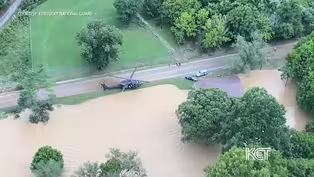
When Flash flooding struck last year, it submerged most of breath at county.
Members of the Russo Volunteer Fire Department found themselves performing water rescues and helping people trapped inside their homes.
And they continue to answer the call of those in need in their county.
We were used to flooding.
You know, flooding happens often, but nothing is significant this bad.
I mean, yeah, we'll go a, you know, day and and it floods in and it blocks the main road and we can't get out and can't do anything but to be this significant is has never happened before.
My cell phone started blowing up and I knew that, that we was in trouble.
I knew that we had people that was trapped and there was 12 in an upstairs attic.
They was there, I want to say, about a day and a half and you see water coming at you.
I mean, you can only imagine what a man thinks.
And a lot.
On the third day of the flood, we we'd done 18 rescues.
We ended up getting five Black Hawk choppers to land here in our jurisdiction.
And every one of them had swiftwater boats.
You know, it was it was crazy.
The water was still big at that time.
And but we was doing what we could.
We knew that we had to get people help.
We was able to get the one that was trapped to safety.
You know, I hate to even stop and turn around and think back at it because, you know, it brings up so much emotion and it's just hard.
It's just hard, you know, because it could have very easily been and we lost a lot of people in the county.
They lost their lives.
And and only imagine that we could lose more is, you know, is pretty it's pretty emotional.
When the water receded and we did start distribution, we delivered 50 roughly 50 bodies throughout the county in general, not near the riverside jurisdiction, but we went throughout the county and delivered that many days.
Food, water, cleaning supplies we had has 15, 16 trucks going out at one time deliver.
I'm trying to help my fellow man and help my neighbors, and we're trying to help everybody that we possibly could.
And still today, you can see in the building here that we're still doing distribution.
We don't turn out.
But they even before the floods, this area was in need of, you know, just food supplement and cleaning.
I mean, everybody in the area is on a fixed income, a lot of other people and virtually below the poverty level.
So it was a great need even before the flood.
And it shined a lot of light on on the community and the needs it had.
And that's why we keep it going.
A lot of people are back on their feet, but then there's still some people that hasn't got back on their feet.
We've had 4500 people, I think 14 campers that came in, and we've got them to people that needed a place to live.
The need is the need is real.
The need is not as great as it was after the flood, but there's still needs in the community.
That's why we keep it going and and we save sometimes 80 people a day comes through here, you know, every every day we see that, you know, that it's slowly coming back.
And we knew that it was going to be a long process.
This is not just going to happen overnight.
This is not going to happen in a year.
We hope we hope that we continue on the road and we and continue to improve daily.
Chief Wilson is one of the people featured in The Daily Yonder is continuing flood coverage.
The Daily Yonder is published by the Center for Rural Strategies, which produced East Kentucky Flood.
A half hour documentary on the flood that aired here on KCET.
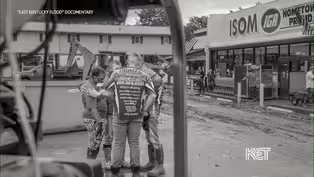
We recently spoke to Dee Davis, president of the Center for Rural Strategies and publisher of The Daily Yonder, who is based in Whitesburg, about telling the stories of those who survived the flood while living through it himself.
Looking at the destruction afterwards, we were trying to figure out what we could do, how we can be of service.
And we just thought, Well, why don't we take this moment and come gather some stories, since that's what we're good at.
A lot of people had witnessed things they had never expected to see, and so the stories were amazing.
A fireman who couldn't swim.
Going with a kayak and rescuing 14 people.
I went into our house as it may and that she were on the couch.
It was obviously about next to her sitting on the couch.
I was able to float her up and get got her right here.
And I was like, Wow.
I mean, I couldn't I couldn't get her over there.
So I actually just found some adrenaline and I just was able to put her in that car.
And I said, we have to go.
We have to go now.
I cannot tell you.
So those stories began to define the flood in very human ways.
I call them the hillbilly, hillbilly refugees that have moved out of here.
They knew we weren't going get any help from anybody else.
And I started calling.
So I just tell them the best I could and when the roads opened up, they rolled in here.
It's often hard to get your bearings when things are moving so fast.
But a year later, we begin to get a glimpse of our trajectory, where we stand, where we need to go.
And I think there's a lot of people who are still here and committed to making something better happen.
So I'll be optimistic.
Yeah.
You can watch the East Kentucky Flood documentary on our website, online and on demand at Georgia.
Org.
For additional content, check out the Daily Yonder website.
Our coverage of the one year anniversary of the Eastern Kentucky flood continues tomorrow night on Kentucky edition.
The mayor of Jackson and Bradford County talks about trying to build back her community as more people are packing up to leave it after the flood.
We leave you tonight on this note.
Kentucky state police are hoping for a third consecutive win in the national best Cruiser competition.
But according to the latest numbers, Kentucky has fallen behind California, Florida and Indiana.
Now, you can vote through survey monkey.
The voting ends Monday at noon Eastern.
So let's reclaim our first place standing Kentucky.
We sure hope you'll vote.
And that you'll join us again tomorrow night at 630 Eastern, 530 Central for Kentucky Edition, where we inform, Connect and Inspire.
And we'll continue our one year anniversary of the Eastern Kentucky flood coverage.
We hope you all subscribe to our weekly email newsletter and watch full episodes and clips at Ket dot org You're welcome to send us a story idea at Public Affairs at KET dot org and follow us all the way as you see on your screen there, Facebook, Twitter and Instagram to stay in the loop.
Thank you so much for joining us tonight.
Will be right back here again tomorrow.
Inside Kentucky politics as well.
In addition to our one year flood coverage of Eastern Kentucky recovery.
Thank you for watching.
I'll see you again tomorrow night.
Eastern Kentucky Flooding: One Year Later
Video has Closed Captions
Clip: S2 Ep41 | 4m 40s | A look back on the one year anniversary of the historic flooding in Eastern Kentucky. (4m 40s)
Video has Closed Captions
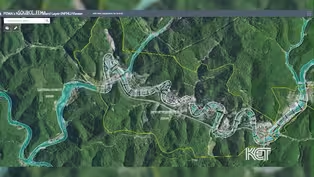
Clip: S2 Ep41 | 3m 2s | FEMA specialist Tim Russo talks about updating maps and assessing risk. (3m 2s)
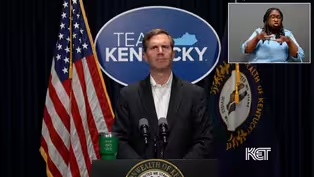
Gov. Beshear On Eastern KY Flooding
Video has Closed Captions
Clip: S2 Ep41 | 1m 5s | Governor Andy Beshear reflects on the Eastern Kentucky flooding one year later. (1m 5s)
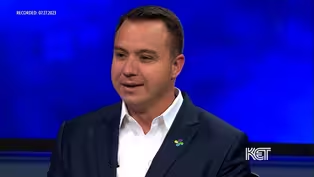
One-On-One with Mayor Alan Keck
Video has Closed Captions
Clip: S2 Ep41 | 6m 19s | Mayor Alan Keck sits down with Renee Shaw to reflect on his gubernatorial run. (6m 19s)
Video has Closed Captions
Clip: S2 Ep41 | 3m 40s | One year after of the flooding in Eastern KY, volunteer fire department continues to help. (3m 40s)
Video has Closed Captions
Clip: S2 Ep41 | 2m 29s | Dee Davis telling the stories of those affected by the flood. (2m 29s)
Transportation And Addiction Recovery
Video has Closed Captions
Clip: S2 Ep41 | 2m 22s | The role of transportation services in addiction recovery. (2m 22s)
Providing Support for PBS.org
Learn Moreabout PBS online sponsorship
- News and Public Affairs

Top journalists deliver compelling original analysis of the hour's headlines.

- News and Public Affairs

FRONTLINE is investigative journalism that questions, explains and changes our world.












Support for PBS provided by:
Kentucky Edition is a local public television program presented by KET