
July 28, 2026 - Full Show
7/28/2026 | 26m 46sVideo has Closed Captions
Watch the full July 28, 2026, episode of "Chicago Tonight."
Cleanup is underway after damaging storms hit the Chicago area. And a contentious budget battle at Chicago Public Schools. The head of the Chicago Teachers Union joins us.
Problems playing video? | Closed Captioning Feedback
Problems playing video? | Closed Captioning Feedback
Chicago Tonight is a local public television program presented by WTTW
WTTW video streaming support provided by members and sponsors.
July 28, 2026 - Full Show
7/28/2026 | 26m 46sVideo has Closed Captions
Cleanup is underway after damaging storms hit the Chicago area. And a contentious budget battle at Chicago Public Schools. The head of the Chicago Teachers Union joins us.
Problems playing video? | Closed Captioning Feedback
Where to Watch Chicago Tonight
Chicago Tonight is available to stream on pbs.org and the PBS app.

WTTW News Explains
In this Emmy Award-winning series, WTTW News tackles your questions — big and small — about life in the Chicago area. Our video animations guide you through local government, city history, public utilities and everything in between.Providing Support for PBS.org
Learn Moreabout PBS online sponsorship>> Hello and thanks for joining us on Chicago Brandis Friedman.
Here's what we're looking at.
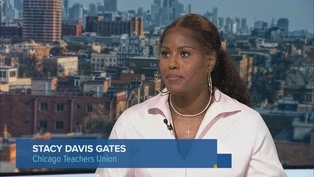
Chicago Teachers Union president Stacy Davis.
Gates sits down with us ahead of school budget vote this week.
And President Trump proposes tariffs on Canada.
How it could impact Illinois.
>> First off tonight, cleanup begins after Monday's strong winds and heavy rain pounded the Chicago area.
The storms were the second time this month alone were nearly a month's worth of rain fell in just a single day.
Comment says more than half a million customers were affected.
>> We've seen significant more intense storms.
Year-to-date than we have.
>> All all of 2025. you know what?
We used to be uncommon.
like, you know, hurricane winds now and there the common, you know, the one intense storms are not happening as a matter of fact.
>> The utility company says power still out for 135,000 customers as of 5 this evening.
But thousands of crew members are still working.
The National Weather Service says 2.9 inches of rain fell at Midway Airport yesterday when the average rainfall for the entire month of July is 3.7 The deluge overwhelmed sewer systems and flooded streets and homes and 80 mile an hour winds led to 2003, 2000 tree emergency reports in Chicago.
The weather service says so far it has confirmed 2 tornadoes, one in Lansing and one in Glen Ellen.
An alliance of community groups rallied in Daly Plaza this morning calling on Governor JB Pritzker to meet with them over the closures of 2 Chicago area.
Hospitals.
>> Cold hospital.
We've got to pull Weisel west of Burt.
The families and state.
>> Somebody say right?
>> Weiss Memorial Hospital in Uptown shut down last August after state regulators found numerous safety and compliance problems including emergency staffing shortages and deteriorating building conditions earlier this year, west Suburban medical Center in Oak Park owned by the same company as Weiss also closed its doors.
Coalition leaders are urging the state to reopen both hospitals under new ownership and are demanding greater transparency about hospital finances.
In a statement, Governor Pritzker's office says, quote, despite intensive financial and operational support from the state, the hospitals are ultimately private facilities whose leadership was both unable and unwilling to do everything in their power necessary to keep their facilities in operation and they never presented the state with any formal request or viable plan to continue operations.
Illinois grade school students will go cell-free during school hours starting with the 2027 28 school year.
Teachers told us >> that they finally felt they had their students back.
They were no longer competing with screen time for attention and focus and they saw a noticeable improvement in our overall school climate.
Our team members watched students sitting together at lunch, playing board games and talking with friends.
They were laughing and simply being kids again.
>> Under a state law state bill signed into law today.
Schools across the state will be required to implement a bell to Bell policy.
Meaning students will be restricted from using their cell phones from the time of the first arrival Bell to the final dismissal bell.
This includes during class lunch and passing periods with several exceptions.
High schools will have a similar policy with more options to allow use during passing periods or lunch.
You may have noticed eager clipboard holders on your way to work or the grocery store today.
That's because candidates for Chicago mayor and city council have started collecting signatures to get on the ballot.
This is the earliest the process has ever.
Bergen thanks to a new state law that moves election qualification deadlines up by a month city council candidates need 473 signatures from registered Chicago voters to qualify for the ballot.
Candidates for Mayor city clerk and city treasurer need 12,500.
Many candidates will submit 3 times that amount to make sure that their petitions can withstand challenges by opponents.
Candidates have 90 days to make it onto the ballot, which is scheduled to be certified by December 17th Election Day is February 23rd.
One on one with the leader of the Chicago teachers Union right after this.
>> Chicago tonight is made possible in part by the Alexander and John Nichols family.
The Pope Brothers Foundation.
And the support of these donors.
>> When the Chicago Board of Education meets later this week, they will have some tough decisions to make.
The board is expected to vote on the nearly 10 billion dollar budget proposal from CPS which the district recently revised to avoid staff furloughs.
But to close the 732 million dollar deficit district is planning 1600 layoffs, including more than 700 teachers.
Joining us now is Stacey Davis.
Gates, president of the Chicago Teachers Union and the Illinois Federation of Teachers.
Welcome back.
Good to see Stacey you to thank you for having So you can see to your calling on board members to reject this budget proposal from CPS recalling on board members to call it a first drive for not calling for rejection.
I think what we saw today from the Chicago public schools is what we expected them to do.
>> Capitulate that the budget is not yet.
Bates.
We know that it's July.
We do this every single summer and by the end of August, we have a budget.
They go back and forth with ID is about with they think is fully baked.
We push them.
We challenge them.
Parents call them.
We make demands and we finally get to a place that both parties can tolerate.
We're not there yet.
>> Cps says that this change to avoid the furlough days is increasing the assumption in tip dollars that they'll get from 202 to 285 as well as listening to the voices of the community and the stakeholders during feedback sessions.
But they're saying that this budget has to be passed this week in order to make payroll in September.
Do you think that's an accurate, reasonable timeline?
This vision has to be passed by the end of August.
We know that by law it.
>> We do this every single year.
But again, here's what we know.
We know that the mayor, Chicago has surplus to a billion dollars to the Chicago public schools since 2024, we know that, right?
come through for us every single year.
We also know that if the governor and the General Assembly do not call for a special session that this budget is never going to be in the place to offer our children.
The type of enrichment they need after school and the type of instruction that they need.
A special education classrooms.
The governor and the General Assembly have to get real.
We're fighting Cook County this year to give us money that they owe this last year.
I think Maria Pappas, his office is holding almost a half billion dollars of money that could be distribute it.
We need them to become a bit more series about that aspect of school season and not having both the money from the county that's coming from property taxes not receiving the full funding from the governor in Springfield and relying, you know, too heavily on tips.
Hes got or schools face scene, both furloughs and layoffs at the same time when all 3 of these entities, if they met in the middle, we might get there.
But if the state doesn't come through, this problem is going to become chaos.
I want to come back to the because you mentioned Cook County, Trevor Cook County Treasurer, Maria Pappas.
>> The Illinois Federation of Teachers is suing her and her office for failure to disperse those property tax funds to school districts.
Why a lawsuit?
Why that approach?
Well, I mean, how else do you get money that's owed to you?
The city council says so the debt to a bill collector.
Our members are the bill collectors.
>> And we filed papers this morning as Illinois Federation of Teachers to get that money back just today.
Evanston Vinton School district and they're asking their parents to volunteer because they cannot pay for crossing guards at a school district.
Give me a break.
Give us the money that you're holding.
Get your operations right in the treasurer's office.
That's an expectation.
Number 2, that governor and the General Assembly, if you can opine about calling a special session for the Chicago Bears, certainly you can call a special session when the largest school district in the state of Illinois is telling you that they're having difficulty reaching payroll because you have been given them the money that they're legally required to have in this moment, we can only rely on tips so much.
And I would tell you the billion dollars that we've received since 2024 have gone to reopen libraries at Fairfield Elementary School.
That same library is on the chopping block right now because we can't get the school funded.
So one of the going back to Maria Pappas, she said in a statement to Wt Tw news, quote.
>> No comment on pending litigation.
We've given the Chicago Board of Education more than 4.5 billion dollars.
These attacks are par for the course.
It's election season.
Well, the treasurer's office doesn't give anything they distribute the funds.
>> That the families who live in Chicago give in order for their schools to be find it.
So we're just looking for her to understand that it's back-to-school season and to make good on the money that we were supposed to get last school year.
We still have athletic directors and coaches who haven't been paid for Fauci's and of last school year and she's calling an election season.
Give me a break.
We have to prioritize what's important.
And that's offering our students a fully funded education.
>> So okay, going back to the state this year.
State budget increase the evidence-based funding amount for CPS by 350 million dollars.
Still less than what many had hoped for.
The governor has said that school funding is a priority, but the state is limited on resources.
You've mentioned the special session or the possibility of a special session in and asking lawmakers and the governor to head back to Springfield to work this out.
What if they don't?
Well, they should.
Revenues are coming in higher than expected.
>> So that taxes that they have levy for those who can pay more are actually bringing the state of Illinois more revenue.
We should consider that especially when the largest school district we have the most special education students and the state.
We have the most and how students in the state we have the most English language learning students in the state.
Those require fines and we're getting more in revenues.
It sounds like there is an opportunity to figure out how to do this for Chicago for Evanston, for places like Cicero who are laying off their teachers instead of bringing more inside of the school building.
This is a special project and it warrants a special session.
And if they don't wear should CPS, what do you think CBS should be looking to cut?
Well, I don't think you When people owe you money.
>> So you call in the dead.
And so we're calling in the day and the governor has their answer the phone that Donald Trump is doing everything in his power in this moment to remake America in yesteryear.
Our governor seems like he wants to be president.
If he wants to be president, he's going to have to have a story for America.
He's going to have to show them that he kimbro fix things that are broke in and the funding for the Chicago Public Schools and other public schools in the state.
That system, that process has been broken for a long time because we don't have the revenue for it.
A billionaire should be able to compel other billionaires to go all in for the common good.
That type of story stands in stark contrast to President Trump.
>> Ok, so shifting gears a little bit.
The entire school board entire 21 members school board will be up for election this fall.
What's at stake in this election?
Well, whether or not we make the Chicago Public schools a sustainable community school district or are we close schools and cause more harm to black Chicagoans?
Okay.
Very simple.
Donations.
A donation limits.
They have been lifted in the school board president race in which the sea to use CTU has endorsed The meeting he's currently a political director position.
You once held in CTU.
How do you anticipate CTU being involved in this campaign?
CTU wants to win the debate for the students that we serve every day in the Chicago Public schools.
>> As you know, the union that I am a member of we have been fighting for an elected school board with a coalition of partners for decades.
And we finally have this thing that we fought so hard to see.
This is about a cause or rating democracy for our schools at a time of mass internationally, we are doing this also at a time where we get to choose which Chicago public schools looks like in 20 years.
We have had a system of billionaires.
We have had a system of mayors choose to do harmful things to the public school system.
We finally have an opportunity for mothers, single mothers who need the school district to work to actually run to have a stake in making it work.
We have people who have struggled slept outside of school board meetings to have their voices heard.
People who have starved themselves in order to keep schools open.
We have an opportunity for Chicago to hear all of those stories and we have an opportunity to choose community and sustainability for our school district.
We can not talk about closing schools when we know it harm students.
It harms the school district and it harms the black communities in which they close schools.
So that conversation is off the table.
This time we get to talk about the vision for an equitable just system that we can all be responsible candidates for mayor and city council started collecting signatures today.
30 seconds left.
Stacey, you and I are not collecting What do you hope to see out a mayoral candidates?
Look, I hope to see Mayor Johnson come off the sideline and I hope to see the people who support him.
>> Get out here and pass a petition.
If he's not gonna pass what?
I'll pass one Okay.
You've got to get in at the right.
maybe we can say that we still have his back and can Joe him to get into it?
Look, I think that the city has done better.
Certainly Chicago public schools has done better where the governor has failed to find our schools.
The mayor has given us a billion dollars.
In fact, we're going to look to him again for his leadership in this moment.
And I don't think we've done better a Chicago public schools.
Then we have been under his leadership.
And so I'm going to look forward to that progress, right?
That's where we'll have to leave it.
Stacy Davis Gates, thanks for joining us.
Thank you.
Good to see you.
And on tomorrow evening's program we'll hear from the superintendent of Chicago Public Schools, Macklin King.
>> Up next, a new round of proposed tariffs on Canada.
A look at the potential impact in Illinois.
>> Education reporting on Chicago tonight is brought to you in part by press forward.
Chicago.
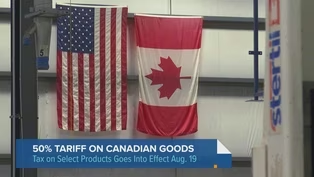
>> President Donald Trump escalates tensions with Canada once again after announcing a new 50% tariff on select Canadian imports just as broader tariffs on dozens of countries take effect.
The administration claims Canada is discriminatory against American industries.
But critics warn the move could further strain one of the United States's closest trade relationships and raise costs for businesses and consumers, particularly in the Midwest.
Joining us now are Michael Nigro, senior fellow at the Center for American Progress.
And Robert Bruno, professor of employment and Labor relations at the University of Illinois, Urbana Champaign.
Welcome back, Tom.
And thanks for joining us.
Thank you.
So by going to Yuko offered a recently published study that found quote, Trump tariffs hit the Midwest harder than the rest of the country.
It's estimated that the tariffs increased costs for the average Midwest household by more than $2000 in the year 2025. reduce the region's economy by 18 billion dollars lead to the loss of about 42,000 manufacturing jobs.
Bob, why is the Midwest disproportionately impacted by these tariffs compared to other regions in the U.S.?
>> thanks for the question is nice to.
He bet on the program vanished fundamentally because the Midwest particularly relies on a lot of manufacturing and makes up a significant amount of GDP.
We also have a large agricultural sector.
We have like the other states in the Midwest.
A good portion of economy is based in consumer behavior and consumer activity.
This is a very large state with a very large GDP for all those reasons to you're going to have a stronger negative impact on tariffs which because of the nature of the economy.
And we're seeing similar impacts across the Midwest states and with some variations depending on the breakdown of their economy and the sectors of the economy and the workers in their economy.
>> So a new round of tariffs went into effect Friday targeting 80 countries at a rate of 10 to 12.5%, which the administration says is dependent on the extent of their efforts to address labor violations.
Mike, on the ground, how different is this round compared to the previous tariffs that we've already seen this year?
>> these tariffs are just more of the same.
What we're seeing here is a president who as very intent on using tariffs as a tool.
I just want to underscore what professor Bruno said.
That tariffs are a tax or a tax that the importer, which is typically an American business is paying to bring something from overseas.
But president has been in love with tariff since the 1980's and since coming into office, they've rolled out essentially the same set of tariffs.
now a 3rd time initially and on Liberation Day, they use and authority an emergency authority to the Supreme Court struck down in February.
Then they shifted to a different authority section one, 22 of the trade act premised on a balance of payments crisis, which means you don't have enough foreign currency union of currency to pay off your debts, which of course, is not the case because United States float its currency and now and at the expiration of those tariffs, which expired after 6 months, he's introducing a new authority section 301, as you noted, is premised on unfair trade, which they're saying is to forced labor practices.
These countries who don't have sufficient forced labor prohibitions gives them a competitive edge.
So what we're seeing is essentially the same set of tariffs double digit percentage tariffs, charged products coming in overseas.
In this case from 80 countries that the reasons have shifted multiple times because the president is just trying to get not to have a pun here, but he's just trying to get the goods through customs.
He's hoping that the Supreme Court doesn't invalidate Meanwhile, its businesses and consumers who are stuck paying the bill.
And I should note with the emergency tariffs, the Supreme Court required the federal government offer refunds to businesses.
And so even the revenues that are collected may not do much for public investment or for the national debt because if the Supreme Court strikes these doubt, these tariffs down, ultimately, they'll have to give it all back.
>> Michael, you mentioned, you know, the impact on consumer and consumers and business is Bob, how might consumers and businesses be impacted?
>> won't be.
It won't be good based on the studies that we've done looking at the 2025 what we would anticipate for every one percent increase in the terrace that impact the state households would see their costs go up by $315.
The state would be subject to losing another 1000 manufacturing jobs and we maybe a half percent drop the GDP.
That's just for.
A one percent increase in.
You heard Michael talking about the size of this.
And I would point out when we think about the household cost, we don't have included in these numbers, the impact of the war of the war on oil prices, right?
So that would be in addition, factoring into the impact on household costs.
That's a pretty severe hit for working Illinois and >> Michael, you mentioned, you know, the Trump administration using this obscure legal provision to justify the tax on Canadian goods section 3.38 Of the 1930, Tariff Act.
And this allows the president to put tariffs of up to up to 50% on imports from countries that discriminate against U.S.
Commerce, in your view, has Canada been unfair to the U.S.?
>> I don't think there's very good evidence of this Canada is very close trading partner for the United States.
Many products manufactured in the United States auto vehicles, for example, automobiles, for example, cross the border multiple times as the products are made of the cars are made and then are ultimately assembled American plant by American workers and then sold in our domestic markets.
And we have just a lot of trade going on with Canada.
There are countries out there who truly abusing trade privileges.
China being chief among them as they the heavily subsidized industries and then dump products at their consumers don't buy and markets like the United States at prices that we can't really compete with.
The president made a lot of noise about China early in his administration but backed off once the Chinese.
It made the reprisals and instead seems to focusing on our allies when the fact is if we wanted to have a good trade policy, we should be working with countries like Canada like Europe to level the playing field with the Chinese to help support American businesses.
But the president is indiscriminately firing tariffs and all of our allies.
And so that type of partnership, it's just not going to be possible.
And so I think we're going to continue to see higher costs and manufacturing job losses unless the president changes course here on tariffs.
>> Bob are just about out of time.
Canada's Illinois is number one trade partner of Canada responds with another round of retaliatory tariffs.
What industries in Illinois might lose the most in about 20 seconds.
>> We could expect manufacturing for Obviously there is some impact on agriculture.
It would actually fairly widespread.
We would feel some pain.
>> Okay.
Story that keeps all of you and all of us working.
Bob Bruno, Mike on the ground.
Thank you so much for joining us.
Thank you.
And that's our show for this Tuesday night.
Be sure to sign up for our free e-mail newsletters, the Daily, Chicago and and Urban Nature.
>> At W T Tw Dot Com Slash newsletter and join us tomorrow night at 5, 30 10 one-on-one with Chicago.
Public Schools, leader Macklin King on the district's budget proposal.
Now for all of us here at Chicago Brandis Friedman, thanks for watching.
Stay healthy and safe and have a good night.
>> Closed captioning is made possible by Robert a cliff and Clifford law offices, a personal injury law firm, working to preserve the
 New
NewChicago Teachers Union President on Planned Layoffs at CPS
Video has Closed Captions
Chicago Public Schools may be facing hundreds of teacher layoffs amid a budget crunch. (11m 14s)
 New
NewMidwest Braces for Impact Ahead of New Tariffs on Canada
Video has Closed Captions
The Trump administration plans to impose new tariffs on Canada. (8m 12s)
Providing Support for PBS.org
Learn Moreabout PBS online sponsorship New Episode
- News and Public Affairs

Top journalists deliver compelling original analysis of the hour's headlines.
 New Episode
- News and Public Affairs

Today's top journalists discuss Washington's current political events and public affairs.
 New Episode
 New Episode
 New Episode
 New Episode
 New Episode
 New Episode


 New Episode
Support for PBS provided by:
Chicago Tonight is a local public television program presented by WTTW
WTTW video streaming support provided by members and sponsors.