
July 30, 2024
Season 3 Episode 42 | 27m 30sVideo has Closed Captions
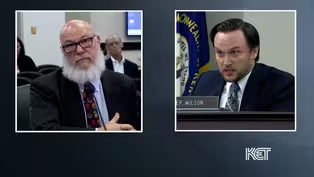
Cabinet leader says budget shortfall means kinship care law cannot be carried out.
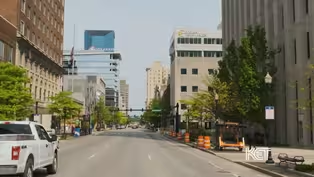
A Cabinet for Health and Family Services leader tells lawmakers he doesn't have the funding to carry out legislation they passed to better protect children and vulnerable adults. Lexington lands a $500,000 grant for a program focused on disrupting gun violence in the city. How a coalition is making sure future generations have access to a key part of bourbon making – white oak trees.
Problems playing video? | Closed Captioning Feedback
Problems playing video? | Closed Captioning Feedback
Kentucky Edition is a local public television program presented by KET
July 30, 2024
Season 3 Episode 42 | 27m 30sVideo has Closed Captions
A Cabinet for Health and Family Services leader tells lawmakers he doesn't have the funding to carry out legislation they passed to better protect children and vulnerable adults. Lexington lands a $500,000 grant for a program focused on disrupting gun violence in the city. How a coalition is making sure future generations have access to a key part of bourbon making – white oak trees.
Problems playing video? | Closed Captioning Feedback
How to Watch Kentucky Edition
Kentucky Edition is available to stream on pbs.org and the free PBS App, available on iPhone, Apple TV, Android TV, Android smartphones, Amazon Fire TV, Amazon Fire Tablet, Roku, Samsung Smart TV, and Vizio.
Providing Support for PBS.org
Learn Moreabout PBS online sponsorship♪ ♪ >> We're moving closer to a vice presidential decision.
Will it be?
And even here?
>> They improved their accuracy, their ability to detect Alzheimer's disease all the way up to 90%.
>> How a blood test can help detect Alzheimer's disease.
>> The White oak admission is really focused on is making sure that the future growth of the forest is there.
So it looks like the makeup of the for us now.
>> The industry is impacting white oak trees and the plan now to KET it sustainable.
It's not just.
>> Country Western.
It's not just blues and rock.
There's so much music that we want to offer.
>> And we take a look at the newest addition to Lexington's Music Row.
>> Production of Kentucky Edition is made possible in part by the KU Team Millennium Fund.
♪ ♪ >> Good evening and welcome to Kentucky EDITION for this Tuesday, July.
The THIRTIETH I'm Kelsey starts filling in for Renee Shaw this evening.
>> Well, we could be just days away from finding out Vice President Kamala Harris is running mate.
The Associated Press says Harris might name her running mate next weekend.
The 2 could begin campaigning together shortly after that.
Governor Andy Beshear is on the list of potential candidates in recent days.
He's campaign for Harris in Iowa and Georgia.
While in Iowa, he told The Des Moines Register if he's picked as Harris is running mate, he would be eager to debate the Republican vice presidential candidate, Senator JD Vance of Ohio.
Kentucky lawmakers say that this year administration is not carrying out legislation.
They pass to better protect children and vulnerable adults as our June Leffler reports, a Cabinet leaders says he doesn't have the money or authority to make good on the Legislature's wishes.
>> This year, every state lawmaker voted for House Bill.
271, and Senate Bill.
151.
The first creates a new reporting system for child abuse and neglect.
The second would help get would be foster kids into homes with their relatives.
But neither is going into full force.
>> We stand up.
You're ready to work with you every day.
On behalf of the Kentucky kids.
But I worry the headline tomorrow is going to be Governor Andy Beshear doesn't care about Kentucky's most vulnerable.
>> Despite the Legislature passing these laws alongside a biennial budget, there were no appropriations made to get the job done.
Says the Cabinet for Health and Family Services Secretary Eric Friedlander.
>> What parts can we implement?
What part?
Are you saying requires more money?
This is important.
We're talking about saving children's lives.
>> Friedlander says the cabinet would need millions of dollars in part to hire more social workers.
>> And we don't have a policy disagreement on the spill.
We have a funding disagreement.
It's going to cost 43 million dollars.
To investigate 11,000 cases.
>> That's a high press today and we've not received a breakdown.
We've not received anything.
How do you expect us and the public to believe that you have a fiscal note that we provided to you.
Where is it?
It's what your budget office.
>> Fried landers Cabinet is also under scrutiny for not providing access to child and adult abuse records to the ombudsman's office.
Just to kind of give you the importance of that, there's a caregiver caregiver misconduct registry, which is so that way.
If you have people in nursing homes.
>> Et cetera.
This registry indicates if someone has determined to be a caregiving abuser.
So it's supposed to be updated regularly, as you know, that your, you know, your your, your grandparents, your elderly relatives are not being taken care of by someone who is an abuser is supposed to have that regulate.
It has not been updated because we have not had access to it to U.S.. >> State Auditor Allison Ball says her staff have legal purview to these records.
According to recent legislation, the Cabinet overseen adult and child abuse cases disagrees.
Earlier this month, Governor Andy Beshear said the auditor's office will get these records.
>> Is this isn't some dramatic this agreement that has any type of political tones at all.
And we want oversight needs to happen for these really important decisions and the children that were supposed to protect.
We're just going to take some steps to get there.
>> 2 solutions represent it either an interagency agreement or clean up legislation come next year.
But some state lawmakers say Kentucky's most vulnerable shouldn't have to wait for Kentucky edition.
I'm John Leffler.
>> Kentucky's second largest city is getting half a million dollars from the governor's.
Everybody counts.
Grant.
The money is going to one Lexington's building Bridges to opportunity program.
One Lexington will use the funds to give $10,000 scholarships to 18 students of color next year.
Scholarships will also be offered to any rising senior whose life has been affected by gun violence.
And one Lexington plans to set aside $150,000 to help with mental health and trauma services in Fayette County, Public Schools.
The program's director says the grant will help disrupt gun violence in the city over the long term.
>> The most underserved communities in Lexington already in deficit.
Those communities that are dealing with gun violence on a regular bases already are most underserved populations.
Right?
And so services and programs are because they even up that deficit or at least they do the work that evening of those deficits.
But if we are to have a comprehensive strategy to address in gun violence across our city, it can not just be full of programs are reactionary services and some point we have to transition from the continuum of care into a movement that creates more access to opportunity.
>> One Lexington was created in 2017 as a part of the city's efforts to address a rise in violent crime among ages 13 through 29.
Well, just weeks before students return to class in Kentucky, schools continue to deal with teacher and staff shortages and other problems too.
We talked about some of those challenges last night on Kentucky.
Tonight, members of our panel talked about absenteeism.
Its cause is and some possible solutions.
It's more in tonight's Education Matters.
Report.
>> Those numbers from last year or what quite staggering.
I think part of that is a possibly due to the coming out of COVID maybe as some students, some parents got east the ideal much out that the show you need to be in school.
But we need to continue to work on that work on that utterance.
You because it's very important for students to be in the classroom.
That last last a learning opportunity can have significant impact on them going forward, especially in the early formative years were building those foundational skills and literacy and numeracy.
>> It's hard from the teacher's perspective.
2.
I feel like I can hold parents accountable for making sure their kids get to school.
It's difficult.
But I see firsthand how much and I have one student who was most definitely chronically absent.
And he was an a student had any time that he could miss school.
I'm e he was a lower performing trying to and and what I try to do as teachers try to make my day is engaging as I can as meaningful to the kids.
If they're missing, basic needs, you know, we'll get them.
Food will get them belonging.
This all of those pieces.
But at what point do I run out of things that I can do as a teacher and, you know, I try to have a lot of communication with the parents, but it's just a little bit out of my purview.
>> The department's cations didn't add campaign.
And that campaign is centered basically students talking about.
They're friendly and absent, for example, imagine a I'm in a band class.
You have everyone play their instruments talking back and forth and then you have a seat that safety.
And then you have a student the back and says we missed you today in band.
we missed.
You have here on the playground and there's ones all the swings are moving back and forth.
And there's one swing that's empty.
We missed you on the playground.
We miss you at the ball game and the the idea there is if we build relationships with students, I think that might be our best tool for battling chronic absenteeism because we want you to know that we missed you.
Yes, you missed out on being there, but we missed you in school, too.
And those relationships are key because if if a student knows this, someone miss them.
In my opinion, it's very likely they're going try to be there the next day because of that relationship that you met with him as a teacher as a principal, as the commissioner has, as a superintendent.
>> You can see more of that discussion about K through 12 education in Kentucky, online on-demand, KET Dot org slash.
Okay.
Why tonight?
A new law banning certain vaping products does not violate Kentucky's constitution.
That's the finding by Franklin Circuit Court Judge Thomas Wingate, the Kentucky Lantern reports Judge Wingate dismissed a lawsuit filed by the Kentucky Vaping Retailers Association.
The Kentucky Hemp Association and for bait vape retailers.
They argue House Bill 11 was too broad relating to more than one subject which goes against the state constitution.
In his opinion, Judge Wingate said the bill's title, quote, more than furnishes a clue to its contents and provides a general idea of the bill's contents.
House Bill 11 was passed during the 2024 legislative session and signed into law by Governor Andy Beshear.
It limits the sale of vaping products to a small number of brands approved by the FDA.
Opponents also argue the FDA has on fairly limited the number of approved vaping products on that matter.
Judge Wingate said, quote, the regulation of these products directly relates to the health and safety of the Commonwealth citizens, the power of which is bested by the Kentucky Constitution in the General Assembly.
Now State Representative Rebecca Raymer, a Republican from Morgantown sponsored House Bill 11.
In a statement she said she was pleased by the court's ruling saying, quote, as a lawmaker, mother and health care provider.
I believe we owe it to the people of the state, particularly our children to ensure that the products they are using are safe.
That new law takes effect January.
1st.
Well, there is a push to improve Kentucky's child immunization rate as cases of whooping cough increase.
And the army is investigating 2 incidents at Fort Knox, one of them deadly.
Our Toby Gibbs tells us more on this.
Look at headlines around Kentucky.
♪ >> The U.S. Army's criminal investigation division is looking into 2 incidents.
One fatal that occurred at Fort Knox during the cadet summer training.
Major Daniel Assad is quoted in the Central Kentucky News Journal as saying a cadre captain died during summer training but that it was a non training related death.
The Central Kentucky News Journal reports the second incident wasn't solved.
The training range.
Thousands of that stuff or Knox every year.
The Kentucky Association of Health Plans and Kentucky Voices for Health are working together to improve immunization rates among children amid rising cases of whooping cough.
The Advocate Messenger reports.
The partnership includes a 3 year $360,000 Grant, according to the group's Kentucky's infants and children at some of the lowest immunization rates for vaccine.
Preventable illnesses, such as measles and mumps, experts say low immunization rates after COVID-19 pandemic.
Given these preventable diseases a chance to turn.
The rural Energy for America program is awarding agricultural grants to 11 rural businesses to help them be more energy efficient.
WKU reports each business will receive $670,000.
The projects that include lighting insulation and solar installation USDA official Tom Carew tells W the goal of the program is to promote economic growth in rural areas.
With headlines around Kentucky.
I will be here.
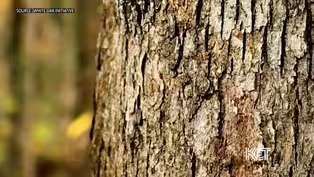
♪ >> There are more than 12 million barrels of bourbon in Kentucky would from white oak trees is a key part of these barrels as roughly 50% of bourbons flavor and 100% of its brown color come from white Oak wood.
>> The White Oak initiative is a coalition made up of various industries and environmental preservation nests that has come together to make sure that future generations have access to the trees.
>> White Oak represents about 20% of the hardwood.
That's for that's a long beach here.
But it's the most economically powerful a species in the forest the way to condition.
And there is a coalition of organizations that have a fundamental that's did interest in the proliferation of White oak for the long term.
So anybody from obviously the bourbon and spirits industry to the Foreign Ministry to the Wild Turkey Federation to the American Forestry Association because White Oak is such a vital component of not only our are bourbon industry, but flooring and the lumber industry.
And we have that reason.
We have that there's plenty of wood and plenty of White oak.
It's a matter of how old they are.
The issue isn't, you know, 10, 20 years out.
We've got a sufficient supply.
We're looking 50 to 100 years down the road because a tree can be 6200 years old before it gets into a barrel.
>> So it's that regeneration process and that what that's what the white out condition is really focused on is.
>> Making sure that this future growth of the forest is there.
So it looks like the makeup of the force.
Now that helps maintain the natural beauty of it and the natural, you know, the people who want to preserve and be in the woods in outdoors, people and things like that.
The commercialization part of that kind of keeps that you know, that economic engine.
>> Motoring on and make sure that everybody has, you know, like said that a long-term outlook.
We basically you know.
Forestry Management program so that a landowner can come and meet with somebody in and have a plan for how my going to manage this.
You know?
>> Because over, you know, over 70% of the hardwood forest in America are privately owned.
So I need to be meet with that landowner and say, look, this is a management program for you.
Long-term generationally that you should be, you know, you see on your land to make sure that that that.
Future is a secure.
When you look at it, generationally say okay, where we are this generation's find.
What about one or 2 generations down the line likes it when that when a tree can be 8200 years old.
>> You have to look at generating the work that's being done today.
Most of us will never see the fruits of that labor alumn to take to you know, battle with skin.
You know, people might say for 5 years, whatever that's like, well.
>> Could be 8200 for that trip.
That a court to turn into a tree that basically, you know, we're going to and a barrel.
>> The White Oak initiative hopes to secure 3 million forested acres of white oak trees in the central hardwood region of the U.S. by the year 2032.
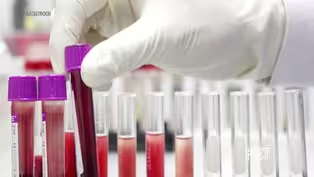
♪ >> A new study from Sweden found a blood test can help in detecting Alzheimer's disease.
We spoke to a Louisville based and doctor about it.
In tonight's look at medical news.
>> Most people would prefer a blood over spinal fluid, the exam, a spinal tap in this particular study.
>> A look at a blood test looking at a couple different proteins.
The forms of amyloid in forms of Phosphorylated town.
Those are the hallmarks of Alzheimer's disease and they found whether these are patients for primary care clinic or from especially clinic, they improved their accuracy, their ability to detect Alzheimer's disease all the way up to 90%.
So we improved from either 60 or 70% up to 90% with a fairly simple blood test.
And this shown repeatedly to be reliable.
What you do some type of medical evaluation where we show that their memory that today just in the office and then the blood test is like any other blood test.
We might have 4 you collapse, trawler, blood sugar, anything else except that we don't need to be fasting for it.
And it's really that simple.
Now the test is not done in just any hospital laboratory around the country for this particular one.
It is an office central lab in and some of the others and development.
We don't get the results back.
Usually for a couple of weeks.
It very often takes months if not years for people to receive a diagnosis.
And there are a lot of reasons for that.
And part of it is just poor access to specialist like us.
The worst thing in the world is to tell someone and I see new 6 months or a year earlier, you might have been a candidate for one of these new treatments and now you're not.
Tests like this will help accelerate that process.
And allow more people to benefit from these therapies.
This blood test if it with continued development, may be a way to help us really shorten those times to get people the right diagnosis to get them to the treatment that may really impact this disease and really help them go forward.
>> Another hurdle, their doctor Cooper hopes more insurance companies will be able to cover these tests in the future.
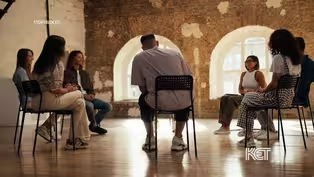
Well, July is minority Mental Health Awareness Month, a month dedicated to bringing awareness to the unique challenges that racial and ethnic minorities face in the U.S. when it comes to mental illness.
According to a report by the Food and Drug Administration, fewer than one in 2 African-American adults got mental health care in 2020.
It also found that Asian Americans were 60% less likely to receive mental health treatment than non-Hispanic whites.
Jasmine bridges with U of L Health Peace Hospital, a behavioral health hospital says minorities often face greater obstacles and whites when it comes to seeking treatment for mental health issues.
>> I think it's important for us to recognize a minority mental health month because for decades and still even to this day, there really is a stigma surrounding mental health services in mental health support.
Yes, the stigma crosses there is cultural backgrounds that specifically regarding Historically, we didn't always seek mental health support from what we call professions.
We didn't lean on more.
So each other families, the charge or other religious affiliations.
So I think it's important for us to to continue to have these open and honest conversations that kind of helped remove that stigma so that people who are from a abuse, I'm struggling with alcohol and other substances.
So that they seen that number one, it's safe to seek h*** is OK to seek help.
And we're here to help you so I think that's one of the reasons less important.
Mental health can be anything from a what's going on within your hand.
Things like anxiety stress, depression, we talk about, you know, bipolar disorder, schisms psychosis.
We're schizophrenia and also using substances being addicted to something that affects your ability to maintain yourself and care for yourself or care for others.
And also looking at just where you are in Do you live in a specific area with a lot of poverty and violence?
Crime what was going on around you.
>> Bridges also says when it comes to speaking up about minority mental health representation matters.
She commended Olympic gold medalist gymnast Simone Biles who had openly struggled with her own mental health after pulling out of the Tokyo Olympics because of a mental block.
>> But unless you decided to do that for a single, I think it will help other people and other young girls wet roads, especially in, you know, black females, 9th and 12th grade had 60% higher suicide, intense.
Then why females, according to the office of Minority Health.
So we need to be having those conversations we have in the schools and for someone like some Simon looks like us to to make that decision.
I think absolutely will.
>> Biles is competing in the Paris Olympics where today, by the way, she and the U.S. women's gymnastics team.
One team gold.
♪ ♪ >> Dubbed at Lexington's Music Row by a former mayor South Lynn Drive has become home to music shops and tall sound.
A summer concert series that allows regional musicians to perform for the Lexington Community.
♪ >> South and I visit historic area in Lexington and that back in the 60's and 70's, it was the intent after that.
It was all fields.
And and by the time the 90's developed and they built them all and that the school in Fayette County closer.
>> South and still kind of stay the same.
There were at one time 5 or 6 music stores in the area in 2010 Mayor Newberry, the south and Lexington's Music Row.
The South Jim Murray its concerts on Tuesday evenings over in the Collins, bowling alley and they were part of the inspiration, says.
Showcase south the music of Lexington says Lexington's Music Corridor.
We community focused concert series focusing on bringing people together elevating the people that are here, recognizing them and celebrating a all these different types of music.
We don't focus on one type one genre.
We have certain themes.
You I like things together in a different way.
And a new setting.
>> But that is our goal as organization.
>> It's a lot of the name and people gathering for the music.
And it's just it's fun.
And, great.
And it's very important for the community to have something like this.
>> The diversity of music that we feature this season.
And the last several seasons have been.
I tried to be year-round since we've moved on to the concert series each night spoke focusing on a little bit different kind of field, whether it's bluegrass Americana.
There's a huge boost to draw from here in town.
It's not just.
Country Western.
It's not just losing not.
There's so much music.
We want to offer the educational aspect of toss out honestly stemmed from one of our regional programmers being involved in child care.
>> It's something that made perfect sense as far as wanting to have.
You know, when we look at the demographic of the neighborhood and salt who would be coming in realize that there are the kids here.
So we should give them something to do.
And it also especially for >> kids.
You know, these days that might not get exposed to a variety of our team experiences like this.
I think it's very to give them.
All the chances available to to see how large the world is.
You know, vote creatively and artistically.
And so I'm glad to be part of that.
>> I've been so impressed to see the growth of our event.
Played the very first set.
My man did the very first set and the very first all sound.
I don't know 12 people and then this year we're seeing things in May to sell 500 and something people which is the first time the broken 500 and in July we broke 1000.
>> We've seen just this continued growth, which means that the community >> really wants to see an event like this and that maybe we're on the right track and we just hope to see it continue to grow in future.
♪ ♪ >> And it up the Golden age of radio lives.
Again, we're going to head to Berea tomorrow where you'll need a man who gives old radios new life.
So don't touch that dial.
You can join us for Kentucky Edition tomorrow.
We do hope you'll join us tomorrow night at 6.30, Eastern 5.30, central for Kentucky edition.
>> Here where we inform connect and inspire.
You can subscribe to our Kentucky Edition, e-mail newsletters and watch full episodes and clips at KET Dot Org.
You can send us a story idea if you have one.
Send that to us at public affairs at KET Dot Org.
Thanks so much for having joining us here tonight for Kentucky Edition.
The great night.
♪
Cabinet Leader Says Funding Shortfall Stopping SB151
Video has Closed Captions
Clip: S3 Ep42 | 3m 14s | Cabinet leader says budget shortfall means kinship care law cannot be carried out. (3m 14s)

Headlines Around Kentucky (7/30/2024)
Video has Closed Captions
Clip: S3 Ep42 | 1m 59s | A look at stories making headlines around the state. (1m 59s)
Lexington Lands $500,000 "Everyone Counts" Grant
Video has Closed Captions
Clip: S3 Ep42 | 1m 32s | Lexington getting $500,000 for program focused on disrupting gun violence in the city. (1m 32s)
Minority Mental Health Awareness Month
Video has Closed Captions
Clip: S3 Ep42 | 3m 30s | Month dedicated to raising awareness about minorities and mental health issues. (3m 30s)
New Study Shows Accuracy of Alzheimer's Blood Test
Video has Closed Captions
Clip: S3 Ep42 | 2m 25s | Louisville doctor on study showing accuracy of simple blood test to detect Alzheimer’s. (2m 25s)
Video has Closed Captions
Clip: S3 Ep42 | 3m 35s | The effort to protect the white oak tree and Kentucky bourbon barrels. (3m 35s)
Providing Support for PBS.org
Learn Moreabout PBS online sponsorship
- News and Public Affairs

Top journalists deliver compelling original analysis of the hour's headlines.

- News and Public Affairs

FRONTLINE is investigative journalism that questions, explains and changes our world.












Support for PBS provided by:
Kentucky Edition is a local public television program presented by KET