
July 31, 2023
Season 2 Episode 43 | 27m 30sVideo has Closed Captions
Jason Glass is stepping down as Ky. Education Commissioner.
Jason Glass is stepping down as Ky. Education Commissioner, a new report shows who Kelly Craft and her husband are and are not supporting financial in the 2024 presidential race, a one-on-one interview with Louisville's new police chief, and when racing will return to Churchill Downs.
Problems playing video? | Closed Captioning Feedback
Problems playing video? | Closed Captioning Feedback
Kentucky Edition is a local public television program presented by KET
July 31, 2023
Season 2 Episode 43 | 27m 30sVideo has Closed Captions
Jason Glass is stepping down as Ky. Education Commissioner, a new report shows who Kelly Craft and her husband are and are not supporting financial in the 2024 presidential race, a one-on-one interview with Louisville's new police chief, and when racing will return to Churchill Downs.
Problems playing video? | Closed Captioning Feedback
How to Watch Kentucky Edition
Kentucky Edition is available to stream on pbs.org and the free PBS App, available on iPhone, Apple TV, Android TV, Android smartphones, Amazon Fire TV, Amazon Fire Tablet, Roku, Samsung Smart TV, and Vizio.
Providing Support for PBS.org
Learn Moreabout PBS online sponsorshipKentucky's top educator is stepping down where Kentucky education commissioner Jason Glass is going and what the process for replacing him will look like.
I'm just really now saying we are stabilized.
I am here.
I know that now I can develop and move forward with my five year strategic plan.
We go one on one with Louisville's new police chief.
What has she learned during her time as the interim leader and what challenges does she see ahead?
It's important because some of these wells are creating active damage with environmental leakage.
How a special partnership is dealing with the Commonwealth's abandoned gas and oil wells.
You never really know what's on a state, not.
Videos by Appalachian filmmakers that were lost to time have been restored.
Join us for a blast to the past.
Production of Kentucky Edition is made possible in part by the Katie Endowment for Kentucky Productions, the Leonard Press, Endowment for Public Affairs and the Katie Millennium Fund.
Good evening and welcome to Kentucky Edition.
On this last day of July.
Can you believe it?
July 31st.
I'm Renee Shaw.
Thank you for winding down your Monday night with us.
Kentucky commissioner of Education Jason Glass is stepping down.
He says he's leaving his post on September 29th to become associate vice president of teaching and learning at Western Michigan University.
In a letter to the Kentucky Board of Education, Glass said he is, quote, committed to working diligently to ensure a smooth handover of responsibilities and to provide any necessary support to whomever is selected as an interim or new commissioner.
The Kentucky native was appointed in 2020.
His four year contract was set to expire in September of next year.
Glass has been publicly at odds with Republican state lawmakers in recent months on controversial matters surrounding transgender youth.
In an interview for Kentucky Edition last month, Glass said he believed his relationship with Republican leadership was beyond repair.
I think it's irrevocably broken.
I think that we hold each other in mutual low regard.
Kentucky attorney general and Republican nominee for governor, Daniel Cameron is weighing in on Glass's decision.
He tweeted, quote, Jason Glass, a teacher, is concerned about radical gender ideology needed to find another job.
That was not the right answer.
The right answer is that he and Andy Beshear need to find other jobs, end quote.
Republican lawmakers are also reacting.
Kentucky House Speaker Pro Tem David Mate of Stanford said, quote, After telling teachers they can leave the classroom if they don't want to follow the administration's radical rules, it appears the commissioner of education finally recognizes how out of step he is with Kentuckians and is following his own advice, end quote.
The Kentucky Board of Education says it will not take any action regarding the search for a new commissioner during a previously scheduled meeting later this week.
Instead, the board says it will hold a special meeting in mid-August to determine its next steps.
What is certain is that the next education commissioner will be subjected to Senate confirmation following the passage of a new law earlier this year.
We'll discuss Jason Glass's decision and how it could impact this year's governor's race on Kentucky tonight, this evening.
And we're also looking ahead to fancy farm, the annual Super Bowl of Kentucky politics, which is now just five days away.
Join us for that conversation tonight at eight Eastern, seven Central right here on KCET.
And we're once again taking Kentucky Edition on the road, this time to Paducah in western Kentucky.
We'll bring you stories from the region, including Fancy Farm.
Our coverage begins tomorrow night, so don't miss it.
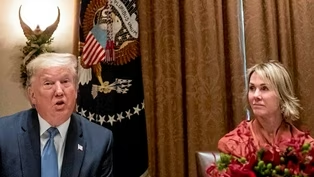
Kentuckians Joe and Kelly Craft are donating to several Republican presidential candidates, and Donald Trump is not one of them.
The crass were major donors to Trump in previous campaigns, but this year, NBC News reports the couple has made maximum donations to four other candidates Mike Pence, Ron DeSantis, Chris Christie and Vivek Rums.
AMI Craft served as United Nations ambassador under the former president, and she touted her close ties to Trump during her unsuccessful race for governor in Kentucky's Republican primary in May.
But she did not receive his endorsement, which instead went to the eventu The the Louisville law enforcement community has a new leader, Mayor Craig Greenburg announced.
Jacqueline Gwen Burrell Well, as the new chief of police on July 20th, six months after she took over as interim chief, our Kelsie Stark sat down with the new chief to discuss the future of Lmpd and the change that's already happening.
Welcome, Chief Gwen Blower.
Well, thank you for being here.
Last time we spoke to you here, you had just been appointed the interim chief, and you said you had an interest in this role as a permanent one.
Now, six months later, what has changed or maybe what have you learned here in the past six months as interim?
Well, thank you, first of all, for having me here.
So being in the interim role just allowed me to be in that number one seat to drive the initiatives that are already had planned and to just to see it implemented and move forward.
So now that I'm the permanent chief, the goals and the missions that I already have in place, I'm just really now saying we are stabilized.
I am here.
I know that now I can develop and move forward with my five year strategic plan for this great department.
So what has changed?
What has changed?
Just a little bit of a change is that my officers now, they understand who their chief is, and that is a big change for them.
That's a change I want to highlight.
And they are ecstatic to know what leader they have and they are excited to know that they do have a chief and that there's stability there.
That is that change that you see.
So now you'll see that I will even like to say that my officers now have excelled.
They were holding their breath.
They didn't know which direction the administration may go or or who else they were going to get.
And so now they understand me.
They know me.
We have a, you know, a great relationship.
And so now they we have excelled and they know exactly where we're going with clear communication.
And so that's the change.
You've already reduced two officer vacancies from 290 to 250.
There's a larger police academy already happening.
What are you doing to try to recruit and retain more officers?
Being visible, being accessible and being available.
And I believe those are just those those qualities that that the police department needs right now as a leader.
But also to it's just not me.
I have great people working behind the scenes.
I background recruitment officers are always thinking about new ways of marketing, how we can target those individuals to spark interest in becoming a law enforcement professional, but also to the funding that we just recently received in our budget from the mayor.
The Council just greatly improved and I'm just so excited about that.
That's going to help us.
That's going to help us do some additional targeted marketing and recruitment for those individuals that truly want a career in law enforcement.
So that is what you're saying.
And I will submit to you, people want sound leadership.
And so you'll have those individuals that are interested that I can work for that that individual.
I can work for that department.
And they're seeing the change the LNP is LAPD is doing and they want to be a part of it.
Some change is already underway.
You've helped launch the department's first nonfatal shooting unit, expanded the crisis call diversion program, opened the First Officer Wellness Center, and created a new Narcotics tip line.
That's a lot in six months in an interim role.
Is there an accomplishment you're most proud of or what do you hope to build on from that?
All of those I'm most proud of, because those are those are actual initiatives that should have been in place a long time ago.
And that I see the need and I know that that is going to help us move in a better direction.
It's going to help the community, the wellness center.
We're going to be looked at across the nation for having a wellness center.
I must submit to you and I must applaud the foundation for their support in this effort and the administration and Mayor Greenberger, from day one getting behind that.
That is huge for us.
But having a healthy, well-rounded officer is going to benefit the community.
And we're hoping to be that model for other agencies to actually say, hey, I will want to do that for our city, because having a healthier officer is going to build upon that public trust that we all need.
So all of those initial initiatives are huge for me and great accomplishments.
Great accomplishments.
Not to say you're without challenges as you are still dealing with negotiations from the Department of Justice.
What's your approach there as you work forward to implement some of those mandated changes?
Yes.
So we know we're going to get into a consent decree and we know the negotiations are right around the corner.
Right.
So we already know that the DOJ is going to come with their proposals, but we have a seat at the table so that we are able to weigh in on those proposals and make sure that wherever agreement that we're we will get into that actually benefits not only the department that we can meet and the benchmarks set in there, but it does benefit the community.
The community wants to see that LAPD is reaching those goals and completing those task, whatever the agreement that we get into.
So those that is critical.
That is a critical opponent of the negotiation agreement.
So I am hopeful.
I see it as an opportunity for more training, better equipment, better community relationships, because they understand what that consent decree is about.
And as we move forward within it, and I'm hoping that will I know we're going to be in it for some years, but I'm hoping that we will not be that city where we're in it for ten and 20 in that amount of years.
That is draining on the funding portion of the city as well.
But also 200 Department chief Gwen Barela well is the city's first black woman to serve as head of the police department in Louisville.
She's also an ordained minister.
She discusses both and part two of our interview tomorrow on Kentucky Edition.
One of her newest officers has finally returned home.
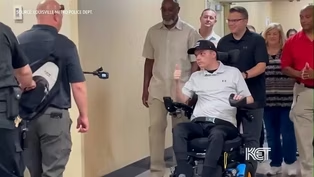
Officer Nicholas Wilt was discharged from a rehab center on Friday, more than three months after he was shot in the head during a mass shooting at Old National Bank in Louisville on April.
The 10th.
Wilt had only been on the job ten days when he was injured.
He's undergone multiple surgeries and intensive therapy and will continue therapy through outpatient care.
We wish him the best.
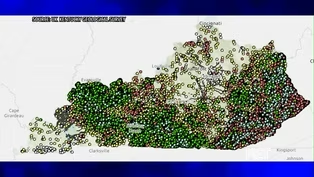
There are approximately three and a half million abandoned oil or gas wells in the nation.
Kentucky is no exception, hosting an estimated 14,000 and counting.
These so-called orphaned wells can pose several environmental hazards.
Now the state is partnering with the Kentucky Geological Survey to plug these orphan wells and study their impact.
We are on the site in Wolf County, Kentucky, of an orphaned whale that we're in the process of measuring the methane leakage, gas leakage from that whale.
It's part of our Federal Plugging Initiative to identify orphaned whales and to address them by plugging and reclamation to restore the site to beneficial land use.
This is a whale that is not in any system with the Kentucky Geological Survey or the Division of Oil and Gas.
It's an orphaned whale.
We don't know its history.
They're covered in.
Perhaps two thirds of Kentucky's counties have a presence of an orphaned whale.
It's important because some of these wells are creating active damage with environmental leakage, gas leakage or crude oil leakage or groundwater leakage.
Some of them are near people's houses.
Some of them are impacting streams.
It's become increasingly aware that methane is a very potent greenhouse gas, and our ability to be methane emissions, say, over the next decade, can very much impact kind of the trajectory of global warming out over the next 30 or 40 years.
So I saw an opportunity to actually do some real good on the greenhouse gas front.
We believe there are about 15,000 orphaned whales across the Commonwealth.
But by fact, we find new wells every month.
What you have to understand is that oil and gas drilling at Kentucky began 100 years before oil and gas laws were enacted.
So we've got a lot of catch up to do.
There are a lot of undocumented, unmapped wells that, you know, we don't have any history on.
Happens a lot with farmers.
They're clearing a field or somebody.
Somebody's building a house, a development, and they find these pipes or wells sticking out of the ground.
So a lot of times a landowner may not know they're there.
Kentucky has oil and gas producing regions, and some are more dominant than others.
There are major areas of oil production over our history.
Oil and gas drilling has been going on for over 150 years.
But South Central Kentucky, east central Kentucky, we're here in Wolf County.
And the big sinking area in West Kentucky, in the Illinois coalfields.
There are basically four key regions in Kentucky that have a high density of whales develop.
We've we've measured 40 wells, both western Kentucky, the south central part of the state and the eastern part of the state.
And what we see so far is that the majority of the wells, probably 75 to 80% of the wells, actually have very little methane.
And when I say little methane, I mean less than a gram per hour.
So the gram per hour is a threshold that the Department of Interior is using to designate wells as either non emitters or emitters.
So most of our wells fall into this kind of low emitter, two nanometer category.
There are 20 to 25% of the wells, however, that emit significant amounts of methane.
And that finding in which a small percentage of wells accounts for the majority of emissions is similar to other studies that have been conducted in the eastern U.S. and the Appalachian Basin region.
A lot of wells set out in the middle of active road crop fields, such as soybean and corn fields.
And so these farmers basically that area around the wellbore is a non tilt bore, non arable land for them.
So it's basically a fallow spot.
And in a worst case situation, there's actually soil contamination, say, from leaking oil.
But in the longer term and on a global scale, methane that comes out of here just doesn't stay encamped in Kentucky.
It gets circulated to the atmosphere and circulates globally and contributes to the overall greenhouse gas loading of the atmosphere and adds to the loading potential, the warming potential of the atmosphere.
Since the partnership began, nearly 600 orphaned oil and gas wells in Kentucky have been sealed.
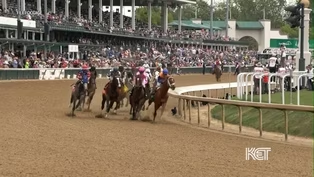
Racing will resume at Churchill Downs in September, with no changes being made to the track.
The decision follows a review of surfaces and safety protocols in the wake of 12 horse deaths.
Seven of the deaths occurred in the days leading up to the Kentucky Derby in May.
The Louisville track suspended racing operations on June 7th and moved the rest of its spring meat to Alice Park in Henderson.
The Churchill Downs CEO calls the deaths, quote, a series of unfortunate circumstances and says the review didn't find anything fundamentally wrong about the track from previous years.
Last week we brought you part of my conversation with former Republican candidate for mayor and Somerset or governor, rather, and Somerset Mayor Alan Keck.
Tonight, the rest of our talk about how he created a lane in the crowded primary for himself with what he calls a unique candor and avoidance of some national issues.
KAC placed sixth in the May primary contest, but says that showing doesn't discourage him from possible future attempts at elected office.
Did you ever feel like you were out of step in terms of your policy positions or on controversial things that could have cost you some votes?
When I traveled the state, I never really got the sense that I was, you know, because of of maybe the uniqueness of my candor in some of the debates.
I think folks felt that I was trying to create a lane that really wasn't the case.
I was just being honest.
And that honesty and transparency, I think, showed up in a way or maybe manifested a way that it could have been more moderate.
You know, I talked about sports gaming before anyone else in the field.
Well, that ended up passing with the Republican legislature.
Medical marijuana in the same way.
And so, in a way, my issues have led the way.
Now we're not trailing behind or waiting to catch up.
Maybe my delivery is a little bit more unique, or I don't talk about some of the national issues in a way that a traditional candidate would.
On things like pro-life pro-choice.
Even though I am adamantly pro-life on the second Amendment, you know, you ask the question that night about being able to destroy a murder weapon.
I had somebody that works in our police force come talk to me about it, spent it, spent a lot of time around murder, weapons.
And he said when he heard my answer, it made him cringe at first.
And then as he started thinking about it, he said, why should somebody on this gun, you know, we're not infringing on anyone's right to own one.
So what I hope is, you know, we will be in issues later.
I'm not going to wait for polling to tell me what's popular.
Is it a little bit early?
Maybe or maybe I was just a little bit late and underfunded.
Maybe my message is exactly what the party needs to win big elections, you know, not just right here at home, but nationwide.
Yeah.
So Congress is a possibility.
And we know, in fact, the Dean Rogers Congressman Rogers was acknowledged the week that we talked to.
Right.
For being the longest serving member.
And so there's a lot of history there.
But he is, you know, progressing.
Yeah.
And so many people do wonder how much more time he might serve.
And there are a lot of people who could be in that same fray.
I mean, we've heard names like Alison.
All right.
My good my good friend, Chris Gardner.
Chris Gardner.
You know who for a long time folks would assume that, you know, he was the heir apparent.
And look, Chris is so talented.
Alison's very talented.
There's there's members of the General Assembly that are thinking about it.
Again, candidly, I'm actually not thinking about that race.
That is not in my immediate plan.
And the main reason I'll say to two things I have young kids is, you know, you ask about them off to the job.
Always appreciate.
You're always so kind to ask about my family.
The other is, you know, you become one of 435.
It's an incredibly important job.
And I'm not ruling it out, but I'm not as naturally wired to do that.
I am not wired to lead and to build and to to build a team and to get things done.
You know, my heart is really in Kentucky.
I that's why I ran for governor, you know, is an executive role.
That's why I love being mayor.
I get to get things done.
I work with that legislative body, cast the vision and go execute it.
So I don't rule it out because, again, I want to make sure that I'm a good steward wherever the Lord would lead me.
And if he changes my heart and Tiffany's heart and says that this is okay, maybe we journey down that path.
But that's that's not where my focus is.
You can see part one of my interview with Mayor Allen Kirk on last Thursday's Kentucky edition.
That's online and on demand at Katie Dawgs slash Kentucky edition.
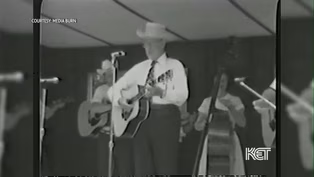
Appalachia is a region rich with creativity, but their stories don't always make it out of the mountains.
Digitizing videotapes is one way to keep history alive.
And Media Burn Archive is partnered with Apple Shop to recover 34 videos from 1970s Appalachia.
They give us a unique glimpse into life way back then.
The work of digitizing videotapes is very costly.
It's very costly.
It's very labor expensive, and it requires equipment that almost no one has anymore.
We thought it would be a great way to.
We wanted to share our resources.
Apple Shop was one of our first choices.
Just because of the extraordinary work they've been doing for the past 50 years.
You never really know what's on a tape.
So one of the tapes that we highlighted that was one of our favorites had all these amazing bluegrass performances, but the tape was labeled Girl Scouts.
And the first 5 minutes of the tape are just a Girl Scout troop meeting.
That's a type of thing that's really exciting for us, is that happens constantly where tapes are mislabeled or things are taped over and like, you just don't know what you're going to find until you digitize them.
I don't believe if God could look down upon this earth that He was made it, he'd be displeased with it conduct.
It went on our knees.
Turn these mountains down.
There are tapes that deal with destruction, that strip mining brought to local communities and efforts to hold companies accountable for that type of destruction.
Through there is this really, really fantastic tape called Burn, Burn, Burn.
And it was made by a group of kids who basically created a little like a funny experimental film about their house burning down and pretended to burn their house down.
And it is just a joy and I hope I think that one has been my favorite.
Hey, I got an idea.
The type of tape that this was produced on is called half inch open reel videotape.
And it was a technical marvel because it was the first time that portable videotape equipment was available to the public.
They weren't meant to be sort of permanent.
They weren't meant to be an archival medium.
They're very fragile.
And at this point, many of them are suffering a lot of damage.
One of those is called sticky Shag, which is basically the tapes are just basically sort of flaking off.
Once it degrades, it's totally gone.
So some things that we do to remediate that is we bake the tapes, which basically involve sort of pulling humidity out to try to stop that process of sticky shag, in particular with Apple Drops collection.
Many of the tapes were very moldy and you can't transfer tapes that have mold.
And so the process of removing the mold is very labor intensive and it's really just sort of hand cleaning, every little bit of it to get that mold off so that we can transfer it.
So we've been working for about 20 years to preserve exactly this type of material, community based work that was generally rarely seen like outside of local context at the time that was created.
And we realize that this has really created a big gap in our understanding of, you know, American history, that there are all these voices whose work was only seen locally and never made it into the bigger picture.
And so one of those communities that has been definitely less hurt has been rural America.
Well, I think that moving images just give us this incredible insight into the way people live, the way they talk, what's important to them that's as close as we can get to like going back in time and being in a place and talking to people and watching events happen in real time.
A Kentucky duel, a famous trial, and the Baseball Hall of Fame.
Toby Gibbs has a look at some of the local connections making news this week in Kentucky history.
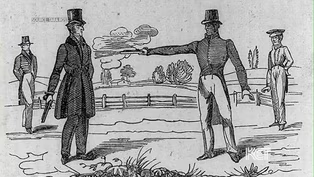
August 1st, 1790, Kentucky had its first ever duel between Captain James Strong and Henry Craig.
Craig was wounded and strong died.
We don't know the cause of the duel.
The first census in Kentucky began the next day, August 2nd, 1790.
Kentucky had a total population of 73,677.
Two years before statehood, Kentucky's Governor John Crittenden, resigned on July 31st, 1850, to become Attorney General under President Millard Fillmore.
A Kentucky native was at the center of one of the most famous trials of the 20th century.
When John T Scopes taught evolution in a Dayton, Tennessee, school in violation of Tennessee law, it led to the famous Scopes Monkey trial in 1925.
You may not know his Kentucky connections.
He was born in Paducah on August 3rd, 1900, and graduated from the University of Kentucky.
The Baseball Hall of Fame inducted Abe Happy Chandler on August 1st, 1982.
He'd been baseball commissioner from 1945 to 1951 and served when Jackie Robinson integrated the game in 1947.
And that's a look back at this week in Kentucky history.
I'm Toby Gibbs.
Thank you, Toby.
GIBBS Paducah is celebrating a decade of showcasing its craft and culture on the world stage.
The UNESCO's creative city is home to such gems as the National Quilt Museum, Carson Center for the Performing Arts and the historic Lowertown Arts District.
The city hosts artists from all over the world.
Tomorrow on Kentucky Edition how Paducah has become home to so many great creatives and what this designation means for the Western Kentucky City.
Find out tomorrow on Kentucky Edition at 630 Eastern, 530 Central, where we inform, connect and inspire.
Subscribe to our weekly email newsletter and watch full episodes and clips at CD Dawg.
You can find us on the PBS video app on your mobile device and smart TV.
Send us a story idea at Public Affairs at KET Dawg and follow us all the way, as you see on our screen there, Facebook, Twitter and Instagram to stay in the loop.
Thanks so much for joining me now.
And I'll see you at 8:00 for Kentucky tonight.
And we do a preview of the fancy farm picnic.
Until then, take good care.
Video has Closed Captions
Clip: S2 Ep43 | 39s | Churchill Downs set to reopen in September with no track changes. (39s)
Video has Closed Captions
Clip: S2 Ep43 | 4m 42s | Taking care of Kentucky's orphaned oil and gas wells. (4m 42s)

Ed. Commissioner Stepping Down
Video has Closed Captions
Clip: S2 Ep43 | 2m 32s | Kentucky Education Commissioner Jason Glass is stepping down. (2m 32s)
Officer Nicholas Wilt Going Home
Video has Closed Captions
Clip: S2 Ep43 | 27s | Nicholas Wilt discharged from a rehab center three months after he was shot in the head. (27s)
One-On-One With Mayor Alan Keck (Part 2)
Video has Closed Captions
Clip: S2 Ep43 | 3m 57s | Mayor Alan Keck sits down with Renee Shaw to reflect on his gubernatorial run. (3m 57s)

Video has Closed Captions
Clip: S2 Ep43 | 5m 52s | Louisville Metro Police Department's new chief Jacqueline Gwinn-Villaroel. (5m 52s)
Preserving Appalachian History
Video has Closed Captions
Clip: S2 Ep43 | 3m 47s | Media Burn & Appalshop digitize historic tapes. (3m 47s)
Report: Crafts Not Backing Trump
Video has Closed Captions
Clip: S2 Ep43 | 43s | Report shows Crafts are donating to other GOP Presidential candidates instead of Trump. (43s)
This Week In Kentucky History (July 31, 2023)
Video has Closed Captions
Clip: S2 Ep43 | 1m 37s | This Week In Kentucky History (July 31, 2023). (1m 37s)
Providing Support for PBS.org
Learn Moreabout PBS online sponsorship
- News and Public Affairs

Top journalists deliver compelling original analysis of the hour's headlines.

- News and Public Affairs

FRONTLINE is investigative journalism that questions, explains and changes our world.












Support for PBS provided by:
Kentucky Edition is a local public television program presented by KET