
July 5, 2024
7/5/2024 | 55m 53sVideo has Closed Captions
Martin Griffiths; Evgenia Kara-Murza; Stephen Breyer
UN Emergency Relief Coordinator Martin Griffiths discusses the deaths of international relief workers in Gaza. Evgenia Kara-Murza, the wife of jailed Russian opposition figure Vladimir Kara-Murza on the state of Putin's Russia. Retired Supreme Court Justice Stephen Breyer explains his pragmatic approach to interpreting the Constitution in his new book "Reading the Constitution."
Problems playing video? | Closed Captioning Feedback
Problems playing video? | Closed Captioning Feedback
July 5, 2024
7/5/2024 | 55m 53sVideo has Closed Captions
UN Emergency Relief Coordinator Martin Griffiths discusses the deaths of international relief workers in Gaza. Evgenia Kara-Murza, the wife of jailed Russian opposition figure Vladimir Kara-Murza on the state of Putin's Russia. Retired Supreme Court Justice Stephen Breyer explains his pragmatic approach to interpreting the Constitution in his new book "Reading the Constitution."
Problems playing video? | Closed Captioning Feedback
How to Watch Amanpour and Company
Amanpour and Company is available to stream on pbs.org and the free PBS App, available on iPhone, Apple TV, Android TV, Android smartphones, Amazon Fire TV, Amazon Fire Tablet, Roku, Samsung Smart TV, LG TV, and Vizio.
Watch Amanpour and Company on PBS
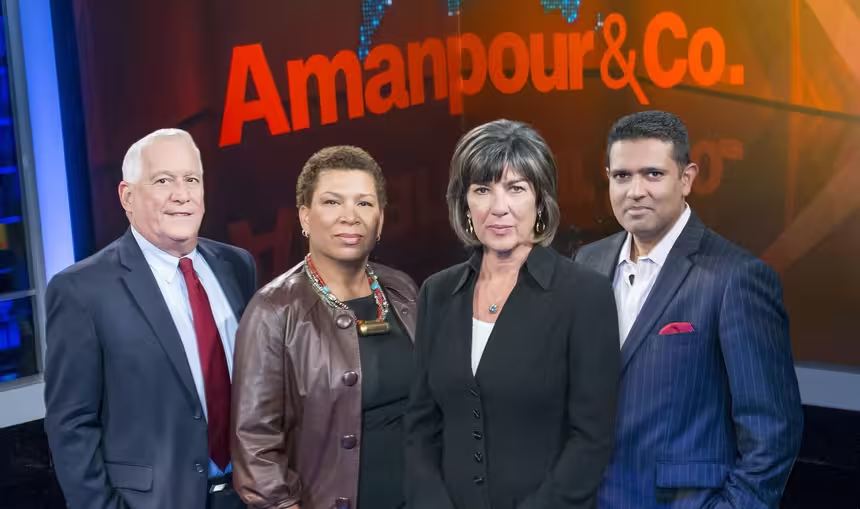
PBS and WNET, in collaboration with CNN, launched Amanpour and Company in September 2018. The series features wide-ranging, in-depth conversations with global thought leaders and cultural influencers on issues impacting the world each day, from politics, business, technology and arts, to science and sports.Providing Support for PBS.org
Learn Moreabout PBS online sponsorship[video title swooshing] [upbeat instrumental music] - Hello everyone, and welcome to "Amanpour & Company".
Here's what's coming up.
[video transition swooshing] - Whether it's intentional or not, it's a crime.
- [Christiane] Israel's airstrikes kill foreign aid workers trying to feed starving people in Gaza.
The U.N.
Relief Chief Martin Griffiths tells me why we should all be outraged, in his first interview since announcing, he's stepping down.
Then, [alarm blaring] horror at Al-Shifa.
A look at the carnage after Israel's 14 day do-over raid of Gaza's largest hospital.
- And.
- I am extremely worried about his life.
And I've been living with this fear for many years already.
- [Christiane] Putin's prisoners.
I speak to the wife of jailed Russian opposition figure, Vladimir Kara-Murza about taking on the Kremlin.
Plus.
- What cases are you going to overrule?
Are you going to overrule every preceding case?
- [Christiane] "Reading the Constitution," retired Supreme Court Justice Stephen Breyer sends a stark message to America's top judges in his conversation with Walter Isaacson.
[upbeat instrumental music] [upbeat instrumental music continues] - [Narrator] Amanpour & Company is made possible by, the Anderson Family Endowment, Jim Atwood and Leslie Williams, Candace King Weir, the Family Foundation of Leila and Mickey Straus, Mark J. Blechner, the Filomen M. D'agostino Foundation, Seton J. Melvin, Charles Rosenblum, Koo and Patricia Yuen.
Committed to bridging cultural differences in our communities.
Barbara Hope Zuckerberg.
Additional support provided by these funders, and by contributions to your PBS station from viewers like you, thank you.
- Welcome to the program everyone.
I'm Christiane Amanpour in London.
Outrage overseas as foreign aid workers feeding starving people are the latest to be killed in Israel's war on Gaza.
Prime Minister Netanyahu called the deadly airstrike quote, "A tragic accident," which quote "happens in war," and vowed to investigate.
The seven who lost their lives worked for World Central Kitchen.
It's the organization founded by the famed chef Jose Andres.
Now, they came from all over the world to help, Poland, Canada, Australia, the UK.
One was Palestinian.
As U.N. Humanitarian Chief, Martin Griffiths has been a key figure in pressing for vital aid to Gaza.
But after three years in the role advocating and acting all over the world's conflict zones, he is stepping down in June due to ill health.
His career with the U.N., the British Diplomatic Service, and many humanitarian organizations has spanned decades from the Balkans to Syria, to Yemen, and all places in between.
He joined me from Geneva for the first interview since announcing he's leaving his U.N. role.
Martin Griffiths, welcome back to our program.
- Thank you very much Christiane for having me back.
- Martin, the news just goes from worse to even worse every day regarding Gaza.
And now obviously the shock of internationals being killed in Gaza, aid workers on top of the 32,000+ Palestinians who've been killed.
Now the prime minister of Israel says "It's unintended and there'll be an investigation."
"Things happen," basically, he says "in war."
What is yours and the U.N. reaction?
- Well, I think it's appalling.
Tragedy is proof as if we needed it, of the incredible dangers that exist involved in delivery of humanitarian aid inside Gaza.
A point that we've been making for months.
And we now after six months of this conflict, and the lawlessness increases, but this was clearly an attack on this convoy of these three vehicles of World Central Kitchen.
And it's a terrible tragedy.
This is food that had just come in by sea.
They were organizing the distribution, and they were all killed, seven of them.
Puts us over 200, I think, Christiane of eight workers killed in Gaza.
It's a terrible statistic.
It's awful.
And we are very hugely sorry to their families.
- So to the Prime Minister's point, Netanyahu's declaration, and they very, very, very rarely admit to anything unintentional.
But this was a, you know, huge, and involved internationals as well as Palestinians that they - Well- - would be investigating it.
- I mean, I hope it was unintentional.
- Well, I'm gonna ask you, because frankly, you know, whether it's [Martin indistinct] unintentional or not, does it take the right duty of care?
Three Israeli hostages were killed, frankly, point blank trying to surrender, you know, Palestinian journalists, Lebanese journalists, and many people say that duty of care is not taken.
What is the United Nations' view after six months of this?
- Well, that's, I mean, let's hope there's an investigation.
Let's say we get the results of the investigation for this time, but clearly while we have had a lot of promises from Israel, for example, on land access, and border access, and quicker and more direct, and more security, we are not seeing it.
And there are those 200,000 or so people in the north in famine or at risk of famine.
But certainly we've yet to see the horror of their future.
So yes, it's a duty of care problem, but it's also a legal problem.
Attacks on humanitarian institutions and workers is prohibited under international law.
So whether it's intentional or not, it's a crime, and we must be very conscious of this.
As I say, it's been happening, as you know, Christiane, to our colleagues from the outset.
So this is a terrible day, and huge credit to World Central Kitchens for what they've done for the people of Gaza, and I hope they will be able to resume operations.
But it's true around the region we see people dying through the heedless decisions of those who wage war.
- Martin, what about Al-Shifa Hospital?
Here's a location.
The biggest hospital in Gaza that the Israelis basically told everybody was an underground Hamas command center, or even an in-ground on-ground, Hamas command center.
They took it once, they then left, then they went back.
And now there are many, many people dead there.
The WHO describes it as "Ripping the heart out of the health system."
Israel says they've killed 200, what they call fighters and captured 500 more.
Again, what is the U.N. seeing there, and how many times does a hospital get raided?
- Well, across the world, by the way, Christiane, as you know, we're seeing that happening in so many countries.
Health institutions, as my colleague Tedros keeps pointing out, it's not as if we aren't on notice of this, seemed to be somehow for some extraordinary reason to be a special target.
Now Al-Shifa hospital was, as WHO has described, the kind of health institution which people have become used to relying on when they need healthcare.
Now, no longer, now, no longer, I don't know the truth, or otherwise about whether there were Hamas militants there.
Fine, but the fact of matter is this is a hospital, it's protected under international law, and more importantly, it's essential for the welfare of the people of Gaza who are suffering so much.
I think we're down to 10 hospitals, partially operating in Gaza out of the total originally of 36.
We are seeing the Health Center in Haiti brought to a standstill by the fighting in Port-au-Prince.
We have seen health institutions targeted in Ukraine and also in Sudan.
There's a nightmarish familiarity about this story, and it is one that goes to the heart of the safety and welfare of people caught up in a crisis, not of their making.
- Martin, can I just ask you, let's leave Al-Shifa for a moment, but the other countries that you've spoken about, is there a discernible reason why people, or any armed group, whether it's a state, or not, would attack hospitals?
Is there some kind of advantage that they think they get from that?
- I've tried to find an answer to this question, Christiane, even today because I was trying to find out why words, is the Haiti health sector so much a principle target?
And I understand it's partly because people went there to raid it, to get supplies, medical supplies, because of course in battles you get hurt and you need medical care.
But none of this comes close to justifying the idea of shutting down hospitals and attacking them.
And that red cross that for all our lives we have associated with protection and safety has become a target.
And as humanitarian aid workers another breach of law.
So in the last, you know, two or three days in Gaza, we have seen the activity of having the worst targets, aid workers, hospitals, and those trucks which are affected by lawlessness.
So the world is a very, very angry place where the norms that we grew up with do not obtain.
- Martin, I wanna ask you this, one of the latest, you know, can you believe it's out of Israel, is that they want to ban and make it unlawful for a news operation, Al Jazeera to keep operating in Gaza.
Now, as you know, they also, this democratic state bans all journalists that they don't take in themselves.
So we can't get in, we wanna get in.
The world is dependent on people like Al Jazeera and the brave Palestinians who are, you know, wielding their own iPhones, or their own cameras to tell us what's going on.
What is the U.N. view on any nation, but most especially a democratic nation outlawing the press.
Is there precedent for that, and does it have a wider chilling effect?
- Well, our spokesman in New York, Christiane, has spoken to this very much to your question, and of course expressing grave concern about the possibility of this law being applied to Al Jazeera and others.
But in addition, particularly as you say in Gaza, for example, where we have claims and counterclaims as to who's delivering aid and who isn't.
The U.N. is often accused by Israel of not delivering aid.
And our response in part is allow the journalists and allow the press in to see the reality.
What the media does, what you do is providing a window, a witness for people across the world, so that we can all make these proper judgements.
And the freedom of the press is integral to that.
It's a human right, it's an entitlement, it's protected by law.
And to ban media is no help to the people of Gaza, as it is no help in other places where that's happened.
So of course we deprecate it, but it's particularly important in crises.
Getting media, for example, Christiane into Sudan, as you know, has not been easy.
- Yeah.
- It's very difficult to get the visas for journalists to go there, but you shine a light, as we try to do, but you shine a light on suffering, which I am absolutely convinced from my three years now in this particular job, is an essential component of pushing back this pattern of war decisions by heedless men.
- And what about your own organization, your U.N. organization, UNRWA, you know, the refugee and work administration, which has been the, for years now, decades now, has been the conduit to provide everything including humanitarian aid, particularly in places like Gaza.
Now the guardian says Israel has launched a proposal to the U.N. to dismantle it.
Is that going to happen?
I know there are investigations underway, not just about Israel's charges against alleged Hamas cooperation, or, you know, working for Hamas.
But in terms of can UNRWA even continue?
Can a U.N. distribution mechanism continue?
- Well, look, and I'm glad you asked me this question because that story that the U.N. has received a formal proposal for the dismantling of UNRWA is simply not true.
And I think I'm in a position to know if that were to be true or not.
Secondly, perhaps more importantly, UNRWA's mandate comes from the General Assembly, and it is only the General Assembly that has the right to amend its mandate.
We believe passionately, and I have spoken out yesterday on this, UNRWA is the backbone, as we have often said of the humanitarian operation.
We need it in Gaza.
It is essential to the welfare of the people of Gaza and elsewhere where Palestinian people reside.
But in fact, the idea that it could be simply dismantled at the request of one member state is simply not paying attention to the origin of its mandate.
And I think frankly, the courage of its staff and its leadership.
So it's a fool's game to think that UNRWA can be dismantled.
UNRWA is essential for us, more so now perhaps than ever in its history.
And we must protect it, preserve it, defend it, fund it, and allow the people of Palestine to have from UNRWA what they have always needed, and that is a way of life and a future.
- Now, I want to ask you about yourself.
You announced just a few days ago that you're stepping down from this position as head of the U.N.'s Humanitarian Organizations because of long COVID.
You've been doing this incredibly difficult job for about three years now.
Tell me what that means.
How does long COVID affect you?
Why do you need to step down?
How are you feeling?
- Well, long COVID is a condition as you know, Christiane, which is new and you know, a novelty, and newly being studied.
In my case quite random.
It's effects change from time to time.
But the reason why I decided with the Secretary General's consent to step aside in OCHA is because OCHA's job, that particular job, Christiane, of Emergency Relief Coordinator Head of OCHA, requires the incumbent, and I think I have been doing this, to go to the front lines of crises around the world, to go everywhere, to have the awful privilege of seeing the desolation of suffering, and to report on it and to react to it.
And I didn't feel I could be confident of regaining the physical stamina to be able to do that particular job.
It doesn't mean to say that I'm done yet with doing what I can for this life's work of trying to push back on those who see war as the first instrument.
So that was the reason I decided that for OCHA's benefit, it was right for me to step aside, so a new person could be recruited.
- Well, you'll be missed because you are indefatigable.
But does that mean you're resigning from retiring, you're retiring from the U.N., or just from OCHA?
- Well, I mean, I'm resigning from the U.N. because my post is the OCHA post.
- Okay.
- And I'll be looking for other things.
- Okay.
So let me ask you this then, and I wonder where the other things, you know, will be in the realm that you've been doing for your whole professional life.
You started in 1972, you were a UNICEF volunteer in Laos.
Tell me what motivated you, and what keeps motivating you through all those decades where presumably you hope to bring peace and human healing, and all we've seen is war and human suffering?
- What I've realized, Christiane, of late, and I'm a slow learner clearly because it has been 50 years of exposure to conflict and wars in all parts of the world.
It has been 50 years when I've had that privilege of seeing terrible atrocities.
But also, and this is the point that I want to make also of that extraordinary humanity and courage, which has not changed.
So while we have more wars, more recklessness, more heedlessness from leaders who choose war.
We do not see any change, any diminution in the humanity that binds communities across the world.
And I have seen this in Gaza, I have seen it in Sudan.
You will remember the extraordinary courage of the Emergency Rooms Civil Society in Khartoum who are still there even in this fighting, delivering aid to their neighborhoods.
I've seen it in Burkina Faso where mothers go across lines of Al-Qaeda fighters to get leaves and salt for children to eat because food is not available.
So the humanity which binds us, has not diminished, even while the tendency to war has increased.
So my life's work, I think as I see it now, is to work on the side of humanity, to push back on the decisions of war.
- Mm-hmm.
- And that is something that I hope I can continue to contribute to on the basis of this experience.
- Now I wanna ask you one final question because this week, in the next few days will be the horrible 30th anniversary of the Rwanda genocide.
And you remember U.N. peacekeepers were withdrawn, a massive genocide was allowed to happen, no intervention, and the U.N. was roundly criticized along with other constituent nations.
In fact, you know, when he became Secretary General Kofi Annan went along with President Clinton and they apologized.
They apologized for not intervening to stop a genocide.
And I just wonder - Yeah.
- what are your thoughts on this approaching grim anniversary?
- You know, speaking out, and that includes apologies, is of the highest order, and the greatest importance, and is of course still rather rare.
It is as if an apology is a sign of weakness.
It is not.
It is because one knows one should have done something differently.
And I knew Annan, as you did, very well, and he of course has been a mentor to all of us.
It is a terrible anniversary, and it's a terrible anniversary, why?
Because we see it happening still across the world.
We see it happening indeed not far from those borders.
When you look at Sudan and Darfur.
So the world has become a more polarized and divisive place since Kofi Annan's time.
And I know what he would be saying to us today is to remember that apology, be guided by that failure and don't repeat it.
Don't allow wrong to triumph over right.
- Martin Griffiths, for the time being, thank you very much indeed.
- Thank you very much indeed, Christiane, thank you for having me.
- And more now on what remains of Gaza's largest hospital, Al-Shifa.
Its director says the medical complex is now permanently out of service, after Israel's two week raid.
Thousands of Palestinians had been sheltering there.
Nada Bashir brings us inside what's been left behind, and a warning, of course, this is a very disturbing story.
[men speaking in foreign language] - [Nada] As dawn breaks over Gaza's Al-Shifa Hospital, the full extent of this latest nightmare becomes clear.
[sirens blaring] Buildings scorched, some still ablaze, others riddled with bullet holes or completely destroyed.
[people chattering] Below bodies lay crushed and decomposing.
- Deyo?
- Under torchlight limbs are found tangled amid earth and rubble.
[wind blowing] This is the aftermath of the Israeli military's 14-day siege on what once was Gaza's largest hospital.
[speaker speaking in foreign language] Please God enough, this woman screams.
[speaker speaking in foreign language] How much more can Gaza's civilians be forced to endure?
[speaker indistinct] Medical crews tell CNN they arrived on Monday morning to find hundreds of bodies scattered around the complex.
Others have been left wounded, starving, and desperate for help.
[Jana speaking in foreign language] "We spent days without food or water until the military gave us a few food cans, but they were not enough to feed all the patients," Jana says.
"They would give each patient just a quarter of a water bottle each day.
The bombardment and shooting was constant."
[Jana speaking in foreign language] [wind blowing] The scale of the destruction wrought by the Israeli military here seems impossible to quantify.
In the surrounding area, entire families were trapped in their homes for two weeks under near constant bombardment.
[clattering] [people chattering] [person speaking in foreign language] Upon the Israeli military's withdrawal, Arafatt Alulu was finally able to return home, only to find that his wife and seven children had been killed.
[people chattering] The Israeli military has described the siege on Al-Shifa as a precise operation targeting Hamas militants, some 200 of which they say were killed, though CNN is unable to verify this figure.
[child shouting] Weapons and intelligence documents are also said to have been found on the complex, which had been housing hundreds of civilians when the siege began.
The IDF maintains that soldiers distinguish between militants and civilians.
But such claims stand in stark contrast to the troubling testimonies and videos CNN has received from countless civilians and medical staff who are trapped in and around the hospital.
[Jadallah speaking in foreign language] "We can't estimate the number of medical staff who were targeted in what we can only call executions," this medical official says.
[Jadallah speaking in foreign language] [people speaking in foreign language] In earlier testimonies, shared with CNN, civilians described being stripped, bound, and blindfolded in the cold before facing interrogations by Israeli soldiers.
Reports of beatings are also widespread.
For days, medical staff within the hospital told CNN they couldn't even move between buildings on the complex for fear of being targeted by Israeli snipers.
[person speaking in foreign language] [Mousa speaking in foreign language] "Every day a patient would die, Nurse Musa says.
The occupation soldiers used us as a human shield inside the hospital."
More than 300 bodies have so far been recovered according to authorities in Gaza.
But that figure will likely only rise.
Warnings that Al-Shifa could soon be turned into a graveyard, now a gut wrenching reality.
- Nada Bashir reporting.
And a note CNN did reach out to the IDF for comment on this report.
We await their full response.
A glimmer of hope for Ukraine's defense against Vladimir Putin's invasion, as House Speaker Mike Johnson looks set to push through that stalled aid package.
But it is an uphill battle still and not just because of GOP opposition.
"The New York Times" reports that Russia is stepping up its disinformation war, amplifying arguments for US isolationism.
Meanwhile, reporter Evan Gershkovich, the first American journalist detained on espionage charges since the Cold War has now been in prison in Russia for over a year.
My next guest tonight knows the pain of Evan's family all too well.
She's Evgenia Kara-Murza, her husband Vladimir, who's a dual British Russian citizen, is now the highest profile Russian political prisoner, since Alexei Navalny's death, and like Navalny, he has survived poisonings.
He's now serving 25 years for treason, after criticizing Putin's illegal invasion of Ukraine.
And Evgenia Kara-Murza joined the program from Geneva.
Evgenia Kara-Murza, welcome to the program.
- Hello Christiane.
Thank you very much for inviting me.
- I'd like to ask you, in light of your husband's persistent imprisonment in Moscow, in Russia.
I know you tried to reach your husband, and your kids, you try to get them to talk to him.
How do you do it?
When was the last time you managed, and how long can you talk for?
- The last time I talked to my husband was last summer, in summer 2023.
My kids were allowed a 15-minute phone call with their dad at the end of December of last year.
And since we had three kids, it meant that each of them got five minutes on the phone with their dad, and that was the first call in over half a year.
And I obviously had to measure those minutes with a timer because I could not allow one of our kids to speak to their father for longer than five minutes.
So in the conditions in which Vladimir is being kept now, and that is a punishment cell in a so-called special regime prison colony in Western Siberia.
He's not allowed any visits by family members.
He's not allowed any calls.
And only under exceptional circumstances.
So in mid-February, we celebrated our 20th anniversary, and Vladimir requested a phone call with me.
And was denied.
The prison authorities told him that this was not an exceptional circumstance, as was not our oldest daughter's 18th birthday.
So they told him that death would be an exceptional circumstance.
Other than that he's not allowed any phone calls with us.
- Wow.
That is just so hard to hear that it's really hard to hear.
What must be going through your mind every day since Alexei Navalny died.
I don't know whether you also believe that he was killed in prison.
- I do believe that this was a murder, and the responsibility lies with Vladimir Putin.
- Your- - As to my family's situation.
Well, you know what?
I have been living with this fear since 2015 when my husband survived the first attack on him, the first assassination attempt.
He then survived yet another one in 2017.
And thanks to an independent investigation by Bellingcat and the Insider, we know that the same team that was implicated in the poison of Alexei Navalny had been following my husband before both attacks.
So now that he's been held by the same people who tried to kill him twice, of course I am extremely worried about his life.
And I've been living with this fear for many years already.
- And I can see the strain obviously in your face and in your words.
Your husband is a domestic, in other words, a Russian critic inside Russia of Putin.
Evan Gershkovich was arrested and jailed on what the Americans called trumped up espionage charges.
The first time a journalist, American journalist since the Cold War.
What is Putin's aim in, I know they're different, but what's the aim of holding these pawns, whether domestically or international figures?
- Well, the imprisonment of Evan Gershkovich on absolutely ridiculous grounds.
I mean, journalism being equated with espionage, seriously?
But that is a hostage situation.
Vladimir Putin takes hostages to then get the persons of interest to him back to Russia in exchange for the lives of these hostages.
Just like in the Soviet times Vladimir Putin wants to show that there is no descent in the country.
There's just a huge number of criminals, spies, traitors and foreign agents.
- You spoke at the U.N. in fact this last week, and you laid into President Putin.
And I'm gonna play a little bit of what you said.
- Vladimir Putin is not a legitimately elected president.
He is a dictator and a usurper.
It's time the free world finally said so.
- Famously, president Biden said that, you know, Putin would pay for the death of Navalny.
You have met, your husband was a dual UK citizen with the foreign minister here and others.
What must the world do, do you think?
- Well, with regard to President Biden's promise, I'm afraid we're still waiting for those devastating consequences that had been promised.
I, you know, I joined my husband in his call for finally calling a spade a spade.
I believe that the world has to finally call Vladimir Putin for what he is, a criminal wanted by the ICC for kidnapping of Ukrainian kids, and for many other crimes that he himself and his regime have been committing over the years.
- Mm-hmm.
- He cannot be seen and recognized as a legitimate partner on the international stage.
- I wanna ask you whether furthermore, the terror attack that took place, that ISIS claimed that killed, you know, nearly 140 people.
You saw that Putin finally admitted that it was ISIS, but said that Ukraine must have had something to do with it.
[President Vladimir speaking in Russian] - [Translator] We know that the crime was committed by radical Islamists, whose ideology the Islamic world itself has been fighting for centuries.
[President Vladimir speaking in Russian] It is also necessary to answer the questions why the terrorists tried to go to Ukraine after committing a crime.
Who was waiting for them there?
- Now Russia does not have a death penalty, but there's constant talk about reviving it.
Do you worry that it will be revived under the current circumstances, and that it might be used against people like your own husband?
- We know that Vladimir Putin has been on the scene for almost a quarter of a century, committing very similar crimes to the ones that are being committed now in Ukraine.
And in the past, the regime used every terrorist attack in the country to its own interests, to strengthen repression in the country and to launch aggression, like the 2002 and 2004 terrorist attacks, Nord-Ost and Beslan were used to start the Second Chechen War, and like the bombings of 1999.
All these terrorist attacks in the past were used to start a Second Chechen War.
And to justify this aggression against Chechnya.
I believe that Vladimir Putin will use this terrorist attack for the same purpose.
Now, my husband was sentenced to 25 years for high treason.
We know of cases where people are being accused of terrorism for donating money to Ukraine, and high treason for donating money to Ukraine for trying to set conscription centers on fire.
So these actions are seen as treason, and are seen as extremism and terrorism.
And yes, the legislation, this atrocious legislation, if it were to be reinstated, would of course affect these people, and that is very, very concerning.
- And finally, I want to ask you about the leadership or the spokesperson role that has been thrust on you, thrust on Yulia Navalnaya, thrust on Sviatlana Tsikhanouskaya in Belarus, all since your own husbands have been killed or imprisoned.
And I wanna read something for you from "Time Magazine," which says, all three of you, quote "represent an increasingly pronounced feminine face of anti-Kremlin activism - one that has emerged within a political culture where politicians' wives are rarely seen, much less heard."
What do you make of that?
- I believe it is a very good sign, and I have been working, for these two years, I've been working with amazing women, and the founder of the organization that I work with, the Free Russia Foundation, a civil society organization about fights for a change in Russia through support of numerous anti-war and pro-democracy initiatives, both inside and outside of the country.
This organization was founded by an incredibly powerful woman, Natalia Arno.
We work with the feminist movement, the anti-war feminist movement of Russia.
And well, I mean, I'm surrounded by incredibly powerful, and committed, and enthusiastic women who work against all odds.
And I very much support Yulia Navalnaya's decision to continue her husband's work.
I believe that this is a very good message to Russian civil society that was to those millions and millions of Russians, both inside of the country and outside who were devastated by Alexei's murder.
And I believe that her standing up and saying that the fight would continue is incredibly powerful.
I don't know how he finds the strength, but I admire it, and she has my full support, as does of course, Tsikhanouskaya, Sviatlana Tsikhanouskaya.
And I believe that we also see the change of Russian pro-democracy, the change of the face of Russian pro-democracy and anti-war movement.
And not just because it's becoming more feminine, but we see a very powerful LGBTQR community also involved in these activities.
We see ethnic groups being, becoming more and more powerful, and more and more represented.
And a Russia, I mean, in Russia we have over 190 different peoples living on this huge territory that lives on in 11 time zones.
So we see that the face of Russian pro-democracy and anti-war movement is changing drastically.
And I think that this is, all these are very good signs.
- And we did see if not a massive, but a token determined protest vote on behalf of Navalny during the Russian elections.
So thank you so much Evgenia Kara-Murza, and we wish you and your family well.
- Thank you very much Christiane.
- Now all over the world, women-led social and peace movements are on the rise.
While at the same time the fight for women's fundamental rights continues, including in the state of Florida, which has cleared the way for the state's six week abortion ban to take effect.
But in a separate ruling, its Supreme Court justices have allowed the issue to be put to voters in November for a proposed constitutional amendment.
Meanwhile, in the first abortion-related case since overturning Roe versus Wade, the U.S. Supreme Court appears skeptical of a nationwide ban on the drug that's used for medical abortions.
Interpreting the Constitution for modern America is of course the divisive legal dilemma of the times.
And the former Supreme Court Justice Stephen Breyer tackles this head on in his new book, which he speaks about next with Walter Isaacson.
- Thank you Christian and Justice Stephen Breyer, welcome to the show.
- Thank you very much.
- So you have this new book, "Reading the Constitution," and you talk about the problems of being too much involved in textualism.
Explain to me what textualism is, and is that the same as originalism?
- When you read a statute, or you read the Constitution, there's some words.
Look at those words and you say, "What would an ordinary person have thought those words meant at the time they were written?"
say 1788, 1789.
And real textualists say, "Don't look at anything else.
Just look at those words and things related maybe to those words, not much, but read the words."
And originalism says, "Yes, we agree with that, but in the Constitution there's some rather vague words.
The right to keep and bear arms is not actually specific.
Not very specific.
And the freedom of speech is less specific yet."
So what we do is go back in our minds to the time that those words were written, 1788, 1787, 1869, for 14, 15, 16, or around that time after the Civil War, or at the founding of the country and say, "What would an ordinary person have thought they meant at that time?"
- And you in this book, push back on that.
- Yes, I do.
- And say, "We should put a little bit more, we should put more emphasis on the purpose."
And by the way, - Yes!
- on the effect, the pragmatic effect, and shouldn't just be parsing the words.
We should say, what was the purpose of it and what pragmatic outcome it will have.
Explain the difference in that approach.
- Well the difference is that the statutes that we interpret in the Supreme Court are usually not clear in terms of their text.
If they're so clear, why are they in the Supreme Court?
We only take cases where lower court judges have come to different opinions about what they mean.
And with the constitution too, same kind of a problem, but even more so.
So I don't think too often the text helps very much, and it can lead you astray.
- Well let's take some of the criticism that an originalist or a textualist would have of your pragmatic approach, which is, man, that could just lead you down a path where you're not emphasizing what the words actually say.
You're just trying to say, what do I think would be good?
What do I think would be pragmatic?
Yes.
- Isn't that dangerous to allow judges to impose their own pragmatic view of the world instead of following the text?
- Well the word pragmatic is not exactly the right word either.
And if you have the patience to read the whole thing, you'll see that what I'm saying is, yes, look at the purposes, look at the consequences, look at the values that underlie it, because that's the better alternative.
What about trying the right to bear arms?
We had a case involving a New York law.
I was in dissent, but the majority said, "Here is what we'll look to, we'll look to, what the founders intended at the time.
They wrote these words."
That was Madison.
In an earlier case they said what they'd intended.
They intended to allow you to keep a pistol under your pillow.
I descended in that 'cause I don't think they meant that one little bit.
But what I'm objecting to now is not that first case.
I'm objecting to what they're saying at this moment.
Just look at the history, in the 18th century earlier, maybe a little later, the history of what that phrase, what kind of weapons was it addressing itself too?
So I said, "Okay, I'll look it up."
You know what the, a Hilde Bard, or a Hilde, Helde Bard, that's it.
A skill ladder.
A Asian fire, which you threw over the wall to burn people up on the other side of the wall.
I mean, is that related to or not related to a pistol, or artillery, or I, to tell you the truth, I have no idea what those weapons were that were being used in 1710, or something, or in 1650, or during the 100 Years' War.
You see, you, Mr. Textualist are asking me to turn awfully important cases upon matters where I am not an expert because I'm not an historian, I'm a judge.
I can do this, I can go look at a couple of other things.
Did you know Mr.
Majority that 400 million guns are floating around this country?
And those 400 million guns puts us number one on gun ownership.
And those 400 million guns, a lot of studies show, cause an awful lot of trouble.
They can cause deaths, they can cause illness, they can cause harm of all sorts, to policemen, to spouses, to everybody under the sun.
Now I think that that fact, and facts like it, are relevant when you're deciding whether the New York gun law is or is not consistent with your idea of that Second Amendment.
- Well, wait, wait, let me push back on that because the law, the Constitution says, "We have a right to bear arms."
It doesn't say, "Gee, let's look at gun ownership and whether it's good or bad or not.
Why would that matter, - No- - when it comes to a constitutional question?
- Oh, do you think it says that everybody has a right.
I mean if you were in a mental hospital, do you have a right to keep your arms, to keep guns around?
Do you think you have a, right after you shot 14 people?
Do you think you have a right to shoot somebody when you're trying to steal some money?
Do you think you have a right?
You see I can go on and on and on.
No one I think will claim that everyone has a right to bear arms.
You have to figure out which laws, which laws are permissible under the Second Amendment.
Just as you have to figure out under the First Amendment, what speech is permissible and what speech is not.
Hey, let's rob the bank.
That speech, when that seriously meant that isn't permissible, some is permissible, some is not.
That's the job of the judge to draw the limits and to work out what the statute means in terms of limits.
So no one textualist or non-textualist is gonna get away from that problem.
In Dobbs, they went back, and they overruled two cases.
Cases that allowed abortions Roe versus Wade, and Casey.
And so I ask the imaginary, Mr. Textualist, Mr. Textualist, what cases are you going to overrule?
Are you going to overrule every preceding case that doesn't use your originalist or textualist method?
All of them?
Do you know how many there are?
I already said it.
All of them.
[chuckles] No, I exaggerate almost all of them.
You mean you're gonna overrule all those We won't have any law left.
Well, no, they won't overrule all those.
So I say, which of the many that you could overrule perhaps, which are you gonna choose to overrule?
And my guess is the answer is going to be the ones that are really wrong in our opinion.
Ah, really wrong, in your opinion.
And how are you going to decide that?
Who is going to decide that?
You are going to decide that.
Now will you just choose what you like, or will you follow the law?
Ah, doesn't that sound like the question you asked of me a little bit earlier?
The question that you said, oh, textualism will stop me.
I'll have to be honest because it'll give me no possibility of substituting my own judgment, mm.
You have the same problem, don't you?
And anyone who doubts it, go read Dobbs.
- Let me take what may be the biggest issue now in which there's a clash between a textualist approach and a purpose-driven approach.
And that's a whole arena of affirmative action and race-based thinking.
The text of the Civil Rights Act is pretty clear.
It says, "There cannot be discrimination on the basis of race, color, religion, sex or national origin."
And so if you have affirmative action, perhaps that's discriminating based on race.
On the other hand, the purpose of that law was to bring African Americans more into society.
How do you balance that when you take a more purpose or pragmatic-driven approach?
- Well it will depend on the particular case, what we've said, 'cause Ruth and I wrote several joint, her opinion, and parents involved in other cases, and Ruth Bader Ginsburg.
And we say roughly what you say that there is a difference in terms of the 14th Amendment, which says, "Every state shall not deny any person equal protection of the law."
There is a difference between discrimination, which keeps people out, hurts them, separates the races, and that kind of discrimination, which is designed to bring them in.
Because bringing them into society and creating one society out of a world that had been divided, slavery and anti-slavery, Jim Crow, et cetera, bringing them in, so we have one country where we get along together.
That was an objective of the 14th Amendment.
And when you have something.
Discrimination?
Maybe call it discrimination, maybe say as Lewis Powell said in Bakke, he said, "There's room here.
There is room for a town, a city, a state to work out.
A good way to bring these different races together in a world that previously had been divided legally."
You see, that's the job.
And what you want?
You want a mathematical rule?
You won't get it.
Law is not hard science.
It is not calculus.
You have human beings who are looking at the facts, the figures.
Yes, the statute, the constitution, the values that underlie them.
And you often have cases that require that judge to think in terms of those values.
Does this statute go too far, too far?
Ah, that's the skill or the effort.
- Justice Antonin Scalia was sort of one of the great advocates of the textualist approach.
You've been one of the great advocates of the more pragmatic or purpose-driven approach, but y'all were pretty good friends, and you used to discuss it publicly and privately.
Tell me about that.
- No, we would, we liked it and we enjoyed it.
The way it would sort of go, if I take bits of that conversation, I'd say, "Nino, I don't say that the importance of free speech changes over time.
I say, George Washington didn't know about the internet.
The facts changed."
And he would say, "I knew that."
And he says, "Well, if we follow your system of say taking into account.
I mean do we take into account the fact that when they wrote the these amendments, 18th century, Civil War, half the population, namely the women, were not part of a political process.
And more than that there was slavery much of that time.
And Jim Crow, do we take that into account?"
"Uh, maybe," I say.
And he say, "You see it's too complicated, too complicated.
You might be able to think you can do it, but nobody else can."
And I say, "Well, maybe others have.
I'm not the only one.
But if we take your system, we're going to end up with a constitution that no one wants."
Laws are designed, they're a human institution designed to help now 320 million Americans of every race, religion, point of view help 'em live together peacefully, and we hope prosperously.
And in the Constitution we have values.
The values don't change very much.
The facts change.
Those values the democracy, human rights, separation of powers, so no one becomes too powerful.
A degree of equality.
Yeah, and the rule of law.
All that's right there.
It's right there in this document here.
There it is, all right?
And Marshall and the other founders, they said, "We don't want that to change," but he says as well, "The future will bring problems that we can see now only dimly, if at all.
And these values should work for those problems not yet seen.
That's all in that word.
It is a constitution.
We are expounding, which no one knows what it means, but it's important.
And it's down in the Supreme Court written on the wall.
And that is what my response is to Justice Scalia.
- We've seen a lot over the course of history, big ideological shifts on the court.
I think especially say from the Taft Court to the New Deal Court is a big shift.
Do you think we're undergoing a big shift now?
- I think that's a very good question.
I think the Taft Court you go back to 1900, and you'll see a United States of America that had just grown from one of the poorest countries in the world to one of the richest, through inventions, through methods of marketing, through methods of finance.
And I think the Taft Court was worried, and emphasized the words "property," and "contract," and "Laissez-Faire" first two words in the Constitution, because they didn't wanna kill a goose that they believed was laying a golden egg.
Nobody thought that by the time of the Great Depression, by the time of Roosevelt's New Deal court.
And that New Deal court did not believe because very few people in the United States believed that what this is all about is keeping Laissez-Faire, and letting companies do whatever they want.
And so they decided the cases somewhat differently.
The person who described what was going on there, Walt Freund, another great constitutional scholar, and he said, as far as politics is concerned, he is talking about no judge.
No judge decides according to the temperature of the day.
But every judge is affected by the climate of the season.
And I hope, but I can't prove, that three years from now, four years from now, people will see that this textualism and originalism pushed to a pretty cold strong extreme where you can't use other things.
That it doesn't work.
That it doesn't take any account, or enough account of the fact that women didn't have the right to vote in these words in the Constitution, for the most part were written.
That trying to follow textualism in some of these statutes and some of these constitutions, and looking to nothing else but text is going to undermine the values that this document sought to keep and work into the future.
That it's going to make it more difficult for Congress to pass laws using sometimes abstract phrases, so that you can adapt those laws more easily to a future with changing problems and changing circumstances.
I think they'll discover that that's a pretty hard road to follow, a pretty hard road to travel.
And so it will diminish, but if it doesn't happen, I worry that people will have less reason to follow a rule of law.
- Mr. Justice Breyer, thank you so much for joining us.
- Thank you.
- And such an important conversation.
Finally tonight, it's certainly isn't feeling like Groundhog Day for Punxsutawney Phil.
While he didn't see his shadow this year, the prognosticator is now seeing double.
For the first time in 138 years, the weather-predicting Woodchuck has welcomed two pups with his partner Phyllis.
When the time is ready, Phil will reveal the names of his young to the president of the Punxsutawney Groundhog Club who speaks Groundhogese.
And that is it for our program tonight.
If you want to find out what's coming up on the show every night, sign up for our newsletter at PBS.org/Amanpour.
Thank you for watching, and join us again tomorrow night.
[upbeat instrumental music]

- News and Public Affairs

Top journalists deliver compelling original analysis of the hour's headlines.

- News and Public Affairs

Today's top journalists discuss Washington's current political events and public affairs.












Support for PBS provided by: